J. L. BELL is a Massachusetts writer who specializes in (among other things) the start of the American Revolution in and around Boston. He is particularly interested in the experiences of children in 1765-75. He has published scholarly papers and popular articles for both children and adults. He was consultant for an episode of History Detectives, and contributed to a display at Minute Man National Historic Park.

Subscribe thru Follow.it


•••••••••••••••••


Showing posts with label Tristram Dalton. Show all posts

Friday, October 24, 2025

“In Lieu of that Part of his Salary received annually from England”

New England’s Puritan heritage made those colonies less than welcoming for the Church of England.

There was an Anglican missionary organization called the Society for the Propagation of the Gospel in Foreign Parts (S.P.G.). It paid for ministers to visit Native American communities.

It also supplemented the salaries of ministers in New England on the assumption that their congregations were small and their work difficult.

The Rev. Edward Bass was one of those ministers. He was born in 1726 in Dorchester into a family that had arrived early in the English settlement of Massachusetts. He studied at Harvard College and spent a couple of years teaching and preaching in Congregationalist meetings.

But by 1752 Bass decided that he really belonged in the Church of England. He sailed to Britain to be ordained, returning to take up the pulpit of St. Paul’s church in Newburyport.

Twenty years later came the war. As quoted yesterday, news of the Declaration of Independence prompted the wardens and vestrymen of St. Paul’s to ask their minister to leave prayers for King George III and his family out of their services for the sake of the church. On 16 July 1776 the Rev. Mr. Bass agreed: “I think it incumbent on me for so important an end to comply with this request during the present state of our political affairs.”

Bass tried to walk a narrow line. He dropped the public prayers for the king but continued to support the Crown personally. When the Massachusetts Council ordered all ministers to read the Declaration of Independence to their congregations, he declined to declaim it from the St. Paul’s church pulpit but evidently allowed a lower church official to do so.

But already other Anglican ministers were complaining about Bass’s conduct. On 15 July 1775 the Rev. Dr. Henry Caner of King’s Chapel in Boston had written to the S.P.G.: “Mr. Bass has complied perhaps too far with the orders of the Rebels.”

The war stopped the S.P.G.’s regular payment to Bass. On 25 Nov 1776, nine Newburyport men signed this pledge:
We the Subscribers of St. Paul’s Church in this town being truly sensible of the Distress which our worthy minister must suffer without some Relief in Lieu of that Part of his Salary received annually from England, and which the present unhappy Times prevent his obtaining, do promise to pay on Demand to Mr. John Vinal the several sums affixed to our Names to be by him delivered to the Rev. Mr. Bass.
The promised amounts ranged between £10 from Tristram Dalton and John Tracy to 18 shillings from Abram Gallisham. As for Vinal the schoolteacher and church warden, his signature doesn’t appear on this document. Perhaps he chipped in on his own, or perhaps his contribution lay in wrangling the contributions of others.

TOMORROW: Did that settle matters?

Monday, February 12, 2024

“Command of a vessel without arms, and with but one eye”

Aside from having several children, what did Sylvanus Lowell do after being so badly injured at the Marblehead smallpox hospital in 1773?

First he returned to the maritime business, as shown by this advertisement from the 23 Mar 1774 Essex Journal, published in Newburyport:
For NEWFOUNDLAND,
THE Schooner ROSE, JACOB LOWELL, master, now lying at Marquand’s wharf, will sail by the first of April.—For Freight or Passage apply to Robert Jenkins, or Silvanus Lowell.
Newbury Port, March 21st, 1774.
Shortly after that, Parliament closed the port of Boston to most trade from outside Massachusetts, thus making secondary ports like Newburyport more important for about a year.

But then the war began, and sailing out of any Massachusetts port put ships at risk for being seized by the Royal Navy. At the same time, the province needed military supplies, and there was money to be made in privateering.

Sylvanus Lowell, despite his injuries, went back to sea. As the Newburyport Herald copied from the Saco Democrat in 1830:
No better evidence of his enterprising spirit is watnng, than the fact of his obtaining command of a vessel without arms, and with but one eye. It is said he was enabled to do much of his own writing, by screwing a pen into the hook attached to his arm.
In February 1777, the Massachusetts board of war commissioned Lowell to sail to St. Eustatia to trade for salt and these goods:
500 Effective Fire Arms, fit for Soldiers, with Bayonets —
500 Soldiers Blankets —
50 Barrels Gun-powder
200 ps Ravens Duck or Tent Cloth —
300 lb Twine —
25 Casks 20d Nails —
30 do 10d do
15 do 4 do
If the above Articles are not to be got, bring the proceeds in Russia Duck, Cordage from 4½ Inches downwards, Coarse Checks & Linnens —
He commanded a crew of at least nine men. The captain was back by July, when he bought a house in Newbury for his growing family.

In 1779 Lowell became captain of a privateering brig listed as the Porgee (also Porgee and Pauga), with a letter of marque from New Hampshire. Though descendants recalled it as “a large war-ship,” the American War of Independence at Sea website says it carried only four guns and eleven men.

Nonetheless, the Porgee managed to capture a ship called the Lively, as shown by a legal notice in the 17 July 1780 Boston Gazette. AWIatsea.com says the ship then received a Massachusetts letter of marque and went out under another captain.

In 1781 Capt. Lowell invested in a privateering sloop named the Betsey, and reportedly he commanded other privateers himself. According to his 1830 obituary:
About 3 days before Peace was concluded, he was captured by the British; but by the time they reached the shore, this news was received, and he was liberated and sent home.

After this, he followed the sea 7 years, as master of a vessel out of Newburyport, in the employ of Tristram Dalton.
Dalton had backed many privateers during the war, including the Betsey.

Levi Mills of Newburyport sailed under Capt. Lowell to Richmond on the “good ship Diana” one winter in the mid-1780s. According to an item about Mills’s journal published by the Colonial Society of Massachusetts, this tobacco-buying trip meant navigating the ice and shoals of the James River.

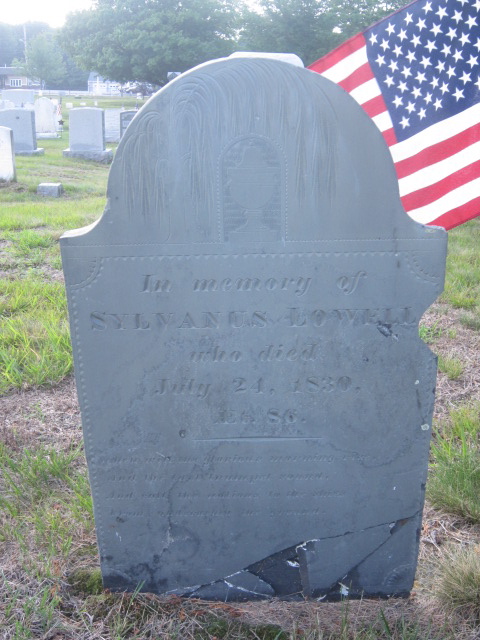
In 1791, as I wrote yesterday, Lowell’s second wife Elizabeth died. By the end of the year he married a third wife, also named Elizabeth. It also appears that the captain’s remaining eye started to fail around this time, eventually leaving him totally blind.

Lowell “quit the sea,” sold that Newbury house, and moved his whole blended family up to Maine, where some of his siblings had already settled. His stepdaughter Fannie later described the part of Biddeford where they made their new home as “then a wilderness.”

I’m not sure how Sylvanus Lowell supported his family after that, but reportedly the children grew up “in comfort.” In Biddeford the captain was “greatly esteemed.” Around 1825 Lowell “was visited with a severe shock of the numb palsy,” and he died on 21 July 1830, aged 86. His third wife survived him for another nine years.