J. L. BELL is a Massachusetts writer who specializes in (among other things) the start of the American Revolution in and around Boston. He is particularly interested in the experiences of children in 1765-75. He has published scholarly papers and popular articles for both children and adults. He was consultant for an episode of History Detectives, and contributed to a display at Minute Man National Historic Park.

Subscribe thru Follow.it


•••••••••••••••••


Showing posts with label Scarborough Gridley. Show all posts

Friday, May 14, 2021

Fifteen Years of Boston 1775

Fifteen years ago today, the first Boston 1775 posting appeared on the web.

(I later went back and added a couple of introductory posts with earlier dates, but the 14 May 2006 entry was the first to hit the web.)

I’d been planning a website for sharing some of the little stories I was finding about Revolutionary New England, and my friend and fellow author Greg Fishbone told me how blogging software could be the platform for such a site.

Then I went to a writers’ conference workshop by another friend and fellow author, Mitali Perkins, and she encouraged everyone to just share their expertise and ideas with the world, focusing on content instead of website architecture. So I found a template and started blogging.

That was fairly early in the blogging wave, which has now passed. A lot of discourse about history, both among academics and the public, has moved to social media and podcasts. Lately the chattering class is excited about Substack. Yet I’ve stuck with a daily blog.

I had no idea what the effects of Boston 1775 would be. It became my bona fides when I didn’t have institutional credentials to point to, and it opened doors for new projects. It also led me into many topics I hadn’t considered exploring. That’s probably why I enjoy writing new essays every day—I keep being drawn into learning new things.

One example is the series earlier this month on Abijah Brown of Waltham. I’d never heard of him before. Those posts grew from my longer-term project on the first months of the Continental artillery regiment, what I hope is the eventual follow-up to The Road to Concord.

A few years back, I noticed a letter from Samuel Adams in which he referred to Scarborough Gridley with the rank of colonel. Since I knew that the Continental Army had cashiered Scar Gridley out of the artillery regiment in the fall of 1775 while he was still only a major, that mistake amused me. Last year I tracked down the letter again and wrote a couple of postings about what Scar was up to.

Researching that episode led me to the petitions that Gridley’s father, Richard, who really was a colonel, sent to the Continental Congress. I didn’t want those documents to go to waste, so I started what I thought would be a short series on them. One of those was about a debt to “Major Brown,” so I took my usual approach and tried to identify who that could be.

All I initially wanted to find was a given name to insert in brackets in the middle of the phrase “Major Brown.” I had no idea that Abijah Brown would turn out to have gotten into so many disputes, received special (disapproving) mention in Gen. George Washington’s general orders, or inspired Massachusetts General Court resolutions. Before I knew it, Lt. Col. Brown had taken over a week.

The freedom to go off on tangents like that is one reason I’ve resisted monetizing Boston 1775 with ads. If I get intrigued by a man like Abijah Brown, I’d rather not worry, even a little bit, about whether he’ll keep the numbers up.

I do have a Ko-fi account for tips, but I don’t push it. I’m trying to figure out whether the Patreon model could work, offering something extra to financial supporters. Ideas are welcome, but I expect to continue chasing rabbits on this site for a while yet.

Saturday, September 26, 2020

“No such order as Mr Gridley alludes to”

Scarborough Gridley didn’t just write to Elbridge Gerry seeking back pay in February 1784, as I quoted yesterday.

Gridley first went to the president of the Massachusetts Senate to ask for his help. That man was Samuel Adams (shown here). This is why Gridley’s letter to Gerry is in the Samuel Adams Papers at the New York Public Library, of all places.

Adams’s political estrangement from John Hancock was at its height, so he was probably quite open to Gridley’s complaint that the governor had failed to carry out his duty to send an inquiry to Gen. George Washington about Gridley’s military role. (In 1789 Hancock and Adams reconciled and ran as a ticket, so Adams was Hancock’s lieutenant governor and successor.)

Adams had been in Philadelphia in 1775, when Gridley was cashiered out of his father’s artillery regiment, and 1776, when Gridley claimed his father brought him back on as an assistant while fortifying Boston harbor. So the senate president wasn’t up on the details of the younger man’s career.

On 25 February, Adams wrote from Boston to Gerry, then representing Massachusetts in the Congress, which was convened at Annapolis.
Inclosd is a Letter to your Self from Colo. Scar Gridley. It seems he applied to this G[eneral] C[ourt] some time ago for Depretion of his pay while in the Service, upon which the Govr. was requested to write to G W to make known to him the Rank held by Mr. Gridley & [missing text] but the Letter has never been written.

I advisd him to write you on the Subject, & hope you will excuse my giving you the Trouble. As you are now near the Place of Residence of General Washington, perhaps it may not be inconvenient to you to write to him, in doing which you will gratify & oblige Mr. Gridley.
On 18 March, Gerry wrote to Washington, then retired:
By the last Post I received from the president of the Senate of Massachusetts a Letter, inclosing the papers herewith transmitted, & requesting me to write to your Excellency on the Subject. As I have no other Knowledge of the Matter, than what is derived from Colo Gridley’s Letter & the Resolve accompanying it, I can only say, that when your Excellency is at Leisure, if You think it expedient to make any Observations on the Subject or Answer to the Resolve, & should inclose them to me, I will direct them to Colo Gridley.

I flatter myself with the Hopes, that since your Retirement from publick Life, You have not only enjoyed, Health, peace & Competence, but likewise the pleasure of seeing all your Friends in the same happy Circumstances.
On 31 March, Washington wrote back from Mount Vernon:
I have examined my Letter and orderly Books but find no such order as Mr Gridley alludes to, in his letter of the 21st of Feby, to you.

If his Father, or himself ever received such orders they are no doubt to be produced, and will speak for themselves. Mr Gridley never reported himself to the Chief Engineer (Genl [Louis Lebègue] Duportail) nor has he ever been returned to me by him, or any Senior Officer in that department that I remember as one of the Corps—in the Service of the United States—It is not in my power therefore, from any recollection I have of the circumstance he speaks of—or of his Services—to certifie anything on which his claim can be founded.
According to Gridley, his father had told Washington about his appointment in 1776 and the commander-in-chief had approved it. But there’s no mention of that in the published correspondence of the two men.

The nearest hint of a new army job for Scar Gridley was his court-martial panel’s statement that “they do not consider him incapable of a Continental Commission, should the General Officers recommend him to his Excellency”—which the general officers never did.

Gerry returned Gridley’s letter with Washington’s response in a note to Adams dated 2 April. Adams replied simply: “Your Letter of the 2d relating to Colo. Gridleys Affair came to hand. I am obligd to you for the Care you have taken.” And that was the end of that.

One detail that stood out to me in this exchange is that Adams, and then Gerry, referred to Scarborough Gridley with the title “Colonel.” Gridley was a major when he was removed from the Continental Army in 1775. Some paperwork hints that in the summer of 1775 he and his father tried to get him the rank of lieutenant colonel, but that didn’t go through.

So when and how did Scar Gridley start introducing himself to people as a colonel? Then again, if he really had managed to collect a few years of pay and rations as an assistant engineer in the Continental Army without any commander knowing it, he had a lot of audacity to call on.

Scarborough Gridley died in 1787 at the age of forty-eight at his parents’ home in Stoughton.

Friday, September 25, 2020

“Less fortunate in my Military reputation than some others”

As I recounted yesterday, Gen. George Washington dismissed Maj. Scarborough Gridley from the Continental Army on 24 Sept 1775.

Dealing with the major’s father, Col. Richard Gridley, was harder. It took a lot of maneuvering by the commander-in-chief, Continental Congress delegates, and the young man Washington wanted in Gridley’s place, Henry Knox.

In November, Col. Gridley was kicked upstairs to the post of Chief Engineer of the Continental Army. When Washington moved south to New York in April 1776, he left the colonel behind in the “Eastern Department,” fortifying Boston harbor.

What happened to Scarborough Gridley? In 1781, he petitioned the Massachusetts General Court for back pay, evidently for service in Gen. John Sullivan’s push against the British in Newport in 1778. That April, the state legislature resolved to pay Gridley “forty five Pounds New England” and asked Gov. John Hancock to write to Gen. Washington asking what rank Gridley had held in the Continental Army and “from whence he is to receive his pay.”

Nothing happened. On 21 Feb 1784 Gridley penned a letter to Elbridge Gerry, one of Massachusetts’s delegates to the Confederation Congress. In it he stated:
At the evacuation of the Town of Boston by the British troops my Father was stationed here by his Excellency General Washington for the purpose of Fortifying the Town and Harbour; the Extension of the Works made it necessary that he should have an Assistant; he appointed me and reported the appointment to His Excellency who confirmed it and order’d me pay accordingly—

I continued in service and received pay as long as any General Officer remained to grant me Warrants—My last warrant for June & July 1779 for 40 dollrs. pay and three rations subsistance was given by General [Horatio] Gates a[t] Providence: since which I have received neither pay nor Subsistance excepting one ration of Provisions to January 1781—

When Military opperations commenced at Rhode Island I repaired to General Sullivans Camp, and on my return to the works in Boston, received the Public thanks of the General for my services on that Expedition. . . .

Notwithstanding my repeated and assiduous application Governor Hancock has not written on the subject. At some times he informed me that he had written at others that it had escaped his memory. . . . that I should be kept from the reward given in common to others by the Neglect of an individual (however high in Office) is humiliating—

If in the early days of the War I have been less fortunate in my Military reputation than some others, I hope it will not be esteemed presumption in me to believe that my subsequent services and the Assiduity with which I have executed every order I have received have entirely effaced every disadvantageous impression on my Character.
That last paragraph was clearly a reference to how Gridley had been cashiered from the army for his behavior during Bunker Hill.

Scar Gridley closed by asking Gerry to request a certificate of his service from Gen. Washington so he could “settle my accounts with the publick and the State.”

TOMORROW: Oh, this will go well.

Thursday, September 24, 2020

“Major Scarborough Gridley guilty of a breach of orders”

On 24 Sept 1775, Maj. Scarborough Gridley’s career in the Continental Army came to an end.

Gridley was the fourth-ranking officer in the artillery regiment. More important, he was the son of the regimental commander, Col. Richard Gridley.

When the Massachusetts Provincial Congress summoned Richard Gridley in April 1775 and asked him to come out of retirement to lead its artillery and engineering force, one of his conditions was a high rank for his youngest son.

On 17 June, Maj. Gridley was ordered to take his artillery company onto the Charlestown peninsula and help defend the provincials’ new redoubt on Breed’s Hill. He found something else to do.

Three months later, that led to a court-martial. And on 24 September Gen. George Washington’s orders stated:
Major Scarborough Gridley, try’d at a late Genl Court Martial, whereof Brigd. Genl [Nathanael] Green was president, for “being deficient in his duty upon the 17th June last, the day of the Action upon Bunkers-hill”—

The Court find Major Scarborough Gridley guilty of a breach of orders; They do therefore dismiss him from the Massachusetts service; But on Account of his inexperience and Youth, and the great confusion which attended that days transaction in general, they do not consider him incapable of a Continental Commission, should the General Officers recommend him to his Excellency—

The General confirms the dismission of Major Scarborough Gridley, and orders it to take place accordingly.
Scar Gridley was born on 9 Oct 1739, so “inexperience and Youth” referred to his age of…thirty-five. Clearly that line was a sop to his father, as was the idea that he might become an officer in the army Washington was organizing for the new year. The commander pointedly took no notice of anything but this “young” man being dismissed.

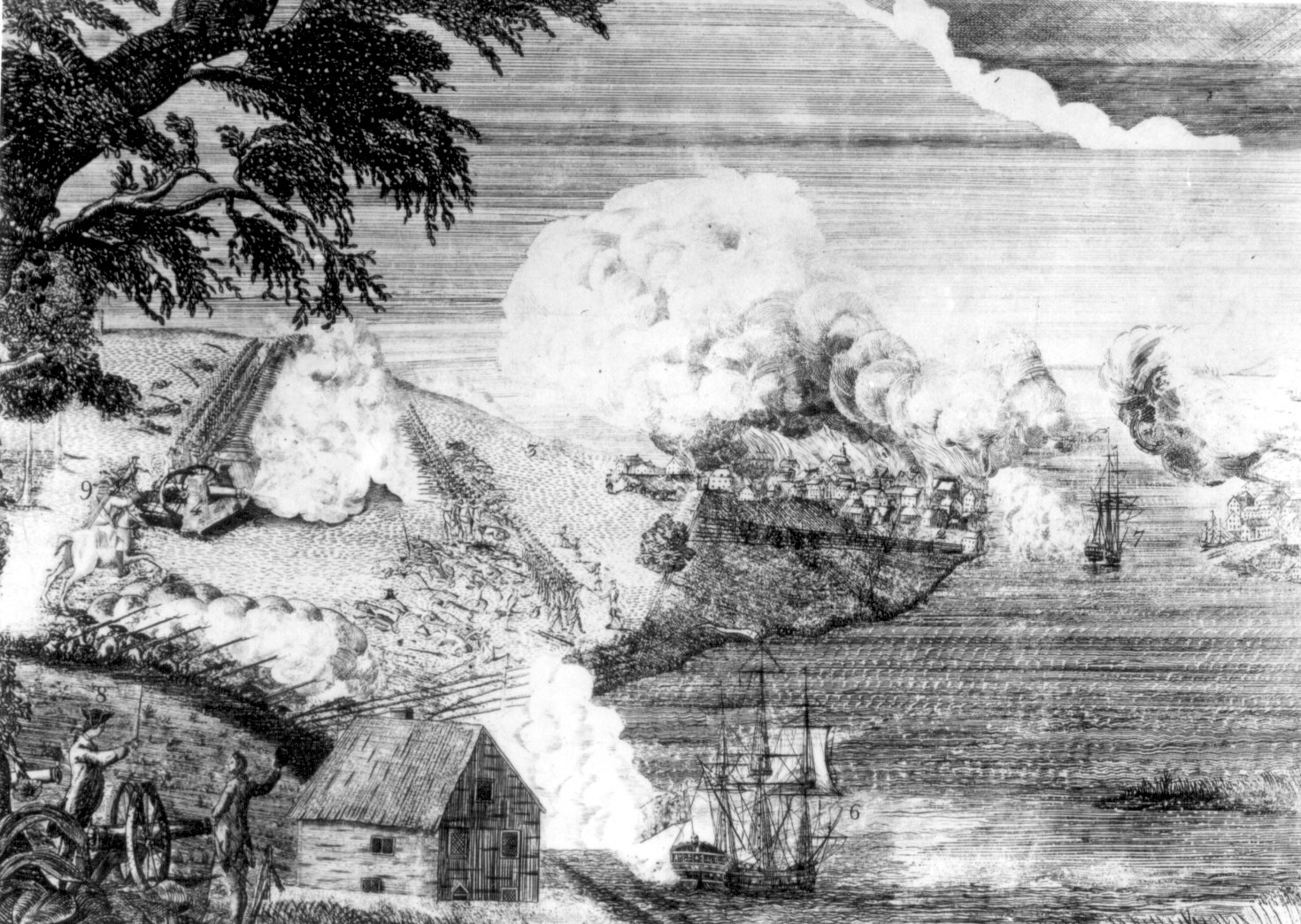
Other Americans noticed the dismissal as well. The artist Bernard Romans produced a print titled “An Exact View of the late Battle at Charlestown, June 17, 1775.” The Philadelphia printer Robert Aitken copied that to make “A Correct View of The Late Battle at Charlestown: June 17th, 1775.”

Romans’s image included a detail, shown above, of Maj. Scar Gridley staying in the foreground, out of the battle, trading cannon shot with a Royal Navy ship in the Charles River. He helpfully labeled that figure “Broken Officer.” (Aitken appears to have left out Romans’s labels, which would have been of most interest to New Englanders.)

Thus, Maj. Gridley’s contemporaries viewed his deficiency as crucial to the American defeat at Bunker Hill and were willing to pay to see why he was thrown out of the army. His five months of military service were not a success.

TOMORROW: Whatever happened to Maj. Gridley?

Tuesday, September 15, 2020

An Acquittal and a Conviction

On 29 Aug 1775, Gen. George Washington told Richard Henry Lee, “I have at this time one Colo., one Major, one Captn, & two Subalterns under arrest for tryal.”

The colonel was John Mansfield of Lynn, originally scheduled to be tried in early August. The major was Scarborough Gridley of Stoughton, in the artillery regiment. As I described yesterday, Gridley had stayed out of the main fighting at Bunker Hill and ordered Mansfield (who had a higher rank) to keep his infantry regiment nearby.

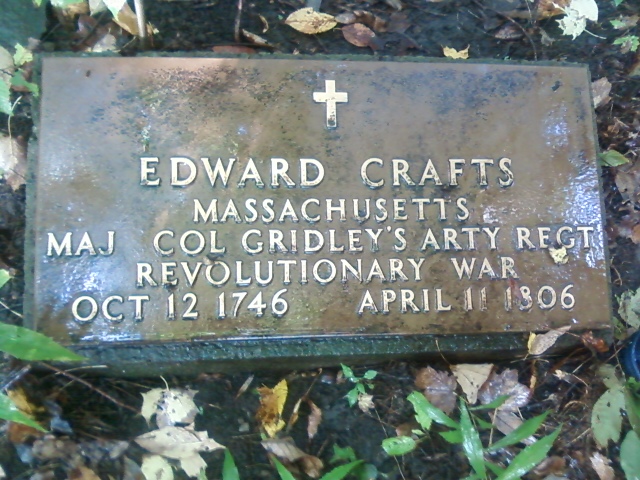
The captain was another artillery officer, Capt. Edward Crafts (1746-1806). He was a younger brother of Thomas Crafts, one of the Loyall Nine who organized the first public protest against the Stamp Act and then remained active in Whig politics. Thomas was an officer in Boston’s militia artillery company, and Edward trained in that unit as a young man.

Edward Crafts was a tinner by profession. He was still in Boston in 1770, when he supplied a deposition for the town’s Short Narrative of the Horrid Massacre. But back in 1768 he had married a country girl, Eliot Winship of Lexington. In 1771 the growing family moved to Worcester. At the end of 1773 Edward became a founding member of the American Political Society, his new town’s new club for Whig politics.

As the province moved toward military conflict in 1774, Worcester put Crafts on a committee to acquire and mount four cannon. He started to train a militia regiment to use those guns. Both Massachusetts Provincial Congress records and spy reports to Gen. Thomas Gage describe a large number of artillery pieces in the town by the spring of 1775.

When war broke out, however, Edward Crafts marched as a private in the town’s minuteman company. Then he returned home and recruited an artillery company to serve through the rest of the year. According to most listings of the Massachusetts artillery regiment under Col. Richard Gridley, Crafts was the senior captain.

That might have given him the stature, and the boldness, to challenge Maj. Scar Gridley. The colonel’s son was nominally fourth in command of the regiment, but in practice he was the colonel’s main aide and protégé. Sometime in the summer of 1775, after Maj. Gridley had behaved so ineffectually at Bunker Hill, he and Capt. Crafts exchanged words and accusations.

That led to the first of a series of court-martial proceedings, starting 1 September. The next day’s general orders announced the verdict:
Capt. Edward Crafts of Col. Gridley’s regiment of Artillery, tried yesterday by a General Court Martial, is acquitted of that part of the Charge against him, which relates to [“]defrauding of his men,” and the Court are also of opinion, that no part of the Charge against the prisoner is proved, except that of using abusive expressions to Major Gridley; which being a breach of the 49th Article of the Rules and Regulations for the Massachusetts Army; sentence the Prisoner to receive a severe reprimand from the Lt Col. of the Artillery in the presence of all the Officers of the regiment and that he at the said time, ask pardon of Major Gridley for the said abusive language.
The lieutenant colonel of the regiment was William Burbeck. I have no idea if he made Capt. Crafts perform this ritual before the end of the month because there was still more legal business to get through.

According to the diary of Lt. Benjamin Crafts (an Essex County cousin of the Crafts brothers from Boston), Col. Mansfield’s court-martial started on 8 September. A week later, on 15 September, the commander’s general orders declared the outcome:
Col. John Mansfield of the 19th Regt of foot, tried at a General Court Martial, whereof Brigdr Genl [Nathanael] Green was president, for “remissness and backwardness in the execution of his duty, at the late engagement on Bunkers-hill”; The Court found the Prisoner guilty of the Charge and of a breach of the 49th Article of the rules and regulations of the Massachusetts Army and therefore sentence him to be cashiered and render’d unfit to serve in the Continental Army.

The General [Washington] approves the sentence and directs it to take place immediately.
Notably, although the Continental Army kicked Mansfield out, the voters of Lynn chose him for their town committee of correspondence, inspection, and safety almost every year until the end of the war, and also voted to have him moderate town meetings.

Likewise, the voters of Newbury sent Samuel Gerrish to the Massachusetts General Court in 1776, the year after the army cashiered him the same way. Those gentlemen’s neighbors felt they still deserved leadership responsibilities.

COMING UP: The trial of Scarborough Gridley.

[The photo above shows the modern marker on Edward Crafts’s grave in Potter, New York, where the family moved in 1792, courtesy of Find a Grave. The original stone also survives there.]

Monday, September 14, 2020

“Remissness and backwardness” at Bunker Hill

On 13 Aug 1775, Gen. George Washington issued orders for a court-martial to take place the following day with Gen. Nathanael Greene presiding.

The defendant was Col. John Mansfield (1721-1809) of Lynn. Three junior officers in his regiment had accused him “of high Crimes and Misdemeanors”—namely “remissness and backwardness in the execution of his duty, at the late engagement on Bunkers-hill.”

But there was a delay. On 17 August, Washington told Greene and the other officers to try Col. Samuel Gerrish instead. There were also hearings on officers of lesser rank in that month. As I discussed last month, Gen. Washington was happy to remove a bunch of officers from the Continental ranks.

On 20 August the commander-in-chief told his cousin and overseer Lund Washington, “there is two more Colos. now under arrest, & to be tried for the same Offences.” One was Mansfield.

Why the delay? The charge against Mansfield also involved Maj. Scarborough Gridley of the artillery regiment, who was a protégé of his father, Col. Richard Gridley. The colonel was highly respected in Massachusetts because of his service in the last two wars, particularly the 1745 siege of Louisbourg. With a half-pay pension from the Crown, he was seen as the equivalent of a British army artillerist. The Massachusetts government had even moved to promote Col. Gridley to major general on 23 June.

Gen. Washington and particularly Gen. Charles Lee were not at all impressed with Col. Gridley’s fortifications and other work when they arrived in Cambridge in July. Washington informed the Continental Congress of Gridley’s new Massachusetts rank but pointedly didn’t endorse it. The Congress commissioned him as a Continental colonel instead. But people still didn’t want to totally alienate Col. Gridley.

What’s more, for a significant time that summer the colonel was home in Stoughton recovering a wound he’d suffered at Bunker Hill. His son Scar was the only liaison between him and the army. So both politically and practically, Maj. Scar Gridley was almost untouchable for a while.

That’s where the incident with Col. Mansfield came in. Mansfield’s failing at the Battle of Bunker Hill was to listen to Maj. Scar Gridley. As Richard Frothingham explained the situation in his History of the Siege of Boston, both officers had been ordered onto the battlefield on the Charlestown peninsula but stopped before crossing the neck:
Major Gridley, of the artillery, inadequate to his position, with part of the battalion, marched a short distance on Cambridge road, then halted, and resolved to cover the retreat, which he thought to be inevitable. Col. [Joseph] Frye, fresh from the battle, urged him forward; but Gridley, appalled by the horrors of the scene, ordered his men to fire at the [Royal Navy ship] Glasgow, and batteries from Cobble Hill. He also ordered Colonel Mansfield to support him with his regiment, who, violating his orders, obeyed.
To convict Mansfield of disobeying higher orders, cowardice, or incompetence would imply that Scar Gridley was guilty of the same charges. And how would his father respond? That might have been why Mansfield’s court martial took so long to get started.

In early September 1775, however, the court-martial proceedings started again. The logjam might have been broken from below as officers in the artillery regiment fired accusations at each other.

TOMORROW: Two trials in two weeks.

Saturday, January 28, 2017

“In daily expectation of Colonel Knox’s arrivall”

Yesterday I quoted the Boston businessman and court official Ezekiel Price about Col. Henry Knox and the artillery he brought from Lake Champlain in January 1776.

At that time Price was a war refugee living at Thomas Doty’s tavern in what was then Stoughton (shown here). That was also the home town of Col. Richard Gridley, Chief Engineer of the Continental Army and, until the previous fall, the commander of its artillery regiment. Price socialized with the Gridley family. He also gathered up rumors from other sources.

Price’s diary entries make clear that people like him knew about Knox’s mission to retrieve cannon and were eagerly awaiting the result.
Thursday, Jan. 11. — Went down to Milton. Could hear nothing remarkable from the American Army. It is reported that Colonel Henry Knox is on his return from Crown Point; got back as far as Worcester, and has with him a number of brass cannon and other ordnance-stores, and was expected at Cambridge last night with his artillery. Mr. William Bant [a business associate of John Hancock] called here on his way to the army, &c. Son Zek spent the day with us. Mrs. Price, Polly, &c, went home with Zek in the chaise. The weather threatens snow or rain soon.

Friday, Jan. 12.— A light snow fell in the night. The weather is moderate, and the morning agreeable for the season. Towards noon, it began to grow cold. Mrs. Gridley and daughter Beckey stopt here, in their way to Cambridge to visit Scar Gridley, who, they hear, is dangerously ill. A soldier from the army below says that nothing material has happened there within a day or two past, except that he heard Colonel Knox was on his return to Cambridge, and that a number of cannon had reached there, which Colonel Knox sent before him. It is cloudy, and has the appearance of more foul weather soon.
I’m skeptical about that “number of cannon” reaching Cambridge; no other sources confirm that secondhand information, and it looks to me like Knox went ahead of the guns instead of the other way around.

On 13 January, Gen. George Washington was still awaiting his artillery commander. He told Col. Alexander McDougall of New York, “I am in daily expectation of Colonel Knox’s arrivall.”

That same day, Price wrote, “By advices from Canada, I think Governor [Guy] Carlton’s head is pretty near the noose: so that we may hope to see him soon at headquarters.” He was expecting news of American triumph at Québec City.

In the evening Thomas Crane, representative from Stoughton to the Massachusetts General Court, told Price “that Knox, with the cannon, was at Springfield.” Which of course contradicted the earlier reports that the colonel was much closer. But Price was still optimistic.

Meanwhile, Washington kept waiting. On 16 January, he received a progress report from Gen. Philip Schuyler in Albany and wrote back: “I am much pleased, that the artillery was like to be got over the River, and am in Hopes, that Colonel Knox will arrive with it in a few Days—It is much wanted.”

Late the next day, Gen. Washington received bad news: Gen. Richard Montgomery had died in an unsuccessful assault on Québec. Washington called his generals together for a council of war the next morning to decide how many soldiers they could spare to bolster that effort against Canada. Knox, according to Gen. William Heath, finally arrived later on the 18th.

Sometime that same day, Ezekiel Price also heard about Montgomery’s death. He held out hope that that “melancholy and unfortunate” report was false. But on the 19th everyone connected with the army told Price the same bad news, and he had more detail by the 20th. For the next two days he described troops preparing to head north. Despite all his anticipation of Knox’s arrival, Price never actually recorded that event or mentioned the new artillery until late February. The disastrous news from Québec completely overshadowed it.

Thursday, June 18, 2015

“Capt. John Callender is accordingly cashiered”

After the British won the Battle of Bunker Hill, there was a great deal of finger-pointing on the American side. Eventually New Englanders decided the battle had actually been a Good Thing, but they still blamed several officers for behaving poorly.

As I related back here, Gen. Israel Putnam insisted that an artillery captain he had met on the battlefield be court-martialed for abandoning his cannon. That process had a false start, but by the time Gen. George Washington settled into his new job in Cambridge the verdict was awaiting his approval.

On 7 July 1775, the commander-in-chief’s general orders made a big deal of his decsion:
It is with inexpressible Concern that the General upon his first Arrival in the army, should find an Officer sentenced by a General Court Martial to be cashier’d for Cowardice—A Crime of all others, the most infamous in a Soldier, the most injurious to an Army, and the last to be forgiven; inasmuch as it may, and often does happen, that the Cowardice of a single Officer may prove the Distruction of the whole Army:

The General therefore (tho’ with great Concern, and more especially, as the Transaction happened before he had the Command of the Troops) thinks himself obliged for the good of the service, to approve the Judgment of the Court Martial with respect to Capt. John Callender, who is hereby sentenced to be cashiered. Capt. John Callender is accordingly cashiered and dismissd from all farther service in the Continental Army as an Officer.

The General having made all due inquiries, and maturely consider’d this matter is led to the above determination not only from the particular Guilt of Capt. Callenders, but the fatal Consequences of such Conduct to the army and to the cause of america.

He now therefore most earnestly exhorts Officers of all Ranks to shew an Example of Bravery and Courage to their men; assuring them that such as do their duty in the day of Battle, as brave and good Officers, shall be honor’d with every mark of distinction and regard; their names and merits made known to the General Congress and all America: while on the other hand, he positively declares that every Officer, be his rank what it may, who shall betray his Country, dishonour the Army and his General, by basely keeping back and shrinking from his duty in any engagement; shall be held up as an infamous Coward and punish’d as such, with the utmost martial severity; and no Connections, Interest or Intercessions in his behalf will avail to prevent the strict execution of justice.
Was Washington trying to make an example of Capt. John Callender? He certainly was. His language, especially at the end, closely followed the suggestion of the respected Massachusetts legislator Joseph Hawley, who on 5 July had written to him:
…I suggest, that although in the Massachusetts part of the Army there are divers brave and intrepid officers, yet there are too many, and even several Colonels, whose characters, to say the least, are very equivocal with respect to courage. There is much more cause to fear that the officers will fail in a day of trial, than the privates. I may venture to say, that if the officers will do their duty, there is no fear of the soldiery.

I therefore most humbly propose to your consideration the propriety and advantage of your making immediately a most solemn and peremptory declaration to all the officers of the Army, in general orders, or otherwise, as your wisdom shall direct, assuring them that every officer who, in the day of battle, shall fully do his duty, shall not fail of your kindest notices and highest marks of your favour; but, on the other hand, that every officer who, on such a day, shall act the poltron, dishonour his General, and by failing of his duty, betray his Country, shall infallibly meet his deserts, whatever his rank, connexions, or interest may be; and that no intercessions on his behalf will be likely to be of any avail for his pardon.
Of course, it’s one thing to say the system was going to be strict with everyone—it’s another thing to carry that out. Callender wasn’t the only Massachusetts artillery officer who had performed below expectations at Bunker Hill. But the other two were the son and nephew of the artillery regiment’s commander. It took months before they faced courts-martial. “No Connections, Interest or Intercessions” indeed!

Calendar eventually returned to the army. Of the Gridley cousins, Scarborough was convicted and cashiered, Samuel acquitted, but neither was in the Continental Army at the start of 1776.

Monday, June 15, 2015

The Broken Officer of Bunker Hill

This is a detail of a print titled “An Exact View of the Late Battle at Charlestown, June 17th, 1775.”

Versions of this image are on display right now in both the Boston Public Library’s “We Are One” exhibit and the Massachusetts Historical Society’s “God Save the People” exhibit. Here’s a link to the B.P.L.’s page for the full picture.

The engraving is credited to Bernard Romans, a native of Holland who had emigrated to Britain and then to North America in the 1750s. He explored parts of Florida and the southern frontier, then journeyed north on business.

When the Revolutionary War broke out, Romans was in Connecticut. He raised a small force to attack Fort George in New York, enjoying the same success as Ethan Allen in seizing Fort Ticonderoga but not the same fame.

In his “Exact View” of the battle we know best as Bunker Hill, Romans took a perspective from a point west of the Charlestown neck, putting the Breed’s Hill redoubt on the left of his frame as shown above and Charlestown in flames farther back toward the right. As shown in the detail, he or his colorist depicted the provincial soldiers in unlikely blue uniforms.

“General [Israel] Putnam” was the only individual Romans’s key identified by name, but that Connecticut officer wasn’t the picture’s biggest figure. There are two men in the left foreground, gesticulating on either side of a cannon. A number 8 hovers over one of their heads. The key at the top identifies that man as “Broken Officer.”

Yes, that’s Maj. Scarborough Gridley, youngest son of the artillery regiment’s commander, who chose to trade potshots with a British warship from Cobble Hill rather than go onto the peninsula where the real battle was.

Scar Gridley wasn’t cashiered from the Continental Army until September 1775, meaning Romans must have created this engraving after that date. The prominence he gave to that embarrassing detail of the battle suggests that his American public was interested in Maj. Gridley’s removal.

Monday, July 09, 2012

Samuel Russell Trevett’s Story of Bunker Hill

As I’ve been describing, in the Battle of Bunker Hill the field officers of the American artillery didn’t cover themselves with glory:
The latter two pulled back, one even after Gen. Israel Putnam had met him and ordered him forward again at gunpoint.

The exception to that pattern was Capt. Samuel Russell Trevett of Marblehead. He was assigned to follow Maj. Gridley, but when he realized his superior wasn’t budging he defied orders and advanced to Charlestown on his own. Trevett and his company were the only American artillerists active in the thick of the battle.

Trevett described some of his experience in a letter he wrote on 2 June 1818:
I commanded a company of artillery from the town of Marblehead, attached to Col. Richard Gridley’s regiment, stationed at Cambridge. About one o’clock in the afternoon of the 17th of June, 1775, I left Cambridge with my company, for Bunker’s Hill. When about a quarter of a mile from the Colleges, I saw Gen. Putnam pass upon a horse towards the town of Cambridge, and in 15 or 20 minutes I saw him pass in like manner towards Charlestown.

When I arrived at Bunker’s Hill, on the north west side, I there saw Gen. Putnam dismounted, in company with several others. I halted my company, and went forward to select a station for my pieces, and on my return, saw Gen. Putnam as before; the American and English forces being then engaged.—

I proceeded on with my company, and soon after joined that part of the American force at the rail fence, towards Mystic river, the Americans commenced a general retreat. As I was descending the north west side of Bunker’s Hill, I again saw Gen. Putnam in the same place, putting his tent upon his horse. I asked him where I should retreat with the field piece I had brought off, he replied to Cambridge, and I accordingly marched my company to Cambridge.
Unfortunately, Trevett wrote that letter to answer questions about whether Putnam was in command during the battle—a consuming issue for authors in the early 1800s. Trevett didn’t leave a full account of the battle, which means we’re missing his memory of the most interesting parts.

We don’t have Trevett’s experience of the fighting, when apparently he and his men fired grapeshot at the advancing British troops from the rail fence. We don’t have his full description of the retreat, in which his company dragged off a four-pounder cannon—the only American field-piece in Charlestown not captured by the enemy. We don’t know if Trevett agreed with Gen. Putnam that backward artillery officers were responsible for losing the peninsula, and that “one of these officers ought to be punished with death.”

Worst of all, we don’t have Trevett’s memory of how he felt when Putnam reported that the artillery officer who had refused orders to go back into the fight was named Trevett.

TOMORROW: The Massachusetts government tries to clean up this mess. And have I mentioned that I’ll be speaking about the new commander-in-chief’s response to the whole situation on Tuesday at 7:00 P.M. at Anderson House?

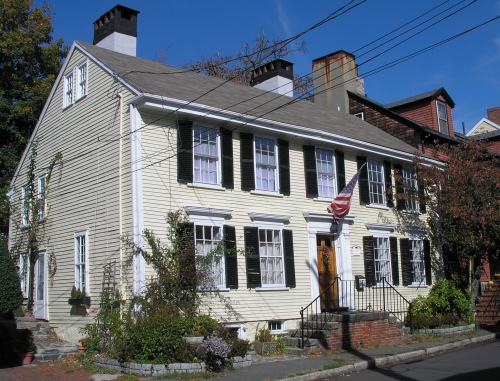
[The photo above shows the house in Marblehead where Samuel Russell Trevett was born in 1751, as photographed by Daniel Sterner of the Historic Buildings of Connecticut and Massachusetts blogs. Sterner has a new book out: A Guide to Historic Hartford, Connecticut.]

Saturday, July 07, 2012

The Gridley Legacy: From Louisburg to Cobble Hill

Continuing my quotation from Alexander H. Everett’s 1836 oration on the Battle of Bunker Hill, here’s how he described the action of Maj. Scarborough Gridley of the Massachusetts artillery:
Major Gridley had been ordered to proceed with his battalion from Cambridge to the lines; but had advanced only a few yards beyond the neck, when he made a halt, determined, as he said, to wait and cover the retreat which he considered inevitable.—At that moment Colonel [James] Frye [1709-1776], whose regiment was in the redoubt, but who, being on other duty, as I remarked before, had not yet joined it, was riding towards the hill, and found Major Gridley with his artillery in the position I have described. Frye galloped up to him and demanded what it meant.—

“We are waiting to cover the retreat.”—

“Retreat?”—replies the veteran, “who talks of retreating?—This day thirty years ago I was present at the taking of Louisburg, when your father with his own hand lodged a shell in the citadel. His son was not born to talk of retreating. Forward to the lines!”—

Gridley proceeded a short distance with his artillery, but, overcome with terror,—unequal to the horrors of the scene,—he ordered his men back upon Cobble Hill to fire with their three pounders upon the Glasgow and the floating batteries.

The order was so absurd that Captain [Samuel Russell] Trevett refused to obey it, and proceeded with his two pieces. He lost one of them by a cannon shot on Bunker Hill: the other he brought to the lines. This little fragment of Major Gridley’s battalion, was the only reinforcement of artillery that came into action.
At another point Everett explained, “In the war of 1745, when Massachusetts alone raised an army of three thousand two hundred men for the expedition against Cape Breton, he [Richard Gridley] commanded the artillery, and with scientific accuracy pointed the mortar which on the third fire threw into the citadel of Louisburg a shell that occasioned its surrender.”

Everett later incorporated his oration into the short biography of Dr. Joseph Warren published in Jared Sparks’s Library of American Biography. It’s the earliest mention I’ve found of either Richard Gridley’s mortar marksmanship at Louisburg or his son’s excuses at Bunker Hill. Everett didn’t state his sources, but from then on those statements were in the American historical record.

The picture above is Bernard Romans’s “Exact View of the Late Battle at Charlestown,” published in Philadelphia in September 1775 and provided by the National Archives. The artillery commander in the foreground shooting toward a warship, labeled “8,” is identified by the key atop the color version  (available at the John Carter Brown Library) as “Broken Officer.” However, Romans wasn’t on the scene, and that figure might be confused with a different American artillerist, not Scar Gridley.

The performance of the American artillery corps at Bunker Hill is a major part of my talk at Anderson House in Washington, D.C., next Tuesday: “Washington’s Artillery: Reengineering the Regiment Between Bunker Hill and Dorchester Heights.”

TOMORROW: Three artillery captains and one general on Bunker’s Hill.

Friday, July 06, 2012

“Great but fruitless interest for the commission in the artillery”

Yesterday I quoted a few phrases from Alexander H. Everett’s address on the sixtieth anniversary of the Battle of Bunker Hill. He spoke in Charlestown “at the request of the young men, without distinction of Party,” according to his lecture’s title page. (Makes you wonder what political dispute had disrupted previous years.)

Here’s a choice passage from Everett about the American artillery, comparing its performance to the fabled British failure:

But where in the mean time are the reinforcements of artillery? Where is Major [Scarborough] Gridley with his battallion? Is he too slumbering in the lap of some beauteous Delilah? Ah, gallant, learned Rumford! could your thorough science, your vigorous and energetic action have done justice to the orders of the veteran hero of Louisburg, there would have been no want of amunition: powder enough would have found its way to the redoubt, and the day might still have been ours. But America must pay the penalty of Col. [Richard] Gridley’s parental partiality, as Britain does of Gen. [Samuel] Cleveland’s superannuated gallantry.—
Col. Richard Gridley, commander of the Massachusetts artillery, had insisted that the Massachusetts Provincial Congress make his youngest son, Scarborough, a major in the regiment. But, as Everett hinted, Scar Gridley wasn’t up to the challenge of the Battle of Bunker Hill. (I’ll discuss that tomorrow.)

Who did Everett think would have done a better job? “Gallant, learned Rumford!” Everett relied on Samuel Swett’s History of Bunker Hill Battle, published about a decade before. Swett in turn appears to have talked to Massachusetts governor John Brooks (1752-1825, shown above), who reported that he’d been on Breed’s Hill on the morning of 17 June 1775 and was sent back to Gen. Artemas Ward’s headquarters ask for reinforcements. Swett wrote:
Maj. Brooks was retained at Cambridge by Ward, till the last reinforcements were sent to Charlestown, when he marched with the two remaining companies of his regiment, and met at the neck the Americans retreating. Benjamin Thompson, better known as Count Rumford, attended him as a volunteer. He was assisting the army by his mathematical learning, his estimates and surveys, but had solicited an appointment in vain, and had made great but fruitless interest for the commission in the artillery which was bestowed on Maj. Gridley.
Some authors later wrote that Brooks and Thompson (1753-1814) were schoolmates, others that they were both teen-aged medical trainees under Dr. Simon Tufts. Thompson did briefly go to school in Medford (Brooks’s home town), but he studied medicine under Dr. John Hay of Woburn, not Tufts. Supposedly Brooks and Thompson maintained a friendly correspondence all their lives, but I’ve never seen a citation for any of those letters.

According to modern biographer Sanborn C. Brown, there’s evidence that Thompson was in Woburn on 15 June, and thus less likely to be in Cambridge two days later. Still, authors of the nineteenth century accepted Brooks’s statement that Thompson was tagging along during the Battle of Bunker Hill, having fruitlessly offered to help the American artillery corps.

By the 1800s, Thompson had become famous and respected in Europe as Count Rumford, government administrator and scientist. Why hadn’t the Massachusetts army accepted his services? Why had his home town’s committee of correspondence kept him confined on suspicion of being a Tory? “America must pay the penalty” for that stubbornness, Everett said.

Neither Thompson’s contemporaries behind the American lines nor the nineteenth-century authors knew that in early May Thompson had sent Gen. Thomas Gage a spy report written in invisible ink. Was Thompson really angling for a high rank in the provincial artillery at the same time? Was he hanging around Gen. Ward’s headquarters and accompanying Maj. Brook to the front lines? If so, that wouldn’t have been good for the Americans.

Sunday, November 16, 2008

A Digital Library from London

My last new online resource for the week is British History Online, a “digital library containing some of the core printed primary and secondary sources for the medieval and modern history of the British Isles...Created by the Institute of Historical Research and the History of Parliament Trust.” It looks especially useful for British history and genealogy, but I came across it while Googling for information on an American family.

Among the printed sources digitized on British History Online and available for free (as opposed to by paid subscription only) are the Journals of the Board of Trade and Plantations, the official notes of the board that governed commerce in the British Empire.

Those notes cover a meeting in February 1777 when the board members reviewed a:

Copy of a letter from Mr. Gridley to Mr. Read, relative to the sea cow fishery, and the annoyance given thereto by two New England schooners. Remarks upon the sea cow fishery.
The board met again in April 1777 and:
Read a memorial of Mr. Gridley, praying to be recommended for a grant of the Madelaine Islands in the Gulph of St. Lawrence, upon certain duties and conditions, for the purpose of carrying on the sea cow fishery.

Their lordships, agreable to a minute of the Board of the 6th of February, 1771, were of opinion, that such a grant ought not to be made without a valuable consideration being given to the Crown for the same.
Samuel Gridley had been petitioning that board for an exclusive right for his family to hunt seals and walruses on the Magdalen Islands since early 1763. He based his request on his Boston-born father’s service to the Crown in the wars against the French, as recorded in March 1772:
Read a memorial of Samuel Gridley of the city of Bristol, merchant, stating the services of his father Colonel [Richard] Gridley, and praying, that, in consideration of the great expence that both himself and his father have been at, and the losses they have sustained, in making establishments and carrying on these a cow fishery in the Magdalene Islands, the said islands may be granted to him in preference to any other person, or that the person, to whom they may be granted, shall be obliged to reimburse him for the very usefull and necessary buildings and improvements erected and made there.
The irony of Samuel Gridley’s 1777 complaint about “New England schooners” was that by that time his father had become a colonel in the Continental Army. Richard Gridley was in fact the first commander of the American artillery, starting in April 1775. He had fought in some of the early skirmishes of the war, laid out the redoubt on Breed’s Hill, and was wounded in the ensuing Battle of Bunker Hill. Samuel’s younger brother Scarborough was also an officer in that artillery regiment, though not a good one.

By 1777, the colonel had been kicked upstairs to a position as Chief Engineer for the Northern Department, replaced in the field with Henry Knox. Scarborough was out of the army altogether. But Samuel was still pushing for the Crown to grant him the sole right to hunt those walruses based on family loyalty.

He didn’t get it. Within a couple of years, I understand, Samuel made his way back to Massachusetts. The London government eventually granted those islands to another, more loyal son of Boston: Admiral Sir Isaac Coffin.

I have to thank David B. Ingram, an expert on the Gridley family, for this lead. He actually found all this stuff some years ago when it was available only in printed volumes or in the actual London archives. I was following up his lead about the New England schooners when Google brought me to the British History Online site, giving me another reason to be grateful to Dave.