J. L. BELL is a Massachusetts writer who specializes in (among other things) the start of the American Revolution in and around Boston. He is particularly interested in the experiences of children in 1765-75. He has published scholarly papers and popular articles for both children and adults. He was consultant for an episode of History Detectives, and contributed to a display at Minute Man National Historic Park.

Subscribe thru Follow.it


•••••••••••••••••


Showing posts with label smallpox. Show all posts

Saturday, July 18, 2026

“To hear the proclamation for independance read and proclamed”

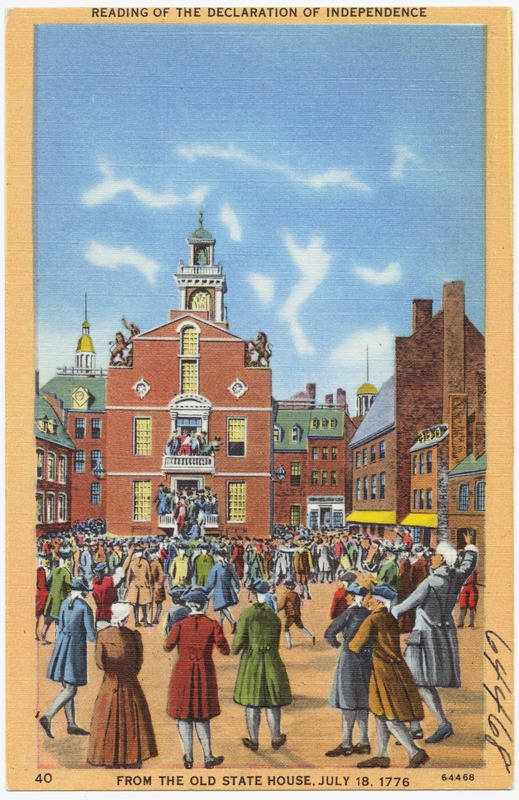
On 18 July 1776, 250 years ago today, the Declaration of Independence was officially proclaimed in Massachusetts.

People had already heard about the Continental Congress’s vote, and many had probably read the Declaration in newspapers. But this was a governmental ceremony. It happened in two places, and on two levels.

With no governor, the highest executive authority in Massachusetts was the Council. Most of its members were meeting in the Edmund Fowle house in Watertown.

Therefore, one part of the official reading was performed by Council secretary Perez Morton, reading the Declaration to the Council and to a crowd gathered outside. Also present were delegates from the Mi’kmaq and St. John’s/Maliseet communities, ready to sign a treaty of friendship with this new United States.

In Boston, there was a parallel, larger ceremony. Inside the Council’s chamber in what was now the State House, Suffolk County sheriff William Greenleaf read the Declaration to some Council members and other officials.

Col. Thomas Crafts of the Massachusetts artillery regiment, who had a bellowing voice, then “deaconed” or repeated the text phrase by phrase from the balcony of the Council chamber to the crowd gathered on the street below.

Thus, most Bostonians at the event heard Col. Crafts’s reading, but the official proclamation in Boston came from Sheriff Greenleaf. The ceremony was meant for both government officials and the “people out of doors.”

On 21 July, Abigail Adams reported to her husband:
Last Thursday after hearing a very Good Sermon I went with the Multitude into Kings Street to hear the proclamation for independance read and proclamed. Some Field peices with the Train were brought there, the troops appeard under Arms and all the inhabitants assembled there (the small pox prevented many thousand from the Country).

When Col. Crafts read from the Belcona of the State House the Proclamation, great attention was given to every word. As soon as he ended, the cry from the Belcona, was God Save our American States and then 3 cheers which rended the air, the Bells rang, the privateers fired, the forts and Batteries, the cannon were discharged, the platoons followed and every face appeard joyfull.

Mr. [James] Bowdoin [a senior member of the Council] then gave a Sentiment, Stability and perpetuity to American independance.

After dinner the kings arms were taken down from the State House and every vestage of him from every place in which it appeard and burnt in King Street. Thus ends royall Authority in this State, and all the people shall say Amen.
Not everyone was entirely pleased. Merchant John Rowe characterized the celebration as “a Great Confusion in Town.”

Pulling the royal emblems of the lion and unicorn down from the State House roof was probably inspired by reports of New Yorkers toppling the statue of King George III after that city’s reading of the Declaration on 9 July. But the street was still called King Street until 1784.

Tuesday, May 26, 2026

“Environmental History & the War of Independence” in Boston, 27 May

David Hsiung is the Dr. Charles R. and Shirley A. Knox Professor of History at Juniata College in Pennsylvania.

For several years he’s been working on the problem of how the enviroment affected the American Revolution, how the Revolution affected the environment, and how it’s possible to study those interactions with the data we have.

That is, of course, a huge topic, so part of the historiographical challenge is, I’m sure, to narrow down and define the questions in a manageable way. In the meantime, I’ve been enjoying his articles and lectures, which always open my eyes to new ways of seeing this history.

On Wednesday, 27 May, David Hsiung will be at the Massachusetts Historical Society for a conversation with Joyce A. Chaplin of Harvard, author most recently of The Franklin Stove: An Unintended American Revolution.

The description of “Curious & Complex Connections: Environmental History & the War of Independence” says:
Many of us give only a moment’s thought about the environment when considering the War of Independence: the slope of Breed’s Hill, the ice-choked Delaware River, and diseases such as smallpox. But what might we gain by connecting biology, ecology, and geology to the thinking and actions of soldiers and civilians? Rebels and British soldiers acquired and used energy in the form of food, fuel, and work animals, which shaped people’s lives, the course of the war, and the direction of environmental change.
This is a hybrid event starting at 6 P.M., with a reception in the preceding half-hour for people attending in person. Attendance costs $10, but is free to M.H.S. members and Card to Culture participants. Listening in online is free. Register for either form of access through this page.

Folks can also take in these talks from Prof. Hsiung:

Saturday, May 16, 2026

“To Vax or Not to Vax” walking tour in Boston, 17 May

On Sunday, 17 May, the Partnership of Historic Bostons is offering a walking tour titled “To Vax or Not to Vax: Smallpox in Early Boston.”
The organization says:
The subject of our newly revised walking tour is smallpox, one of the great killers of the 17th century. This European disease found fertile ground in the growing colonies in New England, with the most devastating effects suffered by Native Americans who had no immunity. Up to 90% of the Massachusett Tribe, whose land included Boston and Charlestown, perished, their villages lying empty and providing English colonists with unoccupied land for reasons that Puritans saw as providential.

English colonists had some immunity but, even so, successive generations suffered wave after wave of deadly smallpox outbreaks. . . .

During the tour, we will investigate how the colonists saw smallpox and tried to contain it, and how smallpox roiled their society in a number of ways. Had God handed the Shawmut peninsula over to them by clearing out the Native population, or was he punishing them with the same pestilence for not sufficiently following His word? Could smallpox be successfully treated by medical methods practiced since the time of the Romans, or would new, more radical methods (some employed by Africans, including Cotton Mather’s enslaved African Onesimus, and Turks) prove more effective?
This tour is led by Michael Prochilo. It will start outside of Park Street Station at 2:30 P.M. and is scheduled to last 90 ninety minutes. Because of construction projects, the route is not wheelchair-friendly. Participants are reminded to bring water [Sunday might bring our first 80°F. days this year] and wear comfortable shoes.

Saturday, April 11, 2026

“Itt’s said she has a large quantity of the Stolen goods”

It didn’t take long for New England Patriots to realize that Cdre. John Manley’s capture of the Elizabeth on 2 April 1776 was a big deal.

On 6 April, Isaac Smith, Sr. (1719–1787, shown here courtesy of the Yale University Art Gallery), wrote to his niece Abigail’s husband, John Adams, from Salem:
Commodore Manleys fleet has taken a brigantine bound to Halifax on board of which is Bill Jackson and all his Effects and itt’s said she has a large quantity of the Stolen goods—

and there is on board likewise One Greenbrush, receiver general of the stolen goods and has distinguisht himself in that way by demanding People’s propaty from them. Itts said he came from York and itts said those Carpenters and runagarders from that way has behaved worse than any Others.—

A sloop is on shore at the Cape, beleive nothing very Valuable on board but itt Appears they (the inhabitants) went away in a most dismal Cituation, not haveing even Water sufficient and crowded and some sick with the small pox.
That sloop was the Sally, commissioned by Jolley Allen and captained by no one who knew what he was doing, as described back here.

As a merchant in Boston before the siege, Isaac Smith knew William Jackson and his troubles well. But Smith wasn’t familiar with Crean Brush, who had arrived from New York after the siege began—hence his reference to the man as “One Greenbrush.”

John Rowe was all too familiar with Brush, having watched that royal appointee confiscate some of his property. On 8 April he wrote in his diary with surprising calm:
Capt. Manly is come to Town & brings the Accot. of his Taking Crian Brush Wm. Jackson & Twenty other passengers in A Brigg bound with The Fleet—

This Vessell tis Said has Twenty five Thousand pound Sterling On board—in English Goods & Other Merchandise—

among the Prisoners is A Sergiant & 12 Men of the Kings Troops
On 8 April Rowe added:
There is a Confirmation of Crean Brush & Wm. Jackson being taken & also My Negro Fellow Adam
Adam was one of the four enslaved people found aboard the Elizabeth. Remarkably, this is the only time in his published diary that Rowe mentioned the man. We therefore have no clue about how he came to be on the brig. Had Adam asked to evacuate the town, or had Rowe sent him away?

TOMORROW: Following the money.

Wednesday, April 01, 2026

“This captain of ours was at the greatest loss”

Yesterday I started to tell the story of how Jolley Allen evacuated Boston with the British fleet in March 1776—or tried to.

Quoting Allen’s own narrative of course gives away the fact that he survived to tell his tale. But it’s such a sarcastically detailed account that I can’t resist.

We left Allen on the morning after the British ships left Boston harbor. Along with his large family and almost two dozen other people, he was on sloop Sally, and it was sinking.

Allen had come to the realization that the man he’d hired to captain that vessel, Robert Campbell, knew nothing about navigating the ocean or even how a sailing ship worked.

That meant for a tense few hours in the early morning of 28 Mar 1776. But then at seven o’clock Campbell “said he saw a vessel.”

Allen urged Campbell to chase after it. Campbell replied that “did not understand steering the vessel he was in, so well as he knew how to give directions to another.” Allen pointed out that he hadn’t hired anyone else who knew how to steer it any better.

Some time later, Campbell announced “he thought he never saw so large a Ship before.” Allen looked and saw the man was pointing at a stretch of land.
I applied to him and asked him what land he thought it was. He told me that he was fully convinced that it was Nantucket. I told him, if that was the case, we must all perish very soon; for the amazing rocks and shoals that lay off Nantucket I could remember very well, as I saw them above Twenty-Two years ago on my passage when I came from London. . . .

This captain of ours was at the greatest loss to know what to do in this situation, seeing land, for want of a map (which I am of opinion had there been one on board he knew no more what to do with than a rat).
The two men called everyone up on deck to discuss what to do. Some passengers feared drowning most. Some had more fear of falling into rebel hands—though Nantucket would prove to be neutral territory for most of the war. Allen advocated running the sloop on shore. Campbell suggested going back out to sea and hoping a Royal Navy ship would come by. Showing their confidence in the captain, the group voted to try the shore.

With the help of a handy current, the Sally moved inland, then struck a sandbar “violently either seven, eight, or nine different times.” Waves lifted the sloop over the bar, but the anchor caught for a while. About 2 P.M. the sloop reached calmer water
with all our sails hoisted, as we had hoisted in Nantasket Road; some all the way up, some half the way up, and some not a quarter of the way up; torn, to appearance, into ten hundred thousand pieces, all flying.

The captain says to me, by way of adviseing with me, seeing no boat come off to us, whether or no we had not better hoist a signal of a white sheet or table-cloth, to let them know we was in distress for want of a boat. The answer I made him was that I thought the above signals was quite sufficient
Eventually a man appeared on shore. The people on the Sally waved. More men appeared. Those men stood and talked with each other.
At last, to our great joy, we saw a cart with a boat (or cano) in it drawn by ten oxen, and six men more, which came down to our assistance. They soon got the boat into the sea, and two men in it to know from whence we came.
Those two oarsmen hadn’t had smallpox, and one of the women on board was dying from the disease (though Allen didn’t come right out and say that). So the passengers had to wait for two different men with immunity to bring out the rowboat. At about seven in the evening the locals started to ferry the people on the Sally to shore. Allen wrote:
I asked them the name of the place; they told me it was Cape Cod. I told them my captain told me, and insisted upon it, that this place was Nantucket. They answered me that Nantucket was above four days’ sail from Cape Cod with a fair wind.
Allen and Campbell hadn’t managed to escape rebel Massachusetts. They hadn’t even managed to get out of Cape Cod Bay.

TOMORROW: More Loyalists at sea.

Wednesday, December 17, 2025

Eight Runaway Men in a Boat from Boston

Capt. Richard Dodge was a Continental Army officer stationed in Chelsea during the second half of 1775. Like his regimental commander, Lt. Col. Loammi Baldwin, he sent periodic reports to Gen. George Washington’s headquarters about what he saw in Boston harbor.

On 16 December, Dodge reported some exciting news: “Last Eveing Eight men Runaway in a bote from Boston to our guard at the farry.”

Following recently enacted protocol, Dodge sent those men to a local health committee who “Clensed them by Smooking them” against the smallpox.

Six (or seven, according to the 25 December Boston Gazette) of those eight men were “masters of Vassels” captured by the Royal Navy and brought into Boston over the preceding months.

One, Capt. James Warden, had sailed for the Philadelphia merchant Thomas Mifflin and was anxious to renew their acquaintance now that Mifflin was the army’s quartermaster general. Naval Documents of the American Revolution reports that Warden was commanding the schooner Tryal on 22 August when it surrendered to H.M.S. Nautilus under Capt. John Collins.

The Essex Journal of Newburyport identified another of those ship’s captains as named Nowell, possibly Silas Nowell (who wouldn’t have been held that long). He came out with a copy of the Boston News-Letter, the only newspaper still being published in the town, and the news that Gen. John Burgoyne had sailed for England.

On 17 December, 250 years ago today, Dodge wrote out a précis of what those men told him about life inside Boston. The prices for food were high. One escapee reported that “he Dined with a man that Dined with Lord parsey a feu Day ago upon horse beaff.”

Firewood was even scarcer with winter coming on. Gen. William Howe had ordered the Old North Meeting-House and empty houses torn down for fuel. We also know Howe told London that he might have to order wharves torn up next.

Citing Capt. Nowell, the newspapers added that “all the drugs and medicines in the town have been seized for the use of the army.”

TOMORROW: Tales of the searcher.

Wednesday, December 03, 2025

“The said Short is a midling sized man”

During the siege of Boston, Benjamin Edes published the Boston Gazette out of Watertown. His main competition was the New-England Chronicle that Samuel Hall printed in Cambridge.

Geography put Edes’s print office closer to the Continental camp in Roxbury. On 13 Nov 1775, and for the next two weeks after, the Boston Gazette carried this advertisement:
DESETED [sic] from Capt. Earl Clap’s company in Col. Theophilus Cotton’s regiment, on the 12th of June last, and taken up on the 9th of this inst. [i.e., this month] at Cambridge, John Short, and in conveying him to Roxbury he ran-away again.

The said Short is a midling sized man, goes a little stooping, fresh looking, lately had the small pox, with a scarr on the right side of his face, and dark complection: Had on when he was last taken a blue coat, wash leather breeches, a surtout of a greyish colour, small brim’d hat with a white ribbon round the crown, and boots on.——

Whoever will take up said run-away, and secure or return him to the regiment he deserted from, shall receive four Dollars reward and all necessary charges paid by me.

Roxbury, Nov. 10, 1775. EARL CLAP.
“Wash leather” meant a form of chamois.

Short was evidently caught in late November or early December since the ad stopped appearing and he was court-martialed on 4 December, as recounted yesterday.

In addition to running away twice, as the ad described, Short’s trial record says he’d gotten Capt. Clapp to pay 36 shillings “for a former theft.” No wonder the army was ready to throw the book at him.

Part of Short’s sentence was to repay Clapp that sum plus £1.16s. for the “expense of advertising and apprehending him.” Most of that was probably the $4 reward, then pegged at £1.

TOMORROW: Witnessing the punishment.

Sunday, October 19, 2025

John Vinal “continues to keep a private School”

Back in September I quoted John Adams’s account from 17 Apr 1764 of meeting a man who had taken the smallpox inoculation before him:
My Unkle [Dr. Zabdiel Boylston?] brought up one Vinal who has just recoverd of it in the natural Way to see Us, and show Us. His face is torn all to Pieces, and is as rugged as Braintree Commons.
That couldn’t have been very encouraging.

That man was John Vinal (1736–1823), the usher, or assistant teacher, at Boston’s South Writing School under Abiah Holbrook.

The Boston Athenaeum has a painting of Vinal, apparently copied from an earlier canvas around 1900. I’ll have to look for smallpox scars the next time I see it.

On 15 May Vinal petitioned the Boston town meeting “that an allowance may be made him, in consideration of the Straits and Difficultys he has been reduced to by means of the Small Pox.” After some debate the town voted to pay Vinal £15 on top of his usual salary of £50.

That was just one way Vinal augmented his town salary. Like other town teachers, he offered private lessons. As early as 1756 he advertised an evening school for adults. This 15 Sept 1760 Boston Evening-Post notice lays out his subjects:
John Vinal
Hereby gives Notice, that he intends an Evening-School will be opened as usual, at the South Writing School, the 29th of this Instant, where Persons may be taught Writing, Arithmetic, Algebra, &c. also Book-keeping, in so plain a Method, that any Person of a common Capacity, may in a short Time, at a small Expence, be able to keep his own Accompts with Exactness.
In the 3 Oct 1763 Boston Post-Boy Vinal promised to cover “Reading, Writing, Arithmetic vulgar and decimal, Navigation and several Branches of the Mathematics; also the Italian Manner of Bookkeeping.”

That still left some free hours of the day. The boys at the town schools went home for their midday dinners, and then again at the end of the day. Master Holbrook probably had his own private pupils come into the South Writing School at that time, so where did that leave Vinal?

He hustled over to a space that yet another teacher, Richard Pateshall, used for private lessons in “the Rudiments of the Latin Tongue” along with English reading, spelling, and arithmetic. While Pateshall was out, Vinal went to work teaching children, as shown in this 30 Apr 1764 Boston Post-Boy ad:
John Vinal,
Hereby gives Notice, that he continues to keep a private School, opposite William Vassall’s Esq; where Youth may be instructed in Reading, Writing and Arithmetic in the best Manner, from XI to XII o’Clock, A.M. and from V to VI o’Clock, P.M. Misses may also be taught Spelling. Those who send their Children, may depend upon their being faithfully instructed.
That ad appeared less than two weeks after Adams saw Vinal’s smallpox-ravaged face. A lesson the youth would never forget.

TOMORROW: Moving up.

Sunday, September 28, 2025

A Last Word on Boston’s Sedan Chairs

Originally I flagged Alun Withey’s blog post about sedan chairs in Britain just because I thought it had interesting details about daily life in the eighteenth century.

But then I got interested in the question of whether those details also applied in Boston.

Looking for sedan chairs locally led me into the smallpox epidemic of 1764, and thus to the name “Williston” appearing over and over in the selectmen’s records. So I had to figure out who Thomas Williston was.

So, having spent nearly a week on what I’d thought was a one-day topic, I’m coming back around to complete this sedan chair trip with some familiar names.

In 1769 the smallpox virus flared up again in Boston, though not nearly as badly as five years before. On 21 June the selectmen’s minutes reported:
Mr. Thomas Cunningham living near Dr. [Jonathan] Mountforts gives information to the Selectmen, that one Joseph Hading who came to his House on Satturday last, from a Vessel which then arrived here from Philadelphia is suspected of having the Small Pox broke out upon him.

Dr. [Joseph] Warren was in consequence of the above information sent to the said Cunninghams house to examine into the same, who having done it, makes Report that the Person has got the Small Pox.

Whereupon the Sedan was sent to carry him to the Hospital at New Boston.
“Mountforts Corner” was the site of a well-known apothecary shop in the North End. The Jonathan Mountfort running it in 1769 was a son of the man with the same name who’d set it up. When he died in 1781, the business passed to his own son, also named Jonathan (born in 1746 and painted as a kid by the young John Singleton Copley, as shown above courtesy of the Detroit Institute of Arts). That third Jonathan Mountfort died only four years later, but the name survived for at least another decade.

In late July 1769 the selectmen sent the town sedan chair to carry more smallpox victims to the province hospital: “Mr. Jabez Searl,” “a Child a Daughter of Abijah Lewis,” and “Capt. Timothy Parker…between the Hours of Two & Three OClock in the morning.” (Others, such as “a Negro Woman Servant to Mr. William Wingfield,” were simply ordered to be removed to the hospital, and it’s not clear how that happened.)

These people were surprised to be catching smallpox. They must not have volunteered to be inoculated with what doctors believed was a mild strain. Health statistics stretching back decades showed that contracting the disease “in the natural way” was more deadly than being inoculated. And indeed, by 9 August, Searl and Parker had both died.

A few months later, the army drummer Thomas Walker was carried to the hospital in what he called “the Machine for the Conveniency of Removing the Sick.” He didn’t have the smallpox; instead, he’d been injured in the fight between soldiers and ropemakers on 2 Mar 1770. I wonder if that “Machine” was the town sedan chair or if the army had its own equipment.

My next milestone in the story of sedan chairs in Boston comes in 1799. In that year the town established its first board of health. Paul Revere was board president, the silversmith’s highest civic office. On 8 Apr 1800, the selectmen’s records say: “On application from the Board of Health, order’d that the Sedan Chairs belonging to the Town be delivered to them for their use”.

Thus, in eighteenth-century Boston, sedan chairs were ambulances. We can find a few individual sedan owners in the records, but they appear to have been in poor health. The appearance of a sedan chair on your street signified not luxury but illness.

Saturday, September 27, 2025

Thomas Williston, Doorkeeper

Yesterday I introduced Thomas Williston, sexton of Boston’s Old Brick (First) Meeting-House starting in the 1740s.

Williston also took on jobs for the town of Boston. Some of those were tied to his work as a church sexton, such as winding his meetinghouse’s clock and burying the dead. Others were civic tasks, as in managing the weekly traffic of farm wagons at the marketplace.

In June 1754 the town government offered another job: “Mr. Thomas Williston is appointed to attend the Select men in the room of Mr. John Savel who by reason of Age and Infirmities cannot attend the business.” Williston was also given “the care and Oversight of all the Watches in the Town.” And he was still the sexton at the Old Brick.

Thomas Williston’s official title was doorkeeper at Faneuil Hall. As such, he continued to patrol the marketplace, arranged to illuminate the building after the capture of Montreal in 1760, and the next year took down “the Potts & other Iron Ware” from the walls and hung “the Town Ladders” there instead.

But being doorkeeper also involved a lot of running around Boston. In 1758 the selectmen empowered Williston to enforce the town’s newly revised by-laws, including speed limits on vehicles. They sent him out on the water to warn ship captains against unloading “French neutrals” or possible smallpox patients. Along with Deacon William Larrabee, Williston was assigned to warn newcomers out of town—though he did that for only a few months, Robert Love’s Warnings reports. At different times Williston summoned new officeholders, tax collectors, and heads of fire companies to meet with the selectmen at Faneuil Hall.

For the annual inspection of the schools, Williston contacted the many respected gentlemen chosen for that committee. He also visited the two grammar-school masters to obtain the names of the graduating scholars so the selectmen could invite their parents to a dinner at Faneuil Hall. (Students leaving the three writing schools didn’t get a party.)

Some of Williston’s assignments overlapped with his roles as gravedigger, bellringer, and watchman. For example, in March 1761 he informed tomb owners they were responsible for paying to repair a wall of the burying ground. But he could also be told to deliver the seals to the newly elected sealers of leather, inspect leaning chimneys, and warn property owners about dangerous drains.

Williston’s busiest months on record were during the smallpox epidemic of 1764. He appears over and over in the selectmen’s minutes: tracking down reported patients, moving some to the hospital at New Boston in the town sedan chair, installing flags and guards (including his brother Ichabod) outside quarantined homes, hiring and dismissing nurses, smoking homes and clothing, and burying the dead under special arrangements to contain the disease. Thomas, his brother John, his other brother Ichabod, and Ichabod’s wife Elizabeth all got extra pay during those months.

After army regiments arrived in Boston in October 1768, Thomas Williston had the task of telling British officers that the selectmen wanted to speak to them—a potentially volatile clash of authorities. In November he summoned two officers accused of having “insulted & interrupted” the Dock Watch; those officers apologized for being drunk. In July 1770 “Mr. Williston, Door-keeper to the Select-men,” carried a letter from a town committee to Capt. Thomas Preston in the town jail. In September, some sick soldiers came back from Castle Island to enter “the Hospital in the Common”; the selectmen had Williston summon regimental surgeon Charles Hall for consultation.

In sum, Thomas Williston was well known in Boston, the liaison between the town’s highest elected officials and citizens of all sorts. He was based at Faneuil Hall and the Old Brick Meeting-House, but he could show up anywhere in the course of his duties.

On 18 Feb 1773, Isaiah Thomas’s Massachusetts Spy reported the death of Thomas Williston, “sexton of the Old-Brick, and doorkeeper of Faneuil hall.” He was buried in the Granary Burying Ground with his wife Sarah, who had died on Christmas Day in 1771.

Four days later the selectmen met in Faneuil Hall. Those men, “taking into consideration who was a proper Person to fill up the place of Mr. Thomas Williston, who for a number of years had attended them on the Towns Business; Agreed to give the Offer of the office to Mr. William Barrett Sexton of Dr. [Samuel] Coopers Church” on Brattle Street.

Williston’s successor as sexton of the First Meeting-house and, as of 31 March, as a town-approved gravedigger was Josiah Carter. As I discussed here, he had also been a town watchman. However, Carter lasted in that sexton’s job less than two years after Williston’s demise.


Thursday, September 25, 2025

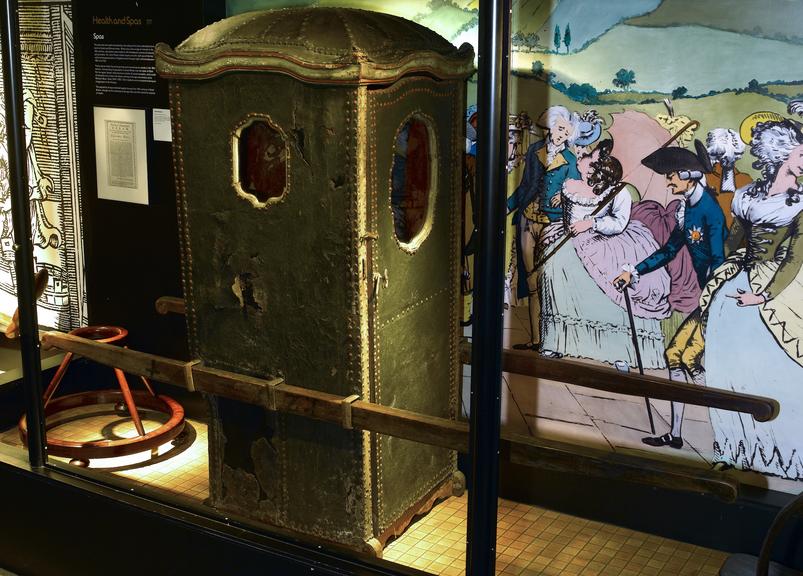
Boston’s “Sedan for Removing the Sick”

Lining up the sparse mentions of sedan chairs in colonial Boston reveals a clear pattern: they were used to transport sick people.

In 1674 the Rev. John Oxenbridge of the First Meetinghouse suffered a stroke while preaching the Thursday Lecture and “was carried home in a Cedan.”

Thirteen years later, Judge Samuel Sewall wrote in his diary: “Capt. Gerrish is carried in a Sedan to the Wharf and so takes Boat for Salem, to see if there he may find amendment of his Distemper.”

In May 1715, the newly reappointed governor Joseph Dudley was bed-ridden with gout. At the end of the month, Sewall wrote, he came to Boston and “was carried from Mr. Dudley’s to the Town-House in Cous. [William? Jeremiah?] Dummer’s Sedan: but twas too tall for the Stairs, so was fain to be taken out near the top of them.”

Yesterday I listed five times sedan chairs were advertised for sale in eighteenth-century Boston newspapers. I don’t think it was coincidence that four of those ads were estate sales, and the fifth seller died within two years. Those men might have acquired sedans as they or their wives became too ill to walk around.

Boston also had a public sedan chair, operated by the town itself. In March 1739, the Boston selectmen took note of “A Sedan, or Chair belonging to the Hon. Edward Hutchinson Esqr. which the Town has had the loan of for a considerable time.” One of those local elected officials was Thomas Hutchinson, and the sedan owner was his uncle. The selectmen decided that the chair “be effectually Repaired, and made fit for Use, in the best and frugal manner.”

That sedan chair became part of Boston’s public-health infrastructure. On 4 Jan 1757 the selectmen voted “that the Sedan for Removing the Sick be broke to Peices” and “Mr. [Isaac] Cazneau make a good Serviceable Sedan at the Charge of the Town.” Cazneau was a saddler.

In 1760 the Massachusetts General Court bought land in the sparsely populated western point of the Boston peninsula called “New Boston” for a new hospital. Four years later, the town suffered a serious smallpox epidemic. That appears in the selectmen’s records with an uptick in orders for the sedan chair to carry people to that hospital.
  • 16 Jan 1764: “Information was given the Select men by Dr. [Phillip] Cast, that One Hallet who came from Newfoundland a Month past, and Boards at Mrs. Nicholsons in Fitches Alley, has the Symptoms of the Small Pox upon him whereupon the Select men endeavour’d to perswade him to consent to his being removed, and having obtain’d such consent, he was accordingly removed in the Sedan to the Province Hospital at New Boston.”
  • 20 Jan 1764: “The Select men having prevailed with Mr. Adams to consent that his Child should be removed from his House to the Hospital at New Boston, they at about 12. OClock that Night took Mr. Williston and a number of hands with the Sedan to said House, when they received the Wet Nurse and Child and carried them to said Hospital”.
Similar entries appeared through August of that year.

TOMORROW: “Mr. Williston.”

(The picture above shows a sedan chair used to carry medical patients in La Paz, Bolivia, now in the Wellcome Collection in London.)

Tuesday, September 09, 2025

“Swelled to three times his size, black as bacon”

Here’s another account of anti-epidemic measures from the Adams family papers, this one a 17 Apr 1764 letter from John Adams to his fiancée, Abigail Smith.

John had gone into Boston to be inoculated with smallpox under the care of Dr. Nathaniel Perkins, and he reported:
Messrs. Quincy’s Samuel and Josiah, have the Distemper very lightly. I asked Dr. Perkins how they had it. The Dr. answerd in the style of the Faculty “Oh Lord sir; infinitely light!” It is extreamly pleasing, says he, wherever we go We see every Body passing thro this tremendous Distemper, in the lightest, easiest manner, conceivable.

The Dr. meaned, those who have the Distemper by Inoculation in the new Method, for those who have it in the natural Way, are Objects of as much Horror, as ever.

There is a poor Man, in this Neighbourhood, one Bass, now labouring with it, in the natural Way. He is in a good Way of Recovery, but is the most shocking sight, that can be seen. They say he is no more like a Man than he is like an Hog or an Horse—swelled to three times his size, black as bacon, blind as a stone. I had when I was first inoculated a great Curiosity to go and see him; but the Dr. said I had better not go out, and my Friends thought it would give me a disagreable Turn.

My Unkle [Dr. Zabdiel Boylston?] brought up one [John] Vinal who has just recoverd of it in the natural Way to see Us, and show Us. His face is torn all to Pieces, and is as rugged as Braintree Commons.

This Contrast is forever before the Eyes of the whole Town, Yet it is said there are 500 Persons, who continue to stand it out, in spight of Experience, the Expostulations of the Clergy, both in private and from the Desk, the unwearied Persuasions of the select Men, and the perpetual Clamour and astonishment of the People, and to expose themselves to this Distemper in the natural Way!—

Is Man a rational Creature think You?—Conscience, forsooth and scruples are the Cause.—I should think my self, a deliberate self Murderer, I mean that I incurred all the Guilt of deliberate self Murther, if I should only stay in this Town and run the Chance of having it in the natural Way.
Smallpox continued to spread well into the age of photography, so there’s graphic documentation of how victims look when the blisters break out. I don’t recommend it.

Monday, September 08, 2025

“Our House is an hospital in every part”

On 8 Sept 1775, 250 years ago today, Abigail Adams had serious news for her husband John, who was heading back to the Continental Congress:
Since you left me I have passed thro great distress both of Body and mind; and whether greater is to be my portion Heaven only knows. You may remember [hired boy] Isaac [Copeland] was unwell when you went from home. His Disorder increasd till a voilent Dysentery was the consequence of his complaints, there was no resting place in the House for his terible Groans. He continued in this state near a week when his Disorder abated, and we have now hopes of his recovery.

Two days after he was sick, I was seaz’d with the same disorder in a voilent manner. Had I known you was at Watertown I should have sent Bracket [a farm hand] for you. I sufferd greatly betwen my inclination to have you return, and my fear of sending least you should be a partaker of the common calamity. After 3 day[s] an abatement of my disease relieved me from that anxiety.

The next person in the same week was [servant girl] Susy. She we carried home, hope she will not be very bad.

Our Little Tommy [Thomas Boylston Adams] was the next, and he lies very ill now—there is no abatement at present of his disorder. I hope he is not dangerous.

Yesterday [servant girl] Patty was seazd and took a puke. Our House is an hospital in every part, and what with my own weakness and distress of mind for my family I have been unhappy enough.
The Adams Papers editors noted: “Patty, who was probably a relative of JA or AA and had lived four years in the Adams household, died after a protracted and grisly illness early in October.”

The letter went on to list other neighbors who were ill. Abigail and John also both knew that his brother Elihu had died of the same disease in early August.

Two days later, Abigail resumed her letter:
As to my own Health I mend but very slowly—have been fearful of a return of my disorder to day but feel rather better now. Hope it is only oweing to my having been fatigued with looking after Tommy as he is unwilling any body but Mamma should do for him, and if he was I could not find any body that is worth having but what are taken up already with the sick. Tommy I hope is mending, his fever has abated, his Bowels are better, but was you to look in upon him you would not know him, from a hearty hale corn fed Boy, he is become pale lean and wan.

Isaac is getting better, but very slowly. Patty is very bad. We cannot keep any thing down that she takes, her situation is very dangerous. Mr. Trot and one of his children are taken with the disorder.
As discussed back here, George Trott was a politically active jeweler from Boston, and Abigail had taken in the Trott family as refugees.

The epidemic that Abigail’s letter described was “camp fever,” a bacterial dysentery. It spread among provincial soldiers and then to their families and neighbors because, basically, people didn’t yet realize they had to wash their hands and clothing thoroughly to avoid spreading germs. Women and servants caring for the sick thus became vectors for the disease to themselves or others.

All this time, Abigail was also worrying about smallpox, a viral disease that spread more slowly but was more deadly. She wrote:
The small pox in the natural way was never more mortal than this Distemper has proved in this and many neighbouring Towns. 18 have been buried since you left us in Mr. [Ezra] Welds parish [of Braintree]. 4, 3 and 2 funerals in a day for many days. Heitherto our family has been greatly favourd.
Looking ahead, Abigail asked John to send her medical supplies:
By the first safe conveyance be kind eno to send me 1 oz. of turkey Rhubub, the root, and to procure me 1 quarter lb. of nutmegs for which here I used to give 2.8 Lawful, 1 oz. cloves, 2 of cinnamon. You may send me only a few of the nutmegs till Bass [another family servant] returns. I should be glad of 1 oz. of Indian root. So much sickness has occasiond a scarcity of Medicine.
Many modern American parents can easily sympathize with Abigail having to care for a child like Tommy. But the number of sick people in the household and the neighborhood, and the specters of serious illness and death, are worries we’ve usually been spared. This sort of document is a reminder of the danger of rolling back proven health measures.

Sunday, August 31, 2025

“He died with the Effects of the Measles”

Henry Marchant (1741–1796, shown here) was a rising young lawyer in Rhode Island.

Born on Martha’s Vineyard, Marchant grew up in Newport and attended the College of Philadelphia (one of the schools that became the University of Pennsylvania in 1791).

In 1771 Marchant was appointed to be Rhode Island’s attorney general. He set sail for London to observe judicial practices there. His notes on James Somerset’s freedom case are an important document of that episode.

Marchant headed home in November 1772. On arriving in Boston, he received a boatload of bad news, as he told Benjamin Franklin in a letter. One loss was particularly close:
Mr. [Tuthill] Hubbart next informed me of the Death of my Third and only Son a Child of Three years old. He died with the Effects of the Measles, the Day after I left London. My two Daughters had been very ill with the same Disorder but are since happily recovered.
Measles was a common disease in colonial America. Martha Washington and other people at Mount Vernon caught it in 1760, and some of her enslaved workers in 1773. Benjamin Franklin’s grandson Benny caught measles in 1772, like little William Marchant. In 1788 Henry Knox reported that he had five children going through the disease.

In 1783 Abigail Adams reported that her son Charles had came down with the measles, adding: “it has proved very mortal in Boston. Tis said 300 children have been buried since last March.” Abigail’s sister Mary Cranch included a cousin’s descriptions of his symptoms in a letter in 1790:
I know you Will rejoice to hear that cousin Tom has got comfortable through the Measles. He caught them at Cambridge the day he arriv’d from new york— He came here the Monday after & told me he thought he had them but return’d the next day—promising to return as soon as he felt the Symtoms The Monday following his cousin William brought him home in a close carriage but he did not break out till Wednesday.

he was pretty sick but not very bad till they came out. He had Several faint turns before & sometimes felt as if he did not weigh a pound after they broke out— The rash came first but the measles soon follow’d thick enough, his cough was troublesome & his Fever pretty high but upon the whole I think he has had them light to what people in general have or to what you & I had. There are many People Who have them now extreamly bad & many have died with them—
Measles was overshadowed by smallpox, another disease that produced fever and spots, because smallpox was much deadlier. On the other hand, measles is much more contagious—spreading far more quickly and easily than Covid-19, H.I.V., and other viruses we’ve faced in recent decades.

We don’t have to worry about measles as much as past generations did because in 1954 medical scientists developed a vaccine. Cases in the U.S. of A. dropped precipitously after the government approved regular immunizations in 1963.

Unfortunately, the Trump administration’s Secretary of Health and Human Services, Robert Kennedy, Jr., has cockamamie ideas about vaccines. In fact, Kennedy was chosen for his cockamamie ideas—he has no other connection to health services. In particular, experts blame Kennedy for promoting a measles epidemic in American Samoa in 2019.

During his confirmation hearings Kennedy made noises about believing in vaccines, pointing out that all his children have been immunized. But as soon as he was in office and a media outlet gives him free rein to talk, Kennedy returned to spouting all sorts of lies about the nature of the vaccine, its effectiveness, and its side effects.

This past month, Kennedy demanded that the Centers for Disease Control adapt to his anti-vaccine beliefs, cancel highly promising research, and curtail the availability of Covid-19 boosters for Americans. When the head of the C.D.C. refused to go along, Kennedy and Trump forced her out, prompting the next level of managers to resign in protest.

There are many ways the Trump administration is harming people and causing deaths around the globe. The effects of Kennedy’s anti-vaccine crusade, if not stopped, will be among the most damaging. Parents will once again be feeling the same grief as Henry Marchant for no good reason.

Thursday, June 05, 2025

More Talks on the Battle of Bunker Hill and Its Aftermath

Here are more upcoming talks that look ahead to the Sestercentennial of the Battle of Bunker Hill.

Tuesday, 10 June, 6:00 P.M.
Courage and Resolve in Nation and Institution Building
Massachusetts General Hospital and online

Major General Joseph Warren’s death at the Battle of Bunker Hill on June 17, 1775, secured his legacy as a Revolutionary War hero. Lesser known is his role as an advocate for organized healthcare for the poor and needy. Both he and his brother John advanced American medicine during the Revolutionary and Early Republic eras. In the early 1800s, John’s son Dr. John Collins Warren would build upon those ideals through his own role in co-founding the Massachusetts General Hospital. Biographer Dr. Samuel Forman explores the lives of these three men and their continued influence on current health care.

This free event will take place in the hospital’s Paul S. Russell, M.D., Museum of Medical History and Innovation at 2 North Grove Street. Register for a seat or a link here.

Thursday, 12 June, 5:30 P.M.
General James Reed and the Battle of Bunker Hill
Main Street Studios, 569 Main Street

The Fitchburg Historical Society says, “Join us for fun discussion,” part of a series on “Local Stories from the American Revolution.” It looks like society officials will provide the basic information.

Continental Army general James Reed (1722–1807) lived in Fitchburg when it was part of Lunenburg and again in the last decade of his life. He was born in Woburn, however, and starting in 1765 led a settlement in Fitzwilliam, New Hampshire. After war broke out, Reed returned to Massachusetts as colonel of a New Hampshire regiment and fought alongside Col. John Stark at the rail fence. In mid-1776 Reed was assigned to the Northern Department, helping the retreat from Canada. He contracted smallpox, lost his sight, and retired from the army.

Friday, 13 June, 10:00 A.M.
Rebels, Rights & Revolution: Battle of Bunker Hill
Massachusetts Historical Society, Boston

Join Chief Historian Peter Drummey for a gallery talk on the exhibition, “1775: Rebels, Rights & Revolution,” which charts major Massachusetts events in the first year of the American Revolution. Drummey will discuss the impact of the Battle of Bunker Hill using items on display. Visitors are invited to explore the rest of the exhibition and ask questions.

Thursday, March 27, 2025

The Short Military Career of Lt. Col. Thomas Williams, Jr.

The Journal of the American Revolution just published Tim Abbott’s article about Lt. Col. Thomas Williams, Jr. (1746–1776), of Stockbridge.

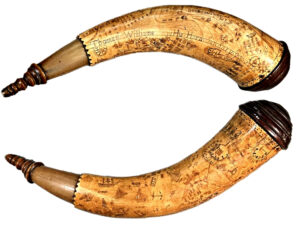
Williams left behind an engraved powder horn, now in the collection of the Stockbridge Library Museum and Archives. It shows Boston landmarks.

(This is different from the Dr. Thomas Williams powder horn recorded by Rufus Alexander Grider in 1888 and now lost.)

The siege lines around Boston contained some professional horn carvers selling their work to men who wanted souvenirs of military service. I suspect the Williams horn is one like that. As an officer and as a lawyer in civilian life, he probably didn’t have the time or inclination to do his own carving.

As Abbott’s article recounts, Williams was one of two minute company captains who responded to the Lexington Alarm from Stockbridge. The other company included a score of men from the town’s Native community and thus gets more attention.

As the troops besieging Boston organized themselves into an army enlisted through the end of the year rather than an emergency militia force, Williams became part of Col. John Paterson’s regiment. In September he volunteered for Col. Benedict Arnold’s expedition through Maine to Québec.

However, Williams was in the rear guard led by Lt. Col. Roger Enos (1729–1808), who in late October decided to turn back. That was controversial. Enos was tried and acquitted in a court-martial. He was probably lucky to go through that procedure before the army at Cambridge received “Colonel Arnolds evidence,” as Gen. George Washington reported.

Williams left Paterson’s regiment at the end of 1775, but on 9 Jan 1776 he became lieutenant colonel of a new regiment under Col. Elisha Porter to be sent up to Québec along Lake Champlain and the St. Lawrence River. This time Williams made it to the outskirts of the city, but smallpox was weakening the Continental forces.

Those Americans were trying to inoculate and fight the war at the same time. Abbott writes:
The timing for the deliberate exposure of Porter’s Regiment to smallpox could not have been worse. The inoculation process required effective quarantine for three to four weeks, during which the men were both weak and contagious. Even for those under treatment, severe cases could still develop and mortality rates under the best conditions still ran 1 to 2 percent. Porter’s men had no more than three days in hospital after they were inoculated before the siege was dramatically lifted by the arrival of a British fleet on May 6 and the American forces were soon driven back upriver in full retreat. Not only were they exposed to physical stress while they developed smallpox symptoms, but they became a significant vector for the spread of the disease to others in its more deadly form.
The American commander, Gen. John Thomas, died on 2 June. Lt. Col. Williams led his men back to Crown Point, New York, before falling ill. He didn’t make it home to Stockbridge.

Williams doesn’t appear to have left behind his own diary or letters—his powder horn might have been his only personal record of military service, and it probably wasn’t his own creation. Abbott has therefore done the work of reconstructing his career by weaving together official records and other officers’ accounts.

Saturday, March 22, 2025

Anderson on Rebellion 1776 in Cambridge, 1 Apr.

Laurie Halse Anderson’s latest novel about the American Revolution is set in Boston: Rebellion 1776.

Anderson has won awards for her Seeds of America Trilogy (Chains, Forge, and Ashes), as well as her earlier novel Fever 1793 and the picture book Independent Dames: What You Never Knew about the Woman and Girls of the American Revolution.

She’s even better known for her contemporary novel Speak, which is frequently challenged in public schools and libraries because it addresses the problem of rape. She’s one of the handful of American authors who have won the Astrid Lindgren Memorial Award for children’s literature.

In an interview with Publishers Weekly, Anderson described the scope of this new book:
My book covers the traumatic effects of the Siege of Boston, the growing political divide within families and communities, and the frightening smallpox epidemic, which threatened everything. One reason I continue to write about this era is because I think we could do a better job depicting the state of the colonies at the start of the Revolution in recognizing that independence was not a done deal.
As a protagonist Anderson created a thirteen-year-old girl named Elsbeth Culpepper, orphaned but taking advantage of the chaos and need for labor in Boston after the British evacuation to keep herself away from the Overseers of the Poor.

Anderson’s long conversation with Horn Book editor Roger Sutton goes deep into her research and storytelling processes:
First I had to understand what the cultural, financial, and sociological constraints were then on a thirteen-year-old kitchen maid. But then came the chaos of the siege, then the changing of the armies, and then it took a while for Boston's government to get up and running again. That chaos opened the door for me and my character to break some rules, some constraints. And then as society gets its act back together, the walls and rules come back up again.
I recommend that interview for anyone writing historical fiction.

Anderson will be speaking and signing books at a ticketed event for Porter Square Books on Tuesday, 1 April. That will happen at the Marran Theater in Cambridge. Admission is $25 (which includes a signed book) or $10 (which doesn’t).

Sunday, February 23, 2025

“The Measles coming into the Town”

In 2015 the medical journal Emerging Infectious Diseases published David M. Morens’s article “The Past Is Never Dead—Measles Epidemic, Boston, Massachusetts, 1713.”

It quoted extensively from the diary of the Rev. Dr. Cotton Mather, and I’ll quote from those extracts.
[18 Oct] …The Measles coming into the Town, it is likely to be a Time of Sickness…

[24 Oct]… [in the past week] my Son Increase fell sick…

[27 Oct] My desirable Daughter Nibby, is now lying very sick of the Measles…

[30 Oct] This day, my Consort, for whom I was in much Distress, lest she should be arrested with the Measles which have proved fatal to Women that were with child, after too diligent an Attendance on her sick Family, was… surprized with her Travail [went into labor]… [and] graciously delivered her, of both a Son and a Daughter… wherein I receive numberless Favors of God. My dear Katy, is now also down with the Measles…

[1 Nov] Lord’s Day. This Day, I baptized my new-born twins… So I called them, ELEAZAR and MARTHA….

[4 Nov] In my poor Family, now, first, my Wife has the Measles appearing on her…

My Daughter Nancy is also full of them…

My Daughter Lizzy, is likewise full of them…

My Daughter Jerusha, droops and seems to have them appearing.

My Servant-maid, lies very full and ill of them.

[5 Nov] My little son Samuel is now full of the Measles….

[7 Nov]… my Consort is in a dangerous Condition, and can gett no rest... Death… is much feared for her… So, I humbled myself before the Lord, for my own Sins... that His wrath may be turned away…

[8 Nov] …this Day we are astonished, at the surprising Symptomes of death upon [my wife]… Oh! The sad Cup, which my Father has appointed me!... God enabled her to Committ herself into the Hands of a great and good Savior; yea, and to cast her Orphans there too…

I pray’d with her many Times, and left nothing undone…

[9 Nov] between three and four in the Afternoon, my dear, dear, dear Friend expired…. [I] cried to Heaven…

[10 Nov] …I am grievously tried, with the threatening Sickness of my discreet, pious, lovely Daughter Katharin.

And a Feavour which gives a violent Shock to the very Life of my dear pretty Jerusha.

[11 Nov] This day, I interr’d the earthly part of my dear consort…

[14 Nov] This Morning… the death of my Maid-servant, whose Measles passed into a malignant Feaver…

Oh! The trial, which I am this Day called unto in… the dying Circumstances of my dear little Jerusha!

The two Newborns, are languishing in the Arms of Death…

[15 Nov] … my little Jerusha. The dear little Creature lies in dying Circumstances. Tho’ I pray and cry to the Lord… Lord she is thine! Thy will be done!...

[18 Nov] …About Midnight, little Eleazar died.

[20 Nov] Little Martha died, about ten a clock, A.M.

I begg’d, I begg’d, that such a bitter Cup, as the Death of that lovely [Jerusha], might pass from me…

[21 Nov] …Betwixt 9 h. and 10 h. at night, my lovely Jerusha Expired. She was 2 years, and about 7 months old. Just before she died, she asked me to pray with her; which I did… and I gave her up unto the Lord. [Just as she died] she said, That she would go to Jesus Christ…

[23 Nov] …My poor Family is now left without any Infant in it, or any under seven Years of Age…
In 1757 Dr. Francis Home of Edinburgh determined that measles was caused by a pathogen. Unfortunately, he did this by using blood from one person with measles to infect others. He then tried to inoculate against the disease using the same technique as with smallpox, but measles doesn’t work the same way.

Not until 1963 did scientists develop an effective measles vaccine. In the first twenty years after the U.S. government tested and licensed that technique, it was estimated to have prevented 52,000,000 cases of the disease in this country. I was among the American children to benefit from the vaccine and never catch measles.

The World Health Organization reported that between 2000 and 2022, measles vaccination averted 57,000,000 deaths worldwide. That’s a huge number of people, about the population of Italy. But through a quirk of our brains, it can be more affecting to read about the series of small deaths, one after another, in Cotton Mather’s house in 1713.

Tuesday, April 02, 2024

“Twang them at the American rebels”

Maj. Robert Donkin ran advertisements in the New-York Gazette promoting his upcoming book Military Collections and Remarks and thanking the latest subscribers from January through June 1777.

In the latter part of that year, the Gazette’s printer, Hugh Gaine, actually produced the book.

According to the accounting published inside, the print run was 1,000 copies, folded, bound, and covered.

But the book turned out to need more work.

Maj. Donkin had no good words for “this unnatural rebellion,” as his ads said. But on one page inside the book, he let his anger run away on him.

In a short section titled “Bows,” the major added this footnote:

Dip arrows in matter of smallpox, and twang them at the American rebels, in order to inoculate them; This would sooner disband these stubborn, ignorant, enthusiastic savages, than any other compulsive measures. Such is their dread and fear of that disorder!
In Pox Americana, Elizabeth Fenn analyzed this passage as showing how British officers could picture spreading smallpox among the enemy as long as they saw those people as “savages.” There had been similar talk of infecting Native Americans during the last war.

Fenn also reported that only three copies of Donkin’s book with that footnote are known to exist. One, now at the Clements Library in Michigan, belonged to Gen. Valentine Jones of the 62nd Regiment, a subscriber.

All other copies have that footnote on page 199 sliced out, as shown below in the University of California’s volume, digitized by Google and also available through the Hathi Trust.


This excision became well known among book dealers and collectors. Around 1900, catalogues describing copies of the book noted the deletion and added “as usual.”

All the copies I’ve found online are missing the footnote. Most of the excisions are neater and more complete than the one I’m showing here. For instance, through this page one can find the American Revolution Institute’s volume. Another copy on Google Books shows how the British Library staff patched the hole with blank paper.

The thoroughness and neatness of the footnote’s removal suggests that some authority demanded that Donkin and Gaine delete it. Soon after the major started to distribute the book, it appears, someone had to go through every remaining copy with a sharp blade. That certainly took more time, and probably more money.

Fortunately, the other side of that page was blank in that spot, so those copies didn’t lose any other text.

In fact, it appears that subscribers and purchasers of the censored version got something extra.

TOMORROW: He is their hero.

Friday, March 29, 2024

New Collection from the Journal of the American Revolution

Next month Westholme Publishing will issue The Journal of the American Revolution Annual Volume 2024, edited ably once again by Don N. Hagist.

This webpage about the book says it will contain two articles by me.

In fact, the book will have only one article from me. That’s because I combined my two web articles about the confounding Samuel Dyer into one complete study.

This volume offers many other articles about Revolutionary New England, including:
  • Remember Baker: A Green Mountain Boy’s Controversial Death and Its Consequences by Mark R. Anderson
  • John Hancock’s Politics and Personality in Ten Quotes by Brooke Barbier
  • Mercy Otis Warren: Revolutionary Propagandist by Jonathan House
  • Captain James Morris of the Connecticut Light Infantry by Chip Langston
  • Smallpox Threatens an American Privateer at Sea by Christian McBurney
  • John Adams and Nathanael Greene Debate the Role of the Military by Curtis F. Morgan, Jr.
  • The Perfidious Benjamin Church and Paul Revere by Louis Arthur Norton
  • The Highs and Lows of Ethan Allen’s Reputation as Reported by Revolutionary-Era Newspapers by Gene Procknow
  • Captain Luke Day: A Forgotten Leader of “Shays’s Rebellion” by Scott M. Smith
  • Engaging the Glasgow by Eric Sterner
(My apologies to the authors of any other relevant articles I missed.)

And there are of course lots of articles about the American Revolution in, you know, other places.