J. L. BELL is a Massachusetts writer who specializes in (among other things) the start of the American Revolution in and around Boston. He is particularly interested in the experiences of children in 1765-75. He has published scholarly papers and popular articles for both children and adults. He was consultant for an episode of History Detectives, and contributed to a display at Minute Man National Historic Park.

Subscribe thru Follow.it


•••••••••••••••••


Showing posts with label John Cotton. Show all posts

Thursday, December 31, 2020

“A determination to discourage a faithful Servant of the Crown”

For acting governor Thomas Hutchinson, the dispute between his Council and the provincial secretary Andrew Oliver was yet one more headache in 1770.

On 28 September, Hutchinson told the departed but still official governor, Sir Francis Bernard: “[Royall] T[yle]r is sowered by that deposition of the Secretarys which was published in England and it has hurt me every way.” (Bernard had been responsible for that publication, at least in part, but Hutchinson didn’t let on that he suspected that.)

Writing to John Pownall, an official in the Colonial Office, two days later, Hutchinson was more careful to avoid suggesting the controversy had hurt his effectiveness:
The Council except a few are…very friendly to me though there is some abatement of their friendship since the deposition of the Secretary taken by my order relative to the Affair of the Troops has been published. These publications & the sufference of the Letters to the Ministry of which a fresh parcel was sent by the last Ship to be made publick do infinite disservice.
Ironically, Hutchinson was just as upset about leaks as the Council—just different leaks.

There was also a private dimension to this dispute. On 10 October, while the Council was in the midst of collecting the depositions I quoted over the past couple of days, the acting governor’s son Thomas, Jr., married Sally Oliver, daughter of the secretary.

The families were already related by marriage. Thomas Hutchinson and Andrew Oliver had married sisters. In February 1770, Hutchinson’s daughter Sarah married Dr. Peter Oliver, son of Andrew Oliver’s brother Peter.

All three of those men were royal appointees. Thomas Hutchinson was lieutenant governor, thus acting governor, and also chief justice of Massachusetts. Andrew Oliver was secretary and was supposed to have been the stamp agent. Peter Oliver was a judge. Furthermore, other relatives were in the provincial government. John Cotton, the deputy secretary, was half-brother to the sisters who had married Hutchinson and Andrew Oliver. And Hutchinson had been trying to get his nephew Nathaniel Rogers appointed provincial secretary before the young man died.

Of course, there were family alliances on the other side of the political divide as well. James Bowdoin, the principal author of the complaint against Oliver, was a son-in-law of fellow Councilor John Erving, brother-in-law of fellow Councilor James Pitts, and father-in-law of Customs Commissioner John Temple, whom other royal appointees regarded as a snake.

Eighteenth-century society ran on such familial connections. People expected officials to look out for their relatives, and officials expected their relatives to be loyal assistants in government. Neither side was pure in this regard, and both sides complained about the other using family ties too much.

On 30 October, Hutchinson summed up his view of the controversy over Oliver’s description of the Council meeting in another letter to Pownall:
Unfortunately it has got published. Mr. Tyler denied that he made any mention of the Commissioners. I am sure I heard it from him but could not be certain whether that Day or a day or two before. Three or four Witnesses present swore, they heard it that Day. All the Council say they do not remember it.

They have not however directly charged the Secretary with false swearing but to a long Narrative drawn up by Mr. Bowdoin there is added divers Resolves declaring him guilty of a Breach of trust in taking the Minutes &c. The whole is a weak but malicious injurious performance which they have ordered to be recorded. . . .

I gave them my Opinion that these Resolves would be more resented than any thing which preceeded them as they plainly indicated a determination to discourage a faithful Servant of the Crown from doing his Duty as far as lay in their power.

These proceedings I hope will not pass without censure either in [privy] Council or when the State of the Province comes before the Parliament. Such a censure would mortify the party and being made matter of Record here would remove the reproach which otherwise will be transmitted to posterity upon the Secretarys Character.
In fact, the London government was already preparing to reward Andrew Oliver for his service. When Hutchinson officially became the royal governor, Oliver was promoted into his brother-in-law’s spot as lieutenant governor. And in 1772 Peter Oliver succeeded Hutchinson as chief justice.

(Hutchinson’s 1770 letters will appear in the Colonial Society of Massachusetts’s next collection of his correspondence, scheduled to be published in the new year.)

Tuesday, December 29, 2020

The Massachusetts Council Investigates Itself

Yesterday we left off as provincial secretary Andrew Oliver’s sworn statement about what members of the Massachusetts Council had said on the day after the Boston Massacre made its way back to Massachusetts.

That statement was the final item in A Fair Account of the Late Unhappy Disturbance at Boston, published in London. Capt. James Scott, who worked for John Hancock, carried a copy of that pamphlet to Boston. Edes and Gill printed Oliver’s deposition without comment in the 24 September Boston Gazette.

The Whigs quickly leapt to the conclusion that Oliver’s description of the 6 March Council meeting was the latest move by royal appointees to misrepresent the province as rebellious.

And in a way they were right—the statement and its publication were part of a campaign by high officials. As Lt. Gov. Thomas Hutchinson later wrote (modestly referring to himself in the third person), they wanted to be sure the London government understood what they were dealing with:
he asked the secretary to recollect, as well as he could, what passed in the debate at council, and to commit it to writing, intending to send it to England, to shew in the fullest manner the reasons for the lieutenant governor’s complying with their advice, and not with any intention to set the council in general or any particular member, in an unfavourable light.

The secretary informed him, that, of his own mere motion, and for his private satisfaction, he had done it the evening before, while the debates were fresh in his mind.

After he had transcribed and corrected the minutes, he made oath to them; and they were transmitted at the same time with the copies of the votes or minutes of council, and other papers relative to the transaction, not to the secretary of state, but to governor [Francis] Bernard, who, at that time, continued governor of the province.
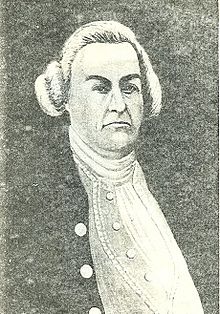
Oliver (shown above) made his oath before justice of the peace Foster Hutchinson, the acting governor’s cousin. 

Soon after the pamphlet arrived, the Massachusetts General Court started a new legislative session in Cambridge, with the Council meeting in Harvard’s Philosophy Chamber. On 4 October, the Council took up Oliver’s statement:
ONE of the Members of the Board having acquainted the Board that he had seen a Deposition signed Andrew Oliver, which was published in the Appendix to a Pamphlet lately printed in London; in which Deposition divers Gentlemen of the Council, which consisted of 8 Members then present, therein said to be convened on the 5th Day of March last, are represented as having made such a Declaration to His Honor the Lieutenant-Governor, respecting a plan formed by the People to remove the King’s Troops and the Commissioners of the Customs from the Town of Boston, as was likely to be attended with the most pernicious Consequences to this Province—He thereupon moved that the Board would make Enquiry of the Gentlemen of which said Council consisted, what Foundation there was for such a representation—

Which motion being seconded, the Board desired said Gentlemen, namely, Mr. [Samuel] Danforth, Mr. [John] Erving, Mr. [Thomas] Hubbard, Mr. [Harrison] Gray, Mr. [James] Russell, Mr. [Royall] Tyler, Mr. [James] Pitts, and Mr. [Samuel] Dexter, to prepare a true State of the Matter and lay the same before the Board as soon as may be.
Those were the eight Council members present at the 6 March meeting. Oliver had named five of them in his account. (To be exact, he had named three and referred to two more by title, and the London pamphlet had helpfully identified them in footnotes.)

The next day, Oliver asked for a chance to respond and to call witnesses to support his account of the discussion. The Council therefore accepted evidence on 9 October from Capt. Benjamin Caldwell of H.M.S. Rose, Lt. Col. William Dalrymple of the 14th Regiment, deputy secretary John Cotton, and clerk Francis Skinner.

All those witnesses basically agreed with Oliver’s description of what Royall Tyler had said about the town and countryside being angry enough to attack the troops if the governor didn’t remove them, and to drive the Customs Commissioners out of Boston as well. They also agreed that no other members of the Council had objected to Tyler’s statement.

Councilors bore down on Cotton and Skinner about one important detail. When Tyler said of the Whigs, “they had formed their plan, and that this was a part of it to remove the troops out of town, and after that the commissioners,” did he let slip news of a plan predating the Massacre? No, said those provincial employees; they didn’t think Tyler’s mention of a ”plan” on 6 March necessarily referred to any planning more than a day old.

TOMORROW: The Councilors’ contentions.

Thursday, May 24, 2018

“One of the leaders of the Disaffected in this town”

In May 1768, as I quoted yesterday, Boston’s town meeting took a stand against letting the Commissioners of Customs dine in Faneuil Hall on Election Day. If Gov. Francis Bernard wanted to invite those tariff-collecting officials to the day’s traditional dinner, he’d have to find somewhere else to dine.

One Bostonian was in an even sharper feud with the Customs service that spring: John Hancock. I’ll save the meat of their dispute for an anniversary next month. For now, I’ll simply say that Hancock had declared that he wouldn’t participate in any dinner that involved the Customs Commissioners. That meant not joining the usual military escort for the governor as an officer in the Company of Cadets, the province’s most prestigious militia company.

On 12 May the Commissioners complained about the situation in a letter to London, as Neal Nusholtz quoted in this article at the Journal of the American Revolution:
We cannot omit mentioning to your Lordships that Mr. Hancock before named is one of the leaders of the Disaffected in this town, that early in the Winter he declared in the General Assembly that he would not suffer our officers to go even on board any of his London Ships and now he carries his opposition to Government to even a higher pitch.

Being Major of his company of Cadets which distinguished itself in the year 1766 [actually September 1765] by putting a stop to the riots, and it being usual for the Governor to invite all the servants of the Crown to Dine with him on the Day of their general election, which happens on the 25th instant, a Majority of his Corps met together a few days ago and came to a resolution to acquaint the Governor, that they would not attend him on that occasion as usual if he invited the Commissioners of the Customs to dine with him, and this being signified to His Excellency, he answered that he would enter into no stipulation with them, and positively required their attendance.
Gov. Bernard liked the Cadets because they had helped keep the peace after the worst Stamp Act riot. He had given the company commander, Leonard Jarvis, some very good introductions before he sailed to London in late 1767. Now the governor summoned the acting commander, Lt. Col. Joseph Scott. (Scott took over formally in 1769. He makes a notable appearance in The Road to Concord because he was an ironmonger who sold artillery ordnance.)

According to a detailed account signed “Marmaduke Myrmidon” and published in the 9 May Boston Gazette, Gov. Bernard told Scott that the Cadets’ disrespect for his office “would tend to anarchy and confusion, and erase the very shadow of military discipline.” He ordered Scott to summon the entire company and ask each man in turn if he would report on Election Day. If anyone said no, the lieutenant colonel should respond that “the G[overnor] thank’d him for his past services, and dismiss’d him from any further employment.”

The Cadets balked at the governor’s demand. The Gazette article said “a very few” promised to attend, “some” said they wouldn’t, and most refused to answer either way. The Customs Commissioners said, “Mr. Hancock thereupon tore the seal off his Commission, and all the rest of the Company except nine Declared they would not continue any longer in the service.”

On 12 May, the same day as the Commissioners’ letter, the bulk of the Cadets met without Scott. They talked about replacing him with a commander they preferred. The next day those men sent a committee out to Gov. Bernard’s home in Jamaica Plain to tell him of their preference. The day after that, the governor’s secretary, John Cotton, replied that the ex-Cadets were just piling one affront on top of another. (“Marmaduke Myrmidon” would publish Cotton’s note in the 23 May Gazette.)

However, at the end of that week, with Election Day coming closer, men moved to patch things up. On 18 May, Cotton wrote to Hancock “conveying the Governor's displeasure at the unlawful assembly of the Cadets and Hancock after the latter’s dismissal” but opening the door to a dialogue. (That description comes from the catalogue of the Cadets’ papers at Boston University.) Bernard was willing to meet and clear up misunderstandings—as long as there was a witness present. At noon on Sunday, 22 May, Council member Thomas Flucker invited Hancock to come to his house “immediately after sunset” to meet with the governor.

On 23 May, the Boston town meeting confirmed their vote against letting Gov. Bernard use Faneuil Hall for any dinner involving the Customs Commissioners. Later that day, the Boston Evening-Post carried a two-paragraph announcement from Joseph Scott, desiring “The Gentlemen of the Cadet Company under my Command” to report that evening and the next at Faneuil Hall, presumably for drill and inspection, and then to gather “at the usual Place of Parade” at 9:00 A.M. on Wednesday—Election Day.

TOMORROW: Election Day at last.

Saturday, October 24, 2015

The End of the Stamp Act Congress

By 24 Oct 1765, the Stamp Act Congress had revised and approved its three petitions to different parts of the British government, as described a couple of days back.

But delegate Robert Ogden (1716-1787) of New Jersey argued that the congress shouldn’t send those documents to London. Rather, he said, each delegation should bring them back to their colonial legislature for their colleagues to amend, approve, and then send across the Atlantic. Which wouldn’t really present a united front against the Stamp Act.

As speaker of the New Jersey house, Ogden had at first been reluctant to authorize any participation in the congress at all. Apparently under pressure from colleagues, he had presided over a special meeting to choose delegates without the authorization of Gov. William Franklin. When he put himself on the list, he probably hoped to steer the process.

Ogden’s late suggestion that the congress lacked legitimacy on its own made people accuse him of foot-dragging. By 2 November, Robert R. Livingston of New York wrote, the New Jersey speaker was “burnt in Effigy in almost all the Towns of East Jersey.” Ogden would resign his legislative seat by the end of that month.

The other delegates stuck with their original plan to send the petitions to London directly. They also voted to recommend “to the several colonies to appoint special agents for soliciting relief from their present grievances, and to unite their utmost interest and endeavors for that purpose”—in other words, a joint lobbying effort. Both those actions were tentative steps toward continental unity.

The only other recorded business on 24 October was an order for clerk John Cotton to sign his sparse record of the congress and arrange for it to be printed and distributed to the colonial legislatures. At least, that was the only business that actually got printed. (As a result, some accounts say the congress ended on that date.) Handwritten transcripts of the proceedings sent to the Maryland legislature and other contemporaneous documents indicated that the congress also met on the following day, 25 Oct 1765, to sign the petitions.

But even that wasn’t simple. For one thing, the New York delegation said that they shouldn’t sign the petitions (which some of them had helped to draft, and which listed “New-York” among the participating colonies) since their legislature hadn’t chosen them in an official session. As I said before, the men from Connecticut and South Carolina had already dropped out for similar reasons. The congress settled for having the documents “signed by such of the members as thought proper.”

That group didn’t include Robert Ogden. And then the congress’s chairman said he wouldn’t sign, either.

TOMORROW: Timothy Ruggles’s challenge.

Monday, October 19, 2015

“It is the indispensable duty of these colonies”

By 19 Oct 1765, the Stamp Act Congress had been meeting and debating for over a week and a half. What sort of debate did they have? We have no idea. Clerk John Cotton’s record reads like this:
Wednesday, Oct. 9th. 1765, A.M. — Then the congress met according to adjournment. The congress resumed the consideration of the rights and privileges of the British American colonists, &c, the same was referred after sundry debates, for further consideration.

Then the congress adjourned until to-morrow morning, 11 o’clock.

Thursday, Oct. 10th, 1765, A.M. — Then the congress met according to adjournment, and resumed, &c, as yesterday — and then adjourned to 10 o’clock, to-morrow morning.
Repeat the entry for 10 October verbatim for the 11th, 12th, 13th, and so on through the 18th. (The delegates took Sunday the 15th off.)

Then a breakthrough on the 19th!
The congress met according to adjournment, and resumed, &c. as yesterday; and upon mature deliberation, agreed to the following declaration of the rights and grievances of the colonists in America, which were ordered to be inserted.
That Declaration of Rights and Grievances was drafted by John Cruger (1710-1791, shown above), mayor of New York and speaker of the New York assembly. The document had thirteen points, but the argument was basically threefold:
  • British colonists had the same rights as people in Britain itself.
  • Those rights included not being taxed without the consent of their own legislature, rendering the Stamp Act unconstitutional.  
  • And besides, the Stamp Act hurt the American economy and thus the whole empire.
The declaration concluded:
Lastly, That it is the indispensable duty of these colonies to the best of sovereigns, to the mother country, and to themselves, to endeavor, by a loyal and dutiful address to his majesty, and humble application to both houses of parliament, to procure the repeal of the act for granting and applying certain stamp duties, of all clauses of any other acts of parliament, whereby the jurisdiction of the admiralty is extended as aforesaid, and of the other late acts for the restriction of the American commerce.
In other words, by opposing the Stamp Act in every way, the men at that congress and elsewhere in America weren’t really defying the king, Parliament, and the British constitution. They were standing up for that system, “protestant succession” and all. It was even their duty to get the Stamp Act repealed! This remained the basis of American Whig thinking right up through the beginning of the war.

Some pre-war Whigs, such as John Cruger himself, never made the jump to believing that the only way to preserve the principles underlying that British constitution was to break with Britain entirely. He voted against the proceedings of the First Continental Congress in 1774 and soon retired from politics, sitting out the war in Kinderhook.

COMING UP: Three messages to Great Britain.

Thursday, October 08, 2015

The Choice between Ruggles and Otis

One of the first acts of the Stamp Act Congress when it convened in New York in October 1765 was to elect a chairman.

Arguably, that was the first political office to derive its authority from the thirteen colonies that would form the U.S. of A. eleven years later. Even if only nine of them had actually sent delegates to that congress, the others (plus Nova Scotia) at least got an invitation.

The winner of the vote was Timothy Ruggles (1711-1795, shown here), brigadier in the Massachusetts militia. According to the New York merchant John Watts, writing to a friend:
Brigr. Ruggles is Chairman, [James] Otis aimed at it and would have succeeded but they thought as he had figured much in the popular way, it might give their meeting an ill grace, but it is observed Otis is now a quite different man, and so he seems to be to me, not riotous at all.
Nearly forty years later, delegate Thomas McKean of Delaware recounted his version of events to John Adams, starting:
In the congress of 1765 there were several conspicuous characters: Mr; James Otis appeared to me to be the boldest and best speaker.—I voted for him as our President, but Brigadier Ruggles succeeded by one vote, owing to the number of the committee from New-York, as we voted individually
The record of the Stamp Act Congress states that the delegates chose Ruggles, and suggests the vote wasn’t unanimous, but it doesn’t mention any other candidates or any vote count. No delegates kept diaries or sent gossipy letters that have survived. Thus, there’s no contemporaneous evidence to confirm or refute McKean’s recollection. (More on his claims to come.)

As its clerk, the congress chose John Cotton (1728-1775), who was deputy secretary of the province back in Massachusetts, as well as registrar of wills in Suffolk County. Cotton was also half-brother to Lt. Gov. Thomas Hutchinson’s late wife and to the wife of former stamp agent Andrew Oliver, who was also his boss in the secretary’s office. In 1770 Hutchinson called Cotton “attached to Government and serviceable so far as his Sphere would permit.” He continued to hold offices in the royal bureaucracy until he died of the flux inside besieged Boston.

Cotton’s record of the congress is very spare, recording only the actions the body agreed to and not the preceding proposals, debates, and amendments. As their first procedural decision, later that first day, the delegates decided that each colony should have one vote, a precedent that remained for the Continental Congress of the 1770s. If McKean’s memory was accurate, then that form of voting would have made Otis the chairman instead of Ruggles.