J. L. BELL is a Massachusetts writer who specializes in (among other things) the start of the American Revolution in and around Boston. He is particularly interested in the experiences of children in 1765-75. He has published scholarly papers and popular articles for both children and adults. He was consultant for an episode of History Detectives, and contributed to a display at Minute Man National Historic Park.

Subscribe thru Follow.it


•••••••••••••••••


Showing posts with label Isaiah Thomas. Show all posts

Thursday, August 06, 2026

Hopestill Capen from the Cornfields to the Jail

On 6 Aug 1776, 250 years ago today, authorities in Boston locked merchant Hopestill Capen (1731–1807) in jail for “aiding and abetting those called enemies to the Colonies.”

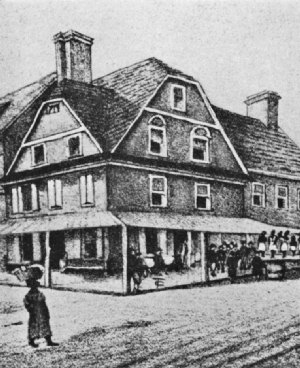
For decades Capen had run his dry goods business at the sign of the Cornfields in a building he owned, now known as the Union Oyster House. He served as a militia officer and held minor town offices.

Late in 1769 Capen took on Benjamin Thompson as an apprentice, but that arrangement didn’t last long. The merchant later reportedly told the teenager’s mother “he oftener found her son under the counter, with gimblets, knife, and saw, constructing some little machine, or looking over some book of science, than behind it, arranging the cloths or waiting upon customers.”

from 1771 until just before the war, one of Capen’s tenants in the building was the Whig printer Isaiah Thomas.

During that time, Capen had become known as a mild Loyalist. He signed the complimentary addresses to Gov. Thomas Hutchinson and Gen. Thomas Gage, and he joined the protest against the Solemn League and Covenant.

Capen chose not to evacuate with the British military in 1776, however. Unlike many Loyalists, he had deep family roots in Massachusetts, and all his property was there.

In April 1776 the Massachusetts House directed the Suffolk County justices and sheriff to detain and question dozens of individuals suspected of disloyalty. Capen was fifth on that list, showing his prominence in town.

But it wasn’t until the summer, after Massachusetts had declared independence from the Crown, that the Council ordered those authorities to lock Capen up. No one ever appears to have ever produced evidence of him “aiding and abetting” Crown forces, but he did refuse to pledge allegiance to the new state.

Capen presented himself as a conscientious objector, motivated by religion. In the 1760s he had joined Boston’s small Sandemanian sect, and he said that his faith required him to stay out of the war.

Some analysts have described the Sandemanians as pacifist because of statements like Capen’s. But he wasn’t opposed to military action in principle. He’d been an active member of the Ancient and Honorable Artillery Company as well as the colonial militia, and during the siege he became a sergeant in a Loyal Associated Volunteers under Capt. Adino Paddock.

Rather, the Sandemanian creed said believers should be loyal to the government in control on the grounds that it must be divinely ordained. With the war still going on, and thus divine will not yet clear, Capen insisted that he couldn’t promise his allegiance to the U.S. of A.

Tuesday, May 12, 2026

Finding Mary Fowle of Londonderry

Yesterday I cited Jane Merrill’s Sex and the Scientist: The Indecent Life of Benjamin Thompson, Count Rumford (1753–1814), the latest and frankest biography of the scientist, statesman, soldier, and seducer.

That book quotes testimony from Mary Fowle of Londonderry, New Hampshire, about how Thompson had an affair with Mary (Dill) Thomas, first wife of the Boston printer Isaiah Thomas.

Merrill distinguishes that woman from the Mary Fowle whom Isaiah Thomas married in 1779, whom she identifies as both the printer’s cousin and the widow of his old master, Zechariah Fowle.

Isaiah Thomas’s second wife named Mary was indeed a cousin, having been born Mary Thomas on 9 June 1750, according to genealogy published in “The Portraits of Isaiah Thomas” by Charles Lemuel Nichols.

However, that cousin Mary didn’t marry Zechariah Fowle. Her mother, Rebecca (Bass) Thomas, did. The older printer died in Portsmouth in 1776. Rebecca (Bass Thomas) Fowle, twice widowed, died in Worcester in 1803 and was buried in her son-in-law’s family tomb.

So who was Mary Thomas’s first husband? Boston vital records show that the Rev. John Lathrop married Isaac Fowle and Mary Thomas on 11 May 1769. The Thomas and Fowle family genealogies say they had two daughters, who both died young:
  • Rebecca T[homas?]. (4 Feb 1770–6 Dec 1773 in New York)
  • Dorothea Whitmarsh (5 Nov 1771–10 Sept 1772)
Isaac Fowle reportedly died in 1777 while serving in the Continental Army.

That same year, Isaiah Thomas leased his financially stressed press and newspaper to his come-of-age apprentice, Anthony Haswell, and moved with his children to “a small farm in Londonderry, New Hampshire,” according to the biography published with the second edition of his History of Printing in North-America. He also initiated a divorce from his first wife.

A couple of years later, Isaiah came back and took over the print shop again. Worcester’s vital records state that on 26 May 1779 Isaiah Thomas married “Mary Fowle of Londonderry” in Boston. Since 1777 he had been a divorcĂ© with three children, his cousin Mary had been a childless widow, and there was a war on. Mary might well have been keeping house for Isaiah in New Hampshire even before they married.

Thus, the Mary Fowle of Londonderry who provided testimony for Isaiah Thomas in his divorce case in 1777 was:
  • his cousin
  • a stepdaughter of his former master
  • his future wife
Isaiah and Mary (Thomas Fowle) Thomas had no children. She died at Worcester in 1818, and he remarried again the next year. The picture above is the pastel portrait of Mary in the collection of the American Antiquarian Society.

Monday, May 11, 2026

“Not playing cards but fondling and kissing each other”

In preparation for tomorrow’s talk about Benjamin Thompson’s early years, I’ve been reviewing the evidence of his affair with Mary (Dill) Thomas, wife of printer Isaiah Thomas.

When Isaiah moved to divorce Mary in 1777 by petitioning the Massachusetts Council, he submitted testimony from several people who had seen his wife traveling with the militia major from New Hampshire in February 1775, behaving like man and wife.

The printer’s file also offered an affidavit from Mary Fowle of Londonderry, New Hampshire, who had stayed with the Thomases in Boston from 20 Sept 1774 to 16 April 1775.

In Sex and the Scientist, Jane Merrill quotes Fowle describing how “Major Thompson [was] then a refugee in Boston who borded in a house opposite.” Mary Thomas started visiting him several times a day even though (or because) she had two children under the age of three.

One Saturday the printer’s wife “dressed herself, shifting her Linen, which I knew was not her custom,” said her house guest. Mary Thomas came home with “a small piece of parchment, on which a Lady’s face had been drawn with a black lead pencil. . . . the Major had taken much pains with it.”

Soon Mary Thomas visited Thompson’s ”bed-chamber, where they staid the whole afternoon and part of the evening.” Fowle stated, “I could not but think there was more intimacy between them than I before tho’t of.” She observed the couple “kissing each other, laying in each others laps, speaking fondly of each without regarding me.”

One day Isaiah came home from business after his wife had gone to play cards with Maj. Thompson. Mary Fowle and a household servant went across to fetch her. They found the couple “not playing cards but fondling and kissing each other, she often laying her head on the Major’s shoulder, and their arms round each other.”

As if that wasn’t clear enough, in February 1775 Mary Thomas insisted on taking that trip to Newbury with Maj. Thompson, first having her hair “in the greatest taste much powdered.” Later the printer gathered testimony from several innkeepers about that journey. At the time, however, he just seems to have felt trapped.

On one Sunday, Isaiah Thomas and Mary Fowle went to church. When they came home, his daughter Mary Ann, who turned three years old that March, showed them a “copper” that Maj. Thompson had given her to go into another room. Fowle stated the little girl said, “The major kissed her Mama and felt her bosom.” In response, little Mary Ann’s mother told her she was lying and threatened to whip her.

Isaiah finally demanded that Mary admit to what was going on. She acknowledged having a sexual affair. And when did it start? True to Benjamin Thompson’s character, he first got into Mary Thomas’s bed right after writing a letter to his own wife back in Concord, New Hampshire.

I won’t bother asking if these marriages can be saved.

TOMORROW: Who was Mary Fowle?

Friday, December 26, 2025

“The Powder Alarm” in Essex, Connecticut, on 4 Jan.

I’ll start off the Sestercentennial year with a talk in the America 250 Winter Lecture Series of the historical society in Essex, Connecticut.

My topic on the afternoon of Sunday, 4 Jan 2026, will be “The Powder Alarm: The Breakdown of Royal Rule in New England, September 1774.”

Here’s our event description:
Before dawn on September 1, 1774, the royal governor of Massachusetts ordered some of the colony’s gunpowder moved into army-occupied Boston. That action put thousands of militiamen on the march. As rumors spread, they grew more dire. People in Connecticut heard that the king’s army and navy had attacked Boston. In Milford, a 13-year-old boy went to bed fearing he would “be dead or a captive before to-morrow morning.” But the real result of this event, dubbed the “Powder Alarm” by later historians, was that almost all of New England was free of royal rule—almost two years before the Declaration of Independence.
I’ve spoken about the “Powder Alarm” before, and this time I’ll emphasize Connecticut’s experience through figures like Israel Putnam, Silas Deane, and Joseph Plumb Martin.

Here’s an account of the colony’s reaction from the 8 Sept 1774 Massachusetts Spy:
By letters from Connecticut, and by several credible gentlemen arrived from thence, we are informed that there were not less than 40,000 men, in motion, and under arms, on their way to Boston, on Saturday, Sunday, and Monday last [3–5 September], having heard a false report that the troops had fired upon Boston, and killed several of the inhabitants: Twelve hundred arrived at Hartford from Farmington, and other places forty miles beyond Hartford, on Sunday last, on their way to this place, so rapidly did the news fly. But being informed by expresses that it was a false report, they returned home, declaring themselves ready at a minute’s warning to arm again, and fight for their country, and distressed brethren of Boston.
That report from printer Isaiah Thomas was no doubt exaggerated. In 1774 Connecticut’s total population was just under 200,000. More than half of those people were under the age of sixteen, and half the adults were women, so “no less than 40,000 men” would be virtually the entire adult male population.

Nonetheless, it’s clear the alarm was widespread, reflecting the urgency that people had come to feel about what was happening in Massachusetts. Several other newspaper articles about the “Powder Alarm” also included the phrase “a minute’s warning,” popularizing it just as citizens were discussing how to improve their militia system.

This talk is scheduled to run from 3:30 to 4:30 P.M. in Hamilton Hall at Essex Meadows, 30 Bokum Road in Essex, Connecticut. It’s free and open to the public. The society asks people to register through this page. Doors will open at 3 P.M., and seating will be on a first-come, first-served basis.

(The modern town of Essex appears on the map above as “Putty Pogue” on the Connecticut River.)

Wednesday, October 22, 2025

“To open his EVENING-SCHOOL, as usual”

Isaiah Thomas and Henry-Walter Tinges launched the Essex Journal newspaper in Newburyport in 1773.

Among its advertisers was town schoolmaster John Vinal, offering private lessons in a broad range of subjects. His notice on 5 Oct 1774 said:

JOHN VINAL,
INTENDS to open his EVENING-SCHOOL, as usual at the NORTH-SCHOOL the 10th Instant, for Writing and the several practical Branches of the Mathematics, enumerated in a former Advertisement of his.
Alas, I haven’t found that “former Advertisement.” 

On 15 Mar 1775 Vinal was more expansive:
JOHN VINAL,
ACQUAINTS his Friends that he intends to begin his private School for Youth of both Sexes, on Monday the third of April next at 11 o’Clock A.M. in the room he improved the last Summer, nearly opposite Mr. Davenport’s Tavern, and from 5 to 7 o’Clock, P.M. at the Town School House for those who can best attend in the Afternoon.

N.B. The Said VINAL has a very genteel BOWFAT, with a Glass Door to dispose of, very cheap, for almost any Pay that will suit the Purchaser.
A what now?

A week later the same ad ran again except the item offered for sale was “a very genteel BUFFET, (commonly pronounced Bowfat,) with a Glass Door.”

Ah.

Dr. Samuel Johnson’s dictionary defined a buffet this way:
Buffet. n.s.  [buffette, Fr.] A kind of cupboard; or set of shelves, where plate is set out to shew, in a room of entertainment.
The rich buffet well-colour’d serpents grace,
And gaping Tritons spew to wash your face.
Pope.
”Mr. Davenport’s Tavern” referred to the tavern started by William Davenport and inherited by his sons Anthony and Moses in 1773. Its sign showed Gen. James Wolfe, so it was also called the Wolfe Tavern.

Vinal’s eagerness to sell that genteel piece of furniture suggests a need for quick cash. Of course, he often seems to have wanted extra cash. But the spring of 1775 wasn’t the best time for selling a luxury item, especially one you didn’t know how to spell.

TOMORROW: War!

Friday, May 02, 2025

“He engages in the fight which was the beginning of the end”

The printer Isaiah Thomas’s family understood him to have been very active on the first day of the Revolutionary War.

As stated in the preface to the 1874 edition of Thomas’s History of Printing in America:
He went out on the night of the 18th of April, to assist in giving notice that the troops were crossing the Charles river. He returned, but was out again by daylight. Crossing the ferry with Dr. [Joseph] Warren he went into a public meeting at Charlestown and urged the arming of the people, and was opposed by one Mr. [James?] Russell “on principles of prudence.”
Gen. Thomas Gage ordered his forces to stop anyone trying to leave Boston via the Neck or the ferry on the night of 18 April, so as to prevent the sort of “notice” Thomas supposedly spread.

Not only did the printer get out of town, this family lore said, but he then got back in. Even though one of the main points of this passage was that Thomas was on the royal authorities’ enemies list.

We know Dr. Warren did get out of Boston early on the morning of 19 April. Richard Frothingham’s 1865 biography of the doctor quoted witnesses saying he rode the ferry to Charlestown, then headed west on horseback.

We also know there was debate in Charlestown about whether to oppose the British army by force. Ultimately most of the townspeople decided to hunker down because they were too vulnerable to counterattack from the army and navy.

As to what Isaiah Thomas did in those busy hours, I’m not sure. He definitely did thrust himself into events at other times, so I’m sure he would have spread the alarm and urged opposition to the troops if he could. I’m just not sure the opportunities were available.

For a couple of paragraphs, the 1874 account slips into a breathless present tense.
As one of the minute men, he [Thomas] engages in the fight which was the beginning of the end. At night he goes to Medford. On the morning of the 20th, he makes a flying visit to his family at Watertown, and then starts on foot for Worcester.

He is constantly met on his journey by bodies of armed men on their way to Cambridge, anxious to learn even the minutest details of yesterday’s fight. After traveling on foot some miles, he meets with a friend who procures him the loan of a horse. Late at night, weary and travel worn, he arrives at Worcester to begin life anew; a good head and stout heart his only capital. . . .

The presses and types sent before him were all that were left as the fruit of five years’ toil and peril. A sum exceeding three thousand dollars (and a dollar meant something then, though soon to lose its meaning) was due him from subscribers, scattered over the continent.
The printer may well have had debts due him, but he was also being sued for debt he owed. The war, a new government, and a new town offered the possibility of a new start.

Isaiah Thomas struggled through the war years but prospered in the new republic. He settled in Worcester, publishing the Massachusetts Spy and many books from that town, and also invested in other print shops and newspapers. Ultimately his estate was solid enough that he set up the American Antiquarian Society to maintain his printing archive and tell his story his way.

TOMORROW: How another printer left Boston.

Thursday, May 01, 2025

“Packed up his presses and types”

Back in 2011, I quoted Isaiah Thomas’s own account from October 1775 of how he’d slipped his printing press out of Boston just a couple of days before the outbreak of war.

For his 1810 History of Printing in America, Thomas wrote a bare-bones version of this event. The 1874 reissue of that book included a descendant’s longer telling, drawn mostly from family lore but also citing that 1775 letter.

According to this account, early in 1775 Timothy Bigelow invited Thomas to start a Whig newspaper in Worcester. That would have been an addition to the Massachusetts Spy in Boston.

It’s not clear whether that venture had gotten anywhere beyond the talking stage, but it meant that Thomas had already thought about moving a press and type to Worcester.

Actions in Boston sped up that process. A mysterious note and a parade by the 47th Regiment threatened the town’s radical printers. Rumors went around that the government in London had told Gov. Thomas Gage to start arresting people. (It had, but the ministers wanted him to start with politicians, not printers.)

According to the 1874 account, Thomas ”sent his family to Watertown to be safe from the perils to which he was daily exposed.” It doesn’t mention that at the time Thomas was breaking up with his wife Mary because she had had an affair with Benjamin Thompson.

The later version continued:
…his friends insisted upon his keeping himself secluded. He went to Concord to consult with Mr. [John] Hancock and other leading members of the Provincial Congress. He opened to them his situation, which indeed the Boston members well understood. Mr. Hancock and his other friends advised and urged him to remove from Boston immediately; in a few days, they said, it would be too late. They seemed to understand well what a few days would bring forth.

He came back to Boston, packed up his presses and types, and on the 16th of April, to use his own phrase, ”stole them out of town in the dead of night.” Thomas was aided in their removal by General [Joseph] Warren and Colonel Bigelow. They were carried across the ferry to Charlestown and thence put on their way to Worcester.

Two nights after, the royal troops were on their way to Lexington, and the next evening after, Boston was entirely shut up. Mr. Thomas did not go with his presses and types to Worcester. Having seen them on their way he returned to the city. The conversation at Concord, as well as his own observation, had satisfied him that important events were at hand.
Thomas was using his old master and partner Zechariah Fowle’s press, made in London in 1747. It remains today at the American Antiquarian Society, which recently celebrated the 250th anniversary of its flight from Boston.

TOMORROW: Important events.

Wednesday, November 20, 2024

Paging Through the Nova-Scotia Chronicle

The Nova Scotia Archives has digitized several newspapers from various periods in the province’s history, with the results open for anyone to look at.

This digital archive doesn’t include the region’s first newspaper—the Halifax Gazette launched by John Bushell, fresh from Boston, on 23 Mar 1752. But the Nova Scotia Archives does own the one surviving copy of Bushell’s first issue; it acquired that precious sheet from the Massachusetts Historical Society in 2002.

The earliest newspaper available in the digital database is the Nova Scotia Chronicle and Weekly Advertiser, published by Anthony Henry in Halifax from 1769 to 1770.

Henry had taken over the Halifax Gazette when Bushell died in 1761. But then he lost his position as the local government’s preferred printer by opposing the Stamp Act of 1765. (Isaiah Thomas, who worked for Henry after skipping out on his apprenticeship in Boston, claimed he pushed his employer into political action. Thomas also sniffed that Henry printed “in a very indifferent manner.”)

For a few years Robert Fletcher enjoyed the government’s favor for his new Nova-Scotia Gazette. Copies of that paper can be read through the University of Toronto.

Anthony Henry’s Nova-Scotia Chronicle was thus the province’s first newspaper published without being sponsored by the province itself. When he started, Henry had only eighty subscribers.

In 1770, after Fletcher returned to Britain, Henry renamed his newspaper Nova Scotia Gazette and Weekly Advertiser, regaining semi-official status by default. He even became the King’s Printer in 1788. After Henry died in 1800, another Boston-trained printer, the Loyalist John Howe, took over. A version of that paper appears today as an official organ of the provincial government: Nova Scotia’s Royal Gazette.

Like other North American newspapers, the Nova-Scotia Chronicle was a weekly. Its pages were half the size of most other papers, but a typical issue contained eight pages instead of four. Without much local news that his readers hadn’t already heard, Henry printed lots of excerpts from British newspapers, as well as articles from the other North American ports.

Folks using the digital archive to track particular citations should bear in mind that Henry dated each issue by the full week it covered: “From TUESDAY September 26, to TUESDAY October 3, 1769,” for instance. Each paper was actually printed on the last date in that range, and the database dates each paper accordingly. However, sometimes authors have cited issues by the first date.

I digitally flipped through these pages hoping to find interesting coverage of the Boston Massacre, but Henry appears to have reprinted articles from the Boston newspapers without commentary. But then I stumbled across an interesting page I’d never read anywhere before.

TOMORROW: Character studies.

Tuesday, October 22, 2024

“Discovered skulking at the North-end of this city”

According to the Massachusetts Spy, when the Pennsylvania Journal printed its incendiary item about Ebenezer Richardson (quoted yesterday), people were already hunting for the man.

On 4 Nov 1773, Isaiah Thomas’s newspaper ran an “Extract of a Letter from a Gentleman in Philadelphia, to his correspondent in Boston, dated the 13th of October, 1773.” That was the same day that William and Thomas Bradford’s Pennsylvania paper published its alert.

The first paragraph of that letter was about the new Tea Act, Philadelphia merchants’ plans to respond, and concern about a report that “the duties on Tea have been regularly paid” in Boston.

The next extract said:
Your infamous Richardson, who has been concealed from public view until very lately, was yesterday haunted about, and very narrowly escaped. But a certain A. T———— who was supposed to have been his associate and patron here, was turned out of the Coffee-house in a very ignominious manner.—I pity him:—He always appeared to be decent and very civil; but to be subjected to a Murderer convict, is so injurious and unsafe, that his appointment here by the Commissioners could be only with a view to provoke to a riot: And if T——— made him his friend it could not be expected that the populace could well distinguish between them.
The Pennsylvania Journal had singled out this “A. T————” as “a Tide-Waiter” who’d said he’d work with Richardson if the Customs Commissioners ordered him to. I can’t identify him further, but folks who know the Philadelphia sources might. Clearly people in 1773 knew exactly whom the newspaper was referring to.

As for “the Coffee-house” that refused this man service, that was probably the London Coffee House (shown above, as drawn from William H. Ukers’s All About Coffee). The proprietor of that enterprise was none other than newspaper printer William Bradford.

A week later, the Bradfords’ 20 October Pennsylvania Journal proudly reported:
The description given in our last paper of the phiz of the Villain, EBENEZER RICHARDSON, being very accurate, he was last Monday [18 October] discovered skulking at the North-end of this city: and being closely pursued by many well-wishers to peace and good order, very narrowly escaped (by means of a wood) the TAR AND FEATHERS, which had several days before been prepared for HIM.—

As the city of Philadelphia is now, and forever must be too hot, to hold this Parracide, he will, in all probability, try his fortune in New-York; and if, contrary to expectation, he should not there meet his reward, but should experience another hair-breadth escape, he may probably, as a dernier Resorte, fly to the arms of his dear, dear P———, the surest and safest asylum for complicated Villainy, on this side the Atlantic.
“P———” was most likely Charles Paxton, Richardson’s longtime employer and one of the those Customs Commissioners in Boston.

TOMORROW: Back home in Massachusetts?

Tuesday, September 03, 2024

“Hostilitys have commenced at Cambridge”?

Here’s another primary source on the “Powder Alarm” of 1774 that I’ve quoted before, but only eight years ago.

These are two entries from the diary of the Rev. Ebenezer Parkman of Westboro.

Parkman really didn’t like conflict, so he hung back from political actions his parishioners and even his sons advocated. I recently traced his losing battle to keep people in town from committing to the Solemn League and Covenant boycott; that comes up here, too.

Naturally, Parkman was most uncomfortable with the idea of his farmworker, neighbors, son, and others marching off to confront the redcoats.

But the real story of these entries is how much misinformation and confusion the people of central Massachusetts were dealing with. The false rumor that the regulars had killed people in Cambridge on 1 September ended up reaching Westboro first as a false rumor that there was shooting on 2 September and “Some [victims] at least may be of Westborough.” That wasn’t completely refuted until the next day.
1774 September 2 (Friday). This morning was ushered in with Alarms from every Quarter, to get ready and run down to Boston or Cambridge. The Contents Magazine of Powder at Winter Hill had been carryed off — namely [550?] Barrells; by Treachery; etc. This is told as the Chief Affair.

72 of our Neighbours marched from Gales (tis said) by break of Day; and others are continuely going. My young man [Asa Ware] goes armed, with them.

About 5 p.m. Grafton Company, nigh 80, under Capt. Golding, march by us.

N.B. Squire [Francis] Whipple here. Says he is ready to sign [the Solemn League and Covenant] etc.

It is a Day of peculiar Anxiety and Distress! Such as we have not had — Will the Lord graciously look upon us; and grant us Deliverance — for we would hope and trust in His Name! We send for Mrs. Spring and her two Children to be here with us, while her husband is gone with the People. Breck [the minister’s son] returned from Lancaster.

At Eve we have most sorrowful News that Hostilitys have commenced at Cambridge, and that Six of our people are killed; that probably Some at least may be of Westborough. Joshua Chamberlin stood next (as it is related) to one that was slain. We have many Vague accounts and indeed are left in uncertaintys about Every Thing that has occurred.

Sutton soldiers — about 250, pass along by us — but after midnight are returning by reason of a Contrary Report. Mr. Zech. Hicks stops here. Breck is employed in the night to cast Bulletts. A Watch at the Meeting House to guard the Town stock etc. Some Towns, we hear, have lost much of theirs, as Dedham, Wrentham etc.
Westboro was using its meetinghouse as its militia armory, as Lexington would do in April 1775.
1774 September 3 (Saturday). Capt. Benjamin Fay came here between 2 and 3 o’Clock in the morn in much Concern and knew not what to do. After Light and through most of the forenoon, vague uncertain Reports. Sutton men that had gone to Deacon Wood, came back to go down the Road again.

My son Breck with provisions, Bread, Meat, etc., Coats, Blanket etc., for it was rainy, rides down towards Cambridge to relieve Asa Ware, Mr. Spring, and others who were unprovided.

About noon the Sutton Companys come back again and go home, Rev. [Ebenezer] Chaplin among them. So do the Grafton men.

Mr. Abraham Temple relates to me, that he, having been as far as to Cambridge and himself Seen many of the Transactions, that there were no Regulars there, no Artillery, no body Slain — but that Lt. Gov. [Thomas] Oliver, Messrs. [Samuel] Danforth, Joseph Lee, Col. [David] Phips (the high Sheriff) had resigned and promised that they would not act as Counsellors — that Mr. Samuel Winthrop computed there were about 7000 of the Country people had gathered into Cambridge on this Occasion — that it was probable, as he (Mr. Temple) conceived, that the Troubles would subside.

N.B. When the Sun run low, Our Company returned (consisting of Horse and Foot about 150). With them were my Son and my young man — all without any Evil Occurrance. To God be Praise and Glory! I Suppose Capt. [Jonathan] Maynard and those who were with him are returned also.
It’s also notable that the Sutton minister Ebenezer Chaplin accompanied men on this militia alarm. He was much more politically active than Parkman, chosen for the 1779 convention to write a constitution for Massachusetts and the 1788 convention to consider the new U.S. Constitition.

Chaplin also seems to have been a volatile man. In 1775 Isaiah Thomas declined to run some of his essays in the Massachusetts Spy, and the minister responded by preaching that the printer was an atheist and a Tory.

In 1791, the Rev. Mr. Chaplin locked up his daughter when she wanted to marry a popular young man. She died. The parish (which eventually became Millbury) dismissed Chaplin from their pulpit. Quite a change from seventeen years earlier, when they went off to possible war together.

Sunday, September 01, 2024

“You have heard of the taking ye. Windmill”

In The Road to Concord I quoted a lot from accounts of the “Powder Alarm” that Dr. Joseph Warren and Dr. Thomas Young sent to Samuel Adams on 4 Sept 1774. (Warren’s letter is undated, so that date is a guess based on context.)

Both those physicians had gone out to Cambridge common on 2 September along with other genteel Boston Whig leaders, hoping to calm the crowd and prevent violence. They could therefore share eyewitness details with Adams.

(In fact, the crowd was already calm, though determined. It didn’t verge on violence until later in the afternoon when Customs Commissioner Benjamin Hallowell, Jr., happened to roll by. And the inland farmers wouldn’t have recognized Hallowell if Bostonians like printer Isaiah Thomas hadn’t pointed him out, calling, “Dam you how doe you like us now, you Tory Son of a Bitch[?]” Needless to say, Thomas wasn’t part of the Boston committee.)

Adams also received a 5 September letter from the Rev. Dr. Samuel Cooper describing the “Powder Alarm.” That minister was not an eyewitness, so all his information was second-hand at best and inaccurate in some details. But that letter offers a look at what the Whigs were telling each other about the event.
You have heard of the taking ye. Windmill, at Cambridg [sic—Charlestown] with the Province Powder there by a Detachment.

The next Morning three thousand assembled at Cambridg. They conducted with Order & great Firmness. [Samuel] Danforth & [Joseph] Lee, expecting a Storm had resign’d the Day before. Sheriff [David] Phips has promis’d not to act upon ye. new Laws. Even the Lt. Governor [Thomas Oliver] resign’d his Seat at ye. Board [i.e., the Council].

The Assembly having done their Business, retir’d.

Hallowell pass’d on that Day thro Cambridg from Salem. When he had got a little Way fro the Assembly, one or two Horsemen follow’d him. He gallop’d with all the Speed he could make thro the blazing Heat to Boston.

When he got upon ye. Neck, as if all the Sons of Liberty in the Province had been at his Heels, He scream’d for the Guard: They ran from their Station to meet him. The Alarm was soon given to the Camp—and an apprehension instantly propagated of a Visit from Cambridg. The Soldiers lay on their arms thro the Night.

They have since doubled their Guard at the Fortification, and planted four Pieces of Cannon there.
Dr. Cooper had other things to say about the mandamus Councilors and what Gen. Thomas Gage was writing to his superiors in London. (How could the minister know?)

Cooper signed this letter “Amicus,” adding, “If you are at a Loss, Mr. [Thomas] Cushing will explain my Signature—conceal my name.”

Monday, August 05, 2024

“John Hancock, Esq; lay past all hopes of recovery”

By 1774, John Hancock was a well known Massachusetts Whig.

Newspapers in other colonies reported on him, though not always correctly. This item appeared in the Norwich Packet on 2 June:
By a Gentleman that arrived here Yesterday, from New-York, we are informed, that a Vessel from London had brought Intelligence, that…General [Thomas] Gage is ordered to send the Honourable John Hancock, of Boston, to England in Irons.
That peril wasn’t why Hancock didn’t attend the Salem session of the Massachusetts General Court, though. Instead, he became seriously ill.

The earliest public mention of this illness that I’ve found appeared in Rivington’s New-York Gazetteer. The issue was dated 22 June, but this item was dated 23 June, suggesting the newspaper may have been printed late: “By accounts from Boston we are told, that John Hancock, Esq; is in a very bad state of health…”

Things escalated quickly. John Holt’s New-York Journal stated on 7 July: “We have the melancholy news from Boston, that the Hon. John Hancock, Esq; lay past all hopes of recovery.”

And William Goddard’s Maryland Journal, 16 July:
The last Boston Mail brings us the melancholy News that the Honourable JOHN HANCOCK, Esq; that distinguished Patriot and amiable Gentleman, who has been long indisposed, lay, to the inexpressible Grief of his affectionate Countrymen, past all Hopes of Recovery.
However, by then Bostonians could read good news in Isaiah Thomas’s 15 July Massachusetts Spy (delayed one day from its usual Thursday publication, probably because that had been proclaimed a “day of fasting and prayer”):
It is with pleasure we can inform the public that the Hon. John Hancock, has so far recovered his health as to be able to take an airing in his chariot.
The following Monday, 18 July, Edes and Gill’s Boston Gazette shared inside information on Hancock’s health:
It is with the greatest Pleasure, we can inform tha Publick, that the Hon. JOHN HANCOCK, Esq; has so far recovered his Health, as to be able to walk abroad; and in the Course of the past Week, has twice honored this Office with his presence. He likewise attended divine Service Yesterday.
Boston Post-Boy printers Mills and Hicks backed the Crown government, but even they shared that day’s news, albeit with less enthusiasm: “The Hon. John Hancock, Esq; is so far recovered from his long Indisposition, as that he Yesterday attended Divine Service.”

The update reached Rivington’s New-York Gazetteer on 21 July: “We hear from Boston, that the Hon. John Hancock, Esq; is now perfectly recovered; and is engaged in returning visits received from his numerous acquaintance during his late illness.”

Finally, on 18 August the Massachusetts Spy reported on a dinner in Roxbury celebrating the first public protest against the Stamp Act in 1765. It quoted several toasts, and the eighth was: “Recovered and confirmed Health to that worthy Patriot the Honourable John Hancock, Esq.” No other local was called out by name.

TOMORROW: The consequence of that illness.

Sunday, May 19, 2024

“The taste of their fish being altered”

Just because the British Empire was sliding toward internal warfare in 1774, that was no reason to stop laughing about the news.

Here are a couple of items that appeared in New England newspapers 250 years ago.

The first must have originated in a London newspaper. The earliest North American reprinting I’ve found is in John Dunlap’s Pennsylvania Packet on 18 Apr 1774. Four days later it appeared in both Isaiah Thomas’s Massachusetts Spy and Timothy Green’s Connecticut Gazette of New London, followed by other papers.

Jan. 28. Letters from Boston complain much of the taste of their fish being altered: Four or five hundred chests of tea may have so contaminated the water in the harbour, that the fish may have contracted a disorder not unlike the nervous complaints of the human body. Should this complaint extend itself as far as the banks of Newfoundland, our Spanish and Portugal fish trade may be much affected by it.
Needless to say, even 340 chests of tea dumped off Griffin’s Wharf weren’t really enough to affect the New England fisheries.
Earlier this month artist Cortney Skinner shared this clip from the 9 May 1774 Boston Gazette. It appeared on page 3 right after a political essay and right before the many mercantile ads it resembled.

This notice reads:
WANTED immediately,
A long, strong BOOM,
that will reach from Cape-Cod to Cape-Ann.———
Any Person having such an One to dispose of, will meet with a good Price, by applying to
N***H.
N. B. The Distance is only 18 Leagues.
This was a poke at Lord North’s plan to close Boston harbor to shipping. Unofficial hints of the Boston Port Bill had started to arrive, and Edes and Gill wanted readers to laugh at the folly of that policy.

The same satirical ad appeared the next day in Samuel and Ebenezer Hall’s Essex Gazette of Salem.

Then the text was reprinted (though no longer looking like an advertisement) in the 16 May New-York Gazette, the 18 May New-Haven Post-Boy and Pennsylvania Journal, and the 23 May Newport Mercury. For readers without so much maritime experience, the capper became “The Distance only 54 miles.”

When the Royal Navy and Customs service really did shut down the port of Boston in June, though, suddenly the situation didn’t seem so laughable.

Monday, May 13, 2024

How the Massachusetts Press Responded to the 1783 Earthquake

Prompted by Karen Kleemann’s article quoted yesterday, I looked at how Massachusetts newspapers treated the 29 Nov 1783 earthquake and found some interesting details.

First, we’re used to a standard time extending across an entire time zone. But before railroads, every town had its own noon, and therefore its own perception of when something big happened.

The Massachusetts Gazette and General Advertiser in Springfield said this earthquake was felt “at 40 minutes past 10 o’clock.” The Boston Gazette reported it at “about six minutes before eleven o’clock.” And the Salem Gazette pegged it “at about 11 o’clock.” Of course, it took a few seconds for the shock to travel between those places. The big difference in those times came from how the Earth spins.

All those reports appeared in the first week of December. Starting on 8 December, Massachusetts newspapers began reporting on other places people detected the quake. Printers wondered if it wasn’t as small an event as it first seemed. On 12 December, the Salem Gazette said the shaking was definitely worse in Connecticut and New York.

By 18 December, the newspapers from Philadelphia had arrived, and Massachusetts printers could share details from nearer the epicenter in New Jersey. China and pewter thrown off shelves! People woken from sleep! Aftershocks later the same night!

Still, there were no deaths. Earlier in the year, American newspapers had reprinted news of many people dying from earthquakes in Italy, and similar reports from China.

Isaiah Thomas’s Massachusetts Spy editorialized:
This year must make a conspicuous figure in the instructive records of Time: Great revolutions have occured in the natural and political world.

In Europe the convulsions of nature have destroyed a great part of Sicily, &c. with about one hundred thousand inhabitants. In America such events have taken place, as were before unknown to its civilized inhabitants.

What gratitude is due from us to heaven for its Benedictions—Independence, as a Nation, with the blessings of Peace; and that we have not in the first transports of our national existence met with those calamities that might in a moment have reduced our Continent to its original Chaos!
The Salem Gazette’s 12 December follow-up to its first report ran just above a local disaster with real damage: A fire in John Piemont’s barn in Ipswich had killed one cow and consumed all his hay for the winter.

Back in 1770, Piemont was a hair stylist at the center of Boston, and at the center of Boston events, as I discussed back here. He was able to bounce back from this fire, and in 1784 advertised that he once more offered a stable for horses.

(The broadside shown above dates from almost thirty years after this quake.)

Tuesday, April 23, 2024

“When forty-two countrymen Sure bid their friends adieu.”

Ezra Lunt and Henry-Walter Tinges printed the Essex Journal in Newburyport with the financial backing of Isaiah Thomas, who made a hasty move from Boston to Worcester in April 1775.

On 26 May, the Essex Journal published this verse in a section of the back page titled “The Parnassian Packet”:
A Funeral ELEGY, to the Immortal Memory of those Worthies, who were slain in the Battle of CONCORD, April 19, 1775.

AID me ye nine! my muse assist,
A sad tale to relate,
When such a number of brave men
Met their unhappy fate.
At Lexington they met their foe
Completely all equip’d,
Their guns and swords made glitt’ring show,
But their base scheme was nipp’d.
Americans, go drop a tear
Where your slain brethren lay!
O! mourn and sympathize for them!
O! weep this very day!
What shall we say to this loud call
From the Almighty sent;
It surely bids both great and small
Seek GOD’s face and repent.
Words can’t express the ghastly scene
That here presents to view,
When forty-two brave countrymen
Sure bid their friends adieu.
To think how awful it must seem,
To hear widows relent
Their husbands and their children
Who to the grave was sent.
The tender babes, nay those unborn,
O! dismal cruel death!
To snatch their fondest parents dear,
And leave them thus bereft.
O! Lexington, your loss is great!
Alas! too great to tell,
But justice bids me to relate
What to you has befell.
Ten of your hardy, bravest sons,
Some in their prime did fall;
May we no more hear noise of guns
To terrify us all.
Let’s not forget the Danvers race
So late in battle slain,
Their courage and their valor shown
Upon the crimson’d plain.
Sev’n of your youthful sprightly sons
In the fierce fight were slain,
O! may your loss be all made up,
And prove a lasting gain.
Cambridge and Medford’s loss is great,
Though not like Acton’s town,
Where three fierce military sons
Met their untimely doom.
Menotomy and Charlestown met
A sore and heavy stroke,
In losing five young brave townsmen
Who fell by tyrant’s yoke.
Unhappy Lynn and Beverly,
Your loss I do bemoan,
Five of your brave sons in dust doth lye,
Who late were in their bloom.
Bedford, Woburn, Sudbury, all,
Have suffer’d most severe,
You miss five of your choicest chore,
On them let’s drop a tear.
Concord your Captain’s fate rehearse,
His loss is felt severe,
Come, brethren, join with me in verse,
His mem’ry hence revere.
O ’Squire Gardiner’s death we feel,
And sympathizing mourn,
Let’s drop a tear when it we tell,
And view his hapless urn.
We sore regret poor Pierce’s death,
A stroke to Salem’s town,
Where tears did flow from ev’ry brow,
When the sad tidings come.
The groans of wounded, dying men,
Would melt the stoutest soul,
O! how it strikes thro’ ev’ry vein.
My flesh and blood runs cold.
May all prepare to meet their fate
At GOD’s tribunal bar,
And may war’s terrible alarm
For death us now prepare.
Your country calls you far and near,
America’s sons ’wake,
Your helmet, buckler, and your spear,
The LORD’s own arm now take
His shield will keep us from all harm,
Tho’ thousands gainst us rise,
His buckler we must sure put on,
If we would win the prize.
This tribute to the local men killed the previous month started with the town of Lexington, not just because redcoats had fired the first fatal shots there but because that town lost more men than any other.

Seven Danvers men were killed in and around Jason Russell’s house in Menotomy, so that town got the next mention—which the newspaper’s Essex County audience probably appreciated.

Eventually the poet got to individuals, naming a couple of men at the top of society—Capt. James Miles of Concord and Isaac Gardiner, Esq., of Brookline—and Benjamin Pierce of Salem, also killed at the Russell House. Other dead officers went unnamed, however.

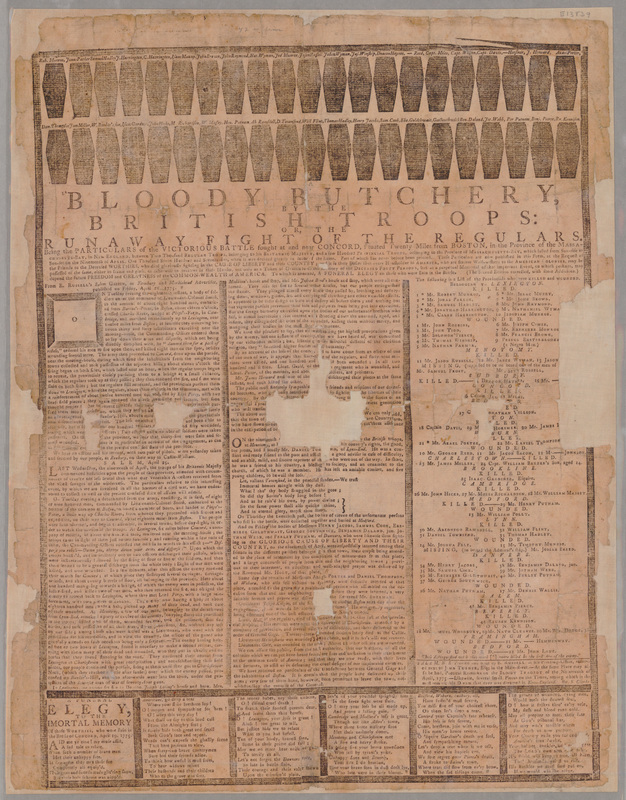
Ezekiel Russell printed this poem at the bottom of his “Bloody Butchery of the British Troops” broadside, shown above. You can peruse that page more closely through the American Antiquarian Society, founded by Thomas.

The Russell broadside contained some errors (a missing “brave,” “young” became “your,” another “your” dropped out), suggesting that shop hastily copied the text out of the newspaper. I would have expected the transmission to go the other way: from the Russell print shop, which was known for publishing a young woman’s elegiac verses, to the Essex Journal.

That in turn suggests that Russell didn’t issue the “Bloody Butchery” broadside until more than a month after the battle. Maybe he needed that time to engrave all those coffins.

Wednesday, February 21, 2024

Is That a Phrygian Cap or Are You Just Glad to See Me?

One thing I learned last year and am still working through is that a Phrygian cap isn’t the same as a Liberty Cap, but became the same in the 1790s.

In classical Greek and Roman cultures, the Phrygian cap and Phrygian helmet were markers of someone from greater Anatolia, or in general east of the civilized world. The Phrygian cap was a soft cloth cap with a bulge at the top that flopped forward. Lots of statuary and other artwork from that ancient period used the floppy cap as a sign of exoticism.

The Romans had another type of cloth cap with symbolic meaning: the pileus. Made of felt, it was used in the ceremony of freeing a slave. This cap was conical and symmetric, without that bulge. The pileus thus came to symbolize liberty in general, especially when it was held up by a spear.

That’s how the pileus appears in many eighteenth-century pictures of Liberty, and in British (and British-American) pictures of Britannica, since of course the British constitution provided the most liberty.

William Hogarth caricatured John Wilkes in 1763 as holding a spear and domed cap helpfully labeled “LIBERTY.” Some analyses say contemporaries would have recognized that thing on the spear as a chamber pot, not a cap. I’m not sure, but it definitely doesn’t look like cloth.

The allegorical woman on the masthead ornament of Edes and Gill’s Boston Gazette held a spear and pileus, as did figures on the 1774 and 1781 cuts for Isaiah Thomas’s Massachusetts Spy.

Paul Revere engraved such figures many more times: on the picture of the Stamp Act repeal obelisk, in the frames around his portraits of Samuel Adams and John Hancock, and so on. When he adapted the London print “Britannia in Distress” into “America in Distress” and “A Certain Cabinet Junto,” he transferred the spear and pileus from Britannia’s arm to America’s.

In those years, the object was called the “Cap of Liberty.” The phrase “Liberty Cap” appeared in American newspapers only once before the Revolutionary War, in a 3 Feb 1774 New-York Journal article signed “An English Yeoman, with his Liberty Cap on.”

When you hold a cloth cap up on a spear, the top doesn’t naturally flop over. All those Liberty Caps are conical or in the shape we’d now call bulletheads. (Bullets were spherical then, remember.)

During the French Revolution, fashion and art merged the Cap of Liberty, the bonnets rouges of a 1675 anti-tax revolt in France, and the Phrygian cap. After a short while, iconographic Liberty Caps were mostly red, and they all had that little bulge flopping over. Even when they were on spears!

(Back when I wrote about rattlesnakes, I found an image of the Continental Congress’s Board of War and Ordnance seal. It showed that the flying snake originally had a rattle, though that detail has disappeared in later U.S. Army redesigns. Now I wonder if the Liberty Cap on that original seal had the bulge of the Phrygian cap, or if that was a later addition. Alas, the image from 1779 is no longer on the web.)

Saturday, February 03, 2024

“John Malcom returns thanks to Almighty God”

Like pretty much everything else in colonial Boston, the mobbing of John Malcolm had a religious aspect.

Malcolm’s parents had migrated from Ireland in 1721, and before that the family was from Scotland. When he married and had children in the 1750s, Malcolm did so in the Rev. John Moorhead’s Presbyterian meeting-house.

(That congregation eventually evolved into the Arlington Street Church. Its surviving eighteenth-century records have been digitized by Harvard, and the image above comes from a book of baptisms. Good luck using that source.)

In 1769, Malcolm made a career change and joined the Customs service. His first station was in Newport, Rhode Island. The Rev. Dr. Ezra Stiles recorded in his diary the difficulties Malcolm found in worshipping there:
24 [Feb 1770]. I am told that Mr. Malcom last week signified his Desires to some of the Brethren of the first Cong. Chh. here to partake with them in the Lord’s Supper last Lords day. His motion was declined.

He is an officer in the Customs here: lately removed from Boston & settled here, & with his Family attends that Meeting. Tho’ a Congregationalist, yet not Member in Communion. with any Congrega. Chh: yet to qualify for an office had received the Sacrament at an Episcopal Chh., I think in Boston.

It is the declared principle of our Churches to receive to occasional Communion, any sober Communicants from any protestant Chhs., as Episco., Bapt., &c., if they should desire it. He pleaded this right. But the scruple arose on his Morals, which are exceptionable.
There’s no clue about what made Malcolm morally objectionable, if it wasn’t simply joining the Customs service. In 1771 he attended Stiles’s own meeting six times before leaving New England for his next assignment.

This episode shows a couple of things. First, Malcolm wanted to be part of a congregation. He preferred independent meetings, though reportedly was willing to take communion in an Anglican church if it would help his career with the royal government. I haven’t seen any evidence about where the Malcolm family was worshipping when he was back in Boston in the winter of 1773–1774.

The first newspaper essay to discuss religion in connection to the January 1774 crowd attack on Malcolm in fact never appeared in a newspaper. But in announcing that he declined to print that essay in the 3 February Boston News-Letter, Richard Draper got the main point across:
VERITAS, his Observations on the Method of Punishment inflicted on J. Malcom, in a Place professing the Christian Religion, cannot be inserted.—He concludes “I would have every one punished that is deserving of it.—But would not have it to be said by the INDIANS, We are SAVAGES.”
In other words, the violence of the attack on Malcolm made Bostonians look bad, even to people that community stereotyped as violent.

During his recovery, Malcolm himself released a couple of public statements. The Boston Evening-Post was the first to publish one, on 14 February:
Yesterday se’nnight [i.e., Sunday, 6 February] the following Note, it’s said, was sent to several Churches in this Town, viz.

“John Malcom desires Prayers of the Christian People of this Congregation, that the vile abuse received on the 25th Day or Evening of January last past, from a vile rebellious Mob, without Provocation, may be sanctified to him and his Family; and that he may bless God that his Usefulness is still spared, and that he is greatly recovered from his dreadful Wounds and Bruises he then received from the bloody and cruel Hands of these cruel Mortals here below.—

May God forgive them!
Just above that item the Fleet brothers printed a warning to peddlers not to sell tea, that paragraph ending with the threat of “a modern Dress.—Remember Pedlar Malcom’s Fate!” So that writer wasn’t in the same forgiving mood.

On 17 March, Isaiah Thomas’s Massachusetts Spy published Malcolm’s next message:
Last Sunday se’nnight [i.e., Sunday, 6 March], the following curious note was sent to several churches in this town, and we hear was read at one of them, viz.

“John Malcom returns thanks to Almighty God, that again he is able to wait on him again in the public worship, after the cruel and barbarous usage of a cruel and barbarous mob in Boston, on the 25th evening of January last past confined him to house, bed and room.

“March 6, 1775.”
I haven’t found any response to these items questioning Malcolm’s faith or choice of denomination, or arguing against the point they all made about how Jesus told people to treat their enemies. Most people seem to have preferred to let that topic drop.

Wednesday, November 29, 2023

The Lexington Tea-Burning, in 1773 and 2023

As I recounted yesterday, on 13 Dec 1773 a town meeting in Lexington voted unanimously to resist the Tea Act, pledge not to help unload any East India Company tea, and condemn the consignees who were trying to import that tea.

That was the easy part. None of the people at the meeting were consignees, or Boston waterfront workers.

Then someone proposed a further measure: Any head of household in Lexington who would “Use or consume any Tea in their Famelies” should be treated with Neglect & Contempt.”

Even though all tea in town was by definition not imported under the Tea Act. Even though that tea might not even have been subject to the Townshend duties (if it had been smuggled in from Dutch islands).

No tea at all. As a gesture of solidarity with the people in Boston trying to stop the new tea cargoes from being landed, and a protest against Parliament’s revenue acts in general. Talk about giving up caffeine!

As I said before, Lexington was a strongly Whiggish community. We can see that in the fact that the meeting actually went through with this proposal, approving it without recorded dissent.

Furthermore, on 16 Dec 1773, Isaiah Thomas’s Massachusetts Spy reported:

We are positively informed that the patriotic inhabitants of Lexington, at a late meeting, unanimously resolved against the use of Bohea Tea of all sorts, Dutch or English importation; and to manifest the sincerity of their resolution, they bro’t together every ounce contained in the town, and committed it to one common bonfire.

We are also informed, Charlestown is in motion to follow their illustrious example.
As it turned out, Charlestown took longer to act (I’ll get to that story). When the Boston Gazette and Boston Post-Boy (newspapers on opposite political sides) reprinted the item days later, they left out that last sentence.

About a decade ago, Lexington began to reenact that tea-burning each year a few days before the Boston Tea Party commemoration. The town will have a sestercentennial reenactment on Sunday, 10 December, in and around Buckman Tavern, which faces the common and the site of the meetinghouse where the events of 1773 took place.

The schedule of events:
  • 9:30 A.M. – 4:00 P.M.: Pop-up exhibit on historic hot drinks upstairs at Buckman Tavern
  • 12:00 noon – 3:00 P.M.: Drop-in activities upstairs at Buckman Tavern
  • 12:30 P.M.: The Lexington Minute Men practice military drill
  • 1:00: 18th-century townspeople (and local Boy Scouts) begin to build a fire 
  • 1:20 – 2:00: Music from the William Diamond Jr. Fife and Drum Corps and the Lexington Historical Society Colonial Singers
  • 1:30: THE BURNING OF THE TEA
  • 2:00: Concluding musket salute from the Lexington Minute Men
All outdoor activities are open to the public to watch. The tea has been provided by the Mark T. Wendell Tea Company.

Wednesday, November 08, 2023

“The party at the North End were victorious”

I started looking into what happened in Boston on 5 Nov 1773 because I was curious about who the designated villains of that year were.

Did the Pope Night processions display effigies of Thomas Hutchinson, Andrew Oliver, and other Loyalists whose letters to Thomas Whately had been leaked earlier that year?

Did the gangs hang dummies of those old stand-bys, the Customs Commissioners? Or the Gaspée Commission?

Or might the young organizers have had the flexibility and speed to turn their wrath on the tea consignees, who had started to attract political attention only a couple of days before the holiday?

I’m sorry to say I didn’t find an answer to that question. I can report that the merchant John Rowe wrote in his diary that the 5th of November was “Very Quiet for A Pope Night.” There were no recorded attacks on the tea agents’ or other officials’ homes.

I suspect the town fathers clamped down on the youths’ celebrations that year as they tried to present a respectable resolve to the world through their official town meeting.

I did find who won that year’s brawl between the North End and South End gangs. On 11 November Isaiah Thomas printed this article in the Massachusetts Spy:
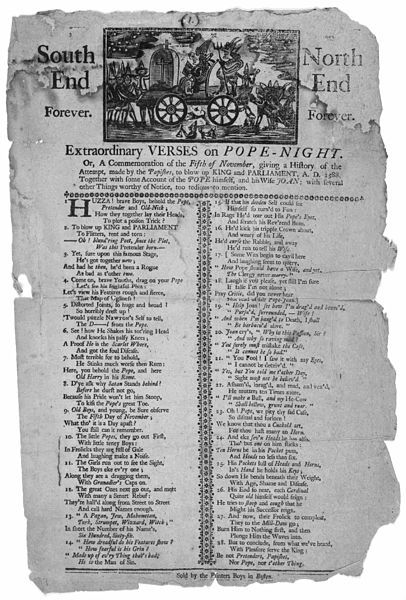
It has long been customary in this town, on the fifth of November, for a number of the lower class of people to carry about pageantries, in derision of the Pope and the Devil and their Powder Plot; and it has likewise been customary for the parties, North End and South, to try their skill at ‘Blows and Knocks,’ and the victory declared to them who should take away the other’s Pope, that being the name given to the pageantry

This year the party at the North End were victorious, which caused the South to give out word, ‘as the saying is,’ that they would on the Monday evening following ‘at them again:’

The consequence of this was, as we are credibly informed, that the Tea Commissioners, fearing the mobility intended paying them a visit, removed most of their valuable effects and their persons, from their respective places of residence, and left their houses guarded, within, by a number of men; but, ‘the wicked flee when none pursue,’—‘a guilty conscience needs no accuser.

We are well assured, that neither nobility nor mobility had the least intention of disturbing them at that time.
“Mobility” was a somewhat cheeky term for the common people, and the source of the word “mob.”

The South End Gang couldn’t counterattack until the evening of Monday, 8 November (250 years ago today) because the two previous evenings were considered part of the Sabbath. But there’s no sign anyone really tried to renew the fighting that year.

Incidentally, that 5 November entry from John Rowe’s diary also lists “Mr. Wm. Burnet Brown Esq of Virginia” among the people he dined with. Back in 2019 I wrote, “Brown returned to Virginia [after he got sucked into the coffee-house brawl with James Otis, Jr.], and I’ve seen no evidence that he ever visited Massachusetts again.” But now I’ve seen evidence that he did.

Sunday, October 01, 2023

Smithsonian’s Phillis Wheatley Peters Collection Now Online

Last month the National Museum of African American History and Culture, part of the Smithsonian in Washington, D.C., announced the acquisition of the Phillis Wheatley Peters Collection of materials related to the Revolutionary-era poet.

The unique jewel in this collection is the poem “Ocean” in the poet’s own handwriting. This was one of the poems listed for Phillis Peters’s second collection in 1781, but during the war that announcement didn’t attract enough subscriptions for the book to be printed.

The manuscript of that collection is lost, but some individual poems survive. “Ocean” was first published in 1998. Scholars speculate that Phillis Wheatley wrote it during her third transatlantic crossing 250 years ago as she came back from London.

The collection of thirty objects includes six published in Wheatley’s lifetime, including:
  • her collection, Poems on Various Subjects, Religious and Moral.
  • short items that her publisher placed in the May 1773 Gentleman’s Magazine ahead of publication.
  • the December 1774 issue of the Royal American Magazine, published in Boston by Joseph Greenleaf, printing “To a Gentleman of the Navy.”
  • A shortened version of “On the Death of a Child” printed in the Rev. John Wesley’s Arminian Magazine in 1781.
Other items show Wheatley’s legacy as an author and a symbol of African-American achievement:
  • Isaiah Thomas’s 1791 proposal to reprint Wheatley’s first collection with additional material, also unsuccessful.
  • reprints of individual poems in the early 1800s. 
  • scholarly studies.
  • a booklet issued by the Phillis Wheatley Club of Waycross, Georgia, a women’s club, in 1930, shown above.
All of that material is already digitized and available for viewing on the Smithsonian’s website and through the Digital Public Library of America.