J. L. BELL is a Massachusetts writer who specializes in (among other things) the start of the American Revolution in and around Boston. He is particularly interested in the experiences of children in 1765-75. He has published scholarly papers and popular articles for both children and adults. He was consultant for an episode of History Detectives, and contributed to a display at Minute Man National Historic Park.

Subscribe thru Follow.it


•••••••••••••••••


Showing posts with label Ezra Stiles. Show all posts

Thursday, November 13, 2025

The Vanishing of Mary Wenwood?

As recounted earlier, Gen. George Washington had Mary Wenwood brought his headquarters to answer questions about a ciphered letter she had given to her former husband to pass on.

The woman held out against the general’s questioning for hours. But still under guard the morning after she arrived, she gave up the name of the cipherer: her lover, Dr. Benjamin Church.

After that, Mary Wenwood fades from the historical record. She had every reason to adopt a low profile. Gen. Washington kept her name out of his official report and paperwork. No surviving informal comment on the episode mentions her name. 

But men had a lot to say about her character. Indeed, just as she vanished as a person, she started to appear as a character in a moral fable—the downfall of a doctor.

James Warren, speaker of the Massachusetts house, called her “a suttle, shrewd Jade” and “an Infamous Hussey.” The Rev. Ezra Stiles of Newport said she was “a Girl of Pleasure,” and had carried the ciphered letter “in her stocking on her Leg.” How did he know?

Lt. Ebenezer Huntington of Norwich, Connecticut, told his brother: “the Plot was discoverd by his [Church’s] Miss who is now with Child by him and he owns himself the father (for he has Dismissed his Wife).” Huntington was stationed in Roxbury, far from Washington’s headquarters, and had no link to people in the case. No one closer to the investigation said the woman was pregnant. Some other details in Huntington’s account are wrong. Therefore, unless other evidence turns up, I think this was probably baseless gossip.

Here are further facts possibly about Mary Wenwood.

The 14 December 1775 New-England Chronicle reported that the Cambridge post office was holding mail for a woman named Mary Butler—which was Mary Wenwood’s maiden name.

Mary was the most common given name for women, and Butler a fairly common surname. Wainwood/Wenwood/Wanewood was much less common. Indeed, all mentions of “Wenwood” and its variants in late-1700s New England newspapers lead back to Godfrey Wenwood, Mary’s former husband.

That said, Newport vital records show that another Mary Wenwood, wife of Frederick Wenwood, gave birth to a baby girl named Mary in December 1785, and that couple baptized a baby girl named Mary (perhaps a new one) in June 1787. Even an uncommon name isn’t necessarily unique.

The most tantalizing clues are that a Mary Wainwood/Wanewood was in and out of the Boston almshouse after the war:
  • Admitted 6 May 1785, left 30 May 1786.
  • Admitted 29 Feb 1792.
  • Admitted 12 Jan 1793.
  • Admitted 25 Apr 1797, died 23 May 1797.
And that last entry stated that the woman was from Rhode Island.

Friday, January 17, 2025

“The Judge supposes he is possessed of the secret”

Before returning to Dr. John Newman, I’ll share some other sources on the treatment of cancers in New England on the eve of the Revolutionary War.

In January 1773, the Massachusetts judge Peter Oliver went to Rhode Island to serve on the royal commission investigating the attack on H.M.S. Gaspée.

Politically the Rev. Ezra Stiles was opposed to Oliver and the inquiry, but he was still polite enough to host the man.

On 11 January, Stiles wrote in his diary:
This Afternoon the hon. Judge Oliver came to drink Tea with me and spent the Evening at my house in Company with Mr. [Robert?] Stevens, Major [Jonathan] Otis and Dr. Jabez Bowen of Providence.

The Judge told us that his Wife had been last year cured of a Cancer in her Neck of 30 years standg. by a young man Mr. [John] Pope of Boston. . . .

His remedy is a secret, but he explained the operation of it to Mr. Oliver in a philosophical Manner, though Mr. Pope is not a man of Letters nor does he make pretension to any other part of Medicine or Surgery.
Peter and Mary (Clarke) Oliver’s son Peter (1741–c. 1831) was a respectable sort of doctor: upper-class, male, practicing standard medicine for his time. Nonetheless, Mary sought treatment from John Pope.

How good that treatment was over the long term is another question. Mary Oliver died on 24 Mar 1775 at the age of sixty-one. Among the pictures of Judge Oliver is one, reproduced above, showing the man mourning at his wife’s grave. It’s one of the rare portraits from the time of a person displaying strong emotion.

Stiles wrote down some of Oliver’s other medical remarks in 1773:
The Judge said that the late Mr. Little of Plymouth found an absolute Remedy for the Quincy, called white Drops, and offered me the Receipt. I suppose it the same as Dr. Bartlets which is only volatile Sp[iri]ts. as Hartshorn or Salarmoniac mixed with Oyl Olive. . . .

The Judge knew an illiterate physician to cure his (the Judge’s) Negro of a bilious Colic or perhaps the Illiac passion in a few Minutes—but would not disclose his Remedy. But the Judge supposes he is possessed of the secret, though that physician died without communicating it even to his own son. For being on the Circuit of the Superior Court in the Co. of York he found a Countryman to the Eastward [i.e., in Maine] who had a Cure for the bilious Colic, which Dr. Lyman had proved infallible in 100 instances.

The Judge bought it of the Man for 30. and it was only the Root of Meadow Flags, or Flower de Luce. Not every flag—but such only whose Root was flat with prongs—that flag root which was surrounded with bushy Fibres will not answer.
The most common name for those flowers today is wild iris.

Wednesday, September 11, 2024

“The purport was, Boston was in action…”

One important element of the “Powder Alarm” of 1774 was that although the British army operation ended peacefully on the morning of 1 September, reports of what happened kept spreading for days.

And as those reports spread, they grew more dire.

Rev. Dr. Ezra Stiles recorded from an eyewitness that in Shrewsbury in the early morning hours of 2 September the rumor was “six men killed.”

Exaggerations like that brought thousands of Middlesex County militiamen into Cambridge that day. That event produced fear about more British military action, which apparently produced more rumors.

At noon on 3 September, Israel Putnam tried to rouse the militia around Pomfret, Connecticut, because of and with this news:
I have this minute had an express from Boston that the fight between Boston and Regulars [began] last night at sunset, the cannon began to and continued playing all night, and they beg for help
Early on 4 September, Titus Hosmer (shown above) in Middletown, Connecticut, was woken by the sheriff, who had received a letter from Putnam. Hosmer wrote:
The purport was, Boston was in action by the “troops sending out to seize all the powder in the country, especially at Framingham [sic] about 20 miles from Boston; which when discovered occasion’d the country people to collect and offer to rescue the powder [i.e., grab it back]. Six of the country people were shot dead at the very time, and many wounded—an Artillery planted at the Neck—the Ships were heard to fire all night of a Friday.
By noon that day, Hosmer heard a less drastic report via Hartford:
[William] Brattle at Cambridge, a high tory, had petitioned [Gen. Thomas] Gage for troops to protect him at his house, which Gage granted; a mob gathered and demand of Brattle to renounce his toryism or whatever you may term it; but after a short parley the troop fired, kill’d some right out, a large numr. wounded. No news from the town itself.
On Sunday, 4 September, the worst rumors reached Longmeadow, Massachusetts. The Rev. Stephen Williams heard that the Royal Navy was involved:
the Ships in ye Harbour—of Boston, & ye Army on ye Land Side were allso fireing upon ye Town so yt. it was like ye Town was Demolishd.
In Milford, Connecticut, young Joseph Plumb Martin heard the talk at church that Sunday afternoon and went to bed fearing redcoats would attack his family’s home before morning.

Of course, none of that happened. But it took a while for the real news to catch up.

TOMORROW: How the news reached the Continental Congress.

Saturday, February 03, 2024

“John Malcom returns thanks to Almighty God”

Like pretty much everything else in colonial Boston, the mobbing of John Malcolm had a religious aspect.

Malcolm’s parents had migrated from Ireland in 1721, and before that the family was from Scotland. When he married and had children in the 1750s, Malcolm did so in the Rev. John Moorhead’s Presbyterian meeting-house.

(That congregation eventually evolved into the Arlington Street Church. Its surviving eighteenth-century records have been digitized by Harvard, and the image above comes from a book of baptisms. Good luck using that source.)

In 1769, Malcolm made a career change and joined the Customs service. His first station was in Newport, Rhode Island. The Rev. Dr. Ezra Stiles recorded in his diary the difficulties Malcolm found in worshipping there:
24 [Feb 1770]. I am told that Mr. Malcom last week signified his Desires to some of the Brethren of the first Cong. Chh. here to partake with them in the Lord’s Supper last Lords day. His motion was declined.

He is an officer in the Customs here: lately removed from Boston & settled here, & with his Family attends that Meeting. Tho’ a Congregationalist, yet not Member in Communion. with any Congrega. Chh: yet to qualify for an office had received the Sacrament at an Episcopal Chh., I think in Boston.

It is the declared principle of our Churches to receive to occasional Communion, any sober Communicants from any protestant Chhs., as Episco., Bapt., &c., if they should desire it. He pleaded this right. But the scruple arose on his Morals, which are exceptionable.
There’s no clue about what made Malcolm morally objectionable, if it wasn’t simply joining the Customs service. In 1771 he attended Stiles’s own meeting six times before leaving New England for his next assignment.

This episode shows a couple of things. First, Malcolm wanted to be part of a congregation. He preferred independent meetings, though reportedly was willing to take communion in an Anglican church if it would help his career with the royal government. I haven’t seen any evidence about where the Malcolm family was worshipping when he was back in Boston in the winter of 1773–1774.

The first newspaper essay to discuss religion in connection to the January 1774 crowd attack on Malcolm in fact never appeared in a newspaper. But in announcing that he declined to print that essay in the 3 February Boston News-Letter, Richard Draper got the main point across:
VERITAS, his Observations on the Method of Punishment inflicted on J. Malcom, in a Place professing the Christian Religion, cannot be inserted.—He concludes “I would have every one punished that is deserving of it.—But would not have it to be said by the INDIANS, We are SAVAGES.”
In other words, the violence of the attack on Malcolm made Bostonians look bad, even to people that community stereotyped as violent.

During his recovery, Malcolm himself released a couple of public statements. The Boston Evening-Post was the first to publish one, on 14 February:
Yesterday se’nnight [i.e., Sunday, 6 February] the following Note, it’s said, was sent to several Churches in this Town, viz.

“John Malcom desires Prayers of the Christian People of this Congregation, that the vile abuse received on the 25th Day or Evening of January last past, from a vile rebellious Mob, without Provocation, may be sanctified to him and his Family; and that he may bless God that his Usefulness is still spared, and that he is greatly recovered from his dreadful Wounds and Bruises he then received from the bloody and cruel Hands of these cruel Mortals here below.—

May God forgive them!
Just above that item the Fleet brothers printed a warning to peddlers not to sell tea, that paragraph ending with the threat of “a modern Dress.—Remember Pedlar Malcom’s Fate!” So that writer wasn’t in the same forgiving mood.

On 17 March, Isaiah Thomas’s Massachusetts Spy published Malcolm’s next message:
Last Sunday se’nnight [i.e., Sunday, 6 March], the following curious note was sent to several churches in this town, and we hear was read at one of them, viz.

“John Malcom returns thanks to Almighty God, that again he is able to wait on him again in the public worship, after the cruel and barbarous usage of a cruel and barbarous mob in Boston, on the 25th evening of January last past confined him to house, bed and room.

“March 6, 1775.”
I haven’t found any response to these items questioning Malcolm’s faith or choice of denomination, or arguing against the point they all made about how Jesus told people to treat their enemies. Most people seem to have preferred to let that topic drop.

Sunday, December 03, 2023

“A See becoming Vacant in a Sudden Surprising manner”

As I quoted yesterday, in December 1773 the Rev. Ezra Stiles was worried by rumors from Cambridge about the sudden resignation of Harvard College president Samuel Locke.

On 20 December the Newport minister finally heard the cause, as he set down in his diary:
Mr. [William?] Ellery left Cambridge last Friday: he tells me that the Week before, President Locke resigned the Presidency of Harv. College, alledging two Reasons.

1. Ill state of Health.

2. That his Usefulness was ruined by the evil Report raised & spread abroad about him. This was that his Maid was with Child by him.

He sent in this Resigno. from Sherburn, whereto he is removed. A most melancholly Event, & humbling Providence!
Despite the nod to a claim that Locke was resigning only because of an “evil Report” about him, Stiles seems to have accepted that the president really had impregnated his maid.

I’ve found one comment about this incident from a woman. Hannah Winthrop was wife of the college professor delegated to secure college property in the president’s house. On 1 Jan 1774, she wrote to her friend Mercy Warren as quoted here:
I have no news of a domestick kind to tell you, we go on in the same little peacefull Circle as usual Varied with alternate sickness & health, sometimes Amused, sometimes astonishd with Viewing Events which happen in the great World. Here, beholding a See becoming Vacant in a Sudden Surprising manner. but it is best for one so near the seat where Candor ought to Reign, to draw a Veil over what the Delinquent tenderly Calls Human imperfections. I know you join me in earnest wishes that it may be filld with a person who may do Honor to the Station.
Harvard was already drawing a veil over a painful subject. Indeed, the college and its supporters did such a good job of keeping the “Sudden Surprising” news about Locke out of print that it wasn’t until Stiles’s diary entry was published in 1901 that historians knew about it.

Well, the Harvard librarian John Langdon Sibley (1804–1885) filed a recollection of the event from a Harvard student. And Winthrop Sargent (1792–1874) must have read John Andrews’s postscript about it, quoted yesterday, when he published other parts of the same letter. Surely other researchers had seen those sources and others. But nothing about the affair appeared in print.

No evidence appears to have survived about Locke’s housekeeper. The vital records of Cambridge list a girl named Hannah Lock, baptized at some unspecified time in 1773, with no named parents. Was this the president’s newborn daughter? Likewise, a Hannah Lock died of consumption in Cambridge on 19 Nov 1809, with no further information about her in that record.

COMING UP: Wedlock.

Saturday, December 02, 2023

“A child Laid to him by his housekeeper”

Though the Harvard College corporation kept quiet about the reason for president Samuel Locke’s resignation in December 1773, news was already seeping out. Tea wasn’t the only thing people around Boston were talking about 250 years ago.

One of the finest sources on Revolutionary Boston is the collection of letters that the businessman John Andrews wrote to his brother-in-law William Barrell in Philadelphia in the 1770s.

Andrews was a gossip sponge, and apparently uninhibited when writing to someone out of town. His letters were discovered during the Civil War, sent back north to the Massachusetts Historical Society, and published in the society’s Proceedings in 1866.

Not entirely, though. The transcriber, Winthrop Sargent, focused on political developments and conflicts with the royal authorities. And of course there was this thing called the Victorian sensibility.

One bit left out of print came from a letter Andrews dated 29 Nov 1773. Most of that letter was about money issues, followed by a paragraph about the arrival of East India Company cargos. (Andrews was working under the impression that two ships had arrived, not one.)

Then came a long postscript in small writing along the left side of the page:
P.S. I have a secret to tell you, which not only affects ye. direction of our Colledge, but brings great dishonor upon it:

after sufferg. the most poignant distress for two months past, and repeatedly leavg. ye. Sacraments, with frequently leavg. off, while in Prayer at ye. Chappel in a most abrupt manner, & going out; it has come out that no less a man than P—i—t L—ke has a child Laid to him by his housekeeper: after trying every method compromise to ye. mattr. wth. her, without effect, even to ye. offerg. her £150 Sterlg., he has retird to ye. Country, [???] wth. ye. most sincere grief, his situation excites ye. compassn. of all, as he is curs’d wth. a wife, whose vices, has been ye. means of drivg. him to it
Clifford K. Shipton quoted two clauses out of that passage in his Sibley’s Harvard Graduates biography of Locke, but I think this is the first time the whole thing is out in the world.

Andrews’s letter tells us that two days before Locke wrote out his resignation from the college presidency, people in Boston were already talking about the sex scandal behind it.

By 9 December, the Rev. Ezra Stiles down in Newport wrote in his diary: “More melancholy news about President Locke of Harvard College Camb.” And a week later: “The Corporation of Harvard College met last Week, & sent a Committee to wait on President Locke, & on return, voted his Answer not satisfactory.”

The Rev. Nathaniel Appleton of Cambridge was the corporation member who forced Locke to stop dithering and resign. His grandson, recent Harvard graduate Nathaniel Walker Appleton, wrote to his classmate Eliphalet Pearson on 14 December:
The unhappy affair concerning the late Pr-s-d-nt remains as yet something in the dark, perhaps Time may discover it. He resigned on 6th. Inst & went off to Sherburne the next Day. We Hope that the Corporation will make Choice of a Person to fill the vacant Chair who by his exemplary VIRTUE will remove the Blemish which now lays upon the College.
But only Andrews’s letter was straightforward about what that blemish was.

TOMORROW: And it was all Mrs. Locke’s fault?

(Incidentally, lately I’ve seen some items identifying John Andrews as a lawyer. He’s labeled “Merchant” in the 25 Feb 1771 Boston Post-Boy report of his marriage to Ruth Barrell. He was later a selectman and helped to set up the Boston Sail-Cloth Manufactory, the Massachusetts Fire Insurance Company, the Boston Dispensary, and other organizations.)

Friday, December 01, 2023

The Resignation of Samuel Locke

On 1 Dec 1773, two and a half centuries ago today, the Rev. Dr. Samuel Locke resigned as president of Harvard College.

I wrote about how the college had come to choose Locke back in 2020, on the sestercentennial of his installment.

Locke had been a star student at the college, where John Adams considered him the second-best classical scholar. He then had a quiet career as a minister in Sherborn, where he married a daughter of his predecessor (whose dowry included some good farmland) and started a family.

Locke wasn’t the Harvard corporation’s first choice to be president in 1770, and he took a long time to accept the job. It looks like the governing board wanted someone clearly different from the Rev. Dr. Edward Holyoke, who had served more than thirty years as president before dying at age seventy-nine. Locke would be the youngest Harvard president ever, and the board hoped he would modernize the teaching and scholarship.

Things appeared to have started off well. In 1772 the college gave Locke an honorary doctorate in sacred theology. The following June, the Rev. Ezra Stiles wrote good things about him, while wishing he would be more supportive of local resistance to the Crown.

And then suddenly Locke was gone. The official college records about his departure come from the minutes of a corporation meeting on 7 December:
Dr. [Nathaniel] Appleton communicated a Letter from President Locke dated Dec. 1st 1773, signifying his resignation of the Office of President of this College. Voted. that the Revd Dr. Appleton, Professor [John] Winthrop and Mr. [Andrew] Eliot be a Committee to receive and take into their Care the Books Papers and other Things in the President’s house, that belong to the College and to receive the Keys as soon as the late President has removed his Family & Effects.
Appleton was the Congregationalist minister in Cambridge, his meetinghouse right next to the college campus. Prof. Winthrop lived nearby. Eliot was a minister in Boston, someone who had turned down the office of president back during the last search. Now they had the task of tidying up after President Locke.

TOMORROW: “The unhappy affair.”

Saturday, June 24, 2023

“He will be in Danger of a Duplicity of Character”

On 24 June 1773, the Rev. Dr. Ezra Stiles of Newport received two visitors from Cambridge. He wrote in his diary:
Visited me Rev. Mr. Samuel Locke President of Harvard College, and Mr. [John] Marsh a Tutor. Had much Conversation together on a Variety of Things both in Politics and Literature. The President is a Gentleman of fine Understanding, clear distinguishing Mind, rather adapted for active gubernatorial Life, than for the deep Researches of Literature. He keeps a good Lookout and will pass serenely through Life. He will be in Danger of a Duplicity of Character for he is ever adjusting himself to everybody, that it is somewhat difficult to find his real Judgment on some Points. Yet he is open and vigorous against the New Divinity.

In politics he will never oppose the Governor nor Crown Interest, and will rather lean on that side the Balla[nce] and against the patriots; but he can talk strong for Patriotism. I believe he likes neither at heart; and designs to trouble himself about neither, further than as either affects the Interest of College—in which Case he will secure both parties if possible, else that which will be most beneficial. He will make no stand in politics either for or against the Liberty of his Country, and will rather divert himself with the Folly of those who are most ventersome and enterprizing on both sides.

If America should become an independent Empire, he would be for a pretty firm Government which the people could not easily overthrow. His own Dominion would make a State happy. In his hands a Tyranny would be good Government. Was Pres’t Locke at the Head of Government either in a Tyranny or Republic, his Government would be administered with Firmness, Justice, Mildness. It would be so good that the most popular Republic would never call him to an account; it would be so good that the subjects of an absolute Monarchy would forget their Chains and think themselves in the fullest possession of true Liberty.

Under the Idea and Purpose of governing well, I believe his Judgment would adopt a Theory of high and Absolute Government. But was he in any other part of the world he would forget Theory and adapt his practice to the Exigencies and Usages of Places. Neither would he suffer himself to be harrassed with laboring the surreptitious Introduction of a Theory different and very opposite to that which took place where he was called to act. He will aim at the Glory of a really useful Man. He will have but little Leisure for Reading and Contemplation. But will profit by Conversation with the Literati of every Branch of Erudition. He has a liberal Understanding, a penetrating Discernment & is capable of looking into and judging upon everything.

He has great Affection for his Pupils, and feels the Father the tender Parent towards all of them. He tells me he has about 180 Undergraduates.

He is a man in almost all respects of an excellent Character. He is in the midst of Life or rather young, I believe about aet. [i.e., age] 38, he is a good classical scholar in Latin, Greek, Hebrew and Chaldee—he made an Oration in Chaldee at the first public Commencement after his Election to the Presidency, which I heard; he is excellent in Philosophy and academical Literature—and in all Branches of Knowledge is far superior to any President of any of the American Colleges, unless Dr. [John] Witherspoon of Nassau Hall should excede him in Theology.

He is one of those Minds which will enlarge to a great Size, will grow and magnify through Life. His Morals are excellent; Piety and a holy Life set on him with a good Grace. I doubt not he is determined to live well, to act his part with Dignity, to die well, and obtain the Crown of immortal Glory. He is a firm Friend to Revelation.
Five years later, Stiles himself became president of a college, Yale. Locke had died earlier in 1778 at the age of forty-five. He had already left Harvard, as I’ll describe later this year.

Friday, February 03, 2023

“He particularly enlarged his accounts of our ammunition”?

On 28 Oct 1775, the Massachusetts House put Dr. Benjamin Church, Jr., on trial for corresponding with the British military inside Boston.

In his defense, the doctor pointed to a passage in the allegedly incriminating letter, dated 23 July (copy shown here):
20 Tons of Powder arroved at Philad. Connecticut and Providence, upwards of 20 Tons are now in Camp, salt petre is made in every Colony. Powder mills are erected and constantly employed in Philada & New York.
That wasn’t giving sensitive information to the enemy, Church told the legislators. Instead, he
declared that the only motive he had in writing was the publick good; that he took care to exaggerate our strength and firmness, with a view to dishearten and intimidate; that he particularly enlarged his accounts of our ammunition, at a time when an attack might have proved fatal, on account of the scarcity of that article…
Nobody believed that. But nobody could refute it, either. The deciphered letter certainly did declare that the Continental Army had a lot of gunpowder.

Some historians have wondered if Church was writing in a code, in addition to cipher—perhaps the men who received his letter would know by previous arrangement he was actually communicating the opposite of what it said. Or maybe the doctor was sincerely trying to reconcile the royal authorities to the provincial cause.

In fact, Church’s 23 July writing reflected a common understanding around the camp that summer. On 2 July, Ezekiel Price, living in Milton, wrote in his diary: “Mr. E[dmund]. Quincy reports that eighteen hundred barrels of powder is arrived at Philadelphia or New York.”

On 10 August, the Boston Gazette reported, “the Needfull is said to be not wanting,” probably a reference to gunpowder.

Down in Newport, on 15 August the Rev. Dr. Ezra Stiles noted: “I am told so that I rely on it, that our Army now have Fifty Tons of Powder.”

In fact, on 3 August Gen. George Washington had learned that the army was facing a gunpowder shortage. He and his generals were writing desperately—but secretly—to various governments asking for more. They were coming up with wild plans to grab powder from colonies still loyal to the Crown. But of course the commander worked to keep that news from spreading. (I wrote about that effort in this article for the Journal of the American Revolution.)

By late October, more gunpowder had arrived in the American camp, making it safe to acknowledge there had been a shortage a couple of months before. But when Dr. Church wrote his letter in late July, nobody knew about that shortage, not even Gen. Washington. So the doctor’s claim that he was deliberately trying to fool his correspondents on that point was plausible only if his listeners didn’t remember what happened when.

And those Massachusetts legislators wouldn’t have believed Dr. Church for an instant if they’d seen his next letter.

TOMORROW: Out of the files of Gen. Gage.

Tuesday, May 17, 2022

“No one justifies the burning of the Gaspee”

The first Boston newspapers to report the 11 June 1772 attack on H.M.S. Gaspee were Richard Draper’s Boston News-Letter, which supported the Crown, and Isaiah Thomas’s Massachusetts Spy, which didn’t.

The 11 June News-Letter told readers that a Rhode Island mob had “dangerously wounded the commander, Lieut. [William] Duddington, and used the Company cruelly” before burning his schooner.

The same day’s Spy said nothing about Dudingston’s injury and stated only that the attackers “bound the men.” It also added in editorializing italics:
To what a dreadful dilemma are the people reduced!—They must suffer themselves to be plundered, or——
However, over the next several weeks the Boston newspapers appear to have reported as little as possible about the Gaspee affair. They stated the facts with a bit of spin, but, after that initial Spy comment, they didn’t use the event as fodder for political arguments. Likewise, neither Samuel Adams nor his cousin John mentioned the Gaspee in their surviving writing from that summer.

“No one justifies the burning of the Gaspee,” the Rev. Dr. Ezra Stiles of Newport (shown above) insisted to a fellow minister the following year. The closest to a defense of the event he could offer was, “But no one ever thought of such a Thing as being Treason.”

That sounds a bit like the Costanza Defense: ‘Storming a government ship—assaulting a naval officer—destroying an entire schooner—was that wrong? Because if we’d known that sort of thing was frowned upon…’

Crowds had in fact attacked British government ships before, as in the Liberty riots in Boston in 1768 and Newport in 1769. In those instances, local press and politicians decried the violence but argued that it was a natural response to seeing the Customs service overreaching.

That argument was harder to make in the case of the Gaspee. The June 1772 attack did grow from the ongoing conflict between merchants ready to break imperial trade laws for higher profits and the royal authorities determined to enforce those laws (and augment their salaries by doing so). But otherwise the locals’ actions looked bad.

Storming the Gaspee wasn’t a spontaneous reaction by waterfront workers. It was obviously a carefully planned operation, with three boats full of armed men rowing out to the schooner after it had run aground.

The men who boarded the Gaspee were the aggressors, not on the defense. They wounded an officer and burned a ship of the Royal Navy, pride of the British people. That action was impossible to spin into a dignified political protest against Parliament’s unjust new laws. It looked much more like racketeers using violence against legal authorities to protect their personal profits.

Boston’s Whigs made sure their destruction of East India Company tea in December 1773 looked different. They protected the Customs officials and others aboard the ships from personal violence. They forbade participants from taking any tea for their own gain and publicly punished one man who tried.

Before that Boston Tea Party, the owners of those three ships were worried that mobs would ruin their valuable property. Instead, leaders of the action ensured that their crew hurt nothing but the tea itself. They even replaced a lock they had broken open—and made sure the press reported on that restitution.

As with the Crown’s frustrated response to the Gaspee attack, the main lesson that American Whigs took from the event was what not to do in future.

TOMORROW: When the royal government gave the Whigs an opening.

Monday, November 09, 2020

A Church in Pomfret, Connecticut

When Cmdre. James Gambier sailed his flagship Salisbury back to Britain in August 1771, he left behind the ship’s chaplain, the Rev. Richard Mosley.

I’m still not sure why, but Mosley had decided to seek a post as an Anglican minister in New England, which was missionary territory.

Literally, the Puritan-founded colonies were so unfriendly to the established church and contained so few Anglicans outside of the port towns that the London-based Society for the Propagation of the Gospel (S.P.G.) paid or supplemented the salaries of ministers willing to work there.

One such barely hospitable spot was Pomfret, Connecticut, a small town in the northeast corner of that colony known best for being where Israel Putnam of the village of Brooklyn killed a wolf in her den (shown above). How did any Anglicans end up there?

That story began with a Virginian named Godfrey Malbone (1696-1768) coming to Newport, Rhode Island, in his twenties. He was a member of the Church of England, not from an old Puritan family. Malbone built a fortune through privateering and transatlantic trade, commissioning a large mansion in town and another in the countryside. He invested more money in Connecticut real estate, hoping to develop a quarry and settlements in Pomfret.

In the 1760s Malbone’s businesses faltered. He had to mortgage property to the Boston Customs officer Charles Paxton. He assigned the Connecticut land to his sons in 1766 and died two years later.

The eldest son, the second Godfrey Malbone (1724-1785), had attended the University of Oxford in the 1740s before returning to Newport. With his father’s death, he had to move to that little town of Pomfret and try to get the most value out of the real estate there.

According to the Rev. Dr. Ezra Stiles of Newport, writing in January 1770:
Col. Godfry Malbone of Newport owns about one quarter of the Land in the small parish of Brookline in Connecticutt. For some years he voluntarily consented to pay a part of the ministerial Tax, as making a parish & settling a minister there has given perhaps a fourfold Value to his Land. I am informed that lately the parish voted to build a new Meetinghouse. His Lands as he is an Episcopalian are exempted by Law of that Colony. Perhaps he felt himself under some Obligations of honor to contribute a part.
Malbone had thus been supporting the Congregationalist meeting that was the town’s established church. But faced with the prospect of a rising tax bill for the new meetinghouse, Malbone with “his wife & family” decided they wanted to have their own church instead. Stiles continued:
I hear to-day that he had engaged to erect an episcopal chh there—prevailed upon 25 Families as is said to declare for the chh—& lately procured a Subscription here of three hundred Dollars in the Fryday Night Club, towards building a chh—& sent home to the Bp of London by Collector [Joseph] Harrison, to get the Society to erect a Mission.

Col. Malbone is a Gentleman of Politeness & great Honor, was educated at Oxford, and dispised all Religion. But now is become a zealous Advocate for the Church of England.
Stiles also claimed that part of Malbone’s pitch to neighbors to join the Anglican congregation was that they wouldn’t have to pay as much as in their previous meetings, given the financial support coming from London and Newport.

Malbone’s church started to go up in June 1770. The following April, the Rev. Samuel Peters of Hebron and another Anglican missionary in Connecticut traveled to Pomfret to dedicate this building as Trinity Church.

As for the S.P.G. in London, in March 1771 its secretary sent a letter to Malbone approving the establishment of a missionary parish covering Pomfret, Plainfield, and Canterbury and offering a salary of £30 per year. However, for that money they couldn’t find any English clergyman willing to emigrate to Connecticut.

With the S.P.G.’s blessing, Malbone wrote to various contacts in America, seeking an Anglican priest. Some recommended a recent Harvard graduate named Daniel Fogg, who was preaching in far-off North Carolina, but letters to him went unanswered.

In September 1771, the Rev. Richard Mosley arrived from Boston. He came with letters of recommendation from the Boston merchants Henry Lloyd and Shrimpton Hutchinson. According to Mosley, reporting to the S.P.G. in 1772:
Upon finding Mr. Malbone had taken so much trouble, and had been at so much pains, and had been at so great an expense, to erect a Church for the worship of Almighty God here at Pomfret, where few were disposed and inclined to join it, and the venerable Society’s charity not being able, together with their small means, to get a minister from England to do the service, I was willing to encourage so good an undertaking, being in hopes that it might be serviceable both to religion and the people’s salvation. These motives have influenced me to stay with them ever since Sept. 13th last.
Mosley and Malbone made no long-term commitments to each other. But Trinity Church in Pomfret, Connecticut, began to have regular sermons from former Royal Navy chaplain Mosley starting on 13 Sept 1771.

TOMORROW: A committee of Congregationalists.

Sunday, October 11, 2020

“Those Letters were not the writings he meant”

When William Story told Thomas Hutchinson in the summer of 1772 that he’d seen some problematic “writings” by the governor, he probably didn’t couch that in the form of a threat.

Rather, Story likely used the language of the patronage system, speaking about loyalty and reciprocal favors as he sought a royal appointment.

But Hutchinson certainly took Story’s words as a threat. In October 1773 he wrote to a correspondent in Britain:
One Story who had been in London…sollicited me for a place that was vacant and upon my declining it he let me know by a letter that he hoped he should not be obliged to make publick the substance & purport of some writings of mine he had seen in London & which I should not like to have known.
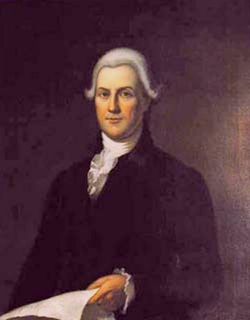
We have a third-hand source on the two men’s interaction from the Rev. Ezra Stiles of Newport. On 10 June 1773 the minister recorded a conversation he’d just had with Judge Peter Oliver (shown here), close to Hutchinson by both politics and family. Stiles didn’t get Story’s name correct, and he was a sucker for any good story that confirmed his beliefs, so we can’t rely on everything he wrote down. But this is how he understood the situation:
Mr. Storer of Boston suffered in the Stamp Act 1765 and went home for Redress. The Ministry put him off, till he should obtain Governor Hutchinson’s Recommendation, and indeed it was finally referred to the Governor to provide for him some provincial office. It has not been done.

Mr. Storer to have a Rod over &c. procured 18 Letters of Lt. Gov. [Andrew] Oliver and half a dozen of Governor Hutch. to one of the Secretaries of some of the Ministerial Boards in London, as a specimen of their Correspondence for 15 years past urging and recommending the present arbitrary Government over the Colonies. The Governors Hutchinson and Oliver were last year given to understand that Mr. Storer had them in his power by means of a Collection of these Letters, and that the only Condition of not exposing them was his being provided for. The matter was neglected.

Judge Oliver now here once took occasion to ask the Governor whether there was any Danger &c. when the Gov. said he was under no Apprehensions. The Judge says, he himself apprehended both for Governor Hutchinson and especially for his Brother the Lieutenant Governor who was greatly exasperated in the Time of the Stamp Act.—
Stiles wrote that down as the Massachusetts house was tussling with the governor over the letters but hadn’t yet made them public. Stiles had nonetheless heard correctly that that collection contained a letter from “Mr. [George] Rome of Newport Rh. Isld.”

I wrote about how the Massachusetts Whigs dealt with those documents starting here. Later that June, the house did publish the papers it had received. The collection included six letters from Hutchinson, four from Andrew Oliver, and a handful from other men in their circle. All that correspondence had gone to Thomas Whately, a Member of Parliament who died in June 1772, and then been copied and distributed as part of a push to change Massachusetts’s constitution in 1770.

When Gov. Hutchinson heard about these letters, he naturally thought back to his interaction with William Story the year before. At first he believed the man had brought those letters back from London. But on reflection, the governor realized, the timing didn’t work, in two ways:
  • First, people in London suspected that the letters had been purloined from Whately’s brother, executor of his estate. Since Whately died a few weeks after Story set sail for Boston, Story couldn’t have carried out such a theft.
  • Second, Hutchinson knew that Story had returned a full year before the letters were published. “I cant trace them in this country farther back than the last Spring,” the governor wrote of those documents. He believed there was no way the Boston Whigs could have sat on that evidence for so long without making a fuss, and in that he was definitely correct.
Furthermore, Story himself started to insist that as for “the Letters which were before the Assembly that he never saw them and they were not brot by him to N. E.” At the end of October Hutchinson wrote to Whatley’s brother:
It has been reported that the original letters which had been wrote by the Lt. Gov. & by me to your late worthy brother were bro’t over here by one Mr. Story. I am desired by the Lt. Gov. to acquaint you that altho Mr. Story gave out that he had seen in London writings of mine yet he has affirmd to me those Letters were not the writings he meant & that he knew nothing of the manner in which they came here.
In sum, Story confirmed that he’d tried to pressure Gov. Hutchinson with the content of some embarrassing letters, but he insisted that he meant some other embarrassing letters.

And the details Stiles wrote down support that. The minister understood Story to have procured six letters from Gov. Hutchinson and eighteen from Lt. Gov. Oliver to “one of the Secretaries of some of the Ministerial Boards.” The documents that came over in the spring of 1773 included only four from Oliver, and Whately hadn’t been a board secretary since 1765. That suggests there were at least two sets of supposedly scandalous letters from Hutchinson and Oliver circulating in London in the early 1770s.

It also looks to me like Story might never have brought back documents at all, just knowledge of documents. Only Stiles wrote that Story had “procured” letters; Hutchinson didn’t say that. The Boston Whigs made no additional disclosures from Hutchinson and Oliver’s correspondence before the war began. Maybe what Story had seen in London seemed minor compared to what the house revealed in June 1773. Maybe enough damage had been done. 

Or maybe Story hadn’t seen any letters at all. He might have only heard about the letters to Whately while he was seeking favors in London, came back to Boston, and added incorrect details while he played a weak hand the best he could. 

[My thanks to John W. Tyler, editor of the Hutchinson letters for the Colonial Society of Massachusetts, for some peeks at the governor’s correspondence in late 1773 as he tried to figure out what had happened.]

Wednesday, March 25, 2020

A New President for Harvard College

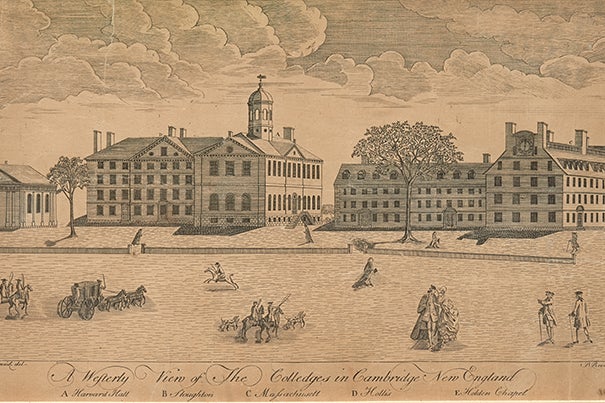
To be sure, there were other things going on in Massachusetts in March 1770 besides responses to the Boston Massacre. On 21 March, Harvard College installed a new president, the Rev. Samuel Locke.

Locke had been born in Woburn on 23 Nov 1731, the oldest child of a substantial farmer and his wife. Later his family moved to Lancaster, where he studied for college with the local minister.

At Harvard, Locke was in the class of 1755. His classmate and friend John Adams thought he was one of the “better Schollars than myself,” and enjoyed hearing him discuss metaphysics. After college, Locke did the equivalent of graduate school while seeking a job as a minister.

Sherborn had a vacancy because the Rev. Samuel Porter had died, and in November 1759 Locke was ordained as that town’s new pastor. Less than two months later, he married the previous minister’s daughter Mary. They had three children between 1761 and 1765: Samuel, Mary, and John.

Ten years later, Harvard College also faced the choice of a successor: Edward Holyoke, president of the college for thirty-two years, died in June 1769. Holyoke was highly respected, and he had built up the college’s reputation and campus, but his approach to education was conservative.

On 18 Dec 1769, after more than six months of discussion and some turn-downs, the Harvard corporation decided to offer the presidency to the Rev. Mr. Locke. Just thirty-eight years old, he would be the youngest person ever in that position.

The Rev. Andrew Eliot of Boston wrote on 25 December:
The corporation have at length chose a President. His name is LOCKE—a truly venerable name! This gentleman is minister of a small parish, about twenty miles from Cambridge. He has fine talents, is a close thinker, had at College the character of a first rate scholar; he is possessed of an excellent spirit, has generous, catholic sentiments, is a friend to liberty, and is universally acceptable, at least so far as I have heard. He has not conversed so much with the world as I could wish, and perhaps has not a general acquaintance with books; but he loves study, and will have opportunity at College to improve, being not yet forty years old. We know not whether he will accept.
Locke’s youth was thus seen as a plus, since he could grow in the job and serve for decades as Holyoke had. Even coming from a small country town turned out to be an advantage: though Eliot felt certain that Locke was “a friend to liberty,” the Sherborn minister had played no visible part in the religious and political controversies that split Massachusetts society.

People also perceived Locke as being strong in some of the modern subjects that the late president had neglected. The Rev. Ezra Stiles later judged:
Dr. Locke was scarcely equal to Mr. Holyoke in classical Knowledge but much superior to him in the Sciences, and in Penetration Judgment & Strength of mind. He was excellent & amiable in Government, tho’ he did not equal the Dignity of his Predecessor. And yet he was a greater Literary Character.
Locke’s old friend Adams always felt he had achieved “a Station for which no Man was better qualified.”

Members of the corporation rode out to Sherborn in late December and offered Locke the job. He took six weeks to accept. One obstacle might have been moving his family into Cambridge. Another was the Sherborn congregation’s reluctance to let him go; Harvard ultimately paid that body £37.1s.

On 21 March, the merchant John Rowe recorded in his diary: “This Day Mr. Lock was installed President of Cambridge.” The ceremony was even more grand than usual because the Massachusetts General Court was then sitting in Cambridge. Lt. Gov. Thomas Hutchinson, Boston representative John Hancock, and many other office-holders attended.

Locke delivered an inaugural address in Latin in his robes. A man who knew him later in life recalled him as “a stout, dignified looking man, a little below the common stature.” Hutchinson gave a brief reply, also Latin, and then a student orated for longer. There were prayers and hymns and a dinner for all the professors and other dignitaries. The institution looked forward to a grand future.

That night, students set fire to the outhouse.

Friday, August 23, 2019

Captain Peck’s “Intelligence”

On 23 Aug 1770, the Rev. Ezra Stiles of Newport wrote in his diary about a conversation with a sea captain named William Augustus Peck.

Born about 1723 and based in Newport, Peck had commanded a privateer in the last war, advertising for sailors in the 28 June 1762 Boston Post-Boy. His wife Mehitabel had died in September 1766, and he’d married Mary Hammond the following June. In 1769 he’d endured a difficult voyage to Amsterdam, as reported in the 18 September Boston Chronicle.

On this day Peck was back from Britain with surprising news:
Capt. Wm. Augustus Peck this day visited me. He brought my Books from London: he tells me there is a secret Intelligence office in London in [blank] street where the Jews live. It has subsisted about four years & has thirty clerks: it is supported by the Ministry: & has settled a correspondence in all parts of America—has four Correspond’ts in Boston, & two in Newport, one of which is Mr. Geo. Rome Mercht. to each of whom the Ministry exhibit Stipends.
George Rome had arrived in Rhode Island in 1761 as an agent of the London mercantile firm of Champion and Hayley. (George Hayley’s wife Mary was a sister of John Wilkes, a hero to American Whigs—but they still resented depending on credit from his firm.) Rome collected what money he could, invested in whaling and other ventures, and within a short time was one of the richest men in Newport. By the late 1760s he was spending most of his time at his rich country estate.

With his family in Britain, business interests, and Anglicanism, Rome was a natural friend of the royal government. In 1767 he wrote a letter criticizing Rhode Island’s form of government and rule of law. Seven years later, that letter was included in the packet leaked from London by Benjamin Franklin, which got him into deep trouble with the local Whigs. In 1775, Rome was one of the people Mary Butler thought could deliver a ciphered letter from her lover, Dr. Benjamin Church, into Boston.

There is, however, no evidence that Rome received a stipend from the British government—much less for the enterprise Stiles described:
As it appears in London, it is intirely a Jew Affair—a Jew Compting House, & is unknown in London. Capt. Peck sailed to London in a Vessel of the Jews & by this fell into the hands of the Jews there, dined with sundrey [?], and not being strong for American rights, they used to open before him; in compa[ny]. he heard one Mr Clark I think speak of their secret Intelligence office—& upon Peck’s questioning, &c., he colored up and diverted the Discourse. Capt. Peck says, that this office boasted of having Intelligence of every Occurrence of any consequence in America.
Stiles was, as I’ve previously written, a sucker for stories that fit his political outlook—in this case, the belief that there was a conspiracy in London to restrict North American colonists’ rights. Stiles knew the leaders of the Jewish community in Newport, but he wasn’t close to them, and was willing to view them as agents of that conspiracy.

Peck’s rumor is an obvious falsehood, an early example of the myth of an international Jewish cabal. It’s a measure of Stiles’s gullibility that he wrote that all down. Even more dismaying, of course, is that this sort of lie is being circulated in the U.S. of A. today.

Friday, May 03, 2019

The Emergence of “Rebellion to Tyrants is Obedience to God”

On 14 Dec 1775, the Pennsylvania Evening Post shared this article with its readers, including many delegates to the Second Continental Congress:
The following inscription was made out three years ago on the cannon near which the ashes of President Bradshaw were lodged, on the top of a high hill near Martha Bray in Jamaica, to avoid the rage against the Regicides exhibited at the Restoration:

STRANGER,
Ere thou pass, contemplate this CANNON,
Nor regardless be told
That near its base lies deposited the dust of
JOHN BRADSHAW,
Who, nobly superior to all selfish regards,
Despising alike the pagentry of courtly splendor,
The blast of calumny, and the terrors of royal vengeance,
Presided in the illustrious band of heroes and patriots,
Who fairly and openly adjudged
CHARLES STUART,
Tyrant of England,
To a public and exemplary death,
Thereby presenting to the amazed world,
And transmitting down, through applauding ages,
The most glorious example
Of unshaken virtue, love of freedom, and impartial justice,
Ever exhibited on the blood-stained theatre of human action.
O, reader,
Pass not on till thou hast blessed his memory,
And never————never forget
THAT REBELLION TO TYRANTS IS OBEDIENCE 
TO GOD.
That publication coincided with the American colonies’ decisive turn away from George III. In short order Patriots decided the king was a tyrant rather than their last hope for relief from ministerial tyranny. The role of John Bradshaw (1602-1659, shown above) in the execution of Charles I became something to admire rather than to regret. The epitaph was reprinted in many American newspapers in late 1775 and early 1776.

A few months later, Benjamin Franklin proposed that the epitaph’s final line—“Rebellion to tyrants is obedience to God”—be a motto on the official seal of the United States. (That never happened, as I discussed back here.)

In 1794, the Rev. Dr. Ezra Stiles repeated that line as a refrain A History of Three of the Judges of King Charles I, saying he’d seen it in print in 1775.

But the biggest fan of the “Rebellion to tyrants” line was Thomas Jefferson.

TOMORROW: Jefferson takes up the motto.

Wednesday, March 27, 2019

The Rev. Dr. Stiles Ponders When “Dr. Church was wavering”

On 16 Mar 1773, the Rev. Dr. Ezra Stiles of Newport put some Massachusetts news into his diary:
At Boston the Sons of Liberty celebrated or commemorating the Anniversary of the Massacre 5th. Inst. [i.e., of this month] when Dr [Benjamin] Church delivered an Oration in the Old South Church or Meetinghouse. Gov. [Thomas] Hutchinson had sent for Dr. Church and endeavored to dissuade him, but without Success.
Church had been born in Newport, and Stiles, a fan of Boston’s Whigs, knew members of his family.

In the fall of 1775, a ciphered letter sent through Newport revealed that Dr. Church was in secret correspondence with people in Boston. This was a bombshell for Patriot leaders. (Some of their wives, knowing that Church was flagrantly cheating on his own wife, were less surprised by this betrayal.)

Patriot men reluctantly concluded that Church had been a paid informant for Gen. Thomas Gage for months. They still lacked definite proof (which didn’t become public until the twentieth century), so they still didn’t know when Church started to cooperate with the royal authorities or what information he had shared.

On 28 Jan 1777, Stiles was back at his diary, pondering the mysteries of Dr. Church. He started by recalling the moment he had recorded almost four years before, but in a different light:
Dr. Church was wavering when he delivered his Oration in 17—. He was a firm Patriot at penning the Suffolk Resolves Sept. 1774—he was already corrupted at the Battle of Lexington Apr. 1775. It is matter of Inquiry, the time of corruption?

I tho’t his conduct odd, and Bravado like, in going into Bo[ston]. after Lexington, carrying in Letters, being taken up, carried before Gen. Gage, in being suffered to talk so laconicly as it was said he did to Gage.

In the Summer of 1775 he was up at Newp[or]t., but little seen by Friends of Liberty, & his Cousin Ch[urch]. then said he was not good. Col. Ezra R[ichmond (1721-1800)] tells me Dr. Ch[urc]h. was at Newp[or]t. between 5th. March & Lexington, he spent Eveng. with the Dr. at Dighton & found him unaccountable & shrewd & sagacious.

The Col. asked, wh[at] would the End of these things be? His Answer vague, yet implying that after fightg. awhile the affairs would be compromised, yet so that America would be conquered & G[reat]. B[ritain]. carry her point.

Also said, he & [John] Hancock &c had been invited to dine with Gen. Gage who treated them with great Politeness & Affability, & beg’d them to use their Influenee to prevent the Oration 5 March—that a week after Gage sent for him—& says Chh., what would you think of £30000.—

The Colonel thinks he reallized 25 Thousd. So his Conversion in March 1775; He is now in Bo[ston]. Goal [jail].
In researching The Road to Concord, I concluded that Dr. Church started to feed Gage serious information on 25 Feb 1775, immediately after the doctor had attended three days of meetings with the Massachusetts Provincial Congress’s committee of safety and supplies.

What then should we make of this story of Gage traducing Church with thousands of pounds a couple of weeks later? Why would the governor make such an offer to a man already working for him? Why, for that matter, would Church report such an offer to anyone else? (Assuming, of course, that Stiles correctly recorded what Richmond had told him, and that Richmond accurately remembered what he had heard.)

I conclude that when Dr. Church talked about Gage’s money, he was boasting to Richmond about an offer he had ostensibly turned down as a way to burnish his Patriot credentials. Perhaps that story was fueled by a guilty conscience or simple wishfulness—we know Church was eager for money, a running theme in his surviving reports to his handlers during the siege of Boston. But the doctor surely wasn’t trying to raise suspicions about his loyalty that summer.

A couple of years later Richmond, feeling certain of Church’s treachery but baffled by the motive behind it, looked back on that conversation and saw it as a confession. He could then express his belief that the doctor “reallized 25 Thousd.” When, of course, he and Stiles had no better information on that point than before.

Wednesday, May 16, 2018

Hunter on Dighton Rock in Middleboro, 19 May

On Saturday, 19 May, the Massachusetts Archaeological Society will host a special lecture by Douglas Hunter on “The Place of Stone: Dighton Rock and the Erasure of America’s Indigenous Past.”

Drawing on his book of the same name, Dr. Hunter will discuss the legacy and mythology behind a petroglyph-covered boulder found in the area that became Berkley:

First noticed by colonists in 1680, Dighton Rock in Massachusetts by the nineteenth century was one of the most famous and contested artifacts of American antiquity. This forty-ton boulder covered in petroglyphs has been the subject of endless speculation that defies its Native American origins. Hunter dissects almost four centuries of Dighton Rock’s misinterpretation, to reveal its larger role in colonization and the conceptualization of Indigenous peoples.
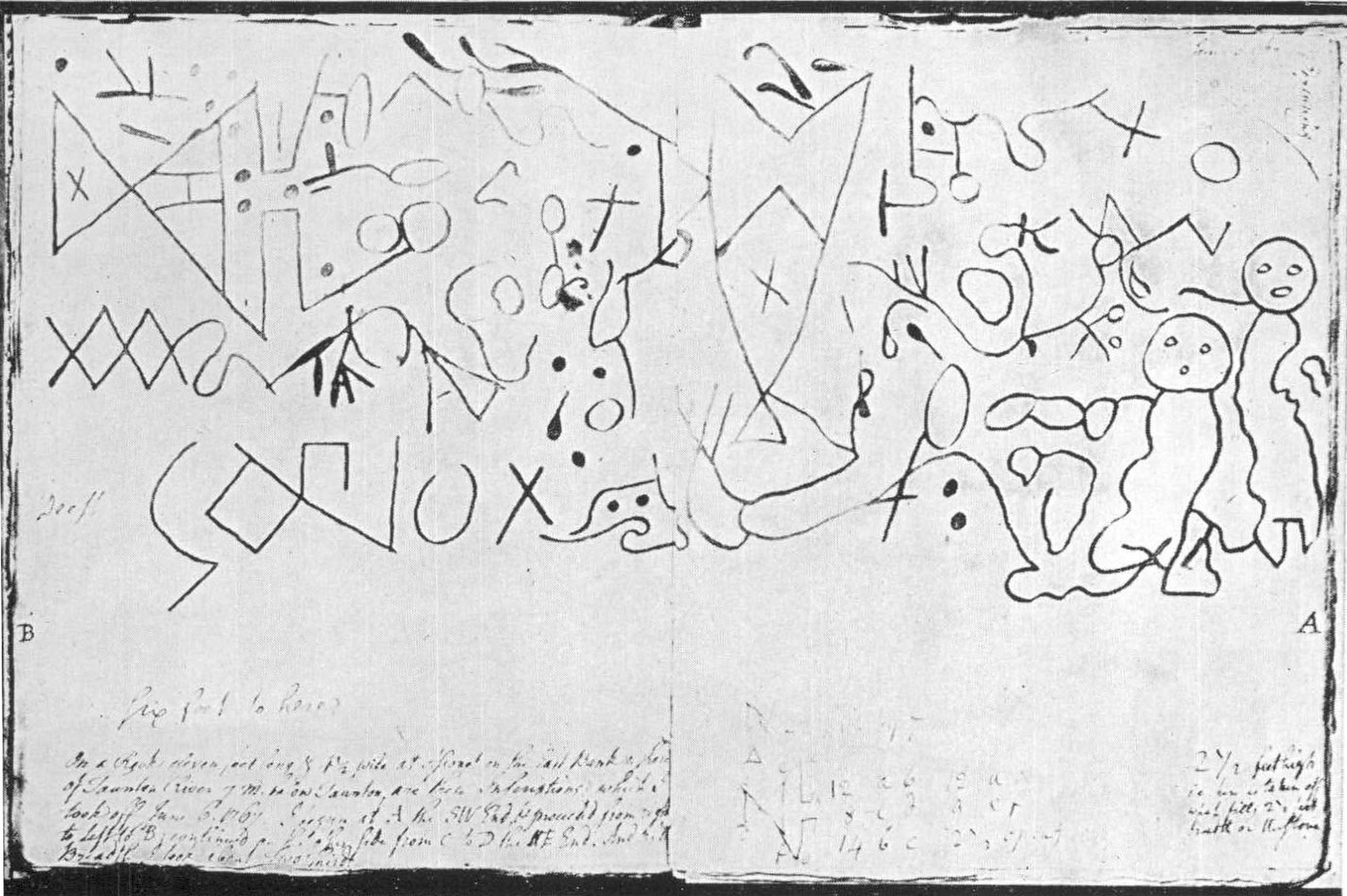
Among the many New England scholars who studied the rock was the Rev. Dr. Ezra Stiles. In 1766, while living in Newport, Rhode Island, he saw a copy of a broadside about the boulder written by the Rev. Dr. Cotton Mather. (Other men who had written about the rock included Prof. John Winthrop of Harvard and Dr. William Douglass, best known for opposing smallpox inoculation and Mather’s other ideas.)

In June 1767 Stiles went to visit a man who lived half a mile from the rock. He used chalk to make the markings more distinct and then drew them in his journal, stating on 6 June: “Spent the forenoon in Decyphering about Two Thirds the Inscription, which I take to be in phoenician Letters & 3000 years old.”

Stiles returned in July for more investigation. He “washed & skrubbed the Rock with a Broom,” fighting the water level, before drawing more surfaces. The next month, two local men did the minister the favor of going out and collecting more drawings, measurements, and even what seems to be a casting of the scrapes in “the Phœnitian rock.”

Here’s one of Stiles’s drawings, courtesy of the Colonial Society of Massachusetts.
In 1768 the Swiss artist Pierre Eugène du Simitière visited Stiles on his way to settle in Philadelphia. He studied the material that the minister had collected. He looked at the characters on Mather’s broadside and and observed, “They are also totally different from the copy taken by Dr. Stiles.” Indeed, most or all of those researchers were seeing what they wanted to see.

Hunter’s talk about this history and what it shows about colonial New Englanders’ attitude toward the Natives around them will take place at the Robbins Museum of Archaeology, 17 Jackson Street in Middleboro, starting at 1:00 P.M. The program is free, but the society suggests a donation of $5 per person.

Friday, September 02, 2016

“An Intimation of the Bombardment of Boston”

Today is the anniversary of the militia uprising in 1774 that Richard Frothingham dubbed the “Powder Alarm” in his biography of Dr. Joseph Warren.

On 2 Sept 1774 up to five thousand Massachusetts militiamen crowded into Cambridge, forcing every royal appointee in town to resign or apologize.

That event demonstrated the end of royal rule in the province outside of Boston, a few harbor islands, and (later) parts of Marshfield—places where the British military was stationed.

Those militiamen were reacting to the British army’s seizure of gunpowder and militia cannon on 1 September. Or, to be more accurate, many of them were reacting to exaggerated accounts of the previous day.

A traveling merchant named McNeil told the Rev. Ezra Stiles that in Shrewsbury he was woken in the middle of the night by “somebody violently rapping up the Landlord, telling the doleful Story that the Powder was taken, six men killed.”

From Hartford, Titus Hosmer informed Silas Deane that “[William] Brattle at Cambridge, a high tory, had petitioned [Gen. Thomas] Gage for troops to protect him at his house, which Gage granted; a mob gathered and demand of Brattle to renounce his toryism or whatever you may term it; but after a short parley the troop fired, kill’d some right out, a large number wounded.”

The Rev. Stephen Williams, minister of Longmeadow, and his congregation heard that “the [Royal Navy] Ships in ye Harbour—of Boston, & ye Army on ye Land Side were allso fireing upon ye Town so yt. it was like ye Town was Demolishd.” [For more of the Williams diary, visit the Longmeadow Library. Thanks to Ray Raphael for pointing me to that source.]

And one of my favorite responses came from young Joseph Plumb Martin, then thirteen years old and living in Milford, Connecticut:

In the afternoon, one Sabbath day [4 Sept 1774], while the people were assembled at meeting, word was brought that the British (regulars, as the good people then called them) were advancing from Boston, spreading death and desolation in their route in every direction. . . .

I went out of the house in the dusk of the evening, when I heard the sound of a carriage on the road, in the direction of Boston; I thought they were coming as sure as a gun; I shall be dead or a captive before to-morrow morning; however, I went to bed late in the evening, dreamed of “fire and sword,” I suppose; waked in the morning, found myself alive, and the house standing where it did the evening before.
The dire rumors traveled at least as far as Philadelphia, where John Adams wrote about “an Intimation of the Bombardment of Boston—a confused account, but an alarming one indeed.” More accurate stories about what had happened in Cambridge followed, but by the time they arrived people’s thinking about the royal government had started to change.

I devote the first two chapters of The Road to Concord to the gunpowder seizure and Powder Alarm of September 1774 because they’re so important to the political shifts in New England and the start of the Revolutionary War that started.

Monday, March 21, 2016

“The very Time of the Convulsion” in Shrewsbury

On Thursday I’ll speak at Longfellow House–Washington’s Headquarters National Historic Site about “The End of Tory Row,” the events that led to drastic changes in that neighborhood in September 1774. (Here’s more information.)

Here’s part of a description of that day, which the Rev. Ezra Stiles of Newport took down from an Irish businessman named McNeil a few days afterward:
Mr. McNeil told me he proceeding from Springfield journeyed towards Boston and on Thursday the first Day of Sept. reached Shrewsbury in the Evening and lodged there. I asked him where he met the public Tumult? he said at Shrewsbury a few miles nearer Boston than Worcester.

He went to bed without hearing any Thing. But about midnight or perhaps one oClock he was suddenly waked up, somebody violently rapping up the Landlord, telling the doleful Story that the Powder was taken, six men killed, & all the people between there & Boston arming & marching down to the Relief of their Brethren at Boston; and within a qr. or half an hour he judges fifty men were collected at the Tavern tho’ now deep in Night, equipping themselves & sending off Posts every Way to the neighboring Towns. . . . The Men set off as fast as they were equipt.

In the Morning, being fryday Sept. 2, Mr. McNeil rode forward & passed thro’ the whole at the very Time of the Convulsion. He said he never saw such a Scene before—all along were armed Men rushing forward some on foot some on horseback, at every house Women & Children making Cartridges, running Bullets, making Wallets, baking Biscuit, crying & bemoaning & at the same time animating their Husbands & Sons to fight for their Liberties, tho’ not knowing whether they should ever see them again.

I asked whether the Men were Cowards or disheartened or appeared to want Courage? No. Whether the tender Destresses of weeping Wives & Children softened effeminated & overcome the Men and set them Weeping to? No—nothing of this—but a firm intrepid Ardor, hardy eager & couragious Spirit of Enterprize, a Spirit for revenging the Blood of their Brethren & rescue our Liberties, all this & an Activity corresponding with such Emotions appeared all along the whole Tract of above fourty Miles from Shrewsbury to Boston.

The Women kept on making Cartridges, & after equipping their Husbands, bro’t them out to the Soldiers which in Crowds passed along & gave them out in handfuls to one and another as they were deficient, mixing Exhortation & Tears & Prayers—spiriting the Men in such an uneffeminate Manner as even would make Cowards fight. He tho’t if anything the Women surpassed the Men for Eagerness & Spirit in the Defence of Liberty by Arms. For they had no Tho’ts of the Men returning but from Battle, for they all believed the Action commenced between the Kings Troops & the Provincials.
Remember, this was 2 Sept 1774, more than seven months before the Battle of Lexington and Concord, but the people of central Massachusetts “believed the Action commenced” already.

Many of those armed men with “a Spirit for revenging the Blood of their Brethren” ended up on the road from Watertown into Cambridge, passing the house of Lt. Gov. Thomas Oliver at the southwestern end of “Tory Row.”