J. L. BELL is a Massachusetts writer who specializes in (among other things) the start of the American Revolution in and around Boston. He is particularly interested in the experiences of children in 1765-75. He has published scholarly papers and popular articles for both children and adults. He was consultant for an episode of History Detectives, and contributed to a display at Minute Man National Historic Park.

Subscribe thru Follow.it


•••••••••••••••••


Showing posts with label Sally Hemings. Show all posts

Sunday, March 31, 2024

“Our firm belief in telling a story here that is accurate and honest”

Daniel P. Jordan, director and then president of Thomas Jefferson’s Monticello for over twenty years, died earlier this month.

Ann Lucas, Senior Historian Emerita at the site, provided a remembrance for its website that says, in part:
Jordan adhered to Jefferson’s principle to “follow the truth wherever it may lead.” As director-elect, he visited Monticello several times as a “regular tourist,” and was struck by the fact that he never once heard a reference to Jefferson owning a plantation or the enslaved labor that it required. Once in leadership, he conveyed to staff that “from January the first on, we're going to try to tell the most honest story we can about Jefferson and slavery and race and the plantation, and it's all going to be based on serious scholarship."

Toward that end, Jordan defined new academic departments (research, archaeology, restoration, education, publications, and historic plants), accelerated the publication of Jefferson’s writings with The Papers of Thomas Jefferson: Retirement Series, and established the Robert H. Smith International Center for Jefferson Studies. He supported a new generation of Jefferson-era research, passing the torch of the Thomas Jefferson Foundation professorship from Merrill Peterson to Peter Onuf.

No event more clearly illustrates Jordan’s dedication to transparency and scholarship - and his confidence in the Monticello staff - than his response to the Sally Hemings DNA study. Steadfast in the face of opposition, Jordan, in his words, “set the tone” to support Monticello’s scholars.

Within 24 hours of the 1998 release of the study linking Jefferson to the paternity of Hemings’ son, Monticello held a press conference, posted public statements on the web site, and instructed interpreters in how to initiate conversations on the subject with visitors. The Foundation pledged to continuously evaluate all relevant evidence, advancing “our firm belief in telling a story here that is accurate and honest - and thus inclusive - about Jefferson’s remarkable life and legacy in the context of the complex and extraordinary plantation community that was Monticello.”
Those findings, bolstered by historical analysis, were convincing for the great majority of historians. There was a great outcry from a few authors, descendants, and self-appointed Jefferson “protectors,” quite like the objections we hear today to “woke” history and any effort at diversity, equity, and inclusion in institutions. In fact, some of the same people are objecting.

Thursday, March 10, 2022

West Ford and the Washingtons

The New Yorker just published an article by Jill Abramson titled “Did George Washington Have an Enslaved Son?”

It discusses the paternity of West Ford (1784/5–1863, shown here), a man of both African and European ancestry enslaved at Mount Vernon as an adolescent in the early nineteenth century. Legally freed on reaching maturity, he helped to manage the plantation and tourist spot for decades.

I remember reading about this question in the New York Times in 1999. In the wake of discoveries about the Jefferson D.N.A. haplotype, Nicholas Wade filed a story headlined “Descendants of Slave’s Son Contend That His Father Was George Washington.”

There doesn’t appear to be new evidence on the question. The link between George Washington and West Ford still appears to rest on an oral tradition passed down by descendants of two different Ford grandsons and first mentioned in print in 1940.

That’s not negligible, but it’s not as strong as the evidence about Thomas Jefferson. We have public statements about Jefferson’s enslaved children from the period of his presidency. We have a detailed 1873 statement from Madison Hemings about how he and his siblings were Jefferson’s children. That description of Sally Hemings’s family turned out to be entirely consistent with the D.N.A. findings more than a century later while other claims proved untenable.

One of the last-gasp arguments that “defenders” of Thomas Jefferson then seized on was that the father of Sally Hemings’s children was the President’s brother, Randolph Jefferson. That relied on overlooking the facts that:
  • Thomas, not Randolph, owned and controlled Hemings.
  • Thomas lived at Monticello with Hemings while Randolph lived on his own slave-labor plantation twenty miles away. (Not to mention Thomas and Hemings were in Paris while Randolph remained in Virginia.)
  • Thomas is documented to have been at Monticello around every period when Hemings conceived children, and there is no strong evidence that Randolph visited Monticello at any of those times.
The theory that George Washington was the father of West Ford looks like a mirror image of that claim about Randolph Jefferson:
  • John Augustine Washington, not his brother George, owned and controlled West Ford’s mother, Venus.
  • John Augustine lived at Bushfield with Venus while George lived on his own slave-labor plantation ninety miles away.
  • It’s not clear when Venus gave birth to West Ford and thus when that child was conceived, but George’s movements are well documented and there’s no strong evidence showing that he and Venus were near each other at the crucial time. (By one interpretation of the ambiguous birthdate, George was still away commanding the Continental Army.)
In addition, we know that Thomas Jefferson impregnated his wife Martha six times in their ten-year marriage while George and Martha Washington never had children together. Most historians therefore believe the “Father of His Country” was infertile.

The West Ford descendants have pushed for D.N.A. testing of the sort that produced new evidence about Jefferson and Hemings. However, that sort of testing wouldn’t distinguish among George Washington, John Augustine Washington, or the latter’s sons.

West Ford came to Mount Vernon after George Washington died and the property passed to his nephew Bushrod, a son of John Augustine Washington.

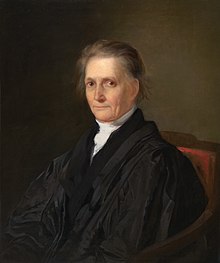
To me it appears likely that West Ford and Supreme Court justice Bushrod Washington (1762–1829, shown here) were related in some way—probably more closely than West Ford and the late President.

Monday, September 21, 2020

When Women Lost the Vote in New Jersey, and Other Troublesome History

Yesterday I wrote about what might be the first and only example of women voting in an official forum in colonial America, two property-owning widows expressing their views at a special Sudbury town meeting in 1655.

The next documented example of American women voting in a governmental election came in New Jersey after the Revolution. As I wrote back in 2010, the state constitution allowed widows and single women meeting the property requirement to vote.

Newspapers at the time made clear that some women did exercise that right—it wasn’t just an abstraction. However, most of what we knew about the custom came from each party complaining that the other side was doing too much to woo female support. In 1807, the men in charge of New Jersey took care of that problem by rewriting the constitution to restrict the vote to men only.

This year we’re observing the hundredth anniversary of the Nineteenth Amendment to the U.S. Constitution and of the first national election in which American women voted. (Those who weren’t disenfranchised because of race, that is.)

The Museum of the American Revolution in Philadelphia decided to use that occasion to dig deeper into the history of female suffrage in New Jersey. As reported earlier this year in the Philadelphia Inquirer and in the New York Times, researchers from the museum went looking for voter rolls that might name women who actually cast ballots.

Jennifer Schuessler reported on the challenge in the New York Times:
A 1920 article in a small historical journal included a transcript of a 1787 poll list from Burlington Township showing two women’s names. But the original list could not be found, and some scholars wondered if the names were transcription errors. (Was “Iona” a woman’s name, or a misreading of “Jona,” a common abbreviation for Jonathan?)

A footnote in a 1992 scholarly article mentioned an 1800 list from Bedminster apparently showing a few women’s names. But that, it seemed, was it.

And so Dr. [Marcela] Micucci began trying to locate surviving poll lists — rarities in themselves — to see if they included women’s names that could be verified against other records.

The first big hit was an 1801 poll list from Montgomery Township, held at the New Jersey State Archives in Trenton, which had acquired it in 2016 from the descendant of a long-ago county clerk.

Dr. [Philip] Mead recalled being on the phone when Dr. Micucci walked in, waving a photocopy with what turned out to be nearly four dozen women’s names highlighted.
As of February, the research team had found eighteen poll lists from four townships, half of those rolls including women’s names. A detail from one such document appears above.

The pandemic disrupted the M.A.R.’s initial plans for its “When Women Lost the Vote” exhibit, but it’s opening next month. The museum says:
Featuring original objects including textiles, works of art, and newly-discovered poll lists highlighting women voters from the period, the exhibition will bring to life the forgotten stories of the women who first pioneered the vote and became role models for women's suffragists two generations later. “When Women Lost the Vote” is an inspiring story that will encourage visitors to reconsider their understanding of the timeline of women’s history in America, but it is also a cautionary tale about one of America’s first voting rights crises. The exhibition will be integrated within the Museum’s permanent galleries and connected by an audio tour.
This exhibition will run through 25 Apr 2021. There are restrictions for visitors to preserve public health.

Also from the M.A.R., on Thursday, 24 September, Annette Gordon-Reed, the Carl M. Loeb University Professor at Harvard University, will deliver the Carl M. Buchholz Memorial Lecture on the topic “The Past in the Present: Dealing with Troublesome Histories.”

Gordon-Reed has written extensively about some of the troublesome aspects of Thomas Jefferson, as well as his more admirable sides, in her books Thomas Jefferson and Sally Hemings, The Hemingses of Monticello, and “Most Blessed of the Patriarchs” with Peter S. Onuf. She has also written a short biography of—talk about troublesome!—President Andrew Johnson.

Watching this online lecture live requires registering in advance. The log-in period will begin on Thursday at 5:45 P.M., and the lecture at 6:00. There will be a question period afterward.

Wednesday, September 13, 2017

Interview with Jefferson Scholar Annette Gordon-Reed

The Harvard Gazette shared an extraordinary interview with university law and history professor Annette Gordon-Reed.

She talks about experiences ranging from being the first black student at her East Texas elementary school to running from the World Trade Center complex during the 2001 terrorist attack.

Here are portions of Gordon-Reed’s thoughts on how Thomas Jefferson was a slaveholder and the Adams family were not:
I suppose I have come to know different Jeffersons as I have become different myself, because you notice different things as you get older. And after working on “Most Blessed Patriarchs: Thomas Jefferson and the Empire of the Imagination,” with my co-author Peter Onuf, I tend to notice vulnerability more than I did before. The book is about him through his entire life, but I would say the perspective is from the older guy looking back over his life, and from that perspective you realize how hard it is to do things.

The Jefferson that I see now is more vulnerable. When I was younger, I saw Jefferson as more powerful than any normal human being. And that tendency to attribute supernatural powers to him helps account for a lot of the anger that people have about him: “Why didn’t you end slavery? Why didn’t you do something about slavery?” And then you think about someone who was a lawyer, a governor, a revolutionary, who wrote the Declaration of Independence, was an ambassador, who was a vice president, who was a president, who founded a university, and then you say, “And why didn’t you end slavery?”

I think about the people who say that, and I think about myself. What is it that I’ve done that approaches all of that? And in asking that question, I now see him with a bit more humility, recognizing how hard it is to do anything, how hard it is to accomplish things. . . . The goal for the last book was to try to understand him on his own terms, to accept the problematic aspects of his life and work, but to also have a degree of humility in looking at a historical figure who didn’t have the advantages that we have in understanding the world. I am much more concerned about people today who harbor racial sentiments that are destructive, who have had a chance to learn more than somebody who was born in 1743. . . .

I think it’s comparatively easy to be John Adams when it’s not a slave society [in Massachusetts] and there’s no huge population of blacks. It’s not what whites do when there are one or two black people; it’s what they do when there are large numbers of black people, and that is in operation today. John Adams did not grow up in a slave society. He didn’t have the same things at stake.

There’s a famous letter Abigail Adams writes about seeing “Othello” for the first time, in which she expresses revulsion at the idea of this black person with this white person. Their son, John Quincy, wrote a review of the play as an older man in which he basically said: “Desdemona deserved to die.” And abolitionist Fanny Kemble mentions Adams at a dinner party essentially saying she deserved to die for marrying “a nigger.”

So you honor John Quincy for being a great champion of [abolishing] slavery but recognize that he was also stone racist. That’s a contradiction I think people may not know. A lot of these people had really conflicted views about race. Unlike Jefferson, John Quincy tried to do something about it as a member of the House of Representatives. But he was really, really racist.
Of all the Adams family, John Quincy commented most explicitly and unfavorably on Jefferson’s relationship with Sally Hemings. It apparently bothered him not just because of the man’s old rivalry with his father but also because of his prejudices.

Monday, October 03, 2016

“William Costin’s reputed father was white”

As I wrote yesterday, Martha Washington’s son John Parke Custis is believed to have had a child by an enslaved woman named Ann Dandridge around 1780 as well as children with his wife, Eleanor.

Jack Custis died in 1781 of a disease he contracted during the siege of Yorktown. His wife remarried. She continued raising their two eldest children while the two younger grew up at Mount Vernon with their grandmother Martha and her second husband, George.

Ann Dandridge was herself the daughter of an enslaved woman and John Dandridge, Martha’s father—which means she was also an aunt of Jack Custis. In An Imperfect God, Henry Wiencek reported that Ann Dandridge eventually married a man named Holmes, and the husband of Jack Custis’s oldest daughter, Eliza Custis Law, freed her in 1802.

What happened to the child of Jack Custis and Ann Dandridge? The answer became public in, of all places, The Special Report of the Commissioner of Education on the Condition and Improvement of Public Schools in the District of Columbia: Submitted to the Senate June, 1868, and to the House, with Additions, June 13, 1870. The federal government published that lengthy report in 1871. It contained a thorough discussion of schools in the District, including some for African-Americans started by a family named Costin.

Although this information wasn’t connected to the condition of the schools, the report stated:
This Costin family came from Mount Vernon immediately after the death of Martha Washington, in 1802. The father, William Costin, who died suddenly in his bed, May 31, 1842, was twenty-four years messenger for the Bank of Washington, in this city. His death was noticed at length in the columns of the National Intelligencer in more than one communication at the time. The obituary notice, written under the suggestions of the bank officers, who had previously passed a resolution expressing their respect for his memory, and appropriating fifty dollars towards the funeral expenses, says: “It is due to the deceased to say that his colored skin covered a benevolent heart,” . . .

John Quincy Adams also, a few days afterwards, in a discussion on the wrongs of slavery, alluded to the deceased in these words: “The late William Costin, though he was not white, was as much respected as any man in the District, and the large concourse of citizens that attended his remains to the grave, as well white as black, was an evidence of tho manner in which he was estimated by the citizens of Washington.” His portrait, taken by the direction of the bank authorities, still hangs in the directors’ room, and it may also be seen in the houses of more than one of the old and prominent residents of the city.

William Costin’s mother, Ann Dandridge, was the daughter of a half-breed, (Indian and and colored,) her grandfather being a Cherokee chief, and her reputed father was the father of Martha Dandridge, afterwards Mrs. Custis, who, in 1759, was married to General Washington. These daughters, Ann and Martha, grew up together, on the ancestral plantations. William Costin’s reputed father was white, and belonged to a prominent family in Virginia, but the mother, after his birth, married one of the Mount Vernon slaves by the name of Costin, and the son took the name of William Costin. His mother being of Indian descent, made him, under the laws of Virginia, a free born man. In 1800 he married Philadelphia Judge, (his cousin,) one of Martha Washington’s slaves, at Mount Vernon, where both were born in 1780. The wife was given by Martha Washington at her decease to her granddaughter, Eliza Parke Custis, who was the wife of Thomas Law, of Washington. Soon after William Costin and his wife came to this city the wife’s freedom was secured on kind and easy terms, and the children were all born free. This is the account which William Costin and his wife and his mother, Ann Dandridge, always gave of their ancestry, and they were persons of great precision in all matters of family history, as well as of the most marked scrupulousness in their statements.
That report didn’t come out and name William Costin’s father, but it linked him and his mother and his wife to Mount Vernon. That left no doubt about which “prominent family in Virginia” his father hailed from. Anyone who knew the Washington-Custis family tree could figure out the rest. Elizabeth Van Lew of Richmond certainly put the pieces together in her private papers, Wiencek found.

Though this account says Costin’s surname came from his mother marrying “one of the Mount Vernon slaves,” I can’t help but wonder if Costin was simply a safe variation on Custis. I can’t find any other mention of an enslaved man named Costin at Mount Vernon.

William Costin’s wife, Philadelphia or Delphy Judge, was a sister of Oney Judge, who escaped to New Hampshire in 1796. If Delphy Judge and William Costin were indeed first cousins, as this profile suggests, the Judge sisters’ mother, “Mulatto Betty,” must have been a sister or half-sister of Ann Dandridge.

The 1871 profile said that for William Costin “being of Indian descent, made him, under the laws of Virginia, a free born man.” In fact, the laws of Virginia assigned him the same status as his mother, who was enslaved. Wiencek suggests that the Custis-Washington family treated William as free simply because they preferred it that way. He and his family remained at Mount Vernon until Martha’s death, then went to the capital, the women and children becoming formally free in the next few years.

It’s notable that this federal government report discussing gentlemen in Martha Washington’s family having children with enslaved women appeared at almost the same time that a U.S. Census taker noted Madison Hemings’s statement about being a son of Thomas Jefferson and Sally Hemings. That was between the Civil War and the end of Reconstruction in 1877. In that narrow window, it appears, some black Americans felt more free to talk about their white ancestors and some white Americans openly acknowledged the realities of intertwined families.

Tuesday, December 15, 2015

Notes on the Stat(u)e of Jefferson

Yet another focus of recent campus protests against honoring historic figures whose behavior was less than honorable has been statues of Thomas Jefferson at the University of Missouri (shown here) and the University of Virginia.

Jefferson was a lifelong slaveholder, of course. He decried the practice, but he never managed to try or even endorse any of the schemes to end slavery that friends presented to him. Jefferson also wrote bigoted things about black people, especially in Notes on the State of Virginia, which some historians argue formed part of the foundation of “scientific racism” in America.

Ironically, Jefferson probably had children with a woman of some African ancestry, his slave Sally Hemings. Because of her age at the time of their first reported child, and because of the power difference between them, many people characterize that relationship as exploitation or even rape.

Of course, there was a lot more to Thomas Jefferson than that. Unlike Isaac Royall, who wasn’t really important, and John C. Calhoun, whose major ideas were repudiated long ago, Jefferson’s ideas and actions are still crucial to the U.S. of A. (In that respect he’s like Woodrow Wilson, another target of criticism for racist policy.) It would be especially difficult to repudiate Jefferson at the University of Virginia since he founded the school.

Some people have argued for removing the Jefferson statues from those campuses. I’m more impressed by the form of protest that evolved out of that debate: students putting sticky notes onto the figures expressing their opposition to the more reprehensible parts of Jefferson’s behavior. Or, presumably, they could express praise, or other thoughts.

I see potential in that becoming a meaningful ritual. It could open discussions, allowing for ongoing acknowledgment of Jefferson’s problematic side without erasing his historical contribution. It could be a form of recurrent iconoclasm without permanent or complete erasure, which brings the dangers of complacency and amnesia.

Certainly it can be a more valuable way of dealing with campus statues than rubbing them for luck, as Harvard students have reportedly done for decades. (Of course, tour guides reportedly say Yale students rub the statue of Nathan Hale the same way, and I can say with certainty that’s a myth.)

Saturday, December 27, 2014

I Only Read This Book for the Relatable Past

You might think that Thomas A. Foster’s Sex and the Founding Fathers is about the sexual behavior of the men who led the American Revolution and the creation of the federal government. But take a look at the subtitle: The American Quest for a Relatable Past.

That signals how this study isn’t about those men’s sexual thoughts or behaviors, about which we have very little information, anyway. Rather, it’s about how American authors have described the sexual side of those men’s lives, in many cases selecting and massaging the known facts to fit what they wanted the readers of their times to believe, or what readers wanted to read.

For instance, what has it meant to Americans that George Washington, the “Father of His Country,” evidently couldn’t father children? Was it a somewhat embarrassing reflection on his masculinity, or a natural frustration that humanizes him, or even a handy refutation of the occasional suggestions that he had children out of wedlock? (Of course, he could have had extramarital affairs without leaving the evidence of a fertile man.)

Foster notes Washington biographers stating strenuously that his infertility problem could not have been due to a sexual transmitted disease—that was simply beyond reason. But they were mum about the possibility of erectile dysfunction, a much more common problem for men but one with symbolic implications of impotence in other areas. (Foster doesn’t discuss a theory I recall seeing bandied about in recent decades, that Washington might have had Klinefelter syndrome, due to XXY chromosomes. Talk about raising gender issues!)

Foster also discusses how historians have treated John Adams, who was known for his long, close, and faithful marriage, and Thomas Jefferson, Alexander Hamilton, Benjamin Franklin, and Gouverneur Morris, who weren’t. Originally the book also discussed Aaron Burr, but Foster converted that material into this article at Common-Place; in contrast to the others, American authors could gleefully discuss Burr as a libertine because he became a villain in the national saga.

Sex and the Founding Fathers also shows how the Founders serve as a barometer of the culture’s attitude toward sexual behavior. For instance, late in the Victorian period the Massachusetts Senator George F. Hoar decided that Franklin, of all people, didn’t belong in a National Hall of Fame:
Dr. Franklin’s conduct of life was that of a man on a low plane…one side of his character gross and immoral. . . . [His letter] on the question of keeping a mistress, which, making allowance for the manners of the time, and all allowance for the fact that he might have been partly in jest, is an abominable and wicked letter; and all his relation to women, and to the family life were of that character.
Come on, Senator, tell us how you really feel!

For me the star of this book was Gouverneur Morris, the least known of its subjects. He was frankly interested in sex throughout his long bachelorhood. Foster argues that Morris doesn’t deserve to be called a rake, however, because he (at least sometimes) passed up sex if he and his lover weren’t really in love, because he cared about whether those women had a good time, and because some of his affairs lasted for years. He just had a lot of them, and his (married) male friends liked to gossip about him.

Foster notes that only four full-length biographies of Morris were published in the 1800s and 1900s. Since 2003, however, there have been “three academic works and two popular biographies.” Those discuss the sexual side of Morris’s life more frankly—far more frankly—than books of previous eras did. Perhaps Gouverneur Morris is the Founder for our time.

In case you wonder, Sex and the Founding Fathers does come with illustrations. Illustrations like “A Philosophic Cock,” a political cartoon attacking Jefferson for his relationship with Sally Hemings.

Wednesday, December 24, 2014

Complete Medical Histories from the Founders

Jeanne E. Abrams’s Revolutionary Medicine: The Founding Fathers and Mothers in Sickness and in Health came out from New York University Press in 2013. Here are an H-Net review, a Journal of Interdisciplinary History review, a C-SPAN video, and a podcast discussion of the book on Liz Covart’s “Ben Franklin’s World” podcast.

I didn’t find the book to be as interesting as some other reviewers have. Most of it consists of chapters on George and Martha Washington, Benjamin Franklin, John and Abigail Adams, and Thomas Jefferson, with a few pages each on James and Dolley Madison and on Dr. Benjamin Rush. Each chapter takes the form of a capsule biography pinned with seemingly all details about its subjects’ health preserved in their papers. Thus, we read every mention of illness in letters or diaries, every known instance of ill health, every bit of health legislation, every possible diagnosis from a latter-day article.

However, those profiles don’t dig very deep below the surface. For example, some scholars have suggested that Abigail Adams, after suffering a health scare giving birth and losing a child, found a way to keep from becoming pregnant so often—possibly longer breast-feeding. But Adams didn’t write about that openly, so it doesn’t make the book. In fact, Revolutionary Medicine seems to have no discussion of birth control at all and only one mention of breast-feeding, which shows the limits of its approach.

Similarly, while these profiles offer an exhaustive discussion of the medical experiences of their elite subjects, they don’t delve far into how the bulk of families with less money experienced health crises and medical care. We learn—as if we didn’t already know—that eighteenth-century medicine was usually painful, disruptive, and useless, but the book doesn’t have much to say about why these people nonetheless thought they were getting the best care possible.

Abrams is Professor at Penrose Library and the Center for Judaic Studies at the University of Denver, and her previous books are about Jewish immigrants to the American west in the nineteenth and early twentieth century. This book didn’t give me a sense that she was yet at home in the world of the eighteenth century, despite the extensive mining of the Founders’ personal papers.

Certainly Abrams seems to have a limited view of the consensus of the field. Page 180 says, “Despite decades of controversy, many historians now believe that it is unlikely that Jefferson conducted a liaison with Sally Hemings and that there is no verifiable proof that he fathered any of her children.” That’s backwards: most historians of early America today believe it likely that Thomas Jefferson had a long sexual relationship with Sally Hemings. Abrams doesn’t explain what she means by “verifiable proof” about the paternity of a child born two hundred years ago, but we have more biological evidence about Hemings’s children than about practically any others from the period.

Abrams ventures into modern politics in her book’s last paragraph, declaring that the Founders “surely would have balked at requiring all citizens to purchase health care insurance.” She doesn’t reconcile that statement with a fact reported on page 155, that President John Adams pushed for legislation requiring all American sailors to give up some of their wages to support the Marine Hospital Service—i.e., Adams’s administration required a class of its poorer citizens to purchase health care insurance.

Given how much Revolutionary Medicine says about the Founders’ very limited knowledge of medical science, I’m not sure how their opinions can carry much weight on modern medical policy anyway. We might as well ask if they’d require surgeons to scrub their hands before operating.

Monday, January 07, 2013

Reviewing Jefferson the Politician

The Jefferson tussles continue with Henry Wiencek, author of Master of the Mountain, assessing Jon Meacham’s political biography Thomas Jefferson: The Art of Power in The New Republic:
Meacham has read the scholarly literature on Jefferson—some of it critical—but doesn’t let enough of this debate intrude on the storytelling, which nearly always puts Jefferson in the best possible light. . . .

In his notes, Meacham concedes that “a vapor of duplicity,” as Charles Francis Adams wrote, beclouds this founder. But Meacham hastens to reassure us that Jefferson would never tell a lie. If his language seemed to deceive, the deception must be in the ear of the listener: “He hated arguing face-to-face, preferring to smooth out the rough edges of conversation …” Thus, Jefferson gets a pass for lying to [George] Washington when he sought to deceive the president about his deep involvement in the propaganda wars raging in the newspaper: “Jefferson had been dishonest …preferring to mislead Washington rather than force a confrontation.” This was power politics at its dirtiest—and most fascinating—yet Meacham gives it only cursory attention, perhaps because, as he admits, Jefferson’s financial ties to the propaganda hounds reeked of “the smell of the stables.”
Abigail Adams fell out with Jefferson not just over the 1800 election but over his bald-faced denials that he had anything to do with press attacks on her husband. On 1 July 1804 Abigail wrote to the President of the U.S. of A.:
And now Sir I will freely disclose to you what has severed the bonds of former Friendship, and placed you in a light very different from what I once viewed you in. . . .

Until I read [James Thomson] Callenders seventh Letter containing your compliments to him as a writer and your reward of 50 dollars, I could not be made to believe, that such measures could have been resorted to: to stab the fair fame and upright intentions of one, who to use your own Language “was acting from an honest conviction in his own mind that he was right.” [In other words, her husband.] This Sir I considerd as a personal injury. This was the Sword that cut asunder the Gordian knot, which could not be untied by all the efforts of party Spirit, by rivalship by Jealousy or any other malignant fiend.
Jefferson, of course, denied that he had been supporting Callender when that printer attacked the Adams administration. Abigail Adams didn’t believe him, and rightly so.

As author of a study of Jefferson’s slaveholding, Wiencek naturally considers what Meacham has to say on that topic:
The shadow of the Peculiar Institution looms over this book and, I suspect, is the main reason why Meacham so persistently emphasizes Jefferson’s political “realism” and his refusal to move farther and faster than the law or the public mood allowed. Meacham has no problem with bold presidential moves such as the Louisiana Purchase, which as Meacham admits, was illegal (the Constitution did not provide for its acquisition) and Jefferson’s naval action against the Barbary pirates, which he pursued without Congressional approval (he secured it retroactively). But slavery is always a special case. Slavery was just one of “the complexities of life.” Sally Hemings was not enslaved by Jefferson but by “geography and culture.” When the political issue is slavery, the man who elsewhere seizes control and imposes his will, immediately gives up: “Wounded by the defeats of his progressive efforts on slavery, Jefferson was finally to retreat to a more conventional position.” Meacham does not let Jefferson entirely off the hook, but his rebuke is gentle.
Meacham uses the phrase “geography and culture” when writing of young Sally Hemings in Paris, saying that having previously enslaved her (i.e., she was born to an enslaved mother in British-speaking North America), those circumstances now offered a risky opportunity for freedom. On the same page of the book, Meacham writes that Jefferson had this “beautiful woman at his command” because of “an evil system,” and “he was not a man to deny himself what he wanted.” So it’s not as if Meacham erases Jefferson and his desires from the picture.

In fact, Meacham, unlike most Jefferson biographers before 1998, cites Madison Hemings’s account as the most reliable source on his mother Sally’s life. Seeing a complimentary biographer do that reveals how much the ground has shifted on the consensus picture of Jefferson.

Nevertheless, Wiencek makes an important point. If Meacham’s Jefferson “was not a man to deny himself what he wanted” yet took very few steps toward ending slavery at Monticello, he can’t have wanted emancipation as much as he said he did. At the very least, he wanted other things more.

Friday, November 30, 2012

“Instead, he cites Annette Gordon-Reed?”

Until I read this week’s New York Times article on Henry Wiencek’s Master of the Mountain: Thomas Jefferson and His Slaves, I didn’t realize how that book treats the work of Annette Gordon-Reed.

As I wrote yesterday, Gordon-Reed’s Thomas Jefferson and Sally Hemings: An American Controversy sparked the recent boom in books about the third President’s conflicted attitudes toward slavery. Her The Hemingses of Monticello, which won a Pulitzer Prize in 2009, is a major study of American slavery, not just slavery at Monticello.

So how does Wiencek discuss Gordon-Reed’s work? Master of the Mountain mentions her books only three times. Two endnotes mention (but don’t quote) transcription errors in the first edition of Thomas Jefferson and Sally Hemings: An American Controversy. Those are undoubtedly sensitive spots for Gordon-Reed since a Jefferson descendant who disliked that book tried to use those errors to have her fired from New York University in July 2001. The Times reports:
David Waldstreicher, a historian at Temple University and the author of several books about slavery and the founders, called those footnotes (which do not identify the errors or acknowledge that Ms. Gordon-Reed corrected one of the transcriptions a decade ago in a reissue of her 1997 book) “fighting words” and “about as nasty as it gets.” A professional historian, he continued, “would publish this in a scholarly journal and make it very clear how it makes a difference, instead of using it to say, ‘I am the last word.’”
Wiencek told the newspaper “that the transcription errors were minor,” but his endnotes don’t leave that impression.

The third reference to Gordon-Reed’s work is this passage:
Many writers on slavery today have emphasized the “agency” of the enslaved people, insisting that we pay heed to the efforts of the slaves to resist their condition and assert their humanity under a dehumanizing system. But as slaves gain “agency” in historical analyses, the masters seem to lose it. As the slaves become heroic figures, triumphing over their condition, slave owners recede as historical actors and are replaced by a faceless system of “context” and “forces.” So we end up with slavery somehow afloat in a world in which nobody is responsible.

One historian writes about Monticello’s slaves as if they had no master: “There is every indication that they grasped the baleful situation they had been born into, and knew that forces were actively working to keep them down.”
And there’s an endnote pointing to page 405 of Gordon-Reed’s The Hemingses of Monticello. That sentence comes from a paragraph about how Sally Hemings’s son Madison learned to read. The same paragraph refers to Jefferson by name and calls his grandchildren Madison’s “white nieces and nephews, who were his age and going to a school that he knew he could never attend, but wanted to.” That’s not a picture of a “faceless system”—it puts specific faces on the system and tells us exactly who was “responsible” for Madison Hemings’s oppression and who benefited from it.

That’s why Prof. Jan Lewis of Rutgers told the Times, “There are historians who in their eagerness to discover the slave perspective have averted our attention from the ways in which slavery really was a horrible, unjust institution, but he doesn’t cite them. Instead, he cites Annette Gordon-Reed? You’ve got to be kidding me.”

I suspect that treatment was a big reason why Gordon-Reed and Lewis published their critical assessments of Master of the Mountain so quickly after its publication, and in online venues (Slate and The Daily Beast) where those reviews could run immediately. Ordinarily the wheels of scholarship grind slow. But this was personal.*

Reading Wiencek’s response to those critical reviews on the Smithsonian website, I think he further mischaracterized Gordon-Reed’s work:
I am not surprised that Gordon-Reed disliked my book so much, given that it systematically demolishes her portrayal of Jefferson as a kindly master of black slaves. In The Hemingses of Monticello, she described with approval Jefferson’s “plans for his version of a kinder, gentler slavery at Monticello with his experiments with the nail factory.”
If Master of the Mountain had “systematically” addressed Gordon-Reed’s portrayal of Jefferson, it really should have cited her work more than three times. And this is the actual passage from The Hemingses of Monticello that Wiencek partially quoted in his riposte:
Building the nation was Jefferson’s true obsession [as President], not the end of slavery and definitely not the racial question.

As he retreated from the antislavery rhetoric of his youth, and grew comfortable in his role as the champion of the common man (the common white man), Jefferson, like others of his type, began to accommodate himself to the institution of slavery. As was discussed earlier, Lucia Stanton has detailed his plans for his version of a kinder, gentler slavery at Monticello with his experiments with the nail factory. He also brought in overseers who eschewed violence in favor of incentives as a way of motivating enslaved worked; for unexplained reasons, however, the men did not remain in his service. Jefferson was again, in all of this, ahead of his time—on the leading edge of adopting the sort of paternalism that would in the coming decades turn his white grandchildren’s generation into full-throated apologists for the peculiar institution.
Gordon-Reed published that book in 2008, during the sunset of George W. Bush’s Presidency. How can anyone think that she used the phrase “kinder, gentler” without irony? Wiencek appears to have missed not only that sentence’s tone but also how it expresses Jefferson’s perception, not Gordon-Reed’s: “his plans for his version…”

Where is the “approval” that Wiencek perceives from Gordon-Reed? Where is her portrayal of Jefferson as a “kindly master”? The only time The Hemingses of Monticello uses the word “kindly” for Jefferson is in describing how his acknowledged grandchildren perceived him. And that paragraph ends, “Kindly, doting grandfathers can be sexual beings, too…” Gordon-Reed assesses the master of Monticello like this:
It may be difficult from our vantage point to believe that Jefferson had an internal sense of justice and fairness, depending as he did on a labor system that was constitutively unjust and unfair. By holding upward of two hundred “souls,” as he called them, in bondage, he worked injustice and unfairness in their lives every single day. . . . But Jefferson did have his own sense of fairness within the confines of his inhumane way of life…
It appears that Wiencek perceives any attempt to understand Jefferson’s thinking instead of simply calling him monstrous as “approval.” For fifteen years Gordon-Reed has been attacked by reactionary critics who felt she was out to denigrate Jefferson when she studied his contradictions. Now Wiencek brands that same work as the most prominent attempt to gloss over Jefferson’s racism.

* Speaking of personal, I should say that I’ve chatted with Gordon-Reed after a couple of her talks over the past decade and exchanged a few emails with Wiencek years back, but I’m not a friend or colleague of either.

Thursday, November 29, 2012

Academic History, Popular History, and Jefferson’s Slaveholding

A more salient element of the debate over Henry Wiencek’s Master of the Mountain: Thomas Jefferson and His Slaves than differing interpretations is the divide between popular and academic history.

Wiencek is an “independent scholar,” not an academic. And more power to him. He’s written two books on American slavery and its legacy, The Hairstons and An Imperfect God, that received good reviews from in and outside academia.

Master of the Mountain’s loudest critics have come from inside the academy. Annette Gordon-Reed is a professor of history and law at Harvard. Jan E. Lewis is a professor of history at Rutgers. David Waldstreicher, also quoted in the recent New York Times article about the controversy, is a professor at Temple. Another researcher who raised her voice on their side, Lucia Stanton, recently retired as historian at Monticello.

But there’s no real enmity between scholarly and popular historians. There’s even some overlap, with some professors publishing through commercial presses that don’t use peer review and some popular writers winning research fellowships. It may well be more of a system of mutual envy from both sides of the fence. Independent scholars might wish for the regular salaries, library access, and prestige of professors. Academic authors might wish they had no teaching responsibilities and could reap big advances by retelling great stories that break no new historiographical ground. But that situation has been in place for years; it inspires more bemusement than passion.

Book marketing might be a source of more friction. Basically, all history books these days have to be promoted as “the untold story.” Even if a book is about a topic that dozens of people have already covered, its publisher wants to be able to announce that it offers important new information. And academic and popular historians have different yardsticks for what’s new. For a professor, the innovation might lie in a research finding, interpretation, or methodology. In contrast, popularizers often define what’s “new” as what overturns the understandings of the general public, which can lag the scholarly discussion by decades.

In writing about Thomas Jefferson and his slaves, Wiencek certainly isn’t traversing unexplored territory. The last fifteen years of Jefferson historiography have been largely consumed with assessing the man’s attitude toward slavery, with particular regard to the strong evidence that he had children with his slave Sally Hemings. Though there were important antecedents, that trend picked up after Gordon-Reed’s Thomas Jefferson and Sally Hemings: An American Controversy was vindicated by D.N.A. findings in 1998. Lots of books followed, including some by scholars who had previously dismissed the Hemings evidence and were catching up.

Furthermore, that sea change in interpreting the Jefferson-Hemings relationship made the newspapers. It prompted new depictions of the third President in popular entertainment. Today Americans are probably more sensitive than ever before to how Jefferson exploited enslaved people. To be sure, there are diehard Jefferson “defenders,” just as there are a few examples of what Wiencek refers to as “slavery’s retrospective apologists.” But there really aren’t enough of those folks to make the case that it’s “new” to reveal Jefferson as a slaveholder.

Master of the Mountain strives for novelty in arguing that Thomas Jefferson was a harsher slaveholder than previous authors have described. In some respects it does this by presenting new arguments. The book is the first to make much of two documents I noted yesterday: Jefferson’s 1793 letter about the growth of slave economies and the 1801 letter about whipping boys in the nail factory. Wiencek’s depiction of Jefferson committing himself to lifelong slaveholding in the early 1790s is new—and debated. But such interpretations aren’t what’s got the academics so upset.

Rather, Master of the Mountain increases its claim to novelty by complaining that previous writing on Jefferson (all of it? a lot? too much?) has minimized or excused the man’s slaveholding. Among those titles Wiencek includes not just older works but some of the groundbreaking academic books of recent years. And some of the arguments in his book appear “new” only in that they don’t acknowledge similar arguments in recent studies.

For example, Wiencek discusses how Jefferson handled Thaddeus Kosciuszko’s bequest suggesting that he free some of his slaves. Gary B. Nash and Graham Russell Hodges were exploring that episode back in 2007. They published a book on the topic: Friends of Liberty: Thomas Jefferson, Tadeusz Kosciuszko, and Agrippa Hull. As far as I can tell, Master of the Mountain doesn’t mention their work at all.

But even that, I don’t think, is what’s fueling the current critique. For decades academic authors have watched popularizers write books that are twenty years behind scholarly findings and take those “new” stories onto the bestseller lists. Something else is happening in this case.

TOMORROW: How Master of the Mountain treats Gordon-Reed’s work.

Monday, October 22, 2012

Reviews of Master of the Mountain

In 1997 Annette Gordon-Reed’s Thomas Jefferson and Sally Hemings: An American Controversy persuasively argued that most previous discussions of the evidence about the relationship between the third President and his enslaved housekeeper were inaccurate and one-sided.

The following year, Nature published D.N.A. tests on surviving patrilineal descendants of Jefferson, Hemings, and others that ruled out the stories the President’s legal descendants had put forward and proved consistent with the long-dismissed recollections of Sally Hemings’s son Madison.

That revelation prompted widespread reassessment of Jefferson’s private life and conflicted writing about slavery. Among the first titles in that wave was the 1999 essay collection Sally Hemings and Thomas Jefferson: History, Memory, and Civic Culture, edited by Jan Lewis and Peter Onuf. Like Gordon-Reed’s book, it was published by the press of the Virginia university that Jefferson himself had founded.

Many more books have followed, including some by authors who had previously dismissed the evidence of a sexual relationship between Hemings and Jefferson. The reassessment extended well beyond that topic, and it’s now common among both scholars and the public to recognize the contradictions in Jefferson’s words and behavior about slavery.

The latest study of that subject is Henry Wiencek’s Master of the Mountain, which I mentioned back here. It appears to be among the most negative assessments of Jefferson and his “modern apologists,” in Publishers Weekly’s terms. Reviews by non-historians in the Washington Post, Salon, and other venues have praised Wiencek for debunking Jefferson’s image.

But Gordon-Reed and Lewis, Jefferson scholars but certainly not apologists, disagree. This month both published detailed reviews of the book, criticizing it for being too harsh about the planter’s behavior and for misrepresenting evidence to make its case.

For example, Gordon-Reed wrote in Slate:
He suggests that Jefferson purchased collars—iron spiked vises—for slaves. Follow Wiencek’s logic and note the incredible inferential leaps required to link these disparate occurrences into a chain: Jefferson’s father, Peter, advertised for a runaway slave (in 1751) who was wearing an iron collar; Jefferson must have seen enslaved people being collared when he was growing up; while in France in the 1780s, Jefferson wrote to Nicholas Lewis, the manager of his farms, telling him to use “extraordinary exertions”; and then—“the manager’s expense accounts in 1791 include a line item for the purchase of ‘collars.’”

Wiencek’s endnote explains that he had “at first” thought the reference was to “horse collars.” That view changed after Wiencek noticed that Jefferson wrote “leather collars” or “horse collars” and “Lewis would have been similarly specific.” Therefore, enslaved people at Monticello must have been put in iron collars.

In fact, Monticello had a blacksmith shop that supplied the surrounding community with iron works. Why, then, would Lewis have to buy iron slave-collars from an outside source? And Christa Dierksheide, a researcher at Monticello, says that the man from whom Lewis bought the collars was not a blacksmith. He was a local tenant farmer, and would have used collars for cattle and horses on his farm. Wiencek should have considered this.
Lewis wrote in The Daily Beast/Newsweek:
Sometimes he cites a source and sometimes he does not, but it really doesn’t make much difference because when you go back to the original, too often it doesn’t say what he claims it does. He says, for example—and this is a statement that will astonish historians—that just after the American Revolution “Virginia came close to outlawing the continuation of slavery.” He cites some pages in a recent book that say nothing of the sort. . . .

Wiencek’s key piece of evidence is a letter in which Jefferson “mocked abolitionists for ‘wasting Jeremiads on the miseries of slavery.’” Except that he was talking about the Federalists—the letter is about the Missouri crisis—and the next words in the sentence, which Wiencek doesn’t quote, are: “as if we were advocates for it. Sincerity in their declamations should direct their efforts to the true point of difficulty, and unite their counsels with ours in devising some reasonable and practicable plan of getting rid of it.” . . . The examples of mangled evidence could be multiplied, believe me.
Both Gordon-Reed and Lewis praise Wiencek’s earlier book about George Washington and slavery, An Imperfect God. But they think his new book lacks critical balance and necessary accuracy.

As Jurretta Heckscher noted on Twitter, another significant aspect of these two reviews is that they appeared in online magazines, not in print (at least not at first). There will undoubtedly be more reviews in newspapers and magazines, both popular and academic. Given the reviewers’ expertise and detail, these may set the scholarly consensus.

(Hat tip to John Fea for spotlighting both these reviews.)

Tuesday, February 08, 2011

A Snapshot of Jefferson-Hemings in the Mid-1990s

The World Wide Web is old enough that some pages now preserve the historical consensus of the past, the way libraries have long done. For example, from 1990 to 1997, acclaimed filmmaker Ken Burns worked on a public-television documentary about Thomas Jefferson. He interviewed several leading historians and other voices about the man.

The website created to accompany that broadcast has become a time capsule of that moment in intellectual history, and not just because it still uses frames. That film was made before the 1998 Nature study which matched the surviving Y-chromosome from Sally Hemings’s children and the surviving Y-chromosomes from Thomas Jefferson’s patrilineal line.

Among Burns’s interviewees was Merrill D. Peterson, author of Jefferson in the American Mind. In that book and his interview for the documentary, Peterson said that having children with Sally Hemings would be out of character for Jefferson:

Was Sally Hemings his mistress?

Well, I can’t just say no. Because I can’t... No, I do not believe Sally Hemings was Jefferson’s mistress.

Because...

Well, the reasons for that go partly to the fact that I think it would have been a moral and psychological impossibility for him to have engaged in that kind of relationship with one of the Monticello slaves, especially a person of that age, of that vulnerability, in the way that it’s generally described. It is said that the relationship began when Jefferson was in Paris and Sally had come to Paris bringing Jefferson’s younger daughter. And she would have been 15 or 16 at the time the seduction took place. And it is said that she came home pregnant by Jefferson and that the first child, one who was said to be named Tom, was born. There is no record of the Tom. But that is another question. There is no historical documentary evidence to support any of this. There is oral evidence. But the oral evidence probably came after the written evidence—after the story was written down by [James] Callender and then by others—so that it could have entered into oral memory after it was written down.

But you don’t think he did.

No, I do not think that she was his mistress, no. That would have required—just to pursue this a little further—that he continue this relationship for a period of 25 years and that two of the children would have been born after the Callender story came out and while he was president of the United States. And that would have been a tremendous presumption on the American public, I think, and public sensitivities in this area as well as his own sensitivities. And so I think it's quite impossible.
By the same arguments, William Jefferson Clinton would never have a sexual affair with an intern in the Oval Office after adultery had been a problem for him in the 1992 election, and Strom Thurmond would never have impregnated a sixteen-year-old maid working for his family. In 1996, those arguments seemed more solid than they do now.

In the same series of interviews, historians dismissing the idea of a sexual relationship between Jefferson and Hemings included Andrew Burstein, Joseph Ellis, Lewis Simpson, and Garry Wills, as well as Dan Jordan of Monticello, children’s author Natalie Bober, and translator Stephen Mitchell.

Scholars who were undecided, some saying that the unanswerable question of sex distracted from the undeniable history that Jefferson owned some of his relatives, included James Cox, Paul Finkelman, John Hope Franklin, James O. Horton, and Jan Lewis. Lucia Stanton of Monticello spoke of Hemings and her children’s reminiscences without actually stating what they’d said about their father, at least as transcribed.

Notably, the voices saying they believe the Hemings family account came from outside the ranks of historians: activist Julian Bond, Hemings descendant Robert H. Cooley III, impersonator Clay Jenkinson, and novelist Gore Vidal. (In the rest of the interview transcripts, the name “Hemings” never comes up.)

After the D.N.A. findings, there was a sea change in the historical consensus. Annette Gordon-Reed’s analysis Thomas Jefferson and Sally Hemings: An American Controversy had already shown the relative robustness of Madison Hemings’s memoir and the weakness of the Jefferson family’s explanation. Many historians changed their minds about the likelihood of a relationship. Some might even have done a little scholarly penance, with Wills publishing “Negro President”: Jefferson and the Slave Power in 2003, and Burstein Jefferson’s Secrets: Death and Desire at Monticello in 2005.

Peterson, who died in 2009 at the age of eighty-eight, never wrote or spoke publicly about the Jefferson-Hemings question after the Nature study. His Washington Post obituary reported that he still thought as he had before:
“He did not believe in any sexual connection between Jefferson and Sally Hemings,” Paul M. Gaston, a longtime U-Va. colleague, said yesterday in an interview.

When the evidence for such a relationship became more persuasive in recent years, Gaston said, Dr. Peterson “didn’t argue with it. He just distanced himself from that discussion.”
Diehard deniers continue to list Peterson as a scholar in their camp, but he never engaged openly with the new evidence.

The shift in consensus about the Jefferson-Hemings relationship might be a rare example of Thomas Kuhn’s paradigm shift in history rather than science. The P.B.S. website and Burns’s film (now available on D.V.D.) capture the state of the field just before that happened.

Thursday, November 18, 2010

Reconciliation Among Some Jefferson Descendants

And speaking of Thomas Jefferson’s descendants, earlier this month Search for Common Ground honored three members of that extended family with its 2010 Common Ground Award for “outstanding accomplishments in conflict resolution, negotiation, community and peace building.” Here’s the announcement, and here’s an interview with those descendants on the National Public Radio show Tell Me More.

The people being honored are Shay Banks-Young, Julia Jefferson Westerinen, and David Works, founders of the Monticello Community. That group welcomes descendants of anyone born at Jefferson’s slave-labor plantation, free or enslaved, related to the President or not. Banks-Young and Westerinen trace their descent to Sally Hemings and Thomas Jefferson, and Works to Thomas and Martha Jefferson.

The three met at meetings of the Monticello Association, open only to descendants from Martha and Thomas. At first it didn’t go well. The Search for Common Ground announcement explains:

David Works himself was initially resistant to the idea of including the Hemings, saying he was “really turned off” by what he “perceived to be the Hemings’ really pushy approach” when they first came to an Association meeting. He admits, “Because of the nastiness of the fight, I never got back to the facts of the argument.”

Eventually, however, he decided to research the Hemings’ claims, reading the original 1998 DNA study as well as a contradictory report issued in 2000. He concluded, “When you put it all together, the simplest and most likely answer was that Thomas Jefferson fathered Hemings’ children.”
In the N.P.R. interview, Works refers to Hemings descendants as his cousins.

Meanwhile, Works’s older brother, John Works, Jr., started the Thomas Jefferson Heritage Society to “defend” their ancestor from that notion. In particular, he wanted to keep the Monticello Association from admitting Hemings descendants or letting them be buried in the graveyard the group owns. David disagreed with that vehement approach, and in 2002 ran for president of the Association, telling the Associated Press that he was a “moderate” on the paternity issue.

At the 2002 annual meeting, the Deseret News reported, John Works, Jr., had to apologize for sending “a photograph of a black man with a zipper across his mouth” to another member who had publicly advocated for including the Hemings descendants. Nevertheless, the overall membership voted for David Works’s opponent and, influenced by the Heritage Society arguments, not to admit Hemings descendants. John Works, Jr., was quoted as insisting that people needed “D.N.A. evidence” to make a case for descent from Thomas Jefferson. Curiously, the association’s membership consists of people claiming descent from Martha Jefferson’s daughters with no genetic evidence at all.

Soon afterward, David Works, Banks-Young, and Westerinen started the more inclusive Monticello Community, with its own meetings. But that wasn’t the end of the friction. In the spring of 2003 Works detected that one person in the group’s chat room, “Cassandra Mays-Lewis,” was posting from the same computer as the new head of the Monticello Association, Nat Abeles. Eventually Abeles’s wife Paula admitted that she had created the persona of a Hemings descendant to keep tabs on the other group.

In 2004, John Works, Jr., told Time that his disagreement with his brother David had “fractured an already strained relationship.” Since then a lot has happened, and any rancor might have cooled a bit. But the Monticello Association continues to bar Hemings descendants from membership.

When I first read about the Monticello Community a few years back, I wondered if this new group was a way to offer some sort of second-class membership to those Hemings descendants without actually acknowledging the strong evidence for their ancestry. Instead, the group appears to have become a catalyst and forum for exploring the members’ common heritage and the racial divisions in American society. Which is why its founders are being honored for seeking larger common ground.

Wednesday, November 17, 2010

Jefferson Hair-Splitting

The latest issue of Colonial Williamsburg magazine, both in print and online, offers an article by James Breig titled “Hair’s Breadth: Locks Could Be Keys to Jefferson Mystery.” That “mystery” is the paternity of Sally Hemings’s children, but most working historians today don’t see that question as mysterious at all.

The article claims otherwise:

Casual readers might believe the Jefferson-Hemings question was resolved in the affirmative in 1998, when a DNA study was done involving descendants of the Jefferson family and of Hemings. . . . the DNA evidence was shaky enough that it had to be bolstered by other data.
That’s backwards. The documentary evidence of Thomas Jefferson’s paternity was already strong, and the D.N.A. provided extra evidence—more than we have for similar cases of the same age.

As a result, most serious readers see the Jefferson-Hemings question as resolved to a high level of probability. Thomas Jefferson was the only Jefferson to have control over Sally Hemings, to be documented as near her each time she conceived, to let her children become free, to be identified by those children as their father, to be said by contemporaries to be their father, and so on. A smaller number of readers insist that other some other Jefferson(s) was more likely, but their arguments are unconvincing.

I don’t see any indication that the author of this article, James Breig, has a scientific background. For twenty-five years he was editor of the Catholic Diocese of Albany’s official magazine, and he wrote a book titled The Emotional Jesus. It’s also not clear to me how much of the Jefferson-Hemings historiography he’s reviewed. The article cites online reports, but none of the books or scholarly articles on the matter. In writing, Breig was apparently unaware that Eugene Foster, the pathologist who led the 1998 study, died two years ago; the text refers to Foster in the present tense.

The article suggests that surviving samples of Thomas Jefferson’s hair could be tested for the D.N.A. markers that have been found in patrilineal descendants of the President’s uncle Field Jefferson and patrilineal descendants of Sally Hemings. It states:
If the owners of the hair gave permission to test the locks, and if the hair yielded DNA, two big ifs, conclusive proof, or disproof, of a Jefferson-Hemings union would be accessible.
Except it wouldn’t. Simple “DNA” wouldn’t be enough, as the article itself quotes a “researcher in DNA and genetics” explaining:
DNA is inherited half from the mother and half from the father. . . . In one generation, we expect to find half of the DNA in common between father and son. When there is more than one generation in distance, then the DNA in common is a smaller percentage, and it gets harder to make any clear conclusion. When looking farther distances in many generations, then the total DNA in common is much lower.
That problem is compounded by the fact that any surviving “hair-shaft DNA is generally very fragmented.”

That’s why Dr. Foster focused on the Y chromosome in his study. That chromosome gets passed down pretty much intact from father to son, not mixing with the mother’s genes. Perhaps Breig meant the Y chromosome when he wrote “DNA.”

So let’s imagine that at some future date scientists discover methods by which they can test the existing Thomas Jefferson hair samples for the appropriate Y chromosome markers. Curiously, the article doesn’t try that thought experiment and discuss the two possible results.

Result 1: a match between Thomas Jefferson, patrilineal descendants of his uncle Field, and patrilineal descendants of Eston Hemings (who later took the name Eston Jefferson). Would that result offer “conclusive proof…of a Jefferson-Hemings union,” as the article claims? Not according to its own measure of significant doubt. Any doubters who are still alive would continue to insist that some other—any other—Jefferson male was a more likely father than Thomas.

Result 2: no match between that hair and the patrilineal descendants of Field Jefferson and Eston Hemings. In that case, the simplest explanation is that the hair wasn’t actually Thomas Jefferson’s. But what if several separate hair samples with solid provenances all match? The next explanation would be that a Jefferson other than Thomas fathered Eston Hemings, and that Thomas himself was not actually the son of the man we believe to be his father.

Or perhaps, moving down the ladder of likelihood, that Field Jefferson wasn’t actually the son of Thomas’s grandfather, or Field’s sons were both secretly fathered by another man, and that whoever left his Y chromosome in that Jefferson line also fathered a man in the Hemings line. All without leaving a clear trace in the documentary record.

Genetic testing on Thomas Jefferson’s hair would point to his brother Randolph or his sons—the currently preferred candidates of the anyone-but-Thomas-Jefferson crowd—only if it also suggests that Thomas Jefferson was the product of an affair between his mother and unknown man. Not only would that probably be among the last things Jefferson’s self-appointed “defenders” would want, but it would also create a bigger “Jefferson Mystery” than we have now.

All told, this article doesn’t strike me as adding much to the Jefferson-Hemings discussion. Any worthwhile historian or scientist would welcome more solid evidence, and revise his or her thinking based on it, so future genetic advances might conceivably be helpful. But this article suggests that we lack sufficient evidence about the Hemings children now, and that people shouldn’t acknowledge Thomas Jefferson’s likely paternity until science advances further. That seems like a petty way to justify keeping doubt alive.


Monday, September 27, 2010

The Problem with “Mark Codman”

Yesterday’s Boston Globe included an article by Francie Latour rounding up several books and a movie issued over the past decade about slavery in New England. It offers a good reading list on the subject, including Elisa Lemire’s Black Walden (and avoiding one unreliable recent title).

The article’s subhead says, “More than we like to think, the North was built on slavery”; a bunch of right-wing commenters confirmed that by showing that they’d prefer not to see such essays at all.

I have my own objection to how the article begins:

In the year 1755, a black slave named Mark Codman plotted to kill his abusive master.
The name “Mark Codman” pulled me up short because that’s not how the man was referred to in his lifetime.

John Codman called his slave “Mark,” with no surname. Massachusetts society and legal practices followed suit. Mark was tried, convicted, and executed under that single name. Referring to blacks by only a given name was undoubtedly a way to signal their lesser status in colonial society. But tacking on their owners’ surnames now strikes me as, in its small way, both a distortion of that history and another imposition on those individuals.

In many cases, we know that people who had been enslaved adopted the surnames of their former masters: Tony Vassall of Cambridge, Prince Estabrook of Lexington, Phillis Wheatley of Boston until her marriage to John Peters, and so on. But in other cases, enslaved people used surnames that differed from their owners’ or former owners’.

Crispus Attucks’s last name hints at a connection to the Natick Indians. Peter Salem also went by the name Salem Middlesex; he apparently took surnames from locations rather than from his one-time owners, Jeremiah Belknap and Lawson Buckminster.

In Framingham in 1721, two African-born slaves of the Rev. John Swift married. They are listed in church records as Nero Benson and Dido Dingo, the latter sounding more like an African name than an English one. Subsequent legal records usually refer to this couple by their first names only, but the surname “Benson” got passed down to their free descendants. (In Maryland later, Frederick Douglass was born Frederick Bailey, and never knew where his original surname came from—clearly not his or his mother’s owner. William S. McFeely’s biography suggests it might be a form of “Belali,” a common African name.)

Sally Hemings’s surname came from the ship’s captain who owned one of her ancestors and fathered another. The Hemings family retained that surname for generations despite owners like Thomas Jefferson usually referring to them only by given names. (Even today, one can often detect writers who want to dismiss Sally Hemings and her descendants’ link to Jefferson by how they refer to her only as “Sally,” or spell the name “Hemmings” as a white Jefferson biographer did.)

Being able to control their own names appears to have been significant for African-Americans. Gary Nash showed in a study of Philadelphia that emancipated black families quickly dropped the classical, geographic, and African day-names that colonial slave-owners liked—no more Pompey, Bristol, or Cuffee. Free blacks instead favored Biblical and common English names, like most of their neighbors.

Given those patterns, I always look for the name that an enslaved or formerly enslaved person appears to have freely chosen and preferred, and to try to use it in the same style as I would for white contemporaries: Attucks, Wheatley, Hemings, &c. (Olaudah Equiano presents a difficult case.) But when I can’t find a surname, I don’t add an owner’s surname because I’ve seen enough examples of individuals choosing otherwise. And recognizing people as individuals is what naming is all about.

I can therefore see the motive to give Mark a surname like most of his Massachusetts contemporaries. But he suffered at the hands of John Codman, and killed the man. Would he really want to be retroactively named “Mark Codman”? Enslavement constricted Mark’s life and treated him as less than fully human; the fact that he was called only “Mark” is a significant reflection of that history.

Wednesday, November 25, 2009

The Hemingses at Harvard, 2 December

On Wednesday, 2 Dec 2009, The Charles Hamilton Houston Institute for Race and Justice at Harvard hosts visiting law school professor Annette Gordon-Reed, who will discuss her book The Hemingses of Monticello: An American Family.

Winner of a National Book Award and a Pulitzer Prize, this is a deeply researched study of a family who served Thomas Jefferson throughout America’s founding. It portrays life in rural Virginia, revolutionary Paris, and republican Philadelphia. And of course it gathers all available information on housekeeper Sally Hemings, her children, and their likely father, the third President of the U.S. of A.

This event begins at 6:00 P.M. in the West Classroom of Austin Hall at Harvard Law School, 1515 Massachusetts Avenue, Cambridge. For more information, visit the Houston Institute webpage.