J. L. BELL is a Massachusetts writer who specializes in (among other things) the start of the American Revolution in and around Boston. He is particularly interested in the experiences of children in 1765-75. He has published scholarly papers and popular articles for both children and adults. He was consultant for an episode of History Detectives, and contributed to a display at Minute Man National Historic Park.

Subscribe thru Follow.it


•••••••••••••••••


Showing posts with label Faneuil Hall. Show all posts

Friday, August 14, 2026

“The 65th lost their Arms, Cloathing, and everything”

Yesterday I quoted the first newspaper account of the fire at the 65th Regiment’s barracks on the Town Dock, rented from the Loyalist merchant Benjamin Davis.

Here are some more accounts from the town, starting with Lt. John Barker’s journal entry for 18 May:
About 9 oclock last night a fire broke out in the Barracks of the 65th Regt. on a Wharf near the Market: every house on the Wharf, amounting to 41, was burnt to the Ground, and most of the things in them; the 65th lost their Arms, Cloathing, and everything; and the 47th has lost 4 Companies cloathing; the loss altogether is considerable as they were all stores on the Wharf and full of Goods. – A chest of Bullets was found in [John] Hancock’s store.

Coll. [James] Abercrombie Adjt. Genl., lately arrived from England, going up Cambridge river this morning in a Man of War’s Boat was fired upon by several of the Rebels from the Banks; several balls went thro’ the boat but nobody was hurt; they made the best of their way back, and I don’t hear that he has been as fond of reconnoitring since.

Detachments from the different Corps were sent to extinguish the fire, which had began to break out again; in 4 or 5 hours they effected it.
Merchant John Rowe put in his journal:
17 May … About Eight of Clock A Terrible Fire Broke Out in the Barracks on Treats Wharff Occupied by the 65th Regiment. it was Occasiond by Accident or rather from Great Carelessness — it destroyd 33 Stores on Dock Square — Mine was in Great Danger I thought it So & therefore removd Great part of my Effects — from thence. it continued untill half past One with Progress — The Officers Behavd Very Well

The Cloathing of 4 Companies belonging to the 47th. Regimt was burnt & Some Fire Arms Lost

18 May Thursday Warm Weather W So. W — The People in General very Busy in Collecting the Effects that were Sav'd Out of the Fire
Rumors were more dire, as usual. From Salem, Nathaniel Appelton wrote: “There has been a very great fire at Boston last night don’t yet learn the particulars but in generall that it broke out near draw-bridge & consumed many buildings; some say 30, some say 100, oh poor Boston!”

In fact, this fire appears to have been confined to a central business district. Although lots of warehouses and stores were destroyed, along with the goods inside them, no private homes were lost—just the 65th Regiment’s quarters.

TOMORROW: Newspaper coverage.

Tuesday, December 09, 2025

Reenacting Tea Meetings in Faneuil Hall and Old South

Bostonians had lots of public debates over what to do about the East India Company’s tea, both before and after persons unidentified destroyed it in the harbor on 16 Dec 1773.

Some of the meetings before that event lasted hours and attracted so many people that the crowd had to gather in the Old South Meeting-House instead of Faneuil Hall.

In 1774, after Parliament passed the Boston Port Bill, the town meeting had more sessions devoted to discussing whether the town or any of its citizens should pay for the tea.

Families can sample the arguments at those meetings in two ways this season, both within the buildings where Bostonians actually gathered to debate.

Saturday and Sunday, 13 and 14 December, 1 P.M.
252nd Boston Tea Party Anniversary Town Meeting
Boston National Historical Park
Faneuil Hall

In early 1774 Parliament responded to the destruction of over 90,000 pounds of property by closing the port of Boston until the East India Company was compensated for its loss. In May, Bostonians gathered in the Great Hall in Faneuil Hall to vote on their response. Should they pay for the destroyed property, either officially or by private subscription, and reopen the port? Or should they endorse a boycott of British goods and continue protesting Parliament?

At 3 P.M. on each day, the same space will host the “1873 Women’s Tea Party,” a rally by the New England Women’s Suffrage Association. Leading suffragists argued that they were inheritors of the legacy of the American Revolution.

All these programs at Faneuil Hall are free and open to the public for all ages. They last 30-45 minutes. Sign up to attend here.

Tuesday, 16 December, 5 P.M.
Reenactment of the Meeting of the Body of the People
Revolutionary Spaces
Old South Meeting House

Commemorate the 252nd anniversary of the Boston Tea Party with a live reenactment of the Meeting of the Body of the People—held in the very room where it all began.

Feel the tension rise as fiery patriots debate the fate of the East India Company’s tea before thousands of restless colonists. Hear the shouts, the arguments, and the call for action that set a revolution in motion. Watch history come to life as Samuel Adams, John Hancock, Paul Revere, and others grapple with the decision to take bold action, ultimately leading to the dramatic event that became known as the Boston Tea Party.

(The Boston Tea Party Ships & Museum will not host a reenactment of the destruction of the tea in Boston Harbor this year.)

Ticket prices for the Old South reenactment range from $60 for V.I.P. seating to $25 for members of Revolutionary Spaces. Order tickets through this page. Doors will open at 5 P.M., and the reenactment will start at 6:15.

Thursday, November 27, 2025

A Tight Squeeze for the 1780–81 School Year

When we left the Boston selectmen yesterday, a town meeting committee had just told them that they’d heard the widow Rebecca Holbrook might have a room in her house suitable for teaching handwriting and arithmetic to 70–80 boys.

Since Widow Holbrook’s late husband and his brother had both been masters of the South Writing School, she would surely be willing to host scholars from that school while it was repaired after a fire, right?

The selectmen delegated two of their number, Gustavus Fellows and Tuthill Hubbard, to confer with Rebecca Holbrook. On 12 April they reported back “that Mr. [Samuel? Mrs.?] Holbrook was out of Town & they were of opinion that said Room would not accommodate the Schoolars of the South part of the Town, without very great expence.”

“Very great“ was the same level of expense that had prompted the selectmen to reject refitting the laboratory building as a school. With the war and wartime inflation both raging, the selectmen very much wanted to avoid spending a lot.

So the selectmen and town came to a decision about what to do with the South Writing School: nothing.

At least that’s how I interpret the record, which doesn’t include any moment of decision but shows the results. The boys appear to have been crowded into the town’s two other Writing Schools, on Queen Street and in the North End. The charred building was apparently left alone.

Normally in early July the selectmen led a big committee of officials and eminent male citizens on a visit to each of the schools. This was an end-of-school-year ritual, an occasion for the Writing School boys to show off their skills and for the Latin School boys to recite. The parents of the Latin School boys who were graduating after the full course of study (only about a third of those who had entered seven years before) joined the town notables for a dinner in Faneuil Hall.

I see no record of that ceremony in 1780—another likely sign of wartime austerity. The selectmen’s records say they visited the schools on 6 July, but there’s no list of invitees. That page left space for the count of boys in the South Latin School, North Latin School, Writing School on Queen Street, and North Writing School—but those spaces are blank. And the South Writing School wasn’t mentioned at all.

On 11 July 1781 the custom was back on, and the count was:
  • South Latin School: 91 scholars
  • North Latin School: 39
  • Queen Street Writing School: 270
  • North Writing School: 271
Back in 1773, the three Writing Schools held 674 students. Evidently Boston’s population was still low enough that all the Writing School boys could squeeze into two buildings.

But that population was growing. Inflation leveled off with the arrival of hard money from France. Bostonians wanted to go back to normal—even if that might cost a bit.

In May 1781 the town meeting authorized paying “Three hundred Pounds old Currency towards purchasing Repairs for South Writing School.” The next month, the selectmen reached an agreement with an experienced writing master to reopen that school, sixteen months after the fire.

John Vinal was moving back from Newburyport.

COMING UP: Vinal in the new republic.

Tuesday, November 25, 2025

Fire in the Schoolhouse

On 24 Feb 1780, Boston’s Continental Journal reported:
Early on Tuesday morning last [i.e., 22 February], a fire broke out in the South Writing-School, (near the Laboratory) in this town, which entirely consumed the same; but by the usual activity of the inhabitants, it was happily prevented from doing further mischief.—

’Tis not yet discovered how the fire happened.
Four days later the Boston Gazette added:
Wednesday last a Person was prosecuted for disobeying the Orders of the Firewards in this Town, at the Fire of the South School the Morning preceeding, and fined £.47 for the same.—

[This Information being given, and the second Instance of the Kind, ’tis doubted whether there will be any Need of cautioning Persons in future, against disobeying the Firewards, at the Time of Fire ]
No information on who disobeyed and how.

The selectmen had other business to handle after a fire. They rewarded Richard Hunnewell’s engine company for being the first to arrive on the scene. On 1 March they announced that “those Persons who have taken Stuff from the late Fire [and] refuse to deliver up what they have taken” had one more week to return those goods before being summoned to Faneuil Hall.

In addition, on 23 February the selectmen asked Master Samuel Holbrook how this fire had broken out in his schoolhouse. He couldn’t explain, saying:
that there had been but little Fire [in the stove] that afternoon, and that he left the School the last of any one, and his Son had looked thro. the Windows about 9. OClock, having smelt fire.
I sense that the selectmen found that inadequate. It had been Master Holbrook’s responsibility to check that the schoolhouse stove was left in safe condition at the end of Monday’s lessons.

On 1 March the selectmen recorded: “Mr. Holbrook Master of the South Writing School has sent a Letter of resignation as Master on account of his health.” He was then fifty-one years old.

So now in the middle of the school year the selectmen had to find a new schoolhouse and a new schoolmaster.

TOMORROW: The search.

(John Fenno, Jr.’s 1787 advertisement for leather fire buckets above comes courtesy of Skinner. The leather-dresser’s nephew, also named John Fenno, knew the South Writing School well: he had trained there under Abiah Holbrook and then worked as Samuel Holbrook’s usher in 1773–74.)

Tuesday, September 30, 2025

Bell-Ringing in 1740s Boston

In my research into Thomas Williston, sexton of the Old Brick Meeting-House from the 1740s to the early 1770s, I came across a petition in the town meeting records that gives a taste of daily life in Boston.

On 14 Mar 1744 Williston and four fellow “Sextons & Bellringers” laid out how they rang their churches’ bells each day.

They weren’t ringing every hour—after all, it would be tough to get any big project done if you had to break off each hour to go to the belfry. Instead, they rang at certain hours only.

The town paid Williston to wind the Old Brick clock since telling the time was more of a secular function than a religious one. By the same rule, the town paid the sextons to ring them bells. But those men were paid at different rates.

Specifically:
  • Isaac Peirce, Old North Meeting-House – 1 P.M., 9 P.M., 5 A.M. – £4.10s for each quarter of the year.
  • Nathaniel Band, New South Meeting-House – 9 P.M., 5 A.M. – 50s. (£2.10s).
  • Joseph Simpson, Hollis Street Meeting-House – 9 P.M., 5 A.M., 1 P.M. – £3.15s.
  • John Roulstone, Old South Meeting-House – 1 P.M. – 30s. (£1.10s).
  • Thomas Williston, Old Brick Meeting-House – 5 A.M., 11 A.M., 9 P.M. – £4.10s.
If I were Simpson, I’d ask why I’m being paid less than Peirce and Williston for ringing the same number of times a day. Not being Simpson, I can imagine some reasons for that difference: an easier bell, less seniority, the church being in a less densely populated part of town and thus serving fewer people. But I’d still ask.

Instead of quibbling among themselves, those five men presented a united front and all together asked the town for more money:
the Petitioners would Represent to the Town that the aforesaid Allowance for the Service aforesaid is so very small, being but about Three pence Old Tenor for each Ringing, that the Petitioners Apprehend they are not by any means Recompenced for their Time & Service and as the Petitioners Allowance is no greater now than has been for about Thirty Years past and Provisions & all Necessarys of Life more than twice as Dear as they were Thirty Years since, they Apprehended the Town would think it reasonable to Increase their Allowance
The meeting empowered the selectmen “to Consider…the Ringing of the Bells, and of the Allowance to be made to the Sextons.” That year’s selectmen included Thomas Hutchinson, Thomas Hancock, and Samuel Adams’s namesake father.

In May 1744 some citizens asked for “the Bell at the New Brick Church at the North End” to be rung at 11 A.M. as well, with its sexton paid. The selectmen took up that question, too. But I can’t find any record of their answer. In May 1745 the town “Voted, that the Bell ringers within the Town be paid for the same as formerly,” so it doesn’t look good for the sextons.

March 1745 had brought the news that “the Old Brick Church Bell…is now broke.” Joseph Marion proposed that the Old South Meeting-House bell be rung more often to fill in the broken bell’s times. The meeting “after some debate” approved that plan. But two days later the town reconsidered and decided the bell at Faneuil Hall, normally rung to signal the start and end of business hours, should be used instead. In May Middlecott Cooke proposed that Boston contribute to the cost of fixing or replacing the Old Brick bell “which was lately broke as he apprehends in the Service of the Town.”

In 1746 Samuel Hunstable asked to be paid for ringing “the Bell of the Meeting house at the westerly part of the Town.” The town meeting put him on the same basis as the other bellringers, but also specified that he increase the number of times a day he rang that bell: 5 and 11 A.M., 1 and 9 P.M.

Finally, in July 1747 the town approved a new payment schedule:
  • Ten Pounds old tenor p. Annum, for once a Day.
  • Twenty Pounds—p. Ditto for twice a Day and
  • Thirty Pounds—p. Ditto for three times a Day.
That was a considerable raise for the sextons, and evidently put them all on the same rate.

TOMORROW: Bell-ringing on occasion.

Saturday, September 27, 2025

Thomas Williston, Doorkeeper

Yesterday I introduced Thomas Williston, sexton of Boston’s Old Brick (First) Meeting-House starting in the 1740s.

Williston also took on jobs for the town of Boston. Some of those were tied to his work as a church sexton, such as winding his meetinghouse’s clock and burying the dead. Others were civic tasks, as in managing the weekly traffic of farm wagons at the marketplace.

In June 1754 the town government offered another job: “Mr. Thomas Williston is appointed to attend the Select men in the room of Mr. John Savel who by reason of Age and Infirmities cannot attend the business.” Williston was also given “the care and Oversight of all the Watches in the Town.” And he was still the sexton at the Old Brick.

Thomas Williston’s official title was doorkeeper at Faneuil Hall. As such, he continued to patrol the marketplace, arranged to illuminate the building after the capture of Montreal in 1760, and the next year took down “the Potts & other Iron Ware” from the walls and hung “the Town Ladders” there instead.

But being doorkeeper also involved a lot of running around Boston. In 1758 the selectmen empowered Williston to enforce the town’s newly revised by-laws, including speed limits on vehicles. They sent him out on the water to warn ship captains against unloading “French neutrals” or possible smallpox patients. Along with Deacon William Larrabee, Williston was assigned to warn newcomers out of town—though he did that for only a few months, Robert Love’s Warnings reports. At different times Williston summoned new officeholders, tax collectors, and heads of fire companies to meet with the selectmen at Faneuil Hall.

For the annual inspection of the schools, Williston contacted the many respected gentlemen chosen for that committee. He also visited the two grammar-school masters to obtain the names of the graduating scholars so the selectmen could invite their parents to a dinner at Faneuil Hall. (Students leaving the three writing schools didn’t get a party.)

Some of Williston’s assignments overlapped with his roles as gravedigger, bellringer, and watchman. For example, in March 1761 he informed tomb owners they were responsible for paying to repair a wall of the burying ground. But he could also be told to deliver the seals to the newly elected sealers of leather, inspect leaning chimneys, and warn property owners about dangerous drains.

Williston’s busiest months on record were during the smallpox epidemic of 1764. He appears over and over in the selectmen’s minutes: tracking down reported patients, moving some to the hospital at New Boston in the town sedan chair, installing flags and guards (including his brother Ichabod) outside quarantined homes, hiring and dismissing nurses, smoking homes and clothing, and burying the dead under special arrangements to contain the disease. Thomas, his brother John, his other brother Ichabod, and Ichabod’s wife Elizabeth all got extra pay during those months.

After army regiments arrived in Boston in October 1768, Thomas Williston had the task of telling British officers that the selectmen wanted to speak to them—a potentially volatile clash of authorities. In November he summoned two officers accused of having “insulted & interrupted” the Dock Watch; those officers apologized for being drunk. In July 1770 “Mr. Williston, Door-keeper to the Select-men,” carried a letter from a town committee to Capt. Thomas Preston in the town jail. In September, some sick soldiers came back from Castle Island to enter “the Hospital in the Common”; the selectmen had Williston summon regimental surgeon Charles Hall for consultation.

In sum, Thomas Williston was well known in Boston, the liaison between the town’s highest elected officials and citizens of all sorts. He was based at Faneuil Hall and the Old Brick Meeting-House, but he could show up anywhere in the course of his duties.

On 18 Feb 1773, Isaiah Thomas’s Massachusetts Spy reported the death of Thomas Williston, “sexton of the Old-Brick, and doorkeeper of Faneuil hall.” He was buried in the Granary Burying Ground with his wife Sarah, who had died on Christmas Day in 1771.

Four days later the selectmen met in Faneuil Hall. Those men, “taking into consideration who was a proper Person to fill up the place of Mr. Thomas Williston, who for a number of years had attended them on the Towns Business; Agreed to give the Offer of the office to Mr. William Barrett Sexton of Dr. [Samuel] Coopers Church” on Brattle Street.

Williston’s successor as sexton of the First Meeting-house and, as of 31 March, as a town-approved gravedigger was Josiah Carter. As I discussed here, he had also been a town watchman. However, Carter lasted in that sexton’s job less than two years after Williston’s demise.


Friday, May 16, 2025

“Our tour was about the American Revolution”

Nick DeLuca’s article “When Is History Advocacy?” at the Contingent Magazine site begins like this:
“Excuse me,” a visitor asked as they tapped my shoulder. I was leading a tour group for the National Parks of Boston. We were standing inside Faneuil Hall and just about to hit the Freedom Trail.

Faneuil Hall was the social, political, and commercial heart of colonial Boston. It also was an arena for action and resistance before, during, and after the American Revolution. The visitor inquired, “Is this one of those woke tours?”

I paused. I thought he was joking at first but he waited for a response. “What do you mean?” I replied.

He asked if the tour was “political.” I told him that our tour was about the American Revolution in Boston, so yes.
DeLuca is a longtime seasonal ranger at Boston National Historical Park.

He’s also a longtime student of the political background of the National Park Service, as he discussed years back in this History News Network article.

It’s of course impossible to discuss history without touching on politics, especially at a site that was created for a political purpose and preserved because of political activity. And even if, say, Abolitionism is no longer controversial, its principles and arguments echo in today’s issues.

Furthermore, because the National Park Service is a government entity, it’s inescapably political. The fact that the overwhelming majority of American citizens approve of the agency doesn’t change how it was created through a political process and answers to politicians.

National Parks employees understand the responsibilities that go along with their jobs. They’re very careful to avoid political advocacy—far more so than the politicians above them or than we the people have to. But that can’t mean misrepresenting history or science.

DeLuca’s story of meeting this anti-“woke” visitor ends happily because he did his job. Unfortunately, the current administration has been moving to cut lots of jobs from the National Park Service, and perhaps cut parks as well, in order to reduce taxes on rich people and leave a mark on history. 

Sunday, May 11, 2025

Thomas Newell’s Secret Notes

As discussed yesterday, Thomas Newell wrote several lines in his 1773–74 diary in cipher.

Since one of those lines coincides with Newell joining the effort to keep the East India Company tea from landing, one might hope the secret words would have political significance.

Barring that, they could be juicy personal gossip. Better than the weather reports that comprise the great majority of entries in this diary.

But no, these ciphered lines turn out to be far less juicy than other things Newell wrote about openly: political brouhahas, a duel between British military officers, the suicide of a British sailor.

Of eleven lines in cipher, four were Newell admitting to not going to a meetinghouse on a Sunday. Four times in two years!

Three expressed Newell’s worry for a woman named Hannah, who was suffering ill health:
  • 10 Oct 1773, Sunday: “Staid at home this day upon account of my dear Hannah being unwell with a breaking out on her hands and legs.”
  • 28 December: “My dear Hannah very unwell; out of her head most of this evening.”
  • 13 Mar 1774: “My Hannah [not in cipher:] went to meeting, after many months’ illness.”
This was presumably the Hannah he married and had two daughters with years later. I haven’t found a date for that marriage, but the Newells were members of the Brattle Street congregation, and the Rev. Dr. Samuel Cooper wasn’t known for scrupulous record-keeping. Hannah Newell died in 1807.

Two entries were about attending social events that would be standard for a young man of his class:
And one ciphered entry was about a holiday gift:
  • 2 Jan 1774: “Yesterday being New Year’s Day, my father gave me a new shirt, for which I was greatly obliged to him.”
Thomas Newell’s father had the same name; he was called captain because he had commanded a ship as a younger man, but in this period he was running a wharf.

Why would Thomas Newell feel the need to keep that information from posterity? Well, he probably didn’t care about us. In this period a diary was less private than we now expect, so Newell’s uncle Timothy or his father or his friends might have expected to be able to read it.

I suspect that Thomas Newell kept these little personal notes private because they were about his own personal life and not the weather or public events.

TOMORROW: Cannon.

Friday, July 12, 2024

“Town Meeting. Nothing done but Harangue.”

As recounted yesterday, in May 1774 the Boston town meeting named merchant John Rowe to its committee to formulate responses to the Boston Port Bill.

Rowe attended committee meetings on 14 and 16 May. In his diary he noted who else came but nothing more.

In contrast, Rowe had a lot to say about what happened on 17 May:
This morning Genl. [Thomas] Gage Our New Governour landed from the Castle after having breakfasted with Admiral [John] Montague on board the Captain Man of Warr—he was saluted by the Castle & the Captain Man of Warr & Rec’d at the Long Wharf by Colo. [John] Hancock’s Company of Cadets.

The [militia] Regiment was under arms in King street. The Company of Grenadiers made a good appearance. Capt. [Adino] Paddock’s Company of Artillery & Colo. [David] Phipps Company of [horse] Guards were also under arms in King street.

He came to the Town House, had his Commission Read by the Secretary [Thomas Flucker] & took the Usual Oaths—from thence he was escorted to Faneuil Hall where a good Dinner by his Majesty’s Council. There were but very few Gentlemen of the Town asked to dine there.
That last remark was Rowe consoling himself that he wasn’t invited. But the next day Rowe got to write: “I waited on Genl. Gage this morning who Received me very Cordially.”

Rowe had already expressed hope that the new governor would soften the blow of the new law: “God Grant his Instructions be not severe as I think him to be a Very Good Man.”

Notably, on the same day Gage received Rowe, the merchant skipped the next session of the town meeting. “I was so Busy I could not attend.”

He never mentioned sitting down with the town committee again. We can see Rowe’s allegiance solidify by the end of the month.
  • 24 May: “The Merchants met at the Town House on Business of Importance.”
  • 30 May: “I paid the General a visit this morning. Town Meeting. Nothing done but Harangue.”
  • 2 June: “I met the Gentlemen Merchts at the West Side of the Court House in Boston.”
TOMORROW: More merchants’ voices.

Wednesday, July 10, 2024

A Sestercentennial Town Meeting in Old South

Tomorrow, 11 July, and then again on Thursdays every two weeks, Revolutionary Spaces’ Old South Meeting House will host programs based on the Boston town meeting that started on 13 May 1774.

In fact, two town meetings happened in Faneuil Hall that day. The first convened at 10:00 A.M., a continuation of Boston’s regular May meeting. That’s when men who met the property qualification voted on the town’s representatives to the Massachusetts assembly and then dealt with various other matters.

That May those other matters included “firing small Arms on the Neck,” a proposal for a well and pump in Dock Square, and so on. Most questions, like the schoolteachers’ salaries, were put off. The citizens formally adjourned until the first Monday in July.

But at 11:00 A.M. a new meeting officially started. News of the Boston Port Bill had arrived in town, and it presented an emergency.

The gathering chose Samuel Adams as the moderator; he’d served the same role in the earlier meeting (after being reelected to the legislature).

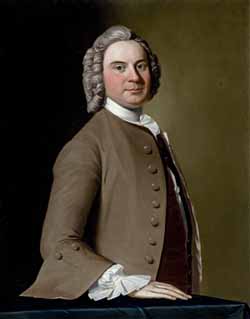
The first motion was to read the Port Bill, the second to ask the Rev. Dr. Samuel Cooper (shown above) to lead a prayer. He came to do so, after making sure the meeting understood “he was just returned fatigued from a Journey.”

Then came the inevitable proposal to form a committee, in this case to formulate a response to the new law. “After some Debate” on that, the meeting broke off for midday dinner and resumed at 3:00 P.M.

In the afternoon, everyone (with no dissenting votes) agreed to appoint a committee “to take the several Proposals, that have been made, & others that may be made, relative to our Conduct on the present Exigency, into their Consideration, & report, as soon as may be, their Opinion.” That’s a very vague mandate, probably recognizing a range of proposals and a lot of unknowns.

There were practical problems, like how to employ or support the many people who would lose work without the maritime trade. There were political considerations like assessing and strengthening support elsewhere—one action everyone agreed right away was communicating with other towns, especially the port of Salem and Marblehead. And finally, there was the choice posed by the Boston Port Bill itself: Should the town (or citizens) repay the cost of the tea destroyed in December?

The staff of Boston National Historical Park designed a program to recreate that discussion, 250 years ago in May. That program is usually offered in the big meeting space in Faneuil Hall, but that’s being refurbished. Like Boston’s overflow public meetings, therefore, these sessions have been moved to Old South.

The events will start at 5:30 P.M. on 11 July, 25 July, 8 August, and 22 August. They’re free, but registration is encouraged.

The programs last about half an hour—much less time than Boston’s town meeting that began on 13 May—and I don’t think was ever officially dissolved.

Tuesday, July 02, 2024

“On the Conduct of the Comittee of Correspondence”

On Monday, 27 June 1774, the political argument over Boston’s committee of correspondence came to a head.

Merchants and friends of the royal government felt that the committee was wielding too much power, dragging the entire community into a costly and treasonous confrontation with the Crown.

Parliament’s Boston Port Bill was stifling every Bostonian’s livelihood, but that problem could go away at the (admittedly significant) cost of £9,660.

The committee’s Solemn League and Covenant boycott was going further than any non-importation measure so far, not only proscribing more goods from Britain and making people pledge not to do any business with people who did import goods. Was that going too far for the country folk?

The Boston Whigs, who had established the standing committee of correspondence back in November 1772, stuck to their position that for the people to make any retreat or compromise would be giving up their British constitutional rights.

The Boston town meeting resumed in Faneuil Hall at 10:00 A.M. His work with the Massachusetts General Court in Salem done (since the Massachusetts General Court in Salem was done), Samuel Adams was once again in the chair.

A motion passed that the meeting should review all the letters the committee of correspondence had written to other towns and colonies about the Port Bill.

But then came another motion: “that this Meeting be adjourned to the Old South Meeting House, the Hall not being sufficient to contain all the Inhabitants assembled.”

The committee chosen to go to Old South and ask if the town could use that space consisted of William Molineux, town clerk William Cooper, and Dr. Benjamin Church, Jr.—all radical Whigs. That alone signaled that their party had the votes to control the meeting. But what if more people came for one side or the other?

In Old South, the meeting reaffirmed its earlier vote to review the correspondence. Cooper began to read the letters aloud. After a while the crowd became bored, and they amended their earlier vote to cover only the Solemn League and Covenant, the letter sent out with that proposal, and “any other Letters that may be particularly called for.”

Eventually someone moved “that some Censure be now passed By the Town on the Conduct of the Comittee of Correspondence; and that said Committee be annihilated.” That would be a total repudiation of the committee and its work.

Adams stated that “he had the Honor of being a Member” of that committee, so someone else should moderate that discussion. By stepping away from the podium for a while, Adams not only made a point of being scrupulously fair but also allowed himself to speak, since the moderator usually didn’t express opinions on motions.

As the temporary chair, the meeting chose Thomas Cushing—merchant, speaker of the House, and another member of the Boston Whigs (though in the moderate set). Again, that showed how that group was in control of this body.

Nonetheless, the debate went on until dark, and still the opponents of the committee said “they had farther to offer.” The meeting voted to adjourn until the next morning at 10:00 A.M.

TOMORROW: The speakers and the vote.

Sunday, June 30, 2024

When Adams Chaired the Boston Town Meeting

Friday, 17 June 1774, turned out to be the last day the Massachusetts assembly met under the Crown.

Before Gov. Thomas Gage shut them down, Samuel Adams and his allies used that session to authorize a delegation from the colony to the Continental Congress, as I’ve just recounted.

On the same day, there was the continuation of a town meeting in Boston. Some of that port’s merchants had started to grumble against the Whigs’ insistence that no one should pay for the tea destroyed in December (or in March, for that matter).

Adams was officially the moderator of that ongoing meeting. Expecting “a warm engagement” with the conciliatory party, Dr. Joseph Warren urged Adams to return to Boston to wield the gavel. But he was was stuck “at Salem, attending the Business of the General Court.”

At 10:00 A.M., the meeting began in Faneuil Hall. The first order of business was appointing a temporary moderator in Adams’s place. The gathering’s unanimous choice was James Bowdoin, a wealthy merchant, learned man, and genteel political leader for the Whigs.

A committee of three men went to Bowdoin’s home near Beacon Hill. He wasn’t there.

The meeting then selected merchant John Rowe to moderate. This was an unusual choice because Rowe was not a Whig stalwart. Nor was he really a Loyalist stalwart. He was a “trimmer,” adjusting his political sails according to the prevailing winds and what looked most advantageous to his business.

Perhaps the public remembered Rowe’s remark back in December about mixing tea and saltwater—the first public suggestion of that method of resolving the standoff over the East India Company cargo. Secretly Rowe appears to have regretted that remark and tried to keep a low profile afterward. So he would hardly want to chair a town meeting making controversial decisions.

In his diary Rowe wrote: “I was much engaged & therefore did not accept.” But he added a remark showing his real attitude: “The People at present seem very averse to Accommodate Matters. I think they will Repent of their Behaviour, sooner or later.”

Back at Faneuil Hall, the gathering moved on to vote for a gentleman who had never moderated the Boston town meeting before. In fact, he later said he usually kept away from town meetings. But he had represented Boston for one year in the Massachusetts General Court.

This was John Adams. Per the record, “a Committee of three Gentlemen” went to him with news of their choice, and Adams “gave his Attendance accordingly.”

TOMORROW: John Adams in the chair.

Thursday, December 14, 2023

The Committee of Correspondence and the Stringer Bell Rule

The Boston Tea Party Ships & Museum social media has been sharing an image from the Boston committee of correspondence records, showing what that group of hard-core activists was doing in December 1773.

Or rather, not showing.

These records are now held by the New York Public Library. The pages in question are in the subcollection “Minutes,” volume 6, pages 463–4. The whole collection is digitized but not transcribed, so you have to read a lot of pages or know what you’re looking for.

The committee of correspondence was an official arm of the Boston town meeting, and thus had some responsibility to keep public records. Most of those records are the letters the committee sent to committees in other towns and colonies, copied by town clerk William Cooper. It was a committee of correspondence, after all.

However, like the Continental Congress making itself a committee of the whole to debate sensitive matters like a little light treason off the record, the Boston committee had ways around openness.

As Stringer Bell reminded us on The Wire, you don’t take notes on a criminal conspiracy.

On Sunday, 12 December, a day after sending a subcommittee to meet with Francis Rotch about his ship Dartmouth and a day before meeting with colleagues from neighboring towns, the Boston committee gathered at the selectmen’s chamber in Faneuil Hall after dark on the Sabbath. But the record of that meeting is:
No Business transacted to be made matter of Record
The discussions with the other towns’ committees “continued thru. the Evening” on Monday. Not that we know what anyone said.

On Tuesday, the Boston men gathered again in the morning.
No Business transacted, matter of Record—
And in the evening.
No Business transacted, matter of Record—
There were no meetings on 15–16 December. Presumably all the committee members were busy at Old South Meeting-House and, well, elsewhere.

On 17 December, with tea leaves floating in the harbor, the committee chose five members of their group to write a “Declaration” about the destruction of the tea. Those men included several of the most radical writers in Boston: Samuel Adams, Dr. Benjamin Church, Dr. Thomas Young, and Dr. Joseph Warren. The fifth was Nathaniel Appleton (1731–1798), since these committees needed someone to represent the town’s merchants.

Monday, November 06, 2023

Fallout from the “Tradesmen’s Protest”

Bostonians gathered on short notice in Faneuil Hall for a town meeting on 5 Nov 1773. Their first act was to choose John Hancock as moderator.

The reason for this meeting was the news that the East India Company was shipping tea to America. By a process not spelled out, the result would be: “our liberties for which we have long struggled, will be lost to them and their Posterity.”

The town’s eventual response to that news was to endorse the resolutions of a Philadelphia meeting condemning the Tea Act, the company, and anyone who cooperated with it.

A closer problem, however, was that some locals had distributed a handbill titled “Tradesmen’s Protest Against the Proceedings of the Merchants Relative to the New Importation of Tea,” printed by Ezekiel Russell. The Massachusetts Historical Society has digitized that flyer here.

A group of merchants, claiming to speak for Boston’s business community, had issued a call to boycott tea. The “Tradesmen’s” handbill responded in kind, also claiming to speak for local businessmen. “You are hereby advised and warned by no means to be taken in by the deceitful Bait of those who falsely stile themselves Friends of Liberty,” it said. “WE are resolved, by Divine Assistance,…to Buy and Sell when and where we please; herein hoping for the Protection of good Government.”

At the town meeting, someone moved for all tradesman to gather on the south side of the hall so they could vote on whether they agreed with this handbill. This question “passed in the Negative, unanimously—there being in the estimation of the Town at least four hundred Tradesmen present.”

That afternoon Ezekiel Russell appeared and addressed the gathering. The official record reads:
He then acquainted the Town that he was the Printer of the Paper called the Tradesmen’s Protest against the Merchants, & that he was paid for the same by the Person who Employed him.—this Information was not given at the desire of the Town; it being their sense, that as a Town they had nothing to do with the Printer or Author of the said Paper——
Russell had a reputation for printing almost anything as long as he was paid. I can’t tell if in this case he kept the name of his customer secret or if town clerk William Cooper chose not to record it. In any event, the point of this item in the meeting record was that Russell was below official notice.

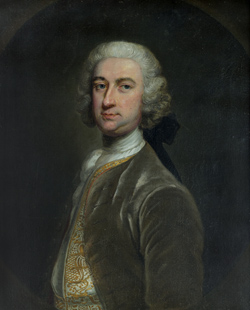
In the morning, “one of the Inhabitants openly declared that he saw Charles Paxton one of the Commissioners of the Customs, giving them away the Day before in Kings Street.” Paxton (shown above) had been one of the most disliked royal officials in Boston for over a decade.

On 10 November, Commissioner Paxton went to justice of the peace Edmund Quincy and swore to a deposition:
WHEREAS a Number of the Inhabitants of the Town of Boston being assembled at Faneuil-Hall on Friday the 5th of November Instant, unanimously voted that I the Subscriber was a Distributor of a Paper called the Tradesmen’s Protest—

Now I solemnly declare, that I never was possessed of more than one of said Papers, which I bought for Three Half-Pence of a Boy in the Street, and not finding it worth Notice, in a few Minutes after I gave it to a Bystander, whom to my Knowledge, I never saw before nor since.—And I further declare, that I never before heard such a Paper was published or intended to be published.
Paxton had that testimony published in the Boston News-Letter and Boston Post-Boy, two Loyalist newspapers, over the following week. He remained unpopular.

TOMORROW: Talking to the tea consignees.

Wednesday, November 01, 2023

The Tea Party Sestercentennial, 15–16 Dec.

This year will see the 250th anniversary, or Sestercentennial, of the Boston Tea Party.

As the most photogenic of the pre-war Revolutionary events, the destruction of the taxable tea has been a very big deal for about two centuries of those 250 years. Before that, it appears, the first rule of the Tea Party was that you didn’t talk about the Tea Party.

This December, we’ll be talking a lot about the Tea Party.

On Friday, 15 December, Revolutionary Spaces’ Old South Meeting House will host its recreated “Meeting of the Body of the People,” representing the gatherings in that same space right up until the destruction of the tea began.

Like last year, I’ll be participating as the voice of the narrator booming from the gallery. The real stars will be the people portraying Samuel Phillips Savage, Samuel Adams, Dr. Thomas Young, Francis Rotch, and such observers as Phillis Wheatley, including some of the area’s top reenactors and museum professionals.

Tickets for this event are $40 for an adult, with discounts for seniors, teens, children, and Revolutionary Spaces members. Even though Old South can squeeze in thousands, this will probably sell out. The event starts at 6:15 P.M. on Friday, and there will be no follow-up on the waterfront that night.

On Saturday, 16 December, the exact anniversary date, there will be a program at Faneuil Hall titled “Act One: Faneuil Hall & The Boston Tea Party, A Protest in Principle: A Retrospective on Revolution.” That’s scheduled to take place from 4:00 to 5:30 P.M.

To be frank, I’m not sure what this event will be, but it doesn’t matter since all seats inside Faneuil Hall have already sold out. The program will be shown on screens outside the hall for the general public.

Then that evening’s action will move to the Old South Meeting House, where we’ll do another “Meeting of the Body of the People.” This event has also sold out, which is why Revolutionary Spaces and its volunteers just added the performance on Friday the 15th.

Outside on the steps at Franklin and Washington Streets, near Old South, reenactors will portray citizens of colonial Boston discussing the politics of the day. This “Patriots and Loyalists” program will run from 6:00 to 7:00 P.M., free and open to the public.

At 7:30 P.M., the crowd from Old South and the area around it are invited to follow the fifes and drums to the waterfront. This walk is longer than back in 1773 since the land has been extended. The event description for “Huzzah for Griffin’s Wharf” says there will be a sight of British soldiers, though in 1773 all the regulars were on Castle Island.

Finally, at around 8:00 P.M. spectators can line the Harborwalk near the Boston Tea Party Ships & Museum to watch from across the water as men storm aboard the Beaver and Eleanor to effect the “Destruction of the Tea,” loose leaves donated by people all over the country. There will be some bleacher seating, but the audience is expected to number in the thousands, so most folks will stand.

As in 1773, this action is expected to be disciplined and quick, so the whole event should be over before 9:00 P.M.

Thursday, September 21, 2023

Informed Discussion of Peter Faneuil and His Legacy

This month the Boston Globe published Brian MacQuarrie’s article, many months in the making, about Peter Faneuil, the Atlantic slave economy, and what that might mean for Boston’s Faneuil Hall.

It’s a long and thoughtful article, presenting recent primary-source research and including many voices. The web version includes animated maps.

I hadn’t known this:
A 2021 survey suggested that Bostonians support renaming the hall, with 51 percent in favor, 36 percent opposed, and 12 percent undecided or declining to answer, according to the MassINC Polling Group. Black voters overwhelmingly backed the change, while white voters were nearly evenly split.
Of course, support for renaming would probably divide if people were asked about different possibilities instead of a generic change. But the minority strongly opposed to renaming are certainly overrepresented in this article’s comments section.

I wrote a series of postings about the name of Faneuil Hall back in 2020 (starting here), and in June reported on the site’s exhibit about slavery in Revolutionary Boston. My thinking, including the value of visible iconoclasm and highighting the many people involved in the building, hasn’t changed.

Renaming landmarks is something all societies do, of course. Revolutionary Boston included King Street, Queen Street, Hutchinson Street—all changed for political reasons in the new republic. For a while King’s Chapel was called the Stone Chapel. Prolonged public discussion of such issues highlights divisions in society, but being able to resolve those questions collectively should be a sign of health.

Thursday, July 13, 2023

The Gap in the Town Clerk’s Records

The official published records of the town of Boston say that on Monday, 3 Apr 1775, the inhabitants held a meeting in Faneuil Hall.

With Samuel Adams busy at the Massachusetts Provincial Congress at Concord, that meeting chose Samuel Swift to preside in his place.

Voters filled some offices that the men they elected in the preceding month had declined. For instance, this town meeting chose the sons of William Molineux and Royall Tyler to be clerks of the market, an entry-level job for young gentlemen.

The other agenda item was collecting a tax approved in July 1774 “for the Relief of the Poor”—a response to the Boston Port Bill. A committee recommended naming collectors, but the citizens put off a decision until their next gathering.

To get around the Massachusetts Government Act’s limit on town meetings without Gov. Thomas Gage’s approval, the citizens then voted to adjourn to 17 April. As long as they kept the same meeting going by adjournment, they were within the law, right?

If a town meeting took place as scheduled on that day, it wasn’t recorded on the following page. That’s because the town clerk, William Cooper, slipped out of Boston around 10 April. He was apparently acting in response to intelligence that the secretary of state, Lord Dartmouth, had recommended to Gage that he start arresting leaders of the rebellion in Massachusetts.

Cooper took the notebooks that recorded town meetings with him. Some of the selectmen remained in town: Timothy Newell, John Scollay, Thomas Marshall, and Samuel Austin. In the following months, as Newell’s journal shows, they tried to document the damages and injustices of war and to stand up for their fellow citizens.

According to Cooper’s records, the next Boston town meeting took place in Watertown on 5 March. This was the annual oration in memory of the Boston Massacre, delivered that year by the Rev. Peter Thacher. That was, of course, the same day the British army saw the Continental fortifications on the Dorchester heights, so Thacher’s speech probably didn’t command people’s total attention.

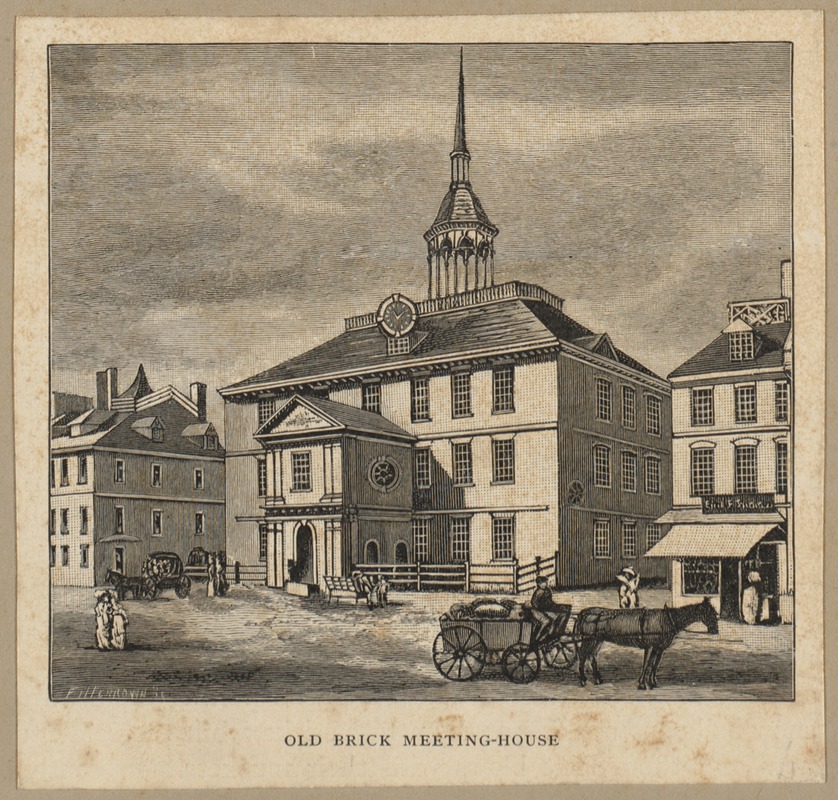
The British military sailed away on 17 March. Bostonians gathered for another town meeting twelve days later, on 29 March. They met in the Rev. Dr. Charles Chauncy’s church, the “old Brick Meeting House” (shown above). The main order of business was to elect officials for the upcoming year, starting with the town clerk. William Cooper continued to fill that role until his death in 1809.

However, there were at least two town meetings held inside besieged Boston that never got recorded in Cooper’s notes.

TOMORROW: The first lost meeting.

Friday, June 16, 2023

“Slavery in Boston” Exhibit Now Open in Faneuil Hall

Today the city of Boston’s Department of Archaeology officially opens its new exhibit in Faneuil Hall, titled “Slavery in Boston.”

The display panels are already up, so I swung by to see them yesterday. The exhibit is in two parts, with an online component as well.

One part is on the ground floor of Faneuil Hall, among the shops selling books, souvenirs, and candy. This consists mostly of vertical panels set up around the building’s structural pillars. Some of the panels have basic introductory material, and some look at the legacy of race-based slavery in the area.

Most of the pillars, however, profile individual enslaved people, using all the sources available to show even a sense of their lives. That sees like a powerful way to communicate the experience of slavery on a one-to-one level to visitors who think they have just a minute or two to spare.

Those visitors who want to learn more (or use the restrooms) can go downstairs, where there’s a larger space and the rest of the exhibit. This area includes benches, a television monitor (now showing a video about abolitionist Lewis Hayden), and an activity table for kids.

Here the walls are lined with panels providing a more general introduction to the laws, economics, and demographics of slavery in Boston. Some of this repeats information upstairs, and sometimes it builds on that. One major message is that in the mid-1700s slavery affected all Bostonians’ daily lives and produced benefits for most free people, not just slaveowners.

At times, the presentation might even be too Boston-centered. One panel describes Charles Apthorp becoming the town’s richest merchant by trading with the Caribbean islands, Britain, and Africa. His business included buying and selling people. That panel could add that Apthorp’s ties to the slavery economy included marrying an heiress, Grizzell Eastwick, born on Jamaica.

A few of the “Slavery in Boston” panels display archeological finds related to households that included enslaved people, but most of the information behind this exhibit comes from documentary sources: legal and church records, newspapers, letters, and so on.

So why is this an Archaeology Department display? I suspect it’s because that’s the branch of local government most concerned with Boston’s past rather than its present and future.

Tuesday, January 24, 2023

“Orders for the Lighting of the Lamps”

As I recounted yesterday, the official records of Boston’s selectmen from the end of August 1774 reveal that the town’s first street lamps, acquired at great expense and trouble just a few months before, were no longer being lit.

The immediate question was how the town would treat its contract with Edward Smith, hired back in March to oversee the lamplighters and maintain supplies. On 31 August the selectmen decided:
Whereas it was agreed with Mr. Edward Smith to take the care of the Town Lamps for twelve months he to receive the sum of Forty Pounds Sterg. for that term of time, and whereas £13–6–8– lawful mony has been paid him for one quarter, & another quarter expires this day; but by reason of the distress occasioned by the Boston Port Bill, the Lamps have not been light the last Quarter—therefore,

Voted, that mr. Smith have a draft for said last Quarter as tho’ the service had been performed he having engaged to perform said service in any future time when called upon for that purpose, it being his intention and agreement to perform the service at the rate he had engaged for a twelve month, when the Town shall think proper to have the Lamps again lighted; and to consider this 2d. Quarters pay as so much advanced on account of service, which remains still to be performed by him, when called upon for that purpose.

In the memo. Book he has signed his Name to such a Writing as the above.
The town was thus still spending money on the street lights even though they weren’t lighting anything—and in a difficult economic time, too. But the selectmen could justify that as a payment for future service, and they kept Smith satisfied.

The decision to stop lighting the lamps coincided with the return of British army regiments to the streets. The presence of those soldiers didn’t make Bostonians feel so secure they decided street lighting was unnecessary. Based on their memories of 1768, citizens expected that having hundreds more young men in town, especially entitled young officers, would bring more trouble, not less.

At a meeting on 3 November, the town endorsed a recommendation to “augment the Town Watch to the Number of Twelve Men in each Watch” instead of four—a huge increase in personnel and expense.

That same town meeting took this confusing series of votes:
Upon a Motion made, Voted, that the Selectmen be desired to give Orders for the Lighting of the Lamps, when they shall think it proper.——

Voted, that a Comittee be now chosen to procure Subscriptions for the Purpose of Lighting of the Town Lamps.

On a Motion made, Voted, that the above Vote respecting Subscriptions for lighting the Lamps be reconsidered
That appears to be the last recorded discussion of the street lamps before the war. Presumably they remained dark.

On 24 November, the selectmen chose one of their number, Timothy Newell, to “receive from John Rowe Esq. all the Lamps and Tin Plates which he has in his hands, and to deposite the same in the upper loft of Faneuil Hall.” Rowe (shown above) had chaired the committee to acquire and install the street lights, and now he was done with the project. The extra equipment went into Boston’s attic, not to be brought out until the lamps had been lit again.

Saturday, January 07, 2023

The Return of Peter Faneuil’s Grasshopper?

On 23 January, Sotheby’s will auction off what it says is the grasshopper weathervane that Shem Drowne crafted for Peter Faneuil’s summerhouse before 1743, as discussed yesterday.

The auction house’s announcement goes into detail about Drowne’s other, long-documented weathervanes and the short paper trail of the summerhouse grasshopper.

It also says the summerhouse weathervane “disappeared into obscurity” after the demolition of the Faneuil mansion in the 1830s. Which is one way to acknowledge there’s no provenance at all for the object on sale before the twentieth century.

The record begins:
It was acquired in Massachusetts circa 1900 by Captain Lucius Bradford (1864-1939) of Newport, New Jersey who was told that it had been on top of a New Hampshire barn. He stored it inside as a decoration, and it was inherited by his son Leslie Bradford (1895-1987). It continued to be passed down through successive generations of the family until purchased by the current owner.
As I read that webpage, whoever sold the weathervane to Lucius E. Bradford didn’t claim that it had spent time over Boston. Someone—either the “current owner” or an appraiser or Sotheby’s own experts—recently hypothesized this was the weathervane from the Faneuil house.

The silhouette of this grasshopper does match the one on top of Faneuil Hall (and not all sculptors shape grasshoppers that way). They’re about the same size. Both creatures have copper bodies and glass eyes.

The one on Faneuil Hall has been regilded multiple times over the years. The one now offered for sale is mostly green, but Sotheby’s says it shows “traces of gilding,” which I presume would be unusual for a weathervane made for a barn.

Then again, it’s conceivable that some metalworker in the Colonial Revival period fashioned a version of Shem Drowne’s famous grasshopper for customers who liked historic American style.

Sotheby’s estimated price for this weathervane is $300,000–500,000.