J. L. BELL is a Massachusetts writer who specializes in (among other things) the start of the American Revolution in and around Boston. He is particularly interested in the experiences of children in 1765-75. He has published scholarly papers and popular articles for both children and adults. He was consultant for an episode of History Detectives, and contributed to a display at Minute Man National Historic Park.

Subscribe thru Follow.it


•••••••••••••••••


Showing posts with label Jeremiah O'Brien. Show all posts

Friday, April 17, 2026

“The honor of this enterprise belongs to Joseph Wheaton”

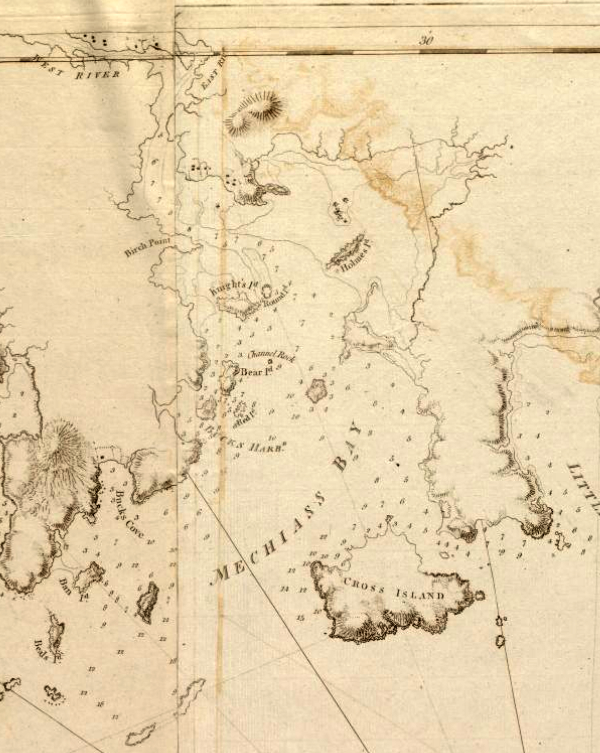
Yesterday I shared part of a letter Joseph Wheaton wrote in 1818 about how men from Machias, Maine, captured H.M.S. Margaretta early in the Revolutionary War.

In 1824, Charles W. Goldsborough quoted that letter in The United States Naval Chronicle. Many other chroniclers drew on it to describe the fight, sometimes said (by people not from Fairhaven) to be the first naval battle of the war.

In The Pictorial Field-book of the Revolution (1852), Benson J. Lossing said in a footnote:
The honor of this enterprise belongs to Joseph Wheaton, a native of New York, then residing at Machias. He was an energetic young man of twenty years. He proposed the expedition, but modestly named [Jeremiah] O’Brien for commander. He was active in the whole affair, and in person seized the colors of the Margaretta.
However, in a 1975 article for Maine History titled “The Historiography of The Margaretta Affair, Or, How Not To Let the Facts Interfere With a Good Story,” Edwin A. Churchill grouped Wheaton’s description of events with other unsupported or untenable tales. Churchill referred to “the self-centered bragging of Joseph Wheaton” and said his memory was “notoriously bad.”

Churchill’s main targets were two big errors that he said “traditionalist” authors kept making in their accounts of the Margaretta affair. It wasn’t sparked by conflict over a Liberty Pole, he insisted, and Benjamin Foster’s ship didn’t run aground before the fight. Wheaton wrote nothing about a pole, but he left Foster out of his account entirely. 

I won’t continue to quote Wheaton’s account, which you can read in full here, thanks to Maine Memory. Nor will I try to pick apart its details, much as I like doing that. Other people, closer to Machias geographically and emotionally, can handle that task.

Instead, I’ll consider how Joseph Wheaton’s account of the Margaretta capture fits, or doesn’t fit, with his status in March 1776: in the family of a royal appointee evacuating Boston with the British military.

It’s possible that Joseph Wheaton did take part in the attack on the Royal Navy sloop in 1775, despite (or because of) how that would have angered his father, a local Customs officer and Loyalist. He wouldn’t have been the only Revolutionary veteran to muddle details of events forty years before and put himself and his friends at the center of an event. He definitely did join the Continental Army a couple of years later.  

On the other hand, coming from a Loyalist family gave Joseph Wheaton a strong incentive to play up his Patriot credentials. In 1776 Massachusetts authorities even confined him as a suspected Loyalist. Telling the story of helping to capture the Margaretta let Wheaton claim that he’d fought for what became the U.S. from (nearly) the start of the war.

And Wheaton told that story a lot.

TOMORROW: Over the decades.

Thursday, April 16, 2026

“I said to him—Dennis let us go and take that Schooner”

Where were Caleb Wheaton, Sr.’s sons when the Revolutionary War began in April 1775?

Wheaton made his home on a substantial riverside plot in Machias, Maine, but he also owned real estate in Dedham. It’s conceivable an older son was farming that land.

The newspaper articles I quoted here suggest Wheaton himself was traveling in his home town of Rehoboth and nearly Providence, Rhode Island, in February.

But I haven’t found any statement from Caleb Wheaton about why or when he left Machias, when he went into Boston, or how many family members were with him.

In contrast, Caleb’s son Joseph Wheaton left a definite and detailed account of how he saw the war begin. In a letter to Gideon O’Brien, written on 23 Apr 1818 and held and published by the Maine Historical Society, Joseph Wheaton stated:
Before the Battle of Concord 19. Apr 1775—the Margarette Schooner Capt Moore—saild from Boston and came to Machias to escort convoy two sloops owned by Ichobod Jones with lumber for Boston & for the use of the British Governmt

while those vessels were loading. their came to Machias a vessel, & brought the news of the Battle of Concord—and communicated it to the people, on a Saturday Evening—

the next Morning Sunday it was proposed to take the officers when at public worship, and thereby obtain the vessel in retaliation for Concord & Lexington,

in attempting this, the officers Capt Moore & others escaped and got on board the Schoon—and fell down to Scotts Wharf—Where they were fired upon by a party who had come there headed by Mr [Benjamin] Foster from the East river—but as it fell dark very soon the Margarette fell down the river near where my family then lived

on Monday morning the people being yet together at Scotts—the Schooner in view. Your Brother Dennis and Myself were Standing on the Wharf by ourselves—when I said to him—Dennis let us go and take that Schooner—

how will you do it Said Dennis—

I said, we can take Job Hains’s Sloop, get the people on board her, the Sloop will out Sail the Margarette, we can board her and take her—

with all my heart said Dennis—

we then called to our aid two youths and renewed the proposition to which they agreed—we four immediately steped into a boat and went on board the Job Hains’s sloop and demand him to take the sloop to Scotts Wharf which with some little opposition was effected—

so soon as we steped on shore and gained the Bank before Scotts house, we four took off our Hatts and gave three cheers—when your Brother Jeremiah steped forward, yourself & Brother John & called upon the people to undertake the interprise to which all consented
We know from other sources that Lt. James Moore brought H.M.S. Margaretta to Machias in early June 1775, well after news that a war had started. That should be our first tip-off not to take the story that Joseph Wheaton told more than forty years later at face value.

TOMORROW: Maine memories.