J. L. BELL is a Massachusetts writer who specializes in (among other things) the start of the American Revolution in and around Boston. He is particularly interested in the experiences of children in 1765-75. He has published scholarly papers and popular articles for both children and adults. He was consultant for an episode of History Detectives, and contributed to a display at Minute Man National Historic Park.

Subscribe thru Follow.it


•••••••••••••••••


Showing posts with label Henry Dearborn. Show all posts

Wednesday, January 24, 2024

“Breathe their Last within the walls of his Detestable General Hospital”
As I quoted yesterday, in September 1775 commanders of the northern wing of the Continental Army besieging Boston were upset with how Surgeon-General Benjamin Church was ordering sick and wounded men moved to his hospitals in Cambridge.

Gen. John Sullivan and Dr. Hall Jackson complained that there were sick people at those hospitals! Meaning men would be more likely to catch infections there than anywhere else.

In addition, the doctors looked down on New Hampshire men as country bumpkins, and Dr. Church and his assistant surgeons weren’t as skilled as Jackson himself.

Well, Jackson didn’t come right out and say that last part (Sullivan did), but on 16 September he lambasted the central army hospitals this way:
Not an Officer or Soldier [from New Hampshire] will go to the Cambridge Hospital, they had much rather provide for themselves at Mistick at any expense, or even die in Camp with their friends than be forced into a General Hospital cram’d with the sick of 25,000 Troops; and attended by strangers from polite Places, who have never been used to the inquisitiveness and impatience of poor Country People, and are in general to apt to conster their simplicity into impertinence: it is the mind of General Sullivan, and all the Officers from New Hampshire, that unless some alteration is made, another Regiment will never be raised in that Colony.

Capt. [Henry] Dearbourn, with many others, are gone to Canada, for no other reason than to avoid the Sickness of our Camp, and dread of the general Hospital.

The arts, contrivance, and hypocricy, of some of the M—u—setts Patriots is dam—a—ble to the last degree. “A Struggle for Liberty”!—good God! my Soul abhors the Idea! If methodically to kill the wounded; to starve the sick, and languishing because they cannot Diet on Salt Pork, or will not submit to be severed from their dearest friends and relations, if these (my Dear Friend) are the Characteristicks of an Army raised for the defence of Liberty, I frankly confess I have no claim to an employment in the glorious Cause.
When Jackson wrote those words, however, the army had already formally looked into the dispute. On 7 September, Gen. George Washington laid set out a formal process in his general orders:
Repeated Complaints being made by the Regimental Surgeons, that they are not allowed proper Necessaries for the Use of the sick before they become fit Objects for the General Hospital: And the Director General of the hospital complains, that contrary to the Rule of every established army, these Regimental Hospitals are more expensive than can be conceived; which plainly indicates that there is either an unpardonable Abuse on one side, or an inexcusable neglect on the other—

And Whereas the General is exceedingly desirous of having the utmost care taken of the sick (wherever placed and in every stage of their disorder) but at the same time is determin’d, not to suffer any impositions on the public;

he requires and orders, that the Brigadiers General with the commanding Officers of each Regiment in his brigade; do set as a Court of enquiry into the Causes of these Complaints, and that they summon the Director General of the hospital, and their several Regimental Surgeons before them, and have the whole matter fully investigated and reported—This enquiry to begin on the left of the Line to morrow, at the hour of ten in Genl Sullivan’s brigade.
That inquiry ended a week later with Church being cleared of all charges. Jackson’s letter was thus carrying on an argument he had already officially lost.

There must have been similar disputes in other parts of the army because Washington ordered the same sort of inquiry in Gen. William Heath’s brigade in the central part of the lines, then in the brigades on the south wing. The commander-in-chief evidently felt that this process would force everyone to an agreement.

The second inquiry likewise ended in praise for Church. But by then the surgeon-general had left the front, pleading illness. Church even sent in his resignation from Taunton. Adjutant-General Horatio Gates wrote the doctor a flattering letter urging him to come back.

Then suddenly the conflict was resolved by an outside factor: The baker Godfrey Wenwood came to Washington’s headquarters from Newport with a ciphered letter that his ex-wife had asked him to send into Boston. Under questioning, that woman, née Mary Butler, admitted she had handled the letter for her lover—Dr. Church!

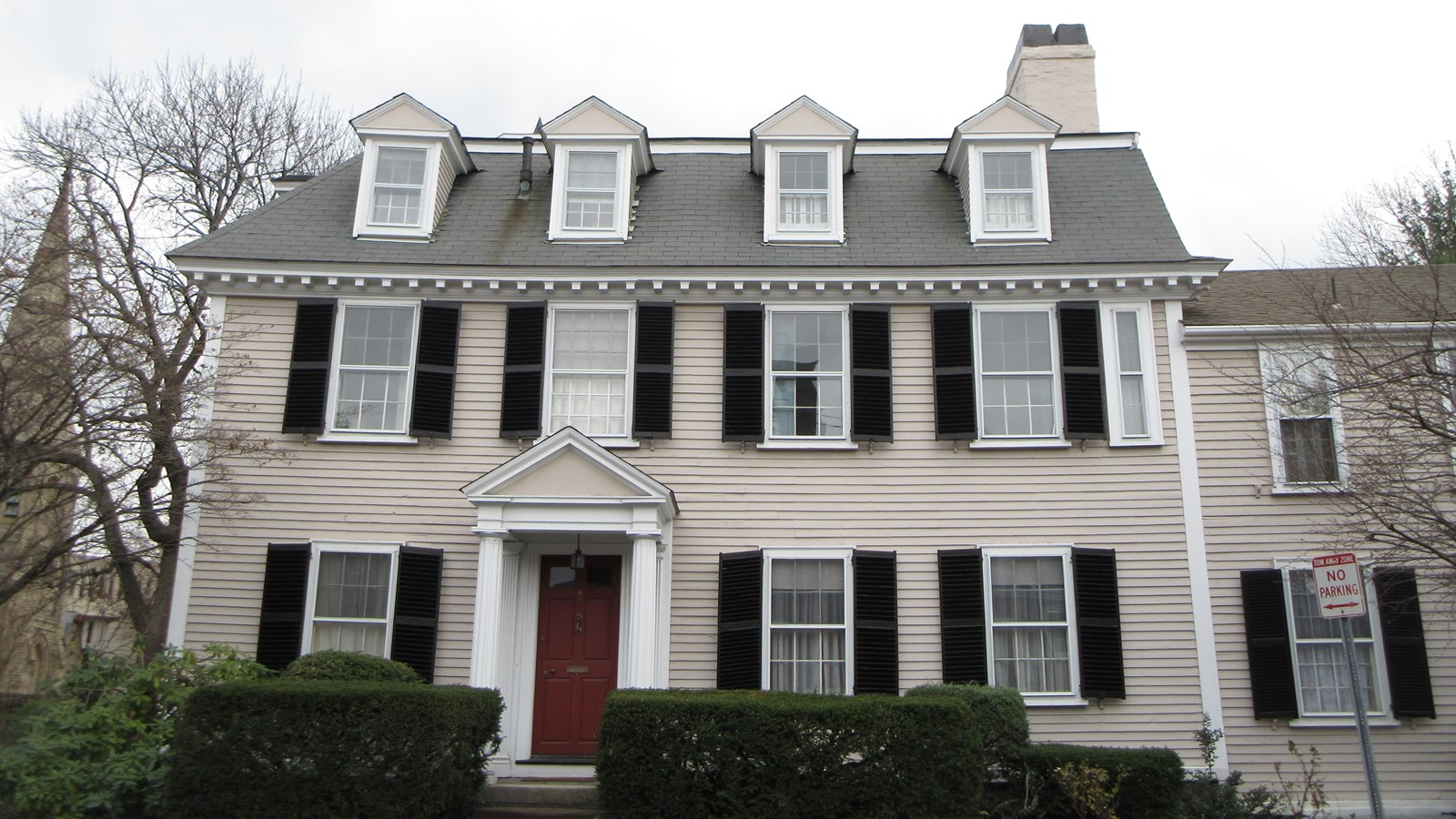
The 30 September inquiry in Gen. Joseph Spencer’s brigade was called off “on account of the Indisposition of Dr Church.” That phrase in Washington’s general orders was cover for the fact that Church was under arrest in one of his hospital buildings (shown above) for secretly corresponding with the British military.

On 4 October, Sullivan wrote in triumph:
You will by this Post Receive Intelligence from head-Quarters of Dr. Church’es having been detected in holding a Treasonable Correspondence with the Enemy—his Behaviour Towards our Sick & wounded long since Convinced me that he either was void of humanity and Judgment, or that he was Determined by untimely Removals & Neglect of Duty to Let all those under his care breathe their Last within the walls of his Detestable General Hospital.
On 17 October, Dr. Hall Jackson returned to Portsmouth. Since June, he had been working with no rank or salary. The next month, New Hampshire’s provincial government recognized his service with a commission as chief surgeon for the colony’s troops and back pay.

COMING UP: Back to Capt. Sylvanus Lowell, wounded in 1773. But first, a Sestercentennial event.

Tuesday, April 27, 2021

“A view or plan of the battle of Bunker’s hill”

On 10 May 1816, the Wilkesbarre Gleaner newspaper, published by Charles Miner, announced a discovery about the Battle of Bunker Hill, more than forty years earlier.

According to a reprint in Niles’s Weekly Register the following month, it said:
I stepped into the house of a friend the other evening, and he told me, that in rummaging over some old drawers he found a curiosity. It was indeed very interesting and curious, to me at least, I dare say it would be so to you, reader.

The thing referred to was a view or plan of the battle of Bunker’s hill, taken by a British officer at the time, who was in the engagement. The execution was in a style of uncommon neatness; and as far as it was possible for me to judge, extremely and minutely accurate.

The references were numerous and particular. The place of landing of the British was laid down—each regiment numbered—the artillery and light infantry particularly designated—the precise line of march pointed out—the situation of the American posts of defence, even to a barn, and the particular force that attacked the barn, laid down.

The place of the greatest carnage or loss of the British—the two vessels that were moored to annoy our people—the battery that played upon our fortifications—the line of retreat and the situation of the craft stationed to cut off our troops, the situation of the commanding officer of the British; and indeed every thing that could tend to give a full and clear idea of the situation and movements of the parties.

On looking over this map deep and strong emotions were excited—pride at the glorious defence made by our undisciplined American yeomanry, against the best regular forces of the old world—patriotism, by considering the spirit and devotion of our militia in defence of freedom and their country—pity for the suffering of the number who fell, and admiration of the dauntless spirit of the assailants and the assailed.

At the same time it was impossible to repress the smile, half in anger and half in mirth at the repetition of the word “Rebels” which occurred so often in the delineation. It brought to our minds the battle of the kegs, where the frequent use of the odious and contemptible expression is so handsomely ridiculed.

This probably is the only accurate plan of that memorable battle, in existence. It ought certainly to be engraved, and the copies multiplied, together with a correct account of the engagement, and to be in the possession of every friend to the liberties of the country.
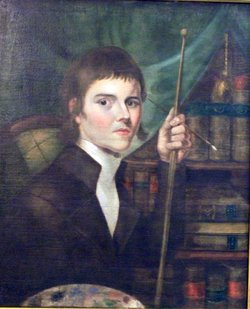
Publishers were intrigued. Some made inquiry and discovered the man who possessed the hand-drawn map was Jacob Cist of Wilkes-Barre, a postmaster, artist, naturalist, and promoter of anthracite coal (shown above).

A man named I. A. Chapham copied Cist’s map and brought it to Philadelphia, where an engraving firm produced prints for the February issue of the Analectic Magazine. Here’s a digitized image from the Leventhal Map Center at the Boston Public Library.

The next month, the Port Folio published a second engraving copied from the competing magazine with red marks overlaid to show corrections by Gen. Henry Dearborn, a veteran of the battle. Here’s an image of that map. Dearborn’s accompanying article ignited a feud with descendants of Gen. Israel Putnam and others that lasted for years.

The publication of the Analectic engraving revealed the name of the British officer who had sketched the map: Lt. Henry DeBerniere, misidentified as an officer of the 14th (rather than 10th) Regiment.

The manuscript sketch doesn’t survive. Neither does any clue about how DeBerniere’s sketch came into the hands of Jacob Cist. He was born in Philadelphia in 1782, and we know DeBerniere was in that city with the British army in 1777-78. Had the officer left the sketch behind, just as he had left his written manuscripts in Boston?

Cist also worked for the U.S. Post Office Department in Washington, D.C., from 1800 to 1808 before settling in Wilkes-Barre. Did he collect the map as a curiosity? Was he really just “rummaging over some old drawers” when he realized what it was?

The provenance will remain a mystery. Similarly, we have no idea how the historian Peter Force came by DeBerniere’s map of the Massachusetts countryside now in the Library of Congress collection. But Lt. DeBerniere’s map has been one of the main sources for every printed map of the Battle of Bunker Hill since 1818.

COMING UP: The post-Revolutionary career of Henry DeBerniere.

Wednesday, June 17, 2020

Bringing Back a Source on the Bunker Hill Battle

Samuel Swett was one of the early historians of the Battle of Bunker Hill. He published a long essay titled “Historical and Topographical Sketch of Bunker Hill Battle” as an appendix to an 1818 reprint of David Humphreys’s biography of Gen. Israel Putnam.

The battle’s 50th anniversary came in 1825, bringing more interest from the public and more accounts from veterans. Some of those old men came to Charlestown for a public ceremony. Swett used interviews with them and his earlier research to publish Notes to the Sketch of Bunker Hill Battle at the end of 1825, quoting the sources he had used for the earlier essay and more.

Unfortunately for us, Swett didn’t tailor his publications and particularly his quotations around providing a comprehensive picture of the battle. Rather, in his own words, he wrote “for the defence of Gen. Putnam, did he need any.” In 1818 Gen. Henry Dearborn had published an article in The Port Folio basically saying that Putnam had been useless during the battle. This set off years of historiographical (and political) debate. Swett published a lot of evidence favoring Putnam, but he left out other testimony that later historians would have liked to see.

This spring I stumbled across two affidavits that Swett sent to the Boston Daily Advertiser for publication at the end of 1825. He had quoted parts of both in his Notes, and those quotations have been cited by many historians since. But as far as I can tell, scholars haven’t used the other parts of these documents, which offer more details about the battle. So I’m going to quote them in full. (As usual, I’ve added paragraph breaks for easier online reading.)

The first affidavit appeared in the Boston Daily Advertiser on 20 Dec 1825, and in a few other newspapers after that. This was how Swett introduced the source:
Col. JOS[eph]. WHITMORE, of Newburyport, a native of Charlestown, brought up there as an apprentice by Richard Devens, Esq., well known in both those places as a witness of the highest respectability, Aug. 6, 1818, stated before a magistrate, Hon. Eben. Moseley, “that he was a Lieutenant in a company from Newburyport, commanded by Capt. Benj. Perkins, and which was raised and marched to Cambridge soon after Lexington battle.”
Capt. Perkins’s company was evidently assigned to Abraham Watson’s house in Cambridge. Lt. Whitmore’s account:
While their company were at their quarters at ’Squire Watson’s, about a mile from the Colleges, an alarm was given on the 17th, [June] 1775. The company immediately formed, marched to Cambridge, and received orders from Gen. [Artemas] Ward to march to Charlestown. Col. Whitmore thinks the company arrived upon Breed’s Hill between 2 and 3 o’clock.

Soon after the company reached the hill, the British reinforcement landed, formed into columns, and marched up the hill. Col. Whitmore with a part of his company went down to the left of the redoubt, near some trees which were standing, and there received an attack. The British were twice repulsed, but the third time they made the attack with great fury, and drove the Americans from their works.

On the retreat, Col. Whitmore was wounded in his thigh. The Colonel states, that at the very moment he was wounded, Gen. [Joseph] Warren fell, and was within six feet of him.

As it respects Gen. Putnam, Col. Whitmore states, that he knew Gen. Putnam perfectly well, that he was well acquainted with him in the old French war—that he saw General Putnam on Breed’s Hill, when he went on with his company, and also on the retreat, soon after he was wounded, on the side of the hill.

He says, that well knowing Gen. Putnam, and the General knowing him, he said to him, “General, sha’nt we rally again?”

Gen. Putnam said, “yes, as soon as we can—are you wounded?”

Col. Whitmore answered that he was, but thought he should get over it.
Swett quoted Whitmore’s words starting at “with a part of his company…” and ending with “…are you wounded?”

A petition to the Massachusetts government printed in John J. Currier’s 1906 History of Newburyport shows that to “get over it” Whitmore had to go home and receive medical care until 8 August. In March 1776 he asked the General Court to reimburse him for that cost since he hadn’t taken a bed in an army hospital.

TOMORROW: Another voice from Newburyport.

Tuesday, June 16, 2015

Benjamin Pierce’s Story of Bunker Hill

In March 1818, the Port-Folio magazine published Henry Dearborn’s account of the Battle of Bunker Hill. Dearborn was a veteran of that battle and the war that followed, later a Secretary of War, and finally a general during the War of 1812. So of course people respected his version of history, right?

Certainly not! Dearborn bluntly criticized Gen. Israel Putnam (shown here). Among other things, he wrote that the Connecticut general “remained at or near the top of Bunker Hill until the retreat. . . . He not only continued at that distance himself during the whole of the action, but had a force with him nearly as large as that engaged.” Within weeks Putnam’s son Daniel and others leapt to the late general’s defense.

Dearborn fought back, gathering recollections from other veterans of the battle who didn’t recall “Old Put” as a leader that day. One was Benjamin Pierce. In a letter dated 17 May 1818 he told Dearborn:
I have read your “Account of the Battle of Bunker’s-hill,” and consider it to be more like the thing itself, than any statement I have ever seen.

I think our Army broke ground on the evening of the 16th of June; and the Battle was on the 17th. I went on to the Hill about eleven o’clock, A. M., on the 17th; when I arrived at the summit of Bunker’s hill, I saw two pieces of cannon there standing, with two or three soldiers standing by them, who observed they belonged to Captain [John] Callender’s Company, and said that the Captain and his officers were cowards, and that they had run away.

General Putnam there sat upon a horse; I saw nobody at that place when I arrived there, but the General and those two or three soldiers. General Putnam requested our Company, which was commanded by Captain John Ford of Chelmsford, Massachusetts, to take those two pieces of cannon, and draw them down; our men utterly refused, and said they had no knowledge of the use of artillery, and that they were ready to fight with their own arms.

Captain Ford then addressed his Company in a very animated, patriotic, and brave strain, which is the characteristic of the man; the Company then seized the drag-ropes and soon drew them to the rail-fence, according to my recollection, about half the distance from the redoubt on Breed’s-hill to Mystic-river. I think I saw General Putnam at that place, looking for some part of his sword; I did not hear him give any orders nor assume any command, except at the top of Bunker’s-hill, when I was going to the field of battle.

I remained at the rail-fence, until all the powder and ball were spent. I had a full view of the movements of the enemy; and I think your statement of the order of the day and of the two contending armies, is correct and cannot be denied with the semblance of truth.

Excuse an old soldier.
Other soldiers described Putnam being much more active, almost frenetic, especially in regard to other abandoned cannon—but not at the rail fence, where Pierce’s and Dearborn’s companies stationed themselves. Thus, they didn’t see Putnam exercise much authority, but other men did, and were still fond of “Old Put.”

According to Liz Covart’s article in the Journal of the American Revolution, the controversy over Dearborn’s attack on Putnam helped to cost him the race for governor of Massachusetts. Ironically, a few years later Benjamin Pierce won two terms as governor of New Hampshire. (In between those terms he lost once to a candidate named John Bell. Pierce’s son Franklin would later win an even bigger election.)

Pierce’s letter is typical of a lot of first-person accounts of the Bunker Hill battle written in the midst of the Dearborn-Putnam controversy: so focused on the question of whether Putnam was in the fight and/or in command that it omits most of the writer’s own experience. Did Ford’s men fire the cannon they took to the fence, and how effectively? What was it like to fight there “until all the powder and ball were spent”? Alas, Pierce didn’t say.

Wednesday, June 18, 2014

More about Bunker Hill from James Winthrop

In 1818, the same year he responded to a map of Bunker Hill published in the Analectic Magazine as quoted yesterday, James Winthrop wrote another letter about the battle published in the North American Review. That second letter was dated 18 June—i.e., right after the battle’s anniversary.

Winthrop was also responding to a statement in Henry Dearborn’s recently published account of the battle, which said that American soldiers had prepared the rail fence “by the direction of the ‘committee of safety,’ of which James Winthrop, Esq. who then, and now lives in Cambridge, was one, as he has within a few years informed me. Mr. Winthrop himself acted as a volunteer on that day, and was wounded in the battle.”

Winthrop insisted that wasn’t right:

I lived in Cambridge all the summer of 1775, and among others was present at the battle of Bunker Hill, on the 17th of June, in that summer. The army was then upon the state establishment [i.e., the Massachusetts army was not yet part of the Continental Army]. About one o’clock, or a little after it, an alarm was given in this vicinity. James Swan, Esq. was then resident here. We two armed ourselves and went down together to Charlestown. A little beyond the College, General Joseph Warren overtook us. We were both known to him and exchanged the passing compliment. But as he was on horseback we did not join company.

When we passed over Bunker Hill, we went immediately to that part of the lines, where the rail-fence stood. There were two fieldpieces there, but no artillery-men with them. Generals [Israel] Putnam and Warren were in conversation by one of them. We spoke with them, and then passed on toward the redoubt. The two generals were standing, and General Putnam had hold of the briddle of his horse; there were then very few, if any men at the fence. When we got to the redoubt, we did not enter, but spent a little time in viewing the situation of the ground and of the enemy. We supposed, from the position of the British troops, that their intention was to advance between our intrenchment and the Mystic river, and that it would become necessary to have that part of our line well guarded. We expressed our opinion, and some of the people about us desired us to go and see if any sufficient force was there. We two accordingly went over to the rail-fence, and being arrived near the place where we had seen the two generals, and where the fieldpieces were still standing, the firing commenced. I did not see either General Putnam or General Warren afterwards on that day.

I have not now the command of dates, but think it was only a few days after this, when the army was taken into continental pay, and General [George] Washington took the command. [Artemas] Ward, Putnam and [William] Heath were general officers, and continued to be generally respected. I never heard any blame cast on General Putnam, and it was about fifteen years after this that he died in peace.

It is altogether a mistake, that either I, or my brother [John Winthrop], was ever on the Committee of Safety. About a month after the battle, if I rightly recollect, the government [i.e., the official Massachusetts General Court] was organized according to the charter, and the Committee of course ceased.
Winthrop’s second letter was thus in basic agreement with his first, which isn’t surprising since he wrote them around the same time. Once again he didn’t provide a complete account of the battle as he’d seen it. He didn’t describe the actual fighting. He didn’t describe the retreat off the peninsula. Dearborn wrote that Winthrop was wounded at the battle, but Winthrop’s own letter says nothing about that.

The North American Review letter was mostly about who was in command of the American forces and what Israel Putnam did. Those were hotly debated questions in the early 1800s, with Putnam’s descendants being particularly keen to make their views known.

The fact that Winthrop was disclaiming the distinction of being on the Committee of Safety and not talking about his wound suggests he might have provided a broad and honest perspective of the battle, rather than puffing himself up. Then again, Winthrop may have bragged to Dearborn and felt pressure to openly disclaim those lies once they became public. Winthrop’s reputation wasn’t the highest—but was his problem being deceitful or too honest?

TOMORROW: Assessing James Winthrop.

Tuesday, February 05, 2013

“He was an awful sight as I ever saw.”

Here are some more reports of gun accidents from the Revolutionary War. I found these through the advanced research method of searching Google Books for the words “accidental,” “shot,” and “Revolutionary.” I’m sure there are more incidents to be found.

From the diary of Capt. Thomas Rodney, spending 4 Jan 1777 in Pluckemin, New Jersey:

Here Sergeant McKnatt was accidentally shot through the arm by one of our own people, who fired off his musket to light a fire and as there was not one surgeon in the whole army I was forced to dress it myself and the next day got one of the prisoners to do it.
Asa Fitch wrote home to his father from Ticonderoga on 23 June 1777:
There was one man shot himself accidentally as he stood talking with his brother, and had the gun before him leaning his chin on it, she accidentally went off, and the ball, together with the whole charge of powder went into his head and tore it all to bits. He was an awful sight as I ever saw.
Here’s the 23 Aug 1779 entry from the journals of Lt. Col. Henry Dearborn:
a Soldier very accidentally discharg’d a musket charged with a ball & several buckshot, 3 of which unfortunately struck Capt. Kimbal of Colo. Cilleys Regt. Who was standing at some distance in a tent with several other officers, in such a manner that he expired within 10 or 15 minutes. . . . one of the shot wounded a soldier in the leg who was setting at some distance from the tent Capt. Kimball was in.
Away from the front, there’s the 9 Jan 1779 incident involving Benjamin Andrews, Benjamin Hichborn, and a pair of pistols, told back here.

Out on the early American frontier, more men used guns for their subsistence, but that didn’t mean they avoided firearms accidents. One of the earliest memories of Davy Crockett (1786-1836) was the aftermath of his uncle Joseph Hawkins shooting a neighbor while hunting. George Hunter wounded himself in the hand and face during an expedition for President Thomas Jefferson on 22 Nov 1804. Meriwether Lewis was shot while hunting during a similar expedition on 11 Aug 1806, as narrated here. Three years later, of course, Lewis apparently shot himself to death.

Wednesday, December 28, 2011

New Voices from the Arnold Expedition Brought to Light

Yesterday’s quotations from diaries of the American attack on Québec in late 1775 came from Voices from a Wilderness Expedition: The Journals and Men of Benedict Arnold’s Expedition to Quebec in 1775, a new book on Col. Benedict Arnold’s advance from Massachusetts through the Maine wilderness to Canada by Stephen Darley.

This book is not a narrative history of Arnold’s expedition, like Thomas A. Desjardin’s Through a Howling Wilderness or Arthur S. Lefkowitz’s Benedict Arnold’s Army. Rather, it’s a study of the diaries that survive from that expedition, and as such a necessary supplement to the third edition of Kenneth Roberts’s March to Quebec.

Darley self-published through AuthorHouse to make his research available. Voices from a Wilderness Expedition contains the first published transcriptions of several first-person accounts of the campaign, as well as research on the full careers of several notable officers, including Col. Roger Enos, Capt. William Goodrich, and Capt. Scott, first name usually left blank.

Darley found three of those first-person accounts in the University of Glasgow Library, catalogued as “Durben Journal.” He argues that the main document is a copy of Capt. Henry Dearborn’s original diary before it was expanded and edited into the version we know (now housed at the Boston Public Library), and hypothesizes about how that collection got to Glasgow.

The volume contains a transcription of the version of Dr. Isaac Senter’s journal at the Rhode Island Historical Society, which differs significantly from the published version, and first full appearances of journals by Pvt. Samuel Barney and Pvt. Moses Kimball.

As Darley notes, the Arnold expedition must have been one of the most minutely documented of the period, with thirty journals and detailed memoirs surviving and more known to have existed but lost. That might reflect how many of its participants came from New England, with its emphasis on literacy. But it also suggests that men understood they were trying something important that deserved to be recorded for their families and friends. Pvt. Barney, for example, bought his blank book (“for nine Coppers”) just a few days after agreeing to go on the expedition.

The prose in Voices from a Wilderness Expedition is somewhat old-fashioned, but that’s not inappropriate for discussions of document provenance and authenticity. This is not supposed to be an entertaining adventure tale. But it should be a necessary resource for anyone researching Arnold’s campaign.

I bought the book in ePub form through Barnes & Noble, partly for the convenience and partly to test that format. I’ve looked at the file now on three devices, including a Simple Touch Nook, an iPad, and my desktop computer. There are some oddities of typography and formatting, and I can’t tell whether those appear in the print edition or surfaced during the transition to ePub format; for self-publishing authors, multiple electronic formats are just one more thing to worry about.

Unfortunately, in all three formats I can’t read Appendix II, which consists of tables listing all the men on Arnold’s expedition. Evidently they were formatted for the printed page as images of a spreadsheet rather than as text, and the images don’t get any bigger on my screens. I don’t know if other electronic formats will work the same way, but if you’re interested in the complete record I recommend a print version.

Tuesday, December 27, 2011

“We was asked who would scale the walls.”

Here are two views of the action outside the city of Québec 236 years ago. The first comes from the journal of an officer identified on the manuscript as Captain Durben (Dearborn?):
26th [Dec 1775]. A return was made of the men in Coloniel [Benedict] Arnold’s Detachment who were willing to storm the town; there were only three in my company consisting of sixty three, who dissented from it.

27th. Afternoon all the troops assembled at the place of rendezvous in very high spirits, and were ready to march to the attack, when an order came from the General [Richard Montgomery] to send them back to their quarters—because he thought the night too clear and calm for the attack—though the day had been windy with snow.
Here’s Pvt. Samuel Barney’s record of the same two days in Canada:
Tuesday, December the 26th. This morning arose some better. We was asked who would scale the walls. There was (17)? Turned out.

Wednesday, December the 27th. This morning arose well and it snowed, and we had orders to go into Quebec, and all paraded, but it cleared up and we did not go.
Both those quotations appear in print for the first time in a new book called Voices from a Wilderness Expedition, by Stephen Darley. More about that book tomorrow.

(Image above of Québec on a mild day in 1768 courtesy of the Library of Congress.)

Monday, February 14, 2011

A “Romantic” Mansion in Roxbury

In 1874, Emily Pierpont Delesdernier (1840-1915) published Fannie St. John: A Romantic Incident of the American Revolution. Though inspired by family lore, that book was fiction.

Delesdernier described an old Roxbury mansion, built in 1723 by Francis Brinley and bought just before the Revolution by her great-grandfather Robert Pierpont, like this:

It was situated in the midst of a large domain of park and wooded hills, and presented a picture of grandeur and stateliness not common in the New World. There were colonnades, and a vestibule whose massive mahogany doors, studded with silver, opened into a wide hall, where tessellated floors sparkled under the light of a lofty dome of richly painted glass. Underneath the dome two cherubs carved in wood extended their wings, and so formed the centre, from which an immense chandelier of cut glass depended. Upon the floor beneath the dome there stood a marble column, and around it ran a divan formed of cushions covered with satin of Damascus of gorgeous coloring. Large mirrors with ebony frames filled the spaces between the grand staircases, at either side of the hall of entrance. All the paneling and woodwork consisted of elaborate carving done abroad, and made to fit every part of the mansion where such ornamentation was required. Exquisite combinations of painted birds and fruits and flowers abounded everywhere, in rich contrast with the delicate blue tint that prevailed upon the lofty walls.

The state rooms were covered with Persian carpets, and hung with tapestries of gold and silver, arranged after some graceful artistic foreign fashion.

The traditions of the princely grandeur of the ancient home have often been recalled at family reunions, but the old place has suffered many changes at the hands of its various owners, who, in attempting modernizing, have destroyed almost every vestige of former magnificence.
When Gen. George Washington arrived in Cambridge, Gen. Artemas Ward took command of the American army’s southern wing, and used this house as his headquarters. Later, in 1809, Gen. Henry Dearborn, who had started his military career as a young officer from New Hampshire in the siege of Boston, moved into the mansion.

By the mid-1800s, the building had been modified almost beyond recognition. Soon after the publication of Fannie St. John, a fire damaged the eastern portion. By then a Catholic order, the Redemptorist Fathers, owned the property and was building a cathedral nearby.

Delesdernier’s novel provided the only detailed description of the building as it had appeared in the Revolution—even though she hadn’t been alive then, and her description was highly romanticized and fairly Victorian. Several local historians quoted the passage from Fannie St. John, and reprinted the nineteenth-century engraving of the house shown above. Francis S. Drake’s history of Roxbury cited Delesdernier’s “somewhat fanciful description” and added with Yankee hospitality:
This once charming locality has completely lost its identity, and the region from the Parker Hill quarries to “Grab Village” is now largely occupied by natives of the Emerald Isle and their numerous progeny.
In The Glories of Mary in Boston: A Memorial History of the Church of Our Lady of Perpetual Help (1921), the Rev. John F. Byrne quoted the passage and added:
Some of our readers, we presume, will consider the foregoing description overdone, but the lady who wrote it, stoutly maintains its truth and adds that “traditions of the princely grandeur of the ancient home have often been recalled at family reunions.” Moreover, several old residents of Roxbury who were in a position to know, have assured the writer that even in their childhood days the house was famous for its magnificent mirrors.
Of course, those mirrors could have arrived well after the Revolution.

Most recently, the description surfaces in Thomas B. Allen’s Tories: Fighting for the King in America’s First Civil War, a lively history of Loyalists’ experiences. However, through a mix-up of generals’ headquarters, that book presents it as a description of the John Vassall mansion in Cambridge, where Gen. Washington lived starting in late July 1775.

Washington did visit the old Brinley mansion when it was Ward’s headquarters. He presided over councils of war there in November 1775 and again in March 1776, as the Americans were on the verge of victory. So it was the site of historic events, whether or not it was romantic.

Saturday, February 14, 2009

Two More Suspects in the Death of Maj. Pitcairn

And here are two more claimants to the honor of having killed Maj. John Pitcairn at the Battle of Bunker Hill. The last two I stumbled across on my own. For these two names I’m indebted to the research of Mark Nichipor of the National Park Service, as reported in George Quintal’s Patriots of Color.

David Noyes’s History of Norway, Maine (1852) recorded this story from a man named Phinehas Whitney, who died in 1830 at age eighty:

He was in the battle of Bunker Hill, and I have often heard him tell the story of that memorable contest. He said that just as he had put his last charge into his gun, the British forces had about reached their rude breastwork; a British officer mounted the embankment, and cried out to his soldiers to “rush on, as the fort was their own;” Whitney then took deliberate aim at him, and, to use his own language, “let him have it,” and he fell into the entrenchment. He [Whitney] then clubbed his musket, and cleared his way the best he could, and finally made good his retreat.
That account doesn’t single out Pitcairn, but Charles F. Whitman made the connection in his own 1924 history of the Maine town. Whitney’s story dovetailed so nicely with what Samuel Swett had first printed in 1819—except for the anecdote involving another provincial soldier.

But that’s not all! James R. Pringle’s History of the Town and City of Gloucester (1892) credited local son Benjamin Webber with shooting Pitcairn:
At the rail fence, young Webber’s attention was drawn to a British officer on horseback actively engaged in directing the movements of his troops. It was Major Pitcairn, brave, but somewhat boastful. “Do you see that officer on horseback?” remarked Webber to a comrade, “Well, I am going to try and bring him down.” Raising on his knee, the young farmer took unerring aim, fired with deadly effect and Major Pitcairn fell mortally wounded. . . .

Such is the story told the writer some eight years ago by the late Mr. Benjamin Webber, a man of the highest respectability and veracity, whose descendents still occupy the old homestead erected on the land granted to their ancestor Michael, at Fresh Water Cove. This account is here given to the public for the first time
This story greatly resembles an incident in Gen. Henry Dearborn’s account of the battle, published in 1818:
An officer was discovered to mount near the position of Gen. [William] Howe, on the left of the British line, and ride towards our left; which a column was endeavoring to turn. This was the only officer on horseback during the day, and as he approached the rail fence, I heard a number of our men observe, “there,” “there,” “see that officer on horseback”—“let us fire,” “no, not yet,”—“wait until he Sets to that little knoll,”—“now”—when they fired and he instantly fell dead from his horse. It proved to be Major Pitcairn, a distinguished officer.
However, the letters of Lt. John Waller show that Pitcairn was with his Marines, not near Howe; on foot, not mounted; and killed at the redoubt, not along the rail fence.

Furthermore, if I read Pringle’s words correctly, he spoke to Benjamin Webber in 1884, or more than a century after the battle. Perhaps the author meant a descendant of the same name, in which case the story came to him second- or third-hand. All in all, I find Webber’s account less than convincing.

TOMORROW: Why we remember Peter Salem instead of all these other guys.

Thursday, May 29, 2008

Whatever Happened to Charles Bourgate?

Yesterday I described the tragical-comical story of Charles Bourgate, a French servant boy who thought it would be a good idea to accuse his master of participating in the Boston Massacre. That worked great for about eight months in which Charles appears to have gotten free room and board in the upper floor of the Boston jail as the province housed him as an important witness. But then he was convicted of perjury and whipped, and he vanished from the record.

I shift forward four and a half years to October 1775, when an American army was invading Canada. One of the young officers in that expedition was Capt. Henry Dearborn (shown here, later in life). He became very sick. Which is a little ironic, since he was a doctor.

On 25 Oct 1775, Dearborn wrote in his diary that “Charles gather’d me some herbs in the woods, and made me Tea of them, I drank very Hearty of it and next morning felt much Better.” That attendant was one of the two young men Dearborn wrote about on 5-6 November:

at evening Charles Hilton [a private in Dearborn’s company, captured at Quebec], and Charles Burget, a French Lad, [who had] Inlisted, at Fort Western, who was a native of Canady, Came back for me with Two Horses, we Stay’d here all night.

I hir’d an Indian to Carry me down the River, 9 Miles, to one Sonsosees, a French-mans, one of Charles Burgets relations, where I hir’d Lodgings and took my Bed Immediately. I was this time in a High fever. I kept the Two Charles’s to take Care of me.
On 9 December, having recovered from a violent fever that left him in delirium, Dearborn wrote:
at this time I concluded to send Charles Burget, my french Lad to Quebec, to see if he could procure me something from an Apothecary to help my Cough and to assist nature, in Carrying off my fever, he went and in four days return’d, but to my great mortification Brought nothing for me but bad News, which was, that our people had not got Possession of Quebec. . . .

I now began to be very uneasy and wanted to be with the Army and the Seventh day I set out in a Carriall to Quebec, and the 9th. day I Cross’d the River St. Laurence, I join’d my Company who Seem’d very Glad to see me, they told me that they had been inform’d by one of our men that Came not many days since from Sattagan that I was Dead, and that he saw Charles Hilton, and Charles Burget making a Coffin for me.
It’s too much to ask for Dearborn’s Charles Burget to be the lost Charles Bourgate. The age is a match—Bourgate was fourteen in late 1770, so he would have been nineteen in 1775, still a “boy” but also old enough to be a soldier. The names don’t match exactly, but they’re close enough for how British-American mangled French names in the eighteenth century (“Sonsosees” = Saint-Souci?). However, Bourgate was said to have been “born in Bordeaux,” and Dearborn called Burget “a native of Canady.” And it’s always dangerous for a historian or genealogist to read too much into a similarity of names with no other evidence.

Nevertheless, if I were writing a novel about Charles Bourgate, I’d make him Charles Burget as well, enlisting in the Continental Army and sticking to Capt. Dearborn with the same fervent loyalty that he’d shown back in Boston. I don’t know what happened to Charles Burget after the invasion of Canada, either.