


J. L. BELL is a Massachusetts writer who specializes in (among other things) the start of the American Revolution in and around Boston. He is particularly interested in the experiences of children in 1765-75. He has published scholarly papers and popular articles for both children and adults. He was consultant for an episode of History Detectives, and contributed to a display at Minute Man National Historic Park.

Subscribe thru Follow.it


•••••••••••••••••


Showing posts with label William Bradford. Show all posts

Sunday, September 21, 2025

The First American Bill of Rights

On 27 Oct 1774 the Philadelphia printers William and Thomas Bradford issued a book on behalf of the Continental Congress, which had broken up the previous day.

It was titled:
Extracts from the Votes and Proceedings of the American Continental Congress, held at Philadelphia, on the Fifth of September, 1774. Containing, the Bill of Rights, a List of Grievances, Occasional Resolves, the Association, an Address to the People of Great-Britain, and a Memorial to the Inhabitants of the British American colonies.
The September date was when that congress convened.

The “Bill of Rights” in that booklet has become known as just one part of the Declaration and Resolves of the First Continental Congress. Americans of 1774 used the “Bill of Rights” term, however. On 2 December the Massachusetts Provincial Congress voted that “the American bill of rights therein contained, appears to be formed with the greatest ability and judgment.”

Here then is the first Bill of Rights adopted by representatives of almost all the colonies that would become independent:
That the inhabitants of the English Colonies in North America, by the immutable laws of nature, the principles of the English Constitution, and the several Charters or Compacts, have the following Rights:

Resolved, N. C. D. [Nemine Contradicente, or with no dissenting votes] 1. That they are entitled to life, liberty, and property, and they have never ceded to any sovereign power whatever a right to dispose of either without their consent.

Resolved, N. C. D. 2. That our ancestors, who first settled these Colonies, were at the time of their emigration from the mother country, entitled to all the rights, liberties, and immunities of free and natural born subjects, within the Realm of England.

Resolved, N. C. D. 3. That by such emigration they by no means forfeited, surrendered, or lost any of those rights, but that they were, and their descendants now are, entitled to the exercise and enjoyment of all such of them, as their local and other circumstances enable them to exercise and enjoy.

Resolved, 4. That the foundation of English Liberty, and of all free Government, is a right in the people to participate in their Legislative Council: and as the English Colonists are not represented, and from their local and other circumstances cannot be properly represented in the British Parliament, they are entitled to a free and exclusive power of legislation in their several Provincial Legislatures, where their right of Representation can alone be preserved, in all cases of taxation and internal polity, subject only to the negative of their Sovereign, in such manner as has been heretofore used and accustomed: But from the necessity of the case, and a regard to the mutual interest of both Countries, we cheerfully consent to the operation of such Acts of the British Parliament, as are, bona fide, restrained to the regulation of our external commerce, for the purpose of securing the commercial advantages of the whole Empire to the mother country, and the commercial benefits of its respective members, excluding every idea of Taxation, internal or external, for raising a revenue on the subjects in America, without their consent.

Resolved, N. C. D. 5. That the respective Colonies are entitled to the common law of England, and more especially to the great and inestimable privilege of being tried by their peers of the vicinage, according to the course of that law.

Resolved, 6. That they are entitled to the benefit of such of the English statutes as existed at the time of their Colonization; and which they have, by experience, respectively found to be applicable to their several local and other circumstances.

Resolved, N. C. D. 7. That these, his Majesty’s Colonies, are likewise entitled to all the immunities and privileges granted and confirmed to them by Royal Charters, or secured by their several codes of Provincial Laws.

Resolved, N. C. D. 8. That they have a right peaceably to assemble, consider of their grievances, and Petition the King; and that all prosecutions, prohibitory Proclamations, and commitments for the same, are illegal.

Resolved, N. C. D. 9. That the keeping a Standing Army in these Colonies, in times of peace, without the consent of the Legislature of that Colony, in which such Army is kept, is against law.

Resolved, N. C. D. 10. It is indispensably necessary to good Government, and rendered essential by the English Constitution, that the constituent branches of the Legislature be independent of each other; that, therefore, the exercise of Legislative power in several Colonies, by a Council appointed, during pleasure, by the Crown, is unconstitutional, dangerous, and destructive to the freedom of American Legislation.

All and each of which the aforesaid Deputies, in behalf of themselves and their constituents, do claim, demand, and insist on, as their indubitable rights and liberties; which cannot be legally taken from them, altered or abridged by any power whatever, without their own consent, by their Representatives in their several Provincial Legislatures.
Joseph Galloway later told Parliament that because voting was done by colony, those unanimous “N.C.D.” votes didn’t mean every delegate at the Congress agreed—only that the majority of every delegation agreed.

The Extracts book was widely reprinted in North America and Britain. But when the Second Continental Congress voted for independence, these resolves based on a colonial relationship to Great Britain were no longer operative and the states started from scratch.

Nonetheless, they are an interesting snapshot of what American Patriots of late 1774 saw as fundamental rights: elected legislatures controlling taxation, rule of law, trial by jury, right of assembly, and no standing armies sent into their communities without their consent.

Tuesday, October 22, 2024

“Discovered skulking at the North-end of this city”

According to the Massachusetts Spy, when the Pennsylvania Journal printed its incendiary item about Ebenezer Richardson (quoted yesterday), people were already hunting for the man.

On 4 Nov 1773, Isaiah Thomas’s newspaper ran an “Extract of a Letter from a Gentleman in Philadelphia, to his correspondent in Boston, dated the 13th of October, 1773.” That was the same day that William and Thomas Bradford’s Pennsylvania paper published its alert.

The first paragraph of that letter was about the new Tea Act, Philadelphia merchants’ plans to respond, and concern about a report that “the duties on Tea have been regularly paid” in Boston.

The next extract said:
Your infamous Richardson, who has been concealed from public view until very lately, was yesterday haunted about, and very narrowly escaped. But a certain A. T———— who was supposed to have been his associate and patron here, was turned out of the Coffee-house in a very ignominious manner.—I pity him:—He always appeared to be decent and very civil; but to be subjected to a Murderer convict, is so injurious and unsafe, that his appointment here by the Commissioners could be only with a view to provoke to a riot: And if T——— made him his friend it could not be expected that the populace could well distinguish between them.
The Pennsylvania Journal had singled out this “A. T————” as “a Tide-Waiter” who’d said he’d work with Richardson if the Customs Commissioners ordered him to. I can’t identify him further, but folks who know the Philadelphia sources might. Clearly people in 1773 knew exactly whom the newspaper was referring to.

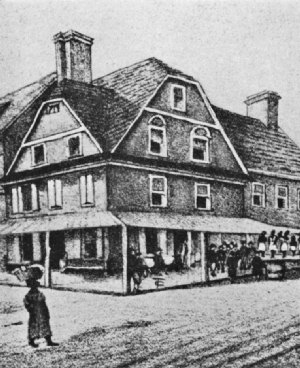
As for “the Coffee-house” that refused this man service, that was probably the London Coffee House (shown above, as drawn from William H. Ukers’s All About Coffee). The proprietor of that enterprise was none other than newspaper printer William Bradford.

A week later, the Bradfords’ 20 October Pennsylvania Journal proudly reported:
The description given in our last paper of the phiz of the Villain, EBENEZER RICHARDSON, being very accurate, he was last Monday [18 October] discovered skulking at the North-end of this city: and being closely pursued by many well-wishers to peace and good order, very narrowly escaped (by means of a wood) the TAR AND FEATHERS, which had several days before been prepared for HIM.—

As the city of Philadelphia is now, and forever must be too hot, to hold this Parracide, he will, in all probability, try his fortune in New-York; and if, contrary to expectation, he should not there meet his reward, but should experience another hair-breadth escape, he may probably, as a dernier Resorte, fly to the arms of his dear, dear P———, the surest and safest asylum for complicated Villainy, on this side the Atlantic.
“P———” was most likely Charles Paxton, Richardson’s longtime employer and one of the those Customs Commissioners in Boston.

TOMORROW: Back home in Massachusetts?

Monday, October 21, 2024

“Lurks about the wharves of this city”

Page 3 of William and Thomas Bradford’s Pennsylvania Journal for 13 Oct 1773 included a notice of a meeting of the American Philosophical Society and a proclamation from Gov. John Penn that the Crown had approved two bills the colonial assembly had passed back in March 1772 (a divorce and a naturalization).

In between those items was this announcement:
WHEREAS the infamous EBENEZER RICHARDSON, convicted of PERJURY and MURDER, has, at the instance of his special friend, Charles Paxton, been sent to this city as a pensioner to the —honorable Commissioners at Boston; and in consideration of his many special Services, has by them been rewarded with a quarterly payment, out of the money levied on the Americans, by an Act of Parliament, without their consent:

And whereas the said RICHARDSON, rioting in the spoils of his country, lurks about the wharves of this city, seeking an opportunity to distress the Trade of Philadelphia, and enslave America: And, in order more effectually to answer his vile purpose, has intimately connected himself with a certain T———, a Tide-Waiter here, who publicly declared “he would not only associate with the VILLAIN, EBENEZER, but with the DEVIL himself, if so ordered by the COMMISSIONERS,”

Now it is expected, that all Lovers of Liberty, in this Province, will make diligent search after the said RICHARDSON, and having found this Bird of Darkness, will produce him, tarred and feathered, at the Coffee-House, there to expiate his sins against his country, by a public recantation.

TAR AND FEATHERS.

N.B. The above RICHARDSON appears to be a man of 40 years of age, is about 5 feet 4 or 5 inches high, pretty thick and broad a-cross the shoulders, has a very ill countenance, and down look, [Cain’s Phyz,] mostly wears a flopped hat, a piss burnt cut wig, and a blue surtout coat, with metal buttons.
That’s quite a display of rhetoric. It makes something sinister from Richardson’s job in the Customs service: he “lurks about the wharves,” aims to “distress the Trade,” receives “a quarterly payment” (i.e., his salary). The item links him to “the DEVIL,” “Cain,” and a “Bird of Darkness.” It also contains the only physical description of the man that I’ve seen, not at all flattering. 

This article appears to have been written in Philadelphia by someone not fully familiar with Richardson’s long history in Massachusetts, picking up cues from Boston newspapers. The man was never “convicted of PERJURY,” to my knowledge. Bostonians called him a perjurer, including at the start of the riot at his house, because he’d deceived the public about his child with Kezia Hincher for several crucial months, and because painting him as a habitual liar let them cast doubt on his reports about smuggling and other activity.

The invocation of “TAR AND FEATHERS” is also striking because that public punishment hadn’t shown up in Philadelphia yet. Indeed, many Americans, even Whigs, viewed those incidents as New Englanders going too far. But the next month a broadside warning river pilots against bringing tea into Philadelphia would be issued by “THE COMMITTEE FOR TARRING AND FEATHERING.” (Or “Committee of Taring and Feathering,” as the next paragraph put it, showing the locals behind this threat were still working out details.)

Lastly, this newspaper notice overtly confronts the royal Customs service. It names one of the agency heads in Boston, verges on calling those men “[dis]honorable,” and refers to a local tide waiter by an initial everyone on the Philadelphia waterfront would recognize. That last seems like a clear threat.

TOMORROW: Results.

Thursday, July 18, 2024

“Like a torrent are rushing upon it with increasing violence”

As I wrote yesterday, the text of the Solemn League and Covenant that towns like Westford and Attleboro approved was not the first version of that document printed in an American newspaper.

On 22 June 1774, one day before Margaret Draper published the agreement in Boston, William Bradford’s Pennsylvania Journal issued a “Postscript” or supplement that included an article datelined “Philadelphia.” It began:
The following is a Circular Letter, written by the Committee of the Town of BOSTON, to the neighbouring towns with a copy of an agreement, which was to begin signing in every town in that government nearly at the same time.
The newspaper then printed William Cooper’s 8 June letter followed by a text that started the same way as what would appear in Draper’s Boston News-Letter.

But at the end of the second point, this text added the phrase “and never to renew any commerce or trade with them.”

Then it went on in a different direction. This text didn’t include an oath for retailers to swear. It included language not seen in the News-Letter version:
And, Whereas the promoting of industry, œconomy, arts and manufactures among ourselves is of the last importance to the civil and religious welfare of a community; we engage,

3dly, That from and after the first day of October next ensuing, we will, not by ourselves, or any for, by, or under us, purchase or use any goods, wares, manufactures or merchandize, whensoever or howsoever imported from Great Britain, until the harbour of Boston shall be opened, and our charter rights restored. And,

Lastly, As a refusal to come into any agreement which promises the deliverance of our country from the calamities it now feels, and which, like a torrent are rushing upon it with increasing violence, must evidence a disposition enimical to, or criminally negligent of, the common safety…
Both versions conclude with similar promises to shun doing business with any “contumacious importers.” The News-Letter text said signers wouldn’t buy “any article whatever” from those people. The Pennsylvania Journal text said they would be shunned “forever.” Both absolutes, but in different dimensions.

In comparing these two texts in 1915, Albert Matthews called the version that first surfaced in Philadelphia “Form B.” He didn’t cite that newspaper article but rather drew on a broadside at the American Antiquarian Society.

Matthews concluded that Form A was Boston’s proposed text and Form B originated in Worcester, created because Boston’s was “too drastic.” More recent scholars disagree.

COMING UP: The Worcester connection.

Friday, July 15, 2022

“If the burning the Gaspee schooner was a matter of serious importance…”

Benjamin Galloway was indeed at Mount Vernon on 1–5 January 1773, much as he described decades later. The evidence for that is George Washington’s own diary.

The anecdote Galloway told about Washington hinged on him reading an article from a recent newspaper, one of several fetched by William Lee from Alexandria, which described the destruction of H.M.S. Gaspee in Rhode Island.

The Gaspee was burned in June 1772, however. Would it have still been hot news in Virginia early the next year?

As I discussed back here, the initial news stories on the Gaspee affair were quite low-key, considering it was an armed attack on a Royal Navy schooner. The American Whig press didn’t make a big deal out of it, as if the event was an embarrassment.

Only one issue of the three Virginia Gazette newspapers—Purdie and Dixon’s for 9 July—carried a report of the burning. Through the end of the year, the rare follow-up items were short dispatches reporting on government actions, such as offering rewards for information and setting up an investigatory commission.

However, in December Rhode Island politicians began to write to local newspapers and to colleagues in other colonies, like Samuel Adams in Massachusetts and Richard Henry Lee in Virginia. They highlighted how that commission might send defendants and witnesses to Britain for treason trials. That would violate sacred British rights, they declared.

The 30 Dec 1772 Pennsylvania Journal joined that campaign by reprinting three separate items about the Gaspee affair from New England newspapers. Under the dateline of Boston, 17 December, printer William Bradford (shown above) combined an angry report on the commission from the 17 December Massachusetts Spy and this commentary from the 21 December Boston Gazette:
If the burning the Gaspee schooner was a matter of serious importance, much more so are the methods pursued by the British administration in consequence of it. This affair was transacted within the body of a county, in a free English government; one would think therefore it should be the subject of the inquiry of the grand jury of inquest for the same county: Instead of which we are told, that five gentlemen, four of whom are of superior rank in different colonies, the other indeed a judge of the admiralty, are appointed by commission to make the enquiry.

By a gentleman lately from Rhode-Island, we are informed, that three of these commissioners are empowered to act, at whose call the army and navy are to attend; that any persons accused, against whom the commissioners shall judge there is evidence sufficient to convict them, are to be apprehended, and together with the evidences [i.e., witnesses] sent to England for trial. And that Capt. [Robert] Keeler, of the Mercury, has notified Gov. [Joseph] Wanton, in consequence of orders, that his ship is ready to receive such persons for the purpose aforesaid.

[Boston News-Letter printer Richard] Draper tells us, that “Admiral [John] Montagu is ordered to hoist his flag in Newport harbour.” The purport of this parade is obvious to common sense. The Admiral will no doubt acquit himself to the satisfaction of his masters upon this occasion. It is said that he has recommended that those who, it is supposed, can give evidence of this matter, and refuse to do it, be put on board the men of war, and there kept until they do; which perhaps may be rather more eligible of the two, than the torture of the RACK.

The indignity offered to all the Colonies, and particularly Rhode-Island, says a gentleman of a neighbouring town in a letter to his friend in this, is not to be equalled. To have a set of crown officers commissioned by the ministry, and supported by ships and troops to enquire into offences against the crown, instead of the ordinary and constitutional method of a grand jury carries an implication that the people of that colony are all so deeply tinctured with rebellious principles, as that they are not to be trusted by the crown.

The inhabitants of this town and province can feel for their brethren of Rhode-Island, having themselves tasted of the cup of ministerial vengeance; when to aid and protect the commissioners of the customs, in carrying into execution a revenue act of the British parliament, Hillsborough’s troops were stationed in the capital, and the city turned into a garrison!—And though these troops, after slaughtering some of our innocent inhabitants, were obliged to retire from the town, they are yet posted in the principal fortress and key of the province.

What shall hinder the like scene of blood, rapine and slaughter in the capitol of Rhode-Island, if the commissions of enquiry there, should so readily call for the military aid as the commissioners of the customs did here? Such treatment of the colonies calls for the most serious attention; and however prophane it may be called by Mr. Draper’s writer the Yeoman, or his canting neighbour, we have reason with firm affiance in HIM who hateth oppression and tyranny, devoutly to acclaim, How Long!—O LORD!—How Long!
That was immediately followed by similar news from the 19 December Providence Gazette, which concluded:
The idea of seizing a number of persons, under the points of bayonets, and transporting them three thousand miles for trial, where, whether guilty or innocent, they must unavoidably fall victims alike to revenge or prejudice, is shocking to humanity, repugnant to every dictate of reason, liberty and Justice, and in which Americans and Freeman ought never to acquiesce.
And then material from the 21 December Newport Mercury, including a letter from a Bostonian warning that three army regiments were soon to march into Rhode Island and another from a Londoner saying:
Our tyrants in administration are greatly exasperated with the late manoeuvre of the brave Rhode-Islanders. . . . We believe that the ancient British spirit of independence which once blest this island, has improved by transportation, and preserves its vigour in the breasts of Americans; cherish it my dear friends! And by relieving yourselves save the small remnant of the virtuous in Britain.
Washington could have received this newspaper among others in early 1773. Living on Virginia’s northern border, he was almost as close to Philadelphia as to Williamsburg, and Philadelphia was a dynamic port with a freer press.

Thus, a newspaper delivered to Mount Vernon in the first days of 1773 could have ignited a dinner-table discussion about the Gaspee affair, British rights, and the use of the military to put down protests and tax resistance, as Galloway described. Those topics were all over the Pennsylvania Journal.

On the other hand, that newspaper did not include the details about how the Gaspee ran aground chasing a smuggling ship, details that Galloway explicitly recalled reading out to the company. He must have picked up that part of the story from other sources.

TOMORROW: George Washington’s other diary.

Friday, December 20, 2013

Rhode Island’s First Major General

A few days back, I quoted Samuel Ward’s December 1774 letter describing how Rhode Island was putting itself on a footing for war by, among other things, appointing the first major-general in the colony’s history. That was not Nathanael Greene, who sprang from the rank of private to that of general only after the war had begun. So who was it?

The Rhode Island legislature appointed Simeon Potter (1720-1806) of Bristol. He had gained wealth and notoriety as a privateer during the mid-century imperial wars and allegedly helped to lead the raid on the Royal Navy’s Gaspée in 1772.

According to Beggarman, Spy: The Secret Life and Times of Israel Potter, by David Chacko and Alexander Kulcsar, Simeon Potter was not a mild-tempered man. For instance, in 1761 he beat up a seventy-four-year-old minister. (To be fair, the minister had told Potter, “There is whoring wherever you go.”)

What did Maj.-Gen. Potter do in the spring of 1775? On 19 April, two members of the Massachusetts Provincial Congress—James Warren of Plymouth and Dr. Charles Pynchon (1719-1783) of Springfield—came to Providence to consult with Rhode Island legislators about the outbreak of fighting in Middlesex County. One of the Rhode Island politicians, Stephen Hopkins, sent Potter a letter reporting:

The King’s Troops are actually engaged butchering and destroying our brethren in the most inhuman manner. The inhabitants oppose them with great zeal and courage.
Hopkins asked Potter to come to Providence to consult with Lt. Gov. Darius Sessions, who had been put in charge of the colony’s military preparations.

Potter never took the field. According to Beggarman, Spy, he “claimed to have received a letter from the commanding general of the Massachusetts Militia telling him that no troops were needed.” Unfortunately, Chacko and Kulcsar don’t quote that letter, and their citation isn’t specific or clear.

That book’s notes mention “Simeon Potter’s letter of September 3, 1774 to his nephew Nathan Miller of Warren in WHS [Warren Historical Society] that is only partially reprinted in NDAR [Naval Documents of the American Revolution].” The second volume of N.D.A.R. does include a letter from Potter dated 3 Sept 1775, saying it went to Col. William Turner Miller and is at the Rhode Island Historical Society. But that letter says nothing about the April crisis or a message from Massachusetts. It’s conceivable that that published transcript is based on an incomplete, mislabeled copy and that the Warren Historical Society holds a longer document, but I wish the information were more solid.

In any event, the Rhode Island legislature cleaned house in May 1775. It replaced Lt. Gov. Sessions with Nicholas Cooke, and later pushed out Gov. Joseph Wanton in favor of Cooke as well. It made Greene a brigadier-general commanding three regiments of infantry and an artillery company outside Boston. For its own defense, the colony chose a new major-general: William Bradford (1729-1808), also of Bristol. In October Bradford became lieutenant governor and Joshua Babcock (1707-1783) of Westerly became the new major general.

As for Potter, one of these days I’ll quote that September 1775 letter to show his resentment about the whole situation. Potter did end up providing cannon for the Continental Army—at a price. In 1776 the Rhode Island legislature even appointed him an Assistant, or member of the upper house. But Potter didn’t show up for sessions, the next year he stopped serving in town offices, and he refused to pay taxes to the new government. That didn’t save him from losing his mansion in a British raid in 1778. Potter had to move into a smaller house, which is now a bed-and-breakfast.