J. L. BELL is a Massachusetts writer who specializes in (among other things) the start of the American Revolution in and around Boston. He is particularly interested in the experiences of children in 1765-75. He has published scholarly papers and popular articles for both children and adults. He was consultant for an episode of History Detectives, and contributed to a display at Minute Man National Historic Park.

Subscribe thru Follow.it


•••••••••••••••••


Showing posts with label Joseph Jackson. Show all posts

Wednesday, September 05, 2018

One Company in the 1769 Boston Militia

One of the many documents that the Boston Public Library has digitized for the public is here: “Copy of Larum List taken March 6, 1769, in Colo. Joseph Jacksons Company.”

This is a rare piece of paperwork from the colonial militia in peacetime. We have good records of who served in militia companies called up for active service because the government had to pay those men. But ordinary militia training was a duty and no money exchanged hands for that labor, so there was no reason to preserve records.

(When I say, “no money exchanged hands,” I should acknowledge that the militia law set nominal fines for not attending militia drills. However, there are so few recorded examples of those fines being collected that the rule was probably symbolic.)

It’s not clear to me who created this document or why it was preserved. But it’s an interesting snapshot of administering a militia company.

Joseph Jackson (1707-1790) was colonel in charge of the Boston militia regiment in the late 1760s, as well as a selectman and a justice of the peace. That regiment was organized along the British model, with one company assigned to Col. Jackson and probably led in practice by a lieutenant.

The purpose of this document appears to be to list all the Boston men assigned to Jackson’s company. There were about 3,000 white males above the age of sixteen—i.e., required to do militia training—in Boston at this time, and 239 men on this list. It looks like Jackson’s men came from the wards near the center of town.

Just as important as listing the men eligible to drill, the document also separated out the men who by law didn’t have to drill. Most of those categories consisted of men from the highest ranks of society:


Another set of categories identified men doing their militia service in other ways:

  • “Batterymen” who did their militia service in the North or South Battery companies
  • “Troopers” on horseback
  • Artillery
  • Cadetts

There was also one “Engine Man,” John Newal. Did this mean he looked after a firefighting engine?

Finally there were two categories of men excused for health reasons:

  • men above age sixty like “Old Mr. Marston”
  • “Inverleads”

That left 154 names under “Liable to Train”—though two were labeled “Lame,” one as at “Sea,” and a fourth as “Excd.,” suggesting he was excused. (He was a Jackson.) A couple of those men have the title “Capt.,” probably meaning they were ship’s captains. Some names already appearing among Boston 1775’s numerous tags are John Gill, Charles Conner, Thomas Waite Foster, John Piemont, Gawen Brown, and Nathaniel Barber.

There are no men identifiable as black or Native American. The law excluded such men from militia training, though some nevertheless did serve when war came. There are also no identifiable Quakers. I don’t think Massachusetts had a provision for conscientious objection yet, but the concept was recognized.

It might be possible to correlate this list from 1769 with the Boston tax records from 1771 and glean more information. But I’ll leave that to another day. Right now I’m feeling too inverlead.

(Thanks to John Hannigan to alerting me to this document.)

Friday, August 21, 2015

Thomas Hutchinson and the First Stamp Act Mob

Boston 1775 now returns to exploring the sestercentennial of the movement against the Stamp Act, and specifically the experiences of Lt. Gov. Thomas Hutchinson.

Hutchinson wrote his own long description of the Stamp Act disturbances in a letter to London, recently published in the Colonial Society of Massachusetts’s Papers of Thomas Hutchinson. Unlike Gov. Francis Bernard, who remained in the Town House during all the action until he left town entirely, Hutchinson actually thrust himself into the action to the point of personal danger.

There were a couple of reasons for Hutchinson’s behavior:
  • He had a personal connection to stamp master Andrew Oliver: the two were brothers-in-law.
  • He was courageous and confident and certain that he knew better than anyone else.
Even before the governor got involved, Hutchinson told Sheriff Stephen Greenleaf “that it was his duty to take some of his officers & go & cut it down & bring it away.” (All the sources agree that Greenleaf never risked confronting the crowd himself; he sent some of his underlings, who came back and said they couldn’t do the job safely.)

Likewise, when the Council told the governor that the disturbance should end at sunset, Hutchinson insisted, “I thought very differently.” And he was right:
Just at dark an amazing mob brought the image thro the court house [Town House] the council then sitting above & carried it to a small building which Mr. O had just erected & which was suppozed to be designed for the stamp office. In a few minutes the building was level with the ground.

The heads of the mob then gave directions to carry the image to forth. being near Mr. O. & then burn it but to do no damage to his dwelling house. I supposed the house in danger but my relation to Mr O would alone have obliged me not to desert him. I went up & found his family in terror and advised them immediately to quit the house which they did he himself intending to tarry. As soon as the bonfire was made the attack upon the house began by breaking the windows. I sent for the Sheriff & Mr [Charles] Paxton who lives near came in & we determined to keep possession of the house but obliged the owner to quit it supposing he would be in danger if they entred.

The breaking the windows continued 1/2 an hour or more until the glass & frames of the lower story were entirely gone on one side the house. At length some of the stones made their way thro the pannels of the shutters & a breach being made they were soon broke to pieces & we obliged to retire into another room. After a little deliberation they entred the house & we tho’t it time to withdraw.

I went immediately down to the Col of the Regiment [Joseph Jackson] & told him I thought it necessary to make an alarm the town being in the hands of the mob & while he was preparing I would procure the gov order for that purpose. The gov. readily gave me the order to make use of at my discretion.

I returned to a house near the scene of action where I found several gentlemen who had been at Mr O.’s & spoke to some of the villains & supposed they had spent their rage & did not doubt if I would take the Sheriff & go to the house I should have [wei]ght enough to disperse them. I was in doubt but how ever went, but upon my entring the cry was [Goddam]n their blood heres the Sheriff with the gov. stand by my boys let no man give way. The cry was suc[ceed]ed by a volley of stones & bricks.

I turned into a little room where a young gentleman cried out for gods sake [Sir pu]t out the lights or youll be dead in a moment & then ran & blew out the candles & fled. I considered [a momen]t whether to take my chance there or run thro the mob & chose the latter & escaped with [a sligh]t stroke in my arm & another in my leg & soon after it appeared by the hallooing they were [dispers]ing.
In The British Empire Before the American Revolution (1961), Lawrence Henry Gipson reported that the copy of this letter in the Massachusetts Archives has a corner torn away, but George Bancroft’s transcription of it from the mid-1800s includes the missing words in brackets above. Gipson therefore inferred that some late Victorian had torn off that corner to obliterate even the hint of “Goddamn.”

But back to 1765. As I quoted yesterday, on the evening of 15 August, Gov. Bernard saw a bonfire burning on a Boston hill and concluded that the mob was out again. Indeed it was, and it was headed for Hutchinson’s house.

TOMORROW: The mob at Hutchinson‘s door.

Sunday, August 16, 2015

Gov. Francis Bernard’s View of the Stamp Act Riots

Royal governor Francis Bernard had, not surprisingly, a different view of the Stamp Act protests of 14 Aug 1765 from those men I quoted yesterday.

Bernard’s view came mainly from the Council chamber of the Town House (now Old State House), where he met with the Massachusetts gentlemen who were supposed to be his natural advisors and supporters.

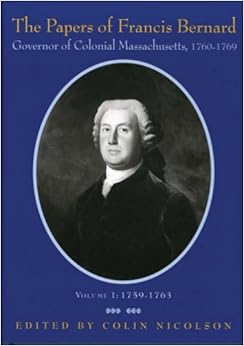
Here’s the governor’s report to the Board of Trade in London, written on 15 August. This text comes from the Papers of Governor Francis Bernard, edited by Colin Nicolson and published by the Colonial Society of Massachusetts. (A similar text, apparently based on Bernard’s concurrent letter to the Earl of Halifax, appears here.)
Many Gentlemen, especially some of the Council, treated it as a boyish sport, that did not deserve the Notice of the Governor & Council. But I did not think so: however I contented myself with the Lt. Govr. [Thomas Hutchinson], as chief Justice, directing the Sheriff [Stephen Greenleaf] to order his Officers to take down the Effigy: & I appointed a Council to meet in the Afternoon to consider what should be done, if the Sheriff’s Officers were obstructed in removing the Effigy.

Before the Council met, the Sheriff reported, that his Officers had endeavoured to take down the Effigy; but could not do it without imminent danger of their Lives. The Council met: I represented this Transaction to them as the beginning, in my Opinion, of much greater Commotions; & desired their Advice what I should do upon this Occasion. A Majority of the Council spoke in form against doing anything, but upon very different Principles. Some said, that it was trifling Business, which, if let alone, would subside of itself; but if taken notice of, would become a serious Affair. Others said, that it was a serious Affair allready; that it was a prearranged Business in which the greatest Part of the Town was engaged; that we had no force to oppose to it; & making an Opposition to it without a power to support the Opposition would only inflame the People, & be a means of extending the mischief to persons not at present the Objects of it.

Tho’ the Council were allmost unanimous in advising that nothing should be done, they were averse to having such advice entered upon the Council Book. But I insisted upon their giving me an Answer to my Question, & that it should be entered in the Book: when after a long altercation, it was avoided by their advising me to order the Sheriff to assemble the Peace Officers, & preserve the Peace: which I immediately ordered, being a matter of form rather than of real Significance.

It now grew dark; the Mob which had been gathering all the Afternoon, came down to the Town House, bringing the Effigy with them; & knowing that we were sitting in the Council Chamber, they gave three huzza’s by way of defiance, & passed on.

From thence they went to a new Building, lately erected by Mr. [Andrew] Oliver to let out for Shops, & not quite finished: this they called the Stamp Office, & pulled it down to the Ground in five minutes. From thence they went to Mr. Oliver’s House, before which they beheaded the Effigy, & broke all the Windows next the Street; then they carried the Effigy to Fort Hill near Mr. Olivers House, where they burnt the Effigy in a Bonfire made of the Timber they had pulled down from the Building.

Mr. Oliver had removed his family from his House, & remained himself with a few friends; when the Mob returned to attack the House. Mr. Oliver was prevailed upon to retire, & his friends kept Possession of the House. The Mob finding the Doors barricaded, broke down the whole fence of the Garden towards fort hill, & coming on beat in all the doors & windows of the Garden front, & entered the House, the Gentlemen there retiring. As soon as they had got possession, they searched about for Mr. Oliver, declaring they would kill him: finding that he had left the House, a Party set out to search two neighbouring Houses, in one of which Mr. Oliver was; but happily they were diverted from this Pursuit by a Gentleman telling them, that Mr. Oliver was gone with the Governor to the Castle. Otherwise he would certainly have been murdered.

After 11 o’clock, the Mob seeming to grow quiet, The (Lt. Governor) Chief Justice & the Sheriff ventured to go to Mr. Olivers House to endeavour to perswade them to disperse. As soon as they began to speak, a Ring leader cried out “The Governor & the Sheriff! to your Arms my boys.” Presently after a volley of Stones followed; & the two Gentlemen narrowly escaped thro’ favour of the Night, not without some bruises.

I should have mentioned before, that I sent a written order to the Colonel of the Regiment of Militia [Joseph Jackson (1707-1790), also a selectman and justice of the peace], to beat an Alarm; he answered that it would signify nothing, for as soon as the drum was heard, the drummer would be knocked down, & the drum broke; he added, that probably all the drummers of the Regiment were in the Mob. Nothing more being to be done, The Mob were left to disperse at their own Time, which they did about 12 o’clock.
The next day, Bernard assembled his Council again, including “all the Members within 10 Miles of Boston.” They were no more helpful than before, repeating that the militia would be useless. The governor did all they advised, issuing a proclamation againt the rioters with an ineffectual £100 reward for their capture. Then he summoned all of Boston’s magistrates and selectmen to the Council Chamber to urge them to keep the peace.

Gov. Bernard was so confident that would work that at sunset he hastened off to Castle William, where no mob could reach him. Before bedtime that night he composed the long report above, concluding:
Whilst I am writing, looking towards Boston, I saw a Bonfire burning on Fort hill: by which I understand that the Mob is up, & probably doing mischief.
COMING UP: The lieutenant governor in the midst of the action.