J. L. BELL is a Massachusetts writer who specializes in (among other things) the start of the American Revolution in and around Boston. He is particularly interested in the experiences of children in 1765-75. He has published scholarly papers and popular articles for both children and adults. He was consultant for an episode of History Detectives, and contributed to a display at Minute Man National Historic Park.

Subscribe thru Follow.it


•••••••••••••••••


Showing posts with label Treaty of Paris. Show all posts

Monday, May 04, 2026

The Hill Brothers Settle in Canada at Last

On 27 Apr 1782, Elizabeth Hill died, “greatly lamented by her Family and Neighbours,” the New-York Gazette reported two days later.

In that news item her husband, John Hill, had “Esq.” after his name, a genteel reflection of his service to the Crown inspecting the Brooklyn ferry.

Also by that time, the Americans had won the war. Gen. Guy Carleton was about to be appointed commander of the British forces, charged with holding things together till the end. Gen. George Washington’s Continental Army was pressuring New York City, but not trying anything too risky. Lt. Col. Benjamin Thompson was getting his combat experience by leading dragoons on Long Island. But basically people were waiting for the final peace terms to be settled.

John’s brother Richard led one of the first contingents of Loyalists to leave New York, embarking in June 1783. He was in Carleton, Nova Scotia (which would become St. John, New Brunswick), in September when he wrote back to John about a ship captain named John Mason who had tried to make off with the vessel under his command.

Richard Hill was described as the first Loyalist to build a frame house in the town of Digby, Nova Scotia. He became a justice of the peace and a vestryman.

John Hill and his family evacuated New York late in 1783, eventually joining his brother in Digby. By the next year, John had remarried. His household consisted of him, his wife, a child over age ten, and three “servants” over age ten.

In 1786 the Loyalists Commission held hearings at Halifax. John Hill applied for “half pay, as a Quarter Master, but was told by their Honors that Pensions, and Half Pay, was to be Settled in England.” Four years later he was in London, petitioning for support for himself and his brother. Returning to Digby, he managed a store and was first treasurer of the local Freemasons’ lodge.

People think that Richard Hill died around 1803, three years after his wife Jane (her gravestone shown above).

John died on 23 Nov 1817—forty years after he had been released from the Boston jail, accused of helping to loot the town during the evacuation.


Wednesday, March 04, 2026

Archive in the Sky


In addition to the Freedom Trucks discussed yesterday, the federal government and its corporate donors are sending the Freedom Plane around the country bearing documents of national importance from the Founding period.

Those documents are listed on the plane’s own website. They are:
  • William Stone’s 1823 engraving of the Declaration of Independence, which is both more common and more legible than the handwritten original. (This artifact is on loan from David M. Rubenstein, co-founder of the Carlyle Group and collector of historical documents, while all the others are originals from the U.S. National Archives.)
  • The Continental Congress’s Articles of Association from 1774, laying out the Continental Association boycott of goods from Britain.
  • Oaths of allegiance signed by George Washington, Alexander Hamilton, and Aaron Burr as Continental Army officers in 1778.
  • The Treaty of Paris from 1783.
  • A copy of the draft Constitution printed for delegates to the 1787 convention to debate and revise, this one with notes by David Brearley of New Jersey. 
  • Chart of votes by states at that convention, including “The Constitution unanimously agreed to” (though Rhode Island didn’t send a delegation and New York’s was incomplete). 
  • The Senate markup of the Bill of Rights in 1789, showing revisions of the language that came out of the House of Representatives. 
Legally the main omission is any form of the Articles of Confederation and Perpetual Union, which actually formed the United States of America into a single country. But we always overlook that. 

The plane’s itinerary is Kansas, Georgia, southern California, eastern Texas, Colorado, southern Florida, Michigan, and Washington. This national tour includes no stop in the Northeast.

Saturday, December 21, 2024

“An Act to Authorise Sarah Cochran…”

As I wrote back here, John Cochran died in New Brunswick, Canada, in 1790.

Though he’d been in ill health for years, he didn’t leave a will, and the probate court appointed his widow Sarah to administer his estate.

Back in 1779 the New Hampshire legislature had passed a law empowering the state to confiscate John Cochran’s property and sell it to defray the costs of the ongoing war.

However, the 1783 Treaty of Paris urged states to repeal such laws and allow Loyalists to return. Some Americans objected to that provision. It took until 1786 for any state to follow that path, but New Hampshire was the first.

Thus, when John Cochran died, his estate included some property he’d left behind in New Hampshire, apparently unsold. Sarah petitioned to be able to sell that land.

On 20 June 1793, the state assembly, still meeting in Portsmouth, passed a law authorizing her to do so:
Whereas Sarah Cochran of Saint-Johns in the Province of New Brunswick in British America, hath petitioned the general Court, representing that she is Administratrix of the estate of her late husband John Cochran of said Saint Johns decd., that she hath taken out letters of Licence from the Judge of probate of wills & within the aforesaid Province To sell and convey all the Estate of said decd., more especially a certain tract of land, situate in said Londonderry Wherefore she prayed that she might be enabled to make and execute, by herself or her Agent, duly appointed a good and valid deed of the land aforesaid in said Londonderry — The prayer of which petition appearing reasonable.

Therefore be it enacted by the Senate and house of Representatives in General Court convened, that the said Sarah Cochran, be and she hereby is authorised and impowered to sell, and make and execute by herself or her Agent duly appointed a good and valid deed of the lands aforesaid, situate in said Londonderry, she the said Sarah or her Agent giving bonds with sufficient surety to the Judge of probate for the County of Rockingham, to account to the said Judge for the money arising on such sale, or to the creditors of said deceased or his heirs when they shall arive to full age or otherwise to such person or persons, to whom of right it may belong.
That’s the last trace of John or Sarah Cochran that I’ve found. Of course, it’s likely that Canadian sources that I’m unfamiliar with have more to say.

John’s father James evidently moved to St. John, New Brunswick, to be with that part of the family. He died there in 1794, aged eighty-four.

TOMORROW: The child who came back.

Thursday, November 24, 2022

The Continental Congress’s Thanksgivings

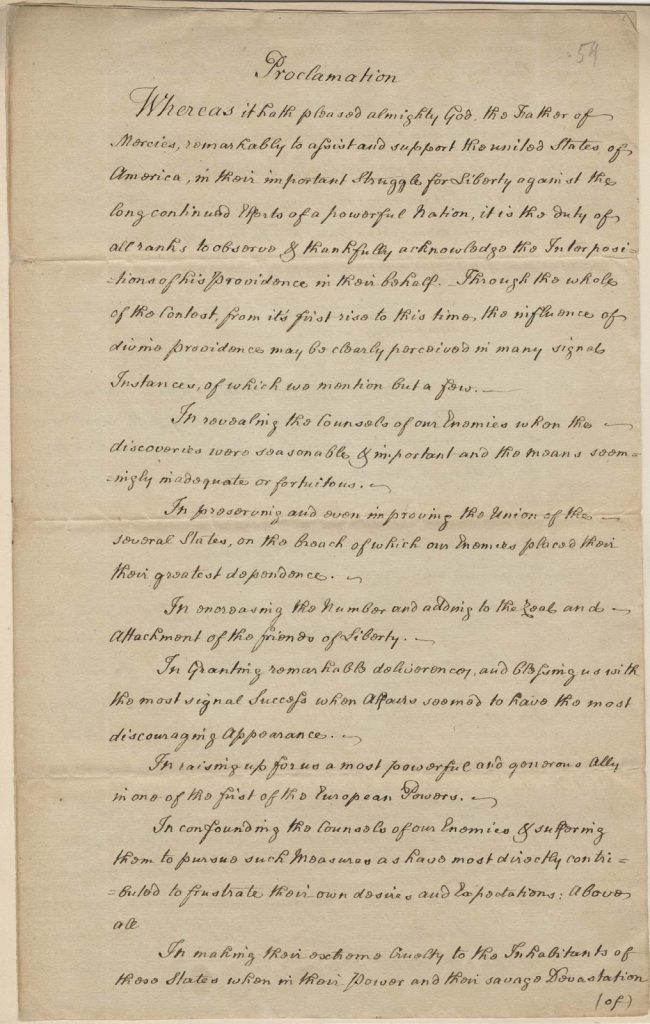
On 1 Nov 1777, the Continental Congress issued a recommendation “to the legislative or executive Powers of these UNITED STATES” to observe a Thanksgiving holiday on Thursday, 18 December.

The proclamation didn’t allude to any particular event, but scholars treat this as an expression of gratitude for the Continental victory at Saratoga.

Certainly the Congress, then meeting in York, Pennsylvania, after being pushed out of Philadelphia, wasn’t feeling thankful about the Battles of Brandywine or Germantown.

The 1777 proclamation was explicitly Christian, referring to “the Merits of JESUS CHRIST,” and culminating in a prayer “to prosper the Means of Religion, for the promotion and enlargement of that Kingdom, which consisteth ‘in Righteousness, Peace and Joy in the Holy Ghost.’”

The Congress continued to issue Thanksgiving proclamations every fall until after the formal end of the war. The 1779 and 1780 resolutions were explicitly Christian, the other four merely theistic (though one mentioned “Louis the Most Christian King our ally”).

At first the Thanksgiving proclamations kept up the pattern of not mentioning specific events. But the long document of 26 Oct 1781, issued just days after the Congress learned of the victory at Yorktown, spelled out multiple blessings:
the goodness of God in the year now drawing to a conclusion:

in which a mutiny in the American Army [the Pennsylvania Line Mutiny, which drove the Congress out of Philadelphia again] was not only happily appeased but became in its issue a pleasing and undeniable proof of the unalterable attachment of the people in general to the cause of liberty since great and real grievances only made them tumultuously seek redress while the abhorred the thoughts of going over to the enemy,

in which the Confederation of the United States has been completed [i.e., Maryland finally ratified the Articles of Confederation] by the accession of all without exception in which there have been so many instances of prowess and success in our armies; particularly in the southern states, where, notwithstanding the difficulties with which they had to struggle, they have recovered the whole country which the enemy had overrun, leaving them only a post or two upon on or near the sea [Charleston, Savannah, and Wilmington, which was soon to be evacuated]:

in which we have been so powerfully and effectually assisted by our allies, while in all the conjunct operations the most perfect union and harmony has subsisted in the allied army:

in which there has been so plentiful a harvest, and so great abundance of the fruits of the earth of every kind, as not only enables us easily to supply the wants of the army, but gives comfort and happiness to the whole people:

and in which, after the success of our allies by sea, a General of the first Rank [Cornwallis], with his whole army, has been captured by the allied forces under the direction of our illustrious Commander in Chief.
For the next three years, the Congress’s Thanksgiving proclamations and recommendations to the states all referred to the slow steps toward a final peace:
  • 1782: “the present happy and promising state of public affairs; and the events of the war in the course of the last year now drawing to a close”
  • 1783: “hostilities have ceased, and we are left in the undisputed possession of our liberties and independence, and of the fruits of our own land, and in the free participation of the treasures of the sea”
  • 1784: “a general pacification hath taken place, and particularly a Definitive Treaty of peace between the said United States of America and his Britannic Majesty, was signed at Paris, on the 3d day of September, in the year of our Lord 1783; the instruments of the final ratifications of which were exchanged at Passy, on the 12th day of May, in the year of our Lord 1784, whereby a finishing hand was put to the great work of peace, and the freedom, sovereignty and independence of these states, fully and completely established”
And then the Continental Congress stopped recommending Thanksgivings. From 1785 to the advent of the new federal government, there were no national Thanksgiving proclamations.

In those years the Congress had difficulty completing normal business, going for long periods without a quorum. The external crisis had passed, and people disagreed about solutions to the internal difficulties. And the Congress delegates might have felt that with independence won Americans had both less to wish for and less to be thankful for.

The image above is one page of the Congress’s Thanksgiving proclamation in 1781, signed for that legislature by Thomas McKean and Charles Thomson and now owned by the Rosenbach museum and library. The texts of all the Congress’s proclamations have been shared by the Pilgrim Hall Museum.holiday

Friday, December 03, 2021

“To that virtue which for a series of years resisted oppression”

In 1784 Sir Thomas Gascoigne, baronet, got serious about one of the principal responsibilities of a titled British gentleman: producing an heir to inherit his estate, centered at Parlington Hall in Yorkshire.

In November of that year he married the young widow Lady Mary (Shuttleworth) Turner, becoming stepfather to her children by Sir Charles Turner, a York politician. In January 1786 the couple’s first son, Thomas Charles Gascoigne, arrived. Sadly, only a month later, Lady Mary departed at age thirty-four.

Sir Thomas Gascoigne had been commissioning plans for a new mansion, having stone hauled in from his quarries. According to tradition, after his wife died he decided instead to use that stone to build a memorial.

Except it didn’t turn out to be a memorial to a lost wife. Instead, it was a triumphal arch modeled on the Arch of Constantine, which Sir Thomas had seen in his travels to Rome. The architect, Thomas Leverton, had exhibited plans for such an arch as early as 1781.

The triumph this arch commemorated was the 1783 Treaty of Paris with America. It thus implicitly praised the Rockinghamite Whig faction in Parliament that had pushed to end the war (including Sir Thomas Gascoigne himself).

Originally, according to archived plans, Sir Thomas wanted this statement on the structure:
To that virtue which for a series of years resisted oppression and by a glorious race rescued its country and millions from slavery
That was deemed too long to be visible in the available space and edited down to:
Liberty in N. America Triumphant MDCCLXXXIII
The result is Britain’s first and biggest monument to the American War for Independence. The Parlington Arch still stands on a hill in Yorkshire, though Parlington Hall fell down over the 1900s.

As for Sir Thomas Gascoigne, he continued his aristocratic life. He stayed wealthy by developing the coal mines on his land, as did his son and heir. However, Thomas Charles Gascoigne died in a hunting accident in 1809, and Sir Thomas passed away four months after his son in February 1810.

The baronetcy therefore died with them. Their properties descended to Lady Mary’s descendants by her first husband on condition that those lines took the Gascoigne name.

Monday, September 26, 2016

Austerity and Stimulus in the American Revolution?

A few weeks back, the Course of Human Events blog highlighted a new book about the American Revolution coming from Steven Pincus, the Bradford Durfee Professor of History and co-director of the Center for Historical Enquiry and the Social Sciences at Yale University. His previous books have been about Britain in the turbulent 1600s.

About The Heart of the Declaration: The Founders’ Case for an Activist Government, the blog explains:
Pincus maintains that the American Revolution was a major turning point in not just British or American history but global history, because it was a response to the huge debt crisis that had overtaken the European empires. The patriots and their opponents had differing opinions on how best to respond to a debt crisis. One side wanted to stimulate economic growth “in the most dynamic part of the empire, and that was the American colonies.” The other side argued for pursuing austerity measures and shifting the tax burden away from the English and onto those who couldn’t vote (the American colonists, for example).

The various acts passed in the 1760s and 1770s demonstrate which side won out in this fight between austerity measures and stimulus measures. The Sugar Act (1764) and Stamp Act (1765) taxed the colonies in order to raise revenue, and the first of the Townshend Acts was even called the Revenue Act (1767). Instead of stimulating economic growth in the American colonies, the colonists refused to purchase or even to import British goods because of the taxes imposed upon them. As Pincus explains, “The 1770s saw the first time austerity measures pursued in response to a debt crisis generated revolution, but it wasn’t going to be the last time.”
I read about this thesis a couple of years ago, and on first blush it struck me as too relevant for its own good. “Austerity measures and stimulus measures” have been a huge debate in western polity since 2009. But do those terms (or does that analogy) fit the situation of the 1760s?

There’s no question that the imperial government in London sought to collect more revenue from the North American colonies through various tariffs and the failed Stamp Act. But “austerity” seems like more than paying down the debt, especially when contrasted with an economic “stimulus.” Austerity also means freezing or cutting services, and I can’t think of significant services that the British imperial government provided to the colonies that could be cut.

With peace in 1763, the imperial government did shrink its military, which meant it wasn’t shipping specie into the colonies to pay its soldiers and sailors and mount campaigns. There was no doubt less expended on fortifications. But can we equate those with the sort of investment in infrastructure or other public projects we now consider “stimulus”? Furthermore, the colonists who protested imperial policy of the 1760s usually objected to seeing more soldiers in their cities on the grounds that those troops required local spending as well (the real problem with the Quartering Act).

In one area, Parliament definitely increased spending after the Seven Years’ War: the payroll of the Customs office. The Treasury Department also started to pay gubernatorial and judicial salaries instead of relying on colonial governments to come through with that money. Again, the American Whigs and their allies in Britain objected to that new imperial spending because the money ultimately derived from the new tariffs and went toward enforcing those tariffs.

So what austerity/stimulus does Pincus argue was significant?

TOMORROW: Another of today’s hot-button issues.

Thursday, January 28, 2016

Fowler on the Crises after Yorktown in Lexington, Jan. 29

On Friday, 29 January, the Lexington Historical Society will host a free talk by William Fowler, Jr., on the topic of his book American Crisis: George Washington and the Dangerous Two Years After Yorktown, 1781-1783.

The publisher’s description:
Most people believe the American Revolution ended in October, 1781, after the battle of Yorktown; in fact the war continued for two more traumatic years. During that time, the Revolution came closer to being lost than at any time in the previous half dozen.

The British still held New York, Savannah, Wilmington, and Charleston; the Royal Navy controlled the seas; the states—despite having signed the Articles of Confederation earlier that year—retained their individual sovereignty and, largely bankrupt themselves, refused to send any money in the new nation's interest; members of Congress were in constant disagreement; and the Continental army was on the verge of mutiny.

William Fowler’s An American Crisis chronicles these tumultuous and dramatic two years, from Yorktown until the British left New York in November 1783. At their heart was the remarkable speech Gen. George Washington gave to his troops encamped north of New York in Newburgh, quelling a brewing rebellion that could have overturned the nascent government.
Fowler is a a professor at Northeastern University and a former director of the Massachusetts Historical Society. His short biography of Samuel Adams was the spur that got me into studying Revolutionary history intently about eighteen years ago, so he might have a lot to answer for.

This talk is in the historical society’s Cronin Lecture series. It will take place at the Lexington Depot starting at 8:00 P.M. It is free and open to the public.

Saturday, August 15, 2015

A Longer View of the Stamp Act

For a broader perspective on how the conflict over the American Stamp Act fit into the dynamics of the British Empire, check out Donald Carleton, Jr.’s essay at Mass Humanities. Don spearheaded the commemoration of the Peace of 1763 in Boston two years ago (check out the website), and he highlights the link between that event and Parliament’s new law:

The ending of lavish wartime military spending triggered an empire-wide economic contraction. British national debt had nearly doubled in nominal terms during the conflict, surging from 78% to 117% of estimated GDP. With domestic taxes already high, Britain’s postwar leadership determined that their American subjects should start paying a share of imperial administrative and defense costs and begin properly adhering to imperial regulations in general.

But measures which seemed mild in London looked outrageous in the colonies. Gripped by recession and already paying heavy provincial taxes, more than a few colonists were sufficiently angered—or desperate—to take the streets. Many more expressed their opposition to the Stamp Act by boycotting British consumer goods. Nine colonial governments took part in a “Stamp Act Congress” to coordinate their opposition.
The mainland colonies developed more unity in opposing the Crown’s new taxes than they had ever mustered before the war.

Thursday, April 02, 2015

David Hartley: “singular in his dress”

Last month I wrote about David Hartley (1732-1813), the Member of Parliament who went from being a far-out-of-power rookie lawmaker in 1774 to signing the Treaty of Paris for Britain in 1783.

He was by no means a typical British gentleman of the time, and not just because of his scientific talent or progressive views on slavery. In The Literature and Literati of Bath (1854), George Monkland wrote of Hartley (at least in later life):
He was a man of an ingenious and inventive mind; in his person and appearance, I can recollect, he was somewhat eccentric; he wore a hat of peculiar shape, and no cravat, but his shirt collar was turned down, and simply confined by a black ribbon tied in a bow, which, at the time I speak of, was by no means an usual style of costume; now-a-days, when men wear anything and everything, he might perhaps have passed unobserved.
In a supplemental volume published the next year, Monkland quoted from a letter by the Rev. Richard Warner (1763-1857):
David Hartley was singular in his dress and simple in his manners, and (perhaps) rather affected the quaint apparel of the puritans; he never wore stockings. . . .

One day after dinner [in the fellows’ room of Merton College, Oxford, of which he was the second oldest fellow], allusion was made to Hartley’s stockingless legs, and denounced as a dirty practice. “I beg your pardon,” said Hartley, and throwing off his shoe, and spreading his naked limb upon the table, “There, gentlemen, you see that there is not a speck of dust upon my foot.”
I think about this in contrast to how Hollywood would want to cast and dress a British diplomat signing the peace treaty with the Americans: as a highly aristocratic, formally dressed snob brought low, not an eccentric intellectual who probably outdid Benjamin Franklin in informality.

For more on eighteenth-century stockings, particularly ladies’, see this post on All Things Georgian.

Friday, March 27, 2015

Hartley and Franklin, Reunited in Paris

I’ve been writing about the on-again, off-again correspondence of Benjamin Franklin and David Hartley, British scientist and Member of Parliament. Their relationship actually turned out to be a factor in the end of the war.

After London received news of the Battle of Yorktown, Lord North’s government fell. In March 1782 power shifted to the Marquess of Rockingham, longtime leader of the opposition, with a mandate to bring the American War to a close before it cost even more money. Rockingham filled the post of prime minister for all of four months before he died of the flu.

The Earl of Shelburne, one of Rockingham’s secretaries of state, took over. He was already steering negotiations with the U.S. of A.’s European diplomats through his envoy, the merchant Robert Oswald. By November 1782 Oswald worked out preliminary articles of peace with Franklin in France.

Meanwhile, Rockingham’s other secretary of state, Charles James Fox, refused to serve under Shelburne. He led other Rockingham Whigs, such as Edmund Burke, out of government. (That created openings for such rising politicians as William Pitt, who became Chancellor of the Exchequer at the age of twenty-three; they didn’t call him “the Younger” for nothing.)

David Hartley had opposed the American War all along, but he also disliked Shelburne and voted against the preliminary articles for peace. Hartley was a Fox ally, and he also maintained a personal friendship with Lord North, despite their political differences.

In April 1783 Fox and North, longtime opponents, made a surprising alliance to force Shelburne out of power. Shortly afterwards, George III appointed Hartley the new negotiator with the Americans. Fox and North both trusted Hartley, and they thought his friendly correspondence with Franklin would help to finish the negotiations on favorable terms.

Hartley walked into a very complex situation since France, Spain, and the U.S., though formally allied and bound to negotiate together, were all secretly angling for their own advantages and undercutting each other. Though there weren’t any more major campaigns on the North American continent, naval battles in the Caribbean and the siege of Gibraltar were still going on, tipping the balance of power and affecting different nations’ hunger for peace.

The Americans in Paris insisted on making very few changes to the terms they had reached with Oswald. If Hartley wasn’t going to sign over Canada, they weren’t about to concede anything else. France and Spain, meanwhile, thought the Shelburne ministry’s agreement to give the new American republic land all the way west to the Mississippi River was quite generous already.

In the end, the Treaty of Paris was basically what Oswald had negotiated eight months earlier. Hartley had voted against those terms, but his main contribution to the final treaty was the “Paris” part—he refused to leave the city for Versailles. On 3 Sept 1783, Hartley signed the final Treaty of Paris on behalf of Great Britain. Franklin, John Adams, and John Jay signed on behalf of the U.S.

(The picture above is Benjamin West’s famous unfinished canvas of the American diplomats involved in the negotiations in Paris. Hartley declined to pose.)

Thursday, December 19, 2013

Meeting William Pencak

Yet another historian of early America who died this fall was William Pencak, who spent most of his career at Penn State. He wrote on a great many topics, including Pennsylvania’s Revolution and Jews and Gentiles in Early America, 1654-1800, but also the American Legion and Icelandic sagas.

In War, Politics, and Revolution in Provincial Massachusetts (1981), he looked at the Revolutionary unrest with a long lens:
Before 1760, it had been customary for men to marry before the age of twenty-five, usually between twenty-one and twenty-three. After 1760, marriages of men in their late twenties became more common. When the Revolution broke out, weddings by men over thirty became the rule rather than the exception. . . . During nearly two decades of war, migration had been primarily female and predominantly local. Beginning in 1765, migration not only increased phenomenally but became primarily male. The newcomers now came not only from Massachusetts, but from other colonies and overseas. The end of warfare, the disbanding of the army, and a postwar depression reinforced in Massachusetts by the catastrophic drought of 1763 to 1764 accounted for the presence of so many single men in Boston. They undoubtedly swelled the size and added to the vigor of the “Boston mob.”
He also co-edited a volume titled Riot and Revelry in Early America.

I met Bill this spring at the “Revolution Reborn” conference in Philadelphia. He sat in the balcony and boomed down comments, but he was also happy to engage with non-academic “buffs” like myself. He had retired from Penn State and seemed to delight in shocking academic colleagues with the news that he’d taken a position at the University of South Alabama.

Bill was also part of a panel on the Treaty of 1763 at Faneuil Hall a few days later, and afterward we walked over to the Old State House together. Or rather, we tried. It was raining hard, the path was uphill, and Bill finally begged off, saying he was exhausted. He really didn’t look well, and I worried about whether he could get back to where he was staying. (Not that Bill let me walk him further than the T stop.)

So I can’t say I was shocked to learn of Bill’s death during heart surgery at age sixty-two. But I was definitely sad. He was still working on at least two big projects, a Jewish Studies program at his new university and a biography of Philadelphia’s first Episcopal bishop, and clearly still enjoying his work.

Saturday, December 25, 2010

“He Would Much Rather Sit on Christmas-Day...”

On Monday, 19 Dec 1774, the British Parliament debated “raising the Supply granted to his Majesty”—i.e., enacting taxes, in this case a land tax. The country’s landowners were, understandably, against raising this charge, so the House of Commons agreed to Lord North’s proposal to keep it at “three Shillings in the Pound.”

Then a member named David Hartley (1732-1813) rose to speak. Representing Kingston upon Hull, he was one of the radical Whigs opposed to the government’s American policy, meaning the Boston Port Bill, Massachusetts Government Act, and duties enacted since 1767. He insisted that Parliament had to deal with the crisis in the Massachusetts Bay colony, where nearly all the army troops on the continent were holed up in Boston.

This description of Hartley’s speech comes from a record of Parliamentary activity published in 1775 (which leaned toward the Whigs):

Mr. Hartley rose, and in a mild, sensible speech, enlarged upon the very extraordinary conduct of Administration concerning American affairs.

He said the accounts from that country were truly alarming; that the Resolutions of the Continental Congress evidently proved that the people were determined not to submit to the late Acts passed in relation to America, nor to any other of a like complexion; that the Troops now stationed at Boston, and the inhabitants of that Town, had no means of procuring subsistence but by Sea, or from the country; that either method was now equally difficult, as the Harbour would be frozen up, and the land carriage, even if subsistence was to be had, rendered impracticable, as the country would be covered with snow; and that, under such circumstances, the situation of the Troops would be no less deplorable than that of the miserable inhabitants.

He continued to say, that he was not well versed in sieges; but if he understood right, he took it that the Town of Boston was surrounded by General [Thomas] Gage with lines of circumvallation, and that such being the very critical state of things, respecting both the situation, the temper, and disposition of the military and the natives, he submitted it to the gentlemen on the other side how they could reconcile it to the duty they owed to the Nation in their publick, or to their constituents in their private capacity, to agree to a long adjournment, while things remained in so dangerous and alarming a state, without taking any one step to avert the numerous and fatal mischiefs which they portended.

For his part, he affirmed solemnly, he would much rather sit on Christmas-day, and continue to do so, de die in diem [from day to day], than go to the country [i.e., adjourn] in so critical a season, without at least agreeing to some measures, though they should extend no further than prevention.
According to Nathaniel Wraxall, who entered Parliament in 1780, Hartley was by no means a stirring orator:
The Rockingham Party had not among them a more zealous adherent; but in Parliament, the intolerable length, when increased by the dullness of his Speeches, rendered him an absolute nuisance, even to his own friends. His rising always operated like a dinner bell.

One day, that he had thus wearied out the patience of his audience; having nearly cleared a very full House, which was reduced from three hundred, to about eighty persons, half asleep; just at a time when he was expected to close, he unexpectedly moved that the Riot Act should be read, as a document necessary to elucidate, or to prove, some of his foregoing assertions.

[Edmund] Burke, who sat close by him, and who wishing to speak to the Question under discussion, had been bursting with impatience for more than an hour and a half; finding himself so cruelly disappointed, bounced up, exclaiming, “The Riot Act! my dear friend, the Riot Act! to what purpose! don’t you see that the mob is already completely dispersed?”

The sarcastic wit of this remark, in the state of the House, which presented only empty Benches; encreased by the manner and tone of despair, in which Burke uttered it; convulsed every person present except Hartley, who never changed countenance, and insisted on the Riot Act being read by one of the Clerks.
Be that as it may, I found that Hartley’s argument had a certain resonance this month, when American legislators also argued about whether to stay in session, not on Christmas but in the days after Christmas. And ended up finishing before the holiday after all.

Back in 1774, the House of Commons “adjourned for Christmas recess” on Friday, 23 December, after the king approved the renewed act “granting to his majesty certain duties upon malt, mum, cyder and perry” as before. The land tax was completed in February. Lord North and his ministers maintained their American policy, and war began in April.

During the war, North’s government had to raise the land tax, which cost it support. After years of fighting and the defeat at Yorktown, a new ministry in London changed policy and started to negotiate a withdrawal from those thirteen colonies. That government appointed David Hartley to represent Britain at the signing of the Treaty of Paris.

Monday, April 06, 2009

“The Happy Peace Taking Place So Suddenly”

According to an reminiscence by Dr. Ephraim Eliot, the Boston merchant Daniel Bell (1752-1791) and his brother-in-law, Dr. Amos Windship (1745-1813), conceived of a novel business venture early in 1783. Nantucket had oil from whaling. Britain had a good market for that oil. So why not send a shipload to England?

Because, technically, Britain and America were still at war. Windship had even served in the medical departments of both the Continental Army and the Continental Navy, so he was well aware of that situation. But that didn’t deter him from signing onto this voyage as supercargo (a job that sounds a lot more exciting than it actually is).

Windship first went to New York, still held tight by the British military, and “obtained a private licence” for the trip. Somehow the partners arranged a deal with an American merchant in Amsterdam to extend credit for the venture, and with merchants in London to buy the oil.

But not “buy” in the usual way. According to Eliot’s account:

The ship with the Doctor on board, was to hover on the coast of England; to be taken by a british privateer & then claimed by the London partners. The Admirals protection [obtained in New York] was to screen him from all other captures.

Unfortunately for the adventurers peace took place while he was on the ocean.
The Treaty of Paris ended the Revolutionary War in September 1783. British privateers returned to port, their licenses to take enemy shipping no longer valid. Which left Dr. Windship on his ship off the English coast, waiting for a capture that never came.

Windship decided that the best way to make a profit was “going immediately into the Thames & selling the oil,” perhaps for even more than originally planned. He didn’t consider that once Great Britain recognized the U.S. of A. as an independent country, American goods were subject to the same stiff Customs duties as other cargoes arriving in London from elsewhere outside the British Empire. And of course the local merchants who had made the previous, surreptitious deal weren’t going to expose that to the authorities.

The tariffs on the Nantucket oil “amounted to more than it was worth,” so the cargo and ship were seized and sold. But Bell still had to pay off that Dutch loan. He eventually applied for legal protection from creditors, pleading the unfortunate fact of “the happy Peace taking place so suddenly and unexpectedly.”

And this brings to an end “No Relation” Week at Boston 1775. So far I know, I’m not related to printer Robert Bell, deputy sheriff John Shubael Bell, any Sgt. Maj. Bell, bricklayer William Bell, or merchant Daniel Bell. And in some cases, that might be a very good thing.