


J. L. BELL is a Massachusetts writer who specializes in (among other things) the start of the American Revolution in and around Boston. He is particularly interested in the experiences of children in 1765-75. He has published scholarly papers and popular articles for both children and adults. He was consultant for an episode of History Detectives, and contributed to a display at Minute Man National Historic Park.

Subscribe thru Follow.it


•••••••••••••••••


Showing posts with label David Cobb. Show all posts

Sunday, August 09, 2026

“The Women from the Windows asking Davis whether he wanted any Gingerbread”

Massachusetts ships captured the Peggy on its voyage from Halifax to New York on 22 July 1776, as described yesterday.

The civilians aboard that ship were taken to Marblehead, then to Boston under guard. Word spread quickly that one of them was Benjamin Davis, a merchant who had left town months before.

On 28 July, Joseph Ward wrote to John Adams from Boston about the ship: “There are many Tories on board, among whom is the noted Benjamin Davis.”

The next day, Ezekiel Price put in his diary: “Brought to town Benjamin Davis and a number of other Tories, who were committed to jail.”

Why was Davis being singled out? He’d made himself notorious in some way, and we have a couple of hints about how.

David Cobb wrote to Robert Treat Paine on 29 July:
Just now the Tories were Landed at the Long Wharf from Marblehead & were attended from thence to the Prison by 2 thousand people; the Women from the Windows asking Davis whether he wanted any Gingerbread, refering to his treatment of the little Chreldren when they were going out of Town last Year. I wish the Devil had ’em.
Abigail Adams alluded to the same scuttlebut in her letter to John the same day:
we have taken a vessel from Halifax bound to New York, which we should call a prize but that it containd about 14 Tories among whom is that infamous Wretch of a Ben Davis the Ginger Bread Robber. How many little ones can say I was an Hungry and you gave me no Bread, but inhumanely took what little I had from me. I wish the Sea or any other Element had them rather than we should be tormented with them.
The editors of the Adams and Paine Papers weren’t sure what to make of those remarks about gingerbread.

I can’t find any sources providing a definite answer, but here’s my guess. At the start of the war, many families sought to leave Boston. Gen. Thomas Gage didn’t want refugees to take out food, which his army needed, or weapons, which the provincial army needed. So the governor set up a system of passes and inspections using both military and civilian administrators.

In the 5 June 1775 Boston Gazette, Benjamin Edes published an open letter addressed “To the perfidious, the truce breaking THOMAS GAGE” and signed “Massachusettensis.” (This was not, presumably, the Loyalist political writer.) Among its complaints about Gage was:
Nay, have not you, and your associates by your orders, been mean enough to steal rum and sugar from a poor teamster, half a cake of gingerbread, a nutmeg, and half a bisket from a poor woman who was flying half famished out of Boston from your low lived tyranny and oppression?
That item was reprinted in several other Massachusetts and Connecticut newspapers over the next couple of weeks. It’s the one gingerbread-related complaint I could find from the period.

That complaint shows that people working for the royal government were confiscating food from folks trying to leave Boston, even mundane food like gingerbread, even from “a poor woman.”

I suspect that Benjamin Davis had agreed to work for Gage’s royal government as some sort of inspector or administrator. At some point that spring, he took gingerbread from a family or two trying to leave town. Children may have cried. That incident didn’t get into the newspapers, but it made him notorious enough that citizens yelled at “Ben Davis the Ginger Bread Robber” more than a year later.

And, unlike Hopestill Capen, few people in Boston minded seeing Davis locked up.

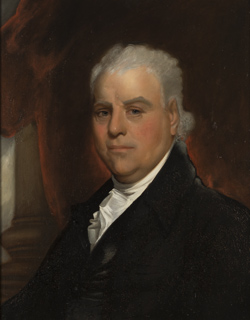
(The picture above shows the Pennsylvania politician Joseph Galloway, not mentioned anywhere in this posting. In September 1774 John Adams wrote in his diary that he was “introduced to Mr. Galloway, the Speaker of the House in Pensylvania. He looks like Ben. Davis the Sandimanian.”)

Monday, July 16, 2018

The Confiscation of John McWhorter’s Gun

On 16 July 1775, the Taunton Patriot leader David Cobb (shown here, courtesy of the Massachusetts Historical Society) wrote to his brother-in-law, Robert Treat Paine, about the Battle of Bunker Hill, smaller skirmishes, and a local conflict:
John McWhorter from a trifling incident that happen’d in the Weymouth Alarm, in which I was oblig’d to take his Gun by force, has wag’d an eternal war with the Neighbourhood and now lives in a surly, morose, malicious, damn’d Scotch looking manner without conversing with his Family or Friends.
John McWhorter was a big man in Taunton. He owned a tavern where John Rowe visited (calling him “McQuarters”), the local Sons of Liberty reportedly met, and attorney and near neighbor Daniel Leonard supped after his wife died. It contained upscale tea tables and was still referred to as “McWhorter’s Inn” years after his death—probably because his wife kept it running most of the time. McWhorter also owned at least one slave, and he had interests in shipping.

Most important for the war effort, McWhorter was part-owner of an ironworks in Stoughton. (David Cobb’s father had also been in the iron business.) Responding to a resolution of the Massachusetts Provincial Congress in February 1775, Stoughton’s committee of inspection
stopped upwards of a Ton of Iron, the Property of John McWhorter of Taunton, by seizing and storing the same in the Town of Stoughton, which Iron they had every probable Reason to suspect was designed for the Use of the British Army.
Whether or not that suspicion was accurate, as war approached people clearly regarded McWhorter as a potential Loyalist. And he no doubt perceived Patriot officials as infringing on his property.

That was the situation when there was an alarm about the Royal Navy threatening Weymouth in the summer of 1775. With many of the region’s fighting men off at the siege of Boston, the task of defending the coast fell to militia companies, including the men of Taunton. A “trifling incident” during that tense time prompted Cobb to confiscate McWhorter’s musket.

In December 1776 Taunton’s militia commander noted that McWhorter was one of twenty men on the town’s “alarm list” who hadn’t turned out to protect Rhode Island from the return of the British military. Of course, McWhorter couldn’t have turned out for militia service if Cobb still had his gun.

McWhorter’s feuds continued. On 5 May 1777 the town’s committee of correspondence considered “the verbal complaint of Mr. [John?] Porter [a committee member] respecting the abuse he received from Mr. McWhorter[;] after hearing both parties, the Chairman was desired to give Mr. McWhorter a reprimand which was accordingly done.”

Back in 1776 the Stoughton committee had sold the confiscated iron, offering McWhorter “24s. per Hundred for said Iron, and Interest from the Time it was seized and stored.” But he refused and sued the committee members for “£486, Lawful Money.”

Just before the case was to be tried in June 1779, the committee brought the Massachusetts General Court into the dispute. In September the legislature ordered the Stoughton committee to pay £30.7s.4p. for the iron—basically the initial offer, nowhere close to what McWhorter had demanded.

John McWhorter stayed in Taunton through the war and died in 1800. By then he had probably reconciled himself to his neighbors and they to him, but people might still have been surly and morose.

Wednesday, March 05, 2008

The British Prepare to Attack Dorchester Heights

On 24 Feb 1776, David Cobb sent his in-law, Robert Treat Paine, an update on how the siege of Boston looked from their home town of Taunton. (Paine was in Philadelphia as a Massachusetts delegate to the Continental Congress). Cobb predicted:

The Bombardment of Boston takes place within 12 days from this, proberbly on the 5th of March, and I am as certain of the Town’s being carry’d, as I am of my own existance.

Poor Devils. 5500 British Troops in a strong Fortefied Town, taken prisoners of War by a percel of undisceplin’d Yankees comanded by a Virginia Farmer. O! terrible.
Why did Cobb have his eyes on the 5th of March? Folks from Massachusetts relished the idea of attacking the British garrison on the sixth anniversary of the Boston Massacre. According to the Rev. Dr. William Gordon’s early history of the war, Gen. George Washington himself told men on the Dorchester heights, “Remember it is the fifth of March, and avenge the death of your brethren.”

[We interrupt this posting for a reminder about this week’s Boston Massacre commemorative activities. And now back to 1776.]

Here’s what 5 Mar 1776 looked like to one British officer, quoted in The Remembrancer, an annual compilation of newspaper dispatches published in London:
This morning, at daybreak, we discovered two redoubts on the hills on Dorchester Point, and two smaller works on their flanks. They were all raised during the night, with an expedition equal to that of the genii belonging to Aladdin’s wonderful lamp. From these hills they commanded the whole town, so that we must drive them from their post, or desert the place.

The former is determined upon, and five regiments are already embarked. A body of light infantry, under the command of Major [Thomas] Musgrave, an excellent officer, and a body of grenadiers, are to embark to-night at seven. I think it is likely to be so far a general affair, that we shall take our share in it. . . .

It is worth while to remark with what judgment the leaders of the rebels take advantage of the prejudices, and work upon the passions of the mob. This 5th of March is the anniversary of what they call the Bloody Massacre, when, in (I think) 1769, the king’s troops fired on the people in the streets of Boston. If ever they dare stand us, it will be to-day; but I hope to-morrow to be able to give you an account of their defeat.
Gen. Sir William Howe later described the new Continental fortifications as “three very extensive works, with strong abattes [abbatis] round them, on the commanding hill on Dorchester-Neck, which must have been the employment of at least twelve thousand men.” The large cannons and mortars on those heights could not only throw shot and shell into Boston, but also threatened the Royal Navy vessels in the harbor. The endgame of the siege had started.

Howe ordered a massive attack on the Continental position. He had five regiments board ships at Long Wharf, each man carrying a full day’s provisions, and sail to Castle William. Meanwhile, he wrote in his general orders:
Clerk’s & Musgrave’s Corps of Lt. Infantry, Agnews & Wemy’s Grenadiers, 23d & 38th Regts. to parade this evening at 7 o’Clock, & be ready for embarkation. The two Corps from Barton’s point will march to the Long Wharf as soon as form’d; the whole to have their Canteens fill’d with Rum & Water, to take the day’s provisions order’d to be ready dress’d & their Blankets with them. Those Corps not to Load [their muskets]; and their Barrack Guards to consist of Convalescents [i.e., no able-bodied man was to be left behind].
These two bodies of men were to attack different parts of Dorchester in the evening and fight their way up to the heights. Both sides expected such a battle could be as hard-fought and bloody as the fight for Bunker Hill, which neither army had truly won.

[Gosh, this is suspenseful! Have I mentioned this week’s Boston Massacre commemorative events?]

Lt. John Barker described how the amphibious expedition unfolded (in a part of his journal that had some gaps]:
5 Regts. embarked under [command?] of B[rigadier]. G[eneral]. Valentine Jones and fell down to Castle William; in the night they were to have [landed in Dorchester?] on that side, while the Grenrs. Light Infy. and some more Regts. were [to have?] attacked on the side next the Town; the Men were not to load but [embark with?] fixed Bayonets: in the night it came on to blow such a gale [that no?] boat cou’d possibly land, which stopt the expedition.
The following day, Howe’s headquarters issued included this statement in his general orders: “The General desires the Troops may know that the intended expedition last Night was unavoidably put off by the badness of the Weather.”

Here’s how the same events looked to selectman Timothy Newell, stuck in Boston with the British troops but hoping for their defeat:
Tuesday.—This morning the Provincials were discovered fortifying the heights of Dorchester—

About 12 oclock 7 Regiments of the Kings Troops, embarked in Transports, commanded by General Jones where were to land at Dorchester-Neck and the main body, with the Light Dragoons were to go out at the lines in the night &c. &c.

Eight or ten Ships sailed below—but whether, a Hurrycane, or terrible sudden storm which arose, in the evening prevented, or a pretence only, can’t say—nothing was attempted,—

Indeed the violence of the storm rendered it impossible for any boat to land—Some of the Transports were driven on Governors Island, but got off and returned.
The storm gave the Continentals another day to strengthen their already-strong position, and that proved crucial.