J. L. BELL is a Massachusetts writer who specializes in (among other things) the start of the American Revolution in and around Boston. He is particularly interested in the experiences of children in 1765-75. He has published scholarly papers and popular articles for both children and adults. He was consultant for an episode of History Detectives, and contributed to a display at Minute Man National Historic Park.

Subscribe thru Follow.it


•••••••••••••••••


Showing posts with label Pope Night. Show all posts

Wednesday, November 05, 2025

“The English have a great festival”

Back in July, I discussed how Simeon Potter of Rhode Island had commanded a privateer in 1744 and attacked “Fort d’Oyapoc,” a small French settlement in Guyana.

In Historical Scenes from the Old Jesuit Missions, the Right Rev. William Ingraham Kip included a translation of a long report from Father Elzéar Fauque about that raid.

Writing from the port of Cayenne on 22 Dec 1744, Father Fauque described this exchange with Capt. Potter:
“Monsieur,” he said to me, “do you know that tomorrow, being the fifth of November, according to our method of computation” [for we French people count it to be the fifteenth], “the English have a great festival?”

“And what is the festival?” I asked him.

“We burn the Pope,” he answered, laughing.

“Explain to me,” I said; “what is this ceremony?”

“They dress up in a burlesque style,” he said, “a kind of ridiculous figure, which they call the Pope, and which they afterwards burn, while singing some ballads; and all this is in commemoration of the day when the Court of Rome separated England from its communion. To-morrow,” he continued, “our people who are on shore will perform this ceremony at the fort.”

After a while, he caused his pennon and flag to be hoisted. The sailors manned the yard-arms, the drum was beaten, they fired the cannon, and all shouted, five times, “Long live the King!” This having been done, he called one of the sailors, who, to the great delight of those who understood his language, chanted a very long ballad, which I judged to be the recital of all this unworthy story.

You see in this, my Reverend Father, an instance which fully confirms what all the world knew before, that heresy always pushes to an extreme its animosity against the visible Head of the Church.
This anecdote confirms the popularity of the holiday called Pope Night in New England and Guy Fawkes Day in Britain today. This Rhode Island crew was even exporting the practice into Catholic territory.

It also confirms that the popular knowledge of the history behind commeorating the 5th of November was fuzzy. That holiday was the anniversary of the foiling of the Gunpowder Plot in 1605, not of England’s break with the Roman Catholic church nor (as a broadside in Boston said) the Spanish Armada.

Monday, October 20, 2025

A New Schoolmaster for a New Town

In January 1764 the Massachusetts General Court passed a law allowing part of the town of Newbury to split off as the new town of Newburyport.

The new town held its first meeting on 8 February, choosing a clerk, selectmen, and other officials. The inhabitants also chose a committee to determine what schoolhouses the children needed. They decided to keep paying the masters of the Newbury grammar and writing schools for now.

In March that committee recommended:
that at least three large schools should be provided and maintained in sd. Town, viz: one Grammar school not far from the Revd. Mr. [John] Lowel’s meeting house, and two reading, writing & arithmetick schools, one of them adjoining to Queen street, Ordua Lane, or Bartlet’s Lane, preferring the latter, and the other adjoining or near Cross street or Elbow Lane.
That summer, the town bought some land on what is now Winter Street, beside Route 1, and started building a schoolhouse.

To oversee that school the selectmen hired John Vinal, usher of Boston’s South Writing-School. They offered him £80 per year, significantly more than he had been earning in Boston though less than what the bigger town’s schoolmasters earned. In addition, each pupil was to bring “two pistareens” to pay for firewood used during the year.

The selectmen announced: “Boys that can read in a Psalter will be received and carefully taught Reading, Writing & Arithmetick.” The school would meet 8 A.M. to noon and 1 to 4 P.M.

Vinal’s school opened on Monday, 5 November, with the Rev. Mr. Lowell and the selectmen present. Given that Newbury’s youth usually celebrated Pope Night with a big procession and bonfire, I imagine that student body was rather antsy that day.

John Vinal continued to look for ways to supplement his salary. The town needed to survey the “common and undivided land” near the Frog Pond, and in 1771 Vinal produced the map shown above, shared by History Newburyport. Around the pond it shows a burying-ground, a potash house, a ropewalk, a powderhouse, and a windmill.

TOMORROW: Vinal’s lessons.

Thursday, August 29, 2024

“Humourously call’d the Little Pope

Here’s one more detail from the merchant John Andrews’s 22 July 1774 letter about how over a hundred Boston merchants came to sign one of two protests against the Boston committee of correspondence.

Andrews wrote that the shorter, milder protest that he signed was “humourously call’d the Little Pope.”

That’s a Pope Night reference! Joshua Coffin’s 1845 Sketch of the History of Newbury, Newburyport, and West Newbury stated:
In the day time, companies of little boys might be seen, in various parts of the town, with their little popes, dressed up in the most grotesque and fantastic manner, which they carried about, some on boards, and some on little carriages, for their own and others’ amusement.
Pierre Eugène du Simitière drew a Boston boy with such a “little pope” on a board in 1767. It’s a miniature version of one of the big wagons rolled around on the night of 5 November with (from left) a horned devil holding a lantern, the papal effigy, and a big lantern.

The milder protest was thus like a miniature effigy carried by little boys while the larger, broader protest was like a full Pope Night wagon. That might not reflect well on Andrews and his cohort, but he had enough of a sense of humor to share the joke. 

Wednesday, November 08, 2023

“The party at the North End were victorious”

I started looking into what happened in Boston on 5 Nov 1773 because I was curious about who the designated villains of that year were.

Did the Pope Night processions display effigies of Thomas Hutchinson, Andrew Oliver, and other Loyalists whose letters to Thomas Whately had been leaked earlier that year?

Did the gangs hang dummies of those old stand-bys, the Customs Commissioners? Or the Gaspée Commission?

Or might the young organizers have had the flexibility and speed to turn their wrath on the tea consignees, who had started to attract political attention only a couple of days before the holiday?

I’m sorry to say I didn’t find an answer to that question. I can report that the merchant John Rowe wrote in his diary that the 5th of November was “Very Quiet for A Pope Night.” There were no recorded attacks on the tea agents’ or other officials’ homes.

I suspect the town fathers clamped down on the youths’ celebrations that year as they tried to present a respectable resolve to the world through their official town meeting.

I did find who won that year’s brawl between the North End and South End gangs. On 11 November Isaiah Thomas printed this article in the Massachusetts Spy:
It has long been customary in this town, on the fifth of November, for a number of the lower class of people to carry about pageantries, in derision of the Pope and the Devil and their Powder Plot; and it has likewise been customary for the parties, North End and South, to try their skill at ‘Blows and Knocks,’ and the victory declared to them who should take away the other’s Pope, that being the name given to the pageantry

This year the party at the North End were victorious, which caused the South to give out word, ‘as the saying is,’ that they would on the Monday evening following ‘at them again:’

The consequence of this was, as we are credibly informed, that the Tea Commissioners, fearing the mobility intended paying them a visit, removed most of their valuable effects and their persons, from their respective places of residence, and left their houses guarded, within, by a number of men; but, ‘the wicked flee when none pursue,’—‘a guilty conscience needs no accuser.

We are well assured, that neither nobility nor mobility had the least intention of disturbing them at that time.
“Mobility” was a somewhat cheeky term for the common people, and the source of the word “mob.”

The South End Gang couldn’t counterattack until the evening of Monday, 8 November (250 years ago today) because the two previous evenings were considered part of the Sabbath. But there’s no sign anyone really tried to renew the fighting that year.

Incidentally, that 5 November entry from John Rowe’s diary also lists “Mr. Wm. Burnet Brown Esq of Virginia” among the people he dined with. Back in 2019 I wrote, “Brown returned to Virginia [after he got sucked into the coffee-house brawl with James Otis, Jr.], and I’ve seen no evidence that he ever visited Massachusetts again.” But now I’ve seen evidence that he did.

Sunday, November 05, 2023

“The 5th. of Novr. being a day of disorder”

On 3 Nov 1773, as I described back in 2019, Boston saw its first tea-inspired violence.

The Sons of Liberty, using a note signed “O.C.,” had summoned half a dozen merchants to meet under Liberty Tree and resign their appointments as agents to sell the East India Company’s tea. Those activists were following the playbook of the first Stamp Act protest from August 1765.

When no merchants showed up, however, William Molineux led a crowd to the warehouse of Richard Clarke (shown here) and demanded a reply. Then they demanded entry, shoving their way inside.

Gov. Thomas Hutchinson, father of two of the tea agents and a more distant relative of others, described how that confrontation ended:
Mr. [Nathaniel] Hatch a gentleman of Dorchester & a Justice of peace commanded the peace & required them to disperse [i.e., Hatch read the Riot Act] but they hooted at him & after a blow from one of them he was glad to retreat. I was all the time in the Council chamber with as many gentlemen of the Council as I could get together but could not make a Quorum.

The mob, after they found the gentlemen determined, began to separate and thereupon a number of gentlemen, who were in the Street, went through those that remained, joined the Gentlemen who were with the consignees in the Warehouse, & guarded them through the mob who were discouraged from offering any further violence.

The next morning I met the Council who advised me, unanimously, to direct the Attorney General [Jonathan Sewall] to prosecute such persons as upon inquiry into this tumult should appear to him to have been Offenders and, as I am informed the Justice has evidence of the person who struck him, I doubt not I can prevail with him to bring forward a separate prosecution of that Offence.

The gentlemen of the town have shewn more resolution upon this occasion than I have known before and, hitherto, nothing has been done which can bring any imputation upon the Town in general. I wish the Select men had discountenanced the proceeding. I am informed a Town meeting is intended to morrow. I wish nothing may be done there which shall oblige me to give your Lordship a less favorable account.
Indeed, the selectmen’s records for 4 November read:
The Selectmen having receiving a Petition from a number of the Inhabitants praying that a Town Meeting may be called immediately for the purpose set forth in their Petition, whereupon,

Voted, that the Town Clerk [William Cooper] issue his Warrant for a Town Meeting Fryday next 10 O’Clock.
“Fryday next” meant the next day. That was also the 5th of November, or Pope Night, when Boston’s youth paraded with effigies of the enemies of the day, collecting money, before having a big rumble and bonfire.

Hutchinson wrote:
The 5th. of Novr. being a day of disorder, every year, in the town of Boston one of my sons thought it advisable to remove with his family to the Lieutenant Governor’s in town, the other came to me in the Country.
In other words, Thomas Hutchinson, Jr., went to his father-in-law Andrew Oliver’s house in Boston, and Elisha Hutchinson left town for his father’s mansion in Milton. Other tea consignees probably took similar protection action.

A town meeting was the most official way for Boston to take political action while the Pope Night processions were the least respectable. How would that Friday play out?

TOMORROW: The 5th of November in 1773.

Tuesday, June 27, 2023

The Mystery of “Mr. Swift from the North”

I’ve been analyzing the publication of the story from Samuel Swift’s descendants that he tried to instigate an uprising against British troops inside besieged Boston before dying in the summer of 1775.

In the early twentieth century American historians did a lot of debunking. The Colonial Revival period had brought a lot of dramatic stories and traditions into print. Taking a more evidence-based approach, the next generations of authors lopped away at myths and hagiography.

The dramatic story of Samuel Swift’s martyrdom—coming from his family, unsupported by other evidence, incredible in its details—was the sort of lore that debunking authors tried to clear out of reliable histories.

But Samuel Swift’s reputation as a strong Patriot survived into the mid-1900s.

That’s because of a conjunction of sources. First, back on 7 Nov 1765 the Boston News-Letter reported about that year’s tightly controlled 5th of November celebration:
The Leaders, Mr. McIntosh from the South, and Mr. Swift from the North, appeared in Military Habits, with small Canes resting on their Left Arms…
(Pierre Eugène du Simitière’s sketch of leaders of the 1767 Pope Night parades, with canes and speaking trumpets, appears above.)

In the nineteenth century the authors Caleb Snow, Samuel A. Drake, and Francis S. Drake reprinted or paraphrased that 1765 news story, including the name “Swift.”

In 1891, the editors of the Jeremy Belknap Papers from the Massachusetts Historical Society identified Samuel Swift as “one of the Committee of Safety, and a prominent man at the North End.”

The “Committee of Safety” reference probably derives from a line in Samuel Swift’s 2 Oct 1774 letter to John Adams: “The Committee of Safety by me pay their best Regards to you.” But there was no formal “committee of safety” at the time. The town of Boston hadn’t named Swift to its committee of correspondence. He wouldn’t even be on the larger committee named on 7 December to enforce the Continental Congress’s Association boycott. It appears Swift was passing on regards from other men.

As for being “a prominent man at the North End,” Swift wasn’t a member of the North End Caucus. He didn’t hold high political office or militia rank. He was a justice of the peace from 1741 to 1760, but wasn’t reappointed under George III. As an attorney, Swift wasn’t a big employer, like shipyard owner John Ruddock.

I suspect the mention of “Mr. Swift from the North” in the 1765 newspapers caused those Belknap editors to identify that leader of the North End gang as Samuel Swift, thus making him “a prominent man” in that neighborhood.

Certainly that’s where George P. Anderson stood when he presented his ground-breaking paper “Ebenezer Mackintosh: Stamp Act Rioter and Patriot” to the Colonial Society of Massachusetts in 1924:
The leaders—Mackintosh of the South End and Samuel Swift of the North End—appeared in military habits, with small canes resting on their left arms, having music in front and at flank.
For decades after that, historians identified Samuel Swift as the leader of the North End gang. After all, well respected scholarly sources said so. 

But that never made sense. The Pope Night gangs were composed of young men and older boys from the working classes. Samuel Swift, a genteel fifty-year-old lawyer in 1765, was the sort of man they begged money from, not the sort to lead their raucous street processions.

In The Boston Massacre (1970), Hiller B. Zobel noted that Samuel Swift didn’t even live in the North End. The Thwing database shows he owned a house on Pleasant Street in the South End.

But among the people indicted for rioting after the 1764 Pope Night disturbances, Zobel reported, was a teen-aged shipwright named Henry Swift. Following his lead, many authors since 1970 have identified Henry Swift as the North End captain.

References to Samuel Swift as a politically active North End leader survive, however, including in the footnotes of older volumes digitized at Founders Online. He was an interesting character, but he wasn’t a militant in either 1765 or 1775.

Sunday, November 06, 2022

“Run over a Boy’s head & he died instantly”

Yesterday I quoted the portion of the article in Richard Draper’s Boston News-Letter for 8 Nov 1764 discussing how kids these days were too violent and divisive in the way they celebrated Pope Night.

That article also complained about the link between that year’s rowdiness and the death of a little child:
It was tho’t this [brawling] would have been prevented on Monday last, by a melancholy Accident which happened just as one of the Stages at the North-End was setting off, a Child of Mr. Brown’s, about 5 Years of Age, falling down, one of the Wheels went over his Head, and kill’d him instantly; but this did not prevent the Rabble from executing their Design.—

In the Afternoon the Magistrates and other Officers of the Town went to the respective Places of their Rendezvous, and demolished their Stages, to prevent any Disorders, which they did without Opposition: Notwithstanding, as soon as it was dark, they collected again, and mended their Stages, which being done they prepared for a Battle, and about 8 o’Clock the two Parties met near the Mill-Bridge, where they fought with Clubs, Staves, Brick-bats, &c. for about half an Hour, when those of the South-End gained a compleat Victory, carrying off not only their own, but also their Antagonists Stages, &c. which they burnt on Boston Neck.

In the Fray many were much bruis’d and wounded in their Heads and Arms, some dangerously; and a few of those who were so curious as to be Spectators, did not come off so well as they could wish; tho’ many would have fared worse had it not been a Moon-light Evening.
We have a couple of other sources on Pope Night in 1764. The merchant John Rowe wrote in his diary:
A sorrowful accident happened this forenoon at the North End—the wheel of the carriage that the Pope was fixed on run over a Boy’s head & he died instantly. The Sheriff, Justices, Officers of the Militia were ordered to destroy both So & North End Popes. In the afternoon they got the North End Pope pulled to pieces, they went to the So End but could not Conquer upon which the South End people brought out their pope & went in Triumph to the Northward and at the Mill Bridge a Battle begun between the people of Both Parts of the Town. The North End people having repaired their pope, but the South End people got the Battle (many were hurt & bruised on both sides) & Brought away the North End pope & burnt Both of them at the Gallows on the Neck. Several thousand people following them, hallowing &ct.
The young printer John Boyle wrote in his “Journal of Occurrences,” perhaps based on the newspaper report and perhaps on his own knowledge:
A Child of Mr. Brown’s at the North-End was run over by one of the Wheels of the North-End Pope and Killed on the Spot. Many others were wounded in the evening.
I’ve looked for a more official record of this boy’s death to know his name and age, but without success. (It would of course be easier if the family wasn’t named Brown.)

Importantly, this child wasn’t killed during the brawling over the wagons, as many mentions of this sad event (including some of my own) have said. Instead, the accident happened “just as one of the Stages at the North-End was setting off.” That wagon was still in friendly territory, not yet menaced by South-Enders and hours before the big fight. The boy died because of crowding or carelessness, not violence.

The News-Letter dispatch didn’t criticize the brawlers for causing the child’s death, only for the poor taste to proceed with their rumble after it happened, and against the orders of town leaders.

Nonetheless, the death of the child in 1764 was and continues to be cited as contributing to the replacement of the usual processions and brawl in 1765. Probably it did play a role, in that after the destruction of Lt. Gov. Thomas Hutchinson’s house in August, Boston’s political leaders insisted the town had to be on its best behavior. The gangs wouldn’t stop for the Brown child, but they would stop to show their united and peaceful disapproval of the Stamp Act.

Saturday, November 05, 2022

“Those that are concerned in this Pageantry make a Party-Affair thereof”

The 8 Nov 1764 Boston News-Letter included this commentary on how the town had come to celebrate the 5th of November:
Monday last being the Anniversary of the Commemoration of the Preservation of the British Nation from the Popish Plot, the Guns at Castle William and at the Batteries in Town were fired at One o’Clock.

It was formerly a Custom on these Annniversaries for the lower Class of the People to celebrate the Evening in a Manner peculiar to themselves, by having carved Images erected on Stages, representing the Pope, his Attendant &c. and there were generally carried thro’ the Streets by Negroes and other Servants, that the Minds of the Vulgar might be impress’d with a sense of their Deliverance from Popery, and Money was generally given to regale themselves in the Evening when they burnt the Images.——

But of late those that are concerned in this Pageantry make a Party-Affair thereof, and instead of celebrating the Evening agreeably, the Champions at both Ends of the Town prepare to engage each other in Battle, under the Denomination of South End & North End.— . . .

It should be noted that these Parties do no subsist much as any other Time.
This article was probably written to put Boston in the best possible light for readers, both locally and in other towns. It may therefore not be correct in all its implications.

First, the custom of moving around effigies of the Pope, Devil, and others wasn’t peculiar to Boston. Most New England ports and many British towns observed Pope Night the same way (though they might have different names for the holidays). There were giant effigies, often on wagons; appeals for money; and a bonfire after dark.

The dismissal of the celebrants as “the lower Class of the People,” “Negroes and other Servants” (probably meaning apprentices), and “the Vulgar” disguised how broadly the population participated in Pope Night. Even if genteel men didn’t join the crowds, their treats funded the activity. Women and girls watched and might have helped the preparations.

Perhaps the biggest question is whether the North End–South End divide really did disappear on most other occasions, as the newspaper claimed. We know that there were separate North End and South End Caucuses in town politics in the early 1770s, though they tried to work together. According to Henry Adams, a version of that rivalry (turned into a fight between the Boston Latin School students and every other boy) persisted until the mid-1800s.

In one important respect, the New-Letter report seems accurate: only in Boston did the Pope Night celebrants divide into neighborhood gangs and end the night with a head-bashing rumble. Joshua Coffin’s detailed 1835 account of the event in Newburyport, for instance, mentioned nothing of the sort. That town’s young men and boys all worked together.

The News-Letter implied that this neighborhood brawling was a recent development, added on top of the genral rowdiness of procession and pageantry. But how recent? The intra-town fight was reported in a newspaper as early as 1745, or before at least some of the brawlers of 1764 were born.

The 1764 celebration was actually fatal—but was that the fault of the gangs?

TOMORROW: The first death.

Saturday, August 20, 2022

The Details in the Devil

For the Washington Post, University of Delaware history professor Zara Anishanslin wrote about the roots of far-right accusations that the Devil is involved in American politics reach down deep to the Revolutionary protest movement.

Devils were a crucial element of American protests against the Stamp Act, including the August 1765 effigies hanging from what became Liberty Tree, the subsequent processions modeled on that event in other colonies, and even Isaiah Thomas’s little stamps on the Halifax Gazette.

I’d push that form of politics back even further because the Stamp Act protest borrowed imagery from New England Pope Nights, which always included the Devil and multiple imps. Since that holiday was part of the British Empire’s loud stance against Roman Catholicism and the Stuart claimants to the throne, using a religious figure of evil made sense.

And Pope Night was always political as well. The Stuart claimants were contemporary figures, and Charles Edward Stuart almost came within striking distance of the British throne in 1745. A 1750s Pope Night was recalled as lambasting Adm. John Byng, another contemporaneous villain. So the shift to using Pope Night–like effigies against men associated with the Stamp Act wasn’t all that big.

Likewise, after Benedict Arnold defected in 1780, Americans resurrected the Pope Night imagery, largely suppressed while leaders sought alliances with the Québecois and French, to show their enmity to him. The details might change, but the Devil did not.

Anishanslin also writes:
How the devil looked was important. And in Colonial and revolutionary era America, the devil was often portrayed as a Black man. Illustrations of the devil in Cotton Mather’s account of the Salem Witch Trials and Paul Revere’s prints alike both showed the devil with black skin. Such depictions played into the racism and fear of slave revolt that undergirded much of the revolution.
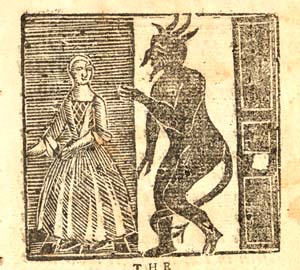
That made me take a closer look at figures of the devil in American printing. The first thing I noticed is a difference between the depictions in woodcuts and in more expensive engravings, such as Revere’s “A Warm Place—Hell.” Engravings could show more detail, but they couldn’t depict solid black. The devils and demons on those pages tend to look like dark, hairy monsters.

In contrast, woodcuts like the one above usually did show the devil as almost a black silhouette. Often that silhouette had a tail, long pointed nose, and spiky horns or hair—different from how artists of the time showed a generic “Black man.” While the symbolism of blackness itself in British-American culture can’t be denied, I don’t think British-American artists were depicting the Devil in the form of either a man or an African. 

Thursday, April 07, 2022

The Deep Roots of New England’s Pope Night

The Journal of Religious History recently made Luke Ritter’s article “Pope's Day and the Language of Popery in Eighteenth-Century New England” open for all here in the Wiley Online Library.

While eventually focusing on New England, this article begins with the reason eighteenth-century Britain celebrated the 5th of November. Unfortunately, that explanation mixes up dynasties:
The paradox of papist ambition and secrecy became powerfully instantiated in the commemoration of Guy Fawkes Day, celebrated in England annually after 1605 on 5 November. A Catholic by the name of Guy Fawkes and several other Jacobite conspirators desired to usurp the Hanoverian, Protestant monarch, James I, to restore a contending Stuart, Catholic family line. Englishmen who supported James I called the Stuart claimant a “pretender.”
James I was a Stuart—indeed, founder of the Stuart dynasty. His grandson, James II, was also a Stuart but not also a Protestant, causing Parliament to replace him with Protestant Stuarts. When that supply ran out in the early 1700s, Parliament invited in the line of Georges from Hanover. That’s when Stuart pretenders started to pose a continental, Catholic, and “Jacobite” threat to the Hanoverians.

The error, though unfortunate, is actually an apt reflection of the shifty nature of England’s established religion over two busy centuries. While the celebration of the 5th of November was rooted in the early 1600s, it took off as a holiday in New England more than a century later. Until then, the region was too often at odds with the British monarchy and Parliament to get behind celebrating their deliverance. But once the causes of anti-Catholicism, imperial pride, and respect for the king were firmly united, New Englanders were all in.

Ritter’s article digs up lots of evidence about the intellectual environment in which the holiday flourished. One of the values that united most Britons in the 1700s was that Roman Catholicism was a Bad Thing. (British Catholics didn’t hold that view, of course, but British law literally excluded them from full participation in British society.) New Englanders, with their culture’s Puritan roots, held that idea even more strongly.

As a result, during theological and political disputes New Englanders on both sides tended to accuse the other of acting too like the Catholics. Ritter quotes a New Light pioneer, the Rev. Elisha Williams, complaining in 1742 that traditionalists displayed the “true Spirit of Popery” by imposing their “Determinations on all within their Power by any Methods which may appear most effectual…in Matters of Religion.” Meanwhile, the Rev. Charles Chauncy, an Old Light leader, said even “POPERY itself han’t been the mother of more and greater blasphemies and abominations” than the New Light revivals.

As Ritter describes, Guy Fawkes was never really the focus of how New England celebrated Pope Night. Indeed, one surviving broadside about the holiday from the early 1760s misdated the Gunpowder Plot to 1588, showing how little people cared about those ancient details. Rather, the New England holiday came to lambaste contemporary enemies, starting with the Pope (not that many revelers could have told you what the current pope’s name was) and Stuart Pretender.

Eventually the “Pretender” became the name for the villain of the year being hanged in effigy. Boston’s “Pretenders” in the 1750s and 1760s included Admiral John Byng, Customs Commissioner Charles Paxton, and Governor Thomas Hutchinson. Thse effigies in turn offered meme for the Stamp Act protests of 1765 and the nonimportation pickets of 1770.

Ritter focuses a lot of attention on Massachusetts and Boston laws meant to keep Pope Night revelry from becoming too rowdy and violent, citing “tensions between elite Massachusetts-Bay legislators” and the celebrants.

While civic leaders undoubtedly worried about the violence and social disorder of Pope Night—a child was killed in 1764, after all—it’s significant that they never tried to end the celebration entirely, simply to keep it within bounds. And from the other side, I think it’s a mistake to see the holiday’s appeal for young males simply as upending authority. Rather, it was a day of misrule sanctified by also being both patriotic and pious.

As the article notes at the end, Pope Night lost its respectable rationale during the Revolutionary War. It was no longer patriotic to praise king and Parliament, and no longer politic to complain about everything Catholic when France was helping win the war. Pope Night imagery proved useful when Americans wanted to show their contempt for Benedict Arnold, but that tradition faded fast.

Mid-autumn misrule still had its appeal, though. Some Pope Night rituals hung on long enough to evolve into Halloween. But that vastly popular American holiday never regained an overt political or religious justification, despite the best efforts of UNICEF.


Tuesday, July 06, 2021

Listening in on Pope Night with The Dollop

A friend alerted me that the Dollop podcast recently cited my name.

The Dollop is a conversation about history between two comedians, Dave Anthony and Gareth Reynolds. Anthony reads up on a topic and presents the facts to Reynolds, and they both riff on the implications. It’s been going strong since 2014.

In Episode 480 Anthony and Reynolds discuss “Pope Day,” a topic I’ve had a lot to say about. Anthony notes my observation that the 5th of November celebration evolved into Halloween, an observation others have also made. (My main thesis is how the holiday’s overt patriotism licensed the raucous violence.)

All in all, this Dollop episode offers a detailed, grounded introduction to a weird colonial tradition. I’d add two important points about Pope Night in the mid-1700s:
  • Colonial New Englanders were expending all that anti-popery energy when there were no practicing Catholics anywhere closer than Canada. They weren’t really intimidating a local Catholic minority; they were showing off for themselves.
  • By the 1750s the Boston processions added a contemporary villain in place of the Pretender: Adm. John Byng, Charles Paxton, John Mein, and so on. That gave the holiday a link to current politics even before the Stamp Act, and then it grew stronger.
One less conceptual correction involves the leader of the North End gang in 1765. That year’s anti-Stamp protests made Ebenezer Mackintosh, the South End gang’s captain, internationally notorious. His North End counterpart didn’t become a concern for the royal governors or the ministers in London, so all the surviving contemporaneous sources mentioned only his last name: Swift.

For a long time authors decided that must be the most visible man named Swift in pre-Revolutionary Boston: Samuel Swift. He was friendly with the Whigs, especially John Adams.

The fact that Samuel Swift was a political moderate, a Harvard-educated attorney, and fifty years old during the Stamp Act crisis should have made people skeptical that he was the leader of a working-class youth gang. Plus, it turned out he lived on Pleasant Street in the far South End.

In The Boston Massacre (1970), Hiller Zobel argued that a far more likely candidate was Henry Swift, a shipwright. He:
  • was a mechanic, like Mackintosh.
  • was born in 1746, thus in his late teens during the Stamp Act rumbles.
  • lived in the North End.
  • was indicted for rioting after the fatal Pope Night of 1764.
I’ve therefore always named Henry Swift as the North End captain.

However, some books continue to point the finger at Samuel Swift, and the Dollop gents must have relied on those sources. Given the class distinctions in the eighteenth century, I think the genteel attorney would have been horrified to be linked to the Pope Night disorder. Now that’s comedy!

Before leaving the topic of digital appearances, here’s a reminder that History Camp America is coming up this Saturday, 10 July. Registration closes on Thursday.

Thursday, November 05, 2020

Peeking in on Pope Night in 1770

Earlier this fall, Boston 1775 reader David Churchill Barrow asked me what Pope Night was like in Boston in 1770, 250 years ago today.

After all, that loud, political, and occasionally violent 5th of November holiday fell in between the first two trials for the Boston Massacre. The Whigs were offering people plenty of reasons to be angry at Lt. Gov. Thomas Hutchinson and the Customs Commissioners. There were no soldiers stationed in town to stamp out disorder (not that they’d stopped riots the previous fall).

Hutchinson himself acknowledged the likelihood of unrest when he wrote to his boss in the Colonial Office, the Earl of Hillsborough, on 26 October. Commenting on how Massachusetts had mostly calmed down, he said:
Even in Boston there is a more favorable appearance & I shall advise the Commissioners of the Customs to leave the Castle after the 5th of November when we must expect some degree of Riot and to hold their Board in Town or if they prefer it near the Town.
So what actually happened on Pope Night in 1770? Which hated figures were hanged in effigy? Who was the target of nasty slogans on the giant lanterns?

To judge by surviving sources, the 1770 holiday was mostly staid, and no one bothered to record details about the youths’ processions. Richard Draper’s 8 November Boston News-Letter reported:
Monday last being the Anniversary of the happy Deliverance of the English Nation from the Popish Plot,—Divine Service was performed at King’s Chappel, and a Semon on the Occasion was preached by the Rev’d Dr. [Henry] Caner.

At twelve o’clock the Guns were fired at the Batteries in this Town:—At one o’ clock those at Castle William were fired, and on board his Majesty’s Ships, Frigates, &c. in this Harbour.

Just as the Guns were firing at one o’clock a Ship newly built, belonging to John Hancock, Esq; was launched at Mr. [Moses] Tyler’s Yard at the North-End.

A Number of Pageants customary on the 5th of November, was carried through the principal Streets, by some of the young People of the Town, and in the Evening Bonfires were made of the Pageantry.
The Boston Gazette and Boston Evening-Post reprinted those remarks. The Massachusetts Spy said nothing.

Merchant John Rowe usually mentioned Pope Night in his diary, but not in 1770. Young printer John Boyle noted the death of Gov. Sir Francis Bernard’s son but not the holiday. Other diarists likewise wrote nothing of the celebrations that year.

All that suggests that Pope Night 1770 was peaceful. How did a date that had been raucous only a few years earlier appear so tame in a year with so many enemies to resent?

The explanation, I think, is precisely because those Massacre trials were still going on. They put the town on its best behavior. Politicians probably spread the word that inhabitants had to show the rest of the British Empire how they were patriotic and peaceful, not riotous zealots. Mobs could not be seen as undercutting the local court system, prejudicing jurymen, or threatening officials with violence.

Therefore, the processions were probably tame. There was no fight between the North End and South End gangs before the bonfires. The newspapers emphasized Boston’s patriotism and commerce, treating the customary “Pageants” as an afterthought.

For more about the roots of Pope Night and its role in Boston’s Revolution, especially in more interesting years, check out my online talk to Boston by Foot tonight.

Saturday, October 31, 2020

“Lost Holiday” Online Talk, 5 Nov.

On Thursday, 5 November, I’ll speak via Boston by Foot on the topic “Lost Holiday: How Colonial Boston Celebrated the Fifth of November.”

Our event description:
The 5th of November was a milestone in the annual calendar for the youth of Boston. On that date they got to march around town in costume, making noise, asking for money, and topping off the evening with a gang brawl and a bonfire. In accord with New England's anti-Catholicism, they called it “Pope Night.”

This talk looks at the roots of that holiday in British history, how its rituals became part of Boston's pre-Revolutionary politics, and how the Revolutionary War brought the tradition to an end.
To be sure, some of that holiday’s rituals survived—in processions during and just after the Revolutionary War that reviled Benedict Arnold; in a Portsmouth, New Hampshire, tradition called “Pork Night”; and in how modern Americans have (at least until this plague year) observed Halloween.

This talk is scheduled to begin at 7:00 P.M. Sign up through this link. In the spirit of Pope Night, the gang politely suggests a modest donation.

Monday, February 17, 2020

“Boys insulting Every body who went in”

We don’t have inside information on the protests in front of the shops of people who defied Boston’s non-importation agreement in February 1770.

Instead, we have the reports of an unfriendly observer reporting to a Customs official. That person wasn’t privy to the Whigs’ planning. He (or she) was apt to ascribe bad motives to local political leaders. She (or he) might have been mistaken about what acts were planned and what were spontaneous.

All that said, within those reports I see evidence that top Whigs began those protests but then events went beyond those organizers’ direct control. Boys took over, making themselves visible participants in the movement.

The action started on 8 February, as described here, with a single sign erected beside the town pump. A painted hand pointed accusingly at William Jackson’s shop, identifying him as an “Importer.”

The informant noted that “a Number of Idle people…were standing by, with Clubs and Sticks in their Hands” and “a Number of considerable Merchants Stood at a Little distance, and seemed highly pleased with what was going on.” In particular, this witness named the radical merchant and protest leader William Molineux. So top Whigs closely supervised that initial action.

Protesters put up that sign at 10:00 A.M. and took it down at 1:00 P.M. The result was a brief, limited action on a busy Thursday when farmers brought their goods to market and the town schools let out early. That timing worked: “boys, and Country people,” came to watch.

Children had very little buying power, so they couldn’t participate in the boycott of the importers’ shops as the Whigs asked of adults. But they could show their support by making others obey the boycott. On that first day, the informant saw “Boys insulting Every body who went in, or out of the Shop, by Hissing and pelting them with Dirt.” Then more shops were vandalized over the following week.

The big question is how much those young people decided on their own to enter the political arena and how much they were used as tools by the adult Whigs.

Years later, the Rev. William Gordon wrote of this time in his history of the Revolution:
Boys, small and great, and undoubtedly men, had been and were encouraged, and well paid by certain leaders, to insult and intimidate those who had avowedly counteracted the combination, and still persevered.
But we don’t have further evidence of this, and Gordon didn’t arrive in Roxbury until 1771.

I think the evidence suggests that boys pushed into the political action, and in doing so pushed the political action further than the Whigs had planned—though Molineux and other radicals might well have encouraged the boys as they saw the result.

On 15 February, the picket line became more elaborate. The informant reported that the sign with the hand was joined by “the Effegies of some of the Importers.” Those effigies were the hallmark of the Pope Night processions, Boston’s annual eruption of youthful patriotic misrule (shown above). The town’s teen-aged boys brought out their political paraphernalia.

To be sure, there were probably still men watching over the protest. When four soldiers from the 14th tried to take down the sign and effigies, whoever pushed them away had to be fully grown. But the form of the protest was shaped by the youth culture.

Another sign that this protest was no longer fully coordinated with top Whigs was the threat on 15 February that effigies would “make their appearance on Liberty Tree the week following.” That didn’t happen. The adult Whig leadership kept control over that protest spot, taking down an unauthorized effigy in March 1768.

But there was still a clear threat of larger protests the next Thursday.

Monday, January 06, 2020

Twelfth Night in Occupied Boston

On Friday, 6 Jan 1775, the Boston merchant John Andrews reported:
This morning we had quite a novel sight. The Sailors belonging to the Transports [i.e., the ships that had brought army regiments to Boston] consisting of about 30 or 40 dress’d in white shirts ornamented with various color’d ribbons dispos’d crossways on their bodies with knots and garlands, paraded each side of a long rope dragging a plow, accompanied with one compleatly tar’d and feather’d, representing a he Devil, together with a She Devil, and an attendant, each furnish’d with a bag to collect money, stopping every person of genteel appearance to request a remembrance of Old England, wishing ’em a merry Christmas.

The former look’d as compleatly like the devil as the most fertile invention could form an idea of or picture. The General [Thomas Gage] gave them two half Joes, and it is suppos’d that they collected at least forty guineas. The design of it was to celebrate the twelfth night, or the breaking up of Christmas.
Those sailors were enacting a variation of the folk rituals that rural Britons traditionally performed on “Plough Monday,” the first Monday after Twelfth Night. That day signaled the end of the Christmas season and the return to fieldwork.

There were many ways to observe Plough Monday, but the one closest to this was described in a footnote in the December 1762 issue of The Gentleman’s Magazine:
On this day the young men yoke themselves, and draw a plough about with musick, and one or two persons, in antic dresses, like jack-puddings, go from house to house, to gather money to drink. If you refuse them, they plow up your dunghill. We call them here [Derbyshire?] the Plough-Bullocks.
Other sources describe the “color’d ribbons” tied into knots and roses like those the sailors wore. Early nineteenth-century authors identified the male and female figures as the Fool and Bessy.

Most Bostonians didn’t celebrate Christmas, of course, and therefore didn’t recognize Twelfth Night, either. But they should have seen some similarities between this ritual and a holiday they knew well: Pope Night. The procession, the requests for money, the strange costumes, the central tarred figures representing devils, the young man dressed as a female—those were all part of how Boston youth celebrated the Fifth of November.

Pope Night, Plough Monday, and the “Christmas Anticks” that appeared in Boston after the war were all variations on the British mumming tradition. Undoubtedly the sailors off the troop ships knew that Bostonians didn’t welcome Christmas misrule. However, by begging money in “remembrance of Old England” they were making the same sort of patriotic appeal that local youths invoked to justify their rowdiness in November.

Monday, November 25, 2019

The Devil and George Gailer

Here’s a final note on the riotous events of 28 Oct 1769—the merchants’ confrontation with printer John Mein and the tarring and feathering of sailor George Gailer.

In 2011 Dr. Caitlin G. D. Hopkins shared a passage from a letter by Elizabeth Cumings, a shopkeeper who witnessed both events from inside nearby buildings. Cumings, from a Concord family, hadn’t had much formal education, so her spelling offers a fun challenge.

Here’s what Cumings had to say about the attack on Gailer:
it was Dark our house shut up & we alon trimbling lick Courds [“trembling like curds,” I think], when a larg Mob of ful a thousand Man & boys aranged themselves befor our Dorr & on a Kart a Man was Exibited as we thought in a Gore of Blod; & poor meen [John Mein] we was shure was the sufrer but we was happyly mistaken it was an informer they had caught the moment Meen found Shalter, & instintly posted him on a kart tard him all over the town then fathered him all under our windo thin carid him threu the town obliging him to carry the lantren in his hand & calling to all the inhabitince to put Candles in their Windoes
Elizabeth Cumings and her older sister Ame were becoming unpopular for defying the non-importation movement. Hopkins has also shared her analysis of the Cumings sisters’ situation in “Enemies to Their Country”:
After Mein’s escape, the crowd had caught a suspected customs informer, George Gailer, who was beaten, tossed into a cart, and jostled through the streets. At strategic points along the route, men poured buckets of tar over Gailer’s bare skin, scalding his flesh and filling his wounds with hot, gummy resin. When the torturers “aranged themselves befor [the Cumings’] Dorr,” they applied this treatment once more, this time finishing it off with feathers. As they moved away, down Cornhill, someone thrust a lantern into Gailer’s hand, obliging him to stay conscious, lest he drop the flame and set himself afire.
In his legal filing, Gailer didn’t mention the lantern or any fear of being set on fire. Instead, he emphasized how the crowd beat him. And I’m not convinced that the purpose of the lantern was to threaten Gailer with being burned.

Indeed, the crowd could simply have held a flame to the feathers. The Customs officer Owen Richards later testified that in 1770 a mob “put him into a Cart, Tarr’d and Feathered him, then set the Feathers on Fire on his Back.”

Richards’s account was probably the source for the “Recipe” for tar and feathers in Peter Oliver’s Origin and Progress of the American Rebellion including the lines: “Then hold a lighted Candle to the Feathers, & try to set it all on Fire; if it will burn so much the better. But as the Experiment is often made in cold Weather; it will not then succeed.”

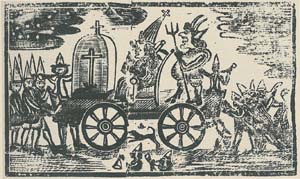
My immediate thought of seeing Cumings’s description of Gailer being made to hold a lantern was the Pope Night wagons. In 1767 Pierre Eugène du Simitière sketched three wagons in Boston. In the back of all three was an oversized effigy of the devil, and all three devils held lanterns out in one hand. Du Simitière’s image of the North End gang’s devil appears above, dangling his lantern off the back of the wagon.

Judge Oliver, Isaiah Thomas, and other witnesses also wrote of those devil figures being covered with tar and feathers. In other words, the 29 October mob turned George Gailer into a living preview of one of the effigies that would roll around town on 6 November, a little over a week away.

[Incidentally, this month I got to see Caitlin Hopkins speak about the extended Vassall family and their slaveholding at Longfellow House–Washington’s Headquarters in Cambridge. She has also turned in a report to the Harvard University administration about the college’s links to slavery, which seems like it should be issued as part of the newly announced initiative.]

Wednesday, November 06, 2019

“Description of the POPE, 1769.”

The Fifth of November was a festival of misrule for eighteenth-century colonial Boston, which locals called “Pope Night.” But the celebration actually followed many strict traditions.

One was that when 5 November fell on a Sunday, as it did in 1769, the holiday was put off until the following day. Thus, Boston’s youth remembered the Fifth of November exactly 250 years ago today.

Another tradition was that the Pope Night wagons would feature effigies of the Devil, the Pope, and one or two hanged men whose identities changed from year to year to keep up with the biggest political enemies.

In 1769 the obvious choice was printer and bookseller John Mein. Since August he had been angering the town’s mercantile and political community. On 28 October he had, in a confrontation with some of those merchants, drawn a pistol and reportedly fired it in the center of town. He then went into hiding, refusing to answer a lawful warrant.

The Pope Night wagons rolled out ten days later. The newspapers and this broadside reported that the following text appeared on the big “lanthorn” (basically a small tent with sides of oiled paper, lit from within) of a main wagon:
Toasts on the Front of the large Lanthorn.
Love and Unity. — The American Whig. —
Confusion to the Torries, and a total Banishment to Bribery and Corruption.

On the right side of the same. —An Acrostick.
J nsulting Wretch, well him expose,
O ’er the whole World his Deeds disclose,
H ell now gaups wide to take him in,
N ow he is ripe, Oh Lump of Sin.
M ean is the Man, M[ei]N is his Name,
E nough he’s spread his hellish Fame,
I nfernal Furies hurl his Soul,
N ine Million Times from Pole to Pole.

Labels of the Left Side.
Now shake, ye Torries! see the Rogue behind,
Hung up a Scarecrow, to correct Mankind.
Oh had the Villain but receiv’d his Due,
Himself in Person would here swing in View
But let the Traitor mend within the Year,
Or by the next he shall be hanging here.
Ye Slaves! ye Torries who infest the Land,
And scatter num’rous Plagues on ev’ry Hand,
Now we’ll be free, or bathe in honest Blood;
We’ll nobly perish for our Country’s Good,
We’ll purge the Land of the infernal Crew,
And at one Stroke we’ll give the Devil his Due.

Labels on each Side the Small Lanthorn.
WILKES and LIBERTY, No. 45.

See the Informer how he stands, If any one now takes his Part,
An Enemy to all the Land, He’ll go to Hell without a Cart
May Discord cease, in Hell be jam’d,
And factious fellows all be dam’d.
From B------- [Bernard?], the veriest monster on earth,
The fell production of some baneful birth,
These ills proceed,—from him they took their birth,
The Source supreme, and Center of all Hate.
If I forgive him, then forget me Heaven,
Or like a WILKES may I from Right be driven.
Here stands the Devil for a Show,
With the I--p---rs [Importers?] in a row,
All bound to Hell, and that we know.
Go M[ei]n lade deep with Curses on thy head,
To some dark Corner of the World repair,
Where the bright Sun no pleasant beams can shed,
And spend thy Life in Horror and Despair.

Effigies,—M[ei]n, his Servant, &c.—A Bunch of TOM-CODS.
I take “his Servant” to mean the “young Lad (belonging to the Office)” who had fired out of Mein’s print shop at the previous procession. How nice that his fellow teenagers remembered him.

The celebrants also made sure to mention George Gailer (“the Informer”) and the departed royal governor, Francis Bernard.

With this holiday coming so soon after the busy 28th of October, town authorities feared that it would be especially rowdy. But channeling public anger at those vanquished political enemies made the holiday a little more orderly than it had been before the Stamp Act.

TOMORROW: Naming names.

[The picture above is a sketch of the South End’s Pope in 1767 by Pierre Eugène du Simitière, now in the collection of the Library Company of Philadelphia.]

Monday, March 11, 2019

More of Mary Clapham’s Massacre Memorials

In the early 1770s, Mary Clapham managed the Royal Exchange tavern on King Street, near the center of Boston.

In this 1801 view of State Street, as it was renamed, the tall white building was the one that housed the tavern. The Boston Massacre had taken place in front of the red building across a small street. That made Clapham’s tavern an appropriate place for Massacre memorial displays, the Boston Whigs decided.

Yesterday I quoted the Boston Gazette description of the first such exhibit in 1772. The large “lanthorn” the Whig activists built, with strikingly painted scenes illuminated from inside, was similar to what the South End and North End gangs carted around on Pope Night, and to the paper obelisk made in 1766 to celebrate the repeal of the Stamp Act.

The Massacre exhibit was back at the Royal Exchange tavern in 1773, as described by the 11 March Massachusetts Spy:
At night a select number of the friends of constitutional liberty, met at Mrs. Clapham’s in King-street, and exhibitted on the balcony a lanthorn of transparent paintings, having in front a lively representation of the bloody massacre which was perpetrated near that spot on the 5th of March 1770, over their heads was inscribed, the fatal effects of a standing army being posted in a free city.

On the right, America sitting in a mourning posture, looking down on the spectators, with this label, Behold my Sons.

On the left, a monument, sacred to the memory of
Messrs. SAMUEL GRAY,
SAMUEL MAVERICK,
JAMES CALDWELL,
PATRICK CARR, and
CRISPUS ATTUCKS,
Who were barbarously murdered by a party of the 29th regiment, on the 5th of March, 1770.

At a quarter after nine, the time of the evening when the bloody deed was acted, the paintings were taken in, and most of the bells in town tolled till ten.
That was the same display, described in the same words, as the previous year. The Boston Gazette reported one new feature: in a “Window East of the Balcony” was a translucent sheet decorated with a 24-line poem on the Massacre. I’ve decided to spare you that until another year.

In 1774 the exhibit was a little delayed, as the 7 March 1774 Boston Gazette explained at the end of its report on that year’s oration:
As this Anniversary happened on Saturday, the Evening of which is considered by many Persons as the Commencement of the Sabbath, the Exhibition Portraits of the Murderers, and the slaughtered Citizens, was put off till this Evening, when they will be exposed to publick View at Mrs. Clapham’s in King-Street.
When the exhibit finally appeared, it included a new visual element, reflecting the new political controversy over the salaries and letters of royal appointees Gov. Thomas Hutchinson and Chief Justice Peter Oliver. The Gazette stated:
On Monday evening the horrid tragedy of the 5th of March was observed with the usual solemnity, by exhibiting to pubic view a portrait of that inhuman and cruel Massacre perpetrated by [Capt. Thomas] Preston, and his infamous butchers;

on the right, a figure of America pointing to her slaughtered sons, on the left, a monument to the memory of Gray, Attucks, Maverick, Caldwell, and Carr.

In one of the windows was a representation of H[utchinso]n and J[udg]e O[live]r, in the horrors, occasioned by the appeared of the two ghosts of Empson and Dudley, advising them to think of their fate. They appeared to be worshipping their ill-gotting gold the modern deity of the North.
Ye TRAITORS; “Is there not some chosen curse,
Some hidden thunder in the stores of heaven,
Red with uncommon wrath, to blast the men
Who owed their greatness to their country’s ruin?
The poetry is from Joseph Addison’s Cato.

John Adams mentioned the display in his diary for 7 March:
This Evening there has been an Exhibition in Kingstreet of the Portraits of the soldiers and the Massacre—and of H[utchinso]n and C[hief]. J[ustice]. Oliver, in the Horrors—reminded of the Fate of Empson and Dudley, whose Trunks were exposed with their Heads off, and the Blood fresh streaming after the Ax.
Sir Richard Empson and Edmund Dudley were administrators for Henry VII executed for treason in 1510 under Henry VIII. They weren’t evoked often in American Revolutionary rhetoric, but one of the writers who did so was Adams himself.

In March 1775, with thousands of British soldiers stationed in Boston, the Whigs put their display away. Those troops stayed through the next Massacre anniversary. In 1777 the town of Boston once again commissioned an oration to commemorate the killings, this time from Benjamin Hichborn, but the Boston Gazette made no mention of an illuminated display.

Monday, November 05, 2018

“Popes and bonfires, this evening at Salem”

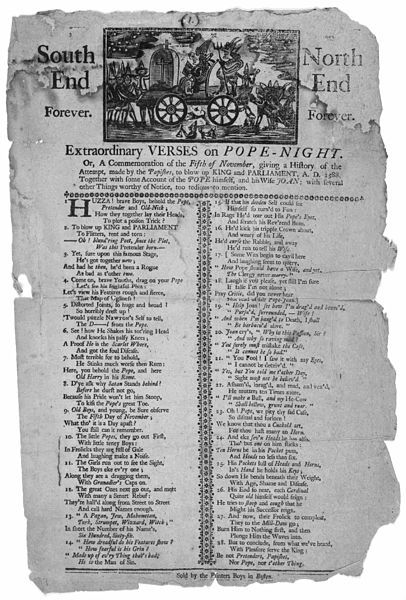
On 5 Nov 1768, 250 years ago today, Boston’s apprentice printers issued this broadside, one of the most elaborate surviving artifacts of the holiday they called Pope Night.

The top of their broadside says, “South End Forever. North End Forever.” Under bibliographic rules, that’s become the title of the sheet, even though its creators probably thought their publication was “Extraordinary Verses on Pope-Night.”

Someone worked hard on the long poem that followed—so hard they didn’t remember that the 5th of November commemorated an event in 1605, not 1588.

That broadside highlights how in the mid-1700s Boston observed the 5th of November differently from every other New England seaport. Only in Boston was the youth population large enough, and the neighborhood pride fervent enough, for there to be rival Pope processions that ended up brawling. Other seaports had one main procession followed by a feast and a bonfire, with no intervening violence.

In the 1760s Boston’s town leaders worked hard to reconcile the South End and North End gangs against the common enemy of royal officials and Parliament’s new revenue-raising laws. That’s how he get this broadside celebrating both ends of town equally.

Here’s Donna Seger’s discussion of the 5th of November in Salem from her Streets of Salem blog last year:
…it is to our second President [John Adams] that we owe the first reference to Pope Night in Salem, long before he became our second President. When he was attending court in Salem he made the following note in his diary for November 5, 1766:
Spent the evening at Mr. Pynchon’s [on Summer Street–a house that is still with us but much changed], with Farnham, [Jonathan] Sewall, Sargeant, Col. Saltonstall &ct. very agreeably. Punch, wine, bread and cheese, apples, pipes and tobacco. Popes and bonfires, this evening at Salem, and a swarm of tumultuous people attending.
Pope Night certainly continued on after the Revolution: I can find references up to 1819 in the Reverend William Bentley’s famous diary. His entry for the 5th of November, 179[5] reads:
Not all the revolutions which have passed over our Country can efface the remembrance of this anniversary. The boys must have their bonfire. But the light of it is going out. We have little concern in powder plots of Kings at this day. . . .
Every other year or so the Reverend makes a Pope Night entry, all of which express his increasing irritation, until his final words on the matter in 1819:
We have had this evening the full proof of the obstinate power of superstition & habit. The 5 of Nov. was celebrated by the ritual & rubric of the English Church for political purposes. The history of the plot against all fact most pertinaciously insisted upon [as real], & the popular celebration, by the carrying about the Pope & the Devil, most zealously encouraged. Tho we have lost all connection with Great Britain & have detected the fraud & the purpose, yet our common people still keep the 5 of Nov. and we had a roaring fire on the Neck on this occasion. We had not the old fashion transportation through the streets, nor the riots & quarrels, but we had enough to shew us that old habits are invincible against all the light which can be offered them.
And after 1820 or so, no other Salem references, save Nathaniel Hawthorne’s short story “Old Times” where Pope Night is something distinctly past.

The “holiday” seems to survive over the nineteenth century in a few other places, namely Marblehead, Newburyport, and Portsmouth, where it became known as Pork Night. I think the boys of Salem transferred all of their mischief and mayhem and bonfire-building energies to two other more American holidays: Halloween and the Fourth of July.
At the start of the twentieth century, Halloween had inherited the Pope Night traditions of bonfires and young people going door to door asking for treats. By the end of the 1900s only the trick-or-treating was left in most of America. These days that tradition seems to vary greatly by neighborhood.

Monday, November 06, 2017

A Fifth of November Wagon Rolls Again

It’s been nearly twenty years since I started to research Revolutionary Boston intensely. At first my goal was to develop a sense of what it was like for a young apprentice to live in Boston in 1770.

Among the early books I read was Patricia Bradley’s Slavery, Propaganda, and the American Revolution. Almost in passing, Prof. Bradley mentioned that there were sketches of Boston’s Pope Night festivities at the Historical Society of Pennsylvania. On-the-spot pictures of what an apprentice would have seen on 5 Nov 1767!

At the time I had grandparents living outside of Philadelphia, so during a visit to them I took a day to go into the city and research at that organization. Sure enough, its documents from the Swiss-born artist Pierre Eugène du Simitière included several sketches of youths tugging decorated wagons like this one, from Boston’s South End gang.

The first time I attended the Dublin Seminar for New England Folklife, I mentioned those pictures to director Peter Benes. He invited me to write an article analyzing them for the seminar collection slated for 2003. The H.S.P. sent me photographs—on actual glossy paper, not pixels—and gave permission for them to be published for the first time. That was my first journal publication.

In 2006 I began this blog. I continued writing articles, chapters for books, a big study for the National Park Service, and eventually The Road to Concord. Folks at local historical organizations whose job is to look ahead as well as back noticed that the sestercentennial of the American Revolution in Massachusetts was upon us and started Revolution 250, and I joined that effort.

This past weekend, I was speaking about where Gen. George Washington slept in Cambridge, a result of the N.P.S. study. That required being at Mount Vernon, and it was a great experience, both educational and fun. Most unfortunately, that meant I had to miss the “Devil and the Crown” reenactment on the streets of Boston the same afternoon.

And look at what that event’s amazing volunteers and interpreters did!
Photograph from Jim Hollister’s Facebook feed. Check out the Facebook pages of Minute Man Park and The History List for videos.