


J. L. BELL is a Massachusetts writer who specializes in (among other things) the start of the American Revolution in and around Boston. He is particularly interested in the experiences of children in 1765-75. He has published scholarly papers and popular articles for both children and adults. He was consultant for an episode of History Detectives, and contributed to a display at Minute Man National Historic Park.

Subscribe thru Follow.it


•••••••••••••••••


Showing posts with label Paul Lunt. Show all posts

Wednesday, July 02, 2025

“Alarmed that the Regulars were advancing towards Our Entrencment”
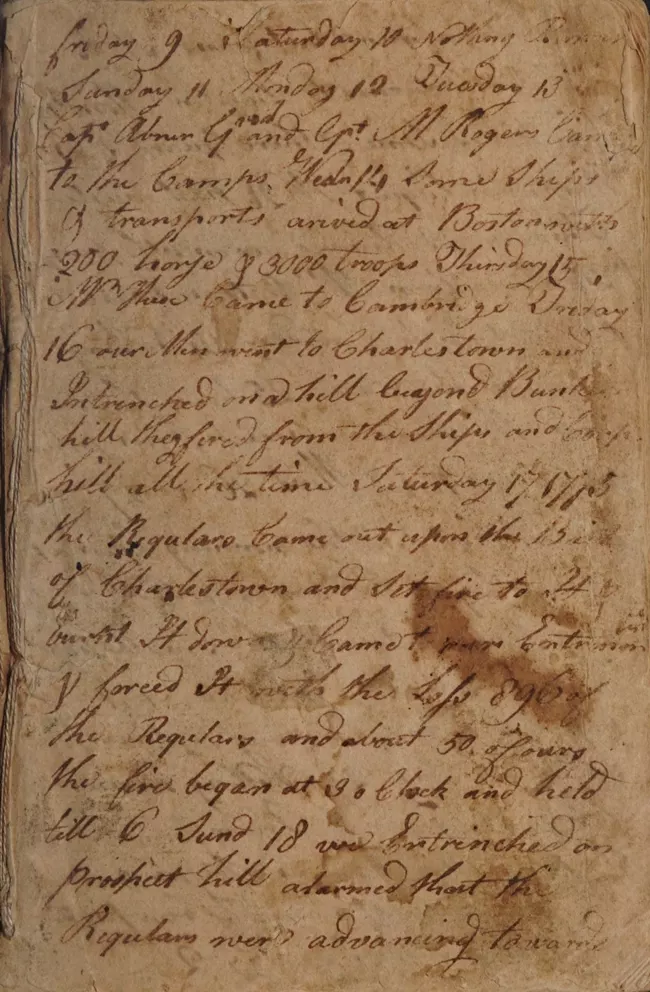
Among the presentations at this Saturday’s commemoration of Gen. George Washington’s arrival in Cambridge is a talk by Longfellow House archivist Kate Hanson Plass on the diary of Moses Sleeper.

Hanson Plass and her team have recently shared the diary online: transcription with annotations and illustrations, plus a link to page images on Archive.org.

The introduction explains:
In the museum collection of the Longfellow House-Washington’s Headquarters National Historic Site is a diary written by a soldier who participated in the early days of the American Revolution. No one knows how the diary got to the house, though it seems likely that a collector in the Longfellow family acquired it for its Revolutionary War connection in the early 20th century.

The book itself is small (5” by 8”), pocket size; its cover and the first and last three pages are missing. There is no indication of the identity of the writer of the diary; at first reading it seems to be anonymous. Using clues inside the diary – references to family members and locations of military service – the author has been established as Corporal Moses Sleeper of Newburyport, Massachusetts, who served for 19 months in Colonel Moses Little’s Regiment (later the 12th Continental Regiment).
Sleeper and Sgt. Paul Lunt of the same regiment obviously shared their diaries since many of their entries are the same. They weren’t keeping private, personal notes but making a record of their military service for people back home and in the future.

Cpl. Sleeper’s surviving pages start right before the Bunker Hill battle, which his regiment wasn’t involved in. Here’s his terse account of those days:
Friday 16 our Men went to Charlestown and Intrenched on a hill beyond Bunker hill they fired from the Ships and Copps hill all the time.

Saturday 17 1775 the Regulars Came out upon the Back of Charlestown and Set fire to It & burnt It down & Came to our Entrenen[?] forced It with the Loss 896 of the Regulars and about 50 of ours The fire began at 3 o Clock and held till 6

Sund 18 we Entrinched on prospect hill alarmed that the Regulars were advancing towards Our Entrencment but found It to be false Returned to Quarters

Mondy 19 Wee killed Some of there Guard

T 20 Went upon Picquet

W 21 past musters

Thirsday 22 Received our month pay
You wouldn’t know from those entries that Capt. Benjamin Perkins’s company, including Cpl. Sleeper, went onto the Charlestown peninsula on 17 June and saw combat. I’ve quoted later recollections of the Bunker Hill fight from other men in that company: Lt. Joseph Whitmore and Pvt. Philip Johnson.

Sgt. Lunt’s description of the battle offered a little more detail:
Saturday, 17th. - The Regulars landed a number of troops, and we engaged them. They drove us off the hill, and burnt Charlestown. Dr. [Joseph] Warren was lost in the battle: the siege lasted about three hours. They killed about 50 of our men, wounded about 80: we killed of the king’s troops 896, - 92 officers, 104 sergeants.
Both Sleeper and Lunt listed an exact number of enemy casualties—a piece of intelligence it usually takes days or weeks to acquire. In Sleeper’s case, we can see that number was written right into the entry, not inserted later. That suggests these provincial soldiers didn’t write their diary entries on the evening after the battle but after time had passed, they had recovered, and they might have had less to do.

Friday, February 17, 2023

“Major, that was worth you seeing”

engraved portrait of Israel PutnamIn the middle of his 24 Sept 1775 spy report to his handler inside Boston, Dr. Benjamin Church, Jr., offered this word picture of a scene in the Continental lines:

but of all seens that ever happen’d not long since our people got a famous New large Standard, Got upon the Hill

Doctor [Abiel] Leanard made amost Solem prayer over the Standard

Genll. [Israel] Putnam pulled of his hat, gave the Signal for three Chears which was given, Cleargeman and all of us huzzard at once, than the Indeans gave the war hoop and to conclud, of went Cannon, Major, that was worth you seeing.
Church’s report on this incident puzzles me, and not because of what it describes. The little mystery is why Church described the scene at all.

This flag-raising took place on Prospect Hill on 18 July. Three days later the New-England Chronicle reported on it in detail:
Last Tuesday Morning, according to Orders issued the Day before, by Major-General Putnam, all the Continental Troops under his immediate Command assembled on Prospect-Hill, when the Declaration [of the Causes and Necessity of Taking Up Arms] of the Continental Congress was read, after which an animated and pathetic Address to the Army was made by the Rev. Mr. Leonard, Chaplain to General Putnam’s Regiment and succeeded by a pertinent Prayer; when General Putnam gave the Signal, and the whole Army shouted their loud Amen by three Cheers; immediately upon which a Cannon was fired from the Fort, and the Standard lately sent to General Putnam was exhibited flourishing in the Air, bearing on one Side this Motto, AN APPEAL TO HEAVEN--- and on the other side, QUI TRANSTULIT SUSTINET.

The whole was conducted with the utmost Decency, good Order, and Regularity, and to the universal Acceptance of all present.----And the Philistines on Bunker’s Hill heard the Shout of the Israelites, and being very fearful, paraded themselves in Battle Array.
The newspapers did not report the detail about Native Americans from Stockbridge shouting in their style, but Lt. Paul Lunt did confirm that detail in his diary: the ceremony ended with “a war whoop by the Indians.”

So did Church’s retelling of this flag-raising have any intelligence value?
  • This was a public event, already described in newspapers.
  • It occurred more than two months before Church wrote. The British army knew about it immediately if they responded with a parade of their own.
  • The letter’s description offers no useful military information, not even a description of the “New large Standard” in case British officers might want to recognize it.
In sum, there appears to be no benefit to the British in Boston from this passage. Was Dr. Church just casting about for something to say to justify his employment? Or was he looking at notes he’d made back in July but hadn’t had a chance to transmit?

Later in the letter Church wrote:
The last Week you killed one Man Wounded another, so that he lost his Leg and broke another Man thigh on Plowed hill.
That was more recent news. In his History of the Siege of Boston, Richard Frothingham wrote:
The British paid special attention to the new works at Ploughed Hill. . . . on the 20th and 21st, after a furious cannonade of shot and shells at the works, and at a fatigue party near them, they killed an ox and wounded two men.
The British command might at least have been pleased to hear that some of their artillery fire caused damage.

TOMORROW: Suspicions about another spy.

Sunday, May 20, 2012

“Hung! Up by the Neck!”

A few days back I quoted Lt. Col. Stephen Kemble’s diary entry for 8 Sept 1775 about an American soldier who deserted into Boston:

another Rifle Man came in, a fine fellow, an Irishman, from Kings County, says…that a report has been spread that one of their Deserters, a Rifle Man, had been Hanged, which checked the spirit of their People coming over to us.
That report of a hanging body appears in the diary of Pvt. Samuel Bixby, stationed in Roxbury, on 2 August:
One of Genl. [George] Washington’s riflemen was killed by the regulars to day & then hung! up by the neck! His comrades seeing this were much enraged, & immediately asked leave of the Genl. to go down and attack them. He gave them permission to go and do as they pleased. The Riflemen marched immediately & began operations. The regulars fired at them from all parts with cannon and swivels, but the Riflemen skulked about, and kept up their sharp shooting all day. Many of the regulars fell, but the riflemen lost only one man.
Some authors, most notably David McCullough in 1776, have treated this report as true.

However, Bixby appears to be the only diarist or letter-writer on either side of the siege lines who reported a rifleman or his body being strung up this way. In fact, Lt. Paul Lunt wrote that the British “killed none upon our side” in skirmishing that day.

Most telling, less than two weeks later Washington complained to Gen. Thomas Gage about the treatment of American prisoners of war but said nothing of a man being hanged or a corpse displayed.

It therefore seems likely that Bixby heard an unfounded rumor. Americans may have deliberately spread the story to incite resentment against the British, or to discourage defections, or both. Or the report could have been a natural exaggeration of the Pennsylvania riflemen’s concern about a comrade captured on 29 July, Cpl. Walter Cruise.

Kemble wrote that the American soldier taken that evening was “an Irish Man from Virginia; says he was forced into the service.” But claiming coercion got Cruise nowhere. The royal authorities put him into the Boston jail, where on 1 August fellow prisoner Peter Edes wrote, “the rifle corporal, Cruise, kept close confined, and allowed nothing but bread and water.”

Cruise was shipped to Nova Scotia as a prisoner during the evacuation and not released until around the start of 1777 in New York. (The rest of his military career mentioned here.) But at least he wasn’t hanged.

Sunday, July 25, 2010

What Did Washington Do on 3 July 1775?

Gen. George Washington probably didn’t take command in a ceremony on Cambridge common on 3 July 1775. Instead, Gen. Artemas Ward almost certainly turned over the orders book and other necessities late the previous afternoon, as soon as Washington arrived at headquarters in Jonathan Hastings’s house beside Harvard College.

Like most other Massachusetts politicians, Ward was probably pleased to have Washington in command since he embodied the support of the Continental Congress. And since the same Congress had made Ward a major general and second-ranking officer in the army, he didn’t have anything to complain about.

So what did Washington do on 3 July instead? He and Gen. Charles Lee almost certainly spent their first day on the front inspecting the siege lines at what seemed to be their weakest point, near the Charlestown Neck. The British had taken Bunker Hill two and a half weeks before, moving closer to the American camps in western Charlestown and northeastern Cambridge.

Furthermore, it seems likely that Gen. Washington did inspect troops while he was there. That review didn’t involve the whole army, but soldiers stationed near Prospect Hill recorded getting ready for inspections on 3 July.

Lt. Paul Lunt of Newburyport wrote in his diary:

Turned out early in the morning, got in readiness to be reviewed by the general. New orders given out by General Washington.
The same words appear in the diary of Pvt. Moses Sleeper, also from Newburyport; that document is now in the archive of Longfellow National Historic Site.

Lt. John Hodgkins of Ipswich wrote a letter home:
Geaneral Washington & Lees got into Cambridge yesterday and to Day they are to take a Vew of ye Armey, & that will be attended with a grate deal of grandor. There is at this time one & twenty Drummers, & as many feffers a Beting and Playing Round the Prayde.
Forty-two musicians would be about two regiments’ worth, three if they were short-staffed. That passage used to be quoted to support the legend of a big assembly near the Washington Elm, but Hodgkins was probably far from that spot.

None of those diaries or letters records the men’s impression of seeing Washington, or his response to seeing them. The commander might never have actually inspected these men, therefore. But since they don’t write anything about getting all set for nothing, most likely the actual review was routine, and they had nothing to add. They would learn more about the new commander over the next few months.

COMING UP: And the next day?

Monday, February 15, 2010

New Englanders’ “Appeal to Heaven”

Paul Lunt, lieutenant of a company from Newburyport at the siege of Boston, wrote in his diary for 18 July 1775:

This morning a Manifesto from the Grand Continental Congress was read by the Rev. Mr. Leonard, chaplain to the Connecticut forces upon Prospect Hill in Charlestown, to those troops encamped upon and near said hill.

Our standard was presented in the midst of the regiments with this inscription upon it, “Appeal to Heaven;” after which Mr. Leonard made a short prayer, and then were dismissed by the discharge of a cannon, three cheers, and a war whoop by the Indians.
In his essay on the life of the Honorable Major-General Israel Putnam, former aide David Humphreys later described this flag as:
the new Standard, lately sent from Connecticut. . . .

On one side was inscribed in large letters, of Gold “An Appeal To Heaven,” and on the other were delineated the armorial bearings of Connecticut, which without supporters or crest, consist unostentatiously of three Vines: with this motto, “Qui transtulit, sustinet” [He who transplants, sustains]
By the fall, other New England units had adopted this flag, or at least the English motto on it. On 20 Oct 1775, Gen. George Washington’s military secretary, Joseph Reed (shown above, courtesy of the U.S. Army’s Center for Military History), wrote to the colonels who were in Beverly arming schooners to attack British supply ships with this instruction:
Please to fix upon some particular color for a flag, and a signal by which our vessels may know one another. What do you think of a flag with a white ground, a tree in the middle, the motto “Appeal to Heaven”? This is the flag of our floating batteries.
The ships those men were equipping did adopt that flag. We know that from sources in London reporting on the capture of one such ship, the brig Washington, out of Plymouth. The descriptions were:
  • Sir Hugh Palliser to the Earl of Sandwich, First Lord of the Admiralty, 6 January 1776: “Captain Medows has brought the American vessel’s colours, it is a white field with a green pine tree in the middle: the motto, Appeal to Heaven.”
  • London Chronicle: “In the Admiralty office is the flag of a provincial privateer. The field is white bunting; on the middle is a green pine-tree, and upon the opposite side is the motto, ‘Appeal to Heaven.’”
  • Almon’s Remembrancer, item dated 6 Jan 1776: “Captain Meadows has likewise brought her colours, which are a pale green palm-tree, upon a white field, with this motto, ‘We appeal to heaven.’”
(I have to think an error crept into that last description; would New Englanders have taken pride in a “pale green palm-tree”? Or were palms and pines interchangeable?)

No actual period examples of this flag survive, to my knowledge. All the designs in flag books are guesses at what they looked like.

Wednesday, September 16, 2009

He “made the best of his way to our guard”

On Saturday, 16 Sept 1775, Lt. Paul Lunt of Newbury was serving in the siege of Boston. He recorded this event in his diary:

Cloudy this morning, but warm. A Regular of the Fifth Regiment, deserted, and came to the Whitehouse guard last night. The plot that he laid was this: he was standing sentry with another Regular, he took the flint out of his own gun, hove out the priming and spit in the pan, then offered to swap with his partner and give him a drink in the morning, which he accepted. As soon as that was done made his escape; his partner snapped [i.e., fired] his gun at him, but to no purpose; he turned round and discharged his piece at his partner, then threw off his watch-coat, and cartridge-box, and made the best of his way to our guard.
Writing in the American Journal of Science and Arts in 1824, John Finch identified the “White House Redoubt” as between the larger fortifications on Winter and Prospect Hill (shown above, courtesy of the Library of Congress). Behind the redoubt was a farmhouse that Gen. Charles Lee used as his headquarters—apparently one owned by John Tufts.

Desertion in this area wasn’t all one way. Just six days earlier, on 10 September, Gen. Nathanael Greene recorded that the Whitehouse Guard had reported a man making his way from the Continental ranks to the British fortification on Bunker Hill, evading shots. Greene ordered the passwords changed.

As long as I’m talking about deserters, I’ll take this opportunity to repeat that tomorrow night, Thursday the 17th, I’ll speak at Minute Man National Historical Park’s first 18th Century Research Forum on some British army deserters who constructed new lives in America.

Back to Lt. Lunt. Here’s his diary entry for 17 September, which was a Sunday:
Rain last night, cloudy this morning. Heard the Rev. Mr. [John] Cleaveland preach, forenoon, from Acts iii. 19: “Repent ye therefore, and be converted, that your sins may be blotted out, when the times of refreshing shall come from the presence of the Lord.”

Some cannon fired from Roxbury upon both sides; all still at Bunker Hill. One Regular lieutenant killed at Roxbury with a cannon-shot, several more wounded; one hung himself because he thought he was in a wrong cause.
I don’t recall any source from inside Boston confirming that last death, and I suspect Lunt simply heard the sort of rumor men told each other to assure themselves they were in the right cause.

Lunt’s diary was published ninety-eight years later by the Massachusetts Historical Society.