J. L. BELL is a Massachusetts writer who specializes in (among other things) the start of the American Revolution in and around Boston. He is particularly interested in the experiences of children in 1765-75. He has published scholarly papers and popular articles for both children and adults. He was consultant for an episode of History Detectives, and contributed to a display at Minute Man National Historic Park.

Subscribe thru Follow.it


•••••••••••••••••


Showing posts with label John Howe. Show all posts

Friday, May 01, 2026

”No other Crime, but retaining their Allegiance to the King”
We left John Hill, his wife Elizabeth (?), and his daughter in the Boston jail in February 1777, suspected of “being Enemical to the States” and “attempting to Carry Intillegence to the Enemy.”

The next trace of Hill that I’ve found is from John Noble’s article “Some Massachusetts Tories” for the Colonial Society of Massachusetts in 1900:
At the July [court] Term, 1777, John Hill of Boston recovers judgment in a plea of the case against Crean Brush for £2.8s.10d lawful money, and costs.
Did Hill sue Brush, his employer during the evacuation from Boston, for some loss? Or was this another John Hill?

There’s firmer information from John Howe’s Newport Gazette, published in the British-occupied city on 20 Nov 1777:
By Mr. JOHN HILL, who left Boston the 15th of October, we learn, that Dr. [Benjamin] Church, Mr. John Dean Whitworth, of the Queen’s Rangers, and a Number of others, are yet confined in Boston; Dr. [Mather] Byles is confined in his own House; and upwards of 70 Persons, who can be charged with no other Crime, but retaining their Allegiance to the King, and Attachment to that happy Constitution under which they were born, and from which they have enjoyed the most solid and inestimable Blessings, are now confined on board a Prison Ship in that Harbour.—

He also adds, that almost every Goal in New England is filled with these unhappy People.

Mr. Hill has also favoured us with the current Prices, in Lawful Money, of the following Articles, at the Time he left it:
Beef, — — 0.1.3
Mutton, — — 0.1.6
Butter, — — 0.4.0
And so on through a list of other meats and foods, alcohols, sugars, teas, and cordwood to shoes for men (£2.2/pair) and women (£1.10/pair).

Presumably Howe was making the point about price inflation in Continental-governed areas, but we’d have to find pre-war costs for comparison.

Years later John Hill told the Loyalists Commission, as recorded by Todd Braisted:
That on the 17th of March 1776, he left Boston, with the Royal Army; but was taken at Sea, by the Rebels, . . . himself, his Wife, & Daughter was carried back to Boston, and he confined in Prison 19 months; they were all tried For their lives, but not Condemned.

In November 1777, they were Exchanged, went to Halifax, and afterwards to New York
Hill’s memory was off by just a few weeks. It’s possible he didn’t remember the port his family came through, or that the Hills went from Newport to Halifax. Adding to the confusion on that point, on 16 Oct 1777 the Independent Chronicle reported that “a Cartel” ship “with upwards 130 Prisoners on board” had sailed the previous day from Boston for Halifax. 

By whatever route they left New England, John Hill, his wife, and his daughter eventually returned to New York, the city he’d been chased out of in the spring of 1775. But now it was held by the British military.

TOMORROW: Inspector Hill.

Monday, April 06, 2026

“All good Subjects will use their utmost Endeavors to have all such Articles convey’d”

When Crean Brush came to him after confiscating Cyrus Baldwin’s goods in March 1776, Gen. William Howe was looking ahead to the next phase of the war.

The British military was about to leave Boston. The American rebels lacked a lot of manufactured goods, from cannon down to woven cloth. Gen. Howe didn’t want them to find such useful material in the town.

In the coming days, the Royal Artillery would damage or spike all the cannon they left behind or pitch them into the water. Local Patriots would congratulate themselves on restoring those guns, but that took a lot of effort, and some of that ordnance was never as good again.

As for cloth, Gen. Howe issued this proclamation on 10 March:
By His Excellency
WILLIAM HOWE,
MAJOR GENERAL, &c. &c. &c.

AS Linnen and Woolen Goods are Articles much wanted by the Rebels, and would aid and assist them in their Rebellion, the Commander in Chief expects that all good Subjects will use their utmost Endeavors to have all such Articles convey’d from this Place:

Any who have not Opportunity to convey their Goods under their own Care, may deliver them on Board the Minerva at Hubbard’s Wharf, to Crean Brush, Esq: mark’d with their Names, who will give a Certificate of the Delivery, and will oblige himself to return them to the Owners, all unavoidable Accidents accepted.

If after this Notice any Person secretes or keeps in his Possession such Articles, he will be treated as a Favourer of Rebels.
That announcement was important enough to be printed, probably by John Howe (no relation).

Gen. Thomas Gage had already put Brush in charge of seizing abandoned property, but this order extended the New York lawyer’s mandate to cover linen and woolen from anyone in Boston.

TOMORROW: Assembling a team.

Wednesday, November 20, 2024

Paging Through the Nova-Scotia Chronicle

The Nova Scotia Archives has digitized several newspapers from various periods in the province’s history, with the results open for anyone to look at.

This digital archive doesn’t include the region’s first newspaper—the Halifax Gazette launched by John Bushell, fresh from Boston, on 23 Mar 1752. But the Nova Scotia Archives does own the one surviving copy of Bushell’s first issue; it acquired that precious sheet from the Massachusetts Historical Society in 2002.

The earliest newspaper available in the digital database is the Nova Scotia Chronicle and Weekly Advertiser, published by Anthony Henry in Halifax from 1769 to 1770.

Henry had taken over the Halifax Gazette when Bushell died in 1761. But then he lost his position as the local government’s preferred printer by opposing the Stamp Act of 1765. (Isaiah Thomas, who worked for Henry after skipping out on his apprenticeship in Boston, claimed he pushed his employer into political action. Thomas also sniffed that Henry printed “in a very indifferent manner.”)

For a few years Robert Fletcher enjoyed the government’s favor for his new Nova-Scotia Gazette. Copies of that paper can be read through the University of Toronto.

Anthony Henry’s Nova-Scotia Chronicle was thus the province’s first newspaper published without being sponsored by the province itself. When he started, Henry had only eighty subscribers.

In 1770, after Fletcher returned to Britain, Henry renamed his newspaper Nova Scotia Gazette and Weekly Advertiser, regaining semi-official status by default. He even became the King’s Printer in 1788. After Henry died in 1800, another Boston-trained printer, the Loyalist John Howe, took over. A version of that paper appears today as an official organ of the provincial government: Nova Scotia’s Royal Gazette.

Like other North American newspapers, the Nova-Scotia Chronicle was a weekly. Its pages were half the size of most other papers, but a typical issue contained eight pages instead of four. Without much local news that his readers hadn’t already heard, Henry printed lots of excerpts from British newspapers, as well as articles from the other North American ports.

Folks using the digital archive to track particular citations should bear in mind that Henry dated each issue by the full week it covered: “From TUESDAY September 26, to TUESDAY October 3, 1769,” for instance. Each paper was actually printed on the last date in that range, and the database dates each paper accordingly. However, sometimes authors have cited issues by the first date.

I digitally flipped through these pages hoping to find interesting coverage of the Boston Massacre, but Henry appears to have reprinted articles from the Boston newspapers without commentary. But then I stumbled across an interesting page I’d never read anywhere before.

TOMORROW: Character studies.

Tuesday, January 09, 2024

The Disappearance of the King’s Speech

On the last day of the year 1775, Boston merchant John Rowe, staying inside besieged Boston, wrote in his diary:
The Niger man of War Capt. Talbot is arrivd in Nantasket Road & has brought the King’s Speech dated the 26 October
On 26 October, George III had opened Parliament with a traditional “most gracious speech.” That tradition continues today, but now everyone knows that what the monarch reads is the program of the current prime minister and his or her cabinet, not a personal statement.

Back in 1775, the king still had a role in politics, at least at a personal level—i.e., the prime minister had to be someone he got along with. But already British politicians expected George III not to be setting policy but reflecting it. Fortunately, on the American question the king, Lord North, and the other ministers saw eye to eye.

That was a disappointment for some Americans who had still hoped the monarch would overrule his supposedly misguided and/or corrupt ministers and negotiate with their Continental Congress. Instead, George III read:
Those who have long too successfully laboured to inflame my people in America by gross misrepresentations, and to infuse into their minds a system of opinions repugnant to the true constitution of the colonies, and to their subordinate relation to Great-Britain, now openly avow their revolt, hostility, and rebellion. They have raised troops, and are collecting a naval force; they have seized the public revenue, and assumed to themselves legislative, executive, and judicial powers, which they already exercise in the most arbitrary manner, over the persons and properties of their fellow subjects.

And although many of these unhappy people may still retain their loyalty, and may be too wise not to see the fatal consequence of this usurpation, and wish to resist it, yet the torrent of violence has been strong enough to compel their acquiescence till a sufficient force shall appear to support them. . . .

It is now become the part of wisdom, and (in its effects) of clemency, to put a speedy end to these disorders by the most decisive exertions, For this purpose, I have increased my naval establishment, and greatly augmented my land forces . . .

When the unhappy and deluded multitude, against whom this force will be directed, shall become sensible of their error, I shall be ready to receive the misled with tenderness and mercy!
In particular, the king mentioned “friendly offers of foreign assistance,” which everyone understood to mean hiring soldiers from German states.

The Boston News-Letter, the only newspaper still being printed in Boston, ran the speech on the front page of its 11 Jan 1776 issue.

By that time the speech had already been printed in Newburyport in the Essex Journal for 5 January, ostensibly taken from a London newspaper dated 23 Oct 1775. (That was three days before the speech was delivered. But some American broadsides reported the king spoke on 27 October, one day late.)

The letters from the Continental headquarters on 3–4 January show that the very first Massachusetts printing of that speech had been back at the very start of the year. The royal authorities printed “a volume” of copies and delivered them to the Continental lines in Roxbury.

And that brings me to the last mystery of the incidents I’ve been discussing: What happened to all those broadsides?

According to some standard early-1900s guides to material published in the colonies, the king’s speech was “Printed by John Howe, in Newbury-Street.” Howe was the young printer managing the Boston News-Letter press for Margaret Draper. However, his edition of the speech was known from only one copy in the collection of the New York Public Library. (The British Library has another copy, according to WorldCat, but its own systems are down after a ransomware cyberattack.)

Washington told John Hancock he would “Inclose one [copy], of many, which were sent out of Boston yesterday,” but the Library of Congress doesn’t appear to have a copy now. Neither do the Harvard libraries, the Massachusetts Historical Society, or the American Antiquarian Society, three major repositories of Revolutionary material in this region.

Where did all the other copies go? I picture Howe and his assistants working through New Year’s Eve to produce the “great number” of copies to cow the rebels, and then those rebels showing their disdain for the king’s words by recycling the paper or using it in their latrines.

Monday, April 26, 2021

The Lost DeBerniere Manuscripts

On 30 June 1775, Ens. Henry DeBerniere was promoted to the rank of lieutenant in the 10th Regiment of Foot.

Nine months later, on 17 March 1776, he evacuated Boston with the rest of the British military.

That departure was rushed enough that Lt. DeBerniere left behind some of his papers, which locals eventually found. Exactly which locals remains a mystery.

In 1779 the printer John Gill issued a collection of those documents, described on the title page as “Left in town by a British Officer previous to the evacuation of it by the enemy, and now printed for the information and amusement of the curious.”

That title page (shown here) rendered the ensign’s name as “D’Bernicre.” Which is only one of the many ways it was spelled at the time.

The documents in that booklet were:
  • Gen. Thomas Gage’s orders to DeBerniere and Capt. William Brown to scout the countryside—thus giving the publication the title General Gage’s Instructions.
  • DeBerniere’s detailed and dramatic narrative of how he and Brown visited Worcester, Framingham, Marlborough, and Weston, barely making it back home in a snowstorm.
  • A much shorter report on the officers’ similar trek to Concord.
  • DeBerniere’s account of the expedition to Concord and the return to Boston under fire on 19 April.
  • A list of the casualties from that action, naming each killed or wounded officer but giving simple body counts for the enlisted men.
The Massachusetts Historical Society has shared scanned and transcribed pages here.

The year before Gill published, the Massachusetts General Court had passed laws banishing Loyalists and empowering the state to confiscate their property. Citizens who read DeBerniere’s narratives could easily recognize the Loyalists who offered them assistance. Most had left the country, but Isaac Jones of Weston was still at the Golden Ball Tavern. By then, though, he had apparently worked his way back into his neighbors’ graces.

The Massachusetts Historical Society reprinted the text of John Gill’s booklet in a volume of its Collections series in 1815, which is how it shared material before the internet.

That reprint was probably the source for another version of the story told in the voice of Brown and DeBerniere’s servant and published as The Journal Kept by Mr. John Howe While He Was Employed as a British Spy; Also, While He Was Engaged in the Smuggling Business by Luther Roby in 1827.

There was a young printer named John Howe working in Boston in 1775. A Sandemanian and partner of Margaret Draper in the last months of the Boston News-Letter, he evacuated Boston at the same time as Lt. DeBerniere. Eventually he settled in Nova Scotia, and his son became an important figure in early Canadian politics. So he wasn’t the “John Howe” narrating that “Journal.”

In fact, the “Journal” was just a hyped-up version of DeBerniere’s original report, using all the dramatic bits and adding to them, eventually reaching the point of implausibility. Nonetheless, extracts can seem credible, and many authors have been fooled into thinking that 1827 publication is an authentic historical source.

TOMORROW: Another DeBerniere manuscript, and another mystery.

Friday, November 01, 2019

“A young Lad (belonging to the Office) fir’d a Gun”

The report of someone inside John Mein and John Fleeming’s print shop firing a gun at Boston’s first tar-and-feathers procession on 28 Oct 1769 raises a number of questions.

First is the matter of how many guns were involved. Edes and Gill’s Boston Gazette reported “a Gun was fired from thence and two others snap’d at them [i.e., someone fired blank shots] just as they got by.” However, the pro-governor Boston News-Letter stated simply that “a Gun was fired from one of the Windows.” So was there one shot or three?

A Crown informant named George Mason reported this version of events:

As soon as the Mob had got as far as Mr. Meins Printing Office and dwelling House (which is near Liberty Tree) they made a Halt, and as I’m very credibly informed endeavour’d to force the Door (I’m certain of this they broke the Windows) upon which a young Lad (belonging to the Office) fir’d a Gun loaded with nothing but Powder with a view to intimidate them from any further violence, this had not the desired effect, for immediately after they recover’d from their fright, they burst the Door open in earnest, and likewise forc’d the Locks and Doors of the inner appartments in search of Mein. Some mischief was done to his Books &c and two Guns were taken away by Persons in the Neighborhood who are well known to Mr. Meins Servants
The Boston Gazette stated: “they bro’t off three Guns, two of them well charg’d, as Evidence.” So it looks like both sides agree that at least one shot was fired, the crowd confiscated at least two guns, and no one was injured.

The next question is who fired that shot. Mason identified the shooter as “a young Lad (belonging to the Office)”—i.e., a printer’s apprentice or devil. The newspapers said the crowd found no one inside the house, so Mason apparently had inside information.

Isaiah Thomas wrote later that Nathaniel Mills was an apprentice to John Fleeming. He was a week shy of twenty years old during this riot, however, and therefore probably not still considered a “young Lad.”

Another possibility, though I’ve found no direct evidence, was John Howe (1754-1835). He had just turned fifteen in October 1769, still too young for militia service. I can’t show that he worked for Fleeming, but he did become a Sandemanian, and Fleeming was the only Boston printer of that faith. If I were writing a historical novel, I’d put young Howe into that building.

The Boston Gazette report is clear that the shot from the print shop caused people in the procession to break in. Mason’s account says the opposite: when members of the crowd “endeavour’d to force the Door,” a frightened boy inside fired the gun. Both sides had every reason to present themselves as the party under threat, indeed many incentives to think of themselves as the party under threat, so I don’t see any way to work that out.

It’s notable that the Boston Gazette made no mention at all of the merchants’ confrontation with John Mein earlier in the day. That makes that paper’s claim that someone fired a gun “for what Reason we know not, as no injury seemed designed them,” more than a little disingenuous. When the whole town was buzzing that your boss, already unpopular, had fired a pistol recklessly in public and was being hunted by the authorities, you could reasonably worry about being injured.

The Boston Post-Boy also declined to report in detail on the confrontation with Mein in its 30 October issue, saying, “as we are informed a Warrant has been issued upon the Occasion, we do not think it proper at present to give a particular relation of the Circumstances of that Affair.” That looks like a cop-out, but at least those printers gave a legal reason.

One last observation about the gunshot from the printing office: this was the third instance of gunfire in Boston in one week of October 1769. There would be more, most memorably in late February and early March of 1770. In all those cases, the shots were fired by employees or supporters of the Crown. Not until late 1774, as the Massachusetts Government Act provoked violence against mandamus Councilors, did any Whig or Patriot fire at a supporter of the royal government. (It’s not clear what James Otis, Jr., was shooting at when he fired out his windows in April 1770.)

That pattern reflects how the Crown supporters were heavily outnumbered. The soldiers marching home from the Neck on 24 October were under assault from a crowd, albeit one trying to enforce a writ. Four days later, John Mein was surrounded by a crowd. The young lad inside Mein’s office apparently felt threatened by a crowd. Months later, Ebenezer Richardson saw his house being attacked, and Pvt. Edward Montgomery had just been knocked down by something thrown from a mob when he shouted to his fellow soldiers to shoot on 5 Mar 1770.

Firing a single-shot musket without a bayonet was a desperate move. It raised the level of violence and the anger of the other side while leaving the shooter essentially defenseless for the next minute at least. Those gunshots show how desperate some Bostonians were feeling.

COMING UP: George Gailer’s experience.

Sunday, July 02, 2017

“All the Seals have been taken out of the Council Chamber”

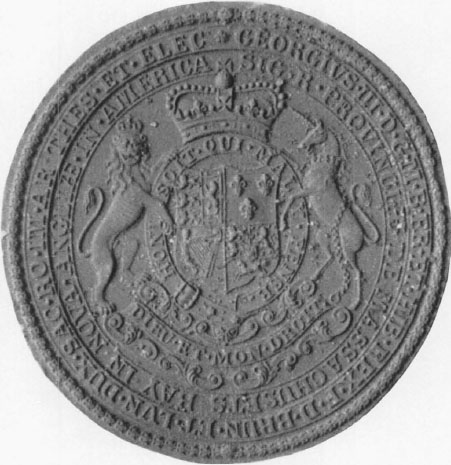
Hace you seen the last royal seal of Massachusetts?

At left is a picture of the impression the seal made. It shows the royal arms of Great Britain, with the lion and unicorn fighting for a crown, within a motto denoting the reign of George III.

As the Massachusetts Secretary of State’s website explains, royal governors Francis Bernard, Thomas Hutchinson, and Thomas Gage used this seal on official commissions in the 1760s and early 1770s.

And then, in the middle of the siege of Boston, the royal seal disappeared. Gen. Gage issued a proclamation dated 3 Oct 1775 offering “a Reward of Ten Guineas” for its return.

The governor also summoned his Council and appointed a committee to find out where the seal had gone. On 6 October, Lt. Gov. Thomas Oliver, Chief Justice Peter Oliver, Treasurer Harrison Gray, William Browne, and Richard Lechmere reported back that they had conducted “a strict enquiry and examination under oath, of all those persons who have been returned to us, as having had access to the Council Chamber between the Ninth day of September and the Fourth of October.” They had collected affidavits. But they had found no answers and no seal.

As reported in the Colonial Society of Massachusetts Transactions, Gage had to report to the Earl of Dartmouth, Secretary of State:
Boston 9th October 1775

My Lord…

I must inform Your Lordship that a Theft has been committed on the Province, and that all the Seals have been taken out of the Council Chamber where they were kept. This was observed on the 4th Inst; on the 6th I sent a Message to the Lieutenant Governor and Council, to make every necessary enquiry they possibly could, into the matter, which they have done, and I am sorry to tell Your Lordship without any good effect; which you will see by their answer to my message, which I have now the honor to transmit to Your Lordship.
I’m curious why the governor reported that people had noticed the seal was missing on 4 October when his proclamation was dated 3 October. Perhaps the young printer John Howe had made an error, or perhaps Gage had. He was about to leave Massachusetts for good, sailing away on 11 October, so he had a lot of other things on his mind.

TOMORROW: Did Patriots steal the seal?

Thursday, January 01, 2015

“ODE on the New-Year” 1775

Traditionally Boston 1775 observes the turn of the year with a “carrier verse,” one of the topical poems that newspaper delivery boys and printers’ apprentices distributed at the new year to aid their request for tips.

This year’s example comes from the Massachusetts Gazette and Boston News-Letter at the start of 1775, when the Crown had closed Boston’s port to intercolonial trade and stationed several army regiments in town. The News-Letter, then owned by the widow Margaret Draper with young John Howe probably running the presses, supported the Crown editorially.

That’s one thing that makes this verse so striking. It talks about Bostonians “with arms opprest” needing to “Be firm” against “threats of war” from “the grand Ruler of the NORTH” (i.e., Lord North). That was the Patriot line at the time. If this verse didn’t have the News-Letter’s name on top, I would have assumed it came from Edes and Gill’s Boston Gazette or Isaiah Thomas’s Massachusetts Spy.

The Carrier of the Massachusets-Gazette,
and Boston Weekly News-Letter,
humbly presents the following ODE
on the New-Year, to all his generous
Customers.                   1775.

I.
BEHOLD! Poor BOSTON sore distrest,
Why is she thus with arms opprest,
By’r cruel Parents hands?—
The reason surely, is because
She’ll not submit to BRITISH laws,
Impos’d by her commands.

II.
Let the grand Ruler of the NORTH,
Spend all that fair BITANNIA’s worth
To lay us at his feet:—
He’ll find his work but just began,
When seven long years their course have ran,
And seek a safe retreat.

III.
Be firm, BOSTONIAN’s, stedfast, true,
Yea ne’er submit to Turk or Jew,
Be of one mind and heart:—
Twas long ago that Heav’n decreed,
That our Fore-fathers here should bleed,
Shall we their cause desert?

IV.
No! GOD forbid,—we’ll firmly trust
In Heav’n’s protection,—’gainst the worst,
Thro’out the ensuing year:—
Tho’ hostile armies from afar,
Have reach’d our coast, with threats of war!
Like heroes banish fear.

V.
Permit your Servant at the door,
Who may be number’d with the poor,
Your bounteous hand to kiss:—
Whose grateful heart shall be replete,
With joy and transport at the sight,
And the kind Donor bless.
Another notable detail about this sample of printing is the prominence of the typographical errors: the printers not only spelled “Massachusetts” differently from how it appeared on the newspaper masthead, but they managed to screw up “Britannia.” Tradition holds that the apprentices themselves wrote and printed carrier verses, and that might explain why both politically and orthographically this one differed from the newspaper.

In one respect, this verse was remarkably prescient. It predicted “seven long years” of struggle for Lord North before he pulled back from his plans for America. Indeed, Lord North’s government fell seven years later in March 1782.

Thursday, July 24, 2014

“Genuine Copies of the Intercepted Letters” in the Press

For the royal authorities in Boston, the letters that Benjamin Hichborn had carried from Philadelphia were the equivalent of today’s intercepted radio communications.

Those papers contained some sensitive information about the enemy’s army—for example, Virginia delegate Benjamin Harrison hinted that Gen. George Washington wasn’t fully impressed by his chief engineer, Col. Richard Gridley. And they laid bare the Continental Congress’s secret factionalism.

The British authorities decided to get even more value out of the documents by publicizing them. There was one newspaper left in Boston, the Massachusetts Gazette and Boston Weekly News-Letter published by Margaret Draper and John Howe (shown above, over four decades later). Its 17 August issue printed all three “Intercepted Letters,” noting that the first was signed by Harrison while the second was unsigned but in the same handwriting as the third, to Abigail Adams from her husband.

The documents offered Loyalists and British observers evidence to confirm the most dire warnings about the American radicals: Adams’s clear statement that he believed his side should already have “arrested every Friend to Government on the Continent and held them as Hostages.”

There were also hints of private misdeeds. On the way to the press, someone apparently juiced up the Harrison letter by adding lines about an interrupted dalliance with “pretty little Kate the Washer-woman’s Daughter over the Way,” and a hint that Harrison was happy to share her with Washington himself. I discussed that passage back here. It was probably included to embarrass and discredit the commander-in-chief.

Finally, the published letters let everyone in America see John Adams writing about his colleagues with contempt, especially “A certain great Fortune and piddling Genius.” I don’t know if folks in Massachusetts realized that meant John Dickinson, but politicians in Philadelphia certainly did. And the British evidently didn’t have to change a word of Adams’s prose to get that point across.

TOMORROW: Dr. Hope shares the news with the folks back home.

Wednesday, March 14, 2007

The John Howe Hoax Finds Another Victim

In yesterday’s Boston Globe, H. D. S. Greenway closed an opinion piece titled “‘Surge’ doomed to final failure” with a Revolutionary anecdote. It began:

In early April 1775, the British governor of Boston sent John Howe out to gather intelligence in that hotbed of insurgency now called the western suburbs, but then the Anbar province of its time.
The analogy is fairly solid, but the anecdote is not. “John Howe” was the putative author of a pamphlet published in 1822, but it was a hoax, a rewrite of an authentic British spy report with more exciting stories and better jokes. See more detail from Mass Moments.