J. L. BELL is a Massachusetts writer who specializes in (among other things) the start of the American Revolution in and around Boston. He is particularly interested in the experiences of children in 1765-75. He has published scholarly papers and popular articles for both children and adults. He was consultant for an episode of History Detectives, and contributed to a display at Minute Man National Historic Park.

Subscribe thru Follow.it


•••••••••••••••••


Showing posts with label Caribbean. Show all posts

Friday, April 03, 2026

All Aboard the Elizabeth

When Cdre. John Manley captured the brigantine Elizabeth, evacuating from Boston, in April 1776, he saw that he’d hooked an important—and potentially lucrative—prize.

Manley sent some of the people aboard that ship to Gloucester on the Lee under Capt. Daniel Waters. He kept the rest on the Elizabeth and escorted that ship to Portsmouth, New Hampshire.  

That harbor was appropriate since it was the Elizabeth’s home port. Back in October 1775 H.M.S. George had captured that brig on its way back from Montserrat. The local merchant Richard Hart (c.1744–1820) was glad to see his ship return.

The Elizabeth was still carrying the seventeen hogsheads of rum and four hogsheads of sugar that it had picked up in the West Indies. And it was loaded with other cargo. There were household and mercantile goods that passengers were taking with them from Boston and, most valuably, a large quantity of linen and woolen cloth.

Sadly, the property on board the ship also included four enslaved people, listed in a public document a couple of months later as:
A negro man named Adam, John Rowe, Esq owner.
A negro man named Scip, Harrison Gray Esq: owner.
A negro woman named Belinder, Benjamin Austin Esq: owner.
A negro woman named Brada, a widow Kitpath, owner.
Rowe, Gray, and Austin were all rich Boston merchants, but they were in different political situations. Gray, also royal treasurer of Massachusetts, had left with the fleet. Austin was on the Patriot side. And Rowe was trying to find his usual place in the middle, having stayed in Boston through the siege but then stayed in town after the siege as well. (I can’t identify the widow.)

The Elizabeth was also carrying “a Serjeant & twelve privates of the 4th or Kings own Regiment,” who were now prisoners of war. At least some of those soldiers had wives and children with them.

In all, there were forty-six civilians on board the Elizabeth, including the ship’s captain, Peter Ramsey, and the crew. The most prominent of the Loyalist passengers were:
And Brush had made himself notorious inside besieged Boston.

TOMORROW: Where those woolens came from.

Tuesday, March 31, 2026

“I told him I was sorry we had not a boat”

Not everyone who evacuated Boston in March 1776 actually got to Halifax.

Back on 11 March, the British-born merchant Jolley Allen rented a sloop called the Sally to evacuate with his wife and seven children. It looks like his party also included “Sally Bradford; servant maid,” and “Lilla Coppinger, belonging to Mr. Allen’s family.”

To command that ship Allen hired a man named Robert Campbell, and Campbell hired a small crew. Allen also authorized his captain to sell space to other passengers: five women, three of them with children along. When the Sally left the dock on 14 March, it carried thirty people, only six of them men.

Capt. Robert Campbell was an experienced mariner working out of New York, as shown by many newspaper entries. Unfortunately, in March 1776 that man was stuck on Antigua, contesting the seizure of his ship America by Capt. Samuel Graves of H.M.S. Viper, as he described at length.

The Robert Campbell whom Allen had hired was, according to New Brunswick Loyalist Journeys, “a farmer and tavern keeper in Monmouth County,” New Jersey, who for political reasons had fled to New York and then to Boston in October. Campbell’s tavern in Freehold continued to be a landmark until at least 1780, so perhaps Robert’s wife Mary and children stayed to run it after he left.

This Robert Campbell’s lack of seagoing experience wasn’t evident when boats towed the Sally out past the Castle on 17 March, then down to the Nantasket Road. The sloop was assigned to be part of the second division of the evacuation fleet, receiving the signal to sail for open waters on 27 March. And then everything started to go wrong.

First the Sally suffered two collisions in Boston harbor, its bowsprit ripping off parts of two larger ships. Then the sloop ran aground. It fell behind the rest of the fleet. Darkness came, and the small crew lost sight of the other ships ahead. By this time Allen had discovered that Campbell couldn’t tell which way the tide was flowing without an almanac, tie a sailor’s knot, or assemble the pumps.

By midnight a corner of the main sail had ripped loose and been jury-rigged to the pumps. The barrel of fresh water had leaked out. The kitchen apparatus (the “cabose”) was knocked overboard. Ice was coating the lines and the deck. And by the early hours of 28 March, “a plank in the side of the vessel had given way, and the sea was pouring in, and the vessel was sinking.”

Allen wrote:
I then desired the Captain to come upon deck with me, which he did; and I asked him whereabout he thought we was at sea.

He told me he could not tell.

I then asked him what distance we was from land.

He said that was impossible for him to tell, for he had not kept any reckoning, and the reason he gave me for it was that he had forgot to bring pens, ink, and paper.

I told him, if he had applyed to me, I had all these things.

He then made me answer he had never learned navigation, and that he never was on salt water before; but he knew how to row a boat in a river;

on which I told him I was sorry we had not a boat, that we might save our lives at the sinking of the vessel, and at the same time I told him, if we had a boat with oars, it was my opinion he knew as little of it as he did of navigation
The two men stayed on deck the rest of the night, not speaking to each other.

TOMORROW: Can this sloop be saved?

Thursday, February 12, 2026

“Cast away upon the Isle of Sable”

There are a lot of unanswered questions about the disappearance of Capt. Thomas Parsons, his ship, and his crew in early 1772.

As colonial newspapers show, shipwrecks happened all the time. The rocky shores of Nova Scotia were notorious for their dangers.

For example, on 16 Sept 1773, the Massachusetts Spy ran this report from John Callahan, just arrived from London:
Capt. Callahan, last Thursday se’nnight, went on shore at Cape Sable, where he saw the Wreck of a Snow, New-England built, Pink Stern, called the Kitty, loaded with Lumber, had all her Cargo on board, but her Sails, Rigging and Crew gone.
That might seem mysterious, even suspicious. But back on 10 May the Boston Post-Boy had reported:
A Fisherman, who arrived here last Week, informs, that the Snow Katy, Capt. Major, from this Port for Newfoundland, is cast away upon the Isle of Sable: The Vessel and Cargo is entirely lost; the Captain and Mate, with great Difficulty saved their Lives, and the Remainder of the Crew, (five in Number) perished.
In the case of Capt. Parsons’s schooner, within a year New Englanders suspected he’d met with foul play. What led them to that conclusion? Unfortunately, our sources don’t say.

Those sources do raise some geographic questions about this voyage. One is why, if Capt. Parsons was heading from Newburyport to the Caribbean, he’d ended up far north. Perhaps that was a way of catching trade winds. Perhaps a storm had pushed his ship off course. Perhaps people didn’t remember his destination accurately. Or perhaps Parsons’s ship was returning from the islands and overshot Cape Cod because of weather.

The March 1773 news item quoted here said a schooner had been lost “near Cape-Sable,” which is the southernmost corner of the Nova Scotia peninsula. In Newburyport people came to believe Parsons had met his fate at “St. Mary’s,” which must mean St. Mary Bay’s at the westernmost corner. Was that close enough to count as “near Cape-Sable” to a New Englander?

Yet another mystery: Near the mouth of St. Mary’s Bay sits the village of Comeauville, where Basile Boudrot was granted 300 acres in May 1772. That was three months after Capt. Parsons reportedly left Newburyport, and in that season Boudrot was supposedly busy digging up buried money. Yet somehow the people of New England came to believe that Basile Boudrot was responsible for the death of Capt. Parsons and his crew.

TOMORROW: Spotting the culprit?

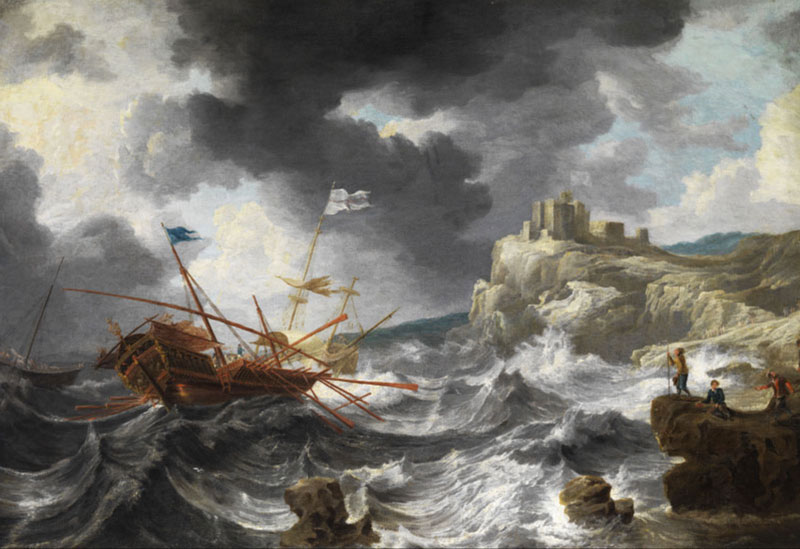
[The picture above is Bonaventura Peeters’s “Shipwreck,” ca. 1652, courtesy of the Journal of Historians of Netherlandish Art.]

Tuesday, February 10, 2026

Parson Parsons and His Sons

Jonathan Parsons was born in West Springfield in 1705, the son of a church deacon. As an adolescent he “worked at a trade,” but a Yale tutor named Jonathan Edwards persuaded him to try college.

Parsons graduated at the late age of twenty-four. He then studied more theology under Edwards, who had become the minister at Northampton.

In 1731 Parsons took the pulpit himself in the town of Lyme, Connecticut. He married Phebe Griswold, from a prominent local family, and they started having children—thirteen in all, but six died in infancy.

The children who grew up were four sons, born every two years from 1733 to 1739 (Marshfield, Jonathan, Samuel Holden, and Thomas), and three daughters, born 1748 to 1755 (Phebe, Lucia, and Lydia).

At Lyme the Rev. Mr. Parsons also got caught up in the “New Light” revival inspired by his old mentor Edwards and further inspired by the Rev. George Whitefield, who came through town in 1740. Parsons was soon known for his energetic preaching and evangelical outreach.

In 1745 the minister’s fervor grew too much for his congregation, and they decided on a separation. Parsons moved his family to Newbury to preach to a small “New Light” congregation that set itself up as Presbyterian, independent of New England’s independent network.

That meeting grew, erecting what’s now called the Old South Presbyterian Church in Newburyport in 1756. Whitefield died during a visit to Parsons in 1770 and was buried in its crypt. The minister’s wife Phebe died later the same year. He married the widow Lydia Clarkson of Portsmouth, New Hampshire, in 1771. 

Of the Parsons sons, Marshfield and Samuel Holden moved back to their birthplace of Lyme. Marshfield was a merchant and with his succession of four wives kept a tavern. Samuel Holden graduated from Yale and became a lawyer. Jonathan, Jr., and Thomas kept Newbury as their base and went to sea.

In particular, Thomas Parsons had a son by his first wife, Mary Gibson, and four daughters by his second wife, Sarah Sawyer. The New-Hampshire Gazette shows a captain named Thomas Parsons sailing out of Portsmouth harbor:
  • on the Charming Sally to Guadaloupe in 1762.
  • on the Success to Dominica and the West Indies in 1769.
  • on the Three Friends to the West Indies and Guadaloupe in 1770.
In February 1772, according to secondary sources, Capt. Thomas Parsons took a schooner out of Newburyport for another voyage to the Caribbean. He never came home.

TOMORROW: Mystery off Cape Sable.

Wednesday, December 24, 2025

John Malcom, Counterfeiter?

Watching the recent American Revolution documentary series by Ken Burns, Sarah Botstein, and David Schmidt, my ear snagged on a detail about John Malcom.

The show said that Malcom, the Customs service officer severely mobbed, tarred, feathered, and whipped in Boston in January 1774, had gotten in trouble for counterfeiting a decade earlier.

Since I’ve collected newspaper reports about John Malcom for a series of postings I really must get back to, I was surprised at not having come across a report of that crime. Whig printers enjoyed publishing stories about Malcom’s behavior after he joined the Customs service. They had even more reason to pull out embarrassing old stories after the attack on him. But no newspaper described Malcom as a counterfeiter.

In Scars of Independence (2017) Holger Hoock wrote of Malcom: “He had become notorious across the colonies after being arrested for debt and counterfeiting in 1763.” Given the lack of newspaper mentions, the captain definitely wasn’t notorious for such a crime. In fact, after further research I’m dubious the man was ever charged with counterfeiting at all.

The earliest mentions of such a crime appear the work of Dirk Hoerder: his 1971 doctoral thesis, “People and Mobs, Crowd Action in Massachusetts During the American Revolution 1765–1780,” and his 1977 book, Crowd Action in Revolutionary Massachusetts, 1765-1780. The latter says of Malcom: “In 1763 he had been apprehended in Boston for debt and counterfeiting.”

The citation for that sentence appears to be Suffolk Court Files 84397, which is a court case listed as Malcom v. Butters. That doesn’t look like a criminal charge for counterfeiting, though it could well be a debt dispute. I haven’t seen that paperwork, though.

Based on newspaper reports, Capt. John Malcom spent little time in Boston in the 1760s. He had moved to Québec and commanded trading voyages to the West Indies. Of course, Malcom might have been charged or sued during a brief stopover in his home town.

Yet we have to be careful we have the right John Malcom. The 15 October 1772 Boston News-Letter announced the death of “Mr. John Malcom, Labourer,” as did the following Monday’s Boston Post-Boy and Boston Evening-Post. Obviously that wasn’t the Customs officer attacked in 1774. But he might have been the debtor of 1763.

Further confusing matters is how a “John Malcom, alias Malcolm,” was convicted of passing counterfeit bills in Maryland—back in 1743. (Kenneth Scott’s Maryland Historical Magazine article “Counterfeiting in Colonial Maryland,” which can be downloaded in a P.D.F. here, misdates that case as in 1734.)

Normally I find Hoerder’s work to be very thorough and reliable. In this case, however, I think that he (if you’ll excuse the expression) tarred the wrong John Malcom with the wrong misdeeds.

Saturday, September 20, 2025

New Research on the Vassall Mansion in Cambridge

The Longfellow House–Washington’s Headquarters National Historic Site is unveiling a special history study researched over many years and in multiple countries. It adds tremendous detail to a dimension of that Cambridge mansion that people have long known about more generally.

That mansion in Cambridge was built in 1759 for John Vassall, heir to wealthy slave-labor plantations on Jamaica. It was not only erected with the profits of slavery, but it was staffed by enslaved workers for two decades.

While John Vassall took his family to England in the first year of the Revolutionary War, at least one family he had enslaved, led by Tony and Cuba Vassall, stayed behind to gain their freedom and found an African-American community nearby.

Black History at the Vassall Estate by Caitlin DeAngelis, Carla D. Martin, Rayshauna C. Gray, Aabid Allibhai, and Eshe Sherley digs into that story from every possible angle, using archives in the U.S. of A., Jamaica, Antigua, and Britain. The story it tells extends from the origins of the (white) Vassall family fortune through the political activity of the (black) Vassall family in the ante-bellum republic.

Two events in the next month will illuminate those findings for the public.

Thursday, 25 September, 6 to 7 P.M.
Black History at the Vassall Estate
Caitlin DeAngelis, Carla Martin, Rayshauna Gray, Aabid Allibhai, and Eshe Sherley
Online, free with registration

A new landmark study documents and analyzes the Black experience at 105 Brattle Street and in the wider Cambridge community from the mid-1700s to the mid-1800s. The authors will introduce the project, share key findings, and take you behind the scenes of their research and writing process.

This study is remarkable not only for the history it documents—much of it appearing in print for the first time—but also for the breadth of research behind it. In partnership with lineal descendants of the Black Vassalls, the authors consulted sources spanning New England, the United Kingdom, and the Caribbean over the course of more than three years. Research of this scale is rare, and even more rarely presented in a format accessible to all readers.

Everyone who registers for that event will receive a digital copy of the study, which is also available for downloading here.

Sunday, 12 October, 1 to 3 P.M.
In Search of Darby Vassall: Tour of Cambridge & Beyond
Denise Washington and Joel Mackall
Free with registration

Starting at Longfellow House–Washington’s Headquarters, travel by trolley in greater Cambridge between seven stops with a Vassall descendant and an educator. Each stop reflects a key location in the life of Darby Vassall (1769-1861), a lifelong community activist who endured slavery and seized freedom with his family in Revolutionary Cambridge. Early dinner provided after the tour.

Sunday, July 20, 2025

“There are always joys while going through manuscripts”

Last month, Commonplace published Jayne Ptolemy’s “The Record Scratch: Uncovering Documents Relating to William Ansah Sessarakoo,” and I recommend reading the whole article.

Ptolemy, who’s on the staff of the William L. Clements Library in Ann Arbor, wrote:
The Clements holds the papers of Charles Townshend (1725-1767), who served as Secretary of War during the Seven Years’ War and the Chancellor of the Exchequer in the decades leading up to the American Revolution. These days, he is mostly known as the straw man for incendiary British taxation policies due to his role in sponsoring the infamous Townshend Acts.

Internally at the library, however, we mostly grumbled about him under our breath because his papers were in a complicated arrangement, the finding aid was difficult to navigate, and the boxes even harder to pull for researchers. It needed someone to puzzle out what was in each box and add descriptive information to the finding aid to make it more manageable. Unfortunately, I don’t have a penchant for economic history, so figuring out how to describe the contents of “Miscellaneous Treasury Papers” meant trying to disambiguate a great many reports on tariffs, duties, and excises.

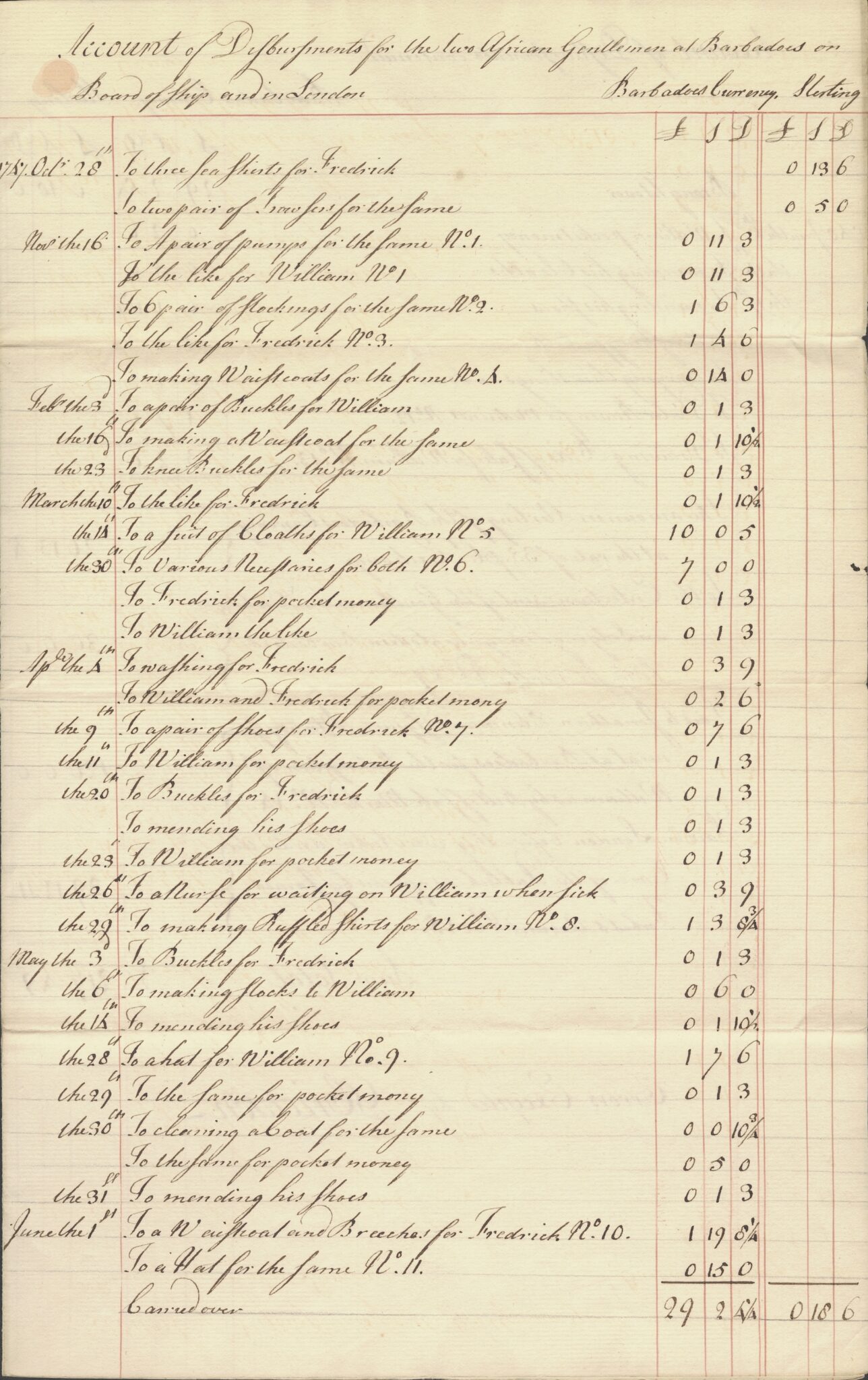
There are always joys while going through manuscripts—an unexpected doodle, a funny quote, beautiful papers—but most of what I was encountering was financial document after financial document–Until one stopped me right in my tracks. It referred to expenses “for the two African Gentlemen at Barbadoes.” Written in 1747, the use of “Gentlemen” to describe African peoples was eye-catching enough, but glancing down at the accounts, the entries for making waistcoats, providing pocket money, buying ruffled shirts, and more signaled something extraordinary. . . .

And then, a document written from Bridgetown, Barbados, laid it all out:
Whereas John Corrantee and the Caboceers of Annamabo are at present exceedingly well disposed towards the British Nation, and beg the resettlement of that place by the English, and the fort to be rebuilt

And whereas a Son of John Corrantee’s Named Ansah was sold here by Captain Hamilton who he (Corrantee) is very anxious to have redeemed

We hereby give it as our Opinion that the Redemption of the said Ansah will be very acceptable to John Corrantee (who is the leading man at Annamabo) . . . and will be a means to conciliate Corrantee to, and rivet him in the Interest of the British Nation in opposition to the French, who have been aiming for some Years past at the aforesaid settlement.
OH.

OH NO.
“The Record Scratch” is a fine metaphor for that moment, though I don’t think it gives a good sense of the rest of this article.

Wednesday, July 09, 2025

“Capt. Potter answered that he would share none”

Rhode Island actually began its military build-up back in December 1774, as detailed in a letter from former governor Samuel Ward that I quoted back here.

At that time the colony appointed its first ever major general: Simeon Potter (1720–1806).

Potter was a militia colonel, representative of the town of Bristol in the colonial assembly, and veteran privateer captain.

Indeed, Potter had already helped to lead one attack on the British military: while several fellow merchants supported the assault on H.M.S. Gaspee in 1772, he actually commanded one of the boats.

Now in fact, Potter’s most successful privateering haul came in 1744 not from attacking enemy ships but from raiding a poorly defended settlement in French Guyana that hadn’t even heard the empires were at war.

According to one of his captives, he sailed away with:
seven Indians and three negroes [none previously enslaved], twenty large spoons or ladles, nine large ladles, one gold and one silver hilted sword, one gold and one silver watch, two bags of money, quantity uncertain; chests and trunks of goods, etc., gold rings, buckles and buttons, silver candlesticks, church plate both gold and silver, swords, four cannon, sixty small arms, ammunition, provisions, etc.
Father Elzéar Fauque reported that the looting included “tearing off the locks and the hinges of the doors, particularly those which were made of brass,” before burning everything to the ground.

Potter’s lieutenant Daniel Vaughan testified in 1746 that at Suriname
Capt. Potter put a Quantity of sd. Merchandize up at Vendue on board a Vessel in the Harbour and purchased the most of them himself and ship’t them to Rhode Island on his own account; then said Sloop Sailed for Barbadoes on wch. passage the men demanded that Capt. Potter would Share the Money taken, according to the Articles, to which Capt. Potter answered that he would share none until his Return for all the Men were indebted to the Owners more than that amounted to and Swore at and Damn’d them threatning them with his drawn sword at their Breasts, which Treatment Obliged the Men to hold their Peace and when said Sloop arrived at Barbadoes Capt. Potter without consulting the Men put part of the afore mentioned Effects into the Hands of Mr. Charles Bolton and kept the other part in his own Hands and Supply’d the Men only with Rum and Sugar for their own drinking, and further this Deponent saith that Capt. Potter refusing to let the men have their Shares and his Ill Treatment of them by beating them occasioned about twenty-four to leave the Vessel whose Shares Capt. Potter retained in his Hands
Simeon Potter came home to Bristol a rich man. A few years later, in 1747, the peninsula that contained that town was shifted from Massachusetts to Rhode Island, making Potter one of the richest men in the small colony.

Potter launched various maritime businesses: a ropewalk, a distillery, a wharf, a store, and so on. He invested in slaving voyages to Africa. By the 1770s he owned more enslaved people than anyone else in Bristol. According to a nephew, Potter declared, “I would plow the ocean into pea-porridge to make money.”

In those years, Potter’s neighbors recognized his status by electing him to the legislature and to militia commands, and he was happy with the power.

TOMORROW: A fighting man.

Friday, June 27, 2025

“Crying most pitifully all exceeping one”

This is a portrait of Mary Hubbard (1734–1808) painted by John Singleton Copley about 1764 and now owned by the Art Institute of Chicago.

According to the institute, Hubbard’s “pose, gown, and background were precisely copied from a British engraving of a noblewoman, yet Copley distinguished the work as his own by capturing the figure’s individual features as well as the surfaces and colors of the luxurious fabrics.”

Mary Greene had married Daniel Hubbard (1736–1796) in 1757. Their mothers were first cousins. What’s more, her widowed father had married his widowed mother in 1744. That was one way mercantile families retained their money.

The Hubbards were Loyalists, particularly invested in importing sugar from the slave-labor plantations in Demarara. Daniel Hubbard signed the merchants’ addresses to the last royal governors, and the family remained in town during the siege

On 18 June 1775, Mary Hubbard wrote this description of the the Battle of Bunker Hill to her half-brother, David Greene (1749–1812):
once more at my Pen I can scarcely compose myself enough for any thing nor will you wonder when you know the situation we are in at present

Yesterday another Battle fought Charlestown the Scene of action they began early in the Morning & continued all day fighting. in the afternoon they set fire to the town & it is now wholy laid in ashes we could view this Melancholy sight from the top of our house

one poor Man went on the top of the meeting house to see the Battle was not able to git down again but perished in the flames.

about five in the afternoon they began to send home their wounded here my dear Brother was a Scene of woe indeed to see such numbers as pass’d by must have moved the hardest heart, judge then the fealings of your Sister, some without Noses some with but one Eye Broken legs & arms some limping along scarcely able to reach the Hospital, while others ware brought in Waggons, Chaise, Coaches, Sedans, & beds on mens Shoulders

the poor Women wringing their hands & crying most pitifully all exceeping one who on seeing her Husband in a cart badly wounded vou’d revenge went of but soon return’d compleatly Equip’t with her gun on her Shoulder her Knapsack at her back march’d down the street & left the poor Husband to try how many she could send along to tell he was comeing.

there is a vast Number of our Men killd & wound a great many Oficers two are sent to their long homes amongst the rest one fine looking Man much about your age who stopt against our windows to have his leg which was sliping moved a little he lived till this morning the poor fellow came a shore but yesterday or the day before, Perhaps his Mothers darling & his Fathers Joy cut of in the midst of his days his Sisters two if he had any must weep his untimely fate

hope it will never be my lot to have any of my near connections follow the Army.

Major [John] Pitcarn & Mr. Gore* both dead with many more that I dont know. we cannot yet learn how many of the enemy are kill’d, think it likely Mr. Hubbard who I supose will give you a particular account of the Battle will be able to write you word, to his Letter I refer you.

* have since heard Mr. Gore is a live
I don’t know who “Mr. Gore” is, not seeing such a British officer on the list of wounded. Hubbard wrote as if that man had been in the battle and thus not from the civilian family of Gores I’ve studied. (Samuel Gore was arrested after the battle for cracking a joke about the British deaths.)

The Hubbards didn’t evacuate Boston with the British military. Daniel kept at his business, and in 1792 was one of the founders of the Union Bank. He died on St. Croix during a voyage back from Demarara in 1796.

Mary Hubbard’s letter was first published by the Charlestown historian Richard Frothingham in 1876 and then as transcribed here in the D.A.R.’s American Monthly Magazine in 1894.

(The correspondent who sent the text to the magazine was Anita Newcomb McGee, a military doctor in the Spanish-American and Russo-Japanese Wars.)

Saturday, March 29, 2025

“Employing every art and all the Address I am Master of”

Here’s another glimpse of espionage in 1775.

That summer, Julien-Alexandre Achard de Bonvouloir, younger son of a French nobleman, and the Chevalier d’Amboise arrived in London on a ship from New England.

They aroused the suspicions of the British government. On 5 August John Pownall, Secretary to the Board of Trade, wrote to the Earl of Dartmouth, Secretary of State for the colonies:
The Lodgers at the Hotel in Watling Street have been watched & pumped by a discreet & proper person employed by Lord Rochford, they proved to be as stated in the Letter you left with me, French officers from the West Indies, by the way of North America; they do not conceal that they have been in [Israel] Putnams Camp, but they speak of him and his troops in a most despicable Light, and say that but for their advice they would have made an Attempt that would have ruined them—if this is true I don’t think we are much obliged to the Gentlemen—

they further say that there is at least 200 able Officers & Engineers of all countrys now here endeavouring to get passages to North America—

a few days ago the Society at the Hotel was increased by the addition of a french officer from France, who got out of his Chaise at Westminster Bridge took a Hackney Coach, and went both to the Spanish and French Embassadours—in a few days we shall probably know more and be able to judge what is fit to be done.
The Earl of Rochford (shown above) was Britain’s other Secretary of State, with responsibility for continental Europe.

This document seems less valuable for its secondhand content about America than for its hints about intelligence methods in London. The Frenchmen were “watched,” “pumped,” and trailed. The new arrival switched vehicles before visiting embassies but didn’t manage to shake his trackers.

Lord Dartmouth’s files also contain a unsigned report headed “Intelligence.” which states:
What I have been able to collect from the two French Officers by employing every art and all the Address I am Master of, amounts to what follows:—

1st. That they have been over great part of the American Continent, particularly at Philadelphia, at New York, Rhode Island, and New England, which with their stay in and about Boston, would have required more time to perform than the three Months they say they remained in America.

2d. That they are particularly acquainted with Putnam and [Artemas] Ward,—the first they represent to be a good natured Civil and brave old Soldier—but a head strong, ignorant and stupid General—Ward they hold indeed very cheap.

[3d.] That they were both in person at the Affair of Lexington, and from circumstances they cited, I am induced to think that they were present at the Affair of the 17th [i.e., Bunker Hill].

4. That they were courted by the Rebels to stay amongst them, and were offered forty Pounds / Month each, of pay—they say they did not think such Offers solid, nor did they like the paper Currency. . . .
I suspect the claim to have been “in person at the Affair of Lexington” meant Bonvouloir and D’Amboise were present in eastern Massachusetts during the militia alarm on 19 April, not that they were in Lexington itself on that early morning. Still, adding two aristocratic Frenchmen to the mix of people in New England at the outbreak of war is intriguing.

TOMORROW: Pumping M. Bonvouloir.

Sunday, February 16, 2025

Who Wrote the “Account of Lexington”?

In 1953 J. E. Tyler published an article in the William and Mary Quarterly titled “An Account of Lexington in the Rockingham Mss. at Sheffield.” 

This account appeared in two letters, the first dated 23 Apr 1775 and the second written a short time later. They were addressed to a friend named “Rogers,” with whom the writer had served “at Jamaica,” and offered news and good wishes for “the Admiral.”

That appears to have been Adm. Augustus Keppel (1725–1786, shown here), who brought the letters (or copies of them) to the Marquess of Rockingham’s cottage in Wimbledon. Ultimately the marchioness filed those copies or further copies.

Tyler wrote: “it is the more unfortunate that the signatures, though copied along with the main text of the letters, have been heavily cancelled, since it is now virtually impossible to establish the identity of the writer.” The clues that remain show that that person:
  • wrote from “Empress of Russia Boston April 23th.”
  • signed “what appears to be the initial letter ‘J’” at the start of his name.
  • described himself as “an Old Valiant.”
  • planned also to write “to my precious Girls.”
  • promised to show Rogers’s letter to “The General [Thomas Gage] and Earl Percy.”
Tyler then hazards a guess that the letter writer was the master of the troop transport Empress of Russia, listed in an Admiralty Office record from 1776 as John Crozier.

However, as reported yesterday, Crozier died in November 1774. He had been in command of the Empress of Russia, and his name might have lingered in some naval records, but he didn’t see the start of the war.

Documents in Gage’s papers confirm that the Empress of Russia was in Boston harbor from April 1775 to the end of the year, when it sailed to the Caribbean for supplies. The commander of the vessel in those months was Lt. John Bourmaster (1736–1807), agent for all the transports to Boston and thus a liaison between navy and army.

Bourmaster was a merchant seaman for most of the 1750s, passing the exam to become a Royal Navy lieutenant in late 1759. His first assignment was H.M.S. Valiant, commanded by Adm. Keppel from 1759 to 1764. Starting in late 1762, Keppel was in command of the Jamaica station. Keppel’s secretary was George Rogers, who would be on the Admiralty Board by the end of the war.

After a slow start, Bourmaster’s Royal Navy career also took off. He became a captain in 1777, a rear admiral in 1794, and a full admiral in 1804. The year 1797 saw the marriage of “Harriet, youngest daughter of Admiral John Bourmaster, of Titchfield”—meaning he had more than one daughter.

Thus, all the clues in those letters are consistent with the writer being Lt. John Bourmaster. 

Friday, January 24, 2025

The Ongoing Story of Harvard and the Legacy of Slavery

In 2016, Harvard University president Drew Gilpin Faust stated publicly:
Harvard was directly complicit in America’s system of racial bondage from the College’s earliest days in the 17th century until slavery in Massachusetts ended in 1783, and Harvard continued to be indirectly involved through extensive financial and other ties to the slave South up to the time of emancipation.
A historian of America’s antebellum South, Faust established a committee to investigate that history further, building on various faculty members’ work. Caitlin Galante DeAngelis, Ph.D., led much of the new research, producing an internal report for the administration.

In 2022, the university issued a public report on how the institution had benefited from slavery. This initiative followed similar efforts at Brown, Georgetown, and many other old American universities, not only to uncover that history but to seek ways to repair the damage of past slaveholding today.

Brown is named after a transatlantic slave trader, and profits from that business helped to endow the university. Georgetown received an infusion of funds in the 1830s from the Maryland Province of Jesuits’ sale of more than 200 people to Louisiana planters. Harvard was actually founded before Massachusetts made chattel slavery legal, but the college undoubtedly benefited directly and indirectly from coerced labor in the following centuries.

Among other responses, the university’s 2022 report recommended creating “a public memorial for the enslaved people who helped shape the institution.” A committee started to solicit ideas from artists, but in May 2024 the committee chairs resigned, saying that university administrators were rushing the process and not consulting enough with descendant communities.

That disagreement appeared to be only the most visible sign of trouble. In September, the Harvard Crimson published a story about the Harvard & the Legacy of Slavery project that began:
A $100 million University initiative intended to make amends for Harvard’s ties to slavery has been hamstrung by infighting, high staff turnover, and senior University officials seeking to limit the project’s scope, multiple current and former staff members told The Crimson.
This long article described various forms of dysfunction, including interpersonal friction, but the problem underlying everything else seemed to be disagreement on the scope and purpose of the project.

As to the scope, one issue is whether the Harvard Slavery Remembrance Program’s research should cover people enslaved by “members of the Harvard Corporation and Board of Overseers…in their personal homes.” In colonial Massachusetts, those governing board members tended to be ministers or wealthy men—the classes of people most likely to own other people. As with any board, some were more involved in the working of the college than others.

The month after that story, the Harvard Slavery Remembrance Program’s director, Richard J. Cellini, published his own opinion essay in the Crimson, reiterating one detail:
Last year, I formally notified the Office of the President and the Office of General Counsel that a small number of senior University administrators pressured me not to find “too many descendants” and not to do my job “too well.”
Obviously Cellini was challenging the university to keep the scope of the program wide.

On 17 January, the college newspaper reported:
Members of the Harvard & the Legacy of Slavery initiative met with Prime Minister Gaston A. Browne and Governor General Rodney E.L. Williams of Antigua and Barbuda on Wednesday after the initiative’s research team determined that “several hundred people” had been enslaved by Harvard affiliates in the island nation between the 1660s and 1815.
That article said researchers had identified four “four Harvard-affiliated enslavers” with property on Antigua. However, it didn’t say how the program had defined those “affiliates.” Antigua was where Isaac Royall, a Harvard overseer and benefactor, derived most of his wealth.

Members of the initiative at that meeting included Cellini, his program’s senior research fellow, and Vincent A. Brown, Charles Warren Professor of History and Professor of African and African-American Studies. Brown’s 2020 book Tacky’s Revolt: The Story of an Atlantic Slave War won the Frederick Douglass Book Prize, James A. Rawley Prize, and Anisfield-Wolf Book Award for non-fiction.

Yesterday, six days after the Crimson reported on that meeting on Antigua, the university suddenly laid off the Harvard Slavery Remembrance Program’s staff. The genealogical work will reportedly be outsourced to American Ancestors (the New England Historic Genealogical Society). The program itself has not been formally ended, though it’s unclear how many people remain and what they’re assigned to do.

No doubt there will be more drama to come.

Tuesday, December 10, 2024

Christopher Machell: Not Wounded at Bunker Hill

Earlier this month I saw a Bluesky posting about a disabled artist named Christopher Machell, who had lost an arm at the Battle of Bunker Hill.

Perhaps because the name was unfamiliar to me, I assumed that was an enlisted man. I sought more information since sources on the experiences of British privates are hard to come by.

I soon realized that Machell was an officer, not a private. The Annual Report of the Yorkshire Philosophical Society for 1907 stated:

Christopher Machell was born in 1747. He was Lt.-Colonel in the 15th Regiment of Foot, and served with the British Forces under General [Thomas] Gage in the American War of Independence. the 17th June, 1775, he was present at the Battle of Bunker’s Hill, and in that fiercely contested and sanguinary engagement the gallant Colonel lost an arm.
The source of this information was Machell’s grandson. Unfortunately, he was wrong on several counts.

First, the 15th Regiment wasn’t in Boston in 1775.

Second, Machell wasn’t a lieutenant-colonel during the war. British Army Lists show that he was a lieutenant when the fighting began and promoted to captain on 9 Oct 1775.

In the 1775 Army List, Machell was the least senior captain in the regiment. In 1783 he was the most senior captain because all of the others had been promoted, died, or retired.

According to Robert John Jones’s History of the 15th (East Yorkshire) Regiment, Machell received a promotion to major in June 1783 and retired at that rank in 1789.

So how did Machell come by the rank of lieutenant colonel? Because in 1807 he was on the War Office’s list of “Persons appointed INSPECTING FIELD OFFICERS of Yeomanry and Volunteer Corps in GREAT BRITAIN, with the Rank of Lieutenant-Colonel in the Army while so employed.” In other words, he was an army veteran called in to inspect militia units. I don’t know whether there was any actual work in that appointment or it was just a courtesy.

What about that wound? According to Burke’s Landed Gentry, Capt. Machell “lost his arm in the battle of New York.” The 15th Regiment was indeed part of the Crown’s New York campaign in 1776, fighting in the Battles of Brooklyn, White Plains, and Fort Washington.

When Machell was wounded is unclear. He wasn’t listed among the casualties in Gen. Sir William Howe’s 27 August report, and the British army and press were much better at reporting wounded officers than wounded privates. It’s conceivable Machell was wounded not in any of the big memorable battles but in the ongoing skirmishing around New York.

The 15th Regiment remained in North America through 1778, when it was moved to the Caribbean. In 1781 the French captured the 15th on St. Eustatius, setting them free the next year. The brief profiles of Machell don’t say anything about him being a prisoner or war, hinting he may not have been with the regiment then.

All that raises the question of why, if Capt. Machell actually lost an arm in the first three years of the war, he remained on the regiment’s roll through the end. Jones’s History of the 15th may contain an answer, but I don’t have access to the whole book.

TOMORROW: Arguing over Crackenthorpe.

Saturday, November 09, 2024

The Intriguing Portraits of William Williams

[Today’s posting would be simpler if so many of the people involved weren’t named Williams.]

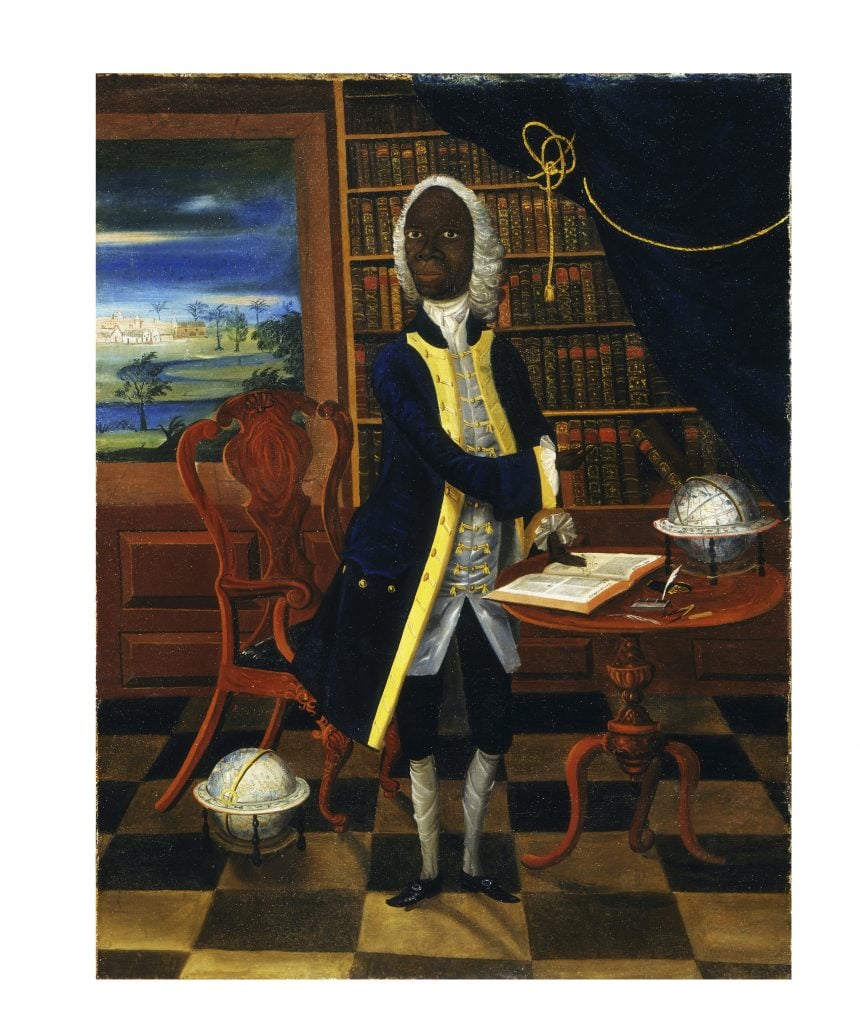
Yesterday I passed on articles about Fara Dabhoiwala’s conclusions about a painting of the Jamaican scholar Francis Williams.

Dabhoiwala hypothesizes that this portrait was made in or shortly after 1759 by the artist William Williams, born in Wales in 1727 but active in the American colonies.

William Williams is known for a couple of other portraits of unusual men in Britain’s American empire.

One portrait, now lost, showed the Haudenosaunee leader Theyanoquin, often called “King Hendrick” by British sources. In January 1755, Theyanoquin was in Philadelphia meeting with Gov. John Penn and the Council about a land dispute. At the time, British authorities were pleased to have the Haudenosaunee as allies in their growing conflict with the French.

The Fishing Company of Fort St. David’s, a genteel men’s club, commissioned William Williams to paint Theyanoquin’s portrait, and club records show it was displayed in their clubhouse. (This club later merged with the Schuylkill Fishing Company, discussed here.)

Later in 1755, Theyanoquin led a contingent of Native soldiers in a British force commanded by Sir William Johnson. Col. Ephraim Williams, Jr., led the Massachusetts contingent. (His brother, Dr. Thomas Williams of Deerfield, came along as a surgeon, and their relative, the Rev. Stephen Williams, as a chaplain.)

That British force clashed with the French beside Lake George on 8 September. Col. Williams and Theyanoquin were both killed, though ultimately Johnson claimed victory.

That event made Theyanoquin, or Hendrick, a martyr for people in Britain. Elizabeth Bakewell and Henry Parker issued an engraved portrait of him titled “The Brave old Hendrick the great Sachem or Chief of the Mohawk Indians” (shown above). That print isn’t dated, and its source is uncertain, but scholars appear to believe that it was most likely based on the William Williams painting. If so, it’s the only remaining version of that image.

In the same decade, Williams painted the radical Quaker Benjamin Lay. The earliest trace of this portrait appears to be a remark in Benjamin Franklin’s 10 June 1758 letter from London to his wife Deborah. The retired printer wrote: “I wonder how you came by Ben. Lay’s Picture.”

Unfortunately, Deborah’s letters to Benjamin before and after that one don’t survive, so we don’t know what she’d told him about that picture or how she answered his query. Franklin had published some of Lay’s writing decades earlier, but the man wrote a lot, and I don’t see signs of a close friendship.

Deborah Franklin might have commissioned William Williams to paint Lay because she sensed public interest in an engraved portrait. At some point such an engraving appeared, credited to painter “W. Williams” and engraver “H.D.” That was Henry Dawkins, another British-born craftsman who had come to the Middle Colonies of America to be a bigger fish in a smaller pond. (It’s also possible Dawkins published that engraving himself and the “Picture” Benjamin Franklin wrote about was a print, not the painting.)

That brings us back to Francis Williams, the Jamaican polymath. Did William Williams paint his portrait with an eye toward its eventual engraving? No such engraving survives.

The painting went into the hands of the planter and lawyer Edward Long (1734–1813), who published a history of Jamaica in 1774. That book includes a poem by Francis Williams and a short, inaccurate, racist biography of him. Did Long at some point also think of putting an illustration of Williams into the book?

For more about those unusual portrait subjects, see Eric Hinderaker’s The Two Hendricks: Unraveling a Mohawk Mystery, Marcus Rediker’s The Fearless Benjamin Lay, and Vincent Carretta’s article “Who Was Francis Williams?” in Early American Literature.

Friday, November 08, 2024

New Light on the Portrait of Francis Williams

Last month Artnet and the Guardian reported on historian Fara Dabhoiwala’s findings about a painting I discussed in 2009.

The painting shows Francis Williams (1697–1762), a Jamaican of African ancestry. Born into a free and prospering family with special legal status, he went to London for education and then returned to the family estate.

The painting is in the collection of the Victoria and Albert Museum, and fifteen years ago I quoted its webpage as saying:
Some writers have suggested that the painting is a caricature of Francis as he has been depicted with a large head and skinny legs. . . . Other critics have considered that the ‘unnaturalistic’ depiction may have been intended to emphasise the subject’s intellectual skills over his physical stature (Francis was alive at the time of the painting’s creation and may even have commissioned it). It may, more simply, be a reflection of the artist’s limited skills.
The new research connects the creation of the painting to a specific historical, and astronomical event.

The Guardian report explains:
Dabhoiwala…discovered the significance of the page number carefully inscribed on the book Williams is reading: it is the page in the third edition of Newton’s Principia that discusses how to calculate the trajectory of a comet by reference to the constellations around it.

An X-ray of the window scene depicted in the background of the painting showed lines intersecting what appears to be a luminous white comet, streaking through the sky at dusk, and connecting – with stunning accuracy – to constellations of stars. These stars would have been visible in that position in the firmament when Halley’s comet was in the sky over Jamaica in 1759, according to research by Dabhoiwala.
In other words, this picture shows a particular moment when Halley’s comet appeared over Williams’s estate, and it shows him as an educated gentleman who knew how to calculate the path of that comet.

Artnet adds:
As for the painting’s creator, Dabhoiwala is confident it’s the work of William Williams, an English-American artist who traveled to Jamaica in the 1760s. The comet together with the appearance [in the bookcase] of [Dr. Samuel] Johnson’s Dictionary, which was first published in 1755, align with this timing and the painting’s style is similar to other early Williams portraits of Benjamin Lay, a Quaker abolitionist, and Hendrick Theyanoguin, a Mohawk Indian.
The Lay portrait, now at the Smithsonian’s National Portrait Gallery, also shows a man “with a large head and skinny legs.” Like Williams, Lay (c. 1681–1759) was notable for standing out in British-American society rather than fitting in. Williams (1727–1791) might have specialized in such subjects.

TOMORROw: More on William Williams’s work.

Saturday, August 17, 2024

“One hundred barrels of gun-powder has been taken out”

On 2 Sept 1774, Gov. Nicholas Cooke reported that the Rhode Island government had finally acquiesced to Gen. George Washington’s wish for the colony to send an armed ship to Bermuda to pick up some gunpowder that island’s inhabitants were reportedly ready to sell to the American rebels.

The man for the job, Cooke said, was Abraham Whipple (1733–1819, shown here). He had commanded a privateer in the last war and had already taken one Royal Navy vessel: the Gaspee in 1772. Rhode Island had made him commodore of its fleet, which at that time consisted of two ships.

Rising from his sickbed, Whipple had one request:
He requests your Excellency to give him a Line under your Hand assuring the People of Bermuda that, in Case of their Assistance, you will recommend it to the Continental Congress to permit them to fetch Provisions for the Use of the Island. He does not purpose to make any Use of it unless he shall find it utterly impracticable to obtain the Powder without their Assistance.
Washington’s military secretary Joseph Reed drafted that document:
In the great Conflict which agitates this Continent I cannot doubt but the Assertors of Freedom & the Rights of the Constitution are possessed of your most favourable Regards & Wishes for Success. As the Descendants of Freemen & Heirs with us of the same glorious Inheritance we flatter ourselves that tho. divided by our Situation we are firmly united in Sentiment. The Cause of Virtue & Liberty is confined to no Continent or Climate it comprehends within its capacious Limits the wise & the good however dispersed & separated in Space or Distance. . . .
On 9 September, Cooke sent more news: “Zealous to do every Thing in our Power to serve the common Cause of America, the Committee have determined, instead of the small armed Sloop, to send the large Vessel with Fifty Men upon the Bermuda Enterprize.”

Whipple sailed on 12 September. Gov. Cooke probably thought the general would finally be satisfied. Then he noticed an item in the 14 September New-England Chronicle under a Philadelphia dateline:
Extract of a letter from Bermuda, dated August 21.

“Upwards of one hundred barrels of gun-powder has been taken out of our magazine: supposed by a sloop from Philadelphia, and a schooner from South Carolina: It was very easily accomplished, from the magazine being situated far distant from town, and no dwelling house near it.”
In fact, this gunpowder heist was an inside job. A Bermuda gentleman named Henry Tucker had made arrangements with the Continental Congress to trade that gunpowder for regular shipments of food. He had arranged for men to break into the storehouse on 14 August and load the 1,182 pounds of powder inside onto the two American vessels. Tucker even sent the Congress a bill for around £162. Read all about that in Hugh T. Harrington’s article for the Journal of the American Revolution.

Back in early August, Gov. Cooke had told Gen. Washington that there was no need for a special voyage since the Bermudans might very well move the gunpowder on their own. Now that turned out to be true. In fact, Tucker’s team had acted even as Cooke was maneuvering his legislature to fund Rhode Island’s effort for Washington’s sake. By the time Cdre. Whipple had sailed, the gunpowder in question had arrived at Philadelphia. Unfortunately, Cooke was unable to get Whipple and his armed ship back to Narragansett Bay.

Remarkably, the governor managed not to write to the general ‘I told you so.’

TOMORROW: Whatever happened to…

Friday, August 16, 2024

“The only Chance of Success is by a Sudden Stroke”

On 11 Aug 1775, Elisha Porter returned to Gen. George Washington’s headquarters with a letter from Rhode Island governor Nicholas Cooke, the second Cooke had sent within four days.

Both letters said the same thing about the general’s proposal to send an armed ship to Bermuda to collect gunpowder: Rhode Island couldn’t spare the resources to do it, and the Bermudans might deliver the gunpowder on their own.

That was not what Gen. Washington wanted to read. During the siege of Boston, he constantly sought to do something about the king’s troops in Boston. He felt the Continental Congress had sent him to drive that force out of Boston, not just to prod them until its commanders decided to leave.

The lack of gunpowder seemed like the biggest obstacle to any plan, so Washington was eager to take any action to fix that problem. Then he could get on to other schemes, like sending Col. Benedict Arnold up through Maine, launching armed schooners, or eventually proposing an attack across the frozen Charles River.

On 14 August, therefore, the general wrote back to the governor that the Bermuda plan was really good, and it depended on not quibbling and acting fast:
Having conversed with Collo. Porter and farther considered the Matter, I am of Opinion it ought to be prosecuted on the single Footing of procuring what is in the Magazine. The Voyage is short, our Necessity is great: The Expectation of being supplied by the Inhabitants of the Island under such Hazards as they must run, is slender: so that the only Chance of Success is by a Sudden Stroke. . . .

I should suppose the Captain who is to have the Direction of the Enterprize, would rather chuse to have Men whom he knew, and in whom he could confide in Preference to Strangers. From what Collo. Porter informs me, I do not see that [William] Harris’s Presence is absolutely necessary, and as his Terms would add considerably to the Expence, after obtaining from him all the Intelligence he could give, his Attendance might be dispens’d with.
Sea captain William Harris of New London, Connecticut, had come to Massachusetts proposing the voyage to Bermuda and obviously hoped to profit from it. Now Washington and Porter planned to milk him for information and cut him out of the deal.

Cooke didn’t write back until the end of the month. He hadn’t even proposed to the Rhode Island assembly that the colony undertake this mission, choosing instead to maneuver until he could work with a select committee. But he was still pessimistic: “At present the Undertaking appears to me extremely difficult. The most suitable Man we have for the Purpose is confined to his Bed by Sickness.”

Washington would not have been pleased to hear that.

TOMORROW: A mission from Rhode Island.

Thursday, August 15, 2024

“The General would be glad to confer with you”

Yesterday I started to profile Elisha Porter, as of July 1775 Hadley’s representative in the Massachusetts General Court and militia colonel.

Porter helped fellow lawyer Joseph Hawley of Northampton write this letter to the Continental Congress waxing eloquent on the need for more gunpowder:
Were you now in the Continental Army which invests Boston, it would beget unutterable vexation and torment in your hearts, to behold so large a body of so active brave men as that army consists of, insulted by the fire and blaze of the enemy’s cannon and mortars from their lines, ships, and floating batteries; and the same brave men, although possessed of divers good pieces of great ordnance, and willing, at any hazard, to improve them, yet wholly restrained from returning any fire of the kind, lest, by so doing, their little stock of gunpowder should soon be exhausted, and they reduced to the fatal necessity of laying down their arms or flying into the woods, leaving their houses to be burnt, their fields wasted; in short to give up and abandon the just claims of all America, and in effect to resign themselves and the lives of all the children of liberty in this whole Continent, to the arbitrary pleasure of a haughty Administration, instigated and influenced by enraged tories of our own breeding.
I couldn’t resist quoting that sentence, as transcribed by Peter Force.

In mid-July, Porter made a trip to New York, seeking “2 hhds Flints & 10 Tons Lead,” as the general wrote. He returned on 2 August, having succeeded in arranging for ”80,000 Flints & eight Tons of Lead.”

The next day, a council of war disclosed how little gunpowder the army had. Joseph Reed (shown above), Gen. George Washington’s military secretary, sent Porter a quick note:
If you could spare Time to ride down to Head Quarters this Afternoon the General would be glad to confer with you on a Matter of some Importance which you mentioned to him on your Return from New York
Porter made the short trip from Watertown to Cambridge. Later that day Washington wrote to Rhode Island governor Nicholas Cooke about the urgent need for gunpowder and the possibility of obtaining it from Bermuda, as quoted here. He concluded:
Col: Porter has undertaken to assist in the Matter or to provide some suitable Person to accompany [William] Harris to you who will communicate all Circumstances to you.
Porter personally carried that letter to Cooke. There was a brief glitch when they lost track of Harris, a sea captain who was continuing to shuttle among American ports. On 11 August, Cooke sent Porter back to Washington with a letter.

Gov. Cooke had already expressed his position: reports suggested that Bermudans were inclined to sell that powder to Continental forces, so there was no need to send a ship to the island, and besides Rhode Island didn’t have the resources for such a mission, anyway.

TOMORROW: The general’s response.

Tuesday, August 13, 2024

“They gave Information of the Powder”

As I quoted back here, on 3 Aug 1775 Gen. George Washington wrote to Gov. Nicholas Cooke of Rhode Island asking him to send all available gunpowder and lead.

Washington also urged the governor to dispatch one of the colony’s armed ships with a man named Harris to Bermuda to seize more gunpowder.

As I wrote yesterday, I think Harris was a Connecticut-based sea captain named William Harris.

Cooke wrote back promptly on 8 August. His responses were:
  • Rhode Island didn’t have that much gunpowder and lead left, and needed all it had.
  • The colony couldn’t spare either of its armed sloops.
  • There wasn’t enough money available to buy the gunpowder in Bermuda.
  • Washington’s agent, Elisha Porter, “can hear nothing of Harris…but is greatly apprehensive that he is fallen into the Hands of the Enemy.”
But aside from those details, Cooke was eager to cooperate with the general’s plans.

I believe Capt. Harris had gone on to New York. The 10 August issue of Rivington’s New-York Gazetteer reported that the Customs office had just cleared “Bittern, Harris,” to sail for “Rhode-Island.”

On 11 August, Cooke told Washington that Harris was back in Providence. And he had news to share about that powder in Bermuda:
Since my last to you Mr [Samuel] Ward One of the Delegates hath returned from the Congress. He informs me that some of the Bermudians had been at Philadelphia soliciting for Liberty to import Provisions for the Use of the Island. They gave Information of the Powder mentioned in your Letter to me, and were of Opinion it might be easily obtained. They were told by the Delegates that every Vessel they should send to the Northward with Powder should be permitted to carry Provisions to the Island. Whether their Situation will not probably prevent them from bringing the Powder I submit to your Excellency.
Gov. Cooke sent that letter back to Cambridge with Porter.

TOMORROW: The general’s operative.

Sunday, August 11, 2024

“Arrived here a Sloop from Bermuda”

As I quoted yesterday, on 4 Aug 1775 Gen. George Washington wrote to the governor of Rhode Island about what he’d heard about Bermuda from a man he called “One Harris.”

The editors of The Revolutionary Correspondence of Governor Nicholas Cooke identified Harris as “Captain Benjamin Harris,” but I don’t see what they based that on. I can’t find other mentions of Benjamin Harris in connection with Rhode Island or Bermuda.

I found clues in newspapers pointing in another direction. Rivington’s New-York Gazetteer for 15 June reported: “sloop Bittern, Harris, [cleared for] Bermuda.” And on 27 July: “Bittren, Harris, Bermuda” was among the inward entries, the only one from that island. The 31 July New-York Gazette reported that sloop as “Brittain, W. Harris.”

In addition, the 24 July New-York Gazette reported:
Friday Night last [i.e., 21 July] arrived here a Sloop from Bermuda: By Letters from thence we learn, that the Inhabitants of that Island are greatly alarmed at the present Situation of publick Affairs, being under the most dismal Apprehensions of Starving; to prevent which they have passed a Law, that no Provisions should be sent off the Island at any Rate whatsoever; and were about dispatching a Vessel to Philadelphia, to request the Honourable the Continental Congress to take their Case into their most serious Consideration.
That was reprinted in the 27 July New-York Journal and from thence in the 2 August Massachusetts Spy and the 3 August New-England Chronicle.

Thus, we have a ship’s captain named “W. Harris” arriving from Bermuda on a ship named something like the Bittern, probably bringing political news, in time to make his way to Gen. Washington’s headquarters in Cambridge with an offer.

Another clue about Harris appears in Gov. Cooke’s 8 August response to Washington saying that he didn’t know where the man was. Washington’s agent Elisha Porter was “bound as far as New-London to endeavour to meet with him,” indicating that people perceived Harris as most likely to surface in New London, Connecticut.

That took me to my favorite smuggling merchant, Nathaniel Shaw of New London. His letter book shows he employed two captains named William Harris in the early 1770s. He wrote sometimes of William Harris, sometimes William Harris, Jr., and most often simply ”Harris.”

The 10 May 1771 New-London Gazette reported among the ships cleared out of that harbor “Sloop Bittren, Harris [to] New York.” On that same say Shaw sent a letter to Peter Vandervoort in New York with a shipload of molasses overseen by “Wm. Harris Junr.” The 6 Dec 1770 Pennsylvania Journal likewise links a “W. Harris” with the “Sloop Bittern” traveling between New York, Philadelphia, and New London. Several newspapers in 1770 render Harris’s ship as the “Bittren.”

Two years later, the 23 Apr 1773 New-London Gazette shows “Capt. William Harris, late of New-London,” had died and one of the estate administrators was “William Harris”—no doubt formerly Jr.

Thus, I propose that the “One Harris” who visited Gen. Washington in August 1775 with a proposition regarding gunpowder was William Harris of New London, Connecticut, a ship captain recently returned from Bermuda on a sloop called something like the Bittern.

COMING UP: Mission to Bermuda.