






John Malcom, Counterfeiter?
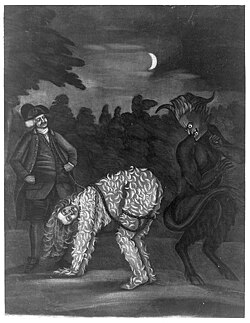
The show said that Malcom, the Customs service officer severely mobbed, tarred, feathered, and whipped in Boston in January 1774, had gotten in trouble for counterfeiting a decade earlier.
Since I’ve collected newspaper reports about John Malcom for a series of postings I really must get back to, I was surprised at not having come across a report of that crime. Whig printers enjoyed publishing stories about Malcom’s behavior after he joined the Customs service. They had even more reason to pull out embarrassing old stories after the attack on him. But no newspaper described Malcom as a counterfeiter.
In Scars of Independence (2017) Holger Hoock wrote of Malcom: “He had become notorious across the colonies after being arrested for debt and counterfeiting in 1763.” Given the lack of newspaper mentions, the captain definitely wasn’t notorious for such a crime. In fact, after further research I’m dubious the man was ever charged with counterfeiting at all.
The earliest mentions of such a crime appear the work of Dirk Hoerder: his 1971 doctoral thesis, “People and Mobs, Crowd Action in Massachusetts During the American Revolution 1765–1780,” and his 1977 book, Crowd Action in Revolutionary Massachusetts, 1765-1780. The latter says of Malcom: “In 1763 he had been apprehended in Boston for debt and counterfeiting.”
The citation for that sentence appears to be Suffolk Court Files 84397, which is a court case listed as Malcom v. Butters. That doesn’t look like a criminal charge for counterfeiting, though it could well be a debt dispute. I haven’t seen that paperwork, though.
Based on newspaper reports, Capt. John Malcom spent little time in Boston in the 1760s. He had moved to Québec and commanded trading voyages to the West Indies. Of course, Malcom might have been charged or sued during a brief stopover in his home town.
Yet we have to be careful we have the right John Malcom. The 15 October 1772 Boston News-Letter announced the death of “Mr. John Malcom, Labourer,” as did the following Monday’s Boston Post-Boy and Boston Evening-Post. Obviously that wasn’t the Customs officer attacked in 1774. But he might have been the debtor of 1763.
Further confusing matters is how a “John Malcom, alias Malcolm,” was convicted of passing counterfeit bills in Maryland—back in 1743. (Kenneth Scott’s Maryland Historical Magazine article “Counterfeiting in Colonial Maryland,” which can be downloaded in a P.D.F. here, misdates that case as in 1734.)
Normally I find Hoerder’s work to be very thorough and reliable. In this case, however, I think that he (if you’ll excuse the expression) tarred the wrong John Malcom with the wrong misdeeds.

No comments:
Post a Comment