J. L. BELL is a Massachusetts writer who specializes in (among other things) the start of the American Revolution in and around Boston. He is particularly interested in the experiences of children in 1765-75. He has published scholarly papers and popular articles for both children and adults. He was consultant for an episode of History Detectives, and contributed to a display at Minute Man National Historic Park.

Subscribe thru Follow.it


•••••••••••••••••


Showing posts with label James Boswell. Show all posts

Wednesday, November 27, 2024

Dr. Johnson, Miss M’Queen, and a “book of science”

At the Scilicet blog, James Fox wrote about a gift from Dr. Samuel Johnson:
In 1773, during their now famous tour of the Western Isles of Scotland, Samuel Johnson and James Boswell made a pit stop at a settlement called Aonach in Glen Moriston, near Inverness. As Johnson later recalled, a girl who served them tea ‘engaged me so much’ that he decided to give her a present. Having only what he could source in Inverness to hand, the gift was a copy of the highly popular maths textbook, Cocker’s Arithmetick.

Despite Boswell’s surprise, Johnson justified his giving of a practical gift. ‘When you have read through a book of entertainment’, he said, ‘you know it, and it can do no more for you; but a book of science is inexhaustible’. . . .

On the surface, Cocker’s Arithmetick was hardly riveting stuff. It taught the basics of arithmetic – addition, subtraction, multiplication and division – presented as a set of ‘rules’ to be memorised with many worked examples that began with very basic problems that became increasinging difficult. Yet its popularity is remarkable by any standards. Written by Edward Cocker, a London-based teacher of writing and arithmetic, the book was first published posthumously in 1678. It was then reissued continually for decades after, not only in London, but also Dublin, Edinburgh and Glasgow. Its final edition appeared over a century later, in 1787, and by my own (conservative) estimate, it saw at least seventy editions. . . .

Chapters on commercial arithmetic skills in the second half of the text hinted at its target audience: aspiring businesspeople. It was this facet of Cocker’s appeal that ensured its enormous popularity. The book appeared at just the moment when the currency of arithmetic was exploding thanks to rising literacy and the emergence of a society oriented around commerce, consumerism and sociability. Buying Cocker’s Arithmetick represented a ticket to this new world.
Fox’s article is framed around Boswell’s report that “Several ladies” later found this gift laughable. He concludes that those women laughed because it had become almost cliché to recommend this “humble textbook.”

I suspect at least part of that laughter came from how the scholar had given this book to “a young woman,” as opposed to an ambitious young man. Even a young woman who “had been a year at Inverness, and learnt reading and writing, sewing, knotting, working lace, and pastry”?

Plus, there’s the class issue. Johnson and Boswell were visiting “a village…of three huts, one of which is distinguished by a chimney.” Fortunately for them, the owner of that one hut with a chimney, a man named M’Queen, accommodated them for the night.

M’Queen’s daughter was the young woman who served these visitors. Johnson later described her as “not inelegant either in mien or dress”; “Her conversation, like her appearance, was gentle and pleasing.” He insisted that in Highlander society she was a “gentlewoman.” But clearly he and Boswell (perhaps especially Boswell) were surprised by some of the family’s claim to gentility:
There were some books here: a Treatise against Drunkenness, translated from the French; a volume of the Spectator; a volume of Prideaux’s Connection, and Cyrus’s Travels. M’Queen said he had more volumes; and his pride seemed to be much piqued that we were surprised at his having books.
Dr. Johnson himself would protest that the Scilicet article’s phrase “Having only what he could source in Inverness to hand” might be misleading. He didn’t pop down to the Inverness shops to find the best available book to give as a present. Instead, the men had already passed through Inverness, and Johnson had bought Cocker’s Arithmetic for his own reading. Then when he wanted to give Miss M’Queen a present, “I presented her with a book which I happened to have about me.”

To Boswell, it was “singular” that Johnson “should happen to have Cocker’s Arithmetick.” That prompted the scholar’s observation that “if you are to have but one book with you upon a Journey, let it be a book of science.” His remark about exhausting “a book of entertainment” wasn’t a comment on what a young woman like Miss M’Queen would most benefit from; it was a comment on what kept his own interest.

Sunday, December 18, 2022

“Not only relishing the sociable but actively contriving it”

Like the Georgian Papers Programme, Digit.En.S is a study of eighteenth-century Britain funded by the E.U. and based at a continental university.

Digit.En.S hosts the Digital Encyclopedia of British Sociability in the Long Eighteenth Century, designed to “Explore the wide range of topics related to British Sociability from 1650 to 1850 and learn about the circulation of models of sociability that shaped European and colonial societies.”

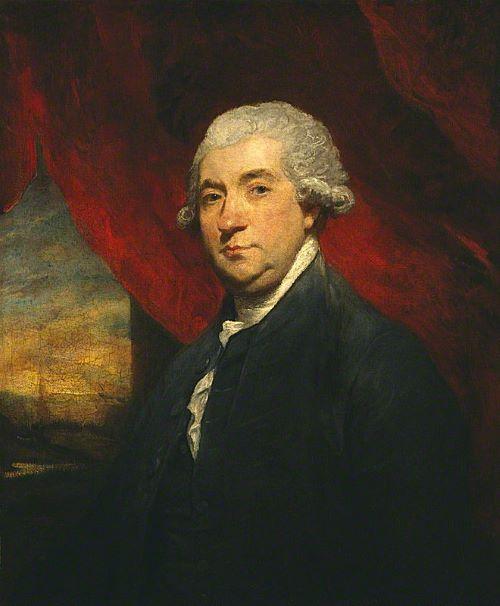
Be that as it may, I enjoyed Allen Ingram’s profile of James Boswell:
…he was, quite simply, good company – attentive, amusing, intelligent and above all lively. [Samuel] Johnson, most clearly, and [Pasquale] Paoli, once exiled in England, became lifelong friends and were pleased to see him often during his annual spring visits to London from Edinburgh. Through Johnson in particular, Boswell became friends with a set of men he might not otherwise have met, or met so soon and so favourably. These included Edmund Burke, David Garrick, Joshua Reynolds and Oliver Goldsmith; but other friends, like John Wilkes, and various members of the Scottish nobility, were already part of Boswell’s circle, and would remain so – indeed, he even contrived a dinner in London in May 1776 that brought Johnson and Wilkes, the bitterest of political rivals, together in an atmosphere of sociability and mutual good humour, though the good humour found its focus in making jokes at Boswell’s expense.

But this was part of Boswell’s talent, not only relishing the sociable but actively contriving it. He could be immensely self-promoting, often in a highly embarrassing way, as at the annual dinner of the Company of Grocers in London in November 1790, in the presence of Prime Minister William Pitt, an honorary member of the Company, when Boswell sang the semi-satirical ballad, ‘William Pitt, The Grocer of London’, six times, apparently by popular acclaim, in a misguided attempt to curry favour from Pitt in his political ambitions. But Boswell seems to have been utterly beyond embarrassment, especially at large social occasions, and especially after consuming alcohol. . . .

Drinking for Boswell almost always took place within a social context. He was not particularly choosey, though, about the nature of that context, or about the location of his drinking. As long as there was company, he would drink: with lords and ladies, as at Northumberland House, where Trafalgar Square now is, where the set surrounding the Duke and Duchess of Northumberland congregated, as he did in London during his visit of 1762-1763; or with politicians and genteel tradesmen, as at the Grocers’ dinner cited above; or with his legal friends and acquaintances back in Edinburgh, as he did all his life; or with prostitutes in London, or Edinburgh, or anywhere, as he also did all his life; or, as he did returning to Edinburgh from Auchinleck in March 1777 with an old friend, Richard Montgomery, ‘at some low ale-house’, where ‘I drank outrageously’ and ‘arrived at Edinburgh very drunk’.

Boswell’s taste in women and in female society was if anything even wider than his taste in alcohol and his expectations of the kind of sociability that was possible from it changed the further down the social scale he went. Few if any of his sexual relationships were with women of the highest social class. With such women his expectations were similar to the sociability he enjoyed with men, with the bonus of their being female: he enjoyed their company and was able to flirt as an amusement rather than as a preliminary to anything. . . . [In contrast,] His relationship with the actress ‘Louisa’ (Anne Lewis) in London in 1762-1763…observes all the polite social niceties, with a mix of gallantry, wit and deference:
‘Madam, I was very happy to find you. From the first time that I saw you, I admired you.’ ‘O, Sir.’ ‘I did, indeed. What I like beyond everything is an agreeable female companion, where I can be at home and have tea and genteel conversation. I was quite happy to be here. ‘Sir, you are welcome here as often as you please.’ (London Journal 115)
The pay-off, however, when it comes is a level of physical reality far beyond ‘tea and genteel conversation’: ‘A more voluptuous night I never enjoyed. Five times was I fairly lost in supreme rapture. Louisa was madly fond of me; she declared I was a prodigy.’
Boswell published essays, travel accounts, and his biography of Johnson in his lifetime, but he came back to life only in the 1900s when his private diaries were discovered and put into print.

Thursday, October 27, 2022

Four Decades of “Dr. Sam Johnson, Detector”

I’ve been discussing the historical background behind Lillian de la Torre’s mystery short story, “The Great Seal of England.”

In 1943 De la Torre was in her forties and known around Colorado Springs as Lillian McCue, wife of a Colorado College professor. Then she sold that story to Ellery Queen’s Mystery Magazine.

That launched De la Torre’s career as a writer. She was an Ellery Queen favorite for the next four decades. A couple of years after that first sale, she even visited Hollywood to consult on some movies. Eventually she served a year as president of the Mystery Writers of America.

With her “Dr. Sam Johnson, Detector” stories, Lillian De la Torre invented a new subgenre of whodunnits. Although Melville Davisson Post had written Uncle Abner mysteries set in the ante-bellum past starting in 1911, De le Torre innovated by basing her “detector” and the characters around him on actual historical figures, and crafting her plots around real events.

De la Torre’s first published book was a fictionalized analysis of what happened to Elizabeth Canning in 1753, called Elizabeth Is Missing. She wrote other books in this vein, such as The Heir of Douglas. Though these were originally published as fiction, De la Torre believed she had identified the correct solutions to those historical enigmas, and they’re now presented as “definitive accounts” of the underlying events. (Other authors would differ.)

For her stories about Dr. Johnson, De la Torre had the advantage of James Boswell’s extensive writings about the man. She produced an entertaining pastiche of Boswell’s voice, including not only his language and details but even dialogue structure.

To her credit, De la Torre also recognized the limitations of that narrative approach, as when Johnson’s other and closer biographer, Hester Thrale Piozzi, makes an appearance. “Boswell did not like Mrs. Thrale,” the author noted in an afterword; “he considered her his rival for ‘that great man.’” (Adam Gopnik wrote about Johnson and Thrale for the New Yorker.)

The stories jump around in time to take advantage of different events in George III’s realm. Some involve figures from the American Revolution, such as waxwork artist and spy Patience Wright and scientist and diplomat Benjamin Franklin. Mike Grost noted that De la Torre wrote about thefts as often as murders.

In some ways, De la Torre’s stories show the biases of her own time. Dr. Johnson had a servant and heir named Francis Barber (shown above), who had been freed from slavery in Jamaica. De la Torre brought Barber onto the scene in her first published story, but gave him no more life than a piece of furniture. Not until “The Blackamoor Unchain’d” (1974) did he become a full character, and then only for one tale. These days I’m sure authors would see much more potential in Barber’s own life.

There were four collections of De la Torre’s “Dr. Sam Johnson, Detector” stories, and the Mysterious Press has reissued them in digital form:
As of this writing, they’re on sale at a discounted price on the major ebook platforms.

Wednesday, October 26, 2022

“The tantalizingly respectable reticence of contemporary chroniclers”

In addition to the theft of the Great Seal of Britain, discussed yesterday, the writer Lillian de la Torre took inspiration from two other details of the life of Baron Thurlow, the Lord Chancellor in 1784.

One was this fact, as De la Torre noted it at the start of her mystery story:
In August of that year, Lord Chancellor Thurlow very graciously intimated to the friends of Dr. [Samuel] Johnson that that learned philosopher might draw against him at need for as much as £600.
James Boswell mentioned that offer of credit in his Life of Samuel Johnson, Ll.D. In an 1831 edition John Wilson Croker discussed it at more length, printing documents and his own acerbic commentary (“It is strange that Sir John Hawkins should have related… The editor cannot guess why Mr. Boswell did not print his own letter…”).

The circumstances were not actually that mysterious. In early 1784 Dr. Johnson, aged seventy-five, had a serious health crisis. His friends wanted him to take a trip to Italy to recover. Money was tight. Boswell and others hoped the government would increase the pension granted to Johnson for his work as a lexicographer and propagandist during the American war.

In July Boswell wrote to Thurlow, asking for that favor. Thurlow responded positively. In a conversation with Sir Joshua Reynolds, the Lord Chancellor offered to personally loan Johnson the money, based on a mortgage against his future pension. Thurlow later said he was trying to get the lexicographer money quickly rather than wait through the uncertain pension process.

Dr. Johnson declined the offer when he learned about it. He never set out for Italy. He died on 13 December.

The other detail of Thurlow’s life that De La Torre used involved his household. The Lord Chancellor lived with a woman called “Mrs. Hervey” and had children by her, all illegitimate. This didn’t seem to affect his government career, social standing, or visits from his brother, an Anglican bishop. Thurlow did have to pass on one of his baronies to a nephew.

Because Thurlow’s children weren’t legitimate, it’s hard to find vital information about them. De la Torre wrote:
The tantalizingly respectable reticence of contemporary chroniclers about Thurlow’s irregular household has forced me to invent his daughters, known to me by name alone, out of whole cloth.
Her story’s characters include Catharine, aged eighteen, and Caroline, “not more than fifteen,” while a younger sister is off with her mother at Bath.

Genealogists have since nailed down when those daughters were born:
  • Caroline in 1772.
  • Catherine in 1776.
  • Maria in 1781.
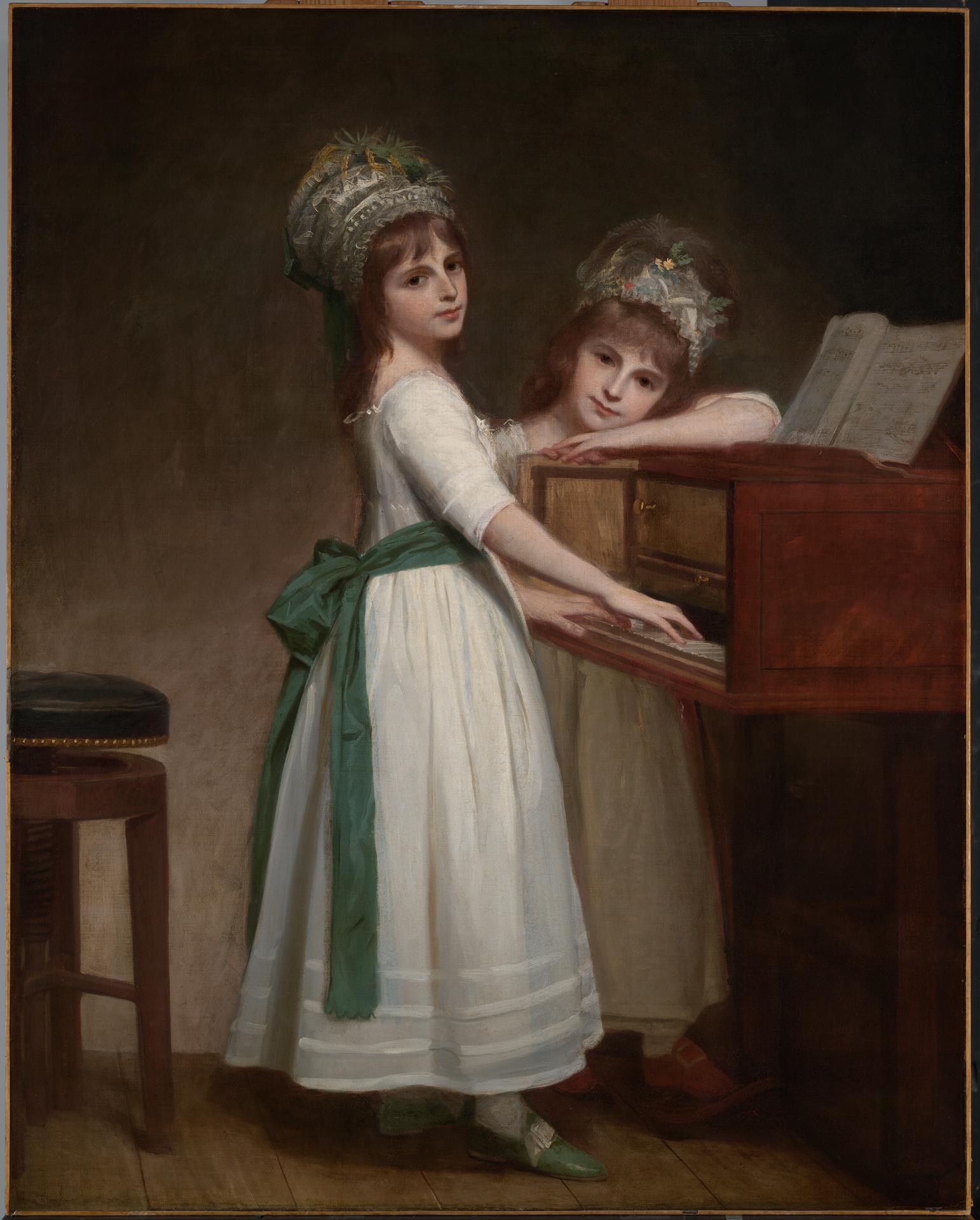
That accords with a picture George Romney painted of the two older girls around 1783, shown above courtesy of the Yale University Art Gallery.

However, it doesn’t accord with De la Torre’s story, set in 1784. Her mystery depends on the two oldest girls being adolescent at the time of the Great Seal theft with Dr. Johnson still alive. Such is the challenge of writing historical fiction with imperfect historical sources.

Had De la Torre but known the actual ages of Thurlow’s daughters, she may never have imagined her debut story “The Great Seal of England” as she did. Or she might have proceeded with the same plot and added a note informing readers about how she’d shifted from strict historical accuracy, as she did in this very story in regard to the last hanging at Tyburn. Such is the freedom of writing historical fiction.

TOMORROW: De la Torre’s books.

Monday, October 24, 2022

Lillian de la Torre and “the ‘detector’ possibilities”

Lillian de la Torre Bueno (1902–1993) grew up in Manhattan reading mystery stories. After teaching in the New York schools for a few years, she earned master’s degrees from two Ivy League universities. At the age of thirty she appears to have put aside her own academic aspirations to marry a fellow graduate student, George McCue.

The McCues moved west to Colorado College, where George became a professor of English. Lillian took on the no-longer-current role of faculty wife. With no children to look after, she helped to found a local choir and joined an amateur theater company. Over time she taught some courses and helped other professors with their research—for example, she worked with Prof. Lewis Knapp on the life of Tobias Smollett, identifying some forged letters.

Around the time she turned forty, Lillian McCue embarked on a writing career that combined her interests in mystery stories and British history. She later told the scholar Douglas G. Greene that one early inspiration was John Dickson Carr’s book The Murder of Sir Edmund Godfrey (1931), a nonfiction account using the structure of Carr’s whodunnits. Another impetus was a conversation with one of her husband’s colleagues, Prof. Frank Krutzke, about “the ‘detector’ possibilities of Dr. Sam: Johnson.”

Lillian McCue had evidently noticed the parallel between the classic detective and sidekick/narrator model, as established by Edgar Allan Poe and Arthur Conan Doyle, and The Life of Samuel Johnson, Ll.D. by James Boswell. Dr. Samuel Johnson was prodigiously smart, given to cutting remarks and paradoxical advice, and full of quirks, both physical and social. Boswell was an admirer, sometimes exasperated but always loyal, with an eye for detail and a strong prose style. (Boswell’s diaries also disclose enough of his own habits, such as womanizing, to make him more than a mere observer.)

McCue used portions of Boswell’s Journal of a Tour to the Hebrides to fashion a tale in Boswell’s voice about Johnson detecting and foiling an exotic Scottish murderer. In 1943 she made her first sale to Ellery Queen’s Mystery Magazine, using the nom de plume Lillian de la Torre. This was a more successful story about “Dr. Sam: Johnson, Detector,” titled “The Great Seal of England.” That story begins:
On the night of March 23, 1784, the Great Seal of England was stolen out of Lord Chancellor Thurlow’s house in Great Ormonde Street, and was never seen again.
And indeed that was an actual mystery of the eighteenth century.

TOMORROW: The fate of the great seal.