J. L. BELL is a Massachusetts writer who specializes in (among other things) the start of the American Revolution in and around Boston. He is particularly interested in the experiences of children in 1765-75. He has published scholarly papers and popular articles for both children and adults. He was consultant for an episode of History Detectives, and contributed to a display at Minute Man National Historic Park.

Subscribe thru Follow.it


•••••••••••••••••


Showing posts with label Taunton. Show all posts

Thursday, September 03, 2026

“Environmental Histories of New England” in Boston, 18 Sept.

On Friday, 18 September, the Massachusetts Historical Society will host the New England Quarterly Symposium on Environmental Histories of New England, 1600-2026.

Papers relevant to our period include:
  • “Preserving the Catch: Curing Practices, Environmental Agency, and the Eighteenth-Century New England Commercial Cod Fishery” by Morgan S. Hardy, University of Tennessee
  • “Beyond ‘Hot Girl Summer’: Rural Life and Gendered Experiences of Seasonal Variability in Eighteenth-Century Northern New England” by Emma C. Moesswilde, Elon University
  • “Many Are These Awfully Sudden Deaths: Mapping the Environmental History of Boston’s 1721 Epidemic” by Christopher Parsons, Northeastern University, and Molly Nebiolo, Butler University
  • “Environmental history with/for Indigenous communities: Examples from Acadia” by Catherine Schmitt, Schoodic Institute at Acadia National Park
  • “‘A Fishay Noyse’: Taunton’s Herring Crisis and New England Energy Futures” by Zachary Bennett, Norwich University
The keynote address at the end of the day will be “Tom Paine’s Sunshine Soldiers” by Joyce Chaplin, the James Duncan Phillips Professor of Early American History at Harvard University.

Registration, which includes food, costs $20. The event is free for graduate students, teachers, and adjunct faculty.

On the afternoon before the symposium, the Norman B. Leventhal Map & Education Center, a co-sponsor of the event, will host an open house in its facilities at the Boston Public Library central building.

For the full program and registration information, start at this page.

Monday, February 02, 2026

Flagging a Call for Presentations at the 2026 HistoryFest in Westfield

In the summer and fall of 1774, New England towns competed to put up Liberty Poles, the taller the better.

On 28 July, Ephraim Potter and Edward Lawrence brought such a flagpole into Deerfield, though they didn’t have time to set it up that day. Young Dr. Elihu Ashley estimated that it was “about fifty feet.”

Dr. Ashley got a good look at that pole because that evening he sawed through it with the help of some friends.

The next day, Ashley wrote in his diary, the talk of the town was “nothing but Liberty, and ye Poles being Sawd.” Soon “ye Liberty Pole was set up and also a Tory Pole as they in their infinite wisdom are pleased to call it.” I wonder if together those poles measured fifty feet.

On 30 July, an anonymous public letter was posted in town. It declared Potter, Lawrence, and their comrades to be “a pack of ignorant villains.” Also, whoever wielded the saw was “some Malicious Person, Inimical to his Country”—though that was meant ironically, since it’s now thought the anonymous letter came from Dr. Ashley. It went on:
Where are things going, that so sensible people as you know the Town of Deerfield are, should suffer these Rascals to carry matters on so. I cannot help feeling, and very sensibly, when I think what the Consequences of these things will be & have no reason to think but that they will issue in blood…
Today Deerfield’s Liberty Pole is commemorated in a stone marker and in a flagpole in Historic Deerfield, as I photographed it above last year. (It was flying a version of the Taunton flag.)

That’s just one Revolutionary story from the Connecticut River valley, also called the Pioneer Valley.

On 11 April, the Pioneer Valley History Network and the Westfield State University History & Philosophy Department will host their 2026 HistoryFest in Westfield. Like History Camp Boston, this is a chance for local chroniclers and researchers to share their work with other people curious about history.

The organizers say:
Our Homespun History Conference thrives on the stories, ideas, and passions of people who care deeply about the history of the Pioneer Valley, Massachusetts, and the many ways history connects to museums, historical societies, and community life today. Whether your focus is local history, material culture, public history practice, education, preservation, or an untold story waiting to be shared, we invite you to submit a proposal to present.
That process starts with their invitation to propose a session through this form.

The organizers say they aren’t necessarily looking for formal “experts” but for:
  • Fascinating stories and fresh perspectives
  • Practical or thought-provoking workshop topics
  • Case studies, community projects, or works-in-progress
For people with questions, they have scheduled some brief Zoom information sessions at different times of the day on 3, 13, and 19 February. For more details, click on the proposal link above.

Thursday, May 22, 2025

“Went in pursuit of these royal pirates”

After setting the stage for the fighting over Hog Island, Noddle’s Island, and Chelsea 250 years ago this month, I should catch up on a couple of other shoreline skirmishes in May 1775.

One fight took place in the waters between Fairhaven and Martha’s Vineyard on 14 May. I wrote about that event starting here, and Derek W. Beck went into more detail in this article.

Today I’ll comment on a couple of sources.

First, Peter Force’s 1833 American Archives included an “Extract of a Letter from Newport, Rhode-Island, dated May 10, 1775” about the action.

That letter described that event as starting “Last Friday,” which is probably why Richard Frothingham writing in the mid-1800s misdated the fight by a week. Naval Documents of the American Revolution reprinted the letter from American Archives with the same date.

However, that passage first appeared in the 26 May Pennsylvania Mercury, and there it’s actually labeled as “Extract of a letter from New-Port, Rhode-Island, May 15,” meaning “Last Friday” was 12 May. That matches up with the other sources. The ship-seizing began on 12 May, and the fighting occurred on 14 May.

Second, here’s the report on the fight from Isaiah Thomas’s Massachusetts Spy, published 24 May in Worcester:
The week before last the Falcon sloop of war, was cruising about Cape-Cod, and meeting with a wood sloop, in ballast, seized her, but promising the skipper to release him and his vessel if he would give information of any vessel that was just arrived from the West-Indies with a cargo on board, he at length told the Captain of the Falcon [John Linzee] that there was a sloop at Dartmouth, which had just arrived;
Significantly, the owner of that wood sloop, Simeon Wing, later told Massachusetts authorities that ”an indian Fellow on board” had offered information about the other sloop, not “the skipper”—who was Wing’s son Thomas. Scapegoating a man of color?
whereupon the Captain of the Falcon, instead of releasing the wood sloop, armed and manned her, and sent her in search of the West-Indiaman;
Other sources show that the prize crew put onto the wood sloop consisted of Midshipman Richard Lucas (called in some New England sources as mate or lieutenant), surgeon’s mate John Dunkinson, gunner Richard Budd, eight seamen, and three marines.
they found the vessel lying at anchor, but her cargo was landed; however, they seized her and carried her off after putting part of their crew and some guns and ammunition on board.

Notice of this getting on shore, the people fitted out a third sloop, with about 30 men and two swivel guns, and went in pursuit of these royal pirates, whom they come up with at Martha’s Vineyard, where they lay at anchor at about a league’s distance from each other; the first surrendered without firing a gun, our people after putting a number of hands on board, bore down upon the other, which by this time had got under sail, but the people in the Dartmouth sloop coming up with her, the pirates fired upon them; the fire was immediately returned, by which three of the pirates were wounded, among whom was the commanding officer;
Massachusetts Provincial Congress documents preserved the names of the two wounded seamen as Jonathan Lee and Robert Caddy.
our people boarded her immediately, and having retaken both sloops, carried them into Dartmouth, and sent the prisoners to Cambridge, from thence nine of them were yesterday brought to this town.
Other newspapers say those prisoners of war were sent to the jail in Taunton, but that might have been only overnight. Authorities kept the three wounded men in Dartmouth along with the surgeon’s mate “to dress their wounds.”

Capt. Linzee never recorded losing the wood sloop and his prize crew in the log of the Falcon. But according to a report out of New York, he later told a passing ship’s captain that he understood Midn. Lucas had “lost an arm.” Locals involved in the fracas, quoted here, recalled that Lucas was wounded in the head with buckshot and recovered.

The 15 May letter from Newport printed in Pennsylvania Mercury (cited above) said one of the wounded men was “since dead.” That appears to have been another false rumor since follow-up newspaper stories and government sources don’t mention any dead at all.

After the actual fighting there were protracted disputes on the provincial side. What to do with the prisoners? What to do with the ships? I discussed those debates back here.

Saturday, September 07, 2024

Gunshots in the Countryside

On 7 Sept 1774, 250 years ago today, Henry Vassall was riding in Lincoln when he heard a gunshot.

The only Henry Vassall I was able to find on the family tree at this time was a nineteen-year-old son of William Vassall, discussed yesterday.

Henry was either visiting or staying with his cousin Elizabeth, wife of Dr. Charles Russell (1739–1780, shown here). I wonder if he was studying medicine.

Later that month Henry Vassall told the Charlestown committee of correspondence about his experience. He then wrote out an account for two Middlesex County magistrates, Henry Gardner of Stow and Dr. John Cuming of Concord:
Passing between the House of Mrs. Rebecca Barons [?] & Doct. Russell’s between the Hours of 7 & 9 in the Evening of the 7 instant [i.e., this month] & to the best of my Knowledge as I rose [?] a little Hill a little a past the first Canopy [?] I heard the report of a Gun saw the light and a Ball Enter’d the Carriage which I was in being Doct. Russells.

I immediately step’d out of the Carriage & stood about five or six Minutes & then stepp’d into the Carriage Again & road in haste to the Doctor when I had gone a small Distance from the Place where the Gun was discharged I met a person on Horse back

when I had past a small Distance further I met several Persons riding on two Horses,

whether the Ball was aim’d at the Carriage I can’t say I further declare I do not know or even suspect who the Person was that Discharg’d the Gun as above mentioned . . .

NB. The above affair I declar’d to no person in Lincoln but the Revd. Mr. [William] Lawrence & desired him to keep it secret—Till the Friday Following.
Gardner and Cuming also gathered statements from a local man named Joseph Peirce and Luck, enslaved to Dr. Russell. Both declared that they had been traveling near young Vassall and had heard no gunshot.

Three members of the Lincoln committee of correspondence then wrote back to Charlestown agreeing that they detested “the Crime of Assassination” but casting doubt on Vassall’s complaint:
We shall only add that as the evening on which this event was said to have happened was very calm it is the general opinion here that it is very improbable if not utterly impossible that a gun should be Discharged at that time & place without being heard by many persons, you have Doubtless seen the impression in the Carriage & are able to judge & Declare whether it is the efect of a Bullet Discharged from a Gun or Not as well as any person in this town
This incident provided yet another reason for members of the Vassall family to seek safety surrounded by the king’s soldiers. (And on the same day that the magistrates wrapped up their investigation, people in Bristol, Rhode Island, threw stones at the chaise of Henry’s father and stepmother, William and Margaret Vassall. Newspapers reported that “next morning [they] set out for Boston.”)

This shot in Lincoln is only the second example I’ve found of someone in Massachusetts firing a gun at a supporter of the royal government. The first had occurred a couple of weeks earlier in Taunton.

According to Daniel Leonard, a veteran of the last war named Job Williams came to his house with a warning that “the People were to assemble” to protest how he had joined the mandamus Council. Leonard left, thinking that would head off the problem. Instead, on 22 August , or perhaps make it clear he wouldn’t be welcomed back. That crowd did arrive. Leonard wrote:
about five hundred persons assembled, many of them Freeholders and some of them Officers in the Militia, and formed themselves into a Battalion before my house; they had then no Fire-arms, but generally had clubs. . . .

My Family supposing all would remain quiet, went to bed at their usual hour; at 11 o’Clock in the evening a Party fixed upon the house with small arms and run off; how many they consisted of is uncertain, I suppose not many; four bullets and some Swan-shot entered the house at the windows, part in a lower room and part in the chamber above, where one Capt. Job Williams lodged. The balls that were fired into the lower room were in a direction to his bed, but were obstructed by the Chamber floor. . . . I conclude it possible that the attack upon the house was principally designed for him.
Back in 1769–1770, there had been three increasingly notorious incidents of government supporters shooting at crowds of protestors: the “Neck Riot,” Ebenezer Richardson killing Christopher Seider, and of course the Boston Massacre. But even in that period Massachusetts protestors had never shot at royal officials or their supporters.

These untraceable gunshots in the late summer of 1774 show that some people in Massachusetts were starting to think it was acceptable to use that level of violence against Loyalists.

Thursday, June 27, 2024

“Undertook to carry off Mr. Leonard”

As I’ve been discussing, in the middle of June 1774 Samuel Adams and his Whig colleagues had come up with a plan to have their colony represented at what would be the First Continental Congress.

But to give the Massachusetts General Court time to approve that plan before Gov. Thomas Gage learned about it and shut down the legislature, they needed to get around committee member Daniel Leonard. He had recently moved to the Loyalist side of the political divide.

Besides Leonard, the other representative from Taunton was Robert Treat Paine, one of Adams’s allies. Both Leonard and Paine were lawyers, and on Tuesday, 14 June, the Bristol County court of common pleas was due to sit in their town. The courthouse was quite close to Leonard’s house, in fact.

As Paine described his actions decades later, he told Leonard that

it had been usual for Years past, to adjourn the Common Pleas Court at Taunton which was to set the then next Tuesday in Order that the Members of the General Court from that County might attend the General Court; but that the Neglect of it always gave uneasiness to many persons; especially the Tavern keepers, who from the great Concourse of people Collected there (the days being long & the Season pleasant) reaped great profits &c., &c., & that we might agree to Shorten the Court by Demurrers & Continuances & get back to [the Massachusetts General] Court in Season to attend to all important business
It was important for politicians to keep local tavern-keepers happy, after all. They were influential men at election times.

But Paine revealed his real motivation when he wrote: “the writer hereof Undertook to carry off Mr. Leonard.”

This maneuver is sometimes described as Paine inducing Leonard to leave Salem just before the crucial legislative vote. But in fact the two men left the previous Saturday, attended the county court for a few days, and even agreed to sit on a county committee to write an address to Gov. Gage.

At the end of the week, Paine and Leonard headed back to the legislature in Salem—“in Season to attend to all important business,” Paine had promised. But Adams’s resolutions were already moving.

TOMORROW: Behind closed doors.

Monday, June 24, 2024

“It was known to all but Mr. Leonard”

Robert Treat Paine and Daniel Leonard were Taunton’s two representatives to the Massachusetts General Court in the spring of 1774.

Both Paine and Leonard were Harvard graduates and well regarded lawyers. Both men had, as I mentioned yesterday, courted Sarah White, with Leonard being successful and marrying her.

(Paine finally married Sally Cobb of Taunton in 1770, when he turned thirty-nine and she twenty-six. Losing no time, they had their first child two months later.)

On 9 June 1774, both Paine and Leonard were named to the assembly’s committee of nine members to consider how Massachusetts should respond to the Boston Port Bill.

Looking back after two decades, Paine described that period this way:
Mr. Leonard was a Gentleman of natural good Sence & Eloquence, polite & of engaging Adress & had been Chosen Several Years as member for the Town of Taunton, on the Idea of his being a firm & able freind to the Opposition in wch. his Town was so determined; but on the prevailing Address & Sollicitation of Govr. [Thomas] Hutchinson he had changed his principles, & considered himself now at Market to make the best of them;

all this was well known to the members of the Court & the rest of the Committee more especially to his Colleague the writer hereof; it was therefore considered unsafe for that committee to enter into the consideration of the State of the Province on principles of Opposition while he was present, & as it appeared by the Port bill that the only releif from the Continual Exn. of it was the payment for the Tea that was destroy’d, the Committee turn’d their whole Attention to that;

& as it was known to all but Mr. Leonard, that Another Committee of vastly more importance, form’d from Members of the house of Representatives by their own inclinations was beginning to operate in secret the committee of nine talkd very favourably of paying for the Tea, as a thing not to be compar’d with the Sufferings from the Port Bill:

it would be hard to discribe the Smooth & placid Observations made by Mr. S[amuel]. Adams, Saying that it was an irritating affair, & must be handled Cautiously; that the people must have time to think & form their minds, & that hurrying the matter would certainly create such an Opposition as would defeat the matter;

& many Observations of this kind, all tending to induce Mr. Leonard the Oblique Member of that Committee to think that matters would work terminate in Obedience to the Port Bill were made by Several other Members of the Committee, & then it was Observ’d that it was very hot, & that they had been engag’d in Court all day, & that it was unprofitable to set any longer at that time for the people must have time to bring their minds to a Compromise;

Proceedings of this kind took place on the PM & Evning of three days; as soon as the Committee on the State of the Province was adjournd, all the Members except Mr. Leonard immediately repaird to a retired room where the Self Created Committee before mention’d mett, & being cornpos’d of Such members only as had Signalized themselves in their Opposition to the British Aggressions of Tyrannick Govt., they Shut their Doors & entered freely & fully on all the Subjects of Grievances;…
Meanwhile, back in Boston some leading merchants were also arguing that the town should pay for the East India Company tea.

TOMORROW: Dr. Warren’s diagnosis.

Sunday, June 23, 2024

Daniel Leonard on the Move

Daniel Leonard (1740–1829) was born into a wealthy family in Norton. He went to Harvard College, where he ranked third in the class of 1760 in social prestige, captained a militia company, and was elected valedictorian.

After graduating, Leonard earned his master’s degree and then went into the law. He was a leader among other bright young attorneys like Josiah Quincy, Jr., Francis Dana, and John Trumbull.

In 1767 Leonard married Sarah White, daughter of his legal mentor. Her other suitors had included Robert Treat Paine. Sarah Leonard died young, however, and in 1770 Leonard remarried to Sarah Hamock, daughter of a wealthy Boston merchant, in Trinity Church.

Inheriting his first father-in-law’s legal practice and his second father-in-law’s money, Leonard settled in Taunton. He quickly gained a royal appointment as the King’s Attorney for Bristol County and a seat in the Massachusetts General Court.

In that legislature Leonard worked with the province’s most fervent Whigs. He was on the committee of correspondence and a committee that called for the removal of Gov. Thomas Hutchinson and Chief Justice Peter Oliver.

Around the time of the Boston Tea Party, however, Leonard moved toward the side of the royal government. He said he’d come to distrust the motives of men like Samuel Adams. In February 1774 Leonard voted against impeaching Oliver.

People said Gov. Hutchinson had lured Leonard over to the Crown. Taunton locals reportedly watched him standing under a pear tree, speaking at length with the governor as he sat in his carriage. (I don’t know of any time the governor actually visited that town.) In 1815 John Adams put his own spin on the younger man’s progress:
As a Member of the House of Representatives, even down to the year 1770 he made the most ardent Speeches which were delivered in that House against Great Britain and in favour of the Colonies. His Popularity became allarming. The two Sagacious Spirits Hutchinson and [Jonathan] Sewall Soon penetrated his Character of which indeed he had exhibited very visible proofs.

He had married a daughter of Mr Hammock, who had left her a Portion, as it was thought in that day. He wore a broad Gold Lace round the rim of his Hatt. He had made his Cloak glitter with laces Still broader. He had sett up his Charriot and Pair and constantly travelled in it from Taunton to Boston. This made the World Stare. It was a Novelty. Not another Lawyer in the Province, Attorney or Barrister, of whatever Age Reputation Rank or Station presumed to ride in a Coach or a Charriot.

The discerning ones Soon perceived that Wealth and Power must have charms to a heart that delighted in So much finery and indulged in such unusual Expence. Such Marks could not escape the vigilant Eyes of the two Arch Tempters Hutchinson and Sewall, who had more Art, Insinuation and Adress than all the rest of their Party.

Poor Daniel was beset, with great Zeal for his Conversion. Hutchinson sent for him, courted him with the Ardor of a Lover, reasoned with him flattered him, overawed him frightened him, invited him to come frequently to his House.

As I was Intimate with Mr Leonard during the whole of this process I had the Substance of this Information from his own Mouth, was a Witness to the progress of the Impression made upon him, and to many of the Labours and Struggles of his Mind between his Interest or his Vanity and his Duty.
Whatever had motivated Daniel Leonard’s political shift, in June 1774 he still had enough of a history of standing up to the royal governors that several colleagues recommended him for the assembly’s committee to respond to the Boston Port Act. But Whig leaders didn’t trust him. He would, they suspected, tell Gov. Thomas Gage everything that committee was talking about.

So Adams and friends came up with a plan.

TOMORROW: An old rival returns.

Thursday, December 30, 2021

Ezekiel Price on “A Great & Glorious Event”

Yesterday’s posting raised the question of when exactly Boston heard about the American and French victory at Yorktown. The most immediate reaction would appear in people’s diaries, so I looked for my usual informants on daily events.

John Adams? In 1781 he was far away in Europe.

Merchant John Rowe? His surviving diaries end in 1779.

Printer John Boyle? He stopped compiling his “Journal of Occurrences” in 1778.

Shopkeeper and selectman Harbottle Dorr? He stopped collecting newspapers assiduously at the end of 1776, adding just a few issues from the next two years.

Robert Treat Paine was keeping his diary out in Taunton in 1781. Fortunately, the folks at the Massachusetts Historical Society have done the hard work of deciphering his handwriting and publishing pertinent entries in the Paine Papers. On 26 October, he wrote: “News came that Cornwallis had Surrendred to Genl. Washington, on 17th. Instant.”

I wanted more detail than that, and I wanted a voice from Boston. Fortunately, Harvard has preserved and digitized the 1781 almanac diary of Boston court official and insurance broker Ezekiel Price (1727–1802), who was a gossip sponge.

Price’s entry for 26 Oct 1781 appears on sequence 37–38 of the digitized version of this diary:
This Morning Mr. Thomas Hulbert [?] came to Town from Providence who brings a Hand Bill printed at Newport Yesterday in which is an Account that the afternoon before one Capt Lovett arrived there from York River who brot an account that Lord Cornwallis & his Army Surrendered Prisoners of War to Genl. Washington on the 18th. instant—

that Cornwallis had wth. him in Garrison 9000 Men with an immense quantity of Stores also that a 44[-gun warship] & one frigate & 100 Transports were Captured—

Mr. Winship who left Newport Yesterday tells me that he saw Capt. Lovett & his Mate who informed him that they say the British Flag lowered & the Continental & French Flags hoisted on the Forts at York Town—that he heard the Huzzas upon the Occasion—

they they saw the French Admiral go on shoar at the Fort that the American Vessells which lay below York Town went up to Town & that he went up so near the Forts that he could throw a Bisket on Shoar—

From all these Accts. it is beyond a doubt that Lord Cornwallis & his great Army with Vast quantities of Artillery & Military Stores are in Possession of our illustrious Genl. Washington & the Allied Army—A Great & Glorious Event—

On this Joyful occasion all the Bells in Town were rang most part of the day & the Sons of Freedom showed evident marks of their felicity. In the Evening the Coffee house was illuminated & Fireworks displayed.

Mr. [John?] Marston tells me that a French Gentleman acquainted him he had received a Letter from a Person who was in York Town at the time of the Surrender & adds that Genl. Washington had ordered 1200 Horse to the Reinforcement of Genl. [Nathanael] Greene.
Price recorded additional information on 27 and 31 October. He came to date Cornwallis’s surrender to the 17th, like Paine. That was when the British general first raised the white flag. It wasn’t until the 19th that the commanders signed surrender terms and the Crown troops gave up their arms, but we now treat that date as the significant one.

Sunday, December 29, 2019

When Balch Came Back

In early October 1775, Nathaniel Balch the hatter left London and sailed back home to America.

On 23 December, the Providence Gazette reported on news from the preceding days:
Captain Gorham is arrived at Nantucket from London, after a Passage of eleven Weeks. With him came passenger Mr. NATHANIEL BALCH, late of Boston.  
Balch was soon on the mainland. On 20 December, the Boston court official and insurance broker Ezekiel Price, taking refuge from the siege in Stoughton, wrote in his diary:
Mr. Bailies, from Taunton, says that Mr. Nathaniel Balch was there last night. He is lately from London, and reports that the great men in England are against us, but that the common people are in our favor.
However, four days later Price wrote that young Benjamin Hichborn had told him:
Mr. Balch says our Boston gentry that lately went to England were, most of them, very desirous of getting back; that the people there in general were against us, and continually threatening to scourge us till they had obliged us to submit.
I don’t trust Hitchborn about anything. But the discrepancy between Price’s entries may simply be due to him using the word “people” to refer to two different groups: ordinary people as opposed to “great men” in his first entry, British gentry as opposed to Loyalist gentry in the second.

Finally, there’s a mention from Isaac Smith, Sr., father of one of the men Balch had sailed and seen some sights in London with. Smith wrote to his niece’s husband, John Adams, on 2 Jan 1776:
Itts likely you may have heard Mr. Balch is returnd from England but came Out the begining Octbr. so cant bring any thing New of a publick Nature tho possibly he may of his One invention.
Balch’s own invention might have meant private information he’d picked up, though, knowing him, it might just as well have been some new funny stories. I haven’t come across any other references to Massachusetts men debriefing the hatter about his trip.

Which means I still have the mystery of why Balch went to Britain at all.

TOMORROW: Post-war legends.

Tuesday, October 16, 2018

Upcoming Events of Interest in Salem and Taunton

Sometimes it’s good to get away from the crowded Boston Common of 1768, so here are a couple of interesting historical events taking place elsewhere in Massachusetts.

On Wednesday, 17 October, and then again on Wednesday, 24 October, the Salem Maritime National Historic Site will offer a special talk titled “Smuggling Stories from Captain Derby’s Wharf.” Richard Derby, Sr. (shown here), was a prominent Salem merchant captain whose sons Richard, Jr.; Elias Hasket; and John all played important roles in Massachusetts’s Revolution.

Drawing on recent research, park rangers will share real tales from the Salem waterfront, including:
  • The Crown’s seizure and auction of Fayal wine from the Derby warehouse in 1771.
  • The accidental sinking of the Crown’s Customs boat in the Salem harbor.
  • John Derby’s smuggling adventure on the Quero.
This free hourlong program is scheduled to start at 7:00 P.M. on Derby Wharf, 173 Derby Street in Salem. The park urges people to bring lawn chairs and blankets because the talk will be delivered outdoors near the water. (If the weather is particularly poor, though, I understand there’s an indoor site at the ready.)

On the weekend between those talks in Salem, Taunton is celebrating its “Liberty and Union” Festival, inspired by the British flag with that motto sewn onto it that local Patriots raised in 1774.

On Thursday, 18 October, public historian and landscape architect Tom Paine will speak at the Old Colony History Museum about “That Spark of Liberty: Robert Treat Paine and America’s D.N.A.” Tom is a sixth-generation descendant of Robert Treat Paine, the Taunton lawyer who became one of Massachusetts’s signers of the Declaration of Independence.

Tom will delve into the Paine family stories that inspired descendants of the Civil War Generation. He will discuss Paine’s years as the first Attorney General of Massachusetts, including his roles in crafting the world’s oldest modern constitution and the legal abolition of slavery in the state.

This talk is free and open to the public. Refreshments will be served at 6:30 P.M. with the talk to begin at 7:00. The museum is at 66 Church Green in Taunton.

The town’s “Liberty and Union” celebration has already reportedly gotten under way with middle-schoolers sticking flags into people’s lawns. But the big day is Saturday, 20 October. There will be a walking tour of historic downtown Taunton starting at 11:00 A.M. at the Old Colony History Museum. At 11:30 a procession from the statue of Robert Treat Paine to the museum will end with the raising off a “Liberty and Union” flag. Meanwhile, there will be music and dance, games and pumpkin-decorating for kids, crafts demonstrations and historical reenactors. The complete list of activities is here.

Monday, July 16, 2018

The Confiscation of John McWhorter’s Gun

On 16 July 1775, the Taunton Patriot leader David Cobb (shown here, courtesy of the Massachusetts Historical Society) wrote to his brother-in-law, Robert Treat Paine, about the Battle of Bunker Hill, smaller skirmishes, and a local conflict:
John McWhorter from a trifling incident that happen’d in the Weymouth Alarm, in which I was oblig’d to take his Gun by force, has wag’d an eternal war with the Neighbourhood and now lives in a surly, morose, malicious, damn’d Scotch looking manner without conversing with his Family or Friends.
John McWhorter was a big man in Taunton. He owned a tavern where John Rowe visited (calling him “McQuarters”), the local Sons of Liberty reportedly met, and attorney and near neighbor Daniel Leonard supped after his wife died. It contained upscale tea tables and was still referred to as “McWhorter’s Inn” years after his death—probably because his wife kept it running most of the time. McWhorter also owned at least one slave, and he had interests in shipping.

Most important for the war effort, McWhorter was part-owner of an ironworks in Stoughton. (David Cobb’s father had also been in the iron business.) Responding to a resolution of the Massachusetts Provincial Congress in February 1775, Stoughton’s committee of inspection
stopped upwards of a Ton of Iron, the Property of John McWhorter of Taunton, by seizing and storing the same in the Town of Stoughton, which Iron they had every probable Reason to suspect was designed for the Use of the British Army.
Whether or not that suspicion was accurate, as war approached people clearly regarded McWhorter as a potential Loyalist. And he no doubt perceived Patriot officials as infringing on his property.

That was the situation when there was an alarm about the Royal Navy threatening Weymouth in the summer of 1775. With many of the region’s fighting men off at the siege of Boston, the task of defending the coast fell to militia companies, including the men of Taunton. A “trifling incident” during that tense time prompted Cobb to confiscate McWhorter’s musket.

In December 1776 Taunton’s militia commander noted that McWhorter was one of twenty men on the town’s “alarm list” who hadn’t turned out to protect Rhode Island from the return of the British military. Of course, McWhorter couldn’t have turned out for militia service if Cobb still had his gun.

McWhorter’s feuds continued. On 5 May 1777 the town’s committee of correspondence considered “the verbal complaint of Mr. [John?] Porter [a committee member] respecting the abuse he received from Mr. McWhorter[;] after hearing both parties, the Chairman was desired to give Mr. McWhorter a reprimand which was accordingly done.”

Back in 1776 the Stoughton committee had sold the confiscated iron, offering McWhorter “24s. per Hundred for said Iron, and Interest from the Time it was seized and stored.” But he refused and sued the committee members for “£486, Lawful Money.”

Just before the case was to be tried in June 1779, the committee brought the Massachusetts General Court into the dispute. In September the legislature ordered the Stoughton committee to pay £30.7s.4p. for the iron—basically the initial offer, nowhere close to what McWhorter had demanded.

John McWhorter stayed in Taunton through the war and died in 1800. By then he had probably reconciled himself to his neighbors and they to him, but people might still have been surly and morose.

Thursday, February 22, 2018

The “Swan Shot” that Killed Christopher Seider

On 22 February 1770, Customs service employee Ebenezer Richardson killed a young boy named Christopher Seider.

Christopher was part of a crowd of boys mobbing Richardson’s house. Indeed, he had just stooped to pick up a stone when he was hit by the discharge from Richardson’s gun.

Richardson had not shot a musket ball. Instead, he had loaded his musket with “Swan shot.” What that meant is clear from the Whig newspapers’ report on the boy’s injuries:

soon after the child’s decease his body was opened by Dr. [Joseph] Warren and others and in it were found eleven shot or plugs, about the bigness of large peas; one of which pierced his breast about an inch and one-half above the midriff and passing clear through the lobe of the lungs, lodged in his back.

This, three of the surgeons deposed before the Jury of Inquest, was the cause of his death; on which they brought in their verdict, wilful murder by Richardson. The right hand of the boy was cruelly torn, whence it seems to have been across his breast and to have deadened the force of the shot, which might otherwise have pierced the stomach.
“Swan shot” was a common term at the time. For example, in the 6 Nov 1729 Pennsylvania Gazette Benjamin Franklin reported:
We are inform’d that the following Accident lately happen’d at Merion, viz. A Man had order’d his Servant to take some Fowls in from Roost every Night for fear of the Fox: But one Evening hearing them cry, he look’d out and saw, as he thought, a Fox among them; accordingly he took his Gun, charg’d with Swan Shot, and fir’d at him; when to his Surprize it prov’d to be the Servant’s Arm, which taking down the Fowls he had mistaken for a Fox. The Man receiv’d several Shot, some thro’ his Arm, but none of them are thought to be dangerous.
In 1751, reporting on how he had knocked himself out with an electric shock, Franklin wrote, “I afterwards found it had rais’d a Swelling there the bigness of half a Swan Shot or pistol Bullet.” Likewise, in Robinson Crusoe, Daniel Defoe had his hero speak of “swan-shot, or small pistol bullets.”

On 22 Aug 1774, a crowd surrounded the house of Daniel Leonard of Taunton, protesting his appointment to the Council under Parliament’s new Massachusetts Government Act. According to Leonard, most people went home but “at 11 o’Clock in the evening a Party fixed upon the house with small arms and run off;...four bullets and some Swan-shot entered the house at the windows.” This is the earliest incident I’ve found of Massachusetts Patriots firing guns in their long political dispute with the royal government and its supporters.

Back in 1770, Richardson’s gun might have contained even smaller pellets than swan shot. During his trial, prosecuting attorney Robert Treat Paine took notes on testimony about George Wilmot, who had helped Richardson defend his house (and was acquitted of murder). If we can read Paine’s handwriting accurately, a witness said: “I took from W[ilmot]. a Gun loaded with 179 Shots. 17. Swan Shot. The rest Goose and Duck.” “Goose shot” and “duck shot” were evidently smaller pellets. Nowadays we’d lump them all together as “birdshot” and assign them numbers.

Thursday, August 24, 2017

Thomas Coram and a Symposium in Greenwich

On 30 October there will be a symposium in London on “Art, Charity & the Navy: The Greenwich & Foundling Hospitals.” This event is hosted and co-sponsored by the Foundling Hospital and Royal Museums Greenwich with its Queen’s House and Old Royal Naval College.

This event will “explore similarities in the origins, artistic involvement and philanthropic purpose of the Foundling Hospital and the Greenwich Royal Hospital for Seamen.” And there’s a Massachusetts connection.

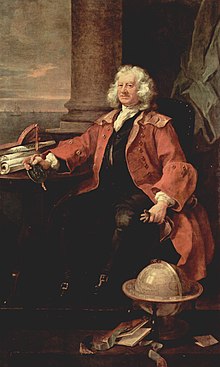
The Foundling Hospital was established in 1739 by Thomas Coram (c. 1668-1751, shown here). Born in Dorset, he went to sea at age eleven. By 1694 he was set up as a shipwright in the part of Taunton soon to be called Dighton. He also apparently had a house, and maybe a shipyard, in Boston, and he certainly worshipped there.

Coram was an Anglican. Most of his Taunton neighbors, like most other New Englanders, were proudly independent of the empire’s established church. In 1703 Coram put 59 acres in trust with the vestry of King’s Chapel in Boston under this condition:
if ever hereafter the inhabitants of the town of Taunton should be more civilized than they now are, and if they should incline to have a Church of England built amongst them, or in their town, then upon application of the inhabitants of said town, that is to say, forty ratable men of them, upon their application, or petition to the said vestry, or their successors, for any suitable part of said land, to build a Church of England, or a school house for the use and service of said church.
Taunton didn’t have an Anglican congregation until 1728. And those worshippers didn’t get the benefit of Coram’s grant; the King’s Chapel vestry sold the land for their own church’s benefit in 1754.

In 1704 Coram returned to England, settling in London. He lobbied Parliament to support the import of tar from North America, which suggests what his own business was. During the early imperial wars, Coram commanded a merchant ship. Afterwards, he promoted settlement in Maine, Georgia, and Nova Scotia. Thomas Coram and his wife Eunice had no children, which freed his fortune for charitable endeavors. Indeed, their surname lives on as a charitable foundation.

As for the Royal Hospital for Seamen at Greenwich, it was set up in 1692 as a marine counterpart to the Chelsea Hospital for old soldiers, receiving a royal charter two years later. The Royal Hospital School was added in 1712. The buildings are a handsome highlight of the Thames waterside.

The speakers at this symposium will include museum officials and curators. The day also includes:
  • A tour of the Chapel at the Old Royal Naval College, formerly the place of worship for the inhabitants of the Royal Hospital for Seamen
  • The opportunity to see the Foundling Museum’s Court Room and Picture Gallery, displaying works of art by Hogarth, Gainsborough, Highmore, Ramsay and many others
  • A visit to the Foundling Museum exhibition “Basic Instincts”
  • Lunch, tea and coffee, and early evening drinks reception
The morning session will take place at the Royal Museums Greenwich, the afternoon at the Foundling Museum, and participants are responsible for not getting lost in between. Full-price tickets are £50.

Wednesday, April 09, 2014

Dating the Forster Flag

Today Doyle New York auctions the Forster Flag, an unusual banner said to date from the Revolutionary War (shown here before its recent conservation).

As I discussed yesterday, the family that owned the flag in the nineteenth and most of the twentieth century passed down lore that it had been captured from British troops on 19 Apr 1775, but that doesn’t seem plausible.

A rival, contradictory claim is Lt. Samuel Forster and his Manchester militia company marched under this flag on that day. That means it would have had to be remade with its thirteen stripes  in 1774 or early 1775.

In 2002 The Flag Bulletin ran an analysis (P.D.F. download) accepting that story and concluding that this was “the first American flag ever made.” (Of course, the author of that article was Dr. Whitney Smith, who had bought the flag from Forster’s descendants for the Flag Heritage Foundation. The foundation is now selling the flag to create an endowment to benefit the Whitney Smith Flag Research Center Collection at the University of Texas.)

I find the idea of this being a pre-war flag to be as dubious as the story about it being captured.

In April 1775, Massachusetts militiamen still presented themselves as British subjects fighting for British rights and the British constitution against a corrupt ministry in London. American Patriots didn’t break with George III and Britain until the first half of 1776.

Before the war American Whigs flew the British flag as part of their protests to make the claim that they were being more patriotic than their opponents. Boston’s Sons of Liberty raised a “Union flag,” probably one with a red field and the British Ensign as its canton, at Liberty Tree. When Whigs in Taunton hoisted a flag on their Liberty Pole in 1774, it had a British canton and the motto “Liberty and Union” sewn to its red field. There are many prewar reports of American protesters marching under British Union flags but none describing flags with thirteen stripes.

That’s because American Patriots weren’t making a fetish of the number thirteen in April 1775. That spring, only twelve colonies were participating in the Continental Congress. (Georgia hadn’t sent any delegates.) Furthermore, that Congress was hoping that Canada and perhaps Nova Scotia and the Floridas would add to their continental alliance. Only at the end of 1775 did the Congress authorize a naval flag with thirteen stripes—and those stripes still appeared under the British Union canton.

So do I think the Forster Flag’s Revolutionary history is a myth? Not at all. I think its current form clearly dates from the Revolutionary War. But it was created after the first year of that war, perhaps after independence. It’s an artifact of Americans rethinking how they presented themselves, moving from British or English subjects, as symbolized by the original canton, into citizens of a new thirteen-member alliance.

Just how to symbolize that continental alliance was still being worked out in the first years of the war. This banner’s scheme of six strips on one side and seven on the other clearly didn’t work. Eventually the Congress decided on a new national emblem. Maybe this cloth is so well preserved because Forster’s company didn’t fly it for long in either its British or American forms.

As the war receded into memory, Americans stopped telling stories about the gradual 1775-76 transition away from thinking of themselves as British. The story of a British flag owned and flown by Americans being changed into an early American banner became a heroic story of capturing a British regimental banner, or a premature tale of marching as Americans on April 19th. But this flag’s stitching, read properly in context, tells its own story of a significant national transition during the war.

Sunday, February 03, 2013

More Upcoming History Seminars

Last week I noted an upcoming session in the Boston Early American History Seminar. The Massachusetts Historical Society sponsors other seminar series that sometimes touch on the period and issues of the American Revolution.

On Thursday, 7 February, at 5:30 P.M. in the series on the History of Women and Gender Jennifer Morgan of New York University will present “Partus Sequitur Ventrem: Slave Law and the History of Women in Slavery.” Linda Heywood of Boston University will comment on the paper, and then the discussion will be open to all attendees.

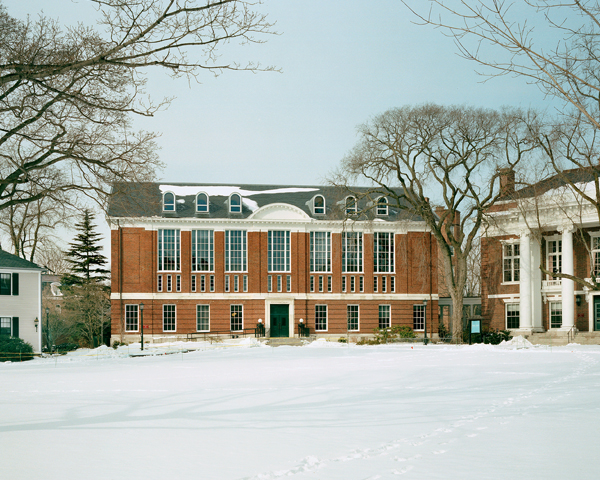
This conversation will take place at the Schlesinger Library of the Radcliffe Institute for Advanced Study in Cambridge (shown above, courtesy of renovation architects Venturi, Scott Brown and Associates). Morgan’s essay is circulated in advance to subscribers and will be available on paper at the meeting. Afterwards there will be a light buffet supper. To reserve a space, email the M.H.S. seminars office.

The Boston Environmental History Seminar will meet at the M.H.S. on Boylston Street on Tuesday, 12 February, at 5:15 P.M. Ben Cronin of the University of Michigan will share his paper “‘To clear the herring brook’: Fluvial Control, Common Rights, and Commercial Development in Plymouth County, Massachusetts, 1660-1860.” William F. Hanna III, author of A History of Taunton, Massachusetts, will comment. This paper is described as follows:
By examining towns of Plymouth County, particularly Pembroke and Middleboro, this project shows how political, economic, and at times military power flowed from effective control of the waterways. The shift in what might be called “water regimes” was a crucial location of what Charles Sellers has called the Market Revolution.
Again, the society asks people to email the M.H.S. seminars office to reserve a space so they know how many are coming.

Finally, on Tuesday, 19 February, at 5:15 P.M., the Early American History Seminar has rescheduled a session with Daniel R. Mandell of Truman State University on his paper “Revolutionary Ideologies and Wartime Economic Regulation.” Brendan McConville of Boston University will comment, which should ensure a lively conversation. Again, email the M.H.S. seminars office to reserve a seat at the seminar and supper table.

Sunday, October 10, 2010

Intelligence from Taunton

Last month the Taunton Daily Gazette reported on an effort by the city’s mayor to have the city—or at least its central area—be designated as some sort of National Park Service site:

Mayor Charles Crowley…said that Taunton is qualified because it has a “rich history” in its role as a bellwether for rebellion leading up to the Revolutionary War. He also discussed how Taunton’s industrial development was remarkable, especially when it came to silver.

Crowley started by detailing the totality of events that occurred in what he called the “theater” of downtown Taunton, including Church Green and the Taunton Green, where the Liberty and Union flag was raised. The flag was raised in 1774 by the revolutionary group the Sons of Liberty in the lead-up to the war against the British, according to historians.

Crowley said that the original pole that to hold up the flag in Taunton is missing, but the the Taunton green nonetheless served as a theater that hosted many of Americans founding fathers, including Benjamin Franklin. . . .

Crowley noted the Sons of Liberty of Taunton embodied American values by going against the grain, refusing to act like cowards like most of the subjects in the colonies. He said they displayed their bravery by raising the Liberty and Union flag, impressing their fellow revolutionaries in Boston.
So take that, all those cowards everyone else in the colonies—only Taunton raised the flag!

Except it wasn’t only Taunton. Towns everywhere in New England were hoisting flags on Liberty Poles that season. It was the thing to do in the fall of 1774.

A report about Taunton did indeed get noticed in Boston, in the 24 Oct 1774 Boston Evening-Post:
We have just received the following intelligence from Taunton—that on Friday last [i.e., 21 October] a Liberty Pole 112 feet long was raised there on which a vane, and a Union flag flying with the words Liberty and Union thereon.
That motto was unusual, but a Union flag on a tall pole was not. When Isaiah Thomas took note of Taunton’s Liberty Pole in the Massachusetts Spy, he also reported on poles erected in Concord, Middleborough, Barnstable, Granville, Vineyard Haven, and Hanover, Massachusetts. Already the 3 October Newport Mercury had reported that “most of the towns” in Connecticut had erected Liberty Poles, with heights ranging from 100 to 170 feet.

And how did the town’s “theater” host Benjamin Franklin? On 10 Nov 1775, Sally Paine wrote to her husband, the Taunton lawyer and Continental Congress delegate Robert Treat Paine:
I had the happiness of seeing Doctor Franklin on his return to Philadelphia. He was so kind as to call at our house for letters or anything else that I wanted to send you. He made but a short stay with us and we would have been glad for more of his company.
Franklin was simply doing a favor to a colleague (and taking the opportunity to visit a pleasant woman—always a favorite activity). “He made but a short stay” in Taunton.

As the article explains, to support a new park the N.P.S. wants a site to be of national influence and not to duplicate the stories told in other parks. (There are also important factors of feasibility, budgets, and congressional support.) Clearly Taunton’s citizens took part in the regional Revolutionary movement, but I don’t see it standing out greatly from other New England towns.

(The conjectural recreation of Taunton “Liberty and Union” flag above is available from Flags Unlimited. Thanks to Rob Velella at the American Literary Blog for his tip about this news story.)