J. L. BELL is a Massachusetts writer who specializes in (among other things) the start of the American Revolution in and around Boston. He is particularly interested in the experiences of children in 1765-75. He has published scholarly papers and popular articles for both children and adults. He was consultant for an episode of History Detectives, and contributed to a display at Minute Man National Historic Park.

Subscribe thru Follow.it


•••••••••••••••••


Showing posts with label White Plains. Show all posts

Monday, October 31, 2022

“My desire is to restore to them the blessings of law and liberty”

Zoffany's portrait of King George III, wearing a red coat and seated at a gilded table
On 31 Oct 1776, Parliament opened a new legislative session. King George III addressed the assembled House of Commons and House of Lords.

The king spoke on behalf of the current government’s leaders, particularly prime minister Lord North and the secretary of state for the colonies, Lord George Germain.

The king strongly agreed with those men, so the remarks also reflected his own ideas about the American War:
My Lords and Gentlemen,

Nothing could have afforded me so much satisfaction as to have been able to inform you, at the opening of this session, that the troubles, which have so long distracted my colonies in North America, were at an end; and that my unhappy people, recovered from their delusion, had delivered themselves from the oppression of their leaders, and returned to their duty: but so daring and desperate is the spirit of those leaders, whose object has always been dominion and power, that they have now openly renounced all allegiance to the crown, and all political connection with this country; they have rejected, with circumstances of indignity and insult, the means of conciliation held out to them under the authority of our commission; and have presumed to set up their rebellious confederacies for independent states.

If their treason be suffered to take root, much mischief must grow from it, to the safety of my loyal colonies, to the commerce of my kingdoms, and indeed to the present system of all Europe. One great advantage, however, will be derived from the object of the rebels being openly avowed, and clearly understood; we shall have unanimity at home, founded in the general conviction of the justice and necessity of our measures.

I am happy to inform you, that, by the blessing of Divine Providence on the good conduct and valour of my officers and forces by sea and land, and on the zeal and bravery of the auxiliary troops in my service, Canada is recovered; and although, from unavoidable delays, the operations at New York could not begin before the month of August, the success in that province has been so important as to give the strongest hopes of the most decisive good consequences: but, notwithstanding this fair prospect, we must, at all events, prepare for another campaign.
In fact, three days before Gen. Sir William Howe had won a solid victory at the Battle of White Plains, part of the Crown’s recovery of New York City and Long Island into the British Empire. But of course that news hadn’t reached London yet.

After directing a request to continue funding the war through taxes to the Commons, as the British constitution required, the king concluded:
In this arduous contest I can have no other object but to promote the true interest of all my subjects. No people ever enjoyed more happiness, or lived under a milder government, than those now revolted provinces: the improvements in every art, of which they boast, declare it; their numbers, their wealth, their strength by sea and land, which they think sufficient to enable them to make head against the whole power of the mother-country, are irrefragable proofs of it. My desire is to restore to them the blessings of law and liberty, equally enjoyed by every British subject, which they have fatally and desperately exchanged for all the calamities of war, and the arbitrary tyranny of their chiefs.
Not everyone in the chamber agreed with that perspective.

TOMORROW: The Rockinghamites strike back.

Monday, August 01, 2022

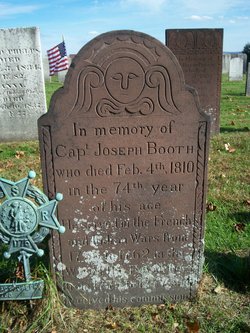
In memory of Capt. Joseph Booth

A tweet from Emily Sneff sent me on the track of an item that appeared in the Connecticut Courant of Hartford on 29 July 1776:
Last Sunday a Child was baptised by the Rev. Mr. [Joseph] Perry of East Windsor, by the Name of INDEPENDENCE.
That news item was reprinted in the New-England Chronicle.

The Courant appeared on Mondays, so “Last Sunday” probably meant not the day before but a week before then: 21 July.

That single sentence still left a lot of questions. Who was the couple who chose to name their child Independence? Was that a boy’s name or a girl’s name? What happened to that child later in life?

So I went looking for Independence. And I found two different babies baptized Independence in central Connecticut in the summer of 1776, with the possibility of still more. Here’s one story.

Joseph Booth (1736–1810) of Enfield, Connecticut, served in the colonial forces during the French and Indian War when he was in his early twenties. Booth’s diary recording that experience and a miscellany of later events, from family milestones to sermon topics to household accounts, has been digitized by the Connecticut Historical Society.

In 1762 Joseph Booth married Mary Hale (1733–1809), born in Glastonbury. They had their first child a year later, “Mary Hale junr.” as Joseph noted in his diary. Booth recorded another child every two or three years after that: David, Annis, Lydia, another Joseph, Peter, Eliphalet… All of the Booth babies survived infancy and lived into the nineteenth century.

That brings us up to the outbreak of war. Heitman’s Historical Register lists a Joseph Booth serving as an ensign in Erastus Wolcott’s Connecticut state regiment from December 1775 to February 1776 and a captain in Comfort Sage’s state regiment from June to December 1776.

One Booth family genealogy, Genealogical Records of Some of the Descendants of Robert Boothe, of Saco, Maine, 1642 by J. H. Booth (1877), quotes a commission signed by Gov. Jonathan Trumbull on 20 June 1776 naming Joseph Booth as a captain. Another, One Branch of the Booth Family Showing the Lines of Connection with One Hundred Massachusetts Bay Colonists by Charles Edwin Booth (1910), states that commission was issued on 21 Mar 1777.

I can’t sort all that out. It’s possible these commissions refer to multiple men. There might have been separate commissions in the Connecticut militia and the state’s short-term forces. And the family chroniclers did make some errors.

All sources agree, however, that Joseph Booth served in the American military early in the Revolutionary War, reaching the rank of captain. Wolcott’s regiment was on the siege lines at Boston in the first months of 1776, and Sage’s was at the Battle of White Plains. But Booth, reaching the age of forty in 1776 and being the father of several young children, was on missions that took him away from Enfield for a few months at most, not years.

TOMORROW: The child Independence was born.