J. L. BELL is a Massachusetts writer who specializes in (among other things) the start of the American Revolution in and around Boston. He is particularly interested in the experiences of children in 1765-75. He has published scholarly papers and popular articles for both children and adults. He was consultant for an episode of History Detectives, and contributed to a display at Minute Man National Historic Park.

Subscribe thru Follow.it


•••••••••••••••••


Showing posts with label Benjamin Burdick. Show all posts

Sunday, December 21, 2025

The Burdicks after the Boston Massacre

In the year after the Boston Massacre, Benjamin Burdick became the proprietor of the Freemason’s Arms tavern—better known as the Green Dragon Tavern, owned by the St. Andrew’s lodge.

I imagine his wife Jane did a lot of the hosting since Benjamin remained Constable of the Town House Watch through 1774.

As the London government cracked down and war approached, the Burdicks moved out to Marblehead. Benjamin opened a “large, genteel, and commodious” inn opposite Jeremiah Lee’s mansion. Soon he was watching over auctions of captured goods and vessels. Later the inn hosted auctions of estates confiscated from absent Loyalists.

By 1786 Burdick had relocated to Danvers, at the Sign of the Flag, but that property was sold the next year. Jane was back in Boston when she died in 1791. I haven’t found a record of Benjamin’s death. (It doesn’t help that genealogists have intertwined him with a man of the same name from Westerly, Rhode Island.)

In 1778, the Boston merchant Samuel Phillips funded the opening of a new academy in Andover with Eliphalet Pearson as preceptor. The inaugural class of that school included Malcolm McNeil Burdick, born in Boston 1764—the Burdicks’ oldest son. (His first and middle name appeared with different spellings.) Malcolm was in his teens but for some reason listed as age ten in school records.

Later Malcolm M. Burdick went to sea, appearing in advertisements as master of the Minerva sailing from Baltimore to Liverpool in 1801 and of the John out of New York in 1807. By 1812 he had settled in Windham, Maine, where he advertised that someone else’s livestock had gotten onto his land.

Another of Benjamin and Jane Burdick’s sons, William, born in 1774, went into printing. In July 1795 he and Benjamin Sweetser cofounded a newspaper in Boston called the Courier. Soon that became The Courier, Boston Evening Gazette and Universal Advertiser. Burdick signed over his portion of the business to Sweetser in December, and it ceased publishing in March 1796 after a fire.

[ADDENDUM: From 1798 to 1800 William Burdick was the junior partner in publishing the Oriental Trumpet newspaper in Portland, Maine. He then returned to Boston.]

In 1809 William Burdick married Lucretia Sprague (1788–1849), daughter of Continental artillery veteran Samuel Sprague (1753–1844). According to her brother, the banker and poet Charles Sprague (1791–1895), their father was also part of the Boston Tea Party.

William Burdick reused the Boston Evening Gazette name for a new periodical in 1813. His printing office at Congress and State Streets was next to the Exchange Coffee House, and he bought stock in that jittery enterprise. The printer’s older brother Malcolm sold subscriptions up in Maine.

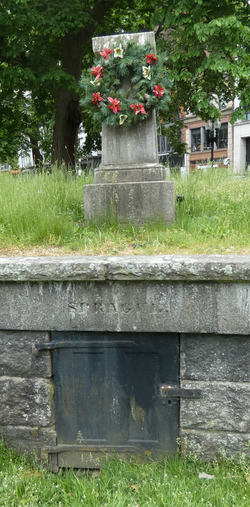
That Boston Evening Gazette evolved into the the Boston Intelligencer in August 1816. Burdick sold the business the following January and died on 30 May 1817, under Dr. John Collins Warren’s care. He was intestate but solvent, so his widow Lucretia could settle the estate and live for three more decades. She was interred in the Sprague family tomb in Boston’s Central Burying-Ground, shown above.

Saturday, December 20, 2025

“I can recollect something of their faces…”

As recounted yesterday, immediately after the Boston Massacre, town watchman Benjamin Burdick went up to the soldiers and examined their faces so he could identify them later.

That didn’t actually turn out to be helpful.

When he was called to testify at the soldiers’ trial in November, Burdick had this exchange:
Q. Did you see any of these prisoners in King street the night of the 5th of March?

A. Not that I can swear to as they are dressed. I can recollect something of their faces, but cannot swear to them.

When I came to King-street, I went immediately up to one of the soldiers, which I take to be that man who is bald on the head, (pointing to [Edward] Montgomery). I asked him if any of the soldiers were loaded, he said yes. I asked him if they were going to fire, he said yes, by the eternal God, and pushed at me with his bayonet, which I put by with what was in my hand.

Q. What was it?

A. A Highland broad sword.
John Adams’s notes on this exchange echo some details:
I went up to one that I take to be the bald man but cant swear to any. I askd him if he intended to fire. Yes by the eternal God. I had a Cutlass or high Land broad sword in my Hand.
In an earlier deposition Burdick said that the soldier he spoke to was “the fourth man from the corner, who stood in the gutter.”

However, multiple other witnesses agreed that Pvt. Montgomery was on the right end of the grenadiers’ arc (James Bailey, Jedediah Bass), and that the man in that position was the first to fire (Bailey, Bass, James Brewer, Thomas Wilkinson, Nathaniel Fosdick, Joseph Hiller). The watchman himself described the first shot coming from “the right hand man,” not the men closest to him. So the soldier Burdick spoke to wasn’t Montgomery, despite all his effort to memorize the men’s faces on King Street.

Burdick’s testimony does offer us some details about the soldiers in the courtroom. As defendants, those men were “dressed” differently from how they appeared on 5 March—differently enough for Burdick to say he could no longer recognize any of them with certainty. That suggests the soldiers were no longer wearing their full uniforms.

In addition, Montgomery wasn’t wearing a wig or hat since Burdick (who, incidentally, had been trained as a barber and peruke-maker) saw that he was “bald.”

Friday, December 19, 2025

“I wanted to see some faces that I might swear to”

For a new project I’ve been taking a deep dive into Benjamin Burdick’s accounts of the Boston Massacre.

Back in 2008 I pointed out that, while previous publications about the event didn’t make this clear, Burdick was a Constable of the Town House Watch. All his actions make sense when we consider that he was on King Street to keep the peace and enforce the law.

One of those actions was helping to carry away the bodies. As Burdick brought Dr. Joseph Gardner and David Bradlee to lift Crispus Attucks, the soldiers aimed their muskets again. Capt. Thomas Preston knocked the guns up, telling his men not to fire.

Burdick then boldly walked up to the soldiers. Here’s how he’s quoted describing that action in different sources.

Boston’s Short Narrative report, printing Burdick’s own deposition:
I then went close up to them, and addressing myself to the whole, told them I came to see some faces that I might be able to swear to another day—Capt. Preston, who was the officer, turned round and answered (in a melancholy tone) perhaps you may. After taking a view of each man’s face I left them.
Prosecuting attorney Robert Treat Paine’s notes on how Burdick testified at Capt. Preston’s trial:
I said I wanted to see a face I should sware to, Prisoner said in a Melancholly tone perhaps you may.
An anonymous spectator in the courtroom taking notes for Gov. Thomas Hutchinson:
After the firing I went up to the Soldiers and told them I wanted to see some faces that I might swear to them another day. The Centinel in a melancholy tone said perhaps Sir you may.
(This observer moved Preston’s words into the mouth of the sentry, Pvt. Hugh White. Or the transcriber mistook “Captain” for “Centinel.”)

Burdick’s testimony at the soldiers’ trial, as taken down by John Hodgson:
I went to them to see if I could know their faces again; Capt. Preston looked out betwixt two of them, and spoke to me, which took off my attention from them.
John Adams took notes on what Burdick said at the second trial, but not on that detail.

TOMORROW: Burdick identifying individual soldiers?

Sunday, November 07, 2021

The Boston Massacre as Never Seen Before

The Museum of the American Revolution in Philadelphia just opened an exhibit of Don Troiani’s paintings of the conflict.

Troiani is not only a talented realistic artist but also one of the country’s most dedicated collectors of historical clothing, weapons, and other artifacts. His work reflects the best thinking about what things really looked like at momentous moments.

WHYY just ran an interesting story about how the museum is making its Troiani exhibit more accessible to people who can’t see those details in the paintings because of limited vision.

There’s a lot in the article, and this is just part of what it says about the presentation of one painting:
The tour at the museum started with Troiani’s painting of the Boston Massacre, the first episode of violence of the American Revolution in 1770 when British soldiers opened fire on an angry rally of Boston residents.

With the help of Trish Maunder, director of Philly Touch Tours, [testers] Mayeux and Bonenfant were first shown how large the painting is, roughly 2 feet by 3 feet. Walking along the width of the painting with their fingers on the frame, they feel in their paces the scale of the work. . . .

“We are standing in this painting behind a group of British soldiers, so imagine them in their bright red coats. There’s about six inches of snow on the ground,” said Tyler Putnam, the museum’s manager of gallery interpretation, describing the painting. “We’re looking at their backs and they are surrounded by a huge crowd.”

Because the perspective of the painting is behind the line of British soldiers, the viewer cannot see their faces in favor of the opposing colonists, whose panicked faces are lit by flashes of black gunpowder explosions.

Putnam then passed around the tactile graphic papers, so Mayeux and Bonenfant could feel the layout of the painting’s composition. Created by the Braille printhouse Clovernook, the paper had been embossed with different types of textures to indicate the surrounding brick buildings, the snow on the ground, and the flashes of gunpowder. A Braille legend in an upper corner identifies what the textures represent.

Although there are several dozen figures in the painting — the crowd of colonists reaches deep into the background of the canvas — the tactile graphic had to be greatly simplified so it could be coherent to fingertips. Only six figures are in the graphic. Most of the information Troiani had put in his painting was eliminated.
The picture above shows the graphic translation of Troiani’s Massacre scene, which folks can view here.

At the left is a sword-wielding civilian, possibly town watchman Benjamin Burdick, and then sentry Pvt. Hugh White in his overcoat. Then two of the seven grenadiers and Capt. Thomas Preston. At the right is another civilian, the apothecary Richard Palmes swiping at Preston with his cane. [Incidentally, Palmes is an important figure in the new book Espionage and Enslavement in the Revolution: The True Story of Robert Townsend and Elizabeth by Claire Bellerjeau and Tiffany Yecke Brooks.]

As the news story says, the tactile graphic leaves out a lot—most of the soldiers and all but two of the large crowd. The two visitors who tested this method of interpretation clearly preferred in-depth description and discussion, though of course most museums can’t provide that all the time.

As the article says, “The tactile graphics are in a trial phase.” As I think about this particular image, I think the layers might be the most important information—the line of soldiers in the foreground, then the first line of locals facing them, then the rest of the crowd, and finally the Town House and other buildings with their straight lines and angles in the background. That would require flipping through three or four tactile graphics. But it was a complex event, after all.

Wednesday, March 04, 2020

Looking for Trouble, Even on the Sabbath

Among the men who brawled at John Gray’s ropewalk on 2 Mar 1770 were a young ropemaker named Samuel Gray (no known relation) and Pvts. William Warren and Mathew Kilroy of the 29th Regiment.

The next day, there were more fights in Boston. Some redcoats from the 29th, including Pvt. John Carroll, went back into Gray’s ropewalk and challenged the men working there, along with sailor James Bailey. Then there was another brawl, with one private reportedly badly injured.

Town watch captain Benjamin Burdick also had a run-in with soldiers on Saturday:
A young man that boarded with me, and was at the Rope-Walks, told me several of them had a spite at him, and that he believed he was in danger. I had seen two soldiers about my house, I saw one of them hearkening at the window, I saw him again near the house, and asked him what he was after;

he said he was pumping ship:
(“Pumping ship” was slang for urinating. This may have been a reference to William Green’s rude joke the day before about cleaning an outhouse. Then again, the soldier might have been urinating.)
Was it not you, says I, that was hearkening at my window last night?

what if it was, he said, I told him to march off, and he damned me, and I beat him till he had enough of it, and he then went off.
That incident made Burdick, and even more so his wife, decide that he should carry a Highland broadsword when he went out on duty.

Sunday was a day of rest in Boston, of course. Yet more military men visited Gray’s ropewalks then, 250 years ago today. But this delegation was at a higher level, as owner John Gray testified:
At Sabbath noon I was surprised at hearing that Col. [Maurice] Carr [of the 29th] and his officers had entered my rope-walk, opened the windows, doors, &c, giving out that they were searching for a dead sergeant of their regiment; this put me upon immediately waiting upon Col. [William] Dalrymple [of the 14th, senior army officer in Boston, pictured above after retirement], to whom I related what I understood had passed at the rope-walk days before.

He replied it was much the same as he had heard from his people; but says he, “your man was the aggressor in affronting one of my people, by asking him if he wanted to work, and then telling him to clean his little-house.”

For this expression I dismissed my journeyman on the Monday morning following; and further said, I would do all in my power to prevent my people’s giving them any affront in future.

He then assured me, he had and should do everything in his power to keep his soldiers in order, and prevent their any more entering my inclosure.

Presently after, Col. Carr came in, and asked Col. Dalrymple what they should do, for they were daily losing their men; that three of his grenadiers passing quietly by the rope-walks were greatly abused, and one of them so much beat that he would die.

He then said he had been searching for a sergeant who had been murdered; upon which, I said, Yes, Colonel, I hear you have been searching for him in my rope-walks; and asked him, whether that sergeant had been in the affray there on the Friday; he replied, no: for he was seen on the Saturday. I then asked him, how he could think of looking for him in my walks; and that had he applied to me, I would have waited on him, and opened every apartment I had for his satisfaction.
These gentlemen in the military and in business were trying to keep the peace, but also sought to protect the interests of their operations.

The 12 March Boston Gazette added detail, perhaps even reliable, to the story of the missing sergeant:
Divers stories were propagated among the soldiery that served to agitate their spirits; particularly on the Sabbath that one Chambers, a sergeant, represented as a sober man, had been missing the preceding day and must therefore have been murdered by the townsmen. An officer of distinction so far credited this report that he entered Mr. Gray’s rope-walk that Sabbath; and when required of by that gentleman as soon as he could meet him, the occasion of his so doing, the officer replied that it was to look if the sergeant said to be murdered had not been hid there.

This sober sergeant was found on the Monday unhurt in a house of pleasure.
On the day of rest there were no more brawls, but rumors flew among the townspeople that soldiers were plotting revenge on Monday. Oddly enough, rumors spread among the soldiers that townspeople were plotting revenge on Monday.

COMING UP: Another glimpse of Sergeant Chambers. But first…

Wednesday, February 12, 2020

The Great 1770 Quiz Answers, Part 2

Here are the answers to the questions remaining from part 1 of the Great 1770 Quiz, along with the background and sources for each answer.

III. Match the person to the weapon he reportedly carried at the Boston Massacre.

1) catstick
2) cordwood stick
3) firelock and bayonet
4) Highland broadsword

A) Crispus Attucks
B) Benjamin Burdick
C) John Carroll
D) Christopher Monk

There are two ways to tackle this on Google, I think: pairing the phrase “Boston Massacre” with the men’s names, and pairing “Boston Massacre” with the weapons.

The first search shows that of these four people, John Carroll was a defendant in the trial—i.e., a soldier. We know those grenadiers were armed with firelocks (muskets) and bayonets.

From the other direction, “Highland broadsword” points to several sources naming Benjamin Burdick; “cordwood stick” to several naming Crispus Attucks; and “catstick” to this Boston 1775 posting about Christopher Monk.

One further comment on Burdick and his broadsword. Boston records show he was “Constable of the Town House Watch,” head of the nighttime patrol in the center of town. However, he never identified himself as such in his testimonies on the Massacre—I assume everybody at the time already knew.

As a result, until I wrote about Boston’s watchmen in a paper titled (after a quote from Burdick) “I Never Used to Go Out with a Weapon,” most people didn’t analyze his behavior through that role. The Highland broadsword wasn’t evidence of a man out for trouble; it was evidence of a man out to do his job of keeping the peace.

All four people commenting on this question—kmjones234, Kathy, Justin C, and John—put the weapons in the right hands.

IV. Followup: Who used “wouldring sticks” as weapons in March 1770?

Google the phrase “wouldring sticks,” and the only references that come up point to the ropemakers of Gray’s ropewalk during their brawl with redcoats on 1 March. The phrase appears in Boston’s Short Narrative of the Horrid Massacre in 1770 and in many accounts based on that source.

Those tools were also called “wouldering sticks” and “way sticks.” Ropemakers used them to help twist large cables tighter. But a thick, tapered stick could be useful in other situations as well.

Again, kmjones234, Kathy, Justin C, and John all answered this question correctly.

V. Which of the following men did the Boston town meeting elect to the Massachusetts house in May 1770?
  • John Adams
  • Samuel Adams
  • James Bowdoin
  • Thomas Cushing
  • John Hancock
  • James Otis, Jr.
  • William Phillips
According to Massachusetts’s charter, Boston could elect four men to the lower house of the General Court. Every other town could elect only two. (That meant Boston’s population, more than twice the size of any other town, was underrepresented. However, its representatives could easily attend sessions in Boston, and they had outsized influence.)

From 1766 to 1769 the town meeting elected the same four men to the legislature each year: Thomas Cushing, James Otis, Samuel Adams, and John Hancock. But the effects of his coffee-house brawl in September 1769 had addled Otis so much that in April he shot a pistol out of his window on School Street. He therefore needed to be replaced.

Over those same years James Bowdoin had served on the Massachusetts Council, but in 1769 Gov. Francis Bernard “negatived” or vetoed him along with a bunch of other troublemakers. That meant Boston had an active Whig politician without an official seat, and a seat needing someone to fill it. People sensed a solution.

Here’s the published record of Boston’s town meetings from 1770 to 1777. The election on 8 May 1770 is on page 21. That shows the four men elected that day were Hancock (511 votes out of 513), Cushing (510), Samuel Adams (510), and Bowdoin (439).

Those weren’t Boston’s representatives for the legislative year, though. When the Massachusetts General Court chose its new Council later in May, members once again named James Bowdoin to that upper chamber—and acting governor Thomas Hutchinson decided to accept him. That left his legislative seat vacant. On 6 June Boston had another town meeting (page 33), and Bostonians chose a young lawyer originally from Braintree to represent them: John Adams (418 votes out of 536).

In 1771 John Adams declined to run again, and Otis was reelected (page 53). Then Otis had another bout of insanity and lost the support of voters. In 1772 the town chose William Phillips as its fourth representative (page 78).

Kathy, Justin C, and John answered this question completely.

VI. Followup: In what building did the Massachusetts house meet in 1770?

To punish Boston and reduce the influence of its representatives, Gov. Francis Bernard convened the Massachusetts General Court in Cambridge in May 1769. That of course produced a lot of arguments about whether he was right to do so. Acting governor Thomas Hutchinson followed that lead and also convened the General Court in Cambridge.

The Massachusetts Secretary of State’s office has a webpage linking to the journals of the Massachusetts house as reprinted by the Massachusetts Historical Society. Those volumes have handy introductions about each year’s legislatives tussles. The title page of the 1770 volume states where the legislature was convened: “at Harvard-College in Cambridge, in the County of Middlesex.”

It takes a little more digging to determine in what building the house met. The 1770 minutes contain many references to messages or people going back and forth between the house and the Council. Gov. Hutchinson and the Council were in “the Philosophy Chamber,” and the lower house was in “the Chapel.”

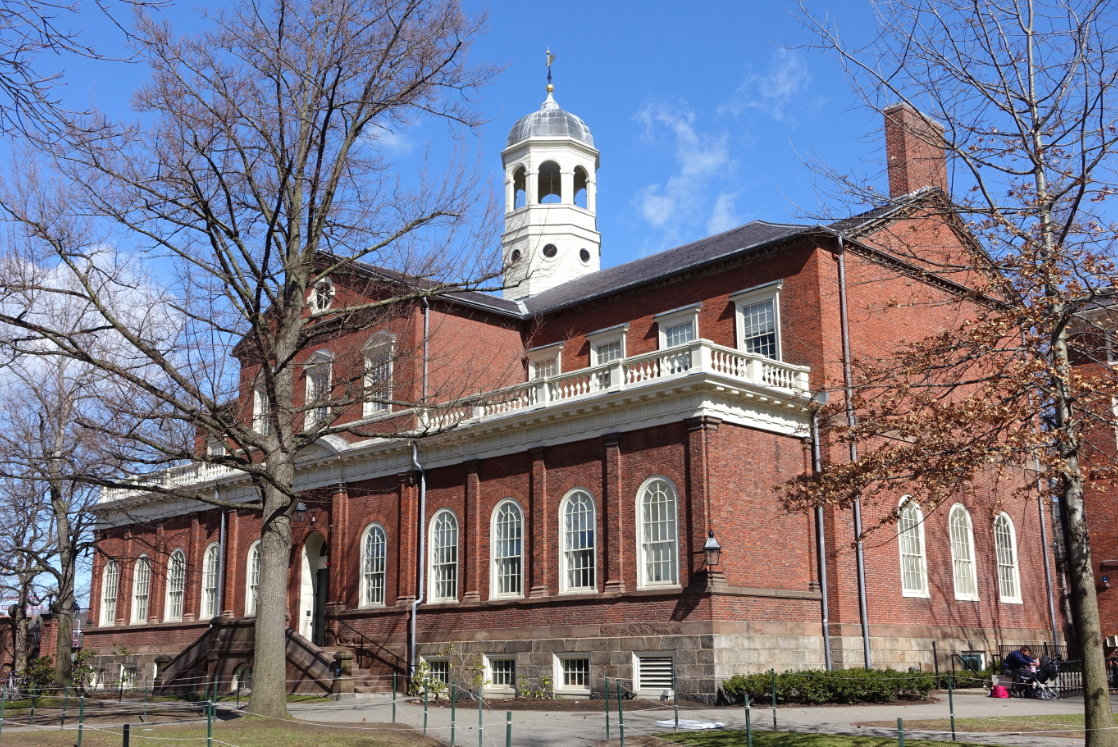
There’s some debate in the literature as to whether “the Chapel” meant Holden Chapel, built in 1744, or the ground-floor chapel of Harvard Hall, rebuilt in 1766. We know the Philosophy Chamber was in Harvard Hall. We also know the legislature had met in the previous Harvard Hall during the smallpox epidemic of 1764; in fact, a fire that started during that session was why the hall had to be rebuilt. Most important, we know the architect of the new building was none other that Gov. Bernard, who got to choose where the legislature met.

Thus, the consensus now, as this guide to Massachusetts legislators specifies, is that the Massachusetts house met on the ground floor of Harvard Hall.

Justin C and John both identified “Harvard College,” earning at least partial credit for this question.

TOMORROW: Pseudonyms and more.

Friday, November 15, 2019

“David Bradley, came down with me to the corpses”

On 5 Mar 1770, eleven days after David Bradlee saw Ebenezer Richardson shooting out of his house, there was a confrontation between soldiers and civilians in King Street. That became, of course, the Boston Massacre.

Among the people on the scene was Benjamin Burdick, Jr., constable of the town house watch. He testified about what he saw in multiple forums. Burdick’s most detailed account appears in the town’s Short Narrative of the Horrid Massacre, and in part it says:
I then looked round to see what number of inhabitants were in the street, and computed them to be about fifty, who were then going off as fast as possible; at the same time I observed a tall man standing on my left-hand, who seemed not apprehensive of the danger he was in, and before I had time to speak to him, I heard the word “Fire!” and immediately the report followed, the man on my left hand dropped, I asked him if he was hurt, but received no answer, I then stooped down and saw him gasping and struggling with death. I then saw another man laying dead on my right-hand, but further advanced up the street.

I then saw the soldiers loading again, and I ran up the street to get some assistance to carry off the dead and wounded. Doctor Jos. Gardner, and David Bradley, came down with me to the corpses, and as we were stooping to take them up, the soldiers presented at us again; I then saw an officer passing busily behind them. We carried off the dead without regarding the soldiers.
At the soldiers’ trial the shorthand expert John Hodgson, who was a relative newcomer to town and didn’t know everyone, quoted Burdick this way:
When the Molatto man was dead, I went up, and met Dr. Gardner and Mr. Brindley. I asked them to come and see the Molatto, and as we stooped to take up the man, the soldiers presented their arms again, as if they had been going to fire, Capt. [Thomas] Preston came, pushed up their guns, and said stop firing, do not fire.
“Mr. Brindley” is clearly the man Burdick knew as “David Bradley.”

The tailor David Bradlee was thus at three violent political events in Boston in the space of five months: the tarring and feathering of George Gailer on 28 Oct 1769, the fatal confrontation at Richardson’s house on 22 Feb 1770, and the Massacre.

Furthermore, Bradlee was willing to walk under the guns of the British troops to help pick up Crispus Attucks’s body.

We write a lot about the Boston “crowd” and the “Sons of Liberty” as a collective actor, but of course that group was made up of individual people. David Bradlee was evidently one of those people. He did the work of resisting Crown authority at the street level. He was part of the crowd that genteel political leaders like Samuel Adams, James Otis, and William Molineux relied upon.

COMING UP: The Bradlees and the Tea Party.

Sunday, July 28, 2019

“The officer swearing and cursing to us”

At the Massachusetts Historical Society’s Beehive blog, Nicole Breault has shared a sample of her research into the town watch of eighteenth-century Boston.

This snapshot is from the fall of 1768, just after units of the British army started to arrive from Canada and Ireland. The Boston government had responded by strengthening the nightly watch, the small squads of men patrolling different sections of town, each under the command of a constable of the watch.

Breault writes:

In November 1768, three constables of the watch filed monthly reports and formal complaints with the town selectmen charging that officers of the regiments used strong language and threats of violence to challenge watch authority.

John Martin of the South End watch reported that one of his watchmen was “asolted,” struck by an officer of one the regiments for inquiring who was walking at night. Benjamin Burdick of the Townhouse watch filed a complaint regarding the threats officers made against their watch unit. Edward Ireland of the Dock Square watch listed five separate incidents, two in his complaint and four in his monthly report.

The complaint written by Ireland is located here in the MHS collection. One of many encounters he reported that month, Ireland described an incident outside of the door of his watch house as such:
the officer swearing and cursing to us we had no business to hail an officer and said do you think to stand four regiments, god dam you? We have four regiments here and we will burn you all to ashes in a moments time, we will send you all to hell and damnation in a minute and drew his bayonet and stabbed it against the door and said god dam you come out here. what do you think to do with us, times is not now as they have been.
The fact that an “officer,” not a regular soldier, was assailing the watch this way fits into my theory that part of the conflict on Boston’s streets in 1768 was class-based. British army officers were from the genteel class. Watchmen were men from the middling and laboring class. This officer felt that such men “had no business to hail an officer.” Meanwhile, the watchmen and the selectmen who employed them wanted all the people in Boston, including gentlemen of the army, to answer to local law.

Monday, January 21, 2019

“Five field Officers, to enquire into the circumstance of the Riot”

The morning after the fight between British army officers and town watchmen that I reported yesterday, the higher authorities swung into action.

That morning six selectmen met at Faneuil Hall: John Scollay, John Hancock, Thomas Marshall, Samuel Austin, Oliver Wendell, and John Pitts. The record of that session says: “Mr. [Benjamin] Burdick & other Constables of the Watch, appeared and complained to the Selectmen of great abuses received from a number of officers of the Army, the last Night.”

The selectmen must have asked the watchmen to produce sworn testimony because that afternoon “Mr. Isaac Pierce, Mr. Joseph Henderson & Mr. Robert Peck & Mr. Constable Burdick gave in their Depositions.”

Gov. Thomas Gage, who was also the general in charge of the soldiers, took steps the same day—a politic move to calm the town. Lt. John Barker wrote in his diary, “A court of Enquiry is order’d to set next Monday, consisting of five field Officers, to enquire into the circumstance of the Riot.”

The prospect of punishment might, however, have made some officers more resentful. The merchant John Andrews wrote on 22 January:
The Officers’ animosity to the watch still rankling in their breast, induc'd two of them to go last night to the watch house again at about 10 o’clock and threaten the watch that they would bring a file of men and blow all their brains out.

The watch thereupon left their cell and shut it up, and went and enter’d a complaint to the Selectmen—some of whom waited on the Governor at about 12 o’clock, who was very much vex’d at the Officers’ conduct, and told the Gentlemen that he had got the names of three that were concern'd in Fryday night’s frolick, and was determin’d to treat them with the utmost severity—and likewise order’d a guard to patrole through every street in town and bring every officer to him that they should find strolling or walking.
Fortunately, the 22nd was a Sunday, so nobody really expected to be out having fun in Boston, anyway.

On Monday, 23 January, the court of enquiry met. It was headed by Lt. Col. George Maddison of the 4th regiment, with two other lieutenant colonels and two majors on the bench. They took testimony every day from Monday to Saturday, according to records in Gen. Gage’s files.

Barker wrote, “it is supposed it will be a tedious affair, and will not be finished for some time.” Andrews also reported:
Yesterday the Officers were all examin’d at the New Court house, respecting fryday night’s affair, being carried there under arrest, nine in number (after which the General is to deal with them): being a great number of evidences they were oblig’d to adjourn till [to] day.
The list of witnesses included:
  • five army captains, including Hugh Maginis of the 38th, who had fought with the watch back in November.
  • twelve lieutenants from the army and Marines, including Gage’s aide de camp Harry Rooke; Lt. House of the 38th, who had sustained a cut on his forehead; William Pitcairn of the Marines, son of the major commanding that unit; and William Sutherland of the 38th, who would later leave a detailed report on the Battle of Lexington and Concord.
  • seven ensigns, including Ens. King of the 5th, whose sword had been taken.
  • a sergeant and at least five privates.
  • “Mr. Winslow,” who had been escorting Lt. Gov. Thomas Oliver’s wife Elizabeth home from “Mr. Vassall’s,” probably her brother, John Vassall.
  • watchman William McFadden.
  • “Thomas Ball Esqr. late Capt. in the Royal Irish Regt. of Foot,” who testified that townspeople were yelling at the soldiers to fire.
At the start of the inquiry John Andrews had high expectations: ”the Captain of the Guard [John Gore] at least will be broke, for being drunk when on duty.”

Meanwhile, some of the town’s justices of the peace held their own hearings.

TOMORROW: The magistrates’ findings.

Monday, March 20, 2017

Colonial Comics at the Royall House, 22 Mar.

On Wednesday, 22 March, I’ll be part of a panel discussion with comics creators E. J. Barnes and Jesse Lonergan at the Royall House and Slave Quarters in Medford.

We’ve all contributed to the two volumes of Colonial Comics: New England, whose main editor is Jason Rodriguez. Volume I told stories from the years 1620-1750, and the new Volume II brings the history up to 1775.

Both books feature an array of writing and illustration styles from many talented creators. They focus on lesser-known events that expose the fault lines of colonial society—“stories about Puritans and free thinkers, Pequots and Jewish settlers, female business owners and playwrights, gravedigging medical students, instigators of civil disobedience, college students, rum traders, freemen, and slaves.” Here’s a recent review of the first volume from Comics in the Classroom.

In volume 1, E. J. Barnes wrote and watercolored the story of Thomas Morton, an English settler in what’s now Quincy who was at odds with the Massachusetts Bay Puritans. She created portraits of historic figures for volume 2. She’s also the author of “Caroline’s Catalog,” about astronomer Caroline Herschel, and “A Beautiful Young Nymph Going to Bed,” based on a poem by Jonathan Swift.

Jesse Lonergan is the author of the graphic novels All Star, Flower and Fade, and Joe and Azat, as well as many short stories in comics form. For the second volume of Colonial Comics he and I created a story about watchman Benjamin Burdick working to solve a mystery about one of the victims of the Boston Massacre.

We’ll talk about how we created these stories, the choices we made historiographically and artistically, and the potential of the comics form, especially in schools.

This event is scheduled to start at 7:30 P.M. It is free for Royall House members, $5 for others. There will be copies of Colonial Comics and other publications available for purchase and signing afterward.

Monday, March 06, 2017

“Returning to our Watch House meeting with three Officers”

As I described yesterday, in the summer of 1768 Edward G. Langford started to work under Benjamin Burdick, constable of the Town House Watch.

As town employees, their assignment was to patrol the streets of central Boston at night. They called out the time and “All’s well” if all was indeed well, and raised the alarm if there were fires or other problems.

Neither Burdick nor Langford had roots in the town’s old Puritan establishment. Burdick was a Presbyterian, Langford an Anglican. Burdick was a barber by trade; I don’t know Langford’s profession, but he didn’t own much property or engage in trade. They were working-class men, doing a important but undesirable job when most of their neighbors were asleep.

And that job got harder in October 1768 when the first of four British army regiments arrived in town, sent to tamp down riots against the Customs department. For the watchmen, the problem wasn’t the soldiers—it was their officers.

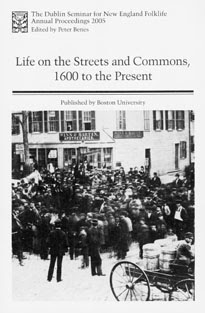
In my paper about Boston’s pre-Revolutionary town watch published in the Dublin Seminar volume on Life on the Streets and Commons, I quoted a complaint that Burdick, Langford, and another watchman named John McFarland filed on 14 Nov 1768. They said two “Officers with their Swords under their Arms” had yelled at them for doing their jobs, threatened them with a “drubbing” from the soldiers, and said “they had Orders from his Majesty, and they were above the Selectmen.” (The whole complaint appears here.)

It turns out that wasn’t the first time Burdick and Langford had clashed with army officers. I recently found this deposition published in the Magazine of History in 1910:
Boston, November ye 5, 1768.

At two o’clock in the Morning Benjamin Burdick Constable of the Watch & Edward Langford a proper Watch Man being upon our rounds returning to our Watch House meeting with three Officers as we gave the Time of Night they gave the Time of Night in answer to us with a great noise in the streets and we hailed them & they came up to us & call’d us damd Scoundrels & swore by God they would put the Constable in Irons

then we retired to our Watch House

Then he went to the Guard gave the command not to suffer the Watch to hail any Body in the street

we told them our orders were to hail every Body that walked the streets & we should obey Our Order

then they replied God damne you you scoundrels I will pull you out of the House & put you in Irons & all the answer I gave them was as thus. Gentlemen I am sorry to see you behave in such a Manner in the Street & they still kept cursing and daming of us & we never receiv’d so much abuse in our lives.
Justice of the peace John Ruddock, who would have his own physical run-ins with the army, collected this testimony on 10 November, and both Burdick and Langford signed it. (I broke up the one big paragraph to make it slightly easier to follow, but I couldn’t do anything about the shifts between first person singular and first person plural.)

In those encounters the watchmen thought they, as “proper” employees of the town, had authority to hail all pedestrians at night. Army officers thought they, as officers and as gentlemen, shouldn’t have to answer to working-class civilians. Likewise, at checkpoints, army sentries were under orders to halt people and vehicles; Bostonians, especially those of higher social rank and Whig consciousness, resented having to answer to a standing army.

Those conflicts flared into violence many times during the regiments’ first months in Boston. On 18 Jan 1769, “several officers of the army” even attacked the watch-house on King Street, where Burdick and Langford worked. The violence became less frequent for most of 1769 but came roaring back at the end of that year and in early 1770.

Thus, when Langford and later Burdick arrived on King Street on 5 Mar 1770, they weren’t surprised to see a fight between locals and soldiers. They had been in the middle of that conflict for months.

TOMORROW: What Langford witnessed.

Sunday, March 05, 2017

Edward G. Langford, Town Watchman

One of the Bostonians caught up in the Boston Massacre was Edward Langford, who identified himself during the subsequent trials as a member of the town watch. What background brought him to patrolling Boston at night?

Notes taken at the trials identify that man as “Edd. Gambleton Langford” (Robert Treat Paine), “Edward Gambett Langford” (John Adams), and “Edward G. Langford” (shorthand transcriber John Hodgson). Later church records state that Edward Langford died on 26 Mar 1777, aged thirty-eight—meaning he was born in 1738 or 1739.

All that appears to connect the watchman with Thomas and Judith Langford, shown in the records of King’s Chapel (shown here) as having two sons baptized there: Edward Mortimore Langford on 24 Dec 1737 and John Gamberto [sic] Langford in 1740. Perhaps the first Edward died young and the parents gave the future watchman the same first name, plus a middle name he’d share with his brother. (The family was unusual for the time for using middle names at all.) Thomas and Judith Langford also appear to have also had sons Nicholas, born in 1724, and Arthur, and perhaps a daughter named Mary around 1725.

Judith Langford died before Edward turned nine, and on 14 Aug 1746 Thomas Langford married Mary Beatel. They had more children, most of whom died young:
  • Frances born in 1747.
  • Sarah born and died in 1749.
  • Nicholas born in 1750, baptized privately (often a hint of poor health), and died in 1751.
  • A second Sarah born in 1752.
  • A second Nicholas, born and died in 1754.
In 1757, close to his twentieth birthday, Edward Langford served as sponsor for the baptism of a baby named Ann Stone in King’s Chapel. That shows he continued to have ties to the Church of England. However, on 9 June 1761 the Rev. Samuel Checkley, Congregational minister of the New South Meetinghouse, married Edward Langford and Mary Gyles, several months after they first announced their intention to marry.

Edward and Mary Langford, along with a senior Mary Langford, sponsored the baptism of Arthur and Elizabeth Langford’s daughter Judith at King’s Chapel in 1765. (That’s why I suspect the senior Mary, Arthur, and Edward were all siblings, children of the late Judith Langford.) I haven’t found records of Edward and Mary having children of their own.

Nor have I found records indicating what profession Langford took up in the late 1750s and early 1760s. He appears to have been too poor to show up in real estate and town government records, too rich to be on the poor rolls. But on 27 June 1768, Boston selectmen’s records say:
Mr. [Benjamin] Burdick the Constable of the Watch presented Edward Langford as a suitable Person for a Watchman in the room of John Hyman who has left the Watch, and he was approved of by the Selectmen accordingly
Langford was thus hired to help Burdick patrol the middle part of the town at night, watching for fires or disturbances and calling out the time.

Three months later, British troop ships arrived in Boston harbor, bringing the first of four regiments of soldiers to patrol the town.

TOMORROW: So how did that go?

Friday, May 01, 2015

Two New Pre-Revolutionary Comics to Choose Between

Tea Party: An American Story is a webcomic from Sam Machado, Cynthia “Theamat” Sousa, and Amanda Sousa Machado, signing themselves as TAS.

It’s one of the most scrupulous fictional depictions of pre-Revolutionary Boston that I’ve seen. As a measure of the level of detail, in episode 6 the Samuel Adams household includes Surry, Job, and Queue. Episode 2 shows Benjamin Burdick tending bar at the Green Dragon Tavern (or, as he advertised it, the Freemason’s Arms).

As a result, there’s not much action in the story. So far it’s shown the Boston Whigs talking seriously about the political issues of the day, largely in the terms of the time. The court party hasn’t shown up yet, limiting the conflict to the frictions internal to those activists and their families. But eventually we’ll move from the judicial salaries issue to Gov. Thomas Hutchinson’s letters to the tea.

On the other end of the comics spectrum, Dark Horse has issued the first issue of The Order of the Forge, written by Victor Gischler and illustrated by Tazio Bettin. The company’s summary:
Before he fathered a nation, young George Washington forged his legend in blood! Imbued with the mystical powers of America’s original inhabitants, George—along with his friends Ben Franklin and Paul Revere—must stop an evil governor who wishes to rule an empire!
The sell line is supposedly in young Washington’s words: “I cannot tell a lie. I f**king hate zombies.” That’s him with his little hatchet on Juan Ferreyra’s cover.

Sunday, February 07, 2010

The Picture For Liberty Leaves

Timothy Decker’s illustrations in For Liberty are in striking black and white, with hatching and patterns to produce the illusion of grays. The effect is in some ways reminiscent of eighteenth-century engravings.

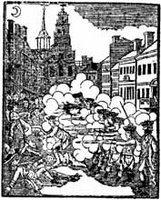
Decker chooses dramatic visual angles, such as an overhead view of King Street immediately after the Boston Massacre, probably inspired by Paul Revere’s hand-drawn scene of the scene.

One spread uses a background of radiating lines to isolate our attention on a soldier firing his gun, a technique I think comes from Japanese comics. This illustration may be why the publisher classifies the book as “graphic fiction.” But really it’s a traditional picture book.

I saw one anachronistic mustache on a townsman, but the book sidesteps other common visual errors, such as the pre-Revolution French flag.

That said, the For Liberty illustrations reflect the same pro-Crown bias as the text, as I discussed yesterday. One picture and caption portray a leather-aproned apprentice throwing a snowball right into Pvt. Edward Montgomery’s chest and knocking him down. The next shows a man in the crowd holding a stick spiked with nails; some waterfront toughs brought sticks to King Street, but those were pieces of firewood the men had picked up along the way, not prepared weapons.

In contrast, another picture shows the soldiers just standing around, not pointing their bayonets out at the crowd as witnesses agreed they did. There’s no mention that Montgomery responded to being knocked down by shouting “Fire!” to his comrades.

I saw other misstatements and omissions in the text, some bearing directly on the Massacre:

  • The book dates the Seven Years’ War as “From 1753 until 1760.” The seven years of that war actually run from 1756 to 1763. Americans like to date its start from 1754, when George Washington led Virginia troops in a clash with the French at what he called Fort Necessity.
  • “Called the Sons of Liberty, they ruled the city through boycotts and riots.” I don’t think Sons of Liberty was really an organized group in Boston; it was a label for any men opposed to Parliament’s new taxes. Regardless, this statement ignores how opponents of the new Crown taxes really controlled the town of Boston: through a big majority in town meetings.
  • “A sentry saw Private White in distress and sought help...” Hugh White was the sentry outside the Customs House. The man who ran to the Main Guard for reinforcements was Thomas Greenwood, an employee in the Customs House.
  • “A moment of silence descended over the street” after the first shot. Some witnesses recalled such a pause, but most testified to “a space of some seconds,” in the words of merchant Richard Palmes.
  • “Turning, Captain [Thomas] Preston lost his footing. As he fell, he was struck by a club.” Actually Palmes, upset by the shooting, swung at Preston with his walking stick. And it wasn’t the captain who slipped, but Palmes, so his cane glanced against Preston’s arm.
  • “After a few minutes of chaos,...” Preston “shoved their musket barrels skyward.” This line and its position in the text implies Preston stopped the shooting. In fact, he testified to having knocked the barrels of his men’s guns up after the crowd had fallen back, the soldiers had reloaded, and a few men, led by watchman Benjamin Burdick, came forward to pick up the bodies.
  • “The soldiers were taken into custody and thus protected from the angry citizens.” The soldiers were taken into custody because they were accused of murder. On the night of 5 March, townspeople were angry (three dead and eight wounded tends to produce anger), but after promises of legal action from Lt. Gov. Thomas Hutchinson there was no attempt to attack the soldiers.
  • “Lawyers were hired to prove that the soldiers provoked the riot.” Boston hired lawyers to prove that the soldiers had committed murder (or manslaughter) by shooting into a crowd of civilians without legal authority. Politicians argued in print that stationing soldiers in the midst of a town was bound to produce violence, and they blamed the government in London and local appointees for that provocation, not the soldiers.
  • “The Boston Massacre was the first in a series of conflicts between the Sons of Liberty and the agents of the king.” This leaves out the Stamp Act protests of 1765, the standoff outside Capt. Daniel Malcom’s warehouse in 1767, the Liberty riot in 1768, the Neck riot of 1769, and the tar-and-feathering of Customs employees in 1769. The Massacre wasn’t even the first fatal conflict—that was the riot that ended in Christopher Seider’s death on 22 Feb 1770.
The book’s last page says:
John Adams foresaw a troubled future.

The lawless mob and the presence of soldiers were signs of a defective system of government. He understood that no nation held dominion over liberty, the protection of one person from the actions of another. He knew that liberty was precious and required wise, vigilant, and reasonable citizens to protect it, even, at times, from the ignorance of one’s own countrymen.
The implication of this text is that Adams was troubled by the riots. He was far more troubled by the London government using its army to force laws on a colony that had never approved them. That’s why Adams went on to lead the argument for independence. He didn’t like mobs, but For Liberty’s language of needing “reasonable citizens” to oppose “the ignorance of one’s own countrymen” is a profoundly conservative misreading of Adams’s position at this time.

But that fits with the book’s profoundly conservative distortion of the Boston Massacre. As in any conflict, there were two sides to the fatal confrontation on King Street in 1770. For Liberty consistently shows only one.

Thursday, June 05, 2008

Life on the Streets and Commons Now Available

The latest volume of articles from the Dublin Seminar for New England Folklife, about life in public spaces, is now available. It includes my essay, “‘I never used to go out with a weapon’: Law Enforcement on the Streets of Prerevolutionary Boston.”

This paper focuses on the experiences of Benjamin Burdick, Jr., who was Constable of the Town House Watch in 1770. That means he was in charge of a four-man squad that patrolled the center of town at night. This post quoted a document spelling out the duties of a Constable of the Watch. (I owe Prof. Cornelia Hughes Dayton a special thanks for pointing me to the file of such town documents in the Boston Public Library.)

Historians have long known that Burdick was present at the Boston Massacre. He testified for the town’s report on the event and at the trials that followed. But people didn’t realize that he was on the scene as the closest thing Boston then had to a police officer; they thought he was just another man in the crowd.

Burdick testified that he brought “a Highland broadsword” to King Street on 5 Mar 1770, and some people have interpreted that to mean he was looking for a fight. He also described pushing to the front of the crowd, giving warnings to the soldiers and Crispus Attucks, fetching men to carry away the bodies after the shooting, and trying to memorize the shooters’ faces—basically, thrusting himself forward all the time.

Once I spotted Burdick’s name in town records related to the watchmen, I realized that all his actions made sense as part of his law-enforcement duties. Even carrying the sword wasn’t surprising since watchmen had had several confrontations and fights with army officers between October 1768 and March 1770. Burdick’s testimony that “I never used to go out with a weapon” showed how much he thought Boston had changed after army regiments were stationed there.

In the article I also discuss Edward Langford, a watchman who reported to Burdick; why British army officers had more recorded confrontations with watchmen than enlisted men; and the ups and downs of the town watch system. This research eventually led me to the story of Pvt. John Moies, which didn’t make it into the paper.

The other articles in Life on the Streets and Commons cover a wide range of periods and places in New England culture, from the Shaker communities to the Big E in Springfield.

Saturday, March 03, 2007

Benjamin Burdick, Jr., Constable of the Town House Watch

Benjamin Burdick, Jr., was born on 23 May 1742, son of a shoemaker. He trained as a barber, advertised his services as a “peruke-maker and hair-cutter” in the Boston News-Letter in June 1765, and under the legal conventions of the time was legally identified with that profession.

But the month he turned twenty-one, Burdick took a different job: he became one of Boston’s town watchmen. After a few years, he became the head of his four-man squad, with the title “Constable of the Watch” for the center of town. He stayed in that job at least until the outbreak of the war in April 1775.

Here are the duties of a Constable of the Watch, as spelled out by Boston’s town clerk in 1767:

1st:— That you with the Watchmen under you attend at said Watch house at the hours of 9 oClock every Night from the 20th: of September to the 20th: of March and continue till clear daylight & at the hour of ten oClock from the 20th: of March to the 20th: of September & that you & each of your [men] continue upon duty untill Sun rise, and if any of your division should misbehave you must inform the Selectmen of it.

2d:— That you keep a fair journal of your doing every Night how you find the State of the Town, and who of the Watchmen are on duty and Report to the Selectmen every Wednesday.

3d:— That two at least of your Division taking their Staves with them walk the Rounds within your Ward to the Westward of your Watch house twice every Night, and oftner if necessary & that other two of your Division walk the rounds in the same manner to ye Eastward of the Watch house...

4th:— In going the rounds care must be taken that the Watchmen are not noisy but behave themselves with strict decorum, that they frequently give the Time of the Night & what the Wheather is with a distinct but moderate Voice; excepting at Times when it is necessary to pass in Silence in order to detect & secure Persons that are out on unlawful Actions.

5 You & your division must endeavour to suppress all Routs Riots & other disorders that may be committed in the Night and secure such Persons as may be guilty; that proper Step’s may be taken the next Morning for a Prosecution as the Law directs we absolutely forbid your taking private satisfaction or any bribe that may be offered you to let such go free or to conceale their Offence from the Selectmen.

6:— You are to take up all Negroes Indian & Molattoe Slaves that may be absent from their Masters houses after 9 oClock at Night & passing the Streets unless they are carrying Lanthorns with light Candles and can give a good & satisfactory Account of their Business that such Offenders may be proceeded with according to Law.
Watchmen carried staffs and lanterns as they patrolled, and also had long bill-hooks in their watch-houses for more difficult jobs, but the town didn’t supply them with swords, guns, or rattles to summon help.

In April 1763 Benjamin Burdick married Jane MacNeal at the town’s Presbyterian meeting-house. Vital records show they had four children in Boston between 1764 and 1774, and the records of a family doctor add a fifth child: Robert, who needed a tooth extracted in 1768.

In 1771, Burdick found another source of income: he took over the bar at the Green Dragon Tavern, home of the St. Andrew’s Lodge of Freemasons, shown above. [As Capt. Ellerby tells Sgt. Dignam in The Depahted, “Hey, world needs plenty of bartenders.”] And the Burdick family also took in boarders.

The arrival of the army regiments in 1768 created problems for Boston’s watchmen: almost immediately, there was a conflict of authority. On 14 November, Burdick and two of his men reported to the Selectmen about a confrontation on the night of the 12th:
Two Persons who were passing were challenged by one of us, when they come to the Watch House & demanded what authority we had for challenging the Kings Soldier. . . . we took [them] to be Officers with their Swords under their Arms; they then forbid us to give the time of Night saying if we did they would put us all in Irons for we had not orders so to do only what the Selectmen gave us which they had no power to do, and also forbid our giving the time of Night any more or keeping any more in the Watch House—they called us damned Scoundrels, threatning that they would bring four Regiments & blow us all to Hell; and likewise threatned to give us a drubbing; they also said they were Kings Soldiers & Gentlemen, that they had Orders from his Majesty, and they were above the Selectmen.
Well-born officers no doubt objected to having to answer to working-class men like Burdick. In return, Whig newspapers complained about army sentinels demanding that locals identify themselves.
The town watch is appointed for our security in the night; to them and not to the military are the inhabitants legally obliged to give an answer, when properly hailed.
It’s hard to imagine a clearer example of conflict between the authority of the London government and the authority of the local government.

In early March 1770, Burdick got swept into the periphery of the fights between ropemakers and soldiers. One of his boarders was a young man who worked at Gray’s ropewalks, perhaps John Wilson. That boarder told Burdick that he felt soldiers were stalking him. The Constable of the Watch later testified:
I had seen two soldiers about my house, I saw one of them hearkening at the window, I saw him again near the house, and asked him what he was after;

he said he was pumping ship: [An allusion to William Green’s insult to Pvt. Patrick Walker?]

Was it not you, says I, that was hearkening at my window last night?

what if it was, he said,

I told him to march off, and he damned me, and I beat him till he had enough of it, and he then went off.