J. L. BELL is a Massachusetts writer who specializes in (among other things) the start of the American Revolution in and around Boston. He is particularly interested in the experiences of children in 1765-75. He has published scholarly papers and popular articles for both children and adults. He was consultant for an episode of History Detectives, and contributed to a display at Minute Man National Historic Park.

Subscribe thru Follow.it


•••••••••••••••••


Showing posts with label Nathaniel Hurd. Show all posts

Wednesday, June 10, 2026

Three Podcast Episodes

Producing a podcast strikes me as a lot of work, but speaking about Boston history on other folks’ podcasts is always fun.

Here are three episodes I’ve recorded in the last few months. Enjoy all you can.

“The Spark: How Boston Ignited the American Revolution” on The Object of History from the Massachusetts Historical Society

We ask several historians for their thoughts on why Boston helped light the spark of the American Revolution. Was there something unique about Boston's community or geography that made it prone to a rebellious spirit? We sit down with J. L. Bell, Historian of the Revolutionary Era in Massachusetts, Garrett Dash Nelson, President & Head Curator at the Leventhal Map & Education Center at the Boston Public Library, and Kathryn Lasdow, Assistant Professor of History and Director of Public History at Suffolk University, to answer this question.
I’d already been mulling about “Why did the Revolutionary conflict flare up in Boston?” when the invitation to explore that question arrived. Hear my threefold answer and more.

“Boston” on History’s Greatest Cities from History Extra
As one of the oldest cities in the United States, Boston played a pivotal role in the outbreak of the American Revolutionary War, as well as the signing of the Declaration of Independence that followed. In this episode of History’s Greatest Cities, Paul Bloomfield is joined by writer John Bell to explore the storied history of the capital of Massachusetts. Together, they wander through Boston’s oldest neighbourhoods, tracing the story of this harbour city from its pre-colonial roots, through Puritan settlement, to its rise as a major port and administrative centre of the British Atlantic world.
This podcast asks its guests to answer a series of questions, from major events to foods a visitor mustn’t miss.

“Not What You Hurd” on Antiques Roadshow Detours from GBH
In the world of rare silver, American Colonial silver is the stuff collectors dream of. So, when a pair of drinking vessels or “canns,” complete with intricate engraving by a master Boston craftsman, were discovered during ROADSHOW’s visit to Akron in 2023, expert Nick Dawes examined the cups’ clues to reveal both the silver’s early-American history and extraordinary value. But does Nick’s tale of the tankards hold water? Join host Adam Monahan as he searches for the untarnished truth, picking through the many stories, half-truths, and wishful legends in a quest for what may or may not have been lost to history forever.
My voice pops up occasionally on this episode, leaving more time for the fine local historians Joel Bohy and Caitlin DeAngelis.

Thursday, May 08, 2025

“The Body of Michael Johnson then and there being Dead”

Revolutionary Spaces preserves what might be the first piece of legal paperwork arising from the Boston Massacre: the report of an inquest convened the day after the shooting.

This document a printed form filled out with specific details on the deceased and the names and signatures of the coroner and his jury. I’ve transcribed it with the printed words in boldface:
Suffolk, ss.

AN Inquisition Indented, taken at Boston within the said County of Suffolk the Sixth Day of March in the tenth Year of the Reign of our Sovereign Lord George the third by the Grace of God, of Great-Britain, France and Ireland, King, Defender of the Faith, &c. Before Robert Pierpont Gentm. one of the Coroners of our said Lord the King, within the County of Suffolk aforesaid;

upon the View of the Body of
Michael Johnson then and there being Dead, by the Oaths of Benjamin Waldo Foreman Jacob Emmons John McLane William Fleet John Wise John How Nathaniel Hurd William Baker junior William Flagg William Crafts Enoch Rust Robert Duncan William Palfrey & Samuel Danforth good and lawful Men of Boston aforesaid, within the County aforesaid; who being Charged and Sworn to enquire for our said Lord the King, When and by what Means, and how the said Michael Johnson came to his Death: Upon their Oaths do say,

That the said Michael Johnson was wilfully and feloniously murdered at King Street in Boston in the County aforesaid on the Evening of the 5th. instant between the hours of nine & ten by the discharge of a Musket or Muskets loaded with Bullets, two of which were shot thro’ his body, by a party of Soldiers to us unknown, then and there headed and commanded by Captain Thomas Preston of his Majesty’s 29th. Regiment of foot against the peace of our Sovereign Lord the King his Crown and dignity and so by that means he came by his death as appears by evidence.

In Witness whereof, as well I the Coroner aforesaid, as the Jurors aforesaid, to this Inquisition have interchangeably put our Hands and Seals, the Day and Year aforesaid.
This document was made so early that Bostonians hadn’t realized that “Michael Johnson” was really named Crispus Attucks.

Revolutionary Spaces shared an essay about this document’s history as a museum artifact and the work that’s been done to conserve it.

Tonight I’ll speak online to the American Revolution Round Table of New Jersey about how Massachusetts’s legal system responded to the Boston Massacre. Four criminal trials followed that event, though we usually hear about only one or two (so I might end up talking more about the others). 

Saturday, March 27, 2021

Copley’s One and Only Political Cartoon

As long as I’m writing about political cartoons and about John Singleton Copley, I should note the only cartoon that Copley ever published.

It survives in a single copy at the Library Company of Philadelphia collected by the Swiss artist Pierre Eugène du Simitière, who came through Boston on his way south in 1767. Du Simitière penciled Copley’s name on his copy and also saved a Pennsylvania knock-off that he deemed “a wretched copy.”

This picture was announced by an item in the 7 Nov 1765 Boston News-Letter:
On the fatal First of November, 1765, was published, a caricatura Print, representing the deplorable State of America, and under what Influence her Ruin is attempted.----

At the Top is a Figure representing France, holding in one Hand a Purse of Money to a Comet, marked with a Jack-Boot, and out of her Mouth a Label, by which we find she actuates the Star to shed its baneful Influence on Britannia; who presents a Box to America, telling her it is the St--p A--t: but on it is wrote Pandora’s Box (which, according to the Poets, was fill’d with all Kinds of Calamities[)].

America, who is in deep Distress, calls out to Minerva to secure her, for she abhors it as Death! Minerva (i. e. Wisdom) forbids her taking it, and points to Liberty, who is expiring at the Feet of America with a Label proper to his Extremity.

Close by is a fair Tree, inscribed to Liberty; at whose Root grows a Thistle, from under it creeps a Vine, and infixes its Stings in the Side of Liberty.--

Mercury (who signifies Commerce) reluctantly leaves America, as is expressed by the Label.—

Boreas, near the Comet, blows a violent Gust full upon the Tree of Liberty; against which Loyalty leans, and expresses her Fear of losing her Support.—

Behind, a Number of Shops haul’d up and to be sold; a Croud of Sailors dismiss’d, with Labels proper to them.

On the other Side a Gallows, with this Inscription, Fit Entertainment for St---p M--n: A Number of these Gentlemen, with Labels expressing various Sentiments on the Occasion. At the Bottom is a Coat of Arms, proper for the St—p M—n.

The above is to be Sold by Nathaniel Hurd, near the Town House.
Scholars agree that Copley took inspiration for this picture from a British cartoon published in March 1765 under the title “The Deplorable State of America or Sc——h Government,” shown here.

Both the British original and Copley’s picture blame the Stamp Act on the Earl of Bute, a former prime minister supposedly influenced by France. They both forecast wounded liberty and damaged trade, and they shows gallows for stamp agents.

However, though Copley drew on the same classical and political symbolism as the London artist, he greatly reinvented the picture. He traced nothing, instead:
  • posing the figures differently
  • replacing the French king with an abstract flying woman
  • replacing the British king losing his crown with the female figure of Loyalty
  • changing Liberty from female to male
  • shifting the background scenes
  • adding a urinating dog
Artistically, Copley’s composition was more unified, but as propaganda his image is harder to read. The grouping of the figures and the heavy hatching mean nobody stands out. The word balloons (“Labels”) are smaller and not framed by white space for easy reading. Copley would almost certainly have improved if he’d kept making political cartoons, but we’ll never know.

Copley left no writing about this cartoon, so we don’t know why he made it. Was he expressing his own political belief at the time? Did Nathaniel Hurd, an established engraver and goldsmith, commission the picture from him? Neither man was politically active, though Copley found himself dragged into the tea crisis. Did they make this print in late 1765 because at that time they were in agreement with the great majority of anti-Stamp Act Bostonians, or because they saw an eager market for it? Again, we don’t know.

TOMORROW: What else did that British cartoon inspire?

Thursday, January 10, 2019

“To be sold by Wholesale and Retail, By James Jackson”

As I research Mary Jackson and her family, I must say it would be a lot easier if they weren’t named Jackson. And if they hadn’t kept choosing first names like James, William, and Mary. But of course they weren’t the only family in eighteenth-century New England who set traps for researchers that way.

As I reported before, James and Mary Jackson had their second son baptized James at King’s Chapel on 8 May 1735. Boys named Jackson were admitted to the South Latin School in 1740 and 1742. Unfortunately, those school records don’t include full names. It’s possible that those boys were William and/or James Jackson, who would have been aged nine and seven respectively. If so, like most boys who started at a Boston grammar school in the 1700s, they never graduated, probably shifting to a writing school for better education in business skills.

This is just a guess based on their later paths, but I suspect William spent his adolescence helping Mama at the Brazen Head while James clerked for another import merchant. I’m even ready to guess that businessman was William Rand (1716-1758), who sold cloth and other dry goods “in Cornhill, The Corner Shop on the North side of the Townhouse,” per the 24 June 1751 Boston Evening-Post. In other words, very close to the Brazen Head.

This shopkeeper William Rand is often mixed with Dr. William Rand (1689-1759), who was an apothecary and a town tax collector. To confound matters further, that doctor had a namesake nephew, who in this period was a Harvard student and medical trainee and later was a counterfeiter. But I digress.

James Jackson came of age in May 1756. Already the town’s ministers were reading a notice that he intended to marry Sarah Rand—possibly the baby sister of shopkeeper William Rand, born in Charlestown in 1729. On 27 May, the couple wed at King’s Chapel. (The record there gives Sarah’s first name as Mary, just to add to the genealogical muddle. But that’s clearly an error, judging by the intention of marriage and later records of the couple.)

James Jackson thus married at an unusually young age, perhaps to a woman six years older. However, there’s no indication Sarah Rand was pregnant when they married, as many New England brides were. Instead, he seems to have been mature for his years.

James and Sarah Jackson had their own little baby James baptized at King’s Chapel on 26 June 1757, with his mother Mary standing as one of the sponsors. Five years later, on 10 Mar 1762, their son William was baptized in the same church; grandmother Mary and uncle William Jackson were sponsors.

On 26 Feb 1759 the Boston Evening-Post ran this advertisement:
Just Imported from LONDON, in the Brigantine Hannah, John Ayers Master, and to be sold by Wholesale and Retail,
By James Jackson,
At his Shop opposite Ebenezer Storer, Esq; and Son’s Warehouse in Union-street, BOSTON, very reasonable for ready Money,

A Great Variety of European and India GOODS, consisting of such a Number of Articles as would be tedious to the Reader. Likewise, a fine Assortment of Cutlery Ware, English Shoe Soles, Writing Paper, Looking Glasses, Raisins, Currants, Starch and Spices.
A similar ad followed in the Boston Post-Boy. Young Jackson had opened his own shop in the North End and was importing from Britain and beyond.

In March, the Boston town meeting elected James Jackson as one of twelve Clerks of the Market, alongside such peers as the silversmith Nathaniel Hurd. That was an entry-level elected position which the community usually gave to a young man seen as reliable and on his way up.

TOMORROW: Taking a chance with the Jackson brothers.

Wednesday, September 20, 2017

Finding Revolutionary Massachusetts Legislative Records Online

Back in 2014 I wrote about finally finding online copies of the journals of the Massachusetts House through the HathiTrust.

Though the books themselves were online at long last, it wasn’t that easy to find particular volumes. But HathiTrust is a vast, changing resources. Here are some updated pages to start from.

For the bulk of eighteenth-century Massachusetts House records, volumes 1-50 and 52-55 covering 1715 to 1779, start at this page. Be aware that the system still has trouble searching those volumes because they’re facsimiles of surviving eighteenth-century books, complete with damaged type, lots of italics, and the long s. The indexes are often good entrance points.

What about volume 51? That volume records the legislative year 1775-76, so it’s kind of crucial. Fortunately, the three installments of that year’s journal can be accessed from this page.

From late 1774 to early 1776, there were two rival governments in Massachusetts:
  • royal governor Thomas Gage and the mandamus Council in Salem and then Boston, and then Gen. William Howe as military commander of Boston, with the mandamus Council meeting briefly under Lt. Gov. Thomas Oliver.
  • the Massachusetts Provincial Congress convened outside of Boston, its executive function exercised between sessions by the Committee of Safety, until a new General Court was elected in the summer of 1775.
Each of those governments maintained records in the usual manner to uphold its claim to be legitimate, and those records are also available online.

For the Provincial Congress and its committees, as well as county conventions, the standard source is William Lincoln’s Journals of Each Provincial Congress of Massachusetts, published in 1838. Here’s a portal to that volume. It’s also available in full on Google Books.

As for the royal Council, the Colonial Society of Massachusetts published a transcription of its records in the 1930s, and recently made all its publications available online. Here’s the volume with “Documents Relating to the Last Meetings of the Massachusetts Royal Council, 1774–1776” starting at page 460.

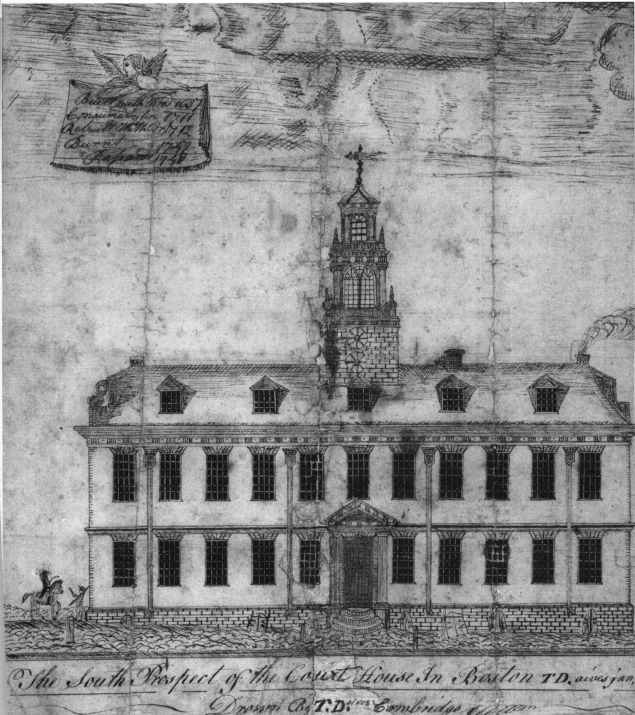
(The picture above also comes courtesy of the Colonial Society of Massachusetts, sharing this article by the late Abbott Lowell Cummings. It’s a 1751 engraving produced by Thomas Dawes and Nathaniel Hurd of the building where the Massachusetts legislature met for most of the eighteenth century, now called the Old State House.)

Tuesday, June 12, 2007

John Adams Hears Some Dirty Jokes

Yesterday I quoted young John Quincy Adams feeling pressure from his father to note down everything useful he hears in a diary. And here’s a couple of ribald jokes John Adams himself wrote down in a notebook he carried in the spring of 1759, when he was twenty-four. The original is at the Massachusetts Historical Society, and readable here.

Ned tells a story tolerably well. He told of [smudge]. He was a better Prophet than Elijah for he stretched himself on her but once to bring her to Life whereas Elijah did 3 times. He breathed into her the Breath of Life.

Ned told the Duke of Whartons Character and Life, &c. Ned was sociable, told the stories he had read pretty well, &c. Billy was sociable too, but awed, afraid.

They told of the wickedest jokes that had been put upon Nat Hurd, by some fellows in Boston, who found out that he had such a Girl at his shop, at such a time. One went to him and pretended to make a confidant of him.

Oh god, what shall I do? That Girl, [smudge] her, has given me the Clap. [smudge]

That scared him and made him cry, Oh damn her, what shall I do? I saw her such a Night. I am [peppered?].

He went to the Dr. [smudge] and was salivated for the Clap. Then they sent him before justice Phillips, then before justice Tyler, in short they played upon him till they provoked him so that he swore, he would beat the Brains out of the first man that came into his shop, to plague him with his [smudge].
Here’s a more dignified portrait of silversmith and engraver Nathaniel Hurd from about a decade later.

Tuesday, January 16, 2007

John S. Copley Paints Nathaniel Hurd

Two days ago Boston 1775 featured John Singleton Copley's portrait of Boston merchant Nicholas Boylston in his cap, banyan, and shaved head. By dressing so casually and resting his arm on books, Boylston showed the world that he was so wealthy and genteel that he could retire from business and devote himself to intellectual pursuits. (Not that I recall any particularly intellectual productions from him, but that's another story.)

Copley painted the silversmith Nathaniel Hurd in much the same style of dress—or undress. That portrait, shown here, is now at the Cleveland Museum of Art. Unlike Boylston, Hurd was a craftsman—albeit a luxury craftsman who worked in gold and silver for an elite clientele. Hurd also engraved book plates and illustrations, which provided a concrete link between him and the volumes pictured on his table. Nevertheless, I sense that Copley struggled over whether it was appropriate to paint a mechanic like Hurd in the same style as a gentleman like Boylston.

There is a similar, unfinished painting of Hurd at Rochester University's Memorial Art Gallery. It also shows the silversmith with a cap over his shaved head, but he has one sleeve rolled up to show his working-man's biceps—not a detail that appears in any other Copley portrait. And Hurd doesn't look happy about the portrayal. He's clearly more satisfied in/with the picture above.

I think Copley's depictions of Hurd map out a middle ground between his images of the Boylston brothers and other wealthy merchants and his now more famous painting of Paul Revere. Copley portrayed Revere as a working silversmith, a silver teapot in his hand and his engraving tools on the table before him. This is a very rare formal portrait of an eighteenth-century craftsman at work, by any artist, and it differs in several respects from Copley's other paintings. Revere wears either his own brown hair or a wig that looks like his natural hair instead of a white wig. He wears an open collar, showing a bit of chest; as far as I can tell, all the merchants and gentlemen Copley painted have their shirts buttoned up tight and cloths around their necks.

And what do you know? Nathaniel Hurd's collar is open, too—more like Revere than like Boylston. I suspect that might symbolize how Hurd wasn't quite as high-class as his cap and banyan might imply.