J. L. BELL is a Massachusetts writer who specializes in (among other things) the start of the American Revolution in and around Boston. He is particularly interested in the experiences of children in 1765-75. He has published scholarly papers and popular articles for both children and adults. He was consultant for an episode of History Detectives, and contributed to a display at Minute Man National Historic Park.

Subscribe thru Follow.it


•••••••••••••••••


Showing posts with label Lynn. Show all posts

Tuesday, March 18, 2025

William Browne, John Glover, and a Farmhouse in Swampscott

Save the Glover is a campaign by several historic organizations in Swampscott and neighboring towns to preserve an eighteenth-century farmhouse.

The house was originally built in the third quarter of the 1700s by William Browne (1737–1802), a wealthy and respected lawyer. It was his country estate since he already owned a mansion in Salem, as well as part of a family seat in what’s now Danvers.

Browne was elected to the Massachusetts General Court in 1762. Though he joined the Customs service in 1762 as collector for the port of Salem, he favored local merchants enough to keep getting reelected—until he voted to rescind the Circular Letter of 1768.

After that, Browne was firmly on the side of the royal government. Gov. Thomas Hutchinson rewarded him with appointments: as colonel of the Essex County militia, as judge in the county court, and eventually as the last royal appointment to the Massachusetts superior court in 1774. That same year, the London government named him to the mandamus Council.

Refusing to resign from the Council made Browne unpopular locally. Dozens of militia officers refused to serve under him. He moved to Boston late in 1774, to Britain in 1776, and to Bermuda as royal governor in 1781. The state of Massachusetts confiscated Browne’s real estate, including that country house and land.

Gen. John Glover (1732–1797) of the Continental Army bought the property and moved in with his second wife in 1782. He lived there for the rest of his life, welcoming fellow veterans and serving in local offices.

In 1793 the Rev. William Bentley recorded how “the general received us with Great Hospitality” when a committee came through to settle the boundaries of Marblehead, Salem, and Lynn. Glover evidently felt he still lived in Marblehead, but surveyors determined that his house stood in a narrow splinter of Salem which later became part of Swampscott.

The property remained a farm through the nineteenth century. The photo above shows how it looked about 1910. In the twentieth century, the original house became the core of a larger inn and then restaurant, both named, in fine Colonial Revival fashion, for Gen. Glover. For the last thirty years or so, however, that complex has been abandoned.

Originally the Save the Glover campaign sought to preserve the house from being taken down for a new residential development (to be called Glover Residences, naturally). However, the developer has scrapped that project. Now weather and decay are the biggest dangers to the Glover house.

Monday, January 20, 2025

John Pope “removed from his late habitation”

It’s possible to follow cancer specialist John Pope’s travels during the Revolutionary War through his advertisements in newspapers.

There was a class of itinerant healers in early America, particularly dentists like John Baker. But Pope had lived in Boston before the war. Not only did he have a family and a Quaker faith community in Boston, but his reputation was strong enough that he didn’t have to go looking for patients; hopeful people came to him.

The siege of Boston disrupted that, sending Pope out to Mendon in the middle of 1775, as mentioned yesterday.

After the British military evacuated Boston in March 1776, Dr. Pope might have returned there, but he didn’t stay. Instead, on 6 July he ran this ad in the Providence Gazette:
The Public are hereby informed, that JOHN POPE who of late Years hath been much noted in curing malignant ULCERS, and inveterate CANCERS, having by Reason of the distressed Situation of the Town of Boston, his native Home, removed into the Country, now resides at Smithfield, near Woonsoket Falls, Rhode-Island Government.
On 22 July Dr. Pope made the same announcement in the Boston Gazette, adding “scrofulous Tumours” to the list of things he was known to cure. Those were swelling in the neck produced by an infection of the lymph nodes, often involving tuberculosis. Since Americans no longer had access to the king’s touch, they need a domestic scrofula cure.

Two years later, on 7 May 1778, Pope told readers of the Independent Chronicle that he had “removed from his late habitation, into Lincoln, at Humphry Farrar’s and expects soon to fix himself in the south of Concord.” Farrar (1741–1816) had mustered in his militia company during the Lexington Alarm and the push onto the Dorchester peninsula. He later moved to Hanover, New Hampshire.

Five more years, and on 22 May 1783 Dr. Pope returned to the Independent Chronicle to announce his new home as “Lynn, Essex County, Massachusetts State, near the Friends Meeting-House.” This ad then added:
He has for sale, at a small Price for the Cash, in the South corner of Concord, about two acres of excellent Land; with some fruit Trees, a well of Water, a small upright House and two other small Buildings; situate very suitable for a Blacksmith, or a good Shoe-Maker.
Folks interested in the property could inquire of a neighbor, Amos Hosmer (1734–1810). Having experience from the previous war, Hosmer had been made a sergeant and then lieutenant in the Middlesex County militia.

Pope’s stay in Lynn wasn’t long, either. On 17 Sept 1785 the Massachusetts Centinel told readers:
John Pope,
Who for 18 years past has been noted for curing Cancers, scrophulous Tumors, fetid and phagedonic Ulcers, &c. has removed into a house, the North corner of Orange and Hollis Street, south end, Boston, Where he proposes to open a school for Reading, Writing, Arithmetick, Surveying, Navigation, Mensuration of superfices and solids, practical Gauging, &c, and an Evening School the 19th inst. [i.e., of this month]
Dr. Pope had finally returned to “his native Home,” and he stayed there until his death in 1796.

[The picture above shows a section on “Mensuration of Superficies” from Nicolas Pike’s A New and Complete System of Arithmetic, Composed for the Use of the Citizens of the United States, published out of Newburyport in 1788.]

Tuesday, July 09, 2024

A Dig into the Lives of Pompey and Isaac Hower

Last month Northeastern Global News published an article about an archeological excavation in what is now Saugus and historical research about a past owner of that site.

This project is a collaboration by Meghan Howey, Alyssa Moreau, and Diane Fiske of the University of New Hampshire’s Great Bay Archaeological Survey; Prof. Kabria Baumgartner of the Northeastern University history department; and their students.

That team is digging into the property and the records of a man named Pompey who lived in Lynn in the late 1700s. According to Alonzo Lewis’s 1829 History of Lynn, Pompey hosted the African-born people of the region for a one-day celebration each year. Baumgartner ties this tradition to the “Negro Election” tradition across New England in that period.

Research into real estate and town records provides some facts that both strengthen that tradition by confirming Pompey’s status as a free black property owner and complicate it with questions of dates:
For instance, research confirmed Pompey’s 1745 marriage to a woman named Phyllis or Phebe, and that he was enslaved by a man named Daniel Mansfield II.

Historians believe Pompey was manumitted, or freed, by the 1750s, but apparently not — as legend holds — in Mansfield’s 1757 will.

“It’s not in the will, and we haven’t found any manumission papers,” Baumgartner says. But she notes that manumission papers are rare to find.

Upon securing his freedom, Pompey borrowed money from another Black man named Isaac Hower to purchase two acres along the Saugus River in 1762. The deed was not recorded until 1787, however, at which time Pompey signed the property over to Hower’s widow, Flora.

But many questions remain unanswered. For instance, if not freed in Mansfield’s will, did Pompey free himself?
And then of course there’s the question of Isaac Hower. What was his story, and how did he gain enough money to be able to lend it out?

The vital records of Salem offer some hints. On 23 Jan 1754, Isaac, enslaved by Samuel Gardner, married Jane, enslaved by Richard Derby. According to the first volume of The Pickering Genealogy, in 1757 Isaac owned the covenant and joined Salem’s First Meeting; this book says he had formerly been called Cato, but the marriage record indicates he was already known as Isaac before that religious experience.

An abstract of Samuel Gardner’s will, dated 1766 and probated in 1769, stated:
As my negro slave named Isaac has generally served me with great diligence and integrity, I give to the same Isaac £10 lawful money with his apparel, and his freedom. If he is unable to support himself, my sons George, Weld, and Henry, to support him.
The Northeastern article thus says Pompey borrowed money from Hower to buy property before Hower was freed, which calls out for more research. Perhaps the purchase and mortgage were separate acts.

The vital records of Salem also record that “Isaac Hower, formerly servant to the late Samuel Gardner, Esq.,” married Mary Banister of Boston in March 1774. Later, it appears, he married a woman named Flora.

The 6 Nov 1787 Salem Mercury reported this death:
Isaac Howard (an African) aged 60——formerly a domestick of the late Samuel Gardner, Esq.---A “good and faithful servant.”
“Honour and shame from no complexion rise;
Act well your part, there all the honour lies.”
Those lines are an adaptation of a couplet in Alexander Pope’s Essay on Man, with the word “condition” swapped out for “complexion.” Such a notice indicated that Hower had stature in Salem.

When Daniel Smith advertised to settle the estate the following January, he used the spelling “Hower,” as did the man’s son, so that was the family’s preference. In December 1788, Flora Hower married Reuben Pernam. The vital records don’t help after that.

Wednesday, February 14, 2024

“Tea which Lot Cheever shook out of his shoe”

Here’s another in the seemingly endless tales of tea surviving from the Boston Tea Party.

The earliest sign of this tea I’ve found is an article in the 7 Nov 1864 Boston Evening Transcript:
Some of the Tea not Thrown Overboard. After the tea was thrown overboard in Boston harbor, Feb 10th, 1774 [sic], one of the party engaged in that movement, Lot Cheever, whose direct descendants now reside in Salem, stopped at the house of Col. Abner Cheever in Saugus to change his disguise. Some of the tea then in his shoes was saved by an old lady of the family, and has from that time until now been carefully preserved.

A lady of the highest respectability and a direct descendant of the Cheever here spoken of, has presented to the manager of the Salem Table at the Naval Fair at Boston a remaining portion of the tea, which will be offered for sale.
The Naval Fair was a fundraiser for sailors in the U.S. Navy, then engaged in quelling another rebellion.

The famous Boston Tea Party didn’t take place 250 years ago this February, and neither did the less famous second Boston Tea Party. No previous source links Lot Cheever to that action. (A Bostonian named Ezekiel Cheever was one of the volunteers patrolling the docks starting in late November.)

In fact, the only man named Lot Cheever I’ve found in the Revolutionary period lived in Danvers. It makes little sense for a man from that far away to take part in destroying the tea in Boston on 16 Dec 1773. It makes even less sense that such a man would travel all the way from Boston to Saugus before removing his disguise.

Incidentally, the man that newspaper story called “Col. Abner Cheever” was only eighteen years old in 1773. He family home was in Lynn, evidently the part of that town which became Saugus in 1815.

People must have realized that some details of that family lore made no sense because over the following decades it evolved to come closer to the standard story.

In 1878 Horace E. Scudder wrote in his novel/travelogue The Bodleys on Wheels about the main characters visiting the East India Marine Hall in Salem and seeing “a little packet of tea which Lot Cheever shook out of his shoe after he had been at the Boston Tea-party.”

A correspondent to St. Nicholas magazine in 1893 described seeing at the Essex Institute in Salem “two bottles of the tea that was thrown over board at the Boston tea-party,—it was found in the shoes of Lot Cheever after removing his disguise.”

That same year, at the 1893 Columbian Exposition in Chicago, the historical exhibits inside the U.S. pavilion included:
Tea in Bottle
Which was found in the boots of Col. Abner Cheever, of the Boston Tea Party, December 16, 1775 [sic], when changing his disguise after the affair was over. Loaned and collected by Dr. D. W. Cheever, Boston, Mass.
Lot Cheever was thus erased from the story. In 1888 the Essex Institute reported that it had received a “pocket-book of Col. Abner Cheever of the Boston Tea Party.”  

The longest presentation appeared in Lynn in the Revolution (1909), in the entry on Abner Cheever:
Family tradition says that he took part in the famous Boston Tea Party. His grand-niece, Miss Rachel Cheever, of Saugus, has still in her possession a small phial of tea which, it is said, he brought away from the party in his shoes.

Many of the older people remember the venerable patriot who was known as Colonel Cheever in his latter days. He was a tall man, rather thin in face, and smooth-shaven in accordance with the old-time custom. He was the last survivor but one in Saugus of the battle of Lexington. He died September 13, 1837, aged eighty-two, and was first interred in a private tomb which had been built upon his estate, but some few years ago his remains were transferred to the new Saugus cemetery and buried in the Perley lot. A marble stone and marker of the S.A.R. were erected at his grave in 1903.
Because one sample of tea can easily be divided, it’s possible there were multiple small containers of tea from the Cheever family on display in the late 1800s. These sources speak of “a little packet,” “two bottles,” one “Bottle,” and “a small phial.” These could all be separate items, or the family might have retrieved tea they loaned to various displays.

Might any of these tea samples survive today? The most likely depository would be the Peabody Essex Museum, successor of the East India Marine Hall and Essex Institute. But the last reports of the tea said samples were owned by “Dr. D. W. Cheever” and “Miss Rachel Cheever.”

(The photo of the Abner Cheever pocket-book above appeared in volume 5 of Elroy McKendree Avery’s A History of the United States and Its People [1908].)

Saturday, October 07, 2023

Dr. Henry Burchsted and the Whale

On 9 Dec 1755, Richard Pratt of Lynn wrote in his journal:
Was a Whale taken up at Sea and Brought in To Kings-Beach abought 75 feet Long
King’s Beach now straddles Lynn and Swampscott, but at this time Swampscott had not yet broken off.

The 15 December Boston Gazette reported:
We hear that a large Whale 75 Feet in length, was drove ashore dead on Lynn Beach a few Days ago.
The same day’s Boston Evening-Post added:
’Tis said she is claimed by a Cape-Cod Man, who struck her on the Banks, and 2 of his Irons were found in her. Several curious Persons from this Town have been down to view her.
Almost seventy-five years later, Alonzo Lewis shifted the whale’s gender and added a new detail as he wrote in his History of Lynn (1829):
Dr. Henry Burchsted rode into his mouth, in a chair drawn by a horse; and afterward had two of his bones set up for gate posts, at his house in Essex street, where they stood for more than fifty years.
Dr. Burchsted (1719–1807) was a third-generation physician. His grandfather had reportedly immigrated from Silesia about 1685. His father had died earlier that year. At least one of his brothers also went into medicine.

Because there’s a line of overlapping Henry Burchsteds, their genealogy isn’t entirely clear, but it looks like this physician married Anna Potter in 1742 and had a child, naturally named Henry, a short time later. At the start of the Revolutionary War, Dr. Burchsted owned one slave.

The doctor’s striking gate of whalebones “disposed in the form of a gothic arch” stood near the foot of High Rock, now a park with a tall stone observatory.

The doctor’s son Henry grew up to become a shoemaker on Boston Street, and another physician bought the house with the whalebone gate. That landmark was really helpful, local chroniclers said, for people trying to find their way to the fortune-teller Moll Pitcher, who lived in a small cottage nearby.

(The photo above shows not Dr. Burchsted’s gate, which is long gone, but a similar arch erected in front of the Captain Edward Penniman House in the Cape Cod National Seashore in 1969. This picture was taken shortly before those bones were taken down in 2018 because they were deteriorating, also after about fifty years.)

Thursday, December 01, 2022

Rewards Offered in 1798

As quoted yesterday, in July 1798 David Stoddard Greenough offered a “ONE DOLLAR REWARD” for the return of his teen-aged indentured servant Dick Welsh.

I wanted to know how that compared to rewards other newspaper advertisements announced for other people. So I looked up the word “reward” in Massachusetts newspapers from June and July 1798.

Here’s what advertisements offered for people of different sorts, sorted from smallest reward to largest:
  • John Scofield, 19 years old, indented to John Neat, Boston: 1¢.
  • Eber Potter, 15, indented to Eliel Gilbert, Greenfield: 1¢.
  • Stephen Mulforde, 13, indented to Daniel Pepper, Boston: 1¢.
  • Elisha Roberts, 16, indented to cordwainer Enoch Mower, Lynn: 1¢.
  • Silas Nowell, boy, indented to printer Edmund M. Blunt, Newburyport: 5¢.
  • Jacob Phelps, 16, indented to Jonathan Whitney: 6¢.
  • Joseph Larrabee, 19, indented to John Newhall, Lynn: 20¢.
  • John Sturgis, 16, from the sloop Nancy: $4.
  • Walter Spooner Belcher, 18, indented to carpenter Marlborough Ripley: $5.
  • John Holbrook, 22, and Ebenezer Hollis, 20, soldiers deserting from Castle Island: $8.
  • Prince, 20, enslaved to Joseph Willcox, 2d, Killingworth, Connecticut: $10.
  • Ebenezer Buckling, 19, indented to papermaker Hugh McLean, Milton: $20.
  • John Barton, adult, sailor who had taken $20 advance pay from Capt. Stephen Curtis: $20.
  • John Wilcot, adult, accused of stealing a horse from Caleb Easty: $50 for man and horse, $30 for horse and tackle alone.
  • Frank, 25, sailor enslaved to Elijah Grinnelds of Virginia: $50.
  • Joseph Haslett, adult, suspected forger: $100.
Greenough’s one-dollar reward for Dick Welsh was much more than some masters offered for their missing apprentices, but that probably reflected Greenough’s wish to be seen as a wealthy landed gentleman. He could afford to toss out a dollar where other men offered only a penny.

Nonetheless, Greenough’s message was probably the same as that from Neat, Gilbert, and the other masters at the top of the list above: this runaway is worthless, and I bought this newspaper notice only as a legality and to make life on the run more difficult for the lad.

For pocketbooks, horses, watches, and other property, people offered substantial rewards—sometimes for the goods alone, sometimes more for the goods and the thieves. Greenough himself advertised a $50 reward in May 1791 for thieves who had broken into his house and stolen a lot of gold and silver items. For people who could just walk away again, not so much.

It’s notable that masters were willing to pay far more for enslaved workers than apprentices. After all, those black men had taken many more years of free labor away with them. Not until the case of the slave-child Med in 1836 did Massachusetts law hold that people enslaved in other states became free if their owners brought them into the commonwealth.

One last observation: Ebenezer Buckling must have learned a lot of the valuable trade of papermaking to be worth $20.

Tuesday, September 15, 2020

An Acquittal and a Conviction

On 29 Aug 1775, Gen. George Washington told Richard Henry Lee, “I have at this time one Colo., one Major, one Captn, & two Subalterns under arrest for tryal.”

The colonel was John Mansfield of Lynn, originally scheduled to be tried in early August. The major was Scarborough Gridley of Stoughton, in the artillery regiment. As I described yesterday, Gridley had stayed out of the main fighting at Bunker Hill and ordered Mansfield (who had a higher rank) to keep his infantry regiment nearby.

The captain was another artillery officer, Capt. Edward Crafts (1746-1806). He was a younger brother of Thomas Crafts, one of the Loyall Nine who organized the first public protest against the Stamp Act and then remained active in Whig politics. Thomas was an officer in Boston’s militia artillery company, and Edward trained in that unit as a young man.

Edward Crafts was a tinner by profession. He was still in Boston in 1770, when he supplied a deposition for the town’s Short Narrative of the Horrid Massacre. But back in 1768 he had married a country girl, Eliot Winship of Lexington. In 1771 the growing family moved to Worcester. At the end of 1773 Edward became a founding member of the American Political Society, his new town’s new club for Whig politics.

As the province moved toward military conflict in 1774, Worcester put Crafts on a committee to acquire and mount four cannon. He started to train a militia regiment to use those guns. Both Massachusetts Provincial Congress records and spy reports to Gen. Thomas Gage describe a large number of artillery pieces in the town by the spring of 1775.

When war broke out, however, Edward Crafts marched as a private in the town’s minuteman company. Then he returned home and recruited an artillery company to serve through the rest of the year. According to most listings of the Massachusetts artillery regiment under Col. Richard Gridley, Crafts was the senior captain.

That might have given him the stature, and the boldness, to challenge Maj. Scar Gridley. The colonel’s son was nominally fourth in command of the regiment, but in practice he was the colonel’s main aide and protégé. Sometime in the summer of 1775, after Maj. Gridley had behaved so ineffectually at Bunker Hill, he and Capt. Crafts exchanged words and accusations.

That led to the first of a series of court-martial proceedings, starting 1 September. The next day’s general orders announced the verdict:
Capt. Edward Crafts of Col. Gridley’s regiment of Artillery, tried yesterday by a General Court Martial, is acquitted of that part of the Charge against him, which relates to [“]defrauding of his men,” and the Court are also of opinion, that no part of the Charge against the prisoner is proved, except that of using abusive expressions to Major Gridley; which being a breach of the 49th Article of the Rules and Regulations for the Massachusetts Army; sentence the Prisoner to receive a severe reprimand from the Lt Col. of the Artillery in the presence of all the Officers of the regiment and that he at the said time, ask pardon of Major Gridley for the said abusive language.
The lieutenant colonel of the regiment was William Burbeck. I have no idea if he made Capt. Crafts perform this ritual before the end of the month because there was still more legal business to get through.

According to the diary of Lt. Benjamin Crafts (an Essex County cousin of the Crafts brothers from Boston), Col. Mansfield’s court-martial started on 8 September. A week later, on 15 September, the commander’s general orders declared the outcome:
Col. John Mansfield of the 19th Regt of foot, tried at a General Court Martial, whereof Brigdr Genl [Nathanael] Green was president, for “remissness and backwardness in the execution of his duty, at the late engagement on Bunkers-hill”; The Court found the Prisoner guilty of the Charge and of a breach of the 49th Article of the rules and regulations of the Massachusetts Army and therefore sentence him to be cashiered and render’d unfit to serve in the Continental Army.

The General [Washington] approves the sentence and directs it to take place immediately.
Notably, although the Continental Army kicked Mansfield out, the voters of Lynn chose him for their town committee of correspondence, inspection, and safety almost every year until the end of the war, and also voted to have him moderate town meetings.

Likewise, the voters of Newbury sent Samuel Gerrish to the Massachusetts General Court in 1776, the year after the army cashiered him the same way. Those gentlemen’s neighbors felt they still deserved leadership responsibilities.

COMING UP: The trial of Scarborough Gridley.

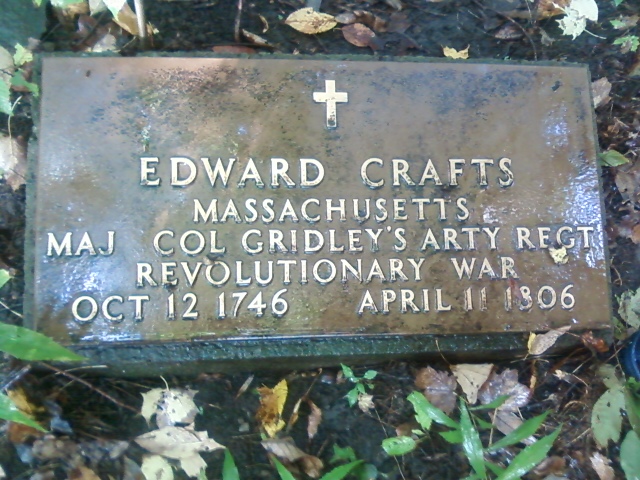
[The photo above shows the modern marker on Edward Crafts’s grave in Potter, New York, where the family moved in 1792, courtesy of Find a Grave. The original stone also survives there.]

Thursday, August 06, 2020

“Two floating batteries came up Mystic River”

Back in June, we left the town of Malden worrying in mid-1775 about being attacked by British forces out of Charlestown, across the Mystic River.

The town had ended up with two cannon from Newburyport. Locals built earthworks near the landing of the Penny Ferry from Charlestown and strengthened the buildings there. (A comment on that June posting reminds us the ferry landing was near what’s now the Encore Casino in Everett.)

To guard that site, the Massachusetts army assigned a company of Malden men to their home town. Their leader was Capt. Naler Hatch (1731-1804), who had learned to command at sea. Locals remembered him as “a stout built man, rather rash in temper, and fiery in zeal.”

Deloraine Pendre Corey’s history of Malden says that on 23 July Christian Febiger, the Denmark-born adjutant of Col. Samuel Gerrish’s regiment in the Continental Amy, wrote of the situation at Malden:
Capt Hatch of Colo. [Thomas] Gardners Regiment is there with one Company & has to mount 20 men on Guard every Day without Officers, three Relieves is 20 men privates mounting every Day & then they have no Sentries on the River which by the Description and the Situation of the place wants at least 4 Centries every Night.
Gerrish moved Capt. Eleazer Lindsey and his company from Winnisimmet in Chelsea to strengthen that spot in Malden. Lindsey was a 59-year-old veteran of the last war from Lynn. His men had signed up from several Essex County towns.

On Sunday, 6 August, the British finally came. Lt. Benjamin Craft of Manchester, stationed at Winter Hill, wrote in his diary:
Just after [morning] meeting two floating batteries came up Mystic River and fired several shots on Malden side, and landed a number of regulars, which set fire to a house near Peny ferrys which burnt to ashes.

One Capt. Lyndsly who was stationed there, fled with his company, and got before the women and children in his flight.

We were all alarmed, and immediately manned our lines, and our people went down to Temple’s Point with one field piece, and fired several shot, at the regulars, which made them claw off as soon as possible. Gen. Gage, this is like the rest of your Sabbath day enterprises.
“Temple’s Point” was no doubt part of Robert Temple’s farm in what is now Somerville.

Katie Turner Getty described this fight in detail from the perspective of Lt. Col. Loammi Baldwin, then stationed in Chelsea, for the Journal of the American Revolution. Baldwin reported directly to Gen. George Washington:
I proceeded to Malding as quick as possable found that Capt. Lindsey was gone home, & his Company dispersd, all but a few with the Lieut. was down at the House that was Burnt[.] I went to him and enquired into the matter who Informd me that the Capt. was gone Home & near one half the Company was fled & where they were gone he could not tell, I ordred him to Rally his Company & Guard his Post which he Seem’d willing & ready to preform as far as Lay in his Power.
It appears that the lieutenant was Daniel Galeucia (also spelled Gallusia and Galushe, 1740-1825). In an odd twist, he was married to Capt. Lindsey’s daughter.

By this time the British were back over in Charlestown, parading on shore in triumph. Inside Boston, though, selectman Timothy Newell noted in his diary “several Soldiers brought over here wounded.”

COMING UP: More fighting and a court-martial or two.

Thursday, September 01, 2016

How Moll Pitcher Told Fortunes

When Lynn historian and poet Alonzo Lewis first wrote about Mary “Moll” Pitcher in 1829, he described her reading tea leaves. But he immediately stated the real source of her insights:
She also availed herself of every ordinary mode of information, particularly by causing one of her domestics to talk with her visitors, to elicit the nature of their business, while she remained in an adjoining room, pretending to be absent. These arts, added to her natural shrewdness, and readiness to seize the slightest hint which might assist her in her surmises, appear to have constituted the whole amount of her power.
Likewise, in his 1852 Life of Lord Timothy Dexter Samuel L. Knapp described how Pitcher won the trust of that eccentric and superstitious merchant:
The first time he visited the dame he went in disguise; but she soon found him out, but, concealing the fact, told all that had happened to him for many years past, and this chained him at once to the full belief of the potency of her spells.
An article about Pitcher in the 12 July 1879 Boston Traveller went further in presenting Pitcher as a deliberate con artist. That was more than sixty years after she had died, and it’s quite possible the stories had been made more entertaining in those decades. Even the anonymous chronicler cited his or her sources with ambivalence: “according to all reports—they are nothing more.” But that article said:
It was always the aim of Moll to find out as much as she could, from whoever wished to consult her, of the circumstances which led to their desired consultation with herself. She could not do it herself, for that would be too suspicious.

Just here the daughter “Becky” was of value. She was to receive the visitors and talk with them. She was to tell them that her mother was away, but would be back presently. The truth is, however, that Moll was hid in one of the adjoining rooms, and was intently listening to the conversation, which of course was very material to her. When she had gathered all she cared to know and was ready to enter, she slipped out and entered by the door. Then with a wonderful accuracy she proceeded to tell all the circumstances, and fairly startled her visitors with her knowledge. . . .

Moll sometimes demanded a high price for her tales, and woe be to the person who refused it. Here, again, “Becky” is said to have been required. In the upper chamber of the hovel was kept a large ox-chain, but sufficiently light for a woman to drag about upon the floor. This chain was supposed to be attached to the devil: really it was attached to “Becky,” and she moved it about when required. If any visitors refused to pay the price which Moll demanded, they were told that the devil would be after them. Immediately the ox-chain is dragged across the floor above by Becky, and then the visitors immediately “come down,” and on the instant the clanking of the chain ceases. The result was that the visitors were so terribly frightened that they really believed the devil was in the house.
The Traveller had some other unflattering things to say about Moll Pitcher and her children. It reported her son John “did not like to work, and his mother humored his aversion to labor by supporting him.” He became known for his fashionable clothes, “the crack young man of the town.” The author said John Pitcher “married a Marblehead girl” and “died young,” and indeed the town vital records say a John Pitcher married in 1799 and died in 1803 at age twenty-five.

Most damning, the Traveller article included this anecdote about Moll Pitcher, though the author added a cautionary “if true”:
She was peculiar, and had many eccentricities. One was to wear two very large pockets in her dress. They were on each side, and would hold a peck each. Why she wore these pockets was long a mystery. At last it was solved.

One day she visited the grocery and apothecary store of Dr. Lummus, and while he was engaged Moll quietly slipped some articles of merchandise into the pockets, such as tea, coffee, sugar, &c. Unfortunately, Dr. Lummus saw her. He did not openly accuse her at first, but, approaching her, he said: “Moll, I want my fortune told. I have lost a number of articles from my store, and I want to detect the thief.”

Moll tried to turn him aside from his purpose, and laughed at his temporary anxiety to have his fortune told, and promised to tell it at some future time. Dr. Lummus then said: “I know the thief.” And, he emptied the pockets of Moll, much to her discomfiture and displeasure.
The only Lynn apothecary I could find named Lummus was Edward Augustus Lummus, who was born in 1820, seven years after Moll Pitcher died. So if that story had a factual basis, it was mangled in the telling.

Pitcher’s daughters married in Lynn, and their descendants remained in town, preserving some of her possessions. It’s therefore possible the inside stories about her methods to support her family telling fortunes came from straight-talking descendants, or from neighbors, or from locals looking for good tales about the local witch.

Wednesday, August 31, 2016

Visiting Moll Pitcher, the Fortune-Teller of Lynn

To visit the fortune-teller Mary “Moll” Pitcher, chroniclers of Lynn wrote, people looked for the house of Dr. Henry Burchstead. He was the [grand]son of a physician from Silesia, and he built a large house on what is now Essex Street.

More notably, Burchstead set up two large whale bones in the form of a “gothic arch” as his front gate. Alonzo Lewis, followed by other authors, said that visitors to Lynn embarrassed to have people know they were consulting Pitcher would instead ask for directions to “the bones of the great whale.”

There’s one problem with those directions, however. According to a genealogy published in the Massachusetts Magazine in 1910, Dr. Henry Burchstead died in 1755, five years before Moll Pitcher married and decades before Lewis and those other chroniclers lived. [CORRECTION: The Dr. Burchsted who died in 1755 was succeeded by his son, another Dr. Henry Burchsted, who lived to 1807. The younger man set up the whalebone gate.] James R. Newhall’s 1897 expansion of Lewis’s history of Lynn said other doctors took over that house: Dr. Peter G. Robbins in 1805 and Dr. Richard Hazeltine in 1817. But it’s not clear who lived there from 1755 to 1805, covering the bulk of Moll Pitcher’s career. In any case, people looked for the whale bones.

Lewis described “the humble dwelling of Molly Pitcher, which stood on what was then a lonely road, near the foot of High Rock.” A less flattering, secondhand description of Pitcher published in the 12 July 1879 Boston Traveller and reprinted in the 15 July New York Times said the house was

a black two-story hovel, which stood in a large field, familiarly called in those days the Pitcher field. There was a well-beaten pathway running from the old rickety gate up to the single door. Before the door, was placed an irregular block of stone, and even that, to the superstitious, had its terrors. . . .

The field where the cottage stood has been filled with nice dwellings, and there is not a sign left of the mysterious dwelling-place…except the remodeled hovel which stands in the rear. It has been materially changed and would scarcely be recognized.
In the March 1899 Essex Antiquarian, Sidney Perley published a picture of the Pitcher house “as it formerly appeared.” It looks like it had one story and an attic, four windows in front, and a small extension on the left side. That picture shows a standard Georgian center door while the 1879 article stated the “single door…stood to the extreme left of the house and opened into a small entry-way, which, in turn, opened into a rather larger room, where Moll received her visitors. There were two small rooms adjoining this large one, where were used for various purposes.” Those two reports seem incompatible.

Perley included three other relics of Mary Pitcher: her signature from some 1770 document, a black bonnet she was known to wear, and a table.
The Essex Institute, owner of this table, is now part of the Peabody Essex Museum in Salem. I wonder if Moll Pitcher’s table is still in its inventory, and if it gets brought out during Salem’s witch tourism season.

TOMORROW: The exposé.

Tuesday, August 30, 2016

Seeking a Clear Image of Moll Pitcher

To figure out what sort of fortune-telling Mary “Moll” Pitcher of Lynn did requires getting around the romanticized descriptions and legends that grew over the nineteenth century.

For example, in Moll Pitcher’s Prophecies; or, The American Sibyl (1895), Ellen M. Griffin claimed that Maj. John Pitcairn visited Pitcher on 17 Apr 1775, and she took information about the march to Concord that she gained from him to the Marblehead Patriot Elbridge Gerry. (Who was actually out of town that week.)

Likewise, there was a widely commonly reprinted picture of Pitcher, shown here. People who had actually seen her in life said it was a terrible likeness. Authors wrote that she was thin, with “a long Athenian nose,” and as she aged “Her nose became peaked and her features seemed to lengthen.” An 1879 profile said, “Her most habitual mode of covering her head, and one perhaps peculiar to herself, was to bind a black silk handkerchief about her forehead.” Nothing of the sort shown in the picture.

That mythologizing process started even in Pitcher’s lifetime. The only reference to her fortune-telling that I’ve found from before her death in 1813 is a series of letters published in the Boston Weekly Magazine. These started as a debate between the fashionable Boston woman Mary Ann Smartly and the Lynn Quaker Rebecca Plainly. The 26 Feb 1803 Smartly letter says:
And now to address you in your own shocking style.—Good Rebecca, (lord, what an old fashioned name) how knowest thou that my wig is red? Hast thou been to Moll Pitcher, to know what colour it is of? Pray thee, how much did it cost thee and the old witch to ascertain the colour of my wig? For I suppose it is some trouble to Mrs. Pitcher, to conjure up her infernal agents.
A Plainly letter dated 6 March likewise alluded to “Moll Pitcher.” And then on 2 April the magazine published a letter dated from Lynn on 17 March with Moll Pitcher’s name at the bottom. That was a protest against her being misrepresented, using Christian language and allusions. It also mentioned having read Hannah More’s Strictures on the Modern System of Female Education, published in England four years before.

For all of this Moll Pitcher’s protests against people misusing her name, I can’t help but suspect that the real Mary Pitcher of Lynn wasn’t involved in that debate at all. The correspondents and their letters all appear to be literary creations. Smartly and Plainly were voices for an ongoing philosophical debate, and whoever wrote the Moll Pitcher letters appears to have treated her as equally symbolic, even though the real woman was still active.

When Pitcher died, the Rev. William Bentley of Salem wrote in his diary for 19 May 1813:
The death of Widow Mary Pitcher, aet. [aged] 75, in Lynn furnishes two facts to the World. This woman has been commonly resorted to by this neighbourhood as a fortune teller & died in the full reputation of her skill. Some dared to insinuate she was a Witch, but there was no fire or halter in the Law for her. Superstition in this sort is still general among seamen & even among such as are not of the lowest order of them. It is a more pleasing circumstance attending the death of “Mother Pitcher” as she is commonly named by those who call upon her, that her death is said to be the only one in Lynn, for five months past from a population exceeding 4 thousand.
The basic source about Mary Pitcher is Alonzo Lewis’s history of Lynn, published in 1829, revised in 1844, and re-edited by later scholars. Lewis saw Pitcher personally as a child, and his attitude toward her was neither credulous nor disdainful. I quoted what he first wrote about Moll Pitcher a couple of days ago. According to him, “Her only ostensible means of obtaining secret knowledge” was reading tea leaves.

Lewis described people coming to Pitcher with three main questions:
  • “affairs of love.” Yet I haven’t come across a single anecdote about this sort of prophecy.
  • “loss of property.” In his History of the Town of Groton (1848), Caleb Butler wrote that Pitcher was “employed in the search” for valuable millstones lost when a flood destroyed a gristmill around 1700; however, the stones were never found.
  • “surmises respecting the vicissitudes of their future fortune,” particularly ocean voyages. Many sailors visited Pitcher, as did eccentric leather-dresser and merchant “Lord” Timothy Dexter after his first fortune-teller of choice, Jane Hooper of Newburyport, died in 1798.
Pitcher’s pronouncements could affect the maritime labor market. In the first volume of his Narrative of Voyages and Travels (1817), Amasa Delano wrote about the grand ship Massachusetts, launched from Quincy in 1789 to trade with China under captain Job Prince and supercargo Samuel Shaw. It didn’t actually set out until the following year. Why?
It is worthy of remark that the Massachusetts had more than three crews shipped before she sailed from Boston. The greatest part of them left the ship in consequence of a prediction by an old woman, a fortune teller, Moll Pitcher of Lynn, that the Massachusetts would be lost, and every man on board of her. Such was the superstition of our seamen at that time, that the majority of them believed the prophecy, and were actuated by it in their conduct.
Ten years later George Whitney wrote in Some Account of the Early History and Present State of the Town of Quincy, “It is commonly reported that this ship was lost in her first voyage. This, however, is not true. The report probably arose from a prediction, of Moll Pitcher of Lynn, a fortune-teller, that she would be lost and every man in her.” And from the fact that the Massachusetts never did return to America; Shaw sold the ship to some even more desperate Danish merchants in the Pacific.

TOMORROW: Visiting Moll Pitcher.

Monday, August 29, 2016

The Fleeting Facts of Moll Pitcher’s Life

Authors disagree about Mary (Moll) Pitcher’s family background. When she died in 1813, she was said to be seventy-five years old, meaning she was born around 1738. No birth or baptism records have been found to match or confirm that.

In his 1844 revision of his History of Lynn, Alonzo Lewis wrote: “Her grand-father, John Dimond, lived at Marblehead, and for many years exercised the same pretensions [to foretelling the future]. Her father, Capt. John Dimond, was master of a vessel from that place, and was living in 1770.”

However, James R. Newhall wrote in his description of Lynn in the 1888 History of Essex County that Mary Pitcher’s father was named Aholiab Diamond while her grandfather was “Captain John Diamond, of Marblehead.” Newhall later edited and revised Lewis’s book, reproducing Mary Pitcher’s signature but leaving out most details about her.

Samuel Roads, Jr.’s The History and Traditions of Marblehead (1880) hints in yet another direction. It suggests that “the famous ‘old Dimond’ of whom such fabulous stories were told and believed” was named Edward Diamond. “It was said that he was a wizard, and possessed the ‘black art’—which enabled him to foretell coming events, to avert disasters from his friends, and bring distress upon his enemies.” Subsequent authors identified Edward Diamond as inhabitant of the house shown above and Moll Pitcher’s fabled grandfather. More recently, John Hardy Wright’s Marblehead says he was her great-uncle. Or he could have been her great-grandfather by that name, who reportedly lived until 1732.

Writing in the Essex Antiquarian in 1899, Sidney Perley agreed with Newhall that Mary’s father was Aholiab Diamond. The vital records of Lynn say that Aholiab Dimond, “cordwainer, s[on of]. Aholiab, of Marblehead, shoreman,” married Lydia Sillsbee on 11 Dec 1735. The groom was then twenty-five years old, his birth having been recorded in Marblehead.

Perley appears to have rested his case for this paternity on real estate records. In 1738 Lydia’s father conveyed to Aholiab Diamond some land in Lynn in an area known as Wood-end Rocks. Aholiab built a small house there on what would become Essex Street, and Mary inherited that house around 1768. That’s where she received clients for decades until her death.

On 2 Oct 1760 Mary Dimond married Robert Pitcher in Lynn, according to the town’s vital records. Lewis identified Pitcher as a shoemaker, and Perley speculated that he had been one of Aholiab Diamond’s apprentices. Lewis stated that the couple had “one son, John, and three daughters, Rebecca, Ruth, and Lydia.” They don’t appear in town vital records, however, until the daughters start to marry in 1785.

A John Pitcher of Lynn married Lydia Twison of Marblehead in 1799 and died of consumption at the age of twenty-five in 1803. If that was Robert and Mary’s son, he was born in 1778 when his mother was about forty. The couple might well have had other children who didn’t survive.

In his 1844 book Alonzo Lewis, who was born in Lynn in 1794, described Mary Pitcher this way:
She was of the medium height and size for a woman, with a good form and agreeable manners. Her head, phrenologically considered, was somewhat capacious; her forehead broad and full, her hair dark brown, her nose inclining to long, and her face pale and thin. There was nothing gross or sensual in her appearance—her countenance was rather intellectual; and she had that contour of face and expression, which, without being positively beautiful, is, nevertheless, decidedly interesting—a thoughtful, pensive, and sometimes down-cast look, almost approaching to melancholy—an eye, when it looked at you, of calm and keen penetration—and an expression of intelligent discernment, half mingled with a glance of shrewdness.
By that point John Greenleaf Whittier had promulgated a much less flattering description in the poem Moll Pitcher. Whittier wasn’t from Lynn and had never known Pitcher; he was simply replicating the stereotype of a witch, and Lewis wanted to correct that notion.

Lewis also justified Mary Pitcher’s profession, writing, “She took a poor man for a husband, and then adopted what she doubtless thought the harmless employment of fortune-telling, in order to support her children.” And, “She supported her family by her skill, and she was benevolent in her disposition. She has been known to rise before sunrise, walk two miles to a mill, purchase a quantity of meal, and carry it to a poor widow, who would otherwise have had no breakfast for her children.”

TOMORROW: What did people ask Mary Pitcher to do?

Sunday, August 28, 2016

The Original Molly Pitcher

As quoted yesterday, two publications from 1835—one in English and one in German—appear to be the first print appearances of the name “Molly Pitcher” in stories about a female artillerist at the Battle of Monmouth.

But that name had already appeared in print attached to a completely different person: a fortune-teller active in Lynn in the late eighteenth and early nineteenth century.

An article about “Witchcraft” in the October 1825 issue of the Boston Monthly Magazine, edited by Samuel L. Knapp, mentioned “Moll Pitcher, of Lynn,” and stated: “she was so well known to most persons, that their recollections will be better than any description.” Pitcher was such a celebrity, at least locally, that she needed no introduction.

In 1829 Bernard Whitman published A Lecture on Popular Superstitions in Boston. He wrote:
Not many years ago, a man was suddenly missing from a certain town in this commonwealth. The church immediately sent one of her members to consult the far famed fortune telling Molly Pitcher. After making the necessary inquiries, she intimated that the absent person had been murdered by a family of negroes, and his body sunk in the deep waters behind their dwelling. Upon this evidence, the accused were forthwith imprisoned, and the pond raked in vain from shore to shore. A few days previous to the trial, the murdered man returned to his friends safe and sound; thus giving the naughty skeptics occasion to say, that the fortune teller, instead of receiving from the devil information of distant and future events, had actually played the very devil with the superstitious church.
I have no clue about the accuracy of that story, which Whitman told with a frustratingly low number of specifics that can be tracked down.

In that same year, a more complimentary description of Pitcher appeared in the first edition of Alonzo Lewis’s History of Lynn:
The celebrated Mary Pitcher, a professed fortune teller, died on the ninth of April, 1813, at the age of 75 years. Her grandfather, John Diamond, lived at Marblehead, and was for many years celebrated for the exercise of the same pretensions. She was married to Robert Pitcher of Lynn, in 1760, and had several children.

This person has been more celebrated than any individual of her class in modern times. Not only was her name known in most towns throughout the United States, but probably there is not a port in Europe, visited by American ships, that has not heard of the skill of “Moll Pitcher.” Many persons came from places far remote, to consult with her on affairs of love or loss of property, or to obtain her surmises respecting the vicissitudes of their future fortune. Every youth who was not assured of the reciprocal affection of his fair one, and every maid who was desirous of anticipating the hour of her highest felicity, repaired at evening to the humble dwelling of Molly Pitcher, which stood on what was then a lonely road, near the foot of High Rock, with a single habitation nearly opposite, at the gate of which stood two bones of the great whale, which the waves of ocean, in the liberality of their power, had cast upon the beach.

To that place also were seen repairing sailors from the neighboring commercial towns, who were desirous of ascertaining the probable success of their future voyages. Many a reputable merchant too, of whose treasures on the faithless waves, the courier of intelligence had not brought the expected information, and being fearful of betraying the nature of his business by inquiring directly for “Moll Pitcher,” has raised a smile by asking in what part of the town he should find the bones of the great whale.

Her skill was principally exercised for the discovery of things lost, either material objects which had been mislaid or purloined, or the affections of some disconsolate fair one, which had taken the advantage of some favorable opportunity to elope. Her power of evil, if she possessed any, was never exerted, unless to punish such delinquents as refused to pay her for the knowledge which she pretended to impart. Some instances have been related, in which she has evinced an unusual degree of discernment; while in others her assertions have had no relation to facts, but appear to have been the result of mere guess work and presumption.

Her only ostensible means of obtaining secret knowledge, was the simple use of tea-grounds poured into a cup; and as the grains were disposed in a peculiar manner, or assumed a particular form, so she judged of the things to which she fancied a resemblance. She also availed herself of every ordinary mode of information, particularly by causing one of her domestics to talk with her visitors, to elicit the nature of their business, while she remained in an adjoining room, pretending to be absent. These arts, added to her natural shrewdness, and readiness to seize the slightest hint which might assist her in her surmises, appear to have constituted the whole amount of her power.

Her sagacity bore no proportion to the infatuation of those who trusted to it. She seems even to have admitted this, especially in one instance, when some gentlemen offered her a large sum, if she would inform them what ticket would draw the highest prize in a certain lottery. “Do you think,” said she, “if I knew, I should not buy it myself?”

Whatever may have been the witchcraft recognised in the Hebrew law, whether an actual communication with evil spirits, or the practice of deception by the means of false pretensions, an impartial investigation of the facts respecting “Moll Pitcher,” justify the conclusion, that her skill had no other foundation, than the practice of uncommon arts, assisted by an unusual degree of shrewdness and discernment.
In the next decade other authors appropriated Mary Pitcher for literary creations. In 1832 John Greenleaf Whittier published a poem, Moll Pitcher, which described her as stereotypical old witch. (The image above comes from a copy of that book owned by the University of Texas; in it someone has drawn several pictures of Pitcher talking back to Whittier.)

Two years later Samuel G. Goodrich’s Token and Atlantic Souvenir included a fictional story called “The Modern Job” with Pitcher as a character: “Moll Pitcher, or, as she is still called in the neighborhood where she resided, Molly Pitcher, was no ordinary woman. . . . In short, poor Molly, by degrees, was made to be a fortune-teller, and a diviner, in spite of herself.”

Thus, when American authors referred to the Monmouth artillerist as “Molly Pitcher” in 1835, they were echoing a name already well known among American sailors and New Englanders in general. Was that echo some kind of inside joke or allusion lost on us? Or had Revolutionary soldiers nicknamed the artillerist after the fortune-teller from Lynn, and why?

Again, Ray Raphael already noted this curious concatenation of Molly Pitchers in his book Founding Myths and in this Journal of the American Revolution article. Because Pitcher lived in Revolutionary New England, I’m going to dig a little deeper into her curious career.

TOMORROW: Moll Pitcher in the flesh.

Tuesday, May 13, 2014

Kimberly Alexander on Shoes in Lynn, 15 May

Alonzo Lewis’s 1829 History of Lynn says proudly:
The principal business of Lynn is the manufacture of Ladies’ shoes. For the first hundred years from the settlement of the town, this business was very limited. Few persons followed it constantly, and the farmers only pursued it in the intervals of their common employment. The shoes were generally made of neats’ leather or woollen cloth.

In 1750, Mr. John Adam Deaggeor [or Dagyr] came from England, and gave this business its first impulse. After his arrival, shoes were manufactured of finer stuffs—of calamanco, silk and satin. They were made with long straps, for the ladies, like the gentlemen, wore buckles, and the rands were commonly white. The reputation of Lynn shoes soon found way to the cities of the south, and the manufacturers began to extend their business by taking apprentices and employing journeymen.
By 1770, Lynn shoes had such a good reputation in Boston that merchants advertised them as such. During the height of the town’s non-importation picketing in February 1770, Isaac Vibird defended his wife Mary from the charge of buying tea from importer William Jackson by publicly offering to swear that she’d gone into Jackson’s shop only to pick up “a Number of Shoes from Lynn.” Surely Whigs would praise her for supporting local industry!

On Thursday, 15 May, the Lynn Museum will host its annual meeting, at which Kimberly Alexander will speak on “The Art & Mystery of Making Shoes”: New England Shoe Stories from the Long Eighteenth Century. Using the letters and biographies of “clever apprentices, skilled cordwainers, and elegant brides,” Dr. Alexander will explore “how shoes were made, sold, and worn in early New England.”

Alexander teaches courses in museum studies and material culture at the University of New Hampshire, Durham. She was founding Curator of Architecture and Design at the M.I.T. Museum and later worked as Curator of Architecture and Design at the Peabody Essex Museum and Chief Curator of Strawbery Banke Museum. Check out her blog for more on historical shoes and other garments.

Thursday, February 17, 2011

“Avowed Themselves to Be Man & Wife”

Yesterday I described how the 1769 marriage of Mary Dill of Bermuda and printer Isaiah Thomas of Boston fell on difficult times in the early 1770s. According to Isaiah, the relationship came to a head on 23 Feb 1775.

On that date, Mary and “Major Thompson set out on a Journey together to Newbury Port.” Isaiah said he tried to

dissuade his Wife from journeying at so unreasonable a time of the Year & without any apparent Necessity; but she persisted in her Intentions & swore she would go “if it was to her eternal Ruin” as she expressed herself.
Isaiah later described for the authorities what had happened on that trip:
3d. In the Course of said Journey at the House of Mr Woart in Charlestown, the said Thompson was seen in the said Mary’s bed Chamber, conversing with her while she was in bed.

4th. At the House of Mr. Newell in Lynn the said Thompson & the said Mary were discovered in bed together. And in their Conversation were constantly uttering such Expressions of Endearment & affection to each other as plainly indicated the wickedness of their Hearts.

5th. At the House of Mr. [Samuel] Greenleaf in Newbury Port they remained in a separate Room together while they continued there, & from thence they proceeded to Portsmouth in a Curricle.

6th. At the House of Mr. [John] Stivers in Portsmouth the said Thompson & the said Mary both insisted on lodging in the same Room but being known they were forbid they however remained shut up in a Room together.

7th. On their Return from Portsmouth they stop’d at the House of Mr. Williams an Innholder in Greenland; where they avowed themselves to be Man & Wife, had a Room to themselves and lodged together all Night
After Mary Thomas returned to Boston, Isaiah “closely questioned” her, and she admitted that she had sexual relations with Maj. Thompson.

The printer then “forbore to cohabit” with his wife, and in May 1777 filed for divorce. The description above comes from that filing. The Massachusetts Council determined that Isaiah Thomas had proved his case, and granted the divorce that month. Isaiah established himself as a printer in Worcester. I don’t know what happened to Mary.

Who was “Major Thompson,” who had whisked Mary Thomas off to scenic Portsmouth? None other than our old friend Benjamin Thompson of Woburn, later titled Count Rumford (portrait shown above). He held the rank of major in the New Hampshire militia.

As a teenager, Benjamin Thompson had worked for a short time in the same building on Union Street where Thomas had his print shop (now the Union Oyster House). But that was before the Thomases settled in Boston, and it’s unclear how Mary Thomas met the young man. Maj. Thompson had a wealthy older wife up in New Hampshire, whom he would abandon before the end of the year—but that’s another marriage.

Sunday, September 19, 2010

“Suspected by Gen. Gage”

Yesterday I quoted Ezekiel Price recording a rumor of information slipped out of besieged Boston in August 1775 by John Carnes, a retired clergyman and grocer who was working for Gen. George Washington.

On 13 November, Ezekiel Price recorded another tidbit of information that may have come by the same route:

Mr. Carnes (a son of the parson’s) was here this afternoon: he says that it is reported at Cambridge, &c., and believed, that twenty-five hundred Regulars have lately arrived at Boston; he also says that the Regulars, last Saturday, intended to land a number of them at Chelsea,—having their boats, &c., ready,—but the wind blowing fresh against them prevented their setting off.
That rumor might not have come from the parson inside Boston, however. A Carnes family tradition that appears to have hit print first in an 1898 volume of American Ancestry says:
lived in Boston during the siege 1775. corresponded with Gen. Washington, was suspected by Gen. [Thomas] Gage, had his house and papers searched, and was ordered to leave, which he did
Gage sailed away from Boston on 11 Oct 1775, leaving the command to Gen. William Howe. If the family lore is correct about Gage ordering Carnes to leave, that must have happened before October, and Price’s November rumor had a different source. Alternatively, the family might not have remembered the right general’s name.

John Carnes was definitely outside the besieged town by 1 Mar 1776 when he took the job of chaplain to a regiment in the Continental Army. He didn’t remain in Boston throughout the siege.

The entry on Carnes in Sibley’s Harvard Graduates calls the lore “an unsubstantiated family tradition,” but I think the man’s name in Washington’s papers and Ezekiel Price’s August diary offers a fair amount of substantiation for his espionage work. I wonder if there’s more to be found in the papers of Gen. Gage or Gen. Howe.

After serving several months as a chaplain, at one point taking over his colonel’s correspondence with Gen. Horatio Gates, Carnes returned to Massachusetts. By the late 1770s he had settled in Lynn, his wife’s home town. The Rev. William Bentley wrote that “by the prosperity of his children [Carnes] rose to competence, was in the General Court & became justice of the peace.” He was also part of the Massachusetts convention to ratify the U.S. Constitution.

And apparently no one outside of the Carnes family suspected the man of having been a spy. In fact, he appears to have come across as an easy mark, which might be why he had so much trouble as a minister. After Carnes died, Bentley wrote:
His talents were small & his manners displeasing but his simplicity had no vice in it. . . . His poverty returned again towards the close of life tho’ not in extreme. We used often to laugh at Carnes, but there was many a worse man in our wicked world.
That harmless impression might have saved Carnes from imprisonment—because his little spy network had been infiltrated from the start.

TOMORROW: The British army’s moles behind the American lines.

Tuesday, September 14, 2010

The Unhappy Ministerial Career of the Rev. John Carnes

John Carnes was born in Boston in 1723. His father was a pewterer who improved his social position through militia service. During the Big Dig, archeologists explored his land in the North End and discovered wine bottles personalized with the man’s name in the wax seals. Carnes had many children, but only young John was apparently interested in becoming a minister, so his father sent him off to Harvard, paying the tuition in pewter tableware.

While John was at college in 1740, the Rev. George Whitefield (shown here) made his first visit to Cambridge, reportedly preaching under an elm on the common. John felt inspired by this “New Light” religious revival, though the professors and tutors were more suspicious.

John Carnes graduated in 1742, earned his master’s degree, and was ordained as the new minister at Stoneham in December 1746. The following July, he married Mary Lewis of Lynn, three years his senior and from a comfortably wealthy family. John and Mary Carnes looked like they were in for a typical rural Massachusetts minister’s career: many uneventful years in the pulpit, children every two or three years, &c.

But the Stoneham congregation came to dislike and disrespect Carnes. They never raised his salary, and didn’t pay what they promised in a timely way, and finally drove him to resign in July 1757. He published his side of the dispute in the Boston Gazette the next month.

Carnes and his family moved back to his wife’s home town of Lynn. After preaching in various meetings, he accepted the job of minister at Rehoboth’s Seekonk parish in April 1759. Almost immediately some congregants started to complain. Their objections may not have been about Carnes so much as how people were taxed for his salary. The grousers appear to have been a minority of the congregation, but a loud one.

In 1763 a council of men from eight other churches met to arbitrate the dispute. They questioned Carnes and his opponents and concluded:

nothing has appeared inconsistent with either his christian or ministerial character. We have reason to conclude that he hath been uncommonly supported under his continued trials and temptations, discovered a serious spirit, and endeavoured in the midst of numberless discouragements, to carry on the great design of his ministry.
But his opponents still weren’t satisfied, and asked the Massachusetts General Court to intervene. A committee of the legislature investigated the situation in Reheboth and decided once again that Carnes had done nothing wrong. But they found “an unhappy alienation of affection in his people to him, and incurable.”

In December 1764, at the Rev. John Carnes’s request, the Seekonk congregation dismissed him from their pulpit. He was forty-one years old, had a wife and five children to maintain, and had failed twice at the only profession he was trained for.

TOMORROW: John Carnes comes home to Boston.