J. L. BELL is a Massachusetts writer who specializes in (among other things) the start of the American Revolution in and around Boston. He is particularly interested in the experiences of children in 1765-75. He has published scholarly papers and popular articles for both children and adults. He was consultant for an episode of History Detectives, and contributed to a display at Minute Man National Historic Park.

Subscribe thru Follow.it


•••••••••••••••••


Showing posts with label Nathaniel Wheelwright. Show all posts

Thursday, February 02, 2023

A Ko-fi Reward, Cheap for Cash

At the end of last year, I announced a Boston 1775 membership tier on the Ko-fi platform.

And at the end of last month, on Tuesday, I posted the first reward for “Buff and Blue” members. It’s an essay titled “A Bankruptcy in Boston, 1765,” about Nathaniel Wheelwright’s financial failure and the effect it had on what became the Revolution. This is a much expanded, updated, and citation-festooned version of an article I wrote for Massachusetts Banker magazine way back during the Great Recession.

If you’ve signed up to make a small monthly contribution to Boston 1775, you should have received a message about this essay, or it’s waiting for you on Ko-fi. I’m not sure how exactly the platform works since this is the first time I’ve used it this way. If reading about the ripples of one colonial merchant’s bankruptcy sounds intriguing, you can sign up on Ko-fi this month now and I’ll get you the file. Thanks for your support in whatever form.

While revamping this article, I wondered if Boston shopkeepers became more eager for cash payments in 1765 as the Wheelwright bankruptcy and the impending Stamp Act made specie even more desirable. And how could I measure that?

Shopkeepers signaled that they gave discounts to customers paying with hard currency through the phrase “Cheap for Cash.” I decided to ask the newspaper database at Genealogy Bank to search through Massachusetts newspapers for “cheap for cash” (and “cheap for cafh,” since the system more often doesn’t recognize the long s) in each year of the 1760s.

I realized that approach could be thrown off by the arrival of a new newspaper, like the Boston Chronicle in late 1767, or simply by one or two businesspeople who liked that phrase and advertised with it week after week. Still, it’s better to have flawed data than no data.

Here’s the result as a bar graph:

The year 1765 was indeed the peak of “Cheap for Cash” advertisements. However, the big rise actually occurred the year before. Then the total tapered off until a big drop in 1769.

Looking at those lines brings me to these tentative conclusions:
  • The post-Seven Years’ War economic recession started making business harder for Boston shopkeepers in 1764. That situation might well have been one stress on Wheelwright’s finances. His bankruptcy in January 1765 in turn made everyone else’s hunger for hard cash even more urgent.
  • When the British military was active in the region, as in the war years and then in the occupation of Boston that started in late 1768, the paymasters and commissaries brought enough specie into the province that shopkeepers didn’t feel they needed to advertise special pricing for cash.
This is of course a crude methodology, and I’m sure specialized historians could improve on it. For instance, a more detailed count of advertisers could determine how many different shops used the phrase. Breaking years down into quarters or months might fine-tune the analysis. Other phrases besides “Cheap for Cash” might have carried the same message. The overall number of ads could have waxed and waned. But for ten minutes’ work, I’m happy with this.

Friday, February 19, 2021

Meeting the Scollays Together

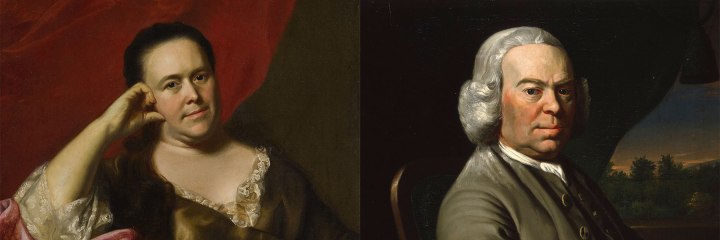
In December the Shelburne Museum in Burlington, Vermont, purchased John Singleton Copley’s portrait of Mercy (Greenleaf) Scollay (1719-1793).

Unknown to the seller, at least at first, the museum already owned Copley’s matching portrait of Scollay’s husband, John Scollay (1712-1790).

Here’s the backstory recounted by Enfilade, the newsletter of the Historians of Eighteenth-Century Art & Architecture:
Completed in 1763, Mrs. Scollay’s portrait demonstrates Copley’s talents and abilities as a painter as evidenced through the beautifully rendered fabric draped around the sitter.

Shelburne Museum founder Electra Havemeyer Webb assembled the American paintings collection with the intention of juxtaposing well-known artists such as Copley with lesser-known itinerant or ‘folk’ painters. She purchased the portrait of John Scollay from Harry Shaw Newman at the Old Print Shop in New York City in 1959. The Museum’s extensive collection of American paintings tell a story about how the fine arts developed and came of age in the United States, and the reunion of these pendants continues to enrich the narrative.
To celebrate the Scollays’ reunion on canvas and explore that acquisition, the director of the Shelburne Museum, Tom Denenberg, delivered an online talk which is now available on the museum’s website and Facebook page.

Denenberg’s talk might overstate Scollay’s political activity in a couple of directions. He was a member of the Boston merchants who often opposed Parliament’s new revenue laws and he served many years as a selectman, including during the siege of Boston. In that way Scollay was a “Son of Liberty,” but we shouldn’t view him as a radical; he was part of the establishment. In addition, as chair of the selectmen he was merely first among equals, not equivalent to a mayor.

The most distinct aspect of Scollay’s political career, I think, is how he was a selectman from 1754 to 1764 and then from 1772 to 1790. Why the break? Because he was caught up in the financial failure of Nathaniel Wheelwright in 1765 and had to declare bankruptcy and rebuild his estate. The fact that he succeeded and was able to return to the selectmen as the board’s senior member reflects how his neighbors must have respected him.

Copley produced another pair of portraits of the Scollays as well, in pastel instead of oil. That picture of Mercy Scollay is at the Harvard Art Museums, the picture of John at the Pennsylvania Academy of Fine Arts.

Friday, October 02, 2020

When William Story Sailed to London

On 2 Oct 1771, the speaker of the Massachusetts House, Thomas Cushing, wrote a letter to that body’s lobbyist in London, Benjamin Franklin.

Though the letter enclosed some legislative news, Cushing was really writing a reference for the man who would carry it to Britain, William Story. Story is an intriguing character because for several years he worked both sides of the political divide in Boston.

In 1763 John Adams listed Story among the members of the Boston political caucus, along with his cousin Samuel, his great-uncle William Fairfield, host Thomas Dawes, John Ruddock from the North End, and other men.

But Story was also a royal appointee, deputy register of the Vice Admiralty Court. That made him a target on 26 Aug 1765, when an anti–Stamp Act protest blew up into an attack on the homes of officials who had nothing to do with that law, including Lt. Gov. Thomas Hutchinson. And William Story.

Those gentlemen asked the Massachusetts General Court to compensate them for their losses. The legislature did so only reluctantly and partially since most of the money would have gone to Hutchinson. Out of the £136 Story asked for, he received £97. Thus, he had a solid reason to resent the Boston Whigs and the General Court.

On the other hand, Story also had a grievance against the Customs Commissioners, and that was the main reason he crossed the Atlantic in the fall of 1771. Cushing’s letter to Franklin laid out the issue:
This will be handed you by William Storey Esqr. who will deliver you the Votes of the last sessions of the General Court.

He goes home to sollicit for releif from the Difficulty under which he at present labours; Natha. Wheelwright Esqr. during Mr. Storeys being Deputy Register in the Court of Admiralty had a Vessell and Cargo Seized and Condemned in said Court from which judgement he appealed; However the Vessell and Cargo were Sold at Public Auction at which Mr. Wheelwright was a Considerable purchaser.
Sometime in the early 1760s, the Customs service seized Wheelwright’s ship and goods for smuggling and put them up for auction. But Wheelwright himself was top bidder on a lot of the stuff, thus regaining ownership, perhaps at a bargain price. (Not a bargain when compared to getting away with the smuggling, but possibly still low enough to be profitable.)

Furthermore, Wheelwright made this purchase with the support of a top Customs officer:
Mr. [John] Temple the surveyer General, with a View of favouring Mr. Wheelwright as much as possible directed Mr. Storey, as he Informs me, to take Mr. Wheelwrights note of hand, in lieu of the Money, p[er?] amount of such goods as he purchased payable [as] soon as the affair of the appeal was fully determined.
At the time, Bostonians traded Wheelwright’s personal notes like cash, so it didn’t seem like a big risk for Story to accept one as payment. But in January 1765 Wheelwright went suddenly, spectacularly bankrupt, and dragged a considerable swath of Boston society down with him.
After some Time Mr. Wheelwright failed and has never been able to Discharge his Note. The Kings Advocate [Samuel Fitch?] has sued Mr. Storey for the Money. Mr. Storey thinks [torn: it would be unreaso?]nable and unjust to oblidge him to pay it, [torn: when he?] Acted in Consequence of orders received from the Surveyer General.

He has applied to the Commissioners of the Customs here, but as it was a Matter transacted before their appointment they can do nothing about it, he therefore has undertaken this Voyage in order to apply for releif to the Commissioners at home. Any assistance you may afford him by your Advise or thro your Influence with those before whom this matter may lie I shall esteem as a favor.
Temple actually was one of the Customs Commissioners from 1767 to 1771, when he sailed to Britain himself in search of even better prospects. But the other Commissioners hated and distrusted him, so they happily disavowed any promise that he had made to Story a decade before.
I would just mention that Mr. Storey was a Considerable Sufferer in the time of the Stamp Act by having his House and Furniture much Damaged by the Mob, who distroyed most of his Books and Papers amoung which there were some relative to the Seizure above mentioned, and for want of which he is fearfull he shall be a great Sufferer.

He had some Compensation made him by our General Court but as all the rest of the Sufferers at that time excepting Mr. Storey, have been Consider’d and in some way or another Compensated by the Government at home he hopes he shall have the more favourable hearing relative to this Matter.
Story was thus hoping for some cash from the royal government, as well as being shielded from the lawsuit over Wheelwright’s payment. And, even though he was carrying letters from some of Massachusetts’s leading Whigs, Story might have taken a new royal appointment as well.

TOMORROW: Samuel Adams’s doubts.

Tuesday, November 12, 2019

Unboxing Pool Spear

Yesterday I noted the difficulty of finding out more information about a sailor with a common name. Luckily, the next person on George Gailer’s list of people who tarred and feathered him in October 1769 has an unusual name: Pool Spear.

Even with the alternative spelling of Poole, it’s easy to track someone who sounds like a toy the Nerf company sends to families posting “unboxing” reviews on YouTube.

In 1864 the New England Historical and Genealogical Register published a confusing “Spear Family Record.” Fortunately, that article offers enough leads to other records that confirm Pool Spear was born 21 Sept 1735 in Hull.

Pool was the younger son of a captain of a packet ship to Philadelphia who died of smallpox in May 1738, when the boy was three. His older brothers included Joseph, a lighterman; Gershom and David, coopers; Nathan, one of the Bostonians who complained about Capt. John Willson in 1768; and Paul. How the parents decided to have successive boys named Paul and Pool is unclear.

In late 1755 Spear did three months of militia service at Crown Point, New York, in Capt. Thomas Stoddard’s company. The men chose him to be an ensign. Back home, Pool became a tailor. I’ve seen estimates that about one in seven mechanics made clothing in some way during those pre-industrial times.

In May 1761, at the age of twenty-five, Pool Spear married Christiana Turner from Pembroke. The family listed their children as Joseph, Daniel, Oliver, Paul, Christiana, and Abigail. However, I’ve found no published church records to confirm that.

In February 1768, Spear declared bankruptcy, part of the wave kicked up by Nathaniel Wheelwright’s failure three years earlier. He listed as his trustees his brother David Spear, Edward Blanchard, and John Soren. That episode was the only time Spear’s name appeared in the Boston newspapers before the war.

Pool Spear was aged thirty-four during the attack on Gailer in late 1769. The other men I’ve been able to identify were all in their twenties (assuming Daniel Vaughan was the younger of the two candidates). However, that wasn’t the last political disturbance Spear was present for.

TOMORROW: Pool Spear and the Boston Massacre.

Thursday, March 07, 2019

William Palfrey at the Boston Massacre

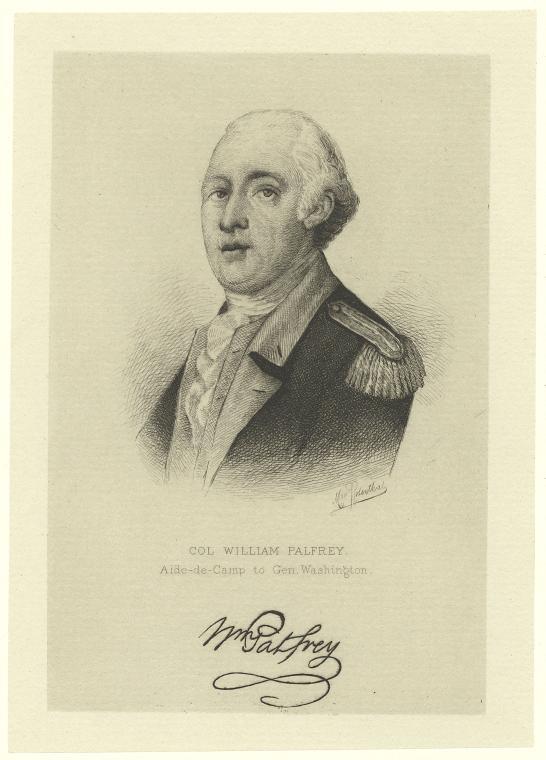
William Palfrey (1741-1780, shown here) was an apprentice and business protégé of Nathaniel Wheelwright, one of Boston’s leading merchants in the early 1760s. Wheelwright’s personal notes circulated like currency in the Boston economy.

In January 1765, Wheelwright suddenly went bankrupt. Palfrey apparently lost his savings and ended up having to take a job as manager of John Hancock’s shop—a big comedown in a society that expected gentlemen not to work for anyone else.

Palfrey made his way back up the ladder, soon managing a lot of Hancock’s transatlantic trade and also much of the Boston Whigs’ correspondence with like-minded British politicians, most notably John Wilkes.

On 5 Mar 1770, Palfrey was writing a letter to Wilkes when he was distracted by a noise outside his house. It took eight days before Palfrey resumed writing the letter, explaining:
I was oblig’d to break off the above by the alarm of ringing a Bell which I at first imagin’d to be for fire, & being not quite recovered of my late illness did not quit the house but sent my servant to see where it was.

He very soon return’d & told me there was no fire but that some of the inhabitants & soldiers were fighting near King Street. I immediately ran out towards the scene of action & had just got to the East end of the Court house [the Town House] which makes the front of King Street, when I heard the discharge of six or seven musquetts.

I ran with many others towards the place, where I was witness to one of the most shocking scenes that ever was exhibited in a Christian Country. Three unhappy victims lay weltering in their gore; two others mortally wounded, & six others dangerously.

This inhuman piece of barbarity was perpetrated by a party of eight men under the command of one Capt. Thos. Preston of the 29th Regiment. All the bells in Town were immediately rung. The inhabitants gather’d. Some in attempting to remove the dead & wounded were threaten’d & wounded by the soldiers.

The Governor [Thomas Hutchinson] met his Council the same night, & he requested the people to disperse and promis’d they should have justice done them. They very justly urg’d to His Honor that the course of justice had been always hitherto evaded or obstructed in favor of the soldiery, and they were determin’d not to disperse till Capt. Preston was committed. Accordingly at three o’clock in the morning he was taken into custody & committed.
This is the transcription published by the Massachusetts Historical Society in 1863. The letter is now at Harvard’s Houghton Library, and Taylor Stoermer shared a slightly different, probably more accurate transcription of part of the letter here.

TOMORROW: Palfrey on the morning after.

Saturday, November 10, 2018

Wheelwright to Apthorp to Molineux

Yesterday I quoted a letter from William Molineux stating that in October 1768 he had agreed to rent buildings near the center of Boston to the royal army, despite being one of the Whig activists most opposed to having troops in town. Was that rank hypocrisy?

When the historian John Richard Alden published that letter for the first time in the New England Quarterly in 1944, he wrote:
It is possible that Molineux acted merely as an agent in these transactions, but it is most likely that he rented his own properties to the British army, in full knowledge that they would be used as quarters for the redcoats.
But a 28 Oct 1768 letter from provincial secretary Andrew Oliver, while also portraying Molineux as a money-grubbing hypocrite, shows that the man was indeed acting as an agent for the real property-owner.

As I quoted yesterday, Oliver wrote that Molineux
made an Offer of the Stores on Wheelwrights Whff. at the modest rate of £400 Sterl. p. Ann:? The General has however agreed with Mr. Apthorp himself for them at the rate of £300 and you may guess who will finally pay the reckoning.   
The final price, per Molineux’s letter, was indeed £25 per month or £300 per year—the price “Mr. Apthorp” had arranged.

“Mr. Apthorp” was Charles Ward Apthorp, oldest son of Boston’s richest merchant and military contractor of the previous generation, Charles Apthorp. The younger man had migrated to New York City with the army command. There he built a successful mercantile career and served on the governor’s council.

After Charles Ward Apthorp dissolved his Boston partnership with his brother-in-law Nathaniel Wheelwright, that led to a frightening wave of bankruptcies in early 1765. Apthorp ended up owning most of Wheelwright’s property. And to manage that property, Apthorp made William Molineux his Boston agent.

Thus, when Molineux wrote that he leased “all the Stores on Wheelwrights Warffe, (so Called)” to the army, he was leasing Apthorp’s property. The 1769 map of Boston even relabeled that wharf as “Apthorp’s” (shown above in the lower left, next to John Rowe’s Wharf).

Oliver’s statement that “The General has however agreed with Mr. Apthorp himself for them” indicates that Gen. Thomas Gage had made a deal with Apthorp before he even left New York. The owner of those buildings wanted the army to have them. Molineux wasn’t acting on his own.

But that doesn’t mean Molineux was above blame. He always had a hard time distinguishing the public good from what was good for himself. In this case, he first offered the Wheelwright’s Wharf buildings for £400 per year. Did he think that would be a prohibitive price that would keep the army out, or did he just want the extra £100? Did Apthorp require him to rent the sugar-distilling house as well, or did Molineux decide to do that on his own?

It’s pertinent that Molineux wasn’t just forwarding the proceeds of these deals to Apthorp with a little commission retained. He was apparently living off the Apthorp properties, tallying up revenue and expenses for some future settlement. In late 1774 that would catch up with him—but that’s a story for another time.

What mattered on 10 Nov 1768, 250 years ago today, was that as the first transport ships carrying soldiers of the 64th and 65th Regiments arrived from Cork, Ireland, the army had secured quarters inside Boston for them.

Monday, August 14, 2017

Women in Debt

I’m about to embark on a summer road trip, so I’ve stockpiled a bunch of interesting items from various corners of the web.

First up is an essay by Alex Wakelam on the Early Modern Prisons site about “The Persistent Presence of the Eighteenth-Century Female Debtor”:
On the 11th December 1742, the young Samuel Foote arrived at London’s imposing Fleet debtors’ prison. At the age of twenty-two the eccentric and extravagant failed lawyer had already been thrown out of Oxford under a cloud of debt, married into money, spent all his wife’s money in London’s premier coffee houses and tailors, and exhausted even the most patient of his creditors. He was thus committed to prison until he came up with the money he owed, amounting to over £650, the equivalent of about £60,000 today.

Foote eventually wrote his way to solvency, cashing in on a highly public family scandal, subsequently taking the London comic scene by storm and ending his life as one of London’s wealthiest theatrical figures as master of the Haymarket theatre. . . .

Behind the young actor entering the Fleet that day was Mary Walpole, a Westminster widow, committed to answer two debts, £20 to William Oakley and £60 to William Harris. Nor was she alone, women made up 9% of commitments to the Fleet that year. They were hardly a majority group though they were certainly far more frequent and representative than artists like Foote. Indeed, other years experienced almost twice as large a female share of commitments.

Even if Foote had somehow not noticed Mary, or (improbably) failed to meet any of the rest of that 9% of prisoners, a letter that arrived shortly after his arrival made him only too aware. The letter, written by his mother Eleanor back home in Truro, must have raised Foote’s hopes upon its arrival, though its contents dashed any hope of rescue, simply reading: “Dear Sam, I am in prison for debt. Come and assist your loving mother – E Foote”. Samuel, without much choice, wrote back “Dear Mother, so am I”.
Dr. Joseph Warren’s mother Mary Warren never went to prison for debt, but she was one of the many people who declared bankruptcy in the mid-1760s after the business failure of Nathaniel Wheelwright. Debt was so widespread in that period that Massachusetts rewrote its bankruptcy law because the prison method clearly wasn’t going to settle enough debt.

Ironically, probate court judge Thomas Hutchinson appointed Dr. Warren to settle Wheelwright’s estate, a knotty task still unfinished when he died at the Battle of Bunker Hill and for several years afterward.

Thursday, April 03, 2014

Memories of History Camp

Remember last month’s History Camp? If you weren’t able to make it, you can still partake of some of the program through the videos that organizer Lee Wright has just posted on YouTube.

Here I am talking about “The Boston Bankruptcy That Led to the American Revolution” (about forty minutes with questions).

Here’s Liz Covart on “How the Patriots Almost Lost the Battle of Saratoga.”

And here’s a panel I missed: “Employment Options for History Lovers.”

Sunday, March 09, 2014

Living in the Past

Yesterday I attended the first (annual?) History Camp, organized by Lee Wright of The History List, at an IBM facility in Cambridge. It was a fun day of meeting other history researchers, students, professionals, and buffs. Check out #HistoryCamp on Twitter for various people’s observations.

In the morning I spoke on “The Boston Bankruptcy That Led to the American Revolution,” as shown here in a photo by Adriene Katz. That was the bankruptcy of Nathaniel Wheelwright in early 1765, and I posit that it unsettled the local economy so much that Bostonians reacted with extra anxiety to Parliament’s Stamp Act.

In the afternoon I gave a workshop titled “How Google Books Changed My Life, and You Can, Too!” trying to share some practical tips for using Google Books (and similar databases of published material like Archive.org, the Hathi Trust, and the Digital Public Library of America).

The day ended with being on a panel about different ways of getting published. That felt a little like blind people feeling around an elephant, but then a lot of the publishing industry sounds like that these days.

And then I went as fast as the T and my feet could carry me to the Old State House in order to participate with many other volunteers in reenacting the Boston Massacre. In this photo from Boston Strolls you can just see me and my script at the far left, resuming narration as wounded men lay on the ground. Check out #BostonMassacre on Twitter, and there are already some videos up on YouTube.

Tuesday, April 28, 2009

“A Stop to All Credit Was Expected”

If you haven’t already read the fourth-quarter 2008 issue of Massachusetts Banker magazine (and I know you’ve been busy), you can download a copy here. It’s 4.9 MB, but some of those bytes consist of my article “A Bankruptcy in Boston, 1765.”

Nathaniel Wheelwright was one of Boston’s leading businessmen in the early 1760s: a merchant, wharf owner, supplier of specie to the British army, and backer of financial notes for people of all classes. He had married into the wealthy Apthorp family, and was the father of three young sons. To quote myself:

Then, in January 1765, Wheelwright suddenly stopped honoring his debts. There is no clue about what exactly prompted this decision, but its consequences were staggering. Governor Francis Bernard reported to London: “This was like an earthquake to the town; numbers of people were creditors, some for their all. Every one dreaded the consequences; lesser merchants began to fail; a stop to all credit was expected and a general bankruptcy was apprehended for a time.”
Eventually this financial crisis caught up several men who might be familiar to Boston 1775 readers: William Molineux, John Scollay, John Rowe, and especially Dr. Joseph Warren, whom Thomas Hutchinson as probate judge assigned to administer Wheelwright’s tangled estate. The repercussions of that crisis, I argue, helped to increase Bostonians’ anxieties about the Stamp Act later in 1765.

Check out Massachusetts Banker for the whole story. I wrote that article in a previous financial quarter, of course, but it seems to have only become more timely.

Wednesday, July 19, 2006

Gossiping about Witches, Rakes, and Rogues

It was nice to read that G. Brenton Simons's Witches, Rakes, and Rogues: True Stories of Scam, Scandal, Murder and Mayhem, 1630-1775, has received an Award of Merit from the American Association for State and Local History.

Brenton, who's now President and CEO of the New England Historic Genealogical Society, and I met while he was working on this book at the Massachusetts Historical Society. As he notes in his notes, we quickly started gossiping about about several of the juiciest scandals of pre-Revolutionary Boston.

Witches, Rakes, and Rogues is a gossipy book, but at no cost to its historical rigor. Indeed, by using his skills and experience as a family historian, Brent has unearthed more documentation about these tales than previous published accounts, and he refrains from going beyond those documents. By "gossipy," I mean that the book focuses on individuals and events that stood out for contemporaries, with no worry about whether such tales are too atypical to matter in larger historical movements. These true stories are interesting in themselves, and that's all the justification this volume needs.

That said, Witches, Rakes, and Rogues has more than enough to make us consider how anomalous individuals might affect larger events. For instance, one of the tales Brent tells involves a powerful Boston merchant named Nathaniel Wheelwright getting conned in 1762 into seeking treasure buried under a mill. Three years after that embarrassment, Wheelwright had to declare bankruptcy, throwing the entire Boston economy into dire straits.

The Boston Post-Boy for 9 September 1765 included this advertisement:

On Tuesday the 10th of September, will be sold by Publick Vendue [i.e., auction], at the Dwelling-House late of Nathaniel Wheelwright Esq; in Green’s Lane, a great Variety of very genteel Household Furniture, among which a quantity of Plate of the newest Taste.—Also a Negro Man and Woman both valuable Servants.
There's the human cost of Wheelwright's financial mismanagement. And for months, the Boston newspapers were filled with people's bankruptcy notices as creditors called in debts. Even the mother of Dr. Joseph Warren, living on the family farm out in Roxbury, had to declare herself bankrupt. Naturally, that economic atmosphere affected how Bostonians responded to the Stamp Act, which promised to take precious hard currency out of local hands.