


J. L. BELL is a Massachusetts writer who specializes in (among other things) the start of the American Revolution in and around Boston. He is particularly interested in the experiences of children in 1765-75. He has published scholarly papers and popular articles for both children and adults. He was consultant for an episode of History Detectives, and contributed to a display at Minute Man National Historic Park.

Subscribe thru Follow.it


•••••••••••••••••


Showing posts with label Aaron Wright. Show all posts

Wednesday, March 15, 2017

“Remarkably stout and hardy men”
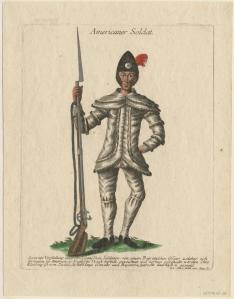
On Thursday, as I announced earlier, I’ll speak at Longfellow House–Washington’s Headquarters National Historic Site about “Washington’s Riflemen: Heroes or Headaches?”

Here are extracts from two journals in the summer of 1775 showing both sides of those Continental soldiers from Pennsylvania, Virginia, and Maryland.

First, Dr. James Thacher, then a surgeon’s mate, under the date of August 1775:
Several companies of riflemen, amounting, it is said, to more than fourteen hundred men, have arrived here from Pennsylvania and Maryland; a distance of from five hundred to seven hundred miles. They are remarkably stout and hardy men; many of them exceeding six feet in height. They are dressed in white frocks, or rifle-shirts, and round hats.

These men are remarkable for the accuracy of their aim; striking a mark with great certainty at two hundred yards distance. At a review, a company of them, while on a quick advance, fired their balls into objects of seven inches diameter, at the distance of two hundred and fifty yards.

They are now stationed on our lines, and their shot have frequently proved fatal to British officers and soldiers who expose themselves to view, even at more than double the distance of common musket-shot.
Second, Pvt. Aaron Wright of Pennsylvania, a rifleman himself, on 10 September:
Great commotion on Prospect Hill among the riflemen, occasioned by the unreasonable confinement of a sergeant by the adjutant of [Col. William] Thompson’s regiment; and before it was over, 34 men were confined, and two of them put in irons at headquarters in Cambridge; on the 12th, they were tried by a court-martial, and one was whipped 17 lashes, for stealing, and drummed out of camp.
Tomorrow night, we’ll look at both sides of those troops.

Thursday, December 22, 2016

M. Voltaire and “that civil war between mother and daughter”?

On 12 Dec 1775, Pvt. Aaron Wright, a rifleman from Pennsylvania serving in Cambridge during the siege of Boston, picked up a copy of the New-England Chronicle dated five days before.

You can read a copy of that same newspaper here, from the Harbottle Dorr collection at the Massachusetts Historical Society.

Wright was particularly interested in one of the front-page items, which had been reprinted from the 18 November Constitutional Gazette of New York. It was headlined as a letter from Voltaire to a Dutch friend “after the defeat of the Spaniards before Algiers,” which had happened in July.

Wright copied much of that item into his journal:
Ever since the religious wars ceased, Christian knights have been totally useless. . . .

Algiers, which has 2 men-of-war of 50 guns each, 4 of 40, and 5 frigates of 30 each, is sole master of the Mediterranean, and prescribes laws to the Dutch, English, French, and Spaniards, each of whose navies consists of at least 200 ships of war; that is ridiculous, you will say. But no matter; they say it is politic. I congratulated myself when I found Spain, most Catholic, cutting throats, and fitting out a fleet to destroy Algiers. But, to my surprise, I soon beheld ten or twelve thousand of them lie dead before the batteries of Algiers, and the fleet sailing home as fast as possible.

But will not France, Great Britain, and Holland immediately join Spain and put a period to these little but troublesome States? No! by no means! Their High Mightinesses, the Dutch, must remain neuter, to sell their powder and ball, as also their cheese, to both belligerent States.

Great Britain is just now engaged in a war of more consequence with her own colonies. Doubtless to know the cause of that civil war between mother and daughter, which has already cost the lives of hundreds, and is likely to throw the whole nation into convulsions, it is in one word this: the daughter colonies say, “We will supply you with every thing in our power, cheerfully, freely, and voluntarily.” But the mother country replies; “Because you will give every thing cheerfully, freely, and voluntarily, you are rebels, and your throats must be cut.”
On that Wright commented, “Which is pretty d—— near the case, I think.”

The presentation of Britain as a cruel mother obviously spoke to Aaron Wright, and he probably liked the picture of the big European states as militarily weak. He must have been pleased to see those observations coming from the famous European philosopher Voltaire.

In fact, that letter appears to have been created in America for an American readership, according to A. Owen Aldridge’s paper, “The American Revolution and a Spurious Letter from Voltaire,” published in 1974. Still, it’s an interesting moment, the rifleman reading the philosophe.

Thursday, December 01, 2016

John McMurtry: “He did not know it was loaded”

On 1 Dec 1775, Pvt. Aaron Wright, stationed in Cambridge, wrote in his diary about a fellow rifleman:
John M’Murtry, in Capt. [James] Chambers’ company, killed John Penn, by his rifle going off, when, he says, he did not know it was loaded. He was cleaning the lock, and put it on and primed it to see how she would “fier.” It shot through a double partition of inch boards, and through one board of a berth, and went in at Penn’s breast, and out at his back, and left its mark on the chimney. Penn put his hand on his breast, and as he turned round, fell down dead, and never spoke more.
I haven’t been able to find out anything more about John Penn.

John McMurtry was in his early twenties. He grew up in Somerset County, New Jersey, but went to Pennsylvania to sign up with a rifle company after the Continental Congress started to raise troops for its newly adopted army in June 1775.

After the shooting, McMurtry reenlisted in the Continental Army for the following year. In fact, he was promoted to corporal on 1 July 1776. According to his pension application, he saw action at White Plains, Trenton, Brandywine, Paoli, and Germantown.

McMurtry recalled becoming a sergeant major and then an ensign on 1 Oct 1779. He resigned from the army on 1 Aug 1780. But then, he said, he went to Philadelphia and signed aboard a privateer named the Fair America under Capt. Stephen Decatur.

McMurtry and his new wife settled in what became Tennessee. He died in 1841. His pension application did not mention John Penn or any other event of note during the siege of Boston.

Monday, February 04, 2013

Gun Accidents in the Founding Era

According to Chris Rodda at Free Thought Blogs, in a recent sit-down with television entertainer Glenn Beck, the debunked author David Barton stated:
I have searched and in the founding era I think I’ve only ever found two gun accidents and everybody was hauling guns back then. You took your guns to church, you were required by state law in some states to take your guns to church. We didn’t have accidents because everyone was familiar with how to use them.
It’s not clear what “law in some states” about taking guns to church Barton had in mind. Clayton Cramer’s Armed America notes laws in colonial South Carolina in 1724 and 1739 requiring white men to bring their weapons to church because of fear of slave rebellions, but those were exceptions. If it had already been usual for “everybody” to go to church armed, the colony wouldn’t have needed new laws to require the practice.

It is clear that Barton’s search for “gun accidents” in the “founding era” was inadequate and produced findings that match his political preferences, not the historical record.

The Boston News-Letter carried this report on 15 Sept 1774:
On Monday last, another very melancholy Accident happened at the same Place [Roxbury].—Mr. Henry Wilson, Baker, in the 32d Year of his Age, having just finished making Bread, spoke to a small Lad, who was standing by him, in Mr. Howe’s Bake house, and told him to take a Gun, and he would learn him the Exercise; the Lad accordingly took a Gun, not knowing it was loaded, and placed it upon his Shoulder,—Mr. Wilson then gave the Words of Command, when he came to the Word Fire,—the Lad instantly pulled the Trigger, and to his inexpressible Grief, shot Mr. Wilson (through the Head) dead on the Spot. The Jury of Inquest returned their Verdict, accidental Death.
That was just when the Massachusetts populace was strengthening its military organization. Was the trained American army free from firearms accidents? Not according to the the diary of Pvt. Samuel Bixby of Sutton:
21st [July]. Friday. A man of Col. Reed’s Regt. was accidentally shot. . . .

7th [Sept]. Thurs:—A Lieut. in Col. Cotting’s Regt. was accidentally shot in the side.
In between those events came this one on 16 August, from the diary of Pvt. Caleb Haskell of Newburyport:
To-day the sentries fired at each other all day; an express came from Cape Ann for men; a number of riflemen marched off; one of the riflemen was shot through the back by accident, but not mortally wounded.
On 16 September, a year and a day after the Boston New-Letter reported the death of baker Henry Wilson, Pvt. Aaron Wright, a Pennsylvania rifleman at the siege of Boston, wrote:
One of the musketmen killed another by accident.
So that’s five “gun accidents” in a little over a year, at least two fatal, all in eastern Massachusetts. And all reported in sources published several decades ago.

TOMORROW: And later in the war?