


J. L. BELL is a Massachusetts writer who specializes in (among other things) the start of the American Revolution in and around Boston. He is particularly interested in the experiences of children in 1765-75. He has published scholarly papers and popular articles for both children and adults. He was consultant for an episode of History Detectives, and contributed to a display at Minute Man National Historic Park.

Subscribe thru Follow.it


•••••••••••••••••


Showing posts with label Thomas Williston. Show all posts

Tuesday, September 30, 2025

Bell-Ringing in 1740s Boston

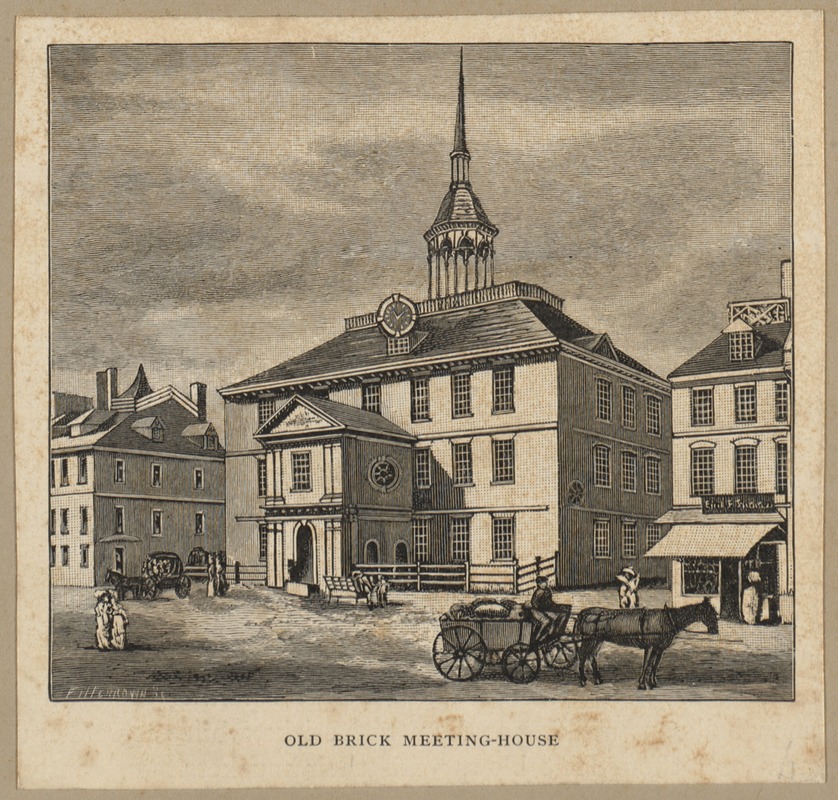
In my research into Thomas Williston, sexton of the Old Brick Meeting-House from the 1740s to the early 1770s, I came across a petition in the town meeting records that gives a taste of daily life in Boston.

On 14 Mar 1744 Williston and four fellow “Sextons & Bellringers” laid out how they rang their churches’ bells each day.

They weren’t ringing every hour—after all, it would be tough to get any big project done if you had to break off each hour to go to the belfry. Instead, they rang at certain hours only.

The town paid Williston to wind the Old Brick clock since telling the time was more of a secular function than a religious one. By the same rule, the town paid the sextons to ring them bells. But those men were paid at different rates.

Specifically:
  • Isaac Peirce, Old North Meeting-House – 1 P.M., 9 P.M., 5 A.M. – £4.10s for each quarter of the year.
  • Nathaniel Band, New South Meeting-House – 9 P.M., 5 A.M. – 50s. (£2.10s).
  • Joseph Simpson, Hollis Street Meeting-House – 9 P.M., 5 A.M., 1 P.M. – £3.15s.
  • John Roulstone, Old South Meeting-House – 1 P.M. – 30s. (£1.10s).
  • Thomas Williston, Old Brick Meeting-House – 5 A.M., 11 A.M., 9 P.M. – £4.10s.
If I were Simpson, I’d ask why I’m being paid less than Peirce and Williston for ringing the same number of times a day. Not being Simpson, I can imagine some reasons for that difference: an easier bell, less seniority, the church being in a less densely populated part of town and thus serving fewer people. But I’d still ask.

Instead of quibbling among themselves, those five men presented a united front and all together asked the town for more money:
the Petitioners would Represent to the Town that the aforesaid Allowance for the Service aforesaid is so very small, being but about Three pence Old Tenor for each Ringing, that the Petitioners Apprehend they are not by any means Recompenced for their Time & Service and as the Petitioners Allowance is no greater now than has been for about Thirty Years past and Provisions & all Necessarys of Life more than twice as Dear as they were Thirty Years since, they Apprehended the Town would think it reasonable to Increase their Allowance
The meeting empowered the selectmen “to Consider…the Ringing of the Bells, and of the Allowance to be made to the Sextons.” That year’s selectmen included Thomas Hutchinson, Thomas Hancock, and Samuel Adams’s namesake father.

In May 1744 some citizens asked for “the Bell at the New Brick Church at the North End” to be rung at 11 A.M. as well, with its sexton paid. The selectmen took up that question, too. But I can’t find any record of their answer. In May 1745 the town “Voted, that the Bell ringers within the Town be paid for the same as formerly,” so it doesn’t look good for the sextons.

March 1745 had brought the news that “the Old Brick Church Bell…is now broke.” Joseph Marion proposed that the Old South Meeting-House bell be rung more often to fill in the broken bell’s times. The meeting “after some debate” approved that plan. But two days later the town reconsidered and decided the bell at Faneuil Hall, normally rung to signal the start and end of business hours, should be used instead. In May Middlecott Cooke proposed that Boston contribute to the cost of fixing or replacing the Old Brick bell “which was lately broke as he apprehends in the Service of the Town.”

In 1746 Samuel Hunstable asked to be paid for ringing “the Bell of the Meeting house at the westerly part of the Town.” The town meeting put him on the same basis as the other bellringers, but also specified that he increase the number of times a day he rang that bell: 5 and 11 A.M., 1 and 9 P.M.

Finally, in July 1747 the town approved a new payment schedule:
  • Ten Pounds old tenor p. Annum, for once a Day.
  • Twenty Pounds—p. Ditto for twice a Day and
  • Thirty Pounds—p. Ditto for three times a Day.
That was a considerable raise for the sextons, and evidently put them all on the same rate.

TOMORROW: Bell-ringing on occasion.
Saturday, September 27, 2025

Thomas Williston, Doorkeeper

Yesterday I introduced Thomas Williston, sexton of Boston’s Old Brick (First) Meeting-House starting in the 1740s.

Williston also took on jobs for the town of Boston. Some of those were tied to his work as a church sexton, such as winding his meetinghouse’s clock and burying the dead. Others were civic tasks, as in managing the weekly traffic of farm wagons at the marketplace.

In June 1754 the town government offered another job: “Mr. Thomas Williston is appointed to attend the Select men in the room of Mr. John Savel who by reason of Age and Infirmities cannot attend the business.” Williston was also given “the care and Oversight of all the Watches in the Town.” And he was still the sexton at the Old Brick.

Thomas Williston’s official title was doorkeeper at Faneuil Hall. As such, he continued to patrol the marketplace, arranged to illuminate the building after the capture of Montreal in 1760, and the next year took down “the Potts & other Iron Ware” from the walls and hung “the Town Ladders” there instead.

But being doorkeeper also involved a lot of running around Boston. In 1758 the selectmen empowered Williston to enforce the town’s newly revised by-laws, including speed limits on vehicles. They sent him out on the water to warn ship captains against unloading “French neutrals” or possible smallpox patients. Along with Deacon William Larrabee, Williston was assigned to warn newcomers out of town—though he did that for only a few months, Robert Love’s Warnings reports. At different times Williston summoned new officeholders, tax collectors, and heads of fire companies to meet with the selectmen at Faneuil Hall.

For the annual inspection of the schools, Williston contacted the many respected gentlemen chosen for that committee. He also visited the two grammar-school masters to obtain the names of the graduating scholars so the selectmen could invite their parents to a dinner at Faneuil Hall. (Students leaving the three writing schools didn’t get a party.)

Some of Williston’s assignments overlapped with his roles as gravedigger, bellringer, and watchman. For example, in March 1761 he informed tomb owners they were responsible for paying to repair a wall of the burying ground. But he could also be told to deliver the seals to the newly elected sealers of leather, inspect leaning chimneys, and warn property owners about dangerous drains.

Williston’s busiest months on record were during the smallpox epidemic of 1764. He appears over and over in the selectmen’s minutes: tracking down reported patients, moving some to the hospital at New Boston in the town sedan chair, installing flags and guards (including his brother Ichabod) outside quarantined homes, hiring and dismissing nurses, smoking homes and clothing, and burying the dead under special arrangements to contain the disease. Thomas, his brother John, his other brother Ichabod, and Ichabod’s wife Elizabeth all got extra pay during those months.

After army regiments arrived in Boston in October 1768, Thomas Williston had the task of telling British officers that the selectmen wanted to speak to them—a potentially volatile clash of authorities. In November he summoned two officers accused of having “insulted & interrupted” the Dock Watch; those officers apologized for being drunk. In July 1770 “Mr. Williston, Door-keeper to the Select-men,” carried a letter from a town committee to Capt. Thomas Preston in the town jail. In September, some sick soldiers came back from Castle Island to enter “the Hospital in the Common”; the selectmen had Williston summon regimental surgeon Charles Hall for consultation.

In sum, Thomas Williston was well known in Boston, the liaison between the town’s highest elected officials and citizens of all sorts. He was based at Faneuil Hall and the Old Brick Meeting-House, but he could show up anywhere in the course of his duties.

On 18 Feb 1773, Isaiah Thomas’s Massachusetts Spy reported the death of Thomas Williston, “sexton of the Old-Brick, and doorkeeper of Faneuil hall.” He was buried in the Granary Burying Ground with his wife Sarah, who had died on Christmas Day in 1771.

Four days later the selectmen met in Faneuil Hall. Those men, “taking into consideration who was a proper Person to fill up the place of Mr. Thomas Williston, who for a number of years had attended them on the Towns Business; Agreed to give the Offer of the office to Mr. William Barrett Sexton of Dr. [Samuel] Coopers Church” on Brattle Street.

Williston’s successor as sexton of the First Meeting-house and, as of 31 March, as a town-approved gravedigger was Josiah Carter. As I discussed here, he had also been a town watchman. However, Carter lasted in that sexton’s job less than two years after Williston’s demise.

Friday, September 26, 2025

Thomas Williston, Sexton

Thomas Williston (1710–1773) was one of colonial Boston’s busiest public servants in the mid-eighteenth century.

Under the prevailing ethos, that wasn’t the status a working- or middling-class man was supposed to aspire to. Society admired “independence,” which meant running one’s own farm or business well enough to support a family, employ others, and own real property. It didn’t view doing tasks for a salary as ideal. But that’s how Thomas Williston worked for most of his adult life.

On 21 Aug 1715, five-year-old Thomas’s parents brought him to Boston’s First Meeting-House to be baptized along with four siblings. It looks like their mother had just been admitted to the meeting to allow that rite. That belated baptism began a lifelong link between Thomas Williston and that church, called the Old Brick.

On 3 July 1733 the minister of the Old Brick married Thomas Williston and Sarah Wormell. Thomas became a full member of that meeting in November 1734, just in time for the baptism of the couple’s first child, born in January 1735. Sarah joined two years later.

Thomas and Sarah had eight more children baptized at the Old Brick between 1738 and 1752, coming in regularly every two or three years. In the “too much information” category, the last five of their children (four births, two being twins) all had birthdays between 20 and 30 August, so we know Sarah Williston had a regular conception window.

I haven’t found sure evidence of what profession Thomas Williston was trained in. (In Robert Love’s Warnings, Cornelia Hughes Dayton identified him as a cordwainer, or shoemaker. However, in the 1748 deposition of “Thomas Williston, cordwainer,” published by the Colonial Society of Massachusetts, the deponent identified himself as fifty years old rather than thirty-eight. So is this the same man?)

In 1741 Thomas Williston became the sexton of the First Meeting-house. He maintained the building, ordered supplies, and carried out errands at the direction of the minister and church leaders. In 1749 the congregation had a big business meeting that ran long. Among its decisions were “that ten Pounds old Tenor be an Addition to Mr Thomas Williston’s Salary as Sexton” and that “Mr Williston should have a list of the large committee and warn said Committee to meet at the adjournment of this Meeting.”

Sextons didn’t get paid much. Indeed, they were proverbially poor. So it’s no surprise that Williston looked for other sources of income. On 9 Mar 1742 the Boston town meeting considered his petition:
Setting forth, That he had been Sexton of said Meeting house the Year past and had Constantly Attended his Duty and it has been an Ancient Custom that the said Sexton should have the Benefit of Publishing the Banns of Matrimony when Capable and most of the Congregation are desirous that he should have the Benefit of Publishing if he had the Order of the Town Meeting for the same
That petition is in fact the earliest evidence I’ve found of Williston’s employment. The meeting had “Considerable Debate” on his request to collect those marriage fees and then voted that “the said Petition should be Dismissed.”

Williston continued to look for public employment. In 1743 the selectmen appointed him to stop “Carts Trucks &c.” from outside Boston from disrupting the market at Faneuil Hall and to keep tents off the Common during militia training day. He worked as a gravedigger—a common task for sextons—and a town watchman.

In 1744 Boston paid Williston £5 Old Tenor for “Winding up the Clock of the Old Brick Church the year past”—though that clock was on the meetinghouse roof, it was a public resource. In 1749 the town tasked him with tracking down the relatives of corpses that had been unearthed during the expansion of King’s Chapel.

The steady job of a sexton looked good enough that Thomas’s younger brother John became “Sexton and Bellringer” at the Old North Meeting-house in March 1747, and their younger brother Ichabod sexton at King’s Chapel from 1754 to 1761. Ichabod also joined the town watch until June 1768 when he was replaced for neglecting that duty.

TOMORROW: On the town payroll.