J. L. BELL is a Massachusetts writer who specializes in (among other things) the start of the American Revolution in and around Boston. He is particularly interested in the experiences of children in 1765-75. He has published scholarly papers and popular articles for both children and adults. He was consultant for an episode of History Detectives, and contributed to a display at Minute Man National Historic Park.

Subscribe thru Follow.it


•••••••••••••••••


Showing posts with label John Piemont. Show all posts

Monday, May 13, 2024

How the Massachusetts Press Responded to the 1783 Earthquake

Prompted by Karen Kleemann’s article quoted yesterday, I looked at how Massachusetts newspapers treated the 29 Nov 1783 earthquake and found some interesting details.

First, we’re used to a standard time extending across an entire time zone. But before railroads, every town had its own noon, and therefore its own perception of when something big happened.

The Massachusetts Gazette and General Advertiser in Springfield said this earthquake was felt “at 40 minutes past 10 o’clock.” The Boston Gazette reported it at “about six minutes before eleven o’clock.” And the Salem Gazette pegged it “at about 11 o’clock.” Of course, it took a few seconds for the shock to travel between those places. The big difference in those times came from how the Earth spins.

All those reports appeared in the first week of December. Starting on 8 December, Massachusetts newspapers began reporting on other places people detected the quake. Printers wondered if it wasn’t as small an event as it first seemed. On 12 December, the Salem Gazette said the shaking was definitely worse in Connecticut and New York.

By 18 December, the newspapers from Philadelphia had arrived, and Massachusetts printers could share details from nearer the epicenter in New Jersey. China and pewter thrown off shelves! People woken from sleep! Aftershocks later the same night!

Still, there were no deaths. Earlier in the year, American newspapers had reprinted news of many people dying from earthquakes in Italy, and similar reports from China.

Isaiah Thomas’s Massachusetts Spy editorialized:
This year must make a conspicuous figure in the instructive records of Time: Great revolutions have occured in the natural and political world.

In Europe the convulsions of nature have destroyed a great part of Sicily, &c. with about one hundred thousand inhabitants. In America such events have taken place, as were before unknown to its civilized inhabitants.

What gratitude is due from us to heaven for its Benedictions—Independence, as a Nation, with the blessings of Peace; and that we have not in the first transports of our national existence met with those calamities that might in a moment have reduced our Continent to its original Chaos!
The Salem Gazette’s 12 December follow-up to its first report ran just above a local disaster with real damage: A fire in John Piemont’s barn in Ipswich had killed one cow and consumed all his hay for the winter.

Back in 1770, Piemont was a hair stylist at the center of Boston, and at the center of Boston events, as I discussed back here. He was able to bounce back from this fire, and in 1784 advertised that he once more offered a stable for horses.

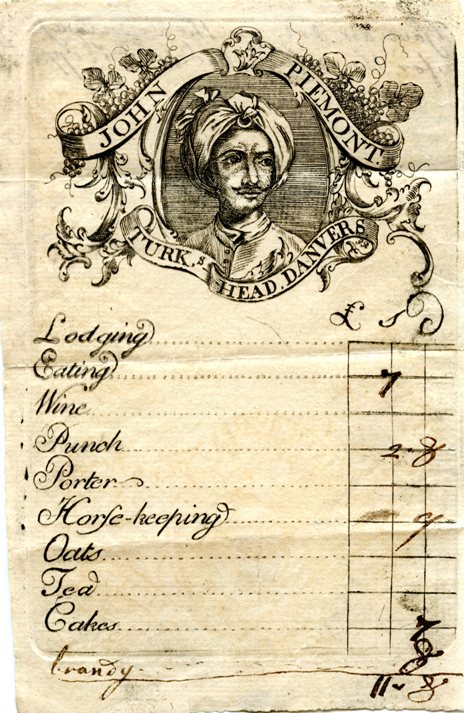
(The broadside shown above dates from almost thirty years after this quake.)

Thursday, December 17, 2020

When John Piemont Set Up Shop in Danvers

At the website of the Danvers Archival Center, part of the town’s public library, Richard B. Trask shared his essay “Discovering Paul Revere in the Dried Prunes Box,” also published decades ago in Family Heritage.

It involves the engraved billhead shown here.
It was the summer of 1969, and I was working for the local Historical Commission as a summer cataloguer and researcher, trying to put into order the thousands of town records. Most of the loose, individual town papers were enclosed in nailed wooden boxes as a result of a W.P.A. project in the 1930s when the records were roughly sorted into various departmental categories. The boxes had originally been used in food relief during the depression and were clearly, and to my eyes humorously, marked, “Dried Prunes–For Relief–Not to be Sold.” Unfortunately, the boxes were not good for storing manuscripts, and many of them had become nesting areas for all sorts of vermin. . . .

Among these handwritten slips of paper, I noticed a very handsome item containing a fine engraving of the shoulders and head of a turbaned and mustachioed man with banners about him proclaiming, “John Piemont. Turk’s Head, Danvers.” The item was a trade bill of John Piemont’s eighteenth-century Turk’s Head Tavern, which was located on the old post road near what is now the junction of Pine and Sylvan Streets in Danvers.

Subsequent to discovering the identity of the trade bill’s printer, I learned from Dr. Richard P. Zollo, who wrote an interesting study on the life of John Piemont titled, “Patriot in Exile,” that Piemont was a Frenchman who settled in Boston in about 1759 and took up the trade of peruke [wig] maker. While residing in Boston, Piemont apparently became enmeshed in the patriot cause. He was a member of St. Andrew’s Lodge of Masons and was actively involved in the events leading up to the Boston Massacre of 1770. In 1773, partly as a result of losing Tory patronage at his wig shop, Piemont moved to Danvers and took on the management of a tavern.
To be exact, apprentices from the shop Piemont shared with another barber and wigmaker were involved in the first violence on King Street on the evening of 5 Mar 1770. One of those teens, Edward Garrick, criticized a passing army officer, and Pvt. Hugh White called the boy over and clonked him on the head.

There’s also a complaint from Pvt. John Timmins about Piemont and some other barbers clonking him on the head, as I quoted way back here. I still can’t make sense of this unmotivated attack, especially since Piemont’s business catered to royal officials and army officers. He even employed a moonlighting private, Pvt. Patrick Dines. I suspect Timmins came up with the complaint after the Massacre when he knew his superiors were eager for complaints about the locals whose names had come up in that dispute.

As Trask writes, Piemont later left Boston and opened a tavern in Danvers. When the war broke out in 1775, some locals “called him a Tory,” and the local committee of correspondence had to vouch for him. But back to the essay.
Months later, while browsing in a local book store I was looking through a book titled Paul Revere’s Engravings by Clarence S. Brigham. A plate in the chapter on trade cards caught my eye. A bill from Joshua Brackett’s “O. Cromwell’s Head” tavern on School Street in Boston, was reproduced. The design, format and size of this Revere engraving was almost identical to the Piemont bill that I had found.

I quickly looked in the index for “Piemont” and was referred to page 175, which stated that Paul Revere’s day book included many charges for engraving advertising cards and bill heads, but that no specimen remains of many of them. In June 1774 Revere made two hundred prints for a charge of 8 shillings to Mr. John Piemont.
Check out Trask’s essay to see the clue that confirmed his suspicion that Paul Revere had engraved this image for the former barber from Boston.

Friday, March 03, 2017

Pvt. Joseph Whitehouse’s Story about Capt. Goldfinch

Yesterday I described how Jane Crothers, an eyewitness to the Boston Massacre, married Pvt. Joseph Whitehouse of the 14th Regiment later in March 1770.

Whitehouse also went to Christ Church (Old North) that month for the baptism of a child of another 14th Regiment soldier, George Simpson, on 14 March. Christ Church was one of Boston’s three Anglican churches, preferred by the soldiers from Britain and Ireland.

By the end of that month, the 14th Regiment had moved to Castle Island in Boston harbor, thus no longer inside the town of Boston and in daily contact with its civilians. They were still there in August, and Pvt. Whitehouse was one of the soldiers who lined up to give testimony to justice of the peace James Murray (shown here) about how badly the locals had treated them.

On 25 August, Whitehouse stated:
That about the latter end of February 1769, he was assaulted in the Streets of Boston by a mob of the townsmen, throwing pieces of Ice and snow-balls at him, calling him Scoundrel, Lobster, bloody back’d dog and much more abusive language, to all which he made no reply.

And further deposeth, that on the 5th. March last in the Evening as he was going to the barracks, he saw a number of the inhabitants striking Capt. Goldfinch who was lying on the ground, his sword taken away, and his face very much bruised, on his attempting to assist him, the mob immediately fell on him, and beat him in such a manner, that it was with much difficulty he reached the barracks.
Capt.-Lt. John Goldfinch of the 14th also played a major role in the events that led up to the Massacre. According to George R. T. Hewes, an apprentice at John Piemont’s shop dressed the officer’s hair in December, and the barber promised that apprentice that he could have the payment for that job. But then Goldfinch didn’t pay immediately, nor, it seems, as soon as the bill came due in three months.

So as Capt. Goldfinch passed by the Customs house on King Street on the evening of 5 March, apprentice Edward Garrick heckled him about the bill. He “owed my fellow Prentice,” Edward called. In fact, by that evening Goldfinch had paid the bill—so recently he still had the receipt in his pocket. But he disdained haggling on the street with an apprentice, leaving Pvt. Hugh White to put an end to the topic by clonking Edward on the head.

Goldfinch was one of the many people who testified about what happened that night. He gave a deposition for A Fair Account of the Late Unhappy Disturbance at Boston, published in London. He testified at the soldiers’ trial. He had every reason to describe the Boston crowd as violent.

Yet Goldfinch never described being personally assaulted, knocked to the ground, “his face very much bruised.” He never described his sword being taken away. Instead, his story was about finding a brawl going on outside the barracks rented from Justice Murray, reestablishing order there, and then hearing the shots from King Street.

Was Pvt. Whitehouse mistaken about which British officer he saw “lying on the ground” and tried to help? That seems unlikely. And if that were so, we would expect to see Goldfinch or another officer complain about that assault on a colleague. The whole point of the Fair Account pamphlet and the depositions collected at Castle William was to paint the townspeople as violent. But there’s no complaint about such an incident on 5 March.

I suspect Pvt. Whitehouse correctly suspected what his superiors wanted to hear about the locals, and knew that Goldfinch was somehow involved in the King Street incident. So he came up with this story of the captain under attack. Whitehouse’s tale is one reason I’m as skeptical about the soldiers’ depositions as I am about the Bostonians’ testimony to their own friendly magistrates.

COMING UP: Don Hagist traces Pvt. Whitehouse’s military career.

Sunday, May 25, 2008

Google Books and Bartholomew Broaders

On Friday morning, Microsoft announced that it was ending its Live Search Books service, in essence acknowledging that Google Books was so far ahead it couldn’t compete. I’m not surprised. At one point I found a few volumes on Live Search Books that hadn’t shown up on Google Books yet, but the downloads were slower and less flexible. And the amount of material on Google Books is just mind-blowing.

Here’s one discovery that would have been nearly impossible without Google Books. It involves Bartholomew Broaders, one of the apprentices of barber and wigmaker John Piemont who was involved in the beginning of the Boston Massacre. Pvt. Hugh White clubbed Broaders’s young co-worker, Edward Garrick, for speaking insolently of the 14th Regiment. According to his own testimony, Broaders yelled at White, demanding “what he meant by thus abusing the people.” A sergeant chased the boys away, but they returned and gathered the crowd that eventually grew threatening. Garrick and Broaders were gone by the time that soldiers fired at that crowd, but they each left testimony about their earlier experiences.

What happened to Broaders after 1770? He was drafted as a private in Lt. Col. Jabez Hatch’s Boston militia regiment in mid-1777 and served for five weeks. Town records show that Boston chose Broaders to be one of its constables in 1783 and 1784. This job usually involved delivering writs and reminding people of the law, not full-time police work. Among the weighty tasks the selectmen gave Broaders and colleagues were viewing coal baskets, trucks, and carts to make sure they weren’t so big as to cause “damage & destruction of the Pavements.”

From church records, I found that Broaders married a young widow named Priscilla Bennett in 1778, and they had six children baptized in the West Meeting-House between 1780 and 1786. Real estate records show that they bought land on Ann Street near the drawbridge that defined the border of the North End in the 1790s.

Broaders got out of the barbering business, which was wise. In pre-Revolutionary Boston, both gentlemen and fashionable tradesmen wore wigs. Learning how to shave heads and build those wigs looked like a lucrative future. But then fashions changed, men started to wear their hair more naturally, and there must have been far less demand for journeymen barbers. (Another trainee in this profession who went into other work was Ebenezer Fox.)

Broaders owned a shop selling “slops,” or sailors’ clothing, according to the 1800 Boston directory. A reference I haven’t fully tracked down says that Bartholomew and Priscilla also ran the Federal Eagle tavern on Fore Street, where the U.S.S. Constitution (shown above, courtesy of the navy) recruited its men. (Bartholomew’s old master Piemont also lived on Ann Street, and had also opened a tavern, though he called his a coffee-shop.) The Massachusetts Mercury says that Priscilla died in 1801, aged forty-five.

By 1802, it was clear that something was wrong with Bartholomew Broaders. According to the Boston selectmen’s records for 10 November of that year:

In compliance with a Warrant from the Honble. Thomas Dawes Jr. Judge of Probate within the County of Suffolk; the Selectmen made inquisition as to the circumstances of Bartholomew Broaders, and find the said Broaders incapable of taking care of himself—& are of opinion that Guardians should be appointed for him
In the 27 Apr 1803 Independent Chronicle, the young lawyer Luther Richardson announced that he had been appointed Broaders’s guardian because the man was non compos mentis. Perhaps court records have more to say about Broaders’s age and condition; I haven’t dared to look yet.

What does this have to do with Google Books? For whatever reason, that reference to Broaders in the selectmen’s minutes didn’t get into that volume’s index. I could therefore have diligently checked his name in the index of every volume of that long series and never found a pointer to this entry. But because Google Books creates texts of the printed material it scans and makes those texts searchable, it brought this reference back to the surface.

Tuesday, February 27, 2007

John Piemont: wigmaker, tavern-keeper, assailant?

John Piemont was born in 1717 or so. He was later referred to as “a Frenchman,” so he probably came to Boston from France or French Canada. I can’t find anything else about Piemont’s life before late 1759, when he advertised in the Boston News-Letter that he was working out of Peter Smith’s house on Union Street. In any event, his trail grows clearer at the end of that year.

On 20 Oct 1762, John Piemont married Hannah Crosby (born in Jan 1739) at Christ Church (now called Old North). They had four children baptized at King’s Chapel: Hannah (1763), John (1766), Elizabeth Murray (1767), and Thomas (1769). In Feb 1766, the couple also sponsored the baptism of John’s apprentice Thomas Allen.

In the 1760s Piemont established himself as a wigmaker on King Street in Boston, one of the town’s busiest streets. In 1767, for example, he sold a bag wig to James Bowdoin, one of the town’s leading merchants and Whigs, but he also served Lt. Gov. Thomas Hutchinson, leader of the court party. In the summer of 1766, Dr. Joseph Warren visited Piemont’s home twice and sold him medicine for a “Servt.,” which was colonial Boston’s usual euphemism for a slave. In 1769, Piemont sold tickets for a fireworks artist and hosted a confectioner—both these men had French names, so he may have been helping out his countrymen.

That same year, according to Pvt. John Timmons of the 29th regiment, Piemont participated in an assault on him. On 28 July 1770, Pvt. Timmons swore to this deposition before the chief justice of New Jersey:

That on the Fourteenth June, One Thousand Seven Hundred and Sixty Nine, he had the Main Guard [i.e., was on sentry duty] in Boston, and between the Hours of Nine and Ten O’Clock at Night, was Knocked down in the Street, by the Blow of a Stone, or Brickbatt, as this Deponant Supposes, and after he Recover’d Himself, he heard a Woman shout Murder, & said the Rogues that struck this Deponant was gone up that way, Pointing towards the South Meeting House, upon which word she was pushed down, and Damn’d for a whore to Keep Silance,

this Deponant then persued according to her Directions, and turning the Corner of the Meeting House, was met by three persons armed with Clubs, who Gave this Deponant a blow on the Forehead, which Knocked him down and Cut him very much, that on this Deponant attempting to rise to Defend himself, they Gave this Deponant another most Desperate Cut on the head, which Rendered this Deponant incapable of helping Himself, and Quite Sensless, they afterwards most Terably Kicked this Deponant, and Dragged him along the Streets but hearing the Main Guard was coming, they left this Deponant for Dead, upon which one Mr. Winslow an Inhabitant, ordered this Deponant to be carried into a House, and Sent for the Docter of the Fourteenth Regiment, who Dressed this Deponant’s wounds, and with a great Deal of Difficulty stopt the Blood,

The Docter at the Same time Asked Mr. Winslow, if those Villians could not be found out, Mr. Winslow told the Doctor, they should be found out, and the Next Morning Mr. Winslow and Mr. [Harrison] Gray (Provincial Treasurer) informed this Deponent of three of the Men they knew, which were John Reed, Josiah Davis, & John Paymount all three Wigmakers and Inhabitants of Boston, and advised this Deponant, to take the Civil law of them, upon which this Deponant applyed to Justice [Edmund] Quincey, when after informing him of the abuse Received, the said Justice advised this Deponant to drop it, if the said Reed, Davis and Paymount would make the Deponant any Restitution, telling this Deponant, it would put Him to more expense then he could afford saying they might postpone it from Court, to Court, upon which this Deponant Imagined the Said Justice Mean’d to baffle him, and insisted for a Warrant, which the said Justice Refused at that time, telling this Deponant he had too Much business in hand, and Desired this Deponant to Come in the Evening, which he accordingly did,

The Said Justice then advised this Deponant to make it up, and said he would send for Mr. Davis, to whome he had Given a Warrant against this Deponant, after this Deponant had left his, the Said Justices House in the Morning, Which this Deponant Refused. Desireing the Said Justice again to Grant a Warrant, which the Chief Justice Refused a Second time, on pretence of Business, Upon which this Deponant, apply’d to two other Magistrates Justice Deney [Francis Dana?] & Justice [John] Hill who both put this Deponant off with Excuses of the same Nature, nor could this Deponant Gett any Satisfaction, for the Injury he had Received, and further Saith not.
There were many brawls like this between soldiers and locals in 1768 and 1769. Some Boston magistrates, including Quincy, Dana, and Hill, did discourage British soldiers from taking legal action after these fights, and put obstacles in their way. Crown authorities took Pvt. Timmons’s deposition, along with scores of others, in mid-1770 in order to document how badly Boston had treated those soldiers.

However, the notion of Piemont assaulting a soldier like this doesn’t add up for me. It seems a bit extreme for a fifty-two-year-old man. It also seems odd that Winslow and Gray were able to track down the soldier’s mysterious assailants overnight. In fact, I can’t track down wigmakers named John Reed and Josiah Davis at all.

Most important, this assault doesn’t fit with how we know Piemont was running his wigmaking business in 1769-70. Not only did he serve royal officials and British army officers, but in March 1770 he was employing Pvt. Patrick Dines of the 29th regiment. Soldiers were allowed to moonlight in order to earn extra cash; this produced some resentment among local workers, but employers like Piemont probably liked a larger labor pool.

Furthermore, within five years Massachusetts Patriots were whispering that Piemont was a Tory. In June 1773, he announced that he was quitting the wigmaking business and moving to Danvers, where he opened a tavern. John Adams stayed there in June 1774. Three days after the Revolutionary War began, a committee from Danvers put the following certificate in the Essex Gazette:
This may certify, That about two years ago Mr. John Piemont came to dwell in the Town of Danvers, and was well recommended by the Selectmen of the Town of Boston, and though some Persons have called him a Tory, to his great Damage, yet we as a Committee of Inspection for the Town of Danvers, have carefully examined into Mr. Piemont’s character, and are fully satisfied that he is a friend to us in the common cause of our country, and we hope all our friends will treat him as such, and call upon him for Entertainment, as he keeps a large public House in said Danvers.
People in Salem probably whispered about Piemont’s loyalties because he was a stranger to town, a foreigner, and an Anglican. But if he’d been such a fervent Whig as to attack a soldier on duty, why did neighbors have any doubt about his politics?

Of course, the historical record is full of holes. I can imagine reasons why Piemont might have attacked Pvt. Timmons in 1769 yet employed Pvt. Dines in 1770. But I must also entertain another reason why Timmons named Piemont as his assailant.

Pvt. Timmons knew that his superiors were gathering depositions as a response to the Boston Massacre of March 1770. And, as I’ll discuss later this week, apprentices from Piemont’s shop helped to instigate that event. [Yes, you thought this was yet another post about wigs, but it’s actually about the Massacre.] So Timmons might have thought that his superiors would be pleased with information that could exonerate his companions back in Boston—such as a tale of a violent barber.

As for Piemont, he was still in Danvers in 1776 when he billed the new state for “supplies to the provincial army.” In 1783 he was keeping an inn in Ipswich, and lost his barn and one cow in a fire; the next year, he assured customers that he could once again stable their horses. By 1789, according to Boston’s first business directory, John Piemont was back in Boston. Indeed, he was back on King Street, now renamed State Street. He was retailing liquor that year, and in October 1791 he took over the Eastern Coffee House (again advertising “Good Stabling for Horses”).

John Piemont died in Boston on 15 Sept 1802, aged 85. The Columbian Centinel said that he would be buried out of his home on Ann Street, and “the Brethren of the Ancient and Honorable Fraternity of Masons (of which he has been an able and eminent Member) are invited to attend.” His wife and all four children survived him.