J. L. BELL is a Massachusetts writer who specializes in (among other things) the start of the American Revolution in and around Boston. He is particularly interested in the experiences of children in 1765-75. He has published scholarly papers and popular articles for both children and adults. He was consultant for an episode of History Detectives, and contributed to a display at Minute Man National Historic Park.

Subscribe thru Follow.it


•••••••••••••••••


Showing posts with label travel. Show all posts

Wednesday, June 10, 2026

Three Podcast Episodes

Producing a podcast strikes me as a lot of work, but speaking about Boston history on other folks’ podcasts is always fun.

Here are three episodes I’ve recorded in the last few months. Enjoy all you can.

“The Spark: How Boston Ignited the American Revolution” on The Object of History from the Massachusetts Historical Society

We ask several historians for their thoughts on why Boston helped light the spark of the American Revolution. Was there something unique about Boston's community or geography that made it prone to a rebellious spirit? We sit down with J. L. Bell, Historian of the Revolutionary Era in Massachusetts, Garrett Dash Nelson, President & Head Curator at the Leventhal Map & Education Center at the Boston Public Library, and Kathryn Lasdow, Assistant Professor of History and Director of Public History at Suffolk University, to answer this question.
I’d already been mulling about “Why did the Revolutionary conflict flare up in Boston?” when the invitation to explore that question arrived. Hear my threefold answer and more.

“Boston” on History’s Greatest Cities from History Extra
As one of the oldest cities in the United States, Boston played a pivotal role in the outbreak of the American Revolutionary War, as well as the signing of the Declaration of Independence that followed. In this episode of History’s Greatest Cities, Paul Bloomfield is joined by writer John Bell to explore the storied history of the capital of Massachusetts. Together, they wander through Boston’s oldest neighbourhoods, tracing the story of this harbour city from its pre-colonial roots, through Puritan settlement, to its rise as a major port and administrative centre of the British Atlantic world.
This podcast asks its guests to answer a series of questions, from major events to foods a visitor mustn’t miss.

“Not What You Hurd” on Antiques Roadshow Detours from GBH
In the world of rare silver, American Colonial silver is the stuff collectors dream of. So, when a pair of drinking vessels or “canns,” complete with intricate engraving by a master Boston craftsman, were discovered during ROADSHOW’s visit to Akron in 2023, expert Nick Dawes examined the cups’ clues to reveal both the silver’s early-American history and extraordinary value. But does Nick’s tale of the tankards hold water? Join host Adam Monahan as he searches for the untarnished truth, picking through the many stories, half-truths, and wishful legends in a quest for what may or may not have been lost to history forever.
My voice pops up occasionally on this episode, leaving more time for the fine local historians Joel Bohy and Caitlin DeAngelis.

Monday, May 11, 2026

“Not playing cards but fondling and kissing each other”

In preparation for tomorrow’s talk about Benjamin Thompson’s early years, I’ve been reviewing the evidence of his affair with Mary (Dill) Thomas, wife of printer Isaiah Thomas.

When Isaiah moved to divorce Mary in 1777 by petitioning the Massachusetts Council, he submitted testimony from several people who had seen his wife traveling with the militia major from New Hampshire in February 1775, behaving like man and wife.

The printer’s file also offered an affidavit from Mary Fowle of Londonderry, New Hampshire, who had stayed with the Thomases in Boston from 20 Sept 1774 to 16 April 1775.

In Sex and the Scientist, Jane Merrill quotes Fowle describing how “Major Thompson [was] then a refugee in Boston who borded in a house opposite.” Mary Thomas started visiting him several times a day even though (or because) she had two children under the age of three.

One Saturday the printer’s wife “dressed herself, shifting her Linen, which I knew was not her custom,” said her house guest. Mary Thomas came home with “a small piece of parchment, on which a Lady’s face had been drawn with a black lead pencil. . . . the Major had taken much pains with it.”

Soon Mary Thomas visited Thompson’s ”bed-chamber, where they staid the whole afternoon and part of the evening.” Fowle stated, “I could not but think there was more intimacy between them than I before tho’t of.” She observed the couple “kissing each other, laying in each others laps, speaking fondly of each without regarding me.”

One day Isaiah came home from business after his wife had gone to play cards with Maj. Thompson. Mary Fowle and a household servant went across to fetch her. They found the couple “not playing cards but fondling and kissing each other, she often laying her head on the Major’s shoulder, and their arms round each other.”

As if that wasn’t clear enough, in February 1775 Mary Thomas insisted on taking that trip to Newbury with Maj. Thompson, first having her hair “in the greatest taste much powdered.” Later the printer gathered testimony from several innkeepers about that journey. At the time, however, he just seems to have felt trapped.

On one Sunday, Isaiah Thomas and Mary Fowle went to church. When they came home, his daughter Mary Ann, who turned three years old that March, showed them a “copper” that Maj. Thompson had given her to go into another room. Fowle stated the little girl said, “The major kissed her Mama and felt her bosom.” In response, little Mary Ann’s mother told her she was lying and threatened to whip her.

Isaiah finally demanded that Mary admit to what was going on. She acknowledged having a sexual affair. And when did it start? True to Benjamin Thompson’s character, he first got into Mary Thomas’s bed right after writing a letter to his own wife back in Concord, New Hampshire.

I won’t bother asking if these marriages can be saved.

TOMORROW: Who was Mary Fowle?

Friday, May 01, 2026

”No other Crime, but retaining their Allegiance to the King”

We left John Hill, his wife Elizabeth (?), and his daughter in the Boston jail in February 1777, suspected of “being Enemical to the States” and “attempting to Carry Intillegence to the Enemy.”

The next trace of Hill that I’ve found is from John Noble’s article “Some Massachusetts Tories” for the Colonial Society of Massachusetts in 1900:
At the July [court] Term, 1777, John Hill of Boston recovers judgment in a plea of the case against Crean Brush for £2.8s.10d lawful money, and costs.
Did Hill sue Brush, his employer during the evacuation from Boston, for some loss? Or was this another John Hill?

There’s firmer information from John Howe’s Newport Gazette, published in the British-occupied city on 20 Nov 1777:
By Mr. JOHN HILL, who left Boston the 15th of October, we learn, that Dr. [Benjamin] Church, Mr. John Dean Whitworth, of the Queen’s Rangers, and a Number of others, are yet confined in Boston; Dr. [Mather] Byles is confined in his own House; and upwards of 70 Persons, who can be charged with no other Crime, but retaining their Allegiance to the King, and Attachment to that happy Constitution under which they were born, and from which they have enjoyed the most solid and inestimable Blessings, are now confined on board a Prison Ship in that Harbour.—

He also adds, that almost every Goal in New England is filled with these unhappy People.

Mr. Hill has also favoured us with the current Prices, in Lawful Money, of the following Articles, at the Time he left it:
Beef, — — 0.1.3
Mutton, — — 0.1.6
Butter, — — 0.4.0
And so on through a list of other meats and foods, alcohols, sugars, teas, and cordwood to shoes for men (£2.2/pair) and women (£1.10/pair).

Presumably Howe was making the point about price inflation in Continental-governed areas, but we’d have to find pre-war costs for comparison.

Years later John Hill told the Loyalists Commission, as recorded by Todd Braisted:
That on the 17th of March 1776, he left Boston, with the Royal Army; but was taken at Sea, by the Rebels, . . . himself, his Wife, & Daughter was carried back to Boston, and he confined in Prison 19 months; they were all tried For their lives, but not Condemned.

In November 1777, they were Exchanged, went to Halifax, and afterwards to New York
Hill’s memory was off by just a few weeks. It’s possible he didn’t remember the port his family came through, or that the Hills went from Newport to Halifax. Adding to the confusion on that point, on 16 Oct 1777 the Independent Chronicle reported that “a Cartel” ship “with upwards 130 Prisoners on board” had sailed the previous day from Boston for Halifax. 

By whatever route they left New England, John Hill, his wife, and his daughter eventually returned to New York, the city he’d been chased out of in the spring of 1775. But now it was held by the British military.

TOMORROW: Inspector Hill.

Wednesday, April 22, 2026

“They were much insulted by the people”

Yesterday we left William Jackson on the road from Portsmouth, New Hampshire, to Boston, having reached the town of Newburyport on 11 April 1776.

Jackson and dozens of fellow Loyalists had been captured aboard the brig Elizabeth while trying to sail to Halifax with the rest of the British evacuation fleet.

Most of the king’s army, and most of the Loyalists inside Boston, had managed to get away. Which meant popular anger about those people focused on the prominent few remaining—like Jackson.

In Newburyport, an angry crowd surrounded the tavern where the captives were eating, objecting to how they were riding in carriages. Carriages that Jackson, ship captain Peter Ramsey, and the others had hired.

Jackson later recounted:
we sent for the Committe of safety to Appease them, but all to no purpose, finding our selves in such a situation we comply’d, the Committe not thinking it safe they Appointed a Guard of five Men and Obliged us to pay the Expence the rest of the Journey,

as soon as we came out of the Inn we received Blow’s, mud, stones, Eggs, and every other abuse and proceeded to Boston being 40 miles on foot
In Salem, the lawyer William Pynchon (1723–1789) wrote in his diary:
Wm. Jackson, merchant, and others, with some regular soldiers, went thro’ Salem on foot for Boston, under guard; ’t is said they were much insulted by the people (it must be presumed to be the rabble) at Newburyport, in their way hither; that Jackson was stopped and obliged to leave his carriage, and walk on foot from Newbury to Salem, and thence to Boston
Pynchon then said: “in Newbury street he was stopped again and obliged, after his hat was knocked off, to fall on his knees and beg pardon of the mob and of the Country, and to say whatever was required of him.” At first I thought that might be a reference back to the streets of Newbury, but the placement suggests this story described when Jackson reached Newbury Street in Boston’s South End. Jackson himself didn’t specify such an incident.

Fellow gentlemen—merchants, professionals, landowners—sympathized with Jackson for coming under fire from crowds of poorer citizens. On 16 April, Isaac Smith, Sr., wrote to John Adams from Salem:
You have heard of Bill Jackson’s being taken. He received some Insult on the road which am sorry for and lamented by all, persons of any consequence. He is in Boston goal, but I dont learn he has behavd any way Ill att Boston dureing the seige.
Indeed, Jackson’s letter complained that after reaching Boston:
we was again carried to Wartertown 9 miles before the late Councill and being each seperately ask’d a few Question’s and not properly Examined was sent back to Boston and committed on a supposed Crime of being concern’d with Crean Brush denied the Use of pen Ink and paper and Candle light not suffer’d to speak to any one but in presence of the keeper whare we have been ever since 13th April
That accusation must have been especially galling to Jackson since one month before he’d been trying to stop Crean Brush from taking away Cyrus Baldwin’s goods.

TOMORROW: In the Boston jail.

Tuesday, April 21, 2026

William Jackson “shipt on board the Brig Elizabeth”

When I started to look at the Continental capture of the brig Elizabeth in early April 1776, I didn’t expect to find so much drama and mystery in the Wheaton family.

I thought they’d be a one-day diversion before I got back to the main storyline, following the other Loyalists on that ship—those sent to Portsmouth, New Hampshire.

Instead, the Wheatons’ story took me right through Patriots Day. But now I’m returning to the others—which also means resuming the Saga of the Brazen Head!

On 6 July 1776, the brazier William Jackson wrote to the Continental Congress, describing his experience of trying to evacuate Boston. His letter started with a bunch of special pleading about not intending to be political when he signed two documents that marked him as a Loyalist. Mind you, that was five years after he’d put himself among the “Enemies of their Country” for not signing the Boston Whigs’ non-importation agreeement.

Eventually Jackson got to his escape narrative:
General [William] How’s quiting this Town in so short a time as he did must of Consequence be attended with the utmost Confusion and gave no one time to settle his thoughts what to do with themselves or property, but the past unhappy situation we had been in this Town I finally concluded to take the Opportunity to go to Halifax their to have tarried or gone from thence to England untill the unhappy disputes whare settled leaving my Property behind,

but upon the proceedings of Mr. [Crean] Brush takeing away the property of the people of this Town as you will see by the copy of paper’s accompanying this which I have related to the Hon’ble Councill of this Province [Massachusetts], I then alter’d my mind and concluded to carry my Goods with me which I shipt on board the Brig Elizabeth being Twenty-Six packages

on the Passage was taken by three of the United Colony Vessell’s and brought in Portsmouth New Hampshire
The Congress had appointed the merchant Joshua Wentworth (1742–c. 1809) as its agent in that port. His job included using the admiralty court to “condemn” captured ships, then selling them and their cargo for the benefit of the government and the mariners who’d made those captures. Wentworth’s house—since expanded, moved, and restored—appears above.
Upon my landing your agent Mr Wentworth Inform’d me he must Examine my Baggage as also what Money and Paper’s I had, from the former he has detain'd about £35- LMy [lawful money] and from the latter five setts of Bills of Exchange amounting to £100- stirlg payeable to my self Only,

after he Examined my Baggage had his leave to carry it with me but haveing no Acquaintance in the Town accepted his Offer of his store, and haveing tarried one day upon Parole the next morning the Master [Peter Ramsey] and two other passenger’s and my self haveing provided Carriadge’s at our own Expence and being attended by a Man sent with us by Mr. Wentworth we set of for head Quarter’s,

but upon our reaching Newbury Port about 20 miles whare we stopt to refresh our selves the popular Assembled and swore we should not ride and threatened to destroy the Carriadge
This was the anti-Loyalist sentiment I wrote about yesterday.

TOMORROW: Escape from Newburyport.

Monday, March 30, 2026

“The Prospect of this Country is very Sterile”

Capt.-Lt. Archibald Robertson, British military engineer, sailed out of Boston harbor on 25 Mar 1776.

Robertson’s ship was an army transport called the Thames. It was in the first contingent of vessels heading for Halifax—forty-nine in all, per his count.

Three days later, Robertson recorded in his diary, the Thames crew spotted Cape Sable, the island at the southernmost corner of Nova Scotia. The next day, the ship “made the light house west of the harbour of Halifax and came to an Anchor about 2 o’clock off Chebucto point in the harbour.”

On 30 March, 250 years ago today, Robertson’s ship moored alongside a wharf, and Loyalist refugees presumably started to disembark at their new home.

The young officer examined his new base with an eye for its defenses. He wrote:
The Prospect of this Country is very Sterile and unimprovable, The Bay very good and extensive and if the Ground was Cultivated or Capable of being so would be very beautifull.

The Town which is long and Stragling built of wood on the side of a hill, and the Dock Yard, are so Commanded by Different heights that it appears to me to be impossible to fortify them without a Multiplicity of Works and more troops than could possibly be spared.

The Ships in the Harbour opposite the Dock Yard could Easily be drove away from either side and the Dock Yard destroy’d from the East side which is not above 1400 Yards across.
Adm. Molyneux Shuldam, Gen. William Howe, and most of the rest of the evacuation fleet arrived from Boston on 2 April.

The picture above is Robertson’s “Sketch of the Harbour & Town of Halifax with our fleet turning up,” now in the collections of the New York Public Library.

Friday, March 27, 2026

“Here I took my leave of that once happy country”

Even after the destruction of Castle William, described yesterday, Judge Peter Oliver’s ship Pacific remained in Boston’s outer harbor, waiting for the right weather.

On 24 March, Oliver recorded, the night was so cold “that the vessell’s bows and cables were loaded with ice.”

The next day the winds were more favorable. A packet ship sailed for London, carrying Oliver’s son Peter, Jr., and his wife Sally; Sally’s brother Thomas Hutchinson, Jr., and his wife Sarah (who was also the judge’s niece); and their children among the passengers. At the same time, the “first Division” of the Loyalist fleet headed toward Halifax.

Still, Oliver’s ship remained. On 26 March he was rowed over to H.M.S. Renown and dined with “Commodore [Francis] Banks,” that ship’s captain.

On 27 March, 250 years ago today, Adm. Molyneux Shuldam (c. 1717–1798, shown above) was ready to sail, his flagship H.M.S. Chatham leading a fleet of Royal Navy warships, army troop transports, and merchant vessels to Nova Scotia. But first he wrote out orders for Capt. Banks:
You are hereby required and directed to employ His Majesty’s Ship under your Command, in such manner as you shall judge best, either by Cruizing or Anchoring occasionally in preventing all communication or Commerce with the Town and Harbour of Boston; And whereas many Vessels are daily expected here with Stores and Provisions for the use of His Majesty’s Fleet and Army, which are in extreme want of them; You are to take under your Command the Ships and Vessels mentioned in the Margin and employ them in Cruizing between the Latitudes of Cape Cod, and Cape Anne at such distance from the Shore, where they are most likely to fall in with the above Expected Vessels, which you are to direct them to see in safety to Halifax, and then return to you.

You are also hereby required and directed on the Arrival of any of His Majesty’s Ships and Vessels at Nantasket (except those you have Orders to take under your Command) to give their Commanders Orders to proceed immediately to join me at Halifax, or where ever else you shall from good Authority hear I may be.

You are to take, sink, burn, or destroy, all Rebel Armed Vessels you may meet with, and to continue upon this Service till further Order, Governing yourself in the Executing of it, by the General Code of Orders and Instructions, you have already received from me, sending all Vessels you may seize or detain to Halifax, to be proceeded against according to Law, and giving me an Account of your Proceedings by all opportunities that offer.
The naval ships that the admiral listed in the margin were the frigates Lively, Niger, and Fowey; the sloop Swan; the brigs Hope and Bolton; and the schooner Dispatch. That flotilla would remain to limit New England shipping.

Judge Oliver wrote in his diary for that day:
I sailed from Nantasket, abt. 3 o’clock, afternoon, in the 2nd and last Division of the fleet, about 70 sail, for Hallifax, under convoy of the Chatham, Admiral Shuldham, and of the Centurion, Capn. [Richard] Braithwaite.

Here I took my leave of that once happy country, where peace and plenty reigned uncontrouled, till that infernal Hydra Rebellion, with its hundred Heads, had devoured its happiness, spread desolation over its fertile fields, and ravaged the peacefull mansions of its inhabitants, to whom late very late if ever, will return that security and repose which once surrounded them; and if in part restored, will be attended with the disagreeable recollection of the savage barbarities, and diabolical cruelties which had been perpetrated to support rebellion, and which were instigated by Leaders who were desperate in their fortunes, unbounded in their ambition and malice, and infernal in their dictates.

Here I drop the filial tear into the Urn of my Country.

O fortunatos nimium, sua si bona norint—Nov-Anglicanos!

And here I bid A Dieu to that shore, which I never wish to tread again till that greatest of social blessings, a firm established British Government, precedes or accompanies me thither.
Oliver’s Latin riffed off of one of Virgil’s lines in Georgics, saying that the farmers (or New Englanders) would count themselves lucky if only they knew how good they had it.

Peter Oliver was one of the wealthier Loyalists, as well as having a royal appointment (and salary). He soon moved on from Halifax to London, where he lived the rest of his life until 1795.

Oliver’s diary of departing Massachusetts was published in a volume of his friend and in-law Thomas Hutchinson’s diary and letters. Oliver also left of bitter, detailed, and gossipy account of the coming of the Revolution, written in the early 1780s and finally published in 1961. (Highly recommended.)

Sunday, March 22, 2026

“On our arrival at Boston we were surprised to find the town blockaded”

Here’s an account of the siege of Boston first published in 1909 by the Women’s Canadian Historical Society of Toronto.

It’s said to be “From the Diary of Robert Woolf,” later a high official in the East India Company, and bears the date of October 1778 at the end. However, internal clues show Woolf wrote down this reminiscence later in life, so that date refers only to the last event he described.

Woolf began:
In April, 1775, although only nineteen years of age, I was intrusted by a London merchant (Sir George Wombwell), in whose counting-house I had been placed, with a sum of £4,000 (four thousand pounds), to proceed to Boston, Mass., U.S., to pay some part of the King’s troops there. I accordingly embarked at Portsmouth on the frigate Cerberus, and found Generals [William] Howe and [Henry] Clinton, with their aides-de-camp, were also passengers.
Gen. John Burgoyne was on the same ship but didn’t rate a mention.

The Parliamentary Register for 1776 states that £400 sterling was entrusted to Woolf to pass on to Capt. John Chads of H.M.S. Cerberus “for his extraordinary expences occured in the passage” with those three generals. Here’s the receipt for that sum, signed by Chads, Wombwell, and Woolf, from Gen. Thomas Gage’s papers.

I can’t find any mention of the amount of £4,000 or any other reference to Wombwell supplying money for the British army in America. (Later he victualed the garrison at Gibraltar.) So Woolf might have misunderstood, misremembered, or exaggerated his mission. Even so, sending a teenager across the Atlantic to reimburse one ship captain seems like a big investment. Was this trip supposed to insert Woolf and his employer into the business of supplying the British military?

Some of that £400 probably went to nice food and liquor on the ship—not that young Woolf got to enjoy it.
The captain of the frigate apologised for thus not being able to accommodate me at his own table, and placed me with the lieutenants, one of whom was afterwards the late Admiral [James] Burney [shown above about fifteen years later], who also accompanied Captain [James] Cook on his voyage round the world; and I carry the remembrance of that gentleman’s musical skill on the violin, frequently dissipating, as it did, the melancholy occasioned by the monotony of the voyage.

Nothing remarkable occurred worthy of observation beyond the swiftness of our frigate’s sailing, compared with that of other vessels with which we fell in, and the extremely thick fog on the banks of Newfoundland, with the astonishing abundance of fine codfish caught there by the sailors.

On our arrival at Boston we were surprised to find the town blockaded and surrounded by the rebels (as they were then called), cutting off all communication with the country, and the town nearly deserted by its inhabitants; those who remained with the King’s troops thus deprived of all supplies, with reason to dread an approaching famine, which would in all probability have occurred had not the approach by sea been kept open.

A first and severe action had taken place a few weeks before in the neighbourhood, when several lives were lost on both sides. This unexpected state of affairs threw me into much perplexity, from which I was partly relieved by Captain [Christopher] Horsfall, of the Welsh Fusiliers, to whom I had letters. He kindly took me to his quarters and gave me both board and lodging. I also received very friendly attention from Major [John] Pitcairn, commanding the second battalion of marines on shore.
Young Woolf has arrived in a besieged town, but he’s recovered from his surprise and found protectors. What was left to worry about? 

TOMORROW: A more severe action.

Friday, February 27, 2026

“Possibly not the best man to colonize a new country”

I’ve been analyzing a letter from the Thomas Gage Papers at the Clements Library, written by Jonathan Hastings, Jr., on 11 June 1775.

Hastings addressed his correspondent as “Friend Jacob.” Their families were known to each other, and Jacob probably had connections to Harvard College.

Another clue to Hastings’s correspondent is his comment “Am happy you had so safe a Passage & found your Friends well.” Jacob was obviously traveling. Hastings then offered basic information about the siege, meaning he knew Jacob was far from Massachusetts. Crown forces probably intercepted the letter at sea, not on land.

I looked at the entries in Sibley’s Harvard Graduates for Harvard students in this period named Jacob who might have gone abroad. Almost all were settled down as ministers by 1775, usually inside Massachusetts.

One remaining candidate is Jacob Welsh (1755–1822) from the class of 1774. He was the son of John Welsh (1730–1812), a Boston jeweler and member of the club that used the silver punch bowl now called the “Sons of Liberty Bowl.” This Jacob had one brother, John, Jr., born in 1757.

Sibley’s says nothing about Jacob Welsh’s whereabouts between graduating in July 1774 and entering the Continental Army as an ensign at the start of 1776. (He served until late 1778, first at Fort Ticonderoga and then in the artillery.) Did Welsh leave Massachusetts in that stretch, missing the start of the Revolutionary War because he was in Europe, the Caribbean, or the west?

Jacob Welsh did prove more peripatetic than most of his peers. In addition, Sibley’s says, he “looked for the main chance wherever it might present itself.” After the war he settled in Lunenburg briefly, serving as the town’s legislative representative. But then he sailed to England, smuggling home a “carding and spinning machine” in hopes of securing a state patent for himself. In 1791 Welsh went to Philadelphia and applied to President George Washington to help build the new national capital. He invested in lots of land, as far afield as Louisiana.

In 1807, it appears, Welsh wrote to Gen. Henry Burbeck, a fellow veteran of the Continental artillery corps. According to Heritage Auctions, he submitted “suggestions for the defense of Boston,” including “substitutions for round cannonballs.”

By 1809 Welsh faced a legal judgment of almost a thousand dollars owed to a merchant in Salem. The authorities began to seize his local property. Welsh lit out for Geauga County, Ohio, to manage land that his father had bought a decade before. A county history published in 1878 stated:
Jacob Welsh was a native of Boston, of an old family, and reared in luxury, possibly not the best man to colonize a new country. At the time he came to Ohio, he was a middle-aged man; a gentleman of the old school, of medium height, fair complexion, dressed in small-clothes, with long hose and buckles at the knee, and shoe-buckles over the instep, liberally educated, of imposing appearance and stately address, quite fitted to the aristocratic drawing-rooms of Boston, but not appearing to especial advantage in the woods, trails, and cabins of the Western Reserve. While he was a good conversationalist, he had little energy, small business capacity, and a large disposition to spend money.
After another decade, enough people had settled around Welsh’s land to form a township. He promised his neighbors to “give glass and nails for a meeting-house, and fifty acres of land, to settle a minister.” In return, the township was named after him. In April 1820 Welshfield Township had its first election, and Jacob Welsh was chosen to be a trustee.

According to that county history, after Welsh died in 1822 locals found that he had “forgot” his promised bequests. Twelve years later, the community changed its name to Troy Township. That township’s website offers a more compact version of the story while Sibley’s says Welsh did make his promised donation. The county histories from 1878 and 1880 seem best documented, so I’ve relied on them.

Jacob Welsh’s gravestone appears above, courtesy of Find-a-Grave. The central, unincorporated part of Troy Township is still called Welshfield.

Sunday, February 22, 2026

“Henry Knox’s Trek from Ticonderoga” in Acton, 26 Feb.

On Thursday, 26 February, I’ll return to the Acton 250 lecture series to speak about “Henry Knox’s Trek from Ticonderoga: Myths, Realities, and Results for Boston.”

Our event description says:
In early 1776, the young Continental Army colonel Henry Knox moved dozens of heavy cannons and mortars from Lake Champlain to the siege lines around Boston; one of the most famous stories from the Revolutionary War. And like many famous stories, it embodies a fair amount of legend and lore.

This talk sorts out what we know, what we only think we know, and what we should know about how Knox brought this “noble train of artillery” that helped to make all of Massachusetts independent.
The day on which I’ll speak will be the 250th anniversary of when Gen. George Washington informed the Massachusetts Council and the Continental Congress about the plan to fortify Dorchester Heights. On that same day the Boston official Ezekiel Price, then living as a refugee in Milton, wrote in his diary:
It is said that the heavy cannon which were left at Framingham are brought down to Cambridge;…every thing getting in readiness to make a push by our army.
For a month the fifty-eight artillery pieces which Col. Knox had managed to bring from Fort Ticonderoga had stayed in Framingham, being equipped with the necessary carriages and tools. Now they were moving forward to the siege lines. How would the Continentals use them?

This talk is scheduled to start at 7 P.M. in Room 204 of the Town Hall, 472 Main Street in Acton. It will also be shown live and recorded on Acton cable television.

(The photo above shows a cannon carriage being completed at the Hartwell Tavern in Lincoln. I took this photo during yesterday’s Minute Man Park/Fort Ti event.)

Wednesday, February 18, 2026

A Last Word on Basile Boudrot

Whenever I recount a story at length, I like to add some new sources, connections, or interpretations. I don’t want to just repeat what other writers have said.

But when I started researching suspected murderer Basile Boudrot, I couldn’t find that sort of material. I felt so stymied that I thought I’d have to confine the story to my Ko-fi updates, where I’ve started to share loose ends and research in progress. 

Ultimately, I spotted enough sources to fill the past several postings. But like everyone else who’s written about this case, I hit a brick wall in August 1776, when the Continental Congress voted to send Boudrot to Massachusetts.

As my closing thoughts, I’ll offer this scenario for how the sources fit together. Bear in mind that this is only one possible reconstruction, perhaps tinged by a fiction writer’s search for plot twists, liable to be upended with a single new document. But here goes.

February 1772: Capt. Thomas Parsons and his eight-man crew sail a schooner (name unknown) out of Newburyport, headed for the Caribbean.

March 1772: Parsons’s ship founders in a storm that blows a lot of vessels north. Meanwhile, Basile Boudrot boards a ship in France, heading to Nova Scotia. Along the way he opens a letter from his relative Marguerite Landry to the D’Entremont family, describing where their relatives hid money as the British expelled Acadians almost twenty years before.

April 1772: Boudrot reaches Nova Scotia and registers for his land grant on St. Marys Bay. But first he follows the directions in the Landry letter and unearths “1004 pieces of money.” Meanwhile, people in Newburyport worry about Thomas Parsons’s ship; no one reports seeing it in the Caribbean.

May 1772: Boudrot visits the D’Entremonts in Pubnico, assuring them that Marguerite Landry and her family are in good circumstances in France. Then he takes off for the province of Canada, abandoning his land since he’s already found a fortune with much less work. Benoni d’Entremont gets suspicious and writes to Landry in Cherbourg.

Summer 1772: The D’Entremonts ask questions in Nova Scotia about Boudrot. Passing ship captains from Massachusetts, including Hector McNeill, ask questions about the missing schooner. Locals talk about Basile Boudrot suddenly having a lot of money and no good explanation for it.

Fall 1772: Folks in Newburyport piece together information and conclude that Basile Boudrot was behind the disappearance of Parsons’s schooner, that he got suddenly rich from plundering that ship after killing all its crew.

Spring 1773: Marguerite Landry writes to the D’Entremonts from Cherbourg, describing the buried money and reporting that French sea captains have spotted Basile Boudrot in North America. In Massachusetts, the Parsons family presses for an inquiry into the alleged attack on the schooner.

Late 1773: Basile Boudrot has spent through most of his windfall. He picks up whispers that the D’Entremonts and Yankee mariners are all hunting him. He adopts the alias “Dugan” to work on ships around MontrĂ©al, Lake Champlain, and points west.

Fall 1775: Americans invade Canada, besieging Québec. Massachusetts mariners Hector McNeill and William Farris leave the city and go to work for the Continental Army.

Spring 1776: As the Continentals withdraw to MontrĂ©al, McNeill spots “Dugan” working on another supply ship. McNeill identifies this man as Basile Boudrot and demands his arrest.

Summer 1776: The Continental Army holds Boudrot prisoner in New York City until the Congress endorses Gen. Samuel Holden Parsons’s plan to send him to Massachusetts to stand trial.

Fall 1776: Soon after Boudrot reaches Massachusetts, the authorities realize the accusation against him doesn’t hold water: he wasn’t even in North America when Thomas Parsons’s ship disappeared. Out of embarrassment, they drop the case and never mention it again. People in Newburyport persist in believing that Nova Scotians plundered the schooner. Basile Boudrot disappears once more.

[The photograph above shows Smuggler’s Cove park on St. Marys Bay, Nova Scotia. Nothing says “law-abiding maritime community” like naming a place Smuggler’s Cove.]

Monday, February 09, 2026

Basile Boudrot and “1004 pieces of money”

According to the Musée des Acadiens des Pubnicos website, Basile Boudrot was born in 1739 in Port Royal, which the British had renamed as Annapolis Royal, Nova Scotia, in 1713.

War broke out between the British and French Empires in the 1740s and again in the 1750s. At some point the Boudrot family moved to Cherbourg, France. Basile’s father was a mariner, and the young man worked as a fisherman “now and then.”

In 1764 Basile married Magdelene d’Entremont in Cherbourg. She, too, had roots on Nova Scotia, in Pubnico on the southeastern shore.

Four years later, the lieutenant governor of Nova Scotia, Michael Francklin, signed a charter creating the settlement of Clare in the easternmost corner of the peninsula. That area was set aside for French-speaking Acadians.

Three important things happened to Basile Boudrot in 1772. First, the Musée des Acadiens des Pubnicos tells this story:
It was in April when he left [France] with a letter from his sister[-in-law] Marguerite Landry for her brother-in-law in Pubnico, asking him to send her the money which had been hidden at the “Cabanaux.”

On his way to Acadia, Basile opened the letter and went right straight to the spot indicated where the money had been hidden and unearthed “1004 pieces of money.”

Then he went to Pubnico and told the d’Entremont bothers that their relatives in France were well provided for, having received money from “the town-hall and a quarter out of two vessels.” Thus, he was going to keep the money. It is obvious that he did not give them Marguerite’s letter.

He left Pubnico on May 7 and disappeared forever. In a letter, we read that some captains from Cherbourg had seen him several times “in America” without saying exactly where.

A few days after Basile had left, Benoni d’Entremont wrote to his sister-in-law Marguerite Landry and told her about the visit that he and his brothers had received from Basile Boudrot. Marguerite answered April 20, 1773, telling of the letter she had entrusted him with and of the lies he had told of her being well provided for, and these the whole story of Basile’s “prevarication” came to light.
Benoni d’Entremont (1745–1841) had spent his adolescence in Marblehead, Medfield, and finally Walpole, Massachusetts, having been expelled from Acadia with his family after the capture of Louisbourg. His father died in 1759 and was reportedly buried in Roxbury. After years as “French neutrals,” the rest of the family returned to Nova Scotia.

Back to Basile Boudrot. According to Isaiah W. Wilson’s A Geography and History of the County of Digby, Nova Scotia (1900), in May 1772 the government of Nova Scotia granted him 300 acres on St. Mary’s Bay within the Clare settlement. Today the village of Comeauville claims him as a founder.

I have questions about how those events fit together, assuming all the details are correct. Did Boudrot use the money he unearthed to buy that land? The timing would be tight if he left France in April and completed the real estate deal by the end of May. Or did he return to Nova Scotia to settle on a land grant and as a bonus stumble onto buried treasure?

Pubnico and Comeauville are more than fifty miles apart, but there weren’t a whole lot of people living on eastern Nova Scotia at that time. Did the D’Entremonts really never hear about Boudrot living in the same province?

As for the third event in 1772, that’s coming up later this week.

TOMORROW: Parson Parsons’s sons.

Friday, January 30, 2026

Knox Trail Commemorations on 31 Jan.–1 Feb.

This weekend brings another set of commemorations of Col. Henry Knox’s artillery train, including a couple of events displaced by last weekend’s snow.

Saturday and Sunday, 31 January–1 February, 10 A.M. to 4 P.M.
Knox Train of Artillery
Old Sturbridge Village

In partnership with Fort Ticonderoga, this unique event explores the Noble Train as it went through central Massachusetts. For regular museum admission, join staff from the village and Fort Ti and reenactors from Knox’s Regiment of Artillery to learn about the 300-mile journey. Examine reproduction artillery tools and ammunition. Explore the historic village and interact with costumed historians as they demonstrate daily life after the Revolution. Highlights include:
  • See oxen in action hauling cannons. 
  • Watch Knox’s Regiment of Artillery demonstrate cannon firing. 
  • Learn about American artillery of the Revolution compared to the Massachusetts Artillery of the 1830s. 
  • Try using an artillery engine, lifting reproduction cannon from Fort Ticonderoga. 
  • Handle reproduction cannon ammunition and explore their types and use. 
  • See cabinetmakers building a log sled. 
  • Learn about using draft animals and their importance to 19th-century farmers. 
  • See blacksmiths forging cannon carriage hardware. 
  • Hear stories from a recreated patriot who marched on the Knox Trail from Pittsfield to Cambridge in 1976. 
For more details, including the schedule of events on each day, see the Old Sturbridge Village webpage.

Saturday, 31 January, 1 to 4 P.M.
250th Anniversary of Henry Knox & the Noble Train of Artillery
185 Salisbury Street, Worcester

Join Revolution 250, Boston Celebrations, the AC Marriott Hotel Worcester, and citizens of the towns of Brookfield, Leicester, Spencer, Worcester, Shrewsbury, and Northborough for a commemoration of the epic 1776 adventure of Henry Knox and his “Noble Train or Artillery” trekking across Massachusetts on their way to Boston. A procession will step off from Elm Park about 1 P.M. and end at City Hall. An indoor commemorative program will begin at 2 P.M.

Sunday, 1 February, 1:30 to 3 P.M.
“Were so lucky as to get the Cannon out of the River”: Henry Knox and His Noble Train of Artillery
Westford Museum

Alexander Cain will discuss Knox’s journey and its impact on the Continental Army’s firepower and the American cause. At Fort Ticonderoga, the colonel selected 58 artillery pieces, including immense 12-, 18-, and 24-pounders. Once they were ready, some of that artillery was positioned on Dorchester Heights, forcing the British evacuation of Boston. Cain explores Knox’s mission transformed the Continental Army’s firepower while embodying the ingenuity and determination that defined the American cause. Learn more about this presentation.

Sunday, 1 Febuary, 4 to 6 P.M.
Henry Knox: Presentation and Cannon Firing
Martha Mary Chapel, Wayside Inn, Sudbury

Local writer Steven Glovsky explores the improbabilities and inconsistencies of Henry Knox’s story, leading up to his undertaking the transport of urgently needed cannon in the winter of 1775–76. The presentation will be followed by cannon fire from Crane’s Third Artillery. For more information.

For those wanting to-the-date exactitude, as of 250 years ago, the fifty-eight cannon and mortars were parked in Framingham, being equipped for use. Col. Knox had taken command of the artillery regiment on the siege lines, issuing his first regimental orders.

Thursday, January 29, 2026

America’s History Conference in Glen Allen, Virginia, 27–29 Mar.

America’s History, L.L.C., will hold its thirteenth Annual Conference of the American Revolution in Glen Allen, Virginia, on 27–29 March.

Here’s the lineup of speakers:
  • Richard “Rick” Bell on “The American Revolution and the Fate of the World”
  • Todd W. Braisted on “‘You must expect to hear me talked of as a monster of cruelty’: Colonel Francis Lord Rawdon and the Revolutionary War”
  • Denver Brunsman on “Prisoners, Press Gangs, and the Battle for Sailors in the Revolutionary War”
  • Iris de Rode on “Something New to Think About: The Dutch in the American Revolution”
  • William “Larry” Kidder on “Defending Fort Stanwix: New York’s Frontier During the Revolutionary War”
  • Stephen L. Kling (the Lorna Hainesworth Sponsored Speaker) on “An Underappreciated Victory: Bernardo de GĂ¡lvez’s Mississippi River Campaign Against the British in 1779”
  • Mark Edward Lender on “War Without Mercy: Liberty or Death in the American Revolution”
  • Charles P. Neimeyer on “Revolutionary Riverine Warfare: The War for Independence on America’s Rivers and Lakes”
  • Gordon Blaine Steffey on “‘Trust Not Professions’: Feuding Founders and Diplomatic Disorder in the Arthur Lee–Silas Deane Affair”
  • Andrew Waters on “Backcountry War: The Rise of Francis Marion, Banastre Tarleton and Thomas Sumter”
In addition to the conference, attendees can sign up for a bus tour on Friday, 27 March, visiting Ferry Farm, Gunston Hall, and Historic St. John’s Church to learn about “More Virginia Founding Fathers: Essentially Important for Independence” from Edward G. Lengel and site staff.

For more information and registration, visit this page.

Thursday, January 22, 2026

Knox Trail Commemorations on 24–26 Jan.

By this date 250 years ago, Col. Henry Knox had checked in with his commander, Gen. George Washington, in Cambridge.

The artillery that Knox had moved from Fort Ticonderoga was, Gen. William Heath wrote, “ordered to be stopped at Framingham.”

Those guns needed to be mounted and equipped for use, a process that would take a few more weeks.

This weekend, the commemoration of Knox’s artillery train will continue with events in several Massachusetts towns.

Saturday, 24 January, noon to 2 P.M.
Demonstration of Knox’s Noble Train
Bidwell Park, Stockbridge

This display of costumed educators from Fort Ticonderoga, a non-firing reproduction cannon, and two friendly oxen is part of “A Day In Revolutionary Stockbridge (1775-1783),” which runs from 10 A.M. to 4 P.M. and marks several moments during the war.

The Mission House will be set up as a tavern with tea, hot chocolate, and baked goods. At the town library, Dennis Picard will discuss eighteenth-century food. Outside the library, Prado del Lana will show her Lincoln Longwool sheep. At the Bidwell Museum and Procter Gallery, museum staff will discuss cooking and other domestic tasks.

Multiple first-person historic interpretations are scheduled from 10 A.M to 1:30 P.M.:
  • Theodore Sedgwick preparing for the Elizabeth Freeman case (Bement Room)
  • Anna Bingham and Abigail Dwight discussing taverns and doing business as women (Red Lion Inn small parlor)
  • Thomas Williams, highest-ranking military officer from Stockbridge to die during the war, recounting the siege of Boston (various locales)
  • Timothy and Rhoda Edwards, storekeepers, community leaders, and relatives of Col. Aaron Burr (Mission House)
  • Members of the 2nd Massachusetts Regiment (various locales)
The afternoon will bring two larger presentations:
  • Stockbridge Committee of Safety court scenario (2 to 3 P.M. in the library lobby)
  • Gregg Duffek and JoAnn Schedler on Mohican Veterans (3 to 4 P.M. in the Bement Room)
Cards with a map and a list of programs will be available at the Stockbridge library and Red Lion Inn. For what’s currently planned, see this page.

Saturday, 24 January, 11 A.M.
Noble Train of Artillery: The Knox Expedition
Bartlett Park and Jacobs Hall Masonic Lodge, Marlborough

The Marlborough Historical Society commemorates Knox’s mission with the town’s own newly acquired cannon and J. Archer O’Reilly III portraying the general and secretary of war. Organizers ask attendees to register in advance so there will be enough refreshments for all.

Sunday, 25 January, 1:30 to 3 P.M.
“Were so lucky as to get the Cannon out of the River”: Henry Knox and His Noble Train of Artillery
Westford Museum

Alexander Cain will discuss Knox’s journey and its impact on the Continental Army’s firepower and the American cause. At Fort Ticonderoga, the colonel selected 58 artillery pieces, including immense 12-, 18-, and 24-pounders. Once they were ready, some of that artillery was positioned on Dorchester Heights, forcing the British evacuation of Boston. Cain explores Knox’s mission transformed the Continental Army’s firepower while embodying the ingenuity and determination that defined the American cause. Learn more about this presentation.

Sunday, 25 January, 4 to 6 P.M.
Henry Knox: Presentation and Cannon Firing
Martha Mary Chapel, Wayside Inn, Sudbury

Local writer Steven Glovsky explores the improbabilities and inconsistencies of Henry Knox’s story, leading up to his undertaking the transport of urgently needed cannon in the winter of 1775–76. The presentation will be followed by cannon fire from Crane’s Third Artillery.

Monday, 26 January, 7 to 8:30 P.M.
Ethan Allen, Benedict Arnold and the Gibraltar of North America
Aeronaut Brewing Company, Somerville

The Somerville Museum presents the first of two talks by Dan Breen on the subject of “Henry Knox and His Noble Train of Artillery” in the sociable space of a brew pub. This evening will cover the story of Fort Carillon/Ticonderoga, its improbable capture, and Col. Knox’s arrival six months later. The second installment, scheduled for 9 February, will complete the tale with “The Noble Train Arrives: Knox, Washington and the End of the Siege.”

Wednesday, January 21, 2026

“Also embarked Colonel Richard Prescott”

In late 1774 the British 7th Regiment, known as the Royal Fusiliers, was stationed southwest of Montréal, guarding the frontier of the British Empire.

But its commanding officer, Col. Richard Prescott (shown here), wasn’t with them.

The 17 October New-York Gazette reported:
On Thursday Morning last Major General [Frederick] Haldimand embarked on board the Transport named the Countess of Darlington, attended by Major of Brigade [Thomas] Moncrieff, Capt. Thomas Gamble, Assistant Quarter-Master General, Captain [Dietrich] Brehm, Aid de Camp, and Captain [Francis] Hutcheson;

with General Haldimand also embarked Colonel Richard Prescott of his Majesty’s Royal Fusileers, a Company of the Royal Artillery, with a large Quantity of Ordnance Stores for Castle-William.
Also headed to Boston were the 47th Regiment, three companies of “the Royal Regiment of Ireland” (18th), an artillery company, and artificers to build barracks.

Those transport ships arrived on Sunday, 23 October, as reported four days later in the Boston News-Letter. This was part of Gen. Thomas Gage’s military build-up after the “Powder Alarm.” Indeed, by the end of the year the 7th would be one of the few regiments in North America not stationed inside Boston.

Col. Prescott was still in Boston when the war began because on 12 June 1775 Gen. Gage wrote to the Secretary of War, Viscount Barrington, that “Colonel Prescot, now declared Brigadier,…is going to Canada to Assist General [Guy] Carleton.”

In addition, this 1905 publication by the Canadian Archives stated that Gage sent the same news that day to Lord Dartmouth, the Secretary of State: “The Colonel Prescott goes immediately to Canada to assist General Carleton, for I hear the Rebels, after surprising Ticonderoga, made Incursions, and committed Hostilities upon the Frontiers of the Province of Quebec…” I haven’t found a copy of that letter in Gage’s papers at the Clements Library, but its online database and transcriptions are still a work in progress.

Thus, through the first half of October 1774 Col. (later Gen.) Richard Prescott was in New York, where Hugh Gaine printed A Letter from a Veteran, to the Officers of the Army Encamped at Boston, as discussed here.

Prescott then sailed north. Eight days after he arrived, booksellers Cox and Berry advertised that pamphlet for sale in Boston.

As a senior officer in Gage’s force, particularly one not engrossed in the daily duty of his regiment, Prescott had the motive and opportunity to pen advice from a “Veteran” to younger officers. He was much closer to the situation in Boston than his younger brother Robert.

When William Tudor, Jr., recorded that people said A Letter from a Veteran was written by “General Prescott,” he most likely meant Richard Prescott.

Thank you for your attention to this matter.

Wednesday, January 14, 2026

Knox Trail Commemorations on 15–18 Jan.

Sestercentennial commemorations of the progress of Col. Henry Knox’s artillery convoys across western Massachusetts continue this weekend.

(I’m trying to list all of these events, but there are so many that I might miss some being promoted locally.)

Thursday, 15 January, 6:30 to 7:30 P.M.
The Most Proper Spot in America: The Continental Arsenal at Springfield
Alex MacKenzie
Captain Charles Leonard House, 663 Main Street, Agawam

The winter meeting of the Agawam Historical Association will hear from Alex MacKenzie, curator of collections at the Springfield Armory National Historic Site. Having visited the region in 1776, Col. Knox chose Springfield to be the site of the Continental Army’s laboratory, or depot for building and repairing ordnance and other military supplies. Starting in 1777, that operation eventually grew into the Springfield National Armory, now a national park. This event is free and open to the public.

Friday, 16 January, 6 to 8 P.M.
250th Anniversary of Henry Knox in Monterey
Monterey Library, 452 Main Road

A new exhibit opens at the town library with a reception and remarks by Mark Makuc, Heather Kowalski, Rob Hoogs, and Jonathan Barkan, including presentations on the Bicentennial and current reenactments of Knox’s trek. These presentations will be repeated at the library on Saturday morning.

Saturday, 17 January, 2 to 3 P.M.
250th Anniversary Commemoration of the Henry Knox Trail
Springfield Armory National Historic Site

Revolution 250, Boston Celebrations, the Springfield Armory National Historic Site, and citizens of the towns of Westfield, West Springfield, Springfield, Wilbraham, Palmer, and Warren join to commemorate the “Noble Train of Artillery” on its way to Boston. Attendees can take in the site’s exhibit “The Continental Arsenal at Springfield During the Revolution” and ongoing display of weaponry through the decades.

Saturday, 17 January, 2 to 4 P.M.
Walk the Old Knox Trail
Bidwell House Museum, Monterey

After an outdoor gathering with a bonfire and hot mulled cider, Rob Hoogs will lead attendees along a segment of old road that Knox’s teamsters used, about half a mile each way.

Saturday, 17 January, 7 to 8:30 P.M.
Panel Discussion on Ye Trodden Path
Monterey Library, 452 Main Road

As the Berkshire County Historical Society publishes a new booklet on the trails through the region in 1775, titled Ye Trodden Path, local historians Rob Hoogs, Bernie Drew, Gary Leveille, Ron Bernard, and Tom Ragusa discuss the research going into that publication.

Sunday, 18 January, shows at 1:30 and 4 P.M.
For Love! For Liberty!
Springfield Performing Arts Venture

This new musical theater production by Vana Nespor and Clifton (Jerry) Noble tells the story of Henry Knox, his young wife Lucy Knox, and his mission to bring cannon to the Continental forces around Boston. Middle school history students help the U.S. Park Service, teachers, and grandparents explore this tale. Tickets available through this webpage.

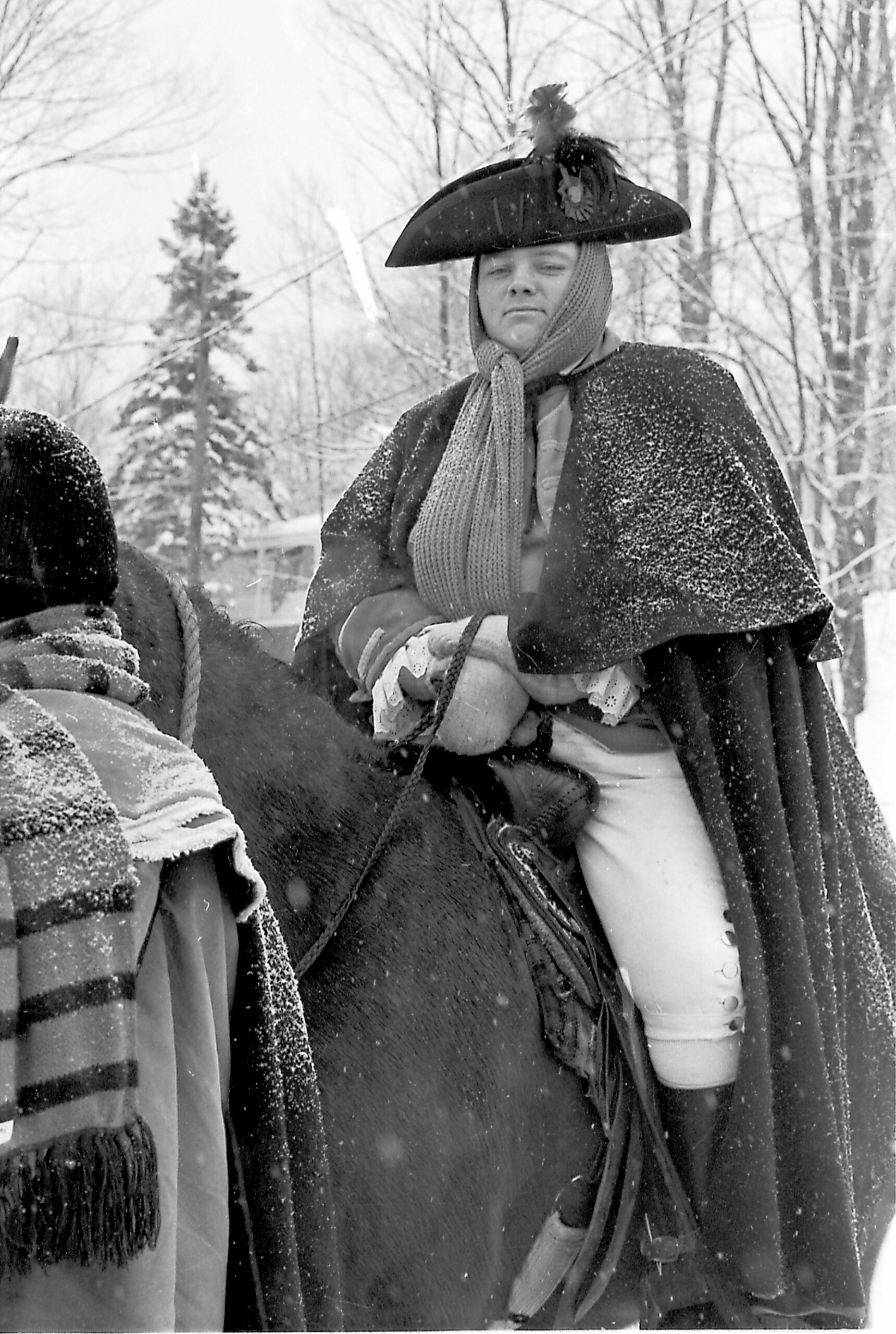
(The photograph above shows William Wilber portraying Henry Knox during the 1976 reenactment, courtesy of Gerry Francis and the Berkshire Edge.)

Sunday, December 28, 2025

“Under the hieroglyphical similitude of tropes and figures?”

As a prominent gentleman in Connecticut, Israel Putnam couldn’t ignore what “A New-York Freeholder” wrote about him in the New-York Gazette, as quoted yesterday.

However, Putnam faced a couple of challenges in replying. First, if he appeared to be flying off the handle, that would simply validate what the “Freeholder” had written.

Second, Putnam wasn’t a highly educated man, and in particular his spelling and punctuation were even more irregular than the eighteenth-century norm.

Even Putnam’s biographers acknowledge that he probably had help in shaping his reply in the 7 October 1774 Connecticut Gazette of New London, either from a friend or from printer Timothy Green. Because it doesn’t look like his usual writing.

The preface reads:
Mr. GREEN,

As my letter to Capt. [Aaron] Cleveland, wrote in consequence of the late alarm, has circulated far and wide, and made unfavourable impressions on the minds of some, ’tis desired that you and the several printers in the other colonies upon the continent, would give the following piece a place in your paper, and you will oblige
Your humble Servant,
ISRAEL PUTNAM.

POMFRET, 3d. October 1774.
The first line of the ensuing essay makes clear what it was really responding to: “In Mr. [Hugh] Gaine’s New-York Gazette of the 12th of September…”

Putnam described how the rumor of a British military attack on Boston had reached him through “Capt. Keyes”—most likely Stephen Keyes (1717–1788, gravestone shown above courtesy of Find a Grave). Keyes had heard the news from “Capt. Clarke of Woodstock,” who heard from his son in Dudley, Massachusetts, who heard from an Oxford man named Wilcot, who heard from his father and also found confirmation in Grafton.

With “only four gentlemen,” Putnam rode toward Boston, traveling “about thirty miles from my house.” In Douglas, Massachusetts, the party met the local militia captain, probably Caleb Hill (1716–1788), who with his company had just returned from their own march to “within about thirty miles of Boston.” Having thus learned that the earlier report was false, Putnam returned home, spreading the new word.

Putnam posited that the false alarm started with Customs Commissioner Benjamin Hallowell having “informed the army that he had killed one man and wounded another” while escaping from Cambridge. Hallowell’s own account of the “Powder Alarm” said nothing of the sort.

As for presenting himself as a gentleman in prose, Putnam acknowledged that he’d written his letter passing on that misinformation in haste and not in high style; he said he “aimed at nothing but plain matters of fact, as they were delivered to him.”

But Putnam also showed himself capable of deploying complex sentences and classical allusions in response to the “New-York Freeholder”:
Paying all due defference to this author’s learning, and his undoubted acquaintance with the rules of grammar and criticism, I would beg leave to ask him, whether he does not betray a total want of the feelings of humanity, if he supposes in the midst of confusion, when the passions are agitated with a real belief of thousands of their fellow countrymen being slain, & the inhabitants of a whole city just upon the eve of being made a sacrifice by the rapine and fury of a merciless soldiery, and their city laid in ashes by the fire of ships of war, he or any one else could set down under the possession of a calmness of soul becoming a Roman senator, and attend to all the rules of composition, in writing a letter, to make a representation of plain matters of facts, under the hieroglyphical similitude of tropes and figures? . . .

Now I submit it to the determination of every candid unprejudiced reader, whether my conduct in writing the aforementioned letter, merits the imputation of imprudence asserted by said writer; or whether they would have had me tamely set down, and been a spectator to the unhuman sacrifice of my friends and fellow-countrymen, or (in other words) Nero like, have set down and fiddled, while I really supposed Boston was in flames, or exerted myself for their relief?
Well, when he put it that way…

TOMORROW: Who was the “New-York Freeholder”?

Sunday, December 14, 2025

“I Enquired for the waggon master”

On 16 May 1776, Gen. John Sullivan was at Albany, New York, trying to organize the remnants of the Continental Army’s invasion of Canada.

He sent a letter to Gen. George Washington complaining of the Northern Department’s wagon master, among other things:

Early on the 15 Inst. to my Surprize I found three hundred Barrels (which I had Sent forward) Lying on the Beach without any teams to Carry them to Still water about twelve miles further

I Enquired for the waggon master & was Informed he was at his own House About Six miles off

I Immediately wrote him of the Necessity of his Exerting himself at this time
Two days later Sullivan sent off another complaint about the wagon drivers:
I found at Still water a Number of Barrells of Pork that the Waggoners had Tap[p]ed & Drawn off the pickle to Lighten their Teams. This pork must Enevetably be Ruin’d before it can reach Canada,

as Genl [Philip] Schuyler was Absent I Order’d the Commissary not to Receive any Such from the Waggoners & the Commissary at half moon not to receive out of the Boats any or Deliver out such to the Waggoners.

I order’d the Waggoners not to Receive any such as it would Eventually be thrown on their hands I then Directed the Commissary here not to Send any Barrels forwards that had lost the Pickle which would be only taking up Batteaus & Waggons to Cary Provisions which when brought to Canada Could not be Eaten.

By this Step I hope to prevent any further fraud in the Waggoners who (it is said) Learnt this piece of Skill in the Last War, for which Some of them were well flogged, and I hope Some of them may Share the Same fate—again.
Washington passed on word of those complaints to Schuyler, who responded a month later:
As to the Waggon master he is an Industrious Active and I believe an honest Man, But It is not in his Power, nor any Mans whatsoever to procure Waggons at all Times & at that Time It was peculiarly difficult both on Account of the Scarcity of Forrage the Badness of the Roads and the extravagant Abuses the Waggoners had met with from some of the Troops that preceded General Sullivan’s Brigade.
Neither general named the wagon master, which might reflect how he wielded authority over the teamsters but wasn’t at the level of a gentlemen. Their letters do offer some clues about the man: He had his own house about six miles from where Sullivan was in Albany. He was literate. He was independent.

Now that man in May 1776 wasn’t necessarily the same official whom Schuyler oversaw in December 1775. Nonetheless, he was clearly not one of Schuyler’s slaves.

TOMORROW: Names at last.

Thursday, December 11, 2025

“You will therefore Countermand any directions you may have given Mr. Palmer”

As discussed back here, as of 13 Dec 1775 Col. Henry Knox and George Palmer of Stillwater, New York, had agreed on how to transport heavy ordnance to Springfield.

Knox wrote to Gen. George Washington about those arrangements on 17 December:
I have made forty two exceeding strong sleds & have provided eighty yoke of Oxen to drag them as far as Springfield where I shall get fresh Cattle to carry them to Camp.
This is the letter in which Knox promised “to present to your Excellency a Noble train of Artillery,” a phrase authors still use to describe the guns.

On the same day, Knox wrote to Gen. Philip Schuyler (shown above) in Albany. He had thought Schuyler had gone south to Philadelphia, so he might have made decisions thinking that he didn’t have to clear them with his superior officer. Knox told Schuyler:
I have agreed with Capt. Palmer of Stillwater to get proper Conveyances for them from hence to Springfield— . . . I expect Capt. Palmer up with the Teams on Tuesday & on Wednesday or Thursday I hope to move as far as Saratoga if the sleding continues as at present from thence we must wait for Snow—
The next day, Schuyler wrote back:
I am happy to hear that all the Military stores you had in charge to bring from Ticonderoga are arrived at Fort George,— I have taken Measures to forward them to Boston as soon as we shall be favoured with a fall of Snow— but I am Informed that you have Applied to Mr. Palmer to Construct Carriages for the purpose, this is a very unnecessary Expence as there are a Sufficiency of Carriges Suitable for the purpose in this County Sufficient to Carry ten times the quantity, you will therefore Countermand any directions you may have given Mr. Palmer on this head.
Note how Knox referred to Palmer as a captain, probably a militia rank, while Schuyler called him only “Mr. Palmer.”

Having received a direct order, Knox wrote to George Palmer saying that his services were no longer needed.

Palmer had been making arrangements with his network of farmers around Stillwater. He didn’t take this news well. On 25 December he responded to Knox:
Since your Departure from this I have an oppertunity with Many of the inhabitants with whom I have Contracted for the Removal of the artillery and Stores, I find all Determined To A Man to fulfill on their Part & that I Shall on mine or Be answerable for the Consequences of A Disapointment which is More than I Shall be able to Do,

Depend Sir the People (& Not only those Employed in Service But others General) are Not indifferent, they are Sensible of the importance of the Grand Cause

they are Sensible To the Minutest Degree of the insult offered in Counteracting your Measures, I take this Earliest opportunity To inform you of the Disposition of the People among whom I Live with whom I am Concerned Particularly in this afair,

your Penetration will Easily Dissern the Consequences that will follow Disapointing Such A Number of People So Resolutely Determined as you may Depend Those are, with Regard to what you mentioned of our Carrying the heavy [space] they are Determined Since there is Such an they are Determined Since there is Such an attempt made To Supplant them To fulfill the whole Contract

I am Sir with all Possible Respect your most obedient hume. Sert/.
I get the impression that Palmer no longer had complete respect for young Col. Knox.

TOMORROW: A sit-down in Albany.