


J. L. BELL is a Massachusetts writer who specializes in (among other things) the start of the American Revolution in and around Boston. He is particularly interested in the experiences of children in 1765-75. He has published scholarly papers and popular articles for both children and adults. He was consultant for an episode of History Detectives, and contributed to a display at Minute Man National Historic Park.

Subscribe thru Follow.it


•••••••••••••••••


Showing posts with label Thomas Buckminster. Show all posts

Wednesday, May 27, 2015

Who Was Crispus Attucks’s Father?

Many websites and books identify Crispus Attucks’s father as Prince Yongey (or Young or Jonar), based on the fact that Framingham records say a man of that name married Nancy Peterattuck on 19 May 1737.

However, according to William Brown’s runaway advertisements, “Crispas” was about twenty-seven years old in 1750. That means he would have been about fourteen when Nancy Peterattuck married Prince Yongey.

Furthermore, in 1860 someone from Natick informed William C. Nell that Attucks’s parents were “Jacob Peter Attucks” and “Nanny,” which might have been another form of Nancy. This source said there were other children in the family—Sam, Sal, and Peter—and that they were all “uncommonly large.”

William Barry’s 1847 history of Framingham says Jacob Peterattucks was in that town by 1730 working for “Col. Buckminster.” There was a series of prominent men with that surname, including Joseph (1666-1747) and his sons Joseph (1697-1780) and Thomas (1698-1795).

It seems more likely, therefore, that Prince Yongey was Crispus Attucks’s stepfather, marrying his mother in 1737 after his father Jacob Peterattucks’s death. There are, of course, many other possible scenarios, including multiple people with the same name, unreliable informants, or a church marriage performed years into the relationship because the couple’s owner got religion.

Jacob Peterattucks was previously listed as a member of John Shipley’s military company in 1722, described as “Servt. John Wood.” On 16 May 1723, he was one of several men dismissed as “Sick, lame and unfit for Servis, by thear own Requests.” Notably, the lieutenant of that company was Joseph “Buckmaster.” Crispus Attucks was born around that year.

(In addition, a Moses Peter Attucks of Leicester served as a private at Fort Massachusetts under Lt. Elisha Hawley and Capt. Ephraim Williams in 1747-49. Another member of the family?)

We have no way of knowing whether Prince Yongey had any influence on Crispus Attucks, who was enslaved to Brown by 1750 and perhaps earlier, and therefore may never have lived with a stepfather. Yongey did become a Framingham fixture, as local historian Barry learned from townspeople who had known him:
But the most noted individual of the class under consideration, was Prince, sometimes called Prince Young, but whose name is recorded as Prince Yongey, and Prince Jonar, by which last name he is noticed [and “rated”] in the Town Rec. in 1767. He was brought from Africa when a young man of about 25 years, having been a person of consideration in his native land, from whence, probably, he derived his name. He was first owned by Col. Joseph Buckminster, and afterwards by his son, the late Dea. Thomas. He married, (by name Prince Yongey) in 1737, Nanny Peterattucks, of Framingham, (the name indicating Indian extraction) by whom he had several children, among them a son, who died young, and a daughter Phebe, who never married.

Prince was a faithful servant, and by his general honesty, temperance and prudence, so gained the confidence of his first master. Col. Buckminster, that for about a quarter of a century, he was left with the management of a large farm, during his master’s absence at the General Court. He occupied a cabin near the Turnpike, and cultivated, for his own use, a piece of meadow, which has since been known as Prince’s meadow. He chose the spot as resembling the soil of his native country.

During the latter part of his life he was offered his freedom, which he had the sagacity to decline; pithily saying, “massa eat the meat; he now pick the bone.” Prince shunned the society of persons of his own color, and though accustomed to appear in public armed with a tomahawk, was a great favorite with the young, whom, under all provocations, he was never known but in one instance to strike.

He had been sufficiently instructed to read, and possessed the religious turn characteristic of the African race. In his last sickness, he remarked with much simplicity, that he was “not afraid to be dead, but to die.” He passed an extreme old age in the family of Dea. Thos. Buckminster, and died Dec. 21, 1797, at the age of 99 years and some months. Numerous anecdotes are yet related, illustrating the simplicity, intelligence, and humor of “Old Prince.”
This description of Prince Yongey is evidently based on people who knew him as an old man, probably after his wife and perhaps his children were gone. He outlived the institution of slavery in Massachusetts, though he insisted that the Buckminster family was obliged to look after him in his old age, and he even outlived Deacon Buckminster.

It occurred to me that some elements of Prince Yongey’s life might have gotten mixed in with locals’ memories of Crispus Attucks, especially if they were indeed part of the same extended family. Brown’s descendants recalled Attucks being allowed to “trade cattle upon his own judgement”; locals recalled Yongey managing the Buckminster farm for his master. And did ”Prince’s meadow” become remembered as the “cellar hole” where the Attucks family lived?

Tuesday, May 26, 2015

Sorting Out the Versions of Crispus Attucks

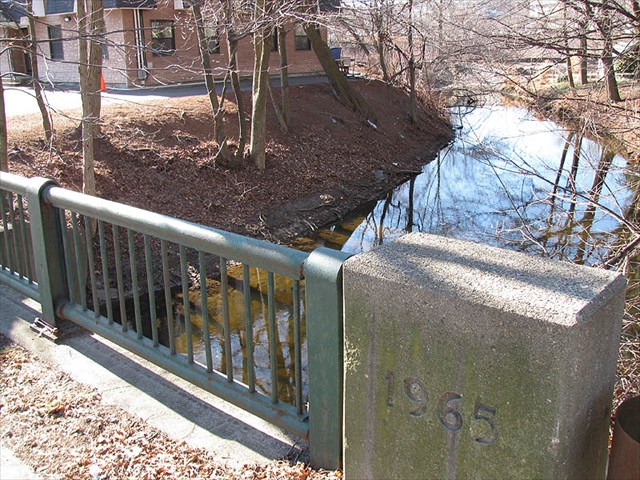
This is a view from the Crispus Attucks Footbridge in Framingham, built near the area where he was reportedly born and worked for William Brown. And it looks like a good place to pause and reflect about how to reconcile the conflicting traditions about Attucks’s life.

The standard modern story (which I’ve repeated myself) is that Attucks escaped from slavery in Framingham in 1750, when he was about twenty-seven years old, and made a new life for himself as a sailor traveling to the Caribbean and North Carolina. At least while he was back in Boston, he used the alias “Michael Johnson,” presumably to preserve his freedom; that was how he was identified immediately after he was killed. We don’t know how within three days printers knew he was “born in Framingham,” nor how his real name became known the next week.

The Brown family traditions don’t fit easily with that story, but they aren’t easy to dismiss, eoither. Descendants of William Brown told their story of his slave Crispus by 1857. We might suspect they were trying to seize on the celebrity that abolitionists like William C. Nell had conferred on Attucks, but in 1859 antiquarians found the Boston Gazette advertisement that backs up the family’s claim.

Brown descendants also brought forward a cup, teapot, and powderhorn that Attucks reportedly owned. The provenance of these “relics” is impossible to confirm, but the two items that survive do appear to date from the early 1700s. They’re also cheap and misshapen, unlikely to have been saved unless the family had invested them with some meaning.

The biggest contradiction between those two stories is that the Brown family said Attucks returned to his master after 1750 and remained in Framingham for the rest of his life. In the late 1800s, that tradition expanded to say that Brown also let Attucks go to sea, apparently to accommodate the documentary evidence from 1770. But there’s still no explanation why Attucks would be using the name “Michael Johnson” if he had his master’s permission to travel to Boston, trade cattle, and work on ships.

One possibility is that in the confusion after the Boston Massacre people misidentified the big mulatto man shot in the chest as the sailor Michael Johnson. William Brown alerted the authorities to their mistake. and they corrected the dead man’s name to Crispus Attucks in legal papers by the next week, but the printers didn’t catch up, leaving us with newspapers that still erroneously called that man a sailor.

This scenario raises more questions:
  • Why did the first reports about “Johnson” already connect him to Framingham?
  • Why did Boston bury Attucks as a “stranger” if he had a master and family still in close touch and living less than a day away?
  • Why didn’t William Brown seek compensation from the Crown for the loss of his slave?
  • Why did Bostonians like William Pierce (cited in Traits of the Tea Party) continue to say Attucks was a sailor for years afterward?
Another possibility is that the Brown family preserved the memories of Crispus Attucks working for their ancestor, trading cattle “on his own judgment,” but forgot the part about how he escaped and never came back. That may not have been his 1750 departure; Attucks may have returned then but left permanently later, and Brown didn’t bother advertising for him again. Other members of the extended Attucks family continued to work in Framingham for years, and the family could have attached memories of them to Crispus after he became famous.

Again, that scenario has a big hole:
  • If one of your family slaves has run away and you later learn he’s been killed in a riot in Boston, wouldn’t you remember him as a miscreant who got what was coming? Why would your family memory drop the fact that he’d run away when to you that was probably one of the most significant facts about his life?
Finally, there’s the Natick tradition that William C. Nell spoke about in 1860, one which named other members of the Attucks family. Nell’s informant said that his or her mother had heard Attucks’s sister Sal speak about him, apparently in the 1770s or 1780s. Nell didn’t name his source, and his papers have probably disappeared, leaving us with less to evaluate. To my knowledge that tradition never got into books, and no historians have grappled with it.

The Natick information emphasized Attucks as a big man, a bold man, and a law-breaker (smuggling horses, fighting soldiers). It said nothing about Attucks being enslaved to the Brown family, though it did identify him as a likely son of Jacob Peterattuck, “who lived with Capt. Thomas Buckminster of Framingham.” That tradition also said nothing about Attucks’s work at sea, saying instead that he had visited home “with three or four horses” shortly before the Massacre. Again, that’s hard to reconcile with the 1770 reports about “Michael Johnson” awaiting work on a ship south.

A lot of recent historical scholarship has used Crispus Attucks as an example of a politically aware sailor, not so much tied to Boston as part of a roving maritime working class within the British Empire. It emphasizes his life in the shadows as a runaway slave.

However, if the Brown family and Natick traditions are correct, then Attucks had much stronger links to life in rural Massachusetts than the standard profile suggests, though he may also have worked on ships. If not legally free, Attucks had at least some practical freedom within his bondage to William Brown. And he had an extended family out in the Framingham and Natick area, some of them known for carrying on Native American traditions (“the gourd-shell squaw”). That would provide new areas for historical consideration. But still, how did “Michael Johnson” enter that scenario?

Sunday, May 24, 2015

More Information about the Attucks Family

In 1860 the historian and activist William C. Nell addressed a crowd at the ninetieth anniversary of the Boston Massacre. That event took place in an auditorium called the Meionaon, part of the Tremont Temple. [Why don’t we have a Meionaon anymore?]

As part of his speech, Nell shared some new information he had gathered about the family of Crispus Attucks, by then a symbol of African-American patriotism. Nell’s speech was printed in The Liberator, the abolitionist newspaper.

Later that year, a writer in the Boston Transcript argued that Attucks was an Indian rather than a black man. (He in all likelihood had both African and North American ancestry.) Nell drew on the same new information when he wrote into that mainstream newspaper to refute that claim.

First, a Massachusetts legislator from Framingham named James W. Brown wrote to Nell on 18 Feb 1860 to say:
He (Crispus) was the slave of my great grandfather, Deacon William Brown, of Framingham. He returned after his runaway excursion, and was a faithful servant. He was allowed to buy and sell cattle on his own judgment. It was probably upon one of these trading tours that he was drawn into the affray of March 5th. He pressed close upon the British troops, who received him and the other people with loaded muskets.

Attucks beat down their guns with a heavy stick, and shouted, “They dare not fire!” They did fire, and with what effect was known to all. Of stout and vigorous frame, athletic, bold and patriotic, had he lived, he would, doubtless, have acted a conspicuous and useful part in our great revolutionary struggle.
That was basically the same thing the Brown family had published three years before, down to the statement that their ancestor had let Attucks trade cattle “on his own judgment.” This letter made explicit that Attucks had returned to Framingham after the months in late 1750 when William Brown had advertised him as a runaway, and was still working for the Brown family when he died.

We should expect that story to reflect what the Browns wanted to believe, or wanted people to believe about them. It portrays William Brown as a lenient master, and Attucks as “faithful” and “patriotic.”

Nell didn’t name the person who had sent him a second letter from Natick dated 17 Feb 1860. It said in part:
Several persons are now living in Natick, who remember the Attucks family—viz., Cris, who was killed March 5th; Sam, whose name was abbreviated into Sam Attucks, or Smattox; Sal, also known as Slattox; and Peter, called Pea Tattox.

My mother, still living, aged 89, remembers Sal in particular, who used to be called the gourd-shell squaw, from the fact that she used to carry her rum in a gourd shell.

The whole family are described as having been uncommonly large, and are said to have been the children of Jacob Peter Attucks, who lived with Capt. Thomas Buckminster, of Framingham.

It has been conjectured that Jacob and Nanny were of Indian blood; but all who know the descendants, describe them as negroes. Crispus lived in many different places in Natick and Framingham.

When the inhabitants were detained in Boston, he used to smuggle their horses out of the town. He brought out three or four horses, which he took to Framingham, and then returned to kill the red-coats. His sister used to say that if they had not killed Cris, Cris would have killed them. Cris is said to have been in every street fight with the soldiers for some time previous to March 5th, 1770.
In addition, in writing to the Transcript Nell said, “Crispus Attucks was born in Framingham. A portion of his early life was passed in Sutton (now Millbury).” I’m not sure what the basis for that last statement is. Of course, all this information was second- or third-hand, about a man who had died ninety years before and had been born nearly a half-century before that.

But some parts seem to check out. There was indeed a prominent Thomas Buckminster (1698-1795) in Framingham. William Barry’s 1847 History of Framingham reported that Jacob Peterattucks “was in F[r]am., 1730, and worked for Col. Buckminster,” and that in May 1737 Nancy Peterattuck married Prince Yongey, a man enslaved to the Buckminster family. At that date Crispus Attucks was evidently in his teens. Was he indeed a son of Jacob Peterattucks? Was Nanny/Nancy his mother, remarrying? Or was this a more extended family?

Other parts of Nell’s new information raise questions, however. Though Framingham and Natick are next to each other, Sutton is twenty miles away. How did young Crispus go from one area to the other and back as Nell described?

Usually the phrase “inhabitants were detained in Boston” refers to the siege of 1775-76, but Attucks was dead by then. I know of no reason for people to “smuggle horses out of town” earlier.

Finally, all these stories about Crispus Attucks working steadily for his Framingham master until 1770 don’t square with the newspaper reports after his death that he was a sailor, nor with how Boston officials at first called him “Michael Johnson.” Those contemporaneous details fit better with the picture of a man who escaped from slavery by going to sea and then protected himself from recapture through an alias while back in Massachusetts.

TOMORROW: The teapot finally surfaces. You remember the teapot, right?

[My great thanks to Boston 1775 readers Joe Bauman and Liz Loveland for giving me the resources to transcribe the 16 Mar 1860 Liberator items fully and accurately. With their help I’ve revised this posting. Folks can find images of all Liberator issues here.]