


J. L. BELL is a Massachusetts writer who specializes in (among other things) the start of the American Revolution in and around Boston. He is particularly interested in the experiences of children in 1765-75. He has published scholarly papers and popular articles for both children and adults. He was consultant for an episode of History Detectives, and contributed to a display at Minute Man National Historic Park.

Subscribe thru Follow.it


•••••••••••••••••


Showing posts with label Byfield. Show all posts

Friday, June 10, 2022

A Boston Boy Rebuilding the British Empire
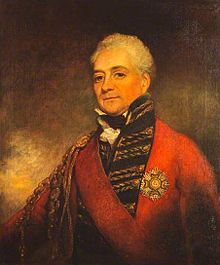
Yesterday’s précis of the life of Charlotte Biggs promised a connection to pre-Revolutionary Boston.

You remember that young man whom Charlotte fell in love with as a teenager before her marriage? The one who went off to India to make his fortune?

His name was David Ochterlony, and he came from Boston.

Ochterlony (shown here) was born on 12 Feb 1758, eldest son of a Scottish merchant captain with the same name. His mother was Katherine Tyler, a niece of the first Sir William Pepperrell. The family house from 1762 was a brick mansion on Back Street.

In 1766 David entered John Lovell’s South Latin School. The year before, however, his father had died on a voyage to the Caribbean. The estate was in debt, not paid off until well after the war.

What happened next to young David and his siblings isn’t easy to sort out. There’s evidence he spent some time studying under Samuel Moody at the Byfield school endowed by Lt. Gov. William Dummer, now the Governor’s Academy.

Katherine Ochterlony moved to Britain and in the early 1770s married Sir Isaac Heard, a Royal Navy veteran, merchant, and, of all things, heraldric official.

The Ochterlony children joined their mother in Britain, and Heard welcomed them into his family. It’s said that David developed a close relationship with his stepfather.

When the American War began, David Ochterlony showed his loyalty to the British Empire by joining the army, or pledging to. During this time in London, the teenager evidently met Charlotte Williams, and she fell in love with him.

Ochterlony shipped out to India as an army cadet. In 1778 he gained the rank of ensign, and in three years became quartermaster for the 71st Regiment. During the Second Anglo-Mysore War, connected with Britain and France’s fight on the other side of the world, Ochterlony was captured and spent two years as a prisoner. Then he returned to army staff positions.

The loss of the most populous North American colonies turned British attention to India, and Ochterlony’s career rose with the empire there. In 1812 he became a major general, and in 1816 a baronet and a Knight Grand Cross of the Order of the Bath. (Those are the sorts of honors his stepfather loved studying.) In the first quarter of the nineteenth century Ochterlony was among the British Empire’s most powerful administrators on the subcontinent.

Gen. Sir David Ochterlony was known for adopting the local aristocratic lifestyle rather than maintaining British, or Boston, ways. He had thirteen concubines or wives, who reportedly paraded around Delhi on elephants. A son by one of those women became the heir to his baronetcy after the general died in India in 1825.

Meanwhile, back in Europe, the teen-aged girl who had become Charlotte Biggs, author and intelligence source, was still carrying a torch for the aspiring officer she had met in the 1770s. When she wrote an autobiography late in life, she addressed it to Ochterlony, evidently still hoping to see him again. (That manuscript became the basis of Joanne Major and Sarah Murden’s biography, A Georgian Heroine.)

Saturday, February 15, 2014

A Solid Source for the “Whites of Their Eyes” Tradition

“Don’t fire till you see the whites of their eyes” is the most famous quotation arising from the Battle of Bunker Hill. Authors have debated which American officer said it, which has been another way of debating who was in command. In recent decades most historians have treated those words as a legend, or at least a tradition that can’t be verified.

That tradition doesn’t benefit from the fact that for a long time the earliest chronicle known to quote the line was the biography of George Washington by Mason Weems, whose tales of cherry trees and praying in the snow at Valley Forge have become exemplars of American mythology.

This month I got lucky in some digital databases and found an earlier source for the “whites of their eyes” tradition, with a clear chain of transmission from the battlefield.

The story starts with David Humphreys’s publication of An Essay on the Life of the Honourable Major-General Israel Putnam in 1788. That book’s description of Bunker Hill does not include the quotation. It also suggested that Dr. Joseph Warren was directing the New England forces in his new capacity as a Massachusetts major general.

The Rev. Josiah Whitney (1731-1824), minister in Brooklyn, Connecticut, followed that up with his most famous parishioner, Israel Putnam. The retired general said that Warren had come onto the battlefield as a volunteer, not a commissioned officer, and didn’t presume to take command. Putnam died in 1790, and Whitney described their conversation in a footnote to his sermon A Sermon Occasioned by the Death of the Honorable Major-General Israel Putnam, of Brooklyn.

Ten years later, the Rev. Elijah Parish (1762-1825) of Byfield, Massachusetts, published An Oration, Delivered at Byfield, February 22d, 1800, the Day of National Mourning for the Death of General George Washington. On page 15 he added his own footnote describing the Battle of Bunker Hill. Parish, who originally came from Lebanon, Connecticut, said he’d discussed that battle with his older colleague Whitney.

Parish wrote:

Putnam was the commanding officer of the party, who went upon the hill the evening before the action: he commanded in the action: : he harangued his men as the British first advanced, charged them to reserve their fire, till they were near, ‘till they could see the white of their eyes,’ were his words.—At the second assault he commended their former calmness, assured them “they would now do much better,” and directed them “to aim at the officers.” They obeyed. The fire was tremendous. ‘My God,’ said said Putnam, in telling the story, ‘I never saw such a carnage of the human race.’

These things he related to the Reverend Mr. Whitney, his Minister, by whose permission they are now published.
Parish repeated this story in a history textbook he cowrote with the Rev. Dr. Jedidiah Morse, A Compendious History of New England (1804).

Thus, we have a clear line of transmission for the quotation:
  • Gen. Israel Putnam reminiscing to Rev. Josiah Whitney, probably between 1788 and 1790.
  • Whitney passing on an interesting anecdote to Rev. Elijah Parish between 1790 and 1800.
  • Parish publishing the story twice in the early 1800s, enough to bring it to the attention of the Rev. Mason Weems by 1810.
That doesn’t mean Putnam coined the “white of their eyes” phrase, but it’s more likely that he said those words at Bunker Hill, just as a few veterans reported later. Eventually the phrase evolved into the now-famous “Don’t fire till you see the whites of their eyes.”

TOMORROW: When Howe said “not to fire before he could see the whites of their eyes.”