






“Avoid becoming the draughtsman of papers to be reviewed by a public body”

True to his character, Thomas Jefferson chose to be “a passive auditor” as his colleagues hashed over the words he’d drafted. But, he admitted to James Madison, the debate affected him:
during the debate I was sitting by Dr [Benjamin] Franklin, and he observed that I was writhing a little under the acrimonious criticisms on some of it’s parts; and it was on that occasion that, by way of comfort, he told me the story of John Thompson the Hatter, and his new sign.Jefferson didn’t explain that allusion in his letter to Madison, but he put it into his notes on Franklin:
When the Declaration of Independance was under the consideration of Congress, there were two or three unlucky expressions in it which gave offence to some members.(Yes, suggesting that the Scottish were foreigners from outside the British Empire would have prompted complaints.)
the words ‘Scotch and other foreign auxiliaries’ excited the ire of a gentleman or two of that country.
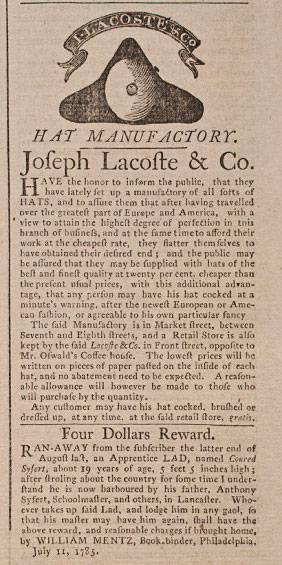
severe strictures on the conduct of the British king, in negativing our repeated repeals of the law which permitted the importation of slaves, were disapproved by some Southern gentlemen, whose reflections were not yet matured to the full abhorrence of that traffic. altho’ the offensive expressions were immediately yielded, these gentlemen continued their depredations on other parts of the instrument.I don’t know any examples of authentic eighteenth-century hatters’ shop signs in the British Empire, but Colonial Williamsburg and the Adverts 250 Project have shared images of hatters’ wordy newspaper advertisements.
I was sitting by Dr Franklin who percieved that I was not insensible to these mutilations. ‘I have made it a rule, said he, whenever in my power, to avoid becoming the draughtsman of papers to be reviewed by a public body. I took my lesson from an incident which I will relate to you.
when I was a journeyman printer, one of my companions, an apprentice Hatter, having served out his time, was about to open shop for himself. his first concern was to have a handsome sign-board, with a proper inscription. he composed it in these words ‘John Thompson, Hatter, makes and sells hats. for ready money,’ with a figure of a hat subjoined. but he thought he would submit it to his friends for their amendments.
the first he shewed it to thought the word ‘Hatter,’ tautologous, because followed by the words ‘makes hats’ which shew he was a Hatter. it was struck out.
the next observed that the word ‘makes’ might as well be omitted, because his customers would not care who made the hats. if good & to their mind, they would buy, by whomsoever made. he struck it out.
a third said he thought the words ‘for ready money,’ were useless as it was not the custom of the place to sell on credit. every one who purchased expected to pay. they were parted with, and the inscription now stood ‘John Thomson sells hats.’
‘sells hats’ says his next friend? why nobody will expect you to give them away. what then is the use of that word? it was stricken out, and ‘hats’ followed it, the rather, as there was one painted on the board.
so his inscription was reduced ultimately to ‘John Thomson’ with the figure of a hat subjoined.’
TOMORROW: Spreading the word.

2 comments:
A comment not about what you wrote, John, but about Dr. Franklin's tale:
My recent research into how commerce and money worked in colonial America indicates that many transactions were indeed made on credit. For example, in Boston from around 1760 to 1774, there was no paper money in circulation, and only limited amounts of silver, gold, and copper coins. Thus credit was, of necessity, used to conduct business. The business owner would "put it on the tab" of his regular customers, Eventually, the bill would be paid, perhaps not in cash, but by barter or other means.
A prominent example is the case of British Army Capt.-Lt. John Goldfinch, who had a running tab with barber-wigmaker John Piemont, which Goldfinch was expected to settle monthly. On March 5, 1770, Piemont's apprentice Edward Garrick harassed Capt. Golldinch over payment of the February bill; Garrick's taunts began the chain of events that led to the Boston Massacre later that evening.
Of course, this sort of credit worked well when people knew each other -- in small towns and neighborhoods, or for regular customers. It didn't work for travelers or strangers. But that is a post for another day.
You’re right, eighteenth-century American communities ran on credit. Specie was rare, and paper notes complicated. So most shopkeepers and craftspeople asked for payment once a quarter—every three months.
Businesspeople therefore kept account books with their regular customers’ running tabs, which can serve as a useful resource for historians. If all those customers were paying cash, their names wouldn’t be recorded.
At hard times, shopkeepers offered better prices for cash. And when someone died, moved away, or closed a business, there would be advertisements calling on everyone to come in and settle their debts.
Post a Comment