


J. L. BELL is a Massachusetts writer who specializes in (among other things) the start of the American Revolution in and around Boston. He is particularly interested in the experiences of children in 1765-75. He has published scholarly papers and popular articles for both children and adults. He was consultant for an episode of History Detectives, and contributed to a display at Minute Man National Historic Park.

Subscribe thru Follow.it


•••••••••••••••••


Showing posts with label Robert Dinwiddie. Show all posts

Friday, June 25, 2021

Founders Feeling Homesick—and Using That Word
At this posting earlier in the month, I said that the first documented use of the English word “homesickness” was in 1756 and that the adjective “homesick” followed.

I was relying on Etymology Online, but that turns out to be mistaken.

The Oxford English Dictionary states that “homesick” first appeared in 1748 in a collection of Moravian Brethren hymns printed in London. That word was a direct translation of the German “heimweh.”

Likewise, the earliest appearance of “homesickness” in 1756 was a direct translation of “heimweh” in an edition of the travel writings of Johann Georg Keyssler.

One might assume the word was still working its way into English at that time, starting in the imperial capital. But I came across an example of the word being used in a remote corner of the British Empire. On 2 Dec 1756, none other than Col. George Washington reported to Gov. Robert Dinwiddie about provincial conscripts under his command:
I have used every endeavour to detain the Drafts, but all in vain. They are home-sick, and tired of work.
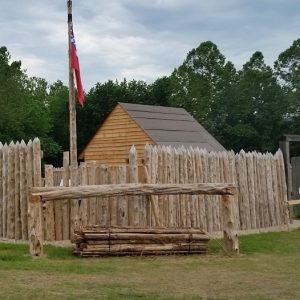
The young colonel wrote from Fort Loudoun (recreation shown above) in what in now south-central Pennsylvania. He obviously expected his superior to understand the word.

In addition (and this example is noted in the O.E.D.), in November 1759 Gen. Jeffery Amherst wrote in his journal: “As soon as the homesick were getting in the boats they were immediately half recovered.”

The second appearance of “home-sick” listed in the O.E.D. is from the journal of Philip Vickers Fithian on 21 Nov 1773. By that point some familiar correspondents were also using the term:
  • Benjamin Franklin to his son William, 30 Jan 1772: “I have of late great Debates with my self whether or not I should continue here any longer. I grow homesick, and being now in my 67th. Year, I begin to apprehend some Infirmity of Age may attack me, and make my Return impracticable.”
  • Franklin to Jonathan Shipley, June 1773?: “But I grow exceedingly homesick. I long to see my own Family once more. I draw towards the Conclusion of Life, and am afraid of being prevented that Pleasure.”
  • Abigail Adams to John, from Weymouth, 30 Dec 1773: “The Time I proposed to tarry has Elapsed. I shall soon be home sick. The Roads at present are impassible with any carriage. I shall not know how to content myself longer than the begining of Next week.”
One last tidbit: That Keyssler translation from 1756 said people from “Bern are especially afflicted” with homesickness or nostalgia. As I wrote before, the earliest medical description of the condition came from a Swiss medical graduate, and physicians from his country were among the first to discuss it. That gave rise to the belief that the Swiss were especially subject to homesickness.

We see that idea reflected in the way John Adams wrote of his own homesickness on 28 Mar 1783.

Monday, May 11, 2015

The Washingtons and George Muse

George Muse (1720-1790) was born in England and moved to Virginia sometime in his youth. He took part in the 1741 British expedition against Cartagena de Indias in Colombia, led by Adm. Edward Vernon.

Another participant in that campaign was Lawrence Washington, who went home to Virginia and named his slave-labor plantation “Mount Vernon” after the admiral. In 1743 the royal governor appointed Washington adjutant general, or chief administrator, of the Virginia militia, and George Muse became one of his deputies.

When Lawrence Washington died in 1752, his little half-brother George applied to succeed him as adjutant general. The fact that George wasn’t yet even of legal age didn’t discourage him, but it was surely a factor for Gov. Robert Dinwiddie. He found a solution that meant more men would owe him favors: he broke up Virginia into districts and appointed adjutants for each. Among the new district adjutants were George Washington and George Muse.

In the spring of 1754, Dinwiddie made young Washington a lieutenant colonel and sent him out to the west to protect Virginia claims against French and Native forces. Another of the top officers on this expedition was Muse, ranked as a major—an interesting dynamic since Muse was more than a decade older.

That campaign ended at Fort Necessity. Lt. Col. Washington made a lot of strategic mistakes, but Maj. Muse hurt his reputation even more. A soldier on the expedition named James Wood wrote:
Wed. morn. 3 July about 9 oClock, an Indian arrived informed them the French and Indians were within 4 miles. in the greatest Confusion fell to diging Trenches[.] abt 11. We drew up on the parade saw the French and Indians coming down a hill We marched to take possession of a Point of Woods

Muse called to halt the French would take possession of Our Fort and Trenches ran back in the utmost Confusion happy he that could get into the Fort first
Landon Carter later recorded in his diary that Muse
instead of bringing up the 2d division to make the Attack with the first, he marched them or rather frightened them back into the trenches, so that the Colo. [Washington] at the head of the Carolina Independent Company was greatly exposed to the French Fire and were forced to retire to the same trenches, where they were galled on All sides by 1,100 French and Indians who never came to an Open ground but fired from behind trees
Muse’s comrades accused him of cowardice. Dinwiddie soon learned that Muse was “not very agreeable to the other Officers.” On 3 August the governor told Washington, “Muse wrote me, & I answer’d he was welcome to resign.” Which he did.

TOMORROW: But that wasn’t the end of the story.