


J. L. BELL is a Massachusetts writer who specializes in (among other things) the start of the American Revolution in and around Boston. He is particularly interested in the experiences of children in 1765-75. He has published scholarly papers and popular articles for both children and adults. He was consultant for an episode of History Detectives, and contributed to a display at Minute Man National Historic Park.

Subscribe thru Follow.it


•••••••••••••••••


Showing posts with label Susannah Wheatley. Show all posts

Thursday, November 30, 2023

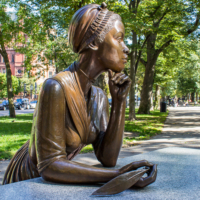
Celebrations of Phillis Wheatley’s Boston Pub Date
At the end of November 1773, the ship Dartmouth was moored in Boston’s inner harbor, watched by a militia-style patrol of volunteers to ensure the tea it carried was not unloaded and taxed.

The Rotch family’s vessel, under the command of James Hall, brought other cargo as well. Among those items were copies of Phillis Wheatley’s Poems on Various Subjects, Religious and Moral.

Wheatley had recently become legally free, and she was counting on sales of those books for her income.

Fortunately, by 1 December the local Whigs made clear that everything could be unloaded from the Dartmouth except the East India Company tea, so the books came ashore.

Historians only recently recognized the connection between Wheatley’s book and the Boston Tea Party because no one mentioned it at the time. Wheatley may have been worried 250 years ago today, but by the time she was writing the letters that survive she had her books on dry land and was busy promoting orders.

Wheatley wrote that her books would arrive “in Capt. Hall,” using the common way of referring to a ship by its master rather than its name. About ten years ago Wheatley biographer Vincent Carretta, researcher Richard Kigel, and others realized that the captain of that name arriving in Boston around that time had to be James Hall on the Dartmouth.

The sestercentennial of the Tea Party thus coincides with the sestercentennial of the publication of Phillis Wheatley’s book in America, and both events are being commemorated this season.

Ada Solanke’s play Phillis in Boston will have its last performances for the year in Old South Meeting House, the poet’s own church, on Sunday, 3 December. That site-specific drama depicts the poet, her friend Obour Tanner, her husband-to-be John Peters, her recent owner Susannah Wheatley, and abolitionist Prince Hall. Order tickets here.

The next evening, 4 December, the Boston Public Library will host “Faces of Phillis,” a free program discussing the poet from various perspectives. It will start with a staged reading of parts of Solanke’s plays about Wheatley. Then there will be a panel featuring Solanke, sculptor Meredith Bergmann, and Kyera Singleton of the Royall House & Slave Quarters museum. The evening will conclude with Boston’s Poet Laureate, Porsha Olayiwola, performing a dramatic reading of her own work and one of Wheatley’s poems.

“Faces of Phillis” is scheduled to last from 6:00 to 7:30 P.M. Register for that event here.

Saturday, October 28, 2023

Learning about Phillis Wheatley in London and Boston

Ade Solanke is a British playwright of Nigerian descent. She earned an M.F.A. in screenwriting at U.S.C. on top of British degrees, and she’s now a senior lecturer at Goldsmiths College in London.

Solanke specializes in stories about the African diaspora. In 2018 her play Phillis in London debuted at the Greenwich Book Festival. It dramatized the experiences of Phillis Wheatley in the summer of 1773, visiting the imperial capital to promote the publication of her book of poetry.

On Monday, 30 October, Solanke will be at the Massachusetts Historical Society for a reading from that play and a panel discussion about researching it, titled “Bringing Phillis to Life.” The other panelists will be:
That event starts at 5:30 with a reception, and the program will begin at 6:00. Admission is $10, free to members. People can also watch online for free. Register to attend one way or the other through this page.

On Friday, 3 November, Solanke’s new play Phillis in Boston will premiere at the Old South Meeting-House—no doubt the event that’s bringing the playwright to Boston. (There will be preview performances the previous two nights.)

Directed by Regge Life, Phillis in Boston explores the life of the poet soon after she returned from London. Revolutionary Spaces says:
The play celebrates friendship, love, community, and joy by centering Wheatley’s relationships with her friend and confidant Obour Tanner, her husband-to-be John Peters, and the dynamic abolitionist Prince Hall. Phillis in Boston examines slavery in New England through the lens of Wheatley’s complex relationship with her enslaver Susanna Wheatley, who supported Wheatley’s literary ambitions even as she kept her in bondage.
Phillis in Boston is designed to be performed in the meetinghouse where Wheatley and other revolutionaries were congregants.

Solanke’s play will run in that space through Sunday, 3 December, on evenings from Wednesday through Sunday. Tickets cost $15–35. For more information and to reserve seats, visit this page.

(The striking image above comes from the webpage of an event at the British Library earlier this month, all inspired by the sestercentennial of Wheatley’s book.)

Thursday, June 29, 2023

When Phillis Met Benjamin

On 7 July 1773, nearly two hundred fifty years ago, Benjamin Franklin wrote to his relative Jonathan Williams, Sr., in Boston:
Upon your Recommendation I went to see the black Poetess and offer’d her any Services I could do her. Before I left the House, I understood her Master was there and had sent her to me but did not come into the Room himself, and I thought was not pleased with the Visit. I should perhaps have enquired first for him; but I had heard nothing of him. And I have heard nothing since of her.
The “black Poetess” was, of course, Phillis Wheatley, in London to finalize arrangements for the publication of her Poems on Various Subjects, Religious and Moral.

Franklin Papers editors suggest that Nathaniel Wheatley kept away from the discussion because of the previous year’s Somerset v. Stewart case. Williams later apologized for having set up the meeting if the young man was going to behave that way. I think there could be any number of other reasons for his absence; we don’t have the Wheatleys’ side of this encounter.

Regardless of any awkwardness surrounding that event, Franklin’s letter shows that he and Wheatley did meet face to face. He came away with no reason to doubt what Bostonians reported about her intelligence and poetic skill.

Debbie Weiss wrote a play inspired by that event, “A Revolutionary Encounter in London.” It was an online presentation through the Massachusetts Historical Society a couple of years ago during the plague, and there are other videos online as well.

On Saturday, 1 July, the Lexington Historical Society will host a staged reading of “A Revolutionary Encounter in London,” directed by Weiss with Cathryn Phillipe portraying Phillis Wheatley and Josiah George as Benjamin Franklin. That presentation will start at 6:30 P.M. in the Lexington Depot. Tickets are $25, available here. Society members get a discount on tickets and can stay to talk with the actors and playwright-director over tea and desserts.

Weiss, Philippe, and George will next bring the show to the Boston Tea Party Ships & Museum on Thursday, 6 July, at 7:00 P.M. I think seats are included in the museum admission for that day.

Wheatley stayed in London for only about six weeks. Learning that Nathaniel’s mother Susannah Wheatley was ill, she left before her book was printed. The publisher shipped copies to Boston later in the year for her to sell.

Unfortunately, those books traveled on the Dartmouth, which also carried the first consignment of East India Company tea to reach Boston. Hence the Tea Party connection.

Tuesday, August 18, 2015

The Mystery of “Mrs. W——”

Yesterday I quoted Phillis Wheatley’s “Ode to Neptune,” published in London in 1773 with the subtitle “On Mrs. W——’s Voyage to England” and dateline “Boston, October 10, 1772.”

For readers seeking to identify “Mrs. W——,” the poem offers some internal clues:
  • Her last initial was W, of course, and she was almost certainly married and alive in October 1772.
  • Later the poem addresses her as “my Susannah.”
  • She was about to make a voyage across the ocean to the Thames River in England.
Given the first two clues, most people’s first guess is that Phillis wrote this poem to her mistress, Susannah Wheatley. Except that other evidence strongly suggests that Susannah Wheatley never went to England.

Phillis Wheatley almost certainly addressed her mistress in another poem titled “A Farewel to America. To Mrs. S. W.” But that was when Phillis was about to sail to London and Susannah was staying behind in Boston.

The next guess is based on notes in a copy of Phillis Wheatley’s 1773 book of poetry owned by the American Antiquarian Society. Beside the “Farewel” poem someone penned “Mrs. Susannah Wright,” and then a different someone penciled, “eminent for her Wax Works etc.”

Scholars agree that the “Mrs. S.W.” mentioned in “A Farewel” is Susannah Wheatley. So some have argued that the notes in that A.A.S. copy were actually meant for another poem—namely, “Ode to Neptune.” A woman named “Susannah Wright” who traveled to England in late 1772 would fit all the internal clues. However, no one has identified such a woman or linked her to the Wheatleys.

The “eminent for her Wax Works” line has prompted other interpreters to assert that Wheatley addressed her “Ode to Neptune” to Patience Wright (shown above), who indeed became famous on both sides of the Atlantic for her wax likenesses of people. Wright was in Boston in the early 1770s, and, like Wheatley, she created a tribute to the Rev. George Whitefield.

Patrick Moseley wrote a whole article in New Essays on Phillis Wheatley (2011) about the relationship of Patience Wright and Phillis Wheatley as two women seeking sustenance and respect from their arts in the pre-Revolutionary British Empire. But there remain some inconvenient facts:
  • Patience Wright sailed for England in February 1772, months before Phillis Wheatley wrote her poem about “Mrs. W——” embarking.
  • Wheatley’s poem clearly addresses its subject as “Susannah.”
  • There’s no evidence Wheatley and Wright had any relationship aside from those notes in the A.A.S. copy, which have no source, get Wright’s name wrong, and are attached to a different poem written for someone else.
So here’s my contribution to Wheatley scholarship: The “Mrs. W——” mentioned in “Ode to Neptune” was Susanna Wool(d)ridge, daughter of London merchant William Kelly.

TOMORROW: Who?!