J. L. BELL is a Massachusetts writer who specializes in (among other things) the start of the American Revolution in and around Boston. He is particularly interested in the experiences of children in 1765-75. He has published scholarly papers and popular articles for both children and adults. He was consultant for an episode of History Detectives, and contributed to a display at Minute Man National Historic Park.

Subscribe thru Follow.it


•••••••••••••••••


Showing posts with label art. Show all posts

Wednesday, July 22, 2026

The Graphic Side of The British Are Coming

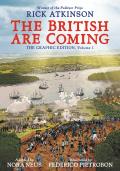
Speaking of comics, this Sestercentennial summer has also brought us The British Are Coming: The Graphic Edition, Volume 1, adapted from the first half of the first volume of Rick Atkinson’s ongoing history of the Revolutionary War.

The comic is credited to Atkinson, Nora Neus as adapter, and Federico Pietrobon as artist. This Altoona Mirror article on the project in progress and this WGBH interview with Atkinson on publication show how he approved work as it came along.

Yet it’s clear that Neus, a journalist and oral historian, made the creative choices in adapting hundreds of pages of dense, fact-filled narration into comics form for Pietrobon to illustrate.

As a CNN producer, Neus picked up the video dispatches of young Muhammad Najem from the midst of the Syrian Civil War and later worked with him to script the graphic memoir Muhammad Najem, War Reporter. She also scripted Renegade Girls, historical graphic fiction, for the same artist, Julie Robine.

The strategy Neus followed for this book, no doubt with Atkinson’s and Ten Speed Press’s approval, was to minimize the words. There are short captions to set the scenes and occasional labels to identify some individuals. All the speech balloons appear to be quotations from actual participants in the events. There are also sound effects, particularly the “BANG” of muskets. But there are an uncommonly large number of panels with no words at all.

The result doesn’t work. Almost all those quotations come perforce from written sources created after the fact, so they don’t read like speech in the moment. The speakers are rarely identified, though I’m sure the sources could all be searched out in the prose edition. The captions don’t provide enough background to understand most events, though military strategy gets a little more analysis than political developments.

In addition, because the siege of Boston was largely static from July 1775 to March 1776, with not much changing despite all the activity, the book devotes proportionally more pages to smaller campaigns: Gen. Richard Montgomery and Col. Benedict Arnold’s thrusts in Canada, Gov. Dunmore’s struggle in Virginia, and the Royal Navy attack on Falmouth.

The spare verbiage puts more burden on the art to convey the history to readers. Occasional infographics, including maps, take advantage of the visual format to impart useful information. But most of the art consists of straightforward, rather slow-paced depictions of events. And those depictions aren’t visually accurate. Pietrobon, working in Italy, didn’t get the guidance, visual references, and time that task would need.

One of my litmus tests of the right look for the late-1700s British Empire is whether a comic shows men with beards, mustaches, and sideburns, which that society shunned. In this book we see men with facial hair on just about every other page spread. Other tests: Does the art render the British flag of the 1770s correctly? No. Does it depict newspapers and shop signs in eighteenth-century style? No. Do all the women have their hair up? Not on page 208.

Except for George Washington, few individuals are recognizable, even when we know what they looked like from good portraits. Likewise, known settings such as King Street in Boston and the Lexington common appear strange. Other places, like Washington’s Cambridge headquarters and Yale College, are all too recognizable because Pietrobon relied on photographs of their present forms.

To assess panel breakdowns, I looked at an episode I’ve studied to death, the Battle of Lexington and Concord (shown on pages 21–49). This rendering starts by showing Lord Dartmouth’s strong suggestion to arrest Patriot leaders and Gen. Thomas Gage’s order to destroy armaments; we see those men’s own words, but the book doesn’t note or explain the difference for readers.

The commander of the British expedition reads his orders before leaving Boston, not after. Paul Revere and William Dawes are shown spotting the redcoats on the march in Cambridge and then setting out west together, not dispatched separately by Dr. Joseph Warren. Then comes the lantern signal from Old North Church, which is placed out in an open field, not on a hill in a dense neighborhood. We never see anyone receiving that signal (and in fact it didn’t matter to how events turned out).

The few seconds of confrontation in Lexington fill seven pages—perhaps proportionate to the importance of that event, but also an indication of how strung out the action is.

At Concord, the British enter in ranks over a hillside rather than along the road. The coloring on page 38 inexplicably changes from day to twilight. The terse description the troops’ search suggests they found nothing in town and all proceeded west. The fight at the North Bridge is portrayed as “a motley crew of farmers and part-time militiamen” stopping the British from crossing. In fact, four companies of regulars had already passed that point without opposition, and most of the British soldiers were still searching the center of town. Only three companies of redcoats were at the bridge, so the provincials were the larger force trying to take control of that chokepoint.

Much of that history is counterintuitive, calling out for explanation. But by choosing to use only historic quotations and minimizing the word count, the creators of this graphic recounting hobbled their ability to explain.

In its verbal approach and pacing, The British Are Coming: The Graphic Edition, Volume 1 might have worked as a visual teaser or accompaniment for Atkinson’s full prose volume—a way to give readers images of its complete, detailed, and explicated narration of events. But the many inaccuracies in the art undercut that value.

Steve Donoghue assessed the volume at Open Letters Review as a reader of history and comics rather than a historian plowing the same field. He came away disappointed as well.

Tuesday, July 21, 2026

America250’s Christian Comics

When Boston 1775 last looked in on America250, the commemorative campaign of the Congressionally-established Semiquincentennial commission, the Trump White House was trying to replace it with its own Freedom250 campaign.

And, of course, its own merchandise for sale.

America250 continues to issue material, though. Among the products bearing its brand and sold through its website is a series of comic books about American history.

That line has included fifteen comics about 36 pages long, a collection of ten of those comics which cover the settlement and founding periods, and a graphic novel on the U.S. Constitution.

The America250 website doesn’t offer clear info on contents and credits, and not all the titles are available there anymore. Its publishing partner, Kingstone, offers all the titles, and at lower prices.

Journalist and historian Colin Woodard recently looked at those comics for Talking Points Memo and reported:
The comics — beautifully executed and bearing the America250 logo — were produced by Kingstone, a Christian publisher best known for its 2000-page, 10,000 panel graphic interpretation of the Bible. . . .

The series — drawn by a world-class Brazilian artist [Joe Bennett] who lost his gig with Marvel comics over antisemitic imagery in cartoons championing Jair Bolsonaro — devotes five volumes to the colonial era, its characters, themes and settings carefully curated to depict the eventual creation of the United States as an outgrowth of divine will and intervention. They all take place north of the Mason-Dixon line, with the action rarely leaving the confines of New England, the only part of colonial North America where Calvinists were the dominant political and cultural force. . . . More glaring is the omission of the origin stories of all of the colonies south of New England — home to most of colonial America’s inhabitants — which don’t fit so well into Kingstone’s narrative. . . .

Miracles abound in the story. Among those explicitly called out in the comics: a young George Washington surviving a rain of French bullets in a 1755 raid; Jefferson writing “all men are created equal” even though he was a slaveowner; the dense fog that fell to protect Washington’s army’s retreat across the East River during the Battle of Long Island; the reversal of fortune allowing Washington’s [sic] victory at the Battle of Saratoga in 1777; the early start to the 1781 hurricane season and the bad decisions made by British generals that facilitated the final British defeat at Yorktown; Franklin’s suggestion that delegates pray to find a compromise solution on legislative representation at the Constitutional Convention; and the Constitution itself, because of its alleged brilliance.
Woodard also detailed many ways the Constitution graphic novel promotes particular positions on today’s political issues, from a historically unfounded reading of the Fourteenth Amendment to opposition to gun regulations, reforming the Electoral College, and expanding the Supreme Court.

Saturday, June 27, 2026

New Boston Museum Exhibits to Visit During the Sestercentennial

Two venerable Boston museums are unveiling big reworked exhibit spaces for the Sestercentennial.

At Revolutionary Spaces’ Old South Meeting House, “Ruckus!” opens formally on 2 July. This is a 25-minute “immersive” show that
drops you right into the heart of the debate and defiance that once filled this iconic space, where ordinary people set extraordinary change in motion.

From the floorboards to the balconies, you will be surrounded by dynamic sound, lighting, and projected animations of fiery revolutionaries, determined citizens, and some unlikely troublemakers whose courage shook these walls.
Revolutionary Spaces encourages people to buy tickets in advance since space at each showing is limited. Arrive around the top of the hour, and the show begins at fifteen minutes past. Tickets include admission to all of Old South’s exhibits and the Old State House.

“Ruckus!” includes loud noises and dynamic lighting to reflect the intensity of the story it tells. It therefore might not be comfortable all visitors. Revolutionary Spaces also offers “Sensory-Friendly Mornings” at the Old State House each month.

The Museum of Fine Arts has reopened its “Art of the Americas: 1700–1800” galleries with a new, hemispheric approach. Thomas Sully’s massive painting of Washington crossing the Delaware stayed where it is, but lots of other iconic artworks are arranged in a new way.

The museum says:
The MFA’s reimagined galleries of 18th-century Art of the Americas bring together works from across North, Central, and South America, and the Caribbean—including works by Native American and Indigenous makers. Together, the eight spaces in this suite, organized by theme, explore how artists have contributed to, or in some cases resisted, ideas of nationhood and identity. Visitors can immerse themselves in expansive versions of familiar stories, discovering the interconnectedness of the Americas and its history, institutions, and people.
The galleries have the themes of “Power and Resistance,” “History and Mythmaking,” “Asian Styles in the Americas,” “Boston’s World,” “Something’s Brewing” (not revolutions but caffeinated beverages), “Communities of Makers,” “Families at Home,” and “Copley’s Ambition.”

Wednesday, June 10, 2026

Three Podcast Episodes

Producing a podcast strikes me as a lot of work, but speaking about Boston history on other folks’ podcasts is always fun.

Here are three episodes I’ve recorded in the last few months. Enjoy all you can.

“The Spark: How Boston Ignited the American Revolution” on The Object of History from the Massachusetts Historical Society

We ask several historians for their thoughts on why Boston helped light the spark of the American Revolution. Was there something unique about Boston's community or geography that made it prone to a rebellious spirit? We sit down with J. L. Bell, Historian of the Revolutionary Era in Massachusetts, Garrett Dash Nelson, President & Head Curator at the Leventhal Map & Education Center at the Boston Public Library, and Kathryn Lasdow, Assistant Professor of History and Director of Public History at Suffolk University, to answer this question.
I’d already been mulling about “Why did the Revolutionary conflict flare up in Boston?” when the invitation to explore that question arrived. Hear my threefold answer and more.

“Boston” on History’s Greatest Cities from History Extra
As one of the oldest cities in the United States, Boston played a pivotal role in the outbreak of the American Revolutionary War, as well as the signing of the Declaration of Independence that followed. In this episode of History’s Greatest Cities, Paul Bloomfield is joined by writer John Bell to explore the storied history of the capital of Massachusetts. Together, they wander through Boston’s oldest neighbourhoods, tracing the story of this harbour city from its pre-colonial roots, through Puritan settlement, to its rise as a major port and administrative centre of the British Atlantic world.
This podcast asks its guests to answer a series of questions, from major events to foods a visitor mustn’t miss.

“Not What You Hurd” on Antiques Roadshow Detours from GBH
In the world of rare silver, American Colonial silver is the stuff collectors dream of. So, when a pair of drinking vessels or “canns,” complete with intricate engraving by a master Boston craftsman, were discovered during ROADSHOW’s visit to Akron in 2023, expert Nick Dawes examined the cups’ clues to reveal both the silver’s early-American history and extraordinary value. But does Nick’s tale of the tankards hold water? Join host Adam Monahan as he searches for the untarnished truth, picking through the many stories, half-truths, and wishful legends in a quest for what may or may not have been lost to history forever.
My voice pops up occasionally on this episode, leaving more time for the fine local historians Joel Bohy and Caitlin DeAngelis.

Tuesday, June 09, 2026

“Paul Revere and Plan B” in Medford, 11 June

On Thursday, 11 June, I’ll speak to the Medford Historical Society on the topic of “Paul Revere and Plan B: Planning and Improvisation in the Lexington Alarm.”

Our event description says:
After the Battle of Lexington & Concord on April 19, 1775, Massachusetts resistance leaders portrayed the uprising as a mostly spontaneous response to the army’s incursion into a peaceful countryside. Decades later, Henry W. Longfellow presented “Paul Revere’s Ride” as nearly a one-man show.

In truth, the Massachusetts Patriots had prepared for months to resist the Crown military. Revere was part of a network of organizers, informants, and alarm riders. At the same time, Revere and his colleagues succeeded by being able to respond to contingencies by changing their plans.

Drawing on new research, this talk will shed light on one of independent America’s oldest stories—and how the day could have turned out differently.
I developed an earlier, short version of this talk for the 19th of April several years ago, and now I’m backloading it with more about Revere’s pre-war propaganda and espionage work.

The society will meet at the Charlotte and William Bloomberg Medford Public Library starting at 7 P.M. This event is free and open to the public.

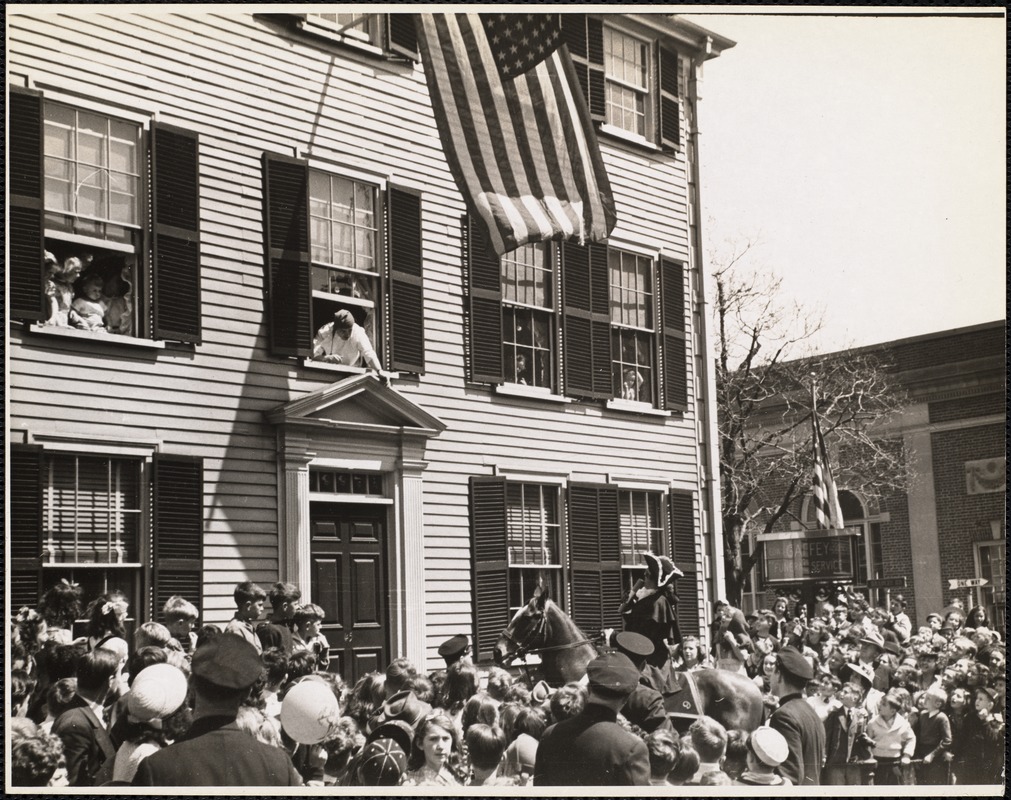
(The photograph above, which comes courtesy of Digital Commonwealth, shows the reenactment of Paul Revere’s stop at the Isaac Hall House in Medford sometime in the mid-1900s.)

Wednesday, May 27, 2026

Uncovering Boston Jersey

Earlier this month the Guardian reported on how researchers had unearthed new information about a figure in this portrait.
For hundreds of years, he was known only as “Jersey”, an enslaved boy of about 11 rendered in oil on canvas by the great 18th-century portrait painter Sir Joshua Reynolds. . . .

The painting, thought to have been completed around 1748, shows the boy and his “master”, the naval officer and MP Paul Henry Ourry. While Ourry looks out into the distance authoritatively, the enslaved child gazes up at the officer tentatively. . . .

Scouring admiralty records, letters, muster books (ships’ registers) and captains’ logs, [Mark] Brayshay and Katherine Gazzard, a curator at Royal Museums Greenwich, found him named as “Boston Jersey” on ships that Ourry was attached to.

They believe he may have been given the surname Jersey because Ourry was born in the Channel Islands. It is possible he had his first name because he once lived in Boston, Massachusetts.

The researchers discovered Jersey was baptised as George Walker (possibly a name he had been known by earlier in his life) on 30 July 1752, probably in a chapel in Westminster.
The article has a little more to say about George Walker and much more about the restoration of the painting.

This discovery led to the quick creation of a Wikipedia page about Boston Jersey/George Walker.

Tuesday, May 12, 2026

Finding Mary Fowle of Londonderry

Yesterday I cited Jane Merrill’s Sex and the Scientist: The Indecent Life of Benjamin Thompson, Count Rumford (1753–1814), the latest and frankest biography of the scientist, statesman, soldier, and seducer.

That book quotes testimony from Mary Fowle of Londonderry, New Hampshire, about how Thompson had an affair with Mary (Dill) Thomas, first wife of the Boston printer Isaiah Thomas.

Merrill distinguishes that woman from the Mary Fowle whom Isaiah Thomas married in 1779, whom she identifies as both the printer’s cousin and the widow of his old master, Zechariah Fowle.

Isaiah Thomas’s second wife named Mary was indeed a cousin, having been born Mary Thomas on 9 June 1750, according to genealogy published in “The Portraits of Isaiah Thomas” by Charles Lemuel Nichols.

However, that cousin Mary didn’t marry Zechariah Fowle. Her mother, Rebecca (Bass) Thomas, did. The older printer died in Portsmouth in 1776. Rebecca (Bass Thomas) Fowle, twice widowed, died in Worcester in 1803 and was buried in her son-in-law’s family tomb.

So who was Mary Thomas’s first husband? Boston vital records show that the Rev. John Lathrop married Isaac Fowle and Mary Thomas on 11 May 1769. The Thomas and Fowle family genealogies say they had two daughters, who both died young:
  • Rebecca T[homas?]. (4 Feb 1770–6 Dec 1773 in New York)
  • Dorothea Whitmarsh (5 Nov 1771–10 Sept 1772)
Isaac Fowle reportedly died in 1777 while serving in the Continental Army.

That same year, Isaiah Thomas leased his financially stressed press and newspaper to his come-of-age apprentice, Anthony Haswell, and moved with his children to “a small farm in Londonderry, New Hampshire,” according to the biography published with the second edition of his History of Printing in North-America. He also initiated a divorce from his first wife.

A couple of years later, Isaiah came back and took over the print shop again. Worcester’s vital records state that on 26 May 1779 Isaiah Thomas married “Mary Fowle of Londonderry” in Boston. Since 1777 he had been a divorcé with three children, his cousin Mary had been a childless widow, and there was a war on. Mary might well have been keeping house for Isaiah in New Hampshire even before they married.

Thus, the Mary Fowle of Londonderry who provided testimony for Isaiah Thomas in his divorce case in 1777 was:
  • his cousin
  • a stepdaughter of his former master
  • his future wife
Isaiah and Mary (Thomas Fowle) Thomas had no children. She died at Worcester in 1818, and he remarried again the next year. The picture above is the pastel portrait of Mary in the collection of the American Antiquarian Society.

Monday, May 11, 2026

“Not playing cards but fondling and kissing each other”

In preparation for tomorrow’s talk about Benjamin Thompson’s early years, I’ve been reviewing the evidence of his affair with Mary (Dill) Thomas, wife of printer Isaiah Thomas.

When Isaiah moved to divorce Mary in 1777 by petitioning the Massachusetts Council, he submitted testimony from several people who had seen his wife traveling with the militia major from New Hampshire in February 1775, behaving like man and wife.

The printer’s file also offered an affidavit from Mary Fowle of Londonderry, New Hampshire, who had stayed with the Thomases in Boston from 20 Sept 1774 to 16 April 1775.

In Sex and the Scientist, Jane Merrill quotes Fowle describing how “Major Thompson [was] then a refugee in Boston who borded in a house opposite.” Mary Thomas started visiting him several times a day even though (or because) she had two children under the age of three.

One Saturday the printer’s wife “dressed herself, shifting her Linen, which I knew was not her custom,” said her house guest. Mary Thomas came home with “a small piece of parchment, on which a Lady’s face had been drawn with a black lead pencil. . . . the Major had taken much pains with it.”

Soon Mary Thomas visited Thompson’s ”bed-chamber, where they staid the whole afternoon and part of the evening.” Fowle stated, “I could not but think there was more intimacy between them than I before tho’t of.” She observed the couple “kissing each other, laying in each others laps, speaking fondly of each without regarding me.”

One day Isaiah came home from business after his wife had gone to play cards with Maj. Thompson. Mary Fowle and a household servant went across to fetch her. They found the couple “not playing cards but fondling and kissing each other, she often laying her head on the Major’s shoulder, and their arms round each other.”

As if that wasn’t clear enough, in February 1775 Mary Thomas insisted on taking that trip to Newbury with Maj. Thompson, first having her hair “in the greatest taste much powdered.” Later the printer gathered testimony from several innkeepers about that journey. At the time, however, he just seems to have felt trapped.

On one Sunday, Isaiah Thomas and Mary Fowle went to church. When they came home, his daughter Mary Ann, who turned three years old that March, showed them a “copper” that Maj. Thompson had given her to go into another room. Fowle stated the little girl said, “The major kissed her Mama and felt her bosom.” In response, little Mary Ann’s mother told her she was lying and threatened to whip her.

Isaiah finally demanded that Mary admit to what was going on. She acknowledged having a sexual affair. And when did it start? True to Benjamin Thompson’s character, he first got into Mary Thomas’s bed right after writing a letter to his own wife back in Concord, New Hampshire.

I won’t bother asking if these marriages can be saved.

TOMORROW: Who was Mary Fowle?

Sunday, May 10, 2026

Thetford’s Most Famous Son

Thomas Paine was born in Thetford, England, in 1737.

In 1964 the town erected a statue of him, over the objections of a councilor who actually resigned after the vote.

Even so, I can’t help but wonder if the statue truly matches Paine’s ideas.

“What do you mean? We set it in a place of honor—on King Street, outside King’s House.”

King Street? How does that reflect Paine’s views of monarchy?”

“Oh, we still have total respect for Thomas Paine and his writing.”

“Okay, good.”

“Why, back in 2020 we gilded him!”


(Now, to be fair, the Thomas Paine Society itself helped to pay for this gilding.)

Thursday, March 26, 2026

The Last of Castle William

On 10 Mar 1776, the last royal chief justice of Massachusetts, Peter Oliver, boarded a ship called the Pacific, which usually sailed between India and Britain. He called it “a very commodious vessell, which General [William] Howe was so polite as to appropriate to the accomodation of my friends and me.”

For the next week, Oliver recorded periodic artillery exchanges between Boston and the Continental lines. On 17 March, he wrote, “The troops at Boston embarked, and about 20 sail fell down into King Road by 11 o’clock this morning.” The next day, he watched the army start to destroy Castle William.

One of the Royal Artillery engineers involved in that operation was Capt.-Lt. Archibald Robertson. In his diary that officer wrote, “In the Morning went to Castle William to see the mines prepar’d; found them ready for Loading.” 

The next day, Robertson “found the mines all loaded but 12 which were again unloaded as the General wanted them not to be ready for some days.” Gen. William Howe was shifting some troops onto transport ships that had just arrived from Halifax, and the 64th Regiment was still holding the Castle, exchanging cannon fire with the mainland.

That night, Judge Oliver reported, the “south Blockhouse of the Castle was burnt, and some of the walls of it blown up.”

On 20 March, Capt.-Lt. Robertson wrote:
At 3 o’clock Colonel [Alexander] Leslie came to the Castle from the General with orders to load the mines. We began immediately and had 63 done by 7 o’clock.

As the night had the Appearance of Rain and the wind fair it was thought proper for the 64th to Embark. . . . Accordingly at 8 o’clock 6 Companies Embark’d and the Boats lay off untill the mines were fired, which was done 1/2 an hour Afterwards and they had a very good Effect.

The Barracks and other houses were then set on fire, and at 9 the Rear Guard consisting of 3 Companies, the Artillery, etc. Embark’d, and we got all safe on board the Transports.
Judge Oliver’s description of this spectacle was:
The blowing up of the Castle Walls continued: and at night all the combustible part of the Castle was fired. The conflagration was the most pleasingly dreadful that I ever beheld: sometimes it appeared like the eruption of Mount Etna; and then a deluge of fire opened to the view; that nothing could reconcile the horror to the mind, but the prevention of such a Fortress falling into the hands of rebels, who had already spread such a conflagration of diabolical fury throughout America, which scarce anything can quench but the— metu tremefacit Olympum.
That Latin phrase meant “He makes Olympus tremble,” hinting at a supernatural power.

Capt.-Lt. Robertson’s watercolor of Castle William being consumed by fire appears above; “a very good Effect” indeed.

TOMORROW: Leaving America behind.

Saturday, February 07, 2026

A Super Bowl Toss-up

Through Craig Bruce Smith I learned that the coin to be tossed at the start of this year’s Super Bowl has a Revolutionary pedigree.

It’s a replica of the Libertas Americana medal that Benjamin Franklin commissioned in 1782 after learning of the French and Continental victory at Yorktown.

That medal has the date 1776 on one side, but the 1777 and 1781 dates of Saratoga and Yorktown are on the other. It’s not quite a Sestercentennial artifact, in sum.

The Super Bowl could have chosen a replica of Washington Before Boston medal, commemorating an event that occurred 250 years ago next month.

That, too, has a 1776 date on it, albeit in Roman numerals. The Continental Congress voted in 1776 to commission that medal, though the project didn’t get done until 1789.

Of course, choosing a coin this year that celebrates the recovery of Boston, based on a medal held by the Boston Public Library, might seem biased toward the New England Patriots.

Tuesday, January 13, 2026

Online Lecture Series from Historic Deerfield

Here’s another series of online lectures exploring the Revolution during the Sestercentennial, this time from Historic Deerfield.

Sunday, 25 January, 2 P.M.
Mighty Microbes: The Deadly 1775 Massachusetts Dysentery Epidemic and the Other Diseases That Shaped the American Revolution
Woody Holton, Professor of History at the University of South Carolina, author of Liberty Is Sweet

Sunday, 22 February, 2 P.M.
Spain, Native Nations, and the American Revolution
Kathleen DuVal, Carl W. Ernst Distinguished Professor of History the University of North Carolina, author of Native Nations

Sunday, 29 March, 2 P.M.
Picturing the American Revolution
Paul Staiti, Professor of Fine Arts on the Alum Foundation at Mount Holyoke College, author of Of Arms and Artists

Historic Deerfield says this series will “explore the American Revolution not just as a political conflict, but as a broad and complex global event that profoundly shaped the lives of everyone in the colonies. The war’s impact extended far beyond political fervor, crucially affecting Native nations seeking autonomy, free and enslaved Black people across the continent, and every sphere of social, cultural, and economic life—from material culture and daily labor to political ideology.”

All three lectures will be free of charge and presented virtually via Zoom webinar. Register for the links through this page.

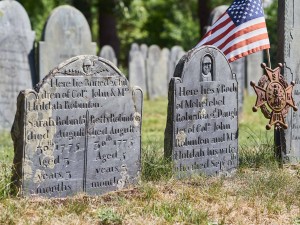
(The picture above shows the gravestones of young sisters Betty, Huldah, and Mehetebel Robinson, dead of dysentery in late 1775, courtesy of the Westford Museum.)

Thursday, January 01, 2026

“Time turns his Glass, and round the Pole Another Year begins to roll”

In 1775 the British artist John Hamilton Mortimer issued a series of prints titled Twelve Characters from Shakespeare.

One of those portraits showed Edgar from King Lear, in his guise as Poor Tom the madman, as shown here.

Among that character’s lines was “Poor Tom’s a-cold.”

Two hundred fifty years ago today, the young carriers of the Pennsylvania Evening Post quoted that line as they regaled their customers with this poem.
New-Year’s Verses,
Addressed to the CUSTOMERS of
The PENNSYLVANIA EVENING POST,
By the PRINTER’s LADS who carry it.

MONDAY, JANUARY 1, 1776.

“POOR TOM’s a cold”---God bless you, Masters,
And save you all from all Disasters!
Time turns his Glass, and round the Pole
Another Year begins to roll:
Welcome the new, adieu the old,
For every Year Poor Tom’s a-cold.

Sages have said, and Bards have sung,
That long ago, when Time was young,
The World enjoy’d a golden Age:
No Dog-Star kindled then to Rage;
No Summer’s Drought, nor Winter’s Snow,
Forbade the limpid Stream to flow:
No Torrents of descending Rain
With Desolation spread the Plain:
No languid Air, with sickly Breath,
Diffused the pois’nous Seeds of Death:
No Comet’s Blaze, of horrid Light,
Shot thro’ the Curtain of the Night;
No chilling Blast flew howling by,
No Lightnings rent the burning Sky,
Nor Thunder shook the rolling Sphere.
One genial SPRING was all the Year.
Then were the Hills and Vallies seen
Forever blooming, ever green;
And, like the Season, mild and gay,
Man liv’d a Stranger to dismay;
For smiling Peace, with Plenty crown’d,
Gave Health and Joy to all around.
No Din of War, no civil Hate,
Were then the chastening Rods of Fate.
O had I seen those Days of old!
But now, alas! Poor Tom’s a-cold:
But you, who live with Hearts at Ease,
Will surely never let him freeze.
Sweet Madam, Gentle Sir, Good-morrow;
God keep you free from Pain and Sorrow,
And let me hope, ere long, to boast
Good News!----Good News!----in the EVENING POST.
This example of carriers’ verse is interesting in how little it says about current affairs. The American colonies were at war with the London government, but the only possible allusion to that was the mention of “civil Hate.”

Earlier American examples of these verses reveled in the patriotism that the newspaper employees and their customers supposedly shared, heaping disdain on foreign enemies like France and Spain. But in a time of civil war, loyalties were more problematic. Better to talk about the weather.

That wasn’t because the printer of the Pennsylvania Evening Post, Benjamin Towne, kept away from politics. He supported the colonial resistance and independence, and a year later his 1777 carriers’ verse celebrated, “Shout, George is King no more.”

Of course, the British army occupied Philadelphia late that year. In 1778 Towne’s carriers offered lines praising Gen. Sir William Howe to the skies.

Monday, December 22, 2025

New Foreword for Stark’s Loyalists of Massachusetts

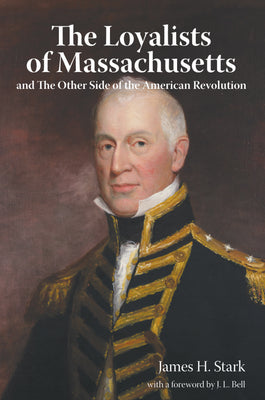
American Ancestors has just reissued James Henry Stark’s The Loyalists of Masssachusetts with a new foreword by me.

I came across a copy of Stark’s Loyalists of Massachusetts in my local library when I was early in my research on eighteenth-century Boston. I was struck by its combination of detailed research on exiled families and apparently still-hot resentment at how the whole Revolution thing turned out.

One notorious detail of this book is an illustration of Paul Revere on horseback—complete with fringed buckskin coat, beard, and vicious snarl.

In researching the publication of The Loyalists of Massachusetts for this foreword, I realized that Stark didn’t commission that and the other full-page illustrations. He reused them from an earlier history of the Revolution. He did, however, change the captions to make their message more pointed.

Stark published through his own printing company, which he had cofounded with a former “spirit photographer.” That gave him the freedom to devote hundreds of pages to “The Other Side of the American Revolution,” as his subtitle said.

I also looked into the reception of the book in 1910. Some reviewers thought Stark, a childhood immigrant from Britain, was too harsh on the Patriots. The press magnified that controversy. The argument became a front-page story in newspapers well outside New England as editors enjoyed the spectacle of elite Bostonians arguing over their ancestors’ actions.

Another of Stark’s interests was yachting. In fact, he was on a cruise when the controversy over his book broke out. I think he’d be pleased that the cover of this new edition shows Sir Isaac Coffin, alumnus of Boston’s South Latin School and admiral in the Royal Navy.

Sunday, September 28, 2025

A Last Word on Boston’s Sedan Chairs

Originally I flagged Alun Withey’s blog post about sedan chairs in Britain just because I thought it had interesting details about daily life in the eighteenth century.

But then I got interested in the question of whether those details also applied in Boston.

Looking for sedan chairs locally led me into the smallpox epidemic of 1764, and thus to the name “Williston” appearing over and over in the selectmen’s records. So I had to figure out who Thomas Williston was.

So, having spent nearly a week on what I’d thought was a one-day topic, I’m coming back around to complete this sedan chair trip with some familiar names.

In 1769 the smallpox virus flared up again in Boston, though not nearly as badly as five years before. On 21 June the selectmen’s minutes reported:
Mr. Thomas Cunningham living near Dr. [Jonathan] Mountforts gives information to the Selectmen, that one Joseph Hading who came to his House on Satturday last, from a Vessel which then arrived here from Philadelphia is suspected of having the Small Pox broke out upon him.

Dr. [Joseph] Warren was in consequence of the above information sent to the said Cunninghams house to examine into the same, who having done it, makes Report that the Person has got the Small Pox.

Whereupon the Sedan was sent to carry him to the Hospital at New Boston.
“Mountforts Corner” was the site of a well-known apothecary shop in the North End. The Jonathan Mountfort running it in 1769 was a son of the man with the same name who’d set it up. When he died in 1781, the business passed to his own son, also named Jonathan (born in 1746 and painted as a kid by the young John Singleton Copley, as shown above courtesy of the Detroit Institute of Arts). That third Jonathan Mountfort died only four years later, but the name survived for at least another decade.

In late July 1769 the selectmen sent the town sedan chair to carry more smallpox victims to the province hospital: “Mr. Jabez Searl,” “a Child a Daughter of Abijah Lewis,” and “Capt. Timothy Parker…between the Hours of Two & Three OClock in the morning.” (Others, such as “a Negro Woman Servant to Mr. William Wingfield,” were simply ordered to be removed to the hospital, and it’s not clear how that happened.)

These people were surprised to be catching smallpox. They must not have volunteered to be inoculated with what doctors believed was a mild strain. Health statistics stretching back decades showed that contracting the disease “in the natural way” was more deadly than being inoculated. And indeed, by 9 August, Searl and Parker had both died.

A few months later, the army drummer Thomas Walker was carried to the hospital in what he called “the Machine for the Conveniency of Removing the Sick.” He didn’t have the smallpox; instead, he’d been injured in the fight between soldiers and ropemakers on 2 Mar 1770. I wonder if that “Machine” was the town sedan chair or if the army had its own equipment.

My next milestone in the story of sedan chairs in Boston comes in 1799. In that year the town established its first board of health. Paul Revere was board president, the silversmith’s highest civic office. On 8 Apr 1800, the selectmen’s records say: “On application from the Board of Health, order’d that the Sedan Chairs belonging to the Town be delivered to them for their use”.

Thus, in eighteenth-century Boston, sedan chairs were ambulances. We can find a few individual sedan owners in the records, but they appear to have been in poor health. The appearance of a sedan chair on your street signified not luxury but illness.

Monday, September 22, 2025

A New Ministry Off to the Races

At the History of Parliament blog, the Georgian Lords welcomed Ioannes Chountis de Fabbri of the University of Aberdeen to discuss the equestrian genesis of the Marquess of Rockingham’s ministry:
By the spring of 1765, George III was determined to be rid of his overbearing minister, George Grenville, who had been in office since April 1763. The task of taking the pulse of the political nation, fell to the king’s uncle, William Augustus, duke of Cumberland. . . .

Cumberland had toured the great country houses in the summer of 1764, including Chatsworth, Wentworth Woodhouse and Woburn, discovering that the Whigs remained unenthusiastic about a return to power without [William] Pitt. The stalemate seemed unbreakable. Yet the solution would not be found in the names listed in the London Gazette, but in the pages of the Newmarket Calendar.

By the 1750s and 1760s horse racing had become a central ritual of aristocratic and political life. Already favoured by Charles II in the seventeenth century, by the 1740s Newmarket was the undisputed capital of the turf. The Racing Calendar, first published in 1727 by John Cheny, recorded results and pedigrees, turning the turf into a semi-official world of statistics and reputations. Ascot, founded in 1711 by Queen Anne, had by the 1760s become a highlight of the London season, attracting large crowds and royal patronage. (Morton, 56–61) Both courses were more than sporting venues: they were theatres of status, where political alliances were cultivated over wagers, where a minister could be sounded out between heats, and where a successful stable enhanced a nobleman’s standing. As one contemporary put it, ‘the turf is the true parliament of our nobility’. . . .

By 1765, Rockingham was already a figure of considerable weight within the Whig aristocracy, though not yet tested as a statesman. Born into immense wealth and heir to Wentworth Woodhouse in Yorkshire, he inherited his title in December 1750. In politics he aligned with the ‘Old Corps’ Whigs grouped around Newcastle, and from 1752 served as a gentleman of the Bedchamber to George II and George III, before resigning in 1762 in protest over Newcastle’s dismissal. . . . Like Cumberland, Rockingham was a passionate breeder and owner of racehorses, and he became known as ‘the Racing Marquess’. (Albemarle, i. 165)

Cumberland was equally at home on the turf, and in June 1765 he held court at Ascot, where the outlines of a new administration were hammered out. As well as Rockingham, the new ministry was to include Augustus Henry Fitzroy, 3rd duke of Grafton, a great-grandson of Charles II. Not yet 30, Grafton brought youth and royal blood; Rockingham brought wealth, influence, and respectability. Their conversations at Ascot and Newmarket were, as Albemarle noted, ‘held not in the closet, but at the races’. (i. 199) . . . Pamphleteers and satirists delighted in the horse racing connexion: ‘From Jockeys to Ministers’, they jibed…
The new ministry took office on 13 July 1765. The Duke of Cumberland hosted its meetings at his London home and country estate. But at the end of October he died, only forty-four years old. Rockingham, Grafton, Newcastle, and their colleagues rode on, but their coalition held together for only slightly more than one year.

During that time, Rockingham repealed the Stamp Act for North America. For the protesting colonists, that restored their loyalty to the British constitution. It did not, however, solve what London saw as the government’s revenue problem.

(The equestrian portrait of the Duke of Cumberland above was made in China, probably in the 1750s, for the British market. It is now in the collection of the Metropolitan Museum of Art in New York.)

Wednesday, September 17, 2025

250 Logos

Over at Emerging Revolutionary War, Bert Dunkerly looked at the national and state logos of the Sestercentennial commissions and campaigns.

I like the Bicentennial logo so much I own a T-shirt with that picture on it, cleverly made to look like it’s an antique silkscreen that’s gone through the laundry five hundred times. But of course that logo came out in my childhood, so it has extra nostalgia appeal.

Dunkerly also likes that 1970s logo much more than America 250’s national Semiquincentennial logo, but otherwise his taste is old-fashioned. His tastes leans toward round, seal-like images and serif fonts.

In the comments, Dunkerly admits that one thing makes the Semiquincentennial logo look better: reviewing the state logos.

Many states aren’t represented in this roundup, and I’ve seen a lot of municipal logos as well. Will any have the staying power of the Bicentennial star? We should probably consult with an eleven-year-old about that.

(Meanwhile, the America 250 Facebook feed is being politically partisan and literally divisive.)

Saturday, August 30, 2025

Hic incipiat

The Commonwealth of Massachusetts’s Seal, Flag, and Motto Advisory Commission started meeting in July 2021, blowing past its original deadline but gaining approval last year to change those state symbols.

Earlier this year, the commission invited citizens to suggest designs for a new commonwealth seal, flag (no longer necessarily just showing the seal), and motto.

This week it unveiled the results—more than a thousand responses (some repeated), which anyone can thumb through in this download.

The commission sent “23 seals, 48 flags, and 32 mottos” to a second round. (For some reason, those are shared as a PowerPoint file.)

The whole collection includes lots of allusions to Revolutionary history, as we might expect. Some are obvious, like Minuteman figures, messengers on horseback, a pair of lanterns (or just one), lots and lots of pine trees, anachronistic teabags, even a Crispus Attucks.

One person suggested simply returning to the seal carved during the Revolutionary War by Paul Revere, with a figure of a Minuteman. Others combined a Minuteman with an Indian, as on the early colony and later state seals. Several proposed versions of the “Bunker Hill” or “New England” flag with a pine tree canton over the English cross.

Some allusions to the Revolutionary era are more subtle. At least a couple of designs used the nine vertical red and white stripes of the “Sons of Liberty flag.” I don’t think that’s an authentic Revolutionary relic, but I do like the idea of the state acknowledging the political activity of Samuel “Rat-trap” Adams.

Since 2005 Massachusetts’s official state colors are blue, green, and cranberry, and those show up in lots of designs, but many more people used the blue, white, and gold of the current flag. To me the gold looks awfully buff, recalling the “buff and blue” of the British Whigs and thence the Continental Army uniform modeled by Gen. George Washington.

Many of the flag designs include five-pointed stars, like the one on the current seal/flag, but the number of those stars varies widely. Six stars was the most common count. I was baffled by what that number represented. Usually stars refer to the number of things making up an entity, as with the fifty states of the union, and I didn’t think Massachusetts has six of anything.

Then I read that six stars refer to Massachusetts being the sixth state to ratify the Constitution. But that ratification was not, as many submitters believed, when Massachusetts joined the United States. The country had been formed a few years earlier as states signed onto the Articles of Confederation, and Massachusetts was the ninth state to do so.

Of course, the commonwealth has a lot more history than the Revolution. The proposed designs also include lots of Mayflowers, both the ship and the flower. Many nod to the state’s educational, technological, and maritime heritages. At the commission’s urging, lots of designers incorporated animals, plants, or landscapes that have some connection to Massachusetts.

The commission’s top three choices in each category are on this page. I don’t like any of the seals, and I don’t love any of the flags. In the larger group, nothing stood out for me as obviously right either, but I thought some worked better than those selected. (Massachusetts also has an official governor’s flag and an official naval ensign, so there’s room for runners-up.)

I did think a few people came up with the right motto: “Let it begin here.” It’s punchy and understandable, forward-looking enough to evoke innovation. It nods to the state’s false claim to be the real start of the American nation and its more arguable claim to provide the cradle of liberty. It definitely derives from a story of the fight at Lexington.

Unfortunately, that proposed motto didn’t get past the first round. The commission evidently wants something in Latin. (One submitter did translate the words attributed to John Parker into Latin: Hic incipiat.)

Monday, July 28, 2025

A Hero of Lake George

The Battle of Lake George on 8 Sept 1755 probably involved fewer than 3,500 men, a little more on the British side than the French. Each commander reported that his force had faced a much larger foe, however.

Each commander also reported inflicting more casualties than his force suffered, and more casualties than the rival commander reported. In fact, it seems impossible to pinpoint the number of dead and wounded.

Both sides lost leaders, however. On the French side, Baron Dieskau was wounded and captured, and Canadian commandant Jacques Legardeur de Saint-Pierre was killed. The British lost Col. Ephraim Williams and Mohawk ally Hendrick Theyanoguin. Among the provincial officers who died of their wounds was Capt. William Maginnis of New York.

Gen. William Johnson was wounded early in the fighting near Lake George and had to sit out the rest of the battle. Not that he mentioned the last detail in his report to the Crown. Nor did he name Col. Phineas Lyman as the officer who took over and completed that part of the fight. But of course Johnson portrayed the battle as a great victory for Britain.

It probably was a British victory, though limited and costly. Crown forces could now move safely from Fort Lyman to Lake George, and the lakefront was clear enough to build another fort there.

But that clash was an even bigger win for William Johnson, Britain’s liaison to the Iroquois and new provincial general. He was made a baronet, thus Sir William Johnson. Eventually Benjamin West painted Johnson nobly sparing a French officer from attack by a Native warrior, as shown above.

The new baronet returned the king’s favor, renaming the nearby landmarks for the royal family: Lac du Saint-Sacrement became Lake George after George II, Fort Lyman became Fort Edward after one of the king’s grandsons (another slight for Phineas Lyman), and the new fort was dubbed Fort William Henry after the king’s younger son and another grandson. Since the territory remained in British hands, those names prevail.

As the senior (and surviving) British captain in the last part of this battle, Nathaniel Folsom enjoyed some of that glory. He rose within the New Hampshire military establishment, ranked as a colonel within a couple of years. Folsom’s businesses in Exeter prospered.

In 1774 the province chose Nathaniel Folsom as a representative to the First Continental Congress, alongside John Sullivan. His son, Nathaniel, Jr., participated in the first raid on Fort William and Mary that December. Decades later a veteran named Gideon Lamson stated (using military titles the men acquired later):
At nine, Colonel [John] Langdon came to Stoodley’s and acquainted General Folsom and company with the success of the enterprise,—that General Sullivan was then passing up the river with the loaded boats of powder and cannon.
Folsom took charge of one barrel of gunpowder removed from the fort.

Given Nathaniel Folsom’s success in the last war, his support for the Patriot resistance, and his activity in the New Hampshire Provincial Congress, it’s no surprise that that body voted to make him commander of the province’s troops on 21 Apr 1775. The legislators reaffirmed that decision on 23 May.

The problem was that no one had checked with the officer who was actually leading the New Hampshire troops around Boston.

TOMORROW: Stark divide.

Tuesday, July 22, 2025

Anishanslin on The Painter’s Fire in Boston, 23 June

On Wednesday, 23 June, Zara Anishanslin will speak at the Massachusetts Historical Society on her new book, The Painter’s Fire: A Forgotten History of the Artists Who Championed the American Revolution.

Zara Anishanslin is a professor at the University of Delaware. Her last book was Portrait of a Woman in Silk: Hidden Histories of the British Atlantic World, winner of The Library Company of Philadelphia’s first Biennial Book Prize.

I got to hear Prof. Anishanslin speak about The Painter’s Fire at the Dublin Seminar for New England Folklife last month. Previous studies of American-born painters in the Revolutionary world have focused on men like John Singleton Copley, Benjamin West, and Ralph Earl—all important artists but also Loyalist in that conflict.

In contrast, Anishanslin looks at three artists who actively supported the new American republic in one way or another: Robert Edge Pine, Prince Demah, and Patience Wright. Pine was a British native, Demah was born enslaved, and Wright was a woman working in wax rather than portraiture, so their lives expand the traditional scope of artists’ studies in other ways as well. Their careers also intersected in interesting ways.

When I first wrote about Prince Demah back in 2006, all that I knew was his first name, that he was enslaved to Christian Barnes in Marlborough, and that she wanted to get him some training as a painter. Research by Paula Bagger and others revealed Demah’s transatlantic career, service in the Continental Army, and more. It’s exciting to see those facts come into the light.

The talk is the society’s Annual Jack Grinold Lecture in American Art and Architecture. It will begin with a reception for in-person attendees at 5:30 P.M. Prof. Anishanslin’s talk (and the online stream) will begin at 6:00. The event is free to society members and online attendees, $10 for others. Register here.