J. L. BELL is a Massachusetts writer who specializes in (among other things) the start of the American Revolution in and around Boston. He is particularly interested in the experiences of children in 1765-75. He has published scholarly papers and popular articles for both children and adults. He was consultant for an episode of History Detectives, and contributed to a display at Minute Man National Historic Park.

Subscribe thru Follow.it


•••••••••••••••••


Showing posts with label Jeremy Belknap. Show all posts

Wednesday, August 14, 2024

Elisha Porter: Widower, Militia Officer, Legislator

I’ve been writing about Gen. George Washington’s wish to obtain gunpowder from Bermuda in August 1775.

Today I’ll focus on one man involved in that effort: Elisha Porter (1742–1796) of Hadley.

Son of a member of the Council, Porter graduated from Harvard College in 1761 before going home to establish himself as a lawyer. In 1773 he became a captain in the Hampshire County militia.

Because of his college degree, there’s an entry for Porter in Sibley’s Harvard Graduates, but it says little about his personal life, blaming how “the collection of his manuscripts at the Massachusetts Historical Society consists chiefly of commissions and like documents.” Even so, I think that profile omitted some important events.

In 1762 Porter married Sarah Jewett, daughter of the minister in Rowley, and they had six children together. Then Sarah Porter died on 5 Apr 1775. Thus, Porter was a single father of six, still grieving, when news of the Concord battle arrived.

Porter marched east with the men of Hampshire County as a colonel, arriving in Cambridge on 25 April. Then came the transition from militia force to a Massachusetts army enlisted for the rest of the year. Still in his early thirties, Porter was probably one of the more junior of the provincial colonels. According to committee of safety records, Porter raised some men for the army, but as of 10 June they had still not arrived. “Col. Porter said he was willing to resign, rather than the public service should be hindered.”

Hadley showed its continued support for Porter by electing him to the Massachusetts Provincial Congress for the session starting on 31 May. In Watertown, colleagues addressed him by his militia rank, and he served on several committees on army matters, including trying to sort out issues for the artillery regiment.

Then on 8 June, according to Sylvester Judd’s History of Hadley, Porter’s son David drowned at the age of seven. We have no accounts of how he took this news, but he had “leave of absence” by the next day. Losing two members of his family in a little over two months must have been profound.

Porter soon returned east to throw himself into the war. Among the anecdotes of the Battle of Bunker Hill that the Rev. Jeremy Belknap wrote down in 1787 was: “Col Porter…conveyed 2 Hhd of Liquor to ye. Men in ye. works thro’ showers of shot from ye. floating batteries.” Porter also lost a gun on that battlefield.

On 24 June, after the congress learned that Gen. Washington was on his way, Porter was one of six members delegated to organize a reception “with proper respect, and to provide a house for him.” Later that same day the congress authorized him “to procure a scythe, and carry it to a blacksmith, to be fitted for a spear, in such a manner as he thinks fit, and bring it before this Congress, when fixed.” Porter was evidently a man of ideas.

Three days later, the congress added Porter to the committee on supplies, meeting in the Edmund Fowle house, shown above. He was also put on a committee to write to the Continental Congress and to Gov. Jonathan Trumbull of Connecticut, “requesting their aid in furnishing us with gunpowder.” On 10 July, Porter was the first man named to a committee to confer with Gen. Washington about adding to what was now the Continental Army.

Massachusetts held elections for a new General Court to meet on 19 July. Hadley must have elected Porter to this official legislature, but his name doesn’t appear in its records until late August. Evidently he was traveling out of the province on special assignments for some of that time.

TOMORROW: Working with the general.

Wednesday, July 24, 2024

“The enclosed covenant is by no means inconsistent”

Having returned from a busy convention in California, I’m going back to the Solemn League and Covenant of June 1774.

Or, more accurately, the multiple overlapping boycott covenants that appeared in print that month, first in broadsides and then in the 22 June Pennsylvania Journal and the 23 June Boston News-Letter.

Albert Matthews discussed two texts in 1915, calling them Form B and Form A, respectively.

He briefly mentioned a third variation, which I’ll call Form C. This was a revision of Form B created and distributed by the committee of correspondence in Portsmouth, New Hampshire, by the end of June 1774. The Library of Congress displays a copy here.

Another copy of Form C survives in the papers of the Rev. Jeremy Belknap at the Massachusetts Historical Society; he cautioned his parishioners in Dover, New Hampshire, against signing on until they’d heard from what would be the Continental Congress.

According to Frederick Chase’s History of Dartmouth College and the Town of Hanover, the voters of Plainfield, New Hampshire, did adopt the text of Form C on 28 July. Town histories of Mason and Wilton, New Hampshire, show those towns adopted Form C while adding a proviso that signers could vote to revise its terms.

We can thus think of Form C as the New Hampshire variation on a document that originated in Massachusetts. But the big question remains: Which of Form A and Form B was the Boston original?

In early June, as the Boston committee of correspondence finalized its text, Whigs in Worcester County were also thinking about a boycott. In a footnote, Matthews shared evidence that William Henshaw (1735-1820, shown above) of Leicester and Timothy Bigelow (1739–1790) of Worcester privately circulated a draft non-consumption agreement. At the bottom of a copy at the American Antiquarian Society, Henshaw wrote: “It is thought best not to sign any agreement yet, as it is expected we shall have the plan of a General one from Boston very soon.”

We thus know that there was a text in Worcester before the town received the Boston committee’s Solemn League and Covenant broadsides, mailed on 8 June. Furthermore, Matthews deemed that draft text to be “still more drastic” in wording than either Form A or Form B.

On 10 June, as I discussed back here, the Boston committee sent out a second circular letter saying they didn’t mean to suggest that all towns adopt their language. Some organizers must have asked to use other language—but we don’t know if those people wanted the pledge to be more strident or less.

Three days later, Worcester’s committee of correspondence issued its own printed letter, signed by chairman William Young. The state archives shares a copy received by the selectmen in Southboro. The Worcester committee noted how “the committee of Boston in their last letter have informed us that they do not mean to dictate to us,” and concluded “the enclosed covenant is by no means inconsistent with the spirit or intention of the form sent out by them.”

Thus, on 18 June Worcester sent out its own text, different in some respects from Boston’s. A week later, the town formally adopted that language.

But was that Form A or Form B?

TOMORROW: Who’s pushing who?

Thursday, January 11, 2024

Who wrote, “we can make every Tory tremble”?

Earlier this year, I saw a tweet crediting Samuel Adams with the line: “With ladies on our side, we can make every Tory tremble.”

Adams wasn’t usually that pithy, and the statement doesn’t appear in the four volumes of The Writings of Samuel Adams.

The line first appeared in a letter to Daniel Fowle’s New-Hampshire Gazette published on 22 July 1774. Here’s more context:
The Consumption of TEA I think is in a fair Way of being totally laid aside in this Town, as there are but very few indeed, that will refuse to sign or solemnly ingage not to suffer it used in their Families;

and what adds a great Pleasure to us all, is, that the Fair Sex universally consent to give up, this detested superfluous Article; and under the Auspices of the worthy Doctor Clement Jackson, we hope soon to see a glorious List of Female Worthies, whose Virtue can withstand every daring Insult when put to the Test; and we all desire their Names may be recorded in the Town Books, to perpetuate their Memories:---

Then let us see who will sell that obnoxious Herb, for with the Ladies on our side, we can make every Tory tremble; as it is generally agreed upon, not to frequent those Shops were TEA is sold.
The signature, under a Latin quotation, was “AMICUS.”

A few weeks later, on 26 August, the New-Hampshire Gazette published another letter, addressed to the people of New Hampshire and signed “AMICUS PATRIAE.” It urged people in that colony to support Boston, suffering under Parliament’s Coercive Acts, with donations for the poor.

Both letters show a pattern of short italicized phrases and occasional all-capitalized nouns. Both end with Latin quotations. The signatures overlap. I therefore think it’s likely the two letters came from the same pen.

In his History of New-Hampshire (1792), the Rev. Jeremy Belknap printed a letter from New Hampshire governor John Winthrop to the Earl of Dartmouth dated 29 August, which said:
The town-clerk of Boston [William Cooper], who is said to be a zealous leader of the popular opposition, has been in this town about a week; immediately appears a publication in the New-Hampshire Gazette, recommending donations for Boston…
Belknap added a footnote to that sentence:
The publication here referred to was written by a person whom the Governor did not suspect, and the town-clerk knew nothing of it.
But Belknap obviously did know the author. In fact, his granddaughter Jane Belknap Marcou wrote in her 1847 biography that she had found “the imperfect manuscript [i.e., draft] remaining among Mr. Belknap’s papers.” In other words, he’d written it himself.

Back in 1774, Jeremy Belknap was the minister in Dover, New Hampshire. Ministers weren’t supposed to get directly involved in politics, but as “AMICUS PATRIAE” he had things to tell his fellow citizens. And Belknap also appears to have been the most likely author of the line “With ladies on our side, we can make every Tory tremble.” (I wonder if a draft of that essay might be in his papers at the Massachusetts Historical Society.)

The line resurfaced in John C. Miller’s Origins of the American Revolution (1943) as an example of American Whig sentiment before the war. Philip Foner picked it up in his History of the Labor Movement in the United States (1947), crediting the sentiment to “Sons of Liberty.” Charles O. F. Thompson included the line in A History of the Declaration of Independence: A Story of the American Patriots who Brought about the Birth of Our Nation (1947), curiously tossing in the word “blessed” ahead of “Tory.” Other books followed.

From there it appears that an author or authors decided that “Sons of Liberty” meant Samuel Adams. In the current century several books and authoritative websites attribute the statement to Adams, usually saying “often quoted” or “reported to have said” as a signal that the writers can’t find the words in those four volumes of Writings. In several places the quotation has also lost the article “the” before “Ladies.”

In conclusion, while it’s definitely possible to quote the line “with the Ladies on our side, we can make every Tory tremble” from the Revolutionary era, it should be tentatively attributed to Jeremy Belknap, not Samuel Adams.

Friday, February 11, 2022

Looking Back on a Fun Month

I didn’t start this year planning to delve into the mystery of who told Dr. Joseph Warren about the British march to Concord.

After all, there’s so much of the Saga of the Brazen Head still to tell.

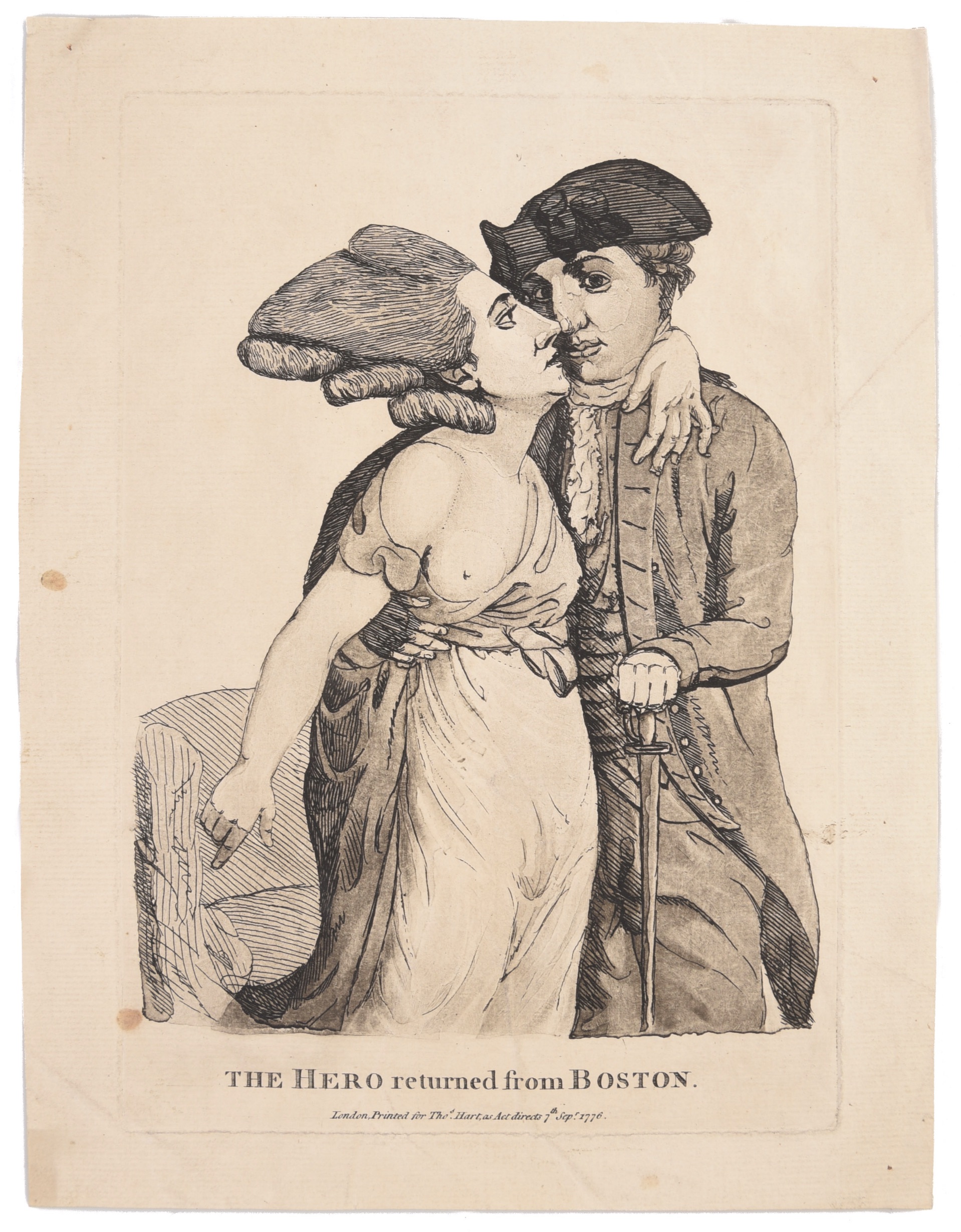
But I was intrigued by this essay at the American Revolution Institute about one of its recent acquisitions, an engraving titled “The Hero returned from Boston.”

That essay discussed the possibility that Warren’s informant was Margaret Gage, wife of the British commander. It also dismissed that idea as unlikely and unsupported. I wrote much the same years back, and didn’t think I had anything new to find out or share.

In its original form, however, that essay quoted a statement about the Gages I hadn’t seen before. That produced a jolting mix of emotions:
  • A relevant source I’ve missed? How exciting!
  • A relevant source I’ve missed? How embarrassing!
So a month ago I had to look into that source. I found it was actually an early-twentieth-century historian misquoted on a British website. (Phew!)

My posting about that prompted the director of the American Revolution Institute, Jack Warren, to revise the essay and to share thoughts in the comments of my posting on why that 1911 historian was so open to the idea of Mrs. Gage betraying her husband’s secrets.

Jack’s comments in turn prompted me to review all the evidence authors have used to point to Margaret Gage, starting in 1788, plus the milestones in the publication of that idea. To my surprise, I saw that for over a century almost every author who brought up that idea did so only to argue against it. So then I had to consider how the evidence came to appear stronger the further we were removed from the eighteenth century.

During that review I also came across a source that didn’t mention Margaret Gage, though it’s been used to bolster a case against her: the Rev. Jeremy Belknap’s diary from late 1775. And I was lucky enough to realize it could link to another source I discussed a couple of years ago, memories of tales told by Josiah Waters around 1800. If both those sources are reliable, they tell us exactly who Dr. Warren got information from and how: the completely overlooked knife-maker William Jasper.

All that, as I suggested above, was a pleasant surprise. It was the result of an intriguing artifact and essay, fortuitous timing, errors to be corrected (including my own), input from commenters, a new approach to the evidence, and the proliferation of digitized sources. 

And a bonus: This week Bob Gross alerted me that the Loyalists Commission claims are available digitized on Ancestry.com, so now I can go explore exactly what Thomas Beaman’s family said about him and a lot more. 

Wednesday, February 09, 2022

Josiah Waters, “very serviceable in this line”

Josiah Waters (1721–1784) was a painter by training who became a respected merchant in pre-Revolutionary Boston.

Waters joined the Old South congregation at age twenty. He was elected to several town offices, including constable, fence viewer, clerk of the market, and finally warden, one of the most prestigious. In 1747 he joined the Ancient & Honorable Artillery Company and filled many roles in that organization.

Also in 1747, Josiah and his wife Abigail had a son, Josiah, Jr. He grew up to work with his father in the firm of “Josiah Waters and Son” on Ann Street. In fact, it’s difficult to distinguish the two, but fortunately they seem to have acted as a unit, so that task isn’t so important. Josiah, Jr., also became a member of Old South and the Ancient & Honorables, and in 1770 he joined the St. Andrew’s Lodge of Freemasons.

In 1768, Josiah Waters invested in land in Maine, buying out partners to become the main proprietor of the Massabesick Plantation. That area included the modern towns of Alfred, Sanford, and what the family would modestly name Waterboro. The Maine Historical Society has digitized the Waters account book and map.

As of 1770, Josiah Waters, Sr., was a captain in the Boston militia regiment. By 1772, Josiah, Jr., was his lieutenant. (I told you they came as a unit.) According to Mills and Hicks’s British and American Register for the Year 1775, as war approached Capt. Waters’s brother-in-law Thomas Dawes was the regiment’s major, and the adjutant, or administrative officer, was their nephew William Dawes, Jr.

When war broke out in April 1775, it looks like the elder Waters quickly got his family out of town and followed by the 22nd. Then as a gentleman volunteer he took on the job of laying out the fort in Roxbury that was to keep the British army from marching over the Neck. In his memoirs Gen. William Heath listed Capt. Waters among the men “very serviceable in this line.” And of course Josiah, Jr., helped his father with those fortifications.

In October, Gen. George Washington and the Continental Congress started organizing an army for the coming year, with revamping the artillery regiment a big priority. John Adams was a fan of the Waters family. On 21 October, he sent James Warren a letter introducing a couple of Pennsylvanians visiting Massachusetts:
I could wish them as well as other Strangers introduced to H[enry]. Knox and young Josiah Waters, if they are any where about the Camp. These young Fellows if I am not mistaken would give strangers no contemptible Idea of the military Knowledge of Massachusetts in the sublimest Chapters of the Art of War.
Earlier in the same month he wrote to Gen. John Thomas asking about Josiah, Sr.’s work as a military engineer, among other men.

Gen. Thomas didn’t have good things to say, however. He wrote back to Adams that Waters
I Apprehend has no great Understanding, in Either [gunnery or fortifications], any further than Executing or overseeing works, when Trased out, and by my Observations, we have Several Officers that are Equal or exceed him…
Likewise, by 2 November Gen. Washington was writing candidly to Gov. Jonathan Trumbull of Connecticut:
I sincerely wish this Camp could furnish a good Engineer—The Commisary Genl [i.e., the governor’s son, Joseph Trumbull] can inform you how excedingly deficient the Army is of Gentlemen skilled in that branch of business; and that most of the works which have been thrown up for the defence of our several Encampments have been planned by a few of the principal Officers of this Army, assisted by Mr Knox a Gentleman of Worcester
Washington was impressed by Knox, whom he helped to maneuver into the artillery command, but not by Josiah Waters, father or son.

By that fall of 1775 it probably became clear to the Waterses that they hadn’t won over the commander-in-chief. They were unlikely to get appointments in the new army being organized for 1776, at least at the ranks they wanted. But they still had the respect of some New Englanders like Heath and Adams. They took on a new assignment helping to fortify New London, Connecticut. Based on how the state calculated the older man’s pay, he started that work on 25 November. Josiah, Jr., was his assistant, of course.

Before heading south, I posit, Josiah, Jr., traveled north to take stock of the family property in Maine. The Massabesick Plantation sat on the western side of that district. Just over the border in New Hampshire was the town of Dover. And the minister of Dover was the Rev. Jeremy Belknap.

I thus think the “Mr. Waters” who talked to Belknap on 25 October about how the war had started was Josiah Waters, Jr. (1747-1805). We know from Belknap’s later correspondence, preserved at and published by the Massachusetts Historical Society, that the two men were friends in the 1780s and ’90s. Waters collected orders for Belknap’s history of New Hampshire, for example. (By then everyone knew Waters as “Colonel Waters” for his highest militia rank.)

If Josiah Waters, Jr., told Belknap about how the Boston Patriots had learned of Gen. Thomas Gage’s plans, he wasn’t speaking as just some random guy in Dover. He came from Boston, where he had close connections with the town’s militia establishment. Even beyond that, his first cousin, William Dawes, was a key figure in both smuggling artillery out of occupied Boston and Dr. Joseph Warren’s alarm system.

The account Belknap wrote down in October 1775 is looking more reliable.

TOMORROW: More details from Mr. Waters?

Tuesday, February 08, 2022

“The infamous Capt. Beeman”

The Rev. Jeremy Belknap’s account of how Gen. Thomas Gage’s plan for the march to Concord leaked out to the Patriots, quoted yesterday, mentions four men by name.

Three of those people were well known Patriot leaders: Dr. Joseph Warren, Samuel Adams, and John Hancock.

The fourth was a Loyalist scout for the British troops identified as “the infamous Capt. Beeman.” Is there any more evidence about such a figure, especially evidence not publicized by October 1775? If so, that would suggest that Belknap truly heard some inside information.

And indeed we can identify “Capt. Beeman.” That must be Thomas Beaman (1729–1780), a Loyalist refugee from Petersham, Massachusetts.

Beaman was born in Lancaster. He joined Gov. William Shirley’s 1755 expedition against Acadia as a sergeant under Capt. Abijah Willard, and before the end of that war he was a captain under Col. Willard at the capture of Montréal. From then on people called him “Captain Beaman” even in peacetime.

In the 1760s Beaman was married and settled in Petersham. The first and so far only minister of that town was the Rev. Aaron Whitney (1714–1779). Unlike most of his Congregationalist colleagues in New England, Whitney strongly supported the royal government in the political disputes of the 1760s and 1770s.

So did Beaman. There was an argument and lawsuit over a schoolhouse around 1770 that I’ll save for later. Instead, let’s skip ahead to late 1774 after royal authority outside Boston broke down. According to Petersham town records, Beaman was among fourteen local men who banded together and agreed:
That we will not acknowledge or submit to the pretended Authority of any Congresses, Committees of Correspondence or other unconstitutional Assemblies of Men, but will at the Risque of our Lives, and if need be, oppose the forceable Exercise of all such Authority.
A 2 January Petersham town meeting summoned those men by name to explain themselves or repent. Only two showed up, defiantly maintaining their position. The meeting then determined:
Therefore as it appears that those persons still remain the incorrigable enemies of America and have a disposition to fling their influences into the scale against us in order to enslave their brethren and posterity forever, and after all the friendly expostulations and entreaties which we have been able to make use of, we are with great reluctance constrained to pronounce those, some of which have heretofore been our agreeable neighbors, traitorous paricides to the cause of freedom in general and the United Provinces of North America in particular…
The meeting urged townspeople not to have any commercial dealings with those men, even planning to print up 300 handbills at town expense. The Boston newspapers reported on that resolution.

Customs Commissioner Henry Hulton left this version of what happened next, starting in February 1775:
A number of Inhabitants in the town of Petersham, who had entered into an association for their mutual defence, finding the spirit of persecution very strong against them, assembled together in an house, resolving to defend themselves to the utmost.

The house was soon surrounded by many hundreds of the people, and they were obliged after some days to capitulate and submit. The people, after disarming them, ordered them to remain each at his own house, not to depart from thence, or any two of them to be seen together upon pain of death.
Petersham’s local historian says that siege concluded on 2 March.

Beaman then probably moved his family into Boston, as many other prominent Loyalists did. [ADDENDUM: Further research cited in the comments below shows that Beaman’s wife and children remained in Petersham until early 1779, when the Massachusetts legislature permitted them to travel through Newport to join him in New York City.] But according to the account his heirs later gave the Loyalists Commission, paraphrased in E. Alfred Jones’s The Loyalists of Massachusetts, “he, at the request of General Gage, frequently traveled the country to discover the real designs of the leaders of the rebellion.”

The Beaman family’s claim also stated that “he was a volunteer (as a guide to Lord Percy) with the military detachment to Concord.” Percy got only as far as Lexington, however. According to Belknap’s informant, Beaman was actually a scout for the first British column under Lt. Col. Francis Smith; those soldiers “landed on Phips’s Farm, where they were met by the infamous Capt. Beeman, and conducted to Concord.”

Furthermore, the New-England Chronicle newspaper of 12 Sept 1776 referred to “Capt Beeman, of Petersham (who piloted the ministerial butchers to Lexington).” And Lemuel Shattuck’s 1835 history of Concord, published before many Loyalist sources became available, stated: “It is also intimated that tories were active in guiding the regulars. Captain Beeman of Petersham was one.” Those sources suggest that locals recognized Beaman among the redcoats, as Belknap’s information implies.

Back in Boston, Gen. Gage rewarded Thomas Beaman in May by appointing him wagon-master to the army. Later in 1775 Beaman became a first lieutenant in the Loyal American Association, a militia company led by his old commander Abijah Willard, which never saw combat.

Beaman kept the position of wagon-master under Gen. William Howe. He traveled with the king's army, working in and around British-occupied New York until he died in November 1780. By then the state of Massachusetts had banished him and confiscated his property. Beaman's widow and children settled in Digby, Nova Scotia.

We thus have our first indication that Belknap’s October 1775 account of the march to Concord came from someone who had at least some reliable, little-known information.

Monday, February 07, 2022

“Got intelligence of their whole design”

Getting back to the question of who told the Boston Patriots about the British army march to Concord, the first historian to gather evidence on that question was the Rev. Jeremy Belknap (1744–1798, shown here), founder of the Massachusetts Historical Society.

Indeed, Belknap recorded information so early that it might not even qualify as historical.

In the fall of 1775 Belknap visited the Continental Army camps around Boston, checking on the New Hampshire troops and observing the siege. He kept a diary during that trip, published by the M.H.S. in 1860.

A few days after returning to his town of Dover, New Hampshire, Belknap added this entry dated 25 October to his travel diary:
Mr. Waters informed me, that the design of the regular troops, when they marched out of Boston the night of April 18, was discovered to Dr. [Joseph] Warren by a person kept in pay for that purpose. That they had a design upon the stores at Concord the week before, and dressed victuals for their men; but, by the dressing an extraordinary quantity in the barracks, the design was discovered. They then marched out only as far as Watertown, as they had frequently done before in the day-time, for an airing, and returned before night.

But, on the night of April 18, they took every imaginable precaution to prevent a discovery. Their meat was dressed on board a transport-ship in the harbor. Their men were not apprised of the design, till, just as it was time to march, they were waked up by the sergeants putting their hands on them, and whispering gently to them; and were even conducted by a back-way out of the barracks, without the knowledge of their comrades, and without the observation of the sentries.

They walked through the street with the utmost silence. It being about ten o’clock, no sound was heard but of their feet; a dog, happening to bark, was instantly killed with a bayonet. They proceeded to the beach under the new powder-house,—the most unfrequented part of the town; and there embarked on board the boats, which had their oars muffled to prevent a noise, and landed on Phips’s Farm, where they were met by the infamous Capt. Beeman, and conducted to Concord.

Notwithstanding all this secrecy, the following circumstances contributed to their discovery. Numbers of people were jealous, and kept a vigilant eye upon them. It was observed, that, two days before, general orders were given out that the light infantry and grenadiers should be excused from duty. The boats were observed to be launched from the transports. In the afternoon of April 18, an uncommon number of officers were seen walking up and down the Long Wharf; and a party of nine rode out of town with their blue surtouts, and passed through Cambridge just before night, riding very slowly; and, being followed by a person who suspected some bad design, they damned him, and told him not to keep so near them. Late in the evening, a light-infantry man was seen in a retail shop with his accoutrements on.

These circumstances being communicated to Dr. Warren, he applied to the person who had been retained, and got intelligence of their whole design; which was to seize [Samuel] Adams and [John] Hancock, who were at Lexington, and burn the stores at Concord. Two expresses were immediately despatched thither, who passed by the guards on the Neck just before a sergeant arrived with orders to stop passengers. Another messenger went over Charlestown Ferry; so that the alarm was given several hours before the troops arrived at Lexington.
Historians have treated this source with skepticism. In fact, despite Belknap’s record being available in a leading historical journal since before the Civil War, almost no book has discussed the “person kept in pay” by Dr. Warren and his colleagues.

There seem to be two problems with that part of the story. First, I can’t help but suspect that American authors felt an ideological aversion to the idea of the Patriots bribing an informant. It was much more reassuring to stress the unity and perspicacity of Bostonians watching the soldiers prepare. And imagining Thomas Gage betrayed by his wife, or Margaret Gage torn by conflicting allegiances to husband and country of birth, is more dramatic.

That distaste opened the door to being skeptical about this account on grounds of provenance. How would this otherwise unidentified “Mr. Waters” in Dover, New Hampshire, have any reliable information on Dr. Warren’s secret source down in Boston? Was this statement anything more than well-traveled camp gossip festooned with unconfirmable claims?

David Hackett Fischer used Belknap’s statement in Paul Revere’s Ride, but only partially. He accepted that Dr. Warren “applied to” his best-placed source late on 18 April after hearing from other sources and before sending out William Dawes and Paul Revere, the “Two expresses.” But Fischer set aside the detail about “a person kept in pay” and instead focused on the possibility that that source was Margaret Gage.

In a 2014 article, Derek W. Beck, author of Igniting the American Revolution, discussed this source and concluded, “Mr. Waters’s statement sounds like an American concoction.” Unsupported by other evidence and judged against more reliable sources, Beck decided, this story reflected Waters’s wish to look like he had inside info and Belknap’s wish to believe him. 

To make this account into useful evidence, we need to answer questions like: Who was Belknap’s acquaintance, the mysterious “Mr. Waters”? Did this person really have connections in Boston’s Patriot leadership? Can any specific, non-public details of this account be confirmed by other sources? And does answering those questions lead us any closer to identifying the “person who had been retained”?

Answering those questions might require spending years studying small details of Revolutionary New England, looking at a plethora of sources both print and digital, and being crazy enough to think they matter.

TOMORROW: You rang?

Friday, November 22, 2019

Capt. David Bradlee, Wine-Merchant

If there’s not enough evidence to say David Bradlee participated in the Boston Tea Party of 1773, I don’t know what he did between the collapse of George Gailer’s lawsuit in late 1771 and the start of the war.

When Bradlee resurfaces in my notes, however, he was still deep inside Boston’s Revolutionary resistance. In early 1776, he was quartermaster of the Continental artillery regiment. (He may have had this job earlier as well.)

Once the war moved south to New York, Bradlee declined to move with the regiment, recently assigned to young Col. Henry Knox. So did the second-in-command, Lt. Col. William Burbeck, and a significant number of the men.

Bradlee instead became an officer in Massachusetts’s artillery regiment under Col. Thomas Crafts, who had helped to organize Boston’s resistance since the first anti-Stamp Act protest in 1765; Crafts was bitterly disappointed not to receive a colonelcy from the Continental Congress. The second-ranking officer in that regiment was Lt. Col. Paul Revere. The regiment’s major was Thomas Melvill, a veteran of the Tea Party. The regimental surgeon was Dr. Joseph Gardner, who had helped Bradlee carry Crispus Attucks away from the Boston Massacre.

Again, Bradlee was right in the middle of the socially rising mechanics who drove the Revolution in Boston’s streets and public meetings. He now had a military rank, and people referred to him as “Captain Bradlee” for the rest of his life. He joined the St. Andrew’s Lodge of Freemasons in 1777.

Bradlee’s connections helped him start building his fortune. On 10 Apr 1778 he joined Melvill and John Hinkley as majority investors in the privateer Speedwell. The ship left Boston harbor in July. After only three days, it captured a British sloop “laden with Sugar, Coffee, Cocoa, Limes, etc.” David Bradlee’s ship had come in.

In Boston’s 1780 tax roll, Bradlee was listed as a tavern-keeper, no longer a tailor. That same year, his younger sister Elizabeth Bradlee (1757-1832) married Gershom Spear (1755-1816), a nephew of Pool Spear, thus uniting the families of two of the people that Gailer had sued ten years earlier.

By the mid-1780s, David Bradlee was recognized as a “wine-merchant,” importing a commodity of upper-class life. He started to rent the basement of the State House to store his inventory, a sign of his continuing connections with the local government. The rent was £17, and the selectmen didn’t collect for two years until he’d finished renovating the space.

In 1794, after nine years, the State House rent was raised to £45, and Bradlee moved out. He bought a large wood and brick shop on the “w[est] side of the…Corn Market,” erected a set of scales outside the front door, and continued selling wine.

Bradlee had carried his family into genteel society. His daughter Sarah married a U.S. Navy captain, Patrick Fletcher. His son Samuel married Catherine Crafts, a daughter of Col. Crafts. His son David W. Bradlee became a member of the Ancient and Honorable Artillery Company and of the Boston Board of Health.

Capt. David Bradlee died on March 6, 1811—“very sudden,” according to one citizen’s diary. He was mourned as a respected member of Boston’s business community and laid to rest in the family’s own tomb, purchased in 1800.

The American Revolution allowed this tailor to become an officer and a merchant. Still, Capt. Bradlee may never have escaped hearing words like those the Rev. Jeremy Belknap attributed to a blacksmith chafing at the demands of a newly-rich tailor: “Come, come, citizen pricklouse, do not give yourself such airs as this! It was but t’other day that you was glad to measure my arse for a pair of breeches.”

Wednesday, June 26, 2019

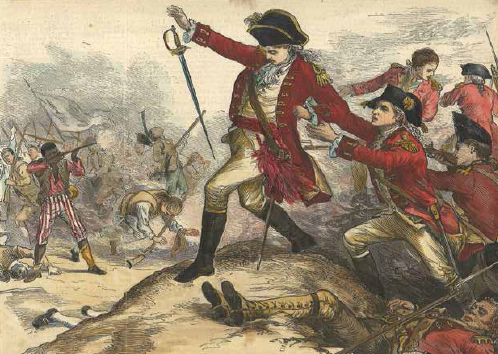
Did Isaac Freeman Kill Maj. John Pitcairn?

The centerpiece of Isaac Freeman’s 1780 petition to the Massachusetts General Court, the basis of his request for compensation and the setting for his expression of ultra-patriotism, is his description of having fought at the Battle of Bunker Hill:
Your memorialist would beg leave to acquaint your honors, that in the second battle that was fought in June following, on Bunker’s Hill, he in the retreat, lost a very good fire-arm, his knapsack, containing one handkerchief, shirts, hose, &c. &c. which cost him in that day, forty or fifty hard dollars…

That your memorialist was the happy man (tho’ a poor negro) that put an end to the life of that bold, and of course, dangerous man, Major [John] Pitcairn, with eight or ten others that day, besides wounding a number of other villains; in the execution of which service, your memorialist received three very bad wounds from the British pirates; in this wounded and bleeding condition, he continued like a bold soldier, fighting for the country, till he was obliged with the heroes of the day, to retreat, which was worse than death to a soldier, and give up the ground to those (British hell-hounds,) and all for want of the help of those cowardly commanders and the poltroon fellows under their command, whose i[n]f[amou]s names I conceal, who lay during the whole action at the back of the hill out of danger:

Had they like men come on, instead of the shame and disgrace of that day, a most compleat victory would have taken place, and the whole of the British army would, by the close of that day, been snuggly sent DOWN DOWN to the abode of shame, disgrace and despair; whose just fate they would have received my hearty amen and amen, as those did which I sent there in battle.—
Freeman’s petition is thus the first surviving written statement that a black man killed the infamous Maj. Pitcairn.

In my J.A.R. article on who killed Pitcairn, I quoted letters from a British marines officer near the major when he was shot. I concluded that Pitcairn was wounded and taken out of action well before he reached the redoubt on Breed’s Hill. The traditional American account of Pitcairn being struck down as he mounted the walls was thus a product of wishful thinking; soldiers wanted to believe they killed an important officer, and chroniclers wanted to believe the officer who supposedly ordered the firing at Lexington was killed in dramatic fashion.

Part of that drama was that an African-American soldier shot the major. My article quoted two early sources saying so. First, in 1787 the Rev. Dr. Jeremy Belknap wrote in his notes on the battle: “A negro man belonging to Groton, took aim at Major Pitcairne, as he was rallying the dispersed British Troops, & shot him thro’ the head…”

Decades later, Samuel Swett credited John Winslow with the information that on the walls of the redoubt “mounted the gallant Major Pitcairn, and exultingly cried ‘the day is ours,’ when a black soldier named Salem, shot him through and he fell.” Swett said Winslow also told him “a contribution was made in the army for Salem and he was presented to [George] Washington.” I found no confirmation of such a presentation, but it does date the report to when the commander-in-chief was in Massachusetts in 1775-76.

It seems likely, therefore, that rumors about a black soldier killing Pitcairn circulated soon after the battle. Isaac Freeman identified himself as that soldier five years later. I doubt his claim just as I doubt every other claim to that kill. But Freeman might sincerely have believed he shot the major. Or he (and anyone who helped him prepare his petition) might just have decided to try for the credit. The petition doesn’t offer any supporting details, such as when Freeman made the shot or how he recognized Pitcairn.

What’s more, Freeman’s petition should prompt some skepticism. It said he killed not only Pitcairn but “eight or ten others that day, besides wounding a number of other villains.” That’s nearly a dozen fatal shots, plus others that found their mark, not to mention misses. That’s an awful lot of shooting when the provincials at Bunker Hill were under orders to hold their fire as long as possible because gunpowder was scarce.

Nonetheless, the Massachusetts General Court responded to Freeman’s story with an award of £5. Should we take that as a contemporaneous endorsement of his claim to having killed Pitcairn? Should Isaac Freeman’s name replace Salem Poor’s and Peter Salem’s (and a bunch of others)? Or was that small payment rapidly devaluing currency simply how the legislature sent away a poor black man with some powerful connections?

I wish there were more information about Isaac Freeman beyond the 1780 petition and the 1782 probate file. (I should acknowledge that it’s not even certain those sets of documents pertain to the same man.) Unfortunately, those sources don’t mention Freeman’s home town, age, family, and so on.  We don’t know if his surname came from a family that enslaved him or reflected his status as a free man. We don’t know if he had always gone by the name of Isaac. (Peter Salem, for example, also lived under the name of Salem Middlesex.) Perhaps someone will spot some new dots and we can see a little more of this picture.

Monday, September 22, 2014

A Clue to the Poet in Ezekiel Russell’s Print Shop?

The September 2014 issue of the American Antiquarian Society’s Almanac magazine reports on the recent acquisition of a 1787 broadside headlined “A Poem, Descriptive of the Terrible Fire, which Made such Shocking Devastation in Boston.” (The picture here is the Rev. Jeremy Belknap’s diagram of the area of that fire in the South End.)

Ezekiel Russell printed three versions of this broadside, all featuring the same woodcut of a fire but with different type layouts below that. The magazine says:
Two versions (one owned by the Massachusetts Historical Society and the other by the John Carter Brown Library) were documented in early bibliographies. The third version was unrecorded before it was acquired by AAS this April.

The authorship of the poem is credited on all three broadsides to “H.W.” The AAS printing significantly reveals that the author was an unmarried woman by crediting the text to a ”Miss H.--- W.---.” Consequently, all three sheets can be added to the just over 200 texts written by women in the United States before 1788.
When looking into that further, I came across WorldCat’s description of the broadside, which includes the line:
Responsibility: Composed by H----h W----n.
I can’t reconcile those final Ns with the magazine’s commentary, though.

Putting that mystery aside, longtime Boston 1775 readers might recall how Isaiah Thomas, printer and founder of the A.A.S., wrote about a woman writing memorial verses for Russell to publish. In the first edition of his History of Printing in America, Thomas credited those verses to Russell’s wife, who I found was named Sarah. In notes incorporated in that book’s posthumous second edition, Thomas changed that reference to “a young woman who lived in Russell’s family.” Was Thomas referring to “H.W.”?

Personally I suspect that Sarah Russell also wrote verses for her husband. She certainly helped keep the shop running from the early 1770s, and it was issuing those sorts of poetic broadsides back then.

Saturday, September 07, 2013

“This is, unquestionably, very funny”

The Rev. Dr. Mather Byles (shown here) was one of those historic figures who becomes a magnet for witty quotations. In America our primary examples are Benjamin Franklin and Mark Twain; any untethered funny remark can be attached to one man or the other, depending on whether it’s also optimistic (Franklin) or pessimistic (Twain).

Back in eighteenth-century Boston, Byles was known for his puns and other jokes. People liked to retell those jokes. And I suspect that some people attributed wordplay to Dr. Byles that he never actually spoke: “As Dr. Byles would have said…” became “As Dr. Byles said…” So which of the surviving stories are most likely to be authentic?

Here’s an anecdote that appeared in the Boston Transcript in 1850 and was then reprinted in a supplement to the Hartford Courant along with a bunch of other examples of Dr. Byles’s puns:
Tho first story that I ever heard, of Mather Byles was related, at my father’s table, by the Rev. Dr. [Jeremy] Belknap, in 1797, the year before he died. It was upon a Saturday; and Dr. John Clarke and some other gentlemen, among whom I well remember Major General [Benjamin] Lincoln, ate their salt fish there, that day.

I was a boy; and I remember their mirth, when, after Dr. Belknap had told the story, I said to our minister, Dr. Clarke, near whom I was eating my apple, that I wished he was half as funny a minister, as Dr. Byles.

Upon a Fast Day, Dr. Byles had negotiated an exchange, with a country clergyman [i.e., they agreed to preach in each other’s pulpits]. Upon the appointed morning, each of them—for vehicles were not common then—proceeded, on horseback, to his respective place of appointment. Dr. Byles, no sooner observed his brother clergyman approaching, at a distance, than he applied the whip; put his horse into a gallop; and, with his canonicals flying all abroad, passed his friend at full run.

“What is the matter?” he exclaimed, raising his hand in astonishment—“Why so fast, brother Byles?”

to which the Dr. without slackening his speed, replied, over his shoulder—“It is Fast day!”

This is, unquestionably, very funny—but it is surely undesirable for a consecrated servant of the Lord, thus lavishly to sacrifice, upon the altars of Momus.
Six years later that newspaper story was republished in the second volume of Dealings with the Dead, by Lucius Manlius Sargent (1786-1867). Thus, for this Byles pun we have a clear provenance: from Belknap, who knew many fellow ministers, to eleven-year-old Lucius in 1797, and to the world fifty-three years later.

Wednesday, October 17, 2012

Belknap on Blackler’s Battery

Before I get to summarizing my study, let me share this entry from the diary of the Rev. Jeremy Belknap, visting the siege lines on 17 Oct 1775. He described how the Continental Army had equipped two rowboats with small cannon:

This evening, two floating batteries, accompanied with some boats, went down Cambridge River [i.e., the Charles] in order to throw some shot into Boston, to alarm the regular army, and fatigue them with extraordinary duty, and also to endeavor to take a floating battery from them which lay near Boston Neck.

They got within three-quarters of a mile of the bottom of the Common, and the firing began between nine and ten o’clock. They fired about seventeen shot into the town; and then a nine-pounder in one of the batteries split: the cartridges took fire, and blew up the covering, or deck, on which several men were standing.

Captain Blackley [William Blackler], of Marblehead, who commanded the battery, had the calf of his leg shot off, and was blown, with several others, into the water. A Portuguese sailor was so badly wounded in the thigh, that he bled to death before morning; another had his arm broken, and is very dangerous; four others were slightly wounded. The battery was much shattered, and partly sunk. They towed her up the river by morning.

This manoeuvre is not generally approved by thinking people: it seemed to be rather a military frolic than a serious expedition. The camp appears to be a scene of wickedness. The oaths and execrations of the men that went on this frolic were horrid and dreadful.
But really I think they had something to swear about.

I hoped to find hints about that “Portuguese sailor” who served under Capt. Blackler in Samuel Roads’s History and Traditions of Marblehead, which reprinted a roll of the town’s Continental regiment. However, that list of men is undated, so it could have been drawn up after this calamitous attack.

Capt. Blackler’s company included a man named “Manuel Seward”—but that appears to be the “Emmanuel Seward” who married in Marblehead in 1785 and survived to apply for a pension. Another man in the company was named “John Freeto”; he left descendants in Marblehead who went into state politics a century later. But the surname “Freeto” appears in the town’s vital records as early as 1731, so that man was probably not an immigrant.

Sunday, June 03, 2012

Timothy Newell’s Diary on the Block

A Boston 1775 reader alerted me that the Bonhams auction house is about to sell Timothy Newell’s diary of the siege of Boston.

Newell was one of Boston’s selectmen that year, as well as a deacon of the Brattle Street Meetinghouse. He recorded what he considered the royal authorities’ outrages and transgressions. He also sometimes wrote down rumors about the besieging forces, which are valuable for knowing how news traveled into Boston. Newell didn’t have a lot to say about his own daily experiences in the town, however. In that respect, this diary is more of an official document than a personal one.

The Rev. Jeremy Belknap transcribed Newell’s manuscript for the young Massachusetts Historical Society, and the society published that transcription in 1852. It took a while for Google Books to get to that volume, so I shared Newell’s intermittent entries day by day back in 2007-08.

Along with the diary Bonhams is selling an oil painting said by descendants to show Newell and attributed to Henry Sargent. Since Sargent was born in 1770, it would have been painted well after the war, but Newell was still wearing a curled wig in traditional style.

Bonhams says:
Newell was a moderate. He remained in Boston and did not join the Provisional [sic] Congress at Lexington as [John] Hancock and Samuel Adams did at this juncture.
I think Newell’s diary shows him as a firm Whig, but one who felt his greatest responsibility lay in Boston with the town and meetinghouse he was supposed to look after. Hancock and Adams had been elected to posts in the Massachusetts Provincial Congress and Continental Congress.

In the same 19 June auction, Bonhams is selling handwritten notes on the proceedings of the House of Lords from 26 Oct 1775 to 23 May 1776. During those months the Crown responded to the Continental Congress’s “Olive Branch” petition and moved toward equipping a massive expeditionary force.


Tuesday, July 05, 2011

General Lee Slept Here

As I described back here, when Gen. Charles Lee first came to Cambridge, he and Gen. George Washington shared the Wadsworth House near Harvard College for about a week. On 7 July, a Massachusetts Provincial Congress committee talked with Lee alone about housekeeping needs, suggesting he was about to set up his own quarters.

Lee probably didn’t need much. Since landing in America in October 1773, he had lived as if he were on a permanent campaign, traveling from one colony to another with his dogs, books, and Italian manservant, Guiseppi Minghini.

Lee’s letters in early July came from “Head-Quarters,” and on 20 July he wrote to Dr. Benjamin Rush from “Cambridge.” Washington split his army into brigades two days later, assigning Lee to command the northern wing.

Lee’s next surviving letter, dated 27 July, went to Robert Morris from “Winter Hill.” From 12 August to 9 December, he datelined his letters from the “Camp on Winter Hill.” Is that change significant? It might suggest a move closer to camp, or it might mean nothing.

Our best clue about where Lee lived in late 1775 actually comes from after he left Massachusetts to design defenses for New York. On 19 Feb 1776, Washington wrote to Gen. John Sullivan, one of Lee’s brigadiers:
I am a little surprizd, and concern’d to hear of your Moving to Colo. [Isaac] Royals House. I thought you knew, that I had made a point of bringing General Lee from thence on Acct. of the distance from his Line of Command, at least that he should not Sleep there. The same reasons holding good with respect to yourself, I should be glad if you could get some place nearer, as I think it too hazardous to trust the left Wing of our Army without a General Officer upon the spot in cases of immergency. I do not wish you to return to your old House, any other tolerably convenient will satisfy me, and I am sure be pleasing to yourself, as I know you would not easily forgive yourself if anything wrong shd. happen for want of your presence on any sudden call.
Unfortunately, there’s no documentation of when Lee moved out of the Royall House in Medford, or where he moved next. Instead, we have tradition and guesswork.

Lee didn’t help by referring to his quarters only with a facetious nickname. In October, the Rev. Dr. Jeremy Belknap recorded hearing about a letter the general had written from “Hobgoblin Hall.” On 10 December, Lee invited Abigail Adams to dine with him at that “Hobgoblin Hall.” (She declined.) And on 21 Jan 1776, Lee’s other brigadier, Gen. Nathanael Greene, wrote to him that
Mr. Eustace lodges at Hobgoblin Hall, he says by your Order—should be glad to know your pleasure in the matter.
(Someday I’ll write more about young John Skey Eustace, and what brought him to Cambridge.)

Nineteenth-century authors said that Lee’s “Hobgoblin Hall” was the Royall House. If so, the general must have continued to use that mansion for work and dinner parties, perhaps because of “the distance from his Line of Command,” but he slept closer to the front. Alternatively, the house where Lee moved after the Royall House might have been his “Hobgoblin Hall,” and the historians guessed wrong.

That building closer to Winter Hill, nineteenth-century histories said, was the old farmhouse now called the Oliver Tufts House in Somerville. During the Revolution, it was reportedly the home of John Tufts (1754-1839) or his father Peter (1728-1791). The old photograph above shows that building about a century ago, after it had been expanded and moved “a few rods” from its original location. Charles Bahne alerted me to this new photograph. And here’s a whole website about the house, based on those later histories.

Similarly, Greene was said to have used the house of Samuel Tufts (1737-1828) as his headquarters. (That man’s wife was, incidentally, a half-sister of little Joel Adams.) That building doesn’t survive. I don’t think anyone’s identified where Sullivan lived before he moved into the Royall House so briefly.

I wish I could find contemporaneous documents confirming that the Tufts men arranged for the generals, the Provincial Congress, or the Continental Army to use their houses. But the best information available suggests that Gen. Lee slept in, in turn, the Wadsworth House in Cambridge, the Royall House in Medford, and the Oliver Tufts House in Somerville.

Sunday, January 16, 2011

“General Lee is a perfect original”

And speaking of Gen. Charles Lee, here’s one of my favorite anecdotes about him. On 21 Oct 1775, the Rev. Jeremy Belknap dined in Cambridge at the house of Thomas Mifflin, quartermaster general for the American army. The other guests included:

It’s testament to Lee’s forceful personality that Belknap’s journal entry about the dinner was almost entirely about him:
General Lee is a perfect original, a good scholar and soldier, and an odd genius; full of fire and passion, and but little good manners; a great sloven, wretchedly profane, and a great admirer of dogs,—of which he had two at dinner with him, one of them a native of Pomerania, which I should have taken for a bear had I seen him in the woods.

A letter which he wrote General [Israel] Putnam yesterday is a copy of his odd mind. It is, as nearly as I can recollect, as follows; being a letter of introduction of one Page, a Church [of England] clergyman: —
Hobgoblin Hall, Oct. 19, 1775.

Dear General,—

Mr. Page, the bearer of this, is a Mr. Page. He has the laudable ambition of seeing the great General Putnam. I therefore desire you would array yourself in all your majesty and terrors for his reception. Your blue and gold must be mounted, your pistols stuck in your girdle; and it would not be amiss if you should black one half of your face.

I am, dear general, with fear and trembling, your humble servant,
Charles Lee.
This Page is suspected by some to be a spy, as he has a plan of the lines, and is bound to England.
And of course one general should introduce a suspected spy to another.

I wonder if this Page was the same man who preached in Newport in March 1773 and got the Rev. Ezra Stiles all gossipy. He claimed to be a chaplain to the Countess of Huntingdon, who was financing Methodism back in Britain. I can’t find a record of that minister’s first name.

Wednesday, January 05, 2011

Massachusetts Historical Society Fellowships

It’s the season to apply for Massachusetts Historical Society fellowships. (That’s society founder Jeremy Belknap looking on encouragingly.) They come in many flavors, such as:

In separate news, this summer I’ll be working with folks at the society and the Longfellow House-Washington’s Headquarters National Historic Site on a teacher’s workshop about the siege of Boston. That’s generously funded by the Massachusetts Society of the Cincinnati. Details to come later.

Thursday, November 04, 2010

“An Exhibition of Effigies at Portsmouth”

In 1765, the Stamp Act was due to take effect on 1 November. And four days after that was the anniversary of the Gunpowder Plot, which young men in most American seaports celebrated with processions, bonfires, and perhaps a few hangings in effigy. New Englanders called this holiday “Pope Night.”

That year, Boston’s town fathers worked hard to convince the South End and North End gangs, led by shoemaker Ebenezer Mackintosh and shipwright Henry Swift respectively, not to have their usual Pope Night parades and brawls. They feared the violence might get out of hand, and ruin the town’s reputation. That story is pretty well known.

I didn’t know, however, that there was a similar effort on a smaller scale up in Portsmouth, New Hampshire. Unlike Boston, that port doesn’t appear to have had rival Pope Night gangs. But town officials did worry about the town’s young men getting out of control.

This is how Portsmouth handled the Stamp Act crisis, according to the Rev. Jeremy Belknap’s History of New Hampshire:

The person appointed distributor of stamps for New-Hampshire, was George Messerve, son of the late Colonel, who died at Louisbourg [in 1758]. He received his appointment in England, and soon after embarked for America, and arrived at Boston. Before he landed, he was informed of the opposition which was making to the act; and that it would be acceptable to the people if he would resign, which he readily did, and they welcomed him on shore.

An exhibition of effigies at Portsmouth had prepared the minds of the people there for his reception; and at his coming to town he made a second resignation, on the parade, before he went to his own house. This was accepted with the usual salutation; and every one appeared to be satisfied with the success of the popular measures. Soon after, the stamped paper destined for New-Hampshire arrived at Boston in the same vessel with that intended for Massachusetts; but there being no person in either Province who had any concern with it, it was, by order of [Massachusetts] Governor [Francis] Bernard, lodged in the castle.

The stamp-act was to commence its operation on the first day of November. . . . In the mean time, the newspapers were filled with essays, in which every plea for and against the new duties was amply discussed. These vehicles of intelligence were doomed to be loaded with a stamp; and the printers felt themselves interested in the opposition. On the last day of October, the New-Hampshire Gazette appeared with a mourning border. A body of people from the country approached the town of Portsmouth, under an apprehension that the stamps would be distributed; but being met, by a number from the town, and assured that no such thing was intended, they quietly returned.

The next day, the bells tolled, and a funeral procession was made for the Goddess of Liberty; but on depositing her in the grave, some signs of life were supposed to be discovered, and she was carried off in triumph. By such exhibitions, the spirit of the populace was kept up; though the minds of the most thoughtful persons were filled with anxiety.

It was doubtful, whether the Courts of Law could proceed without stamps; and it was certain that none could be procured. Some licentious persons began to think that debts could not be recovered, and that they might insult their creditors with impunity. On the first appearance of this disorderly spirit, associations were formed at Portsmouth, Exeter and other places, to support the Magistrates and preserve the peace.

The fifth of November had always been observed as a day of hilarity, in remembrance of the powder-plot. On the following night, a strong guard was kept in Portsmouth. By these precautions, the tendency to riot was seasonably checked, and no waste of property or personal insult was committed; though some obnoxious characters began to tremble for their safety.
“Obnoxious characters” being Belknap’s terms for supporters of the royal government.

Sunday, April 12, 2009

Massachusetts Manuscript Maps

Back in January I bumped into the Massachusetts Historical Society’s “Massachusetts Maps” online exhibit. A lot of these images are manuscript maps—i.e., drawn by hand, not made for mass reproduction, and thus not to be seen anywhere else. Until now.

Among the choice selections:

The exhibit also offers a look at other locations in Massachusetts: And I’ve barely started to explore the graphic representation of the comprehensive Boston property survey of 1798.

Wednesday, February 11, 2009

Identifying the Soldier Named “Salem”

In 1819, Samuel Swett identified the American soldier who shot Maj. John Pitcairn of the British Marines as “a black soldier named Salem.” It didn’t take long for a local historian to claim that man for his town.

Gov. Emory Washburn (shown here) wrote this in his Topographical and Historical Sketches of the Town of Leicester, published in the Worcester Magazine in 1826:

There was residing here, till within a few years, a black man, who, we have good reason to believe, was the one who shot Maj. Pitcairn, whose death forms so affecting an incident in that bloody affray. History relates that he was shot by a negro, and from the story of the one we allude to, and many corroborating circumstances, we are led to conclude that he was the person who did the deed.

The person to whom we refer was named Peter Salem; he was a servant of Gen. [John] Nixon during the revolution, was a native of Framingham, and removed here a few years since, where he died. Major Pitcairn was shot as he was mounting the redoubt, and fell into the arms of his son.
William Barry followed up that lead with more information in his A History of Framingham, Massachusetts, published in 1847. He wrote:
Peter Salem—alias Salem Middlesex—was originally the slave of Capt. Jeremiah Belknap, and was sold by him to Maj. Lawson Buckminster. He married in 1783, Katy Benson, a grand daughter of Nero [Benson], and lived for a time, where is now a cellar hole on the farm of the late Mr. Richard Fiske, near the pond. He served in the war of the Revolution as waiter to Col. Thomas Nixon, of Framingham; and at the opening of the war was present at the battle of Bunker Hill.
Barry then quoted Washburn’s passage and concluded: “Peter died in Fram., Aug. 16, 1816.” Other sources say he died in Framingham’s poorhouse, having been forced to return to his native town when he could no longer support himself.

Washburn and Barry disagreed about which of the Nixon brothers Salem worked for—Gen. John of Sudbury or Col. Thomas of Framingham. But he could have worked for each in turn. More troubling about Washburn’s identification of Peter Salem as the soldier who shot Pitcairn is that he didn’t describe any of his evidence: no remarks about people having heard Salem describe the battle, for example. Washburn wrote at length about Salem as an older man in his 1860 Historical Sketches of the Town of Leicester, describing how he’d told his “stories of the war”—but again the only clear link from him to shooting Pitcairn is the name “Salem.”

A Sketch of the History of Framingham, published in 1827, says nothing about Peter Salem/Salem Middlesex being at Bunker Hill, though it does list the name of at least one other black private, Cato Hart. Salem is on the rolls of the Nixon regiment, and that unit was in the battle, so there’s no reason to doubt he was there. But somehow those earlier Framingham chroniclers didn’t find him significant enough to name.

By a strange coincidence, Peter Salem had been owned in youth by the father of the Rev. Dr. Jeremy Belknap, the historian who first recorded that Maj. Pitcairn had been shot by a black man. But Belknap didn’t write down anything about such a family connection, which he surely would have mentioned if he knew. He also believed the shooter had come from Groton. So either he and his sources didn’t know about Peter Salem’s past, or they were discussing another man named Salem.

TOMORROW: Another man named Salem.