






“Hoping he will still continue Honestly, faithfully & obediently to serve”
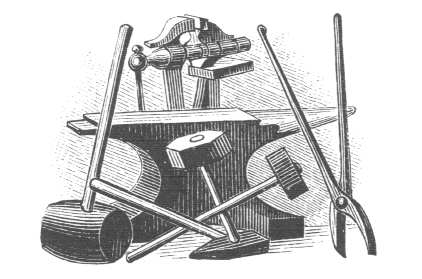
Edward Marion was born in Boston in 1692. He served in some town offices in the 1720s and ’30s, joined the Ancient and Honorable Artillery Company, and donated blacksmithing work for the town’s new workhouse.
Marion didn’t advertise his services (blacksmiths rarely had to), but he placed a couple of advertisements in the Boston Gazette in 1758 when he administered the estate of turner John Underwood.
Marion married Mary Reynolds in 1715. I’ve found no evidence that they had children, which would explain why the blacksmith didn’t feel a need to preserve his property for a son. It also left the Marions without the traditional source of support in their old age.
Both Edward and Mary Marion turned seventy years old in the early 1760s. Presumably journeymen and slaves like Caesar were already doing most of the physical work in Edward’s smithy.
On 9 May 1769, Marion made out an unusual written promise:
of my own meer motion & in consideration of the Faithfullness & honesty wherewith my Negro Servant Caeser has Served me for divers years past, & hoping he will still continue Honestly, faithfully & obediently to serve me & his mistress Mary my Wife I do hereby order & declare that it is my Will & pleasure that at & immediately after the Decease of me and my said Wife & the Survivor of us that my said Negro Caeser shall be manumitted & freed from his Servitude.Marion added to that promise on 30 Jan 1770:
And I do also hereby give & order unto my said Negro at the time of his freedom all my working Tools belonging to the Black smiths Business now in my Shop & also the sum of six Pounds lawfull money and I do hereby also order my Ex’ors or Adm’ors In Case of his Living to be Aged or Infirm & unable to Support himself, that they be Aiding & Ajusting to him out of my Estate to prevent his becomeing a Charge to the Town—
provided always & these presents are granted upon this Condition that my said Negro shall honestly Soberly obediently & faithfully [missing word—behave?] himself towards me & my said Wife during our & each of our Lives otherwise I do hereby reserve in my own Power to revoke & invalidate this my bequest in case my said Negro shall not so faithfully & honestly bare & behave himself towards me & his said Mistress as I hope & expect he will.
I or his said Mistress may invalidate the same either by Destroying this Instrument or Expressing the same by Writing
I the within named Edward Marion do further give and order unto my said Negro at the time of his Freedom All his Cloaths Bed & Bedding, & also the Use & Improvement of my Blacksmiths Shop for him to Work in during his Life upon the Condition of his future faithfull Service to me & my said Wife as within mentioned.As discussed yesterday, notary Ezekiel Price recorded the document on 2 February.
Jared Hardesty interprets the legal recording of that document as evidence of Caesar Marion looking out for his economic interest, exercising agency in his own life. I’m struck by how it shows the reversal of a concern I’ve seen in anecdotes about enslaved people resisting emancipation in old age, when they feared their owners simply didn’t want to support them any longer after having squeezed the labor out of them.
In this case, Edward Marion was concerned for his and his wife’s support. And he was willing to make their slave into their heir to ensure it. Of course, the blacksmith also added clauses demanding that Caesar keep up his end of the bargain at the risk of losing everything (and added a clause to keep him from becoming a burden on the town). Of course, Edward Marion may also have been motivated by feelings of duty and genuine fondness toward Caesar—we can’t read that in the legal record.
COMING UP: How did this arrangement work out?
(Thanks to professional genealogist Liz Loveland for sharing images from the Ezekiel Price notarial records at the Boston Athenaeum, the source of the above quotations.)
