J. L. BELL is a Massachusetts writer who specializes in (among other things) the start of the American Revolution in and around Boston. He is particularly interested in the experiences of children in 1765-75. He has published scholarly papers and popular articles for both children and adults. He was consultant for an episode of History Detectives, and contributed to a display at Minute Man National Historic Park.

Subscribe thru Follow.it


•••••••••••••••••


Showing posts with label Acton. Show all posts

Sunday, February 22, 2026

“Henry Knox’s Trek from Ticonderoga” in Acton, 26 Feb.

On Thursday, 26 February, I’ll return to the Acton 250 lecture series to speak about “Henry Knox’s Trek from Ticonderoga: Myths, Realities, and Results for Boston.”

Our event description says:
In early 1776, the young Continental Army colonel Henry Knox moved dozens of heavy cannons and mortars from Lake Champlain to the siege lines around Boston; one of the most famous stories from the Revolutionary War. And like many famous stories, it embodies a fair amount of legend and lore.

This talk sorts out what we know, what we only think we know, and what we should know about how Knox brought this “noble train of artillery” that helped to make all of Massachusetts independent.
The day on which I’ll speak will be the 250th anniversary of when Gen. George Washington informed the Massachusetts Council and the Continental Congress about the plan to fortify Dorchester Heights. On that same day the Boston official Ezekiel Price, then living as a refugee in Milton, wrote in his diary:
It is said that the heavy cannon which were left at Framingham are brought down to Cambridge;…every thing getting in readiness to make a push by our army.
For a month the fifty-eight artillery pieces which Col. Knox had managed to bring from Fort Ticonderoga had stayed in Framingham, being equipped with the necessary carriages and tools. Now they were moving forward to the siege lines. How would the Continentals use them?

This talk is scheduled to start at 7 P.M. in Room 204 of the Town Hall, 472 Main Street in Acton. It will also be shown live and recorded on Acton cable television.

(The photo above shows a cannon carriage being completed at the Hartwell Tavern in Lincoln. I took this photo during yesterday’s Minute Man Park/Fort Ti event.)

Friday, April 18, 2025

Counterfactual 3: If Prescott Hadn’t Alerted Concord

Continuing my speculation about what might have happened if Paul Revere and William Dawes hadn’t alerted Lexington about the regulars coming out, I’m now going to look at Concord.

This post was prompted by the suggestion in Kostya Kennedy’s book The Ride that if Revere hadn’t ridden out on 18 April “the munitions at Concord could have been seized.”

That’s mistaken because militia colonel James Barrett, his helpers, and his family had started moving the most valuable military supplies out of town days before the British army march. In part because Revere had brought a warning from Boston on an earlier ride. 

On 6 April, James Warren was in Concord for a meeting of the Massachusetts Provincial Congress, and he wrote to his wife Mercy: “This Town is full of Cannon, ammunition, stores, etc., and the Army long for them and they want nothing but strength to Induce an attempt on them.”

But when the redcoats arrived, Ens. Henry DeBerniere said, they “did not find so much as we expected.” Specifically, he reported:
Capt. [Mundy] Pole of 10th regiment…knock’d the trunnions off three iron 24 pound cannon and burnt their carriages; they also destroyed a quantity of flour, and some barrels of trenchers and spoons of wood for their camp.
At Barrett’s farm the soldiers burned some more carriage wheels. But the town was obviously no longer “full” of military stores. And that change had taken days, not a few hours.

If the British expedition hadn’t paused in Lexington but marched straight through, as I posited yesterday, the vanguard would probably have arrived in Concord less than half an hour earlier. Some of the local militia might have been on alert, but without Dr. Samuel Prescott’s warning, it probably wouldn’t have been at full force.

But would that have mattered at first? When the regulars approached the town, the Concord militia marched away and took a position on a hill west of the North Bridge. Other men and then other town companies joined them there while the redcoats searched both the town and Barrett’s farm.

Without the earlier alerts from Revere riding west from Medford to Lincoln and the Prescott brothers riding out of Concord, those militia companies from other towns wouldn’t have joined the Concord companies as quickly as they did. It’s thus possible there would have been significantly fewer men on that hill when smoke began to rise from the center of town, where redcoats were burning carriage wheels (and, briefly, the town house).

The Concord men might have been just as upset by the sight of that smoke, but might not have felt their numbers were strong enough to do anything about it. And eventually the smoke would have dissipated as people in town succeeded in dousing the fire. So the provincials might never have made their fatal march down to the bridge, with the Acton company in the lead.

TOMORROW: The battle that never was.

Monday, April 14, 2025

Revisiting the Spies of 1775

I recently spoke in the Acton 250 series of talks on the start of the Revolutionary War.

My topic was “The Spies of 1775,” reeling off stories of disparate people drawn into intelligence-gathering efforts on both sides of the siege lines around Boston.

Since I didn’t want to go back over the spies at the center of The Road to Concord, I talked about:
The Acton Exchange just reported on the event:
Speaking to a capacity audience in the Francis Falkner Hearing Room on March 31, author and historian John L. Bell related a fascinating story of the spies used by the commanders on both sides of the conflict. While many informants chose to provide information due to loyalty to their cause, others were primarily driven by money, property, revenge, or self-promotion.
Acton 250 television has now posted its video recording of the event, neatly edited to remove evidence of some technical difficulties.

And here’s a postscript to that evening. On Friday I participated in the conference “1775: A Society on the Brink of War and Revolution” hosted by the Concord Museum and organized by the David Center for the American Revolution at the American Philosophical Society and and the Massachusetts Historical Society.

That program included Iris de Rode from the University of Virginia presenting on “French Observers of Early American Unrest: How Lexington and Concord Shaped France’s Entry into the American Revolution.” Among other people she discussed Bonvouloir, one of the spies I’d described in Acton, so I gossiped with her afterwards.

Bonvouloir and his companion, the Chevalier d’Amboise, were in London in the late summer of 1775. A British government agent pumped them for information. The Frenchmen described witnessing “the Affair of Lexington, and the Affair of the 17th [Bunker Hill].” They claimed to have met “Putnam and Ward.”

But Dr. de Rode said that there’s no evidence of similar reports in French government sources. Even though Bonvouloir lobbied to become his government’s agent to the American rebels, which would make his experience with the war relevant, he doesn’t appear to have told those stories to the French ambassador to pass on to the Foreign Ministry. So she thinks he was just talking through his no doubt fashionable hat.

The British intelligence service was definitely shadowing Bonvouloir in London, and he was definitely involved in a secret mission to Philadelphia at the end of 1775. So he fits into a talk on spies. But whether he was in New England in 1775 is in question. I must consider the possibility that in London he engaged in a disinformation campaign—not to help the Americans or the French but to make himself look more important.

Friday, March 28, 2025

“The Spies of 1775” in Acton, 31 Mar.

On Monday, 31 March, I’m returning to Acton to speak in the town’s series of Sestercentennial lectures.

My topic this time is “Spies and Military Intelligence,” though I’m titling it “The Spies of 1775” for the assonance.

In my previous visit last spring I talked about the story of The Road to Concord: the Patriots’ effort to build an artillery force and Gen. Thomas Gage’s desire to thwart them.

That talk covered the Boston militia men who smuggled cannon away from the redcoats, the British officers scouting the countryside, and the still unidentified spy sending Gage messages from Concord in bad French.

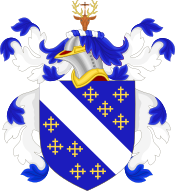
I don’t want to go over the same ground again, so for this talk I’m collecting the stories of other intelligence sources active from late 1774 to early 1776. One I’ve mentioned only once on this blog is John Skey Eustace, represented above by his coat of arms.

Eustace arrived at Gen. George Washington’s Cambridge headquarters in December 1775, one of several Virginians whom Capt. John Manley had captured on a British ship. He’d been sent north to Boston by his mentor: Lord Dunmore, royal governor of Virginia.

Within weeks Eustace was giving Gen. Washington useful tips about Dunmore’s agent Dr. John Connolly. Washington had already collected information on Connolly’s plan to recruit a Loyalist regiment, and at his warning Patriot authorities in Maryland had locked the man up. On 25 December, Washington warned John Hancock there was more to find:
I have received undoubted Information—that the genuine instructions given to Conolly, have not reached your hands—that they Are very artfully Concealed in the tree of his Saddle & coverd with Canvas So nicely, that they are Scarcely discernable—that those which were found upon him are intended to deceive—if he was caught—you will Certainly have his Saddle taken to pieces in order to discover this deep Laid plot.
Washington repeated that intelligence at the end of January 1776:
You may rely that Conolly had Instructions concealed in his Saddle—Mr Eustice who was one of Ld Dunmores family, & Another Gentleman who wishes his Name not to be mentioned, saw them cased in Tin, put in the Tree & covered over—he probably has exchanged his Saddle, or withdrew the papers when It was mended as you Conjecture—those that have been discovered are sufficiently bad, but I doubt not of the Others being worse & containing more diabolical & extensive plans
That information must have been deemed reliable because on 13 June Richard Henry Lee wrote to Washington:
I am informed that a certain Mr Eustace, now in New York, but some time ago with Lord Dunmore, is acquainted with a practise that prevailed of taking letters out of the Post Office in Virginia and carrying them to Dunmore for his perusal and than returning them to the Office again. As it is of the greatest consequence that this nefarious practise be stopt immediately, I shall be exceedingly obliged to you Sir for getting Mr Eustace to give in writing all that he knows about this business, and inclose the same to me at Williamsburg. I wish to know particularly, what Post Offices the letters were taken from, by whom, and who carried them to Lord Dunmore.
What’s striking about John Skey Eustace eagerly sharing what he knew about Lord Dunmore’s plots is that he was only fifteen years old.

And he’s just one of the people I’ll cover in this talk.

Monday, 31 March, 7 to 8:30 P.M.
The Spies of 1775
Acton Town Hall, Room 204

This event is free to all. It will be livestreamed on ActonTV.org and recorded for posting on the Acton 250 YouTube channel.

Wednesday, January 29, 2025

Talks on Bullet Strikes and Women Printers

Sestercentennial talks are starting to come fast. I’ll have some of mine to announce soon, and here are two happening tonight and tomorrow.

Wednesday, 29 January, 7:00 P.M., at the Acton Town Hall and livestreamed
“‘Dreadful Were the Vestiges of War’: Bullet Strikes from the First Day of the American Revolution”
Joel Bohy

Bohy, historic arms & militaria specialist at Blackstone Valley Auctions and Estates, will discuss the arms and ammunition used by both British and provincial forces on April 19, 1775, as well as the battle damage that remains. Modern shooting-incident reconstruction, archaeology, live fire studies, and new research sheds new light on the heavy fighting along the route of the British retreat back to Boston.

This free event is an Acton 250 program, and a recording will be available through Acton TV.

Thursday, 30 January, 7:00 P.M., at the Westford Museum
“In the Margins: Women Printers in the 18th Century”
Michele Gabrielson

In the 18th century, newspapers and pamphlets were crucial in spreading information and stoking the fires of conflict during the revolutionary period. Although printing was primarily seen as a masculine profession, women—such as widows, wives, and daughters—stepped up to embrace the responsibilities of a free press. These women not only set the type but, in some cases, also owned and managed their own printing businesses. This lecture will lay out the essential contributions of women in the printing industry leading up to the American Revolution.

Gabrielson is an award-winning educator, a historical interpreter, and secretary for the recently formed Mercy Otis Warren Society.

The suggested donation for this event is $10 per person.

(The picture above shows the broadside “A Bloody Butchery, by the British Troops,” issued after the 19th of April by Ezekiel Russell, whose wife Sarah helped run the print shop.)

Saturday, May 04, 2024

G. F. Hoar and “stories of the Battle of Concord”

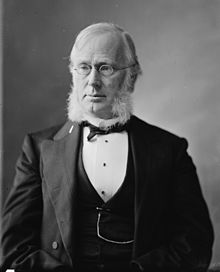
George Frisbie Hoar (1826–1904, shown here) was born in Concord. His father, Samuel Hoar, represented the area in the U.S. Congress and contributed to the wording of the town’s monument at the North Bridge.

In his autobiography Hoar wrote fondly about growing up in Concord, and particularly about living reminders of the Revolutionary War:
Scattered about the church were the good gray heads of many survivors of the Revolution—the men who had been at the bridge on the 19th of April, and who made the first armed resistance to the British power. They were very striking and venerable figures, with their queues and knee-breeches and shoes with shining buckles. Men were more particular about their apparel in those days than we are now. They had great stateliness of behavior, and admitted of little familiarity.

They had heard John Buttrick’s order to fire, which marked the moment when our country was born. The order was given to British subjects. It was obeyed by American citizens. Among them was old Master [Thaddeus] Blood, who saw a ball strike the water when the British fired their first volley. I heard many of the old men tell their stories of the Battle of Concord, and of the capture of Burgoyne.

I lay down on the grass one summer afternoon, when old Amos Baker of Lincoln, who was in the Lincoln Company on the 19th of April, told me the whole story. He was very indignant at the claim that the Acton men marched first to attack the British because the others hesitated. He said, “It was because they had bagnets [bayonets]. The rest of us hadn’t no bagnets.”

One day a few years later, when I was in college, I walked up from Cambridge to Concord, through Lexington, and had a chat with old Jonathan Harrington by the roadside. He told me he was on the Common when the British Regulars fired upon the Lexington men.

He did not tell me then the story which he told afterward at the great celebration at Concord in 1850. He and Amos Baker were the only survivors who were there that day. He said he was a boy about fifteen years old on April 19, 1775. He was a fifer in the company. He had been up the greater part of the night helping get the stores out of the way of the British, who were expected, and went to bed about three o’clock, very tired and sleepy. His mother came and pounded with her fist on the door of his chamber, and said, “Git up, Jonathan! The Reg’lars are comin’ and somethin’ must be done!” . . .

A very curious and amusing incident is said, and I have no doubt truly, to have happened at this celebration. It shows how carefully the great orator, Edward Everett, looked out for the striking effects in his speech. He turned in the midst of his speech to the seat where Amos Baker and Jonathan Harrington sat, and addressed them. At once they both stood up, and Mr. Everett said, with fine dramatic effect, “Sit, venerable friends. It is for us to stand in your presence.”

After the proceedings were over, old Amos Baker was heard to say to somebody, “What do you suppose Squire Everett meant? He came to us before his speech and told us to stand up when he spoke to us, and when we stood up he told us to sit down.”
In Concord, George F. Hoar became lifelong friends with Henry David Thoreau. They met as schoolboys at different grades, and George later attended the Thoreau brothers’ Concord Academy for a while. It’s unclear whether he overlapped with Edmund Quincy Sewall, Jr.

However, in an 1891 letter Hoar wrote that as a boy he attended a lecture in Concord where the speaker exhibited the skull of a British soldier killed in 1775. That could only have been Walton Felch at the town’s lyceum in the spring of 1840.

After the obligatory years at Harvard, George F. Hoar went into the law, establishing his practice in Worcester. Then he went into politics. He served in the Massachusetts General Court, then the U.S. Congress after the Civil War, and finally the U.S. Senate from 1877 to 1904.

Back home, Hoar helped found what became the Worcester Polytechnic Institute and served as president of the American Antiquarian Society. He also sat on boards of the Smithsonian Institute and the Peabody Museum of Archaeology and Ethnology, so he didn’t have a complete aversion to museums holding human remains.

But Sen. Hoar didn’t like the idea of the Worcester Society of Antiquity holding that skull of a British soldier killed on 19 Apr 1775.

TOMORROW: A private arrangement.

Thursday, March 28, 2024

“The Gathering Storm” in Acton, 2 Apr.

On the evening of Tuesday, 2 April, I’ll speak in Acton at the invitation of the Acton 250 Committee.

We’re calling this talk “The Gathering Storm,” and here’s the description:
As 1774 began, Massachusetts politicians worried about the royal government response to the Boston Tea Party. The force of that reaction became clear in the return of troops to Boston, the Coercive Acts, and the Massachusetts Government Act. In late summer the province’s people rebelled by shutting down government functions in rural counties, seizing weapons in ports, and electing their own legislature.

The engine of that resistance was a little-understood institution: the colonial militia. By fall, it was clear that the new royal governor had no leverage outside Boston. This talk traces the end of British power in most of Massachusetts even before the war began.
I’ll draw on the stories in The Road to Concord and elsewhere, discussing how rural Massachusetts shifted in 1774 from lukewarm support for Boston’s fight against tariffs to militant opposition to the Crown.

This will be part of a series of talks by different authors tracing the events that led to war in 1775. Eventually the people of Acton were so committed to the Patriot cause that their militia company marched at the front of the Middlesex County column confronting the British regulars at the North Bridge in Concord.

This talk will take place in Room 204 of the Acton Town Hall on Main Street starting at 7:00 P.M. It is free, but the Acton 250 Committee asks people to register so that they can be contacted about future events. The talk will also be shown live on Acton TV and Zoom.

Sunday, April 16, 2023

Getting to Know Dr. Samuel Prescott

One of the questions after my online talk for the Army Heritage Center Foundation last week led me to discussing Dr. Samuel Prescott and how little we know about him. So I decided to look into what we do know.

Dr. Prescott is remembered for joining Paul Revere and William Dawes on their ride west from Lexington center in the small hours of 19 Apr 1775. Revere’s 1798 account is largely responsible for that clear identification. The silversmith wrote: “We were overtaken by a young Docter Prescot, whom we found to be a high Son of Liberty.”

Some authors have claimed that Prescott was already active in the Patriot resistance, carrying messages. I’ve never seen evidence of that beyond the fact that Revere called him “a high Son of Liberty.” But look at how that clause began, “whom we found…” Revere and Dawes, who were active in the network and in Revere’s case had been out to Concord before, didn’t know Prescott. They had to get to know him.

Note also how Revere, aged forty, recalled this rider as “a young Docter Prescot.” Samuel Prescott was only twenty-three years old. In fact, he was the fourth Dr. Prescott in Concord, after his father, Dr. Abel Prescott (1718–1805), and his brothers, Benjamin (1745–1830) and Abel, Jr., who had just turned twenty-six. (Their mother had died the previous July.)

(I’m following the dates that appear in The Prescott Memorial, published by a family member in 1870. Find-a-Grave gives a different date in 1749 for Abel, Jr.’s birth without citing a source. The family doesn’t appear in Concord’s published vital records.)

Revere warned his companions that there were British army officers on the road that night, so they should be prepared. And:
I likewise mentioned, that we had better allarm all the Inhabitents till we got to Concord; the young Doctor much approved of it, and said, he would stop with either of us, for the people between that & Concord knew him, & would give the more credit to what we said.
The elder Dr. Abel Prescott had treated people in that region for decades, succeeding his own father and elder brother. He had probably brought his sons along on calls for training.

In Lincoln, while Prescott and Dawes visited a house together, Revere spotted two riders up ahead. He thought they were behaving like the army officers who had nearly stopped him in Charlestown. He called for his companions to join him, thinking three Patriots could handle two officers. Instead, “in an Instant I was surrounded by four.”

Revere continued:
The Docter being foremost, he came up; and we tryed to git past them; but they being armed with pistols & swords, they forced us in to the pasture;—the Docter jumped his Horse over a low Stone wall, and got to Concord.
Revere had nothing more to say about Prescott. Concord sources confirm that he reached his home town with the Bostonians’ warnings and then continued on west to Acton and Stow.

Meanwhile, Dr. Abel Prescott, Jr., mounted and carried the same news to Framingham and Sudbury, south of Concord. Later in the morning he tried to return to Concord over the South Bridge, only to find regulars from the 10th Regiment of Foot guarding that position.

TOMORROW: Wounded and hiding.

Saturday, April 07, 2018

Patriots’ Day Season at Minute Man Park, 7-21 Apr.

The Patriots’ Day season is upon us, so I’ll focus for several days on details and commemorations of the Battle of Lexington and Concord and the start of the Revolutionary War.

Minute Man National Historical Park has a bunch of free events lined up, starting today. For additional information, check its website. In addition, there are commemorations and events not on park land but in nearby towns such as Lexington, Bedford, and Arlington; visit the Battle Road website for those.

Saturday, 7 April, 1:00 P.M. 
Meriam’s Corner Exercise
737 Lexington Road, Meriam’s Corner, Concord
The Town of Concord, joined by area minute companies, fife and drum units, and the Concord Independent Battery, pay remembrance to the fight at Meriam’s Corner that marked the beginning of the six-hour running battle back to Boston.

Saturday, 7 April, 3:00 P.M. 
Paul Revere Capture Ceremony
Paul Revere Capture Site, 200 North Great Road, Lincoln
The Lincoln Minute Men and the Town of Lincoln, joined by other reenactment units, observe the historic capture of Paul Revere with fife and drum music and a musket fire salute.

Saturday, 14 April, 7:00 A.M.
Tough Ruck and Captain Brown’s Company of Minute Men
Step off at The Old Manse field, adjacent to North Bridge, Concord
Minute Man National Historical Park is honored to once again host the “Tough Ruck,” military personnel marching in memory of our fallen soldiers. Support our soldiers and veterans in this 26.2-mile hike along the historic Battle Road Trail. The ruck will kick off with a musket volley from the North Bridge.

Saturday, 14 April, 9:30 A.M. to 5:30 P.M.
Life at Hartwell Tavern
136 North Great Road, Lincoln
Park staff, Lincoln Minute Men, and living history volunteers will be demonstrating various aspects of life in Massachusetts at the beginning of the American Revolution.

Saturday, 14 April, 10:00 A.M. to 12:00 noon and 2:00 to 5:00 P.M.
Visit Whittemore House 
Behind Minute Man Visitor Center, Rte. 2A, Lexington
Whittemore House will be staffed by costumed park volunteers demonstrating what life was like in 1775. Try on colonial children’s clothing, gather ingredients for a meal, and listen to stories of the Whittemore family and their experience of April 19, 1775.

Saturday, 14 April, 10:30 A.M.
Explore Bloody Angle with Edmund Foster
Hartwell Tavern, 136 North Great Road, Lincoln
Edmund Foster, a volunteer from Reading, Massachusetts (portrayed by Park Volunteer Ed Hurley), will lead a tour to this key battle site where he fought in 1775.

Saturday, 14 April, 11:30 A.M.
1st Michigan Colonial Fife and Drum Corps
Amphitheater, Minute Man Visitor Center, Rte. 2A, Lexington
Listen to military music of the American Revolution and get into the spirit of Patriots’ Day!

Saturday, 14 April, 9:30 A.M. to 12:15 P.M.
Caught in the Storm of War: Civilians of April 19th
Captain William Smith House, 136 North Great Road, Lincoln
What would you take with you if you had to leave your home in a hurry, uncertain of your return? Learn about the local civilians on April 19, 1775. Once the refugees leave the Smith house, you may encounter them along the Battle Road Trail heading towards Lexington and the Minute Man Visitor Center just prior the the Parker’s Revenge Battle Demonstration. The Smith house will remain open until 4:00 P.M.

Saturday, 14 April, 1:00 P.M.
Parker’s Revenge Battle Demonstration
Battle Road Trail behind Minute Man Visitor Center, Rte. 2A, Lexington
Hundreds of British and colonial reenactors will engage in a tactical weapons demonstration with musket firing and fast-paced battle action along a stretch of the actual Battle Road of 1775. This is one of this year’s major events, newly informed by archeological findings.

Sunday, 15 April, 1:00 to 4:00 P.M.
Warlike Preparations: British Soldiers Search the Barrett House
Colonel James Barrett House, 448 Barrett’s Mill Road, Concord
In 1775, Colonel James Barrett of Concord was responsible for safeguarding all the military supplies in town, and his house was searched by British soldiers during their mission to Concord. Visit the Barrett House and learn about the intense military preparations that helped launch America into the Revolutionary War. Around 3:00, redcoats will arrive and search the property for arms and supplies.

Sunday, 15 April, 2:00 P.M.
Revolutionary Dogs: “Paws for the Cause!”
Minute Man Visitor Center, Rte. 2A, Lexington
Join Park Ranger Roger Fuller for a walk on the Battle Road to explore the lives of dogs in colonial America and in the Revolution. The 45-minute walk starts at Minute Man Visitor Center and is open to all, including well-behaved, friendly dogs on leashes.

Monday, 16 April, 8:45 A.M. 
Commemoration of the North Bridge Fight and Concord Parade
North Bridge, Concord
British reenactors will be joined by the Acton Minutemen and other local companies for a special commemoration of the North Bridge Fight featuring musket volleys. The Concord Parade will arrive at North Bridge around 9:30 A.M. All of the roads in the center of town are closed to vehicles beginning at 8:30 A.M.

Wednesday, 18 April, 7:50 to 8:45 P.M.
The Patriot Vigil
North Bridge, Concord
As darkness descends upon the North Bridge battlefield, we invite you to come and reflect on the events of April 19, 1775, and the meaning of liberty. The evening ceremony will feature a lantern-light procession stepping off from North Bridge Visitor Center at 7:50, poetry, music, and a recitation of the names of Patriots who gave their lives on that “ever-memorable” 19th of April. (To participate in the procession, bring an enclosed real candle lantern; no flashlights or L.E.D. bulbs.)

Thursday, 19 April, 6:00 A.M. to 12:00 noon
Salutes from the Bridge
North Bridge, Concord
A series of musket and cannon salutes from the bridge at various times of the day. 6:00 A.M.: The Concord Minute Men and the Concord Independent Battery. 10:00 A.M. (approximately): The Molly Cutthroats, a living-history group dedicated to the role of women in the Revolution. 11:30 A.M.: The Sudbury Companies of Militia and Minutemen. 12:00 noon (approximately): Sons of the American Revolution, Henry Knox Color Guard.

Saturday, 21 April, 4:30 - 8:30 p.m.
After the Battle: The War Has Begun
Hartwell Tavern, 136 North Great Road, Lincoln
War between the people of Massachusetts and Gov. Thomas Gage and the British regulars has just broken out. Thousands of men are preparing to leave home for the front lines around Boston. Whole communities are faced with numerous challenges demanded by this frightening new reality. Step back into the year of 1775 and get involved. Recommended donation: $5 per person, $10 per family. Children wearing a Junior Ranger badge (which can be earned on 14 or 21 April) admitted free.


Sunday, April 17, 2016

Amos Baker at the Bridge

On 22 Apr 1850, three days after the seventy-fifth anniversary of the Battle of Lexington and Concord, justice of the peace Ebenezer Rockwood Hoar took down the memories of a nonagenarian veteran named Amos Baker.

Baker was thought to be “the sole survivor of the men who were present at the North Bridge at Concord,…and the only man living who bore arms on that day.”

Hoar wrote out an affidavit that said:
I, Amos Baker, of Lincoln, in the County of Middlesex, and Commonwealth of Massachusetts, on oath depose and say that I was ninety-four years old on the eighth day of April, 1850; I was at Concord Fight on the nineteenth of April, 1775; I was then nineteen years and eleven days old.

My brother Nathaniel, who was then paying his addresses to the girl whom he afterwards married, was at the house where she was staying, near the line between Lexington and Lincoln, and received the alarm there from Dr. Samuel Prescott, and came over and gave it to me. My father and my four brothers, Jacob, Nathaniel, James, and Samuel, and my brother in law, Daniel Hosmer, were in arms at the North Bridge. After the fight at the bridge, I saw nothing more of them, and did not know whether they were alive or dead, until I found two of my brothers engaged in the pursuit near Lexington meeting house. Nathaniel followed the enemy to Charlestown.

When I went to Concord in the morning, I joined the Lincoln company at the brook by Flint’s pond, near the house then of Zachary Smith, and now of Jonas Smith. I loaded my gun with two balls,—ounce balls, and powder accordingly. I saw the British troops coming up the road that leads on to the Common at Concord. The sun shone very bright on their bayonets and guns.

Abijah Pierce of Lincoln, the Colonel of the minute men, went up armed with nothing but a cane.

When we were going to march down to the bridge, it was mentioned between Major [John] Buttrick, and Capt. Isaac Davis, that the minute men had better be put in front, because they were the only men that had bayonets, and it was not certain whether the British would fire, or whether they would charge bayonets without firing. I do not remember which of them said it, but they both agreed to it; and Captain Davis’s company of minute men [from Acton] was then brought up on the right. Then they saw the smoke of the town house, and, I think, Major Buttrick said “Will you stand here and let them burn the town down?”
Local historian Josiah Adams noted that other witnesses were more certain in ascribing these words to adjutant Joseph Hosmer.

That smoke having roused the officers, Baker said, “the order was given to march, and we all marched down without any further order or arrangement.”

TOMORROW: “Firing jackknives”?

Saturday, April 16, 2016

“I wished to ask him more about the Concord Fight”

On 5 July 1850 Josiah Adams called on Amos Baker of Lincoln, a veteran of the fight at Concord’s North Bridge over seventy-five years before. Adams hoped to interview Baker about his experiences.

Adams, a native of Acton, was preparing a pamphlet that championed his own town’s minute company against implications by Concord historian Lemuel Shattuck that it had not marched foremost among the provincial companies at the bridge.

Adams later described his visit to Baker this way:
He was asleep on his bed, and I was unwilling to disturb him. In about half an hour, he awoke and walked very slow and feebly across the room to a chair. I understood he had failed very much in a few days. I told him I wished to ask him more about the Concord Fight, but he seemed so feeble, and so distressed with the idea, that I judged it improper to trouble him further.

It was my purpose to inquire if he heard anything about the hatchet [the killing of a wounded British soldier], either at the time or afterwards; if he knew that both the soldiers who lay side by side were dead;—whether he saw them when he pursued over the bridge, or when he returned;—whether the Concord Minute Companies had bayonets—whether Major [John] Buttrick was present when he saw the bodies of [Isaac] Davis and [Joseph] Hosmer, and whether he or Col. [James] Barrett pursued in the afternoon—whether there was any firing, on the retreat, between the bridge and the village, and some other matters to which his attention did not seem to have been called; but his state was such that it did not appear probable that certain reliance could be placed on his answers.

Mr. Baker died July 16.
Fortunately, the previous April three other men had helped Baker create and sign an affidavit about his memories of the battle.

TOMORROW: Amos Baker’s account.

(That’s actually Josiah Adams’s gravestone up there, courtesy of Find-a-Grave, not Amos Baker’s. The researcher lived only four years longer than the old veteran.)

Thursday, April 10, 2014

Patriots Day Week Begins

Saturday, 12 April, seems to be the start of this year’s commemoration of the Battle of Lexington and Concord. I know of four events that day.

10:30 A.M.
Bedford Parade and Pole Capping
Wilson Park, Bedford
Minutemen from throughout New England will convene on Bedford town common and march with fife and drum down the Great Road to Wilson Park to watch the official pole-capping tradition. A minuteman will proclaim freedom by shinnying up a 25-foot pole and placing a red cap atop it.

1:00 P.M.
Meriam’s Corner Exercise
Meriam’s Corner, Lexington Road, Concord
The town of Concord, joined by area minute companies and Minute Man National Historical Park, commemorate the fight at Meriam’s Corner that sparked the six-hour running battle back to Boston.

3:00 P.M.
Paul Revere Capture Ceremony
Revere Capture Site of Minute Man National Historical Park, Route 2A, Lincoln
The minute men march down Battle Road and narrate the story of Paul Revere’s capture at the actual site. Hear Revere, Samuel Prescott, William Dawes, Mary Hartwell, even Henry Wadsworth Longfellow. Music, dramatic reading and musket fire in the Park. For all ages.

7:00 P.M.
Embattled Farmers
South Acton Congregational Church, 35 School Street, Acton
Author Rick Wiggin tells stories from his book profiling the Revolutionary War soldiers from Lincoln, Massachusetts, throughout the war. Tickets are $5, free for children under twelve.

Next weekend will be much busier. For more events, visit Battleroad.org.

Thursday, April 18, 2013

Luther Blanchard, Fifer

Yesterday I wrote about the Acton Minutemen marching toward Concord’s North Bridge, reportedly to the tune later codified as “The White Cockade.” The fifer in that unit was Luther Blanchard, son of Simon and Sarah Blanchard, born 4 June 1756 and therefore eighteen years old.

Luther was also one of the first people wounded during the North Bridge skirmish. In A History of the Fight at Concord (1827), Ezra Ripley wrote:
In a minute or two, the Americans being in quick motion, and within ten or fifteen rods of the bridge, a single gun was fired by a British soldier, which marked its way, passing under Col. [John] Robinson’s arm, slightly wounding the side of Luther Blanchard, a fifer in the Acton company. This gun was instantly followed by a volley, which killed Capt. [Isaac] Davis and Mr. [Abner] Hosmer, both of the same company.
Eight years later, Lemuel Shattuck added in a footnote in A History of the Town of Concord:
Luther Blanchard went to Mrs. [Rebeckah] Barrett’s, who, after examining his wound, mournfully remarked, “A little more and you’d been killed.”

“Yes,” said Blanchard, “and a little more and ’t wouldn’t have touched me;”—and immediately joined the pursuers.
Though Luther Blanchard marched with the Acton company (fifers got paid for musters), he lived in the neighboring town of Littleton, in an area that’s now part of Boxborough. Luther appears on Boxborough’s town seal, and every June it observes Fifer’s Day in his honor; this year’s celebration comes on 15 June.

COMING UP: What happened to Luther Blanchard?

Wednesday, April 17, 2013

The Questions of “The White Cockade”

In 1835, septuagenarian Charles Handley sat down with local historian Josiah Adams to relate his memory of the start of the Revolutionary War. Handley testified that on 19 Apr 1775 he was twelve years old and “lived at the tavern kept by Mrs. Brown, nearly a mile northwest of the North Bridge” in Concord. Usually when a child was “living with” someone outside the family, that meant he or she had been put out to work.

Handley recalled:
I saw Captain [Isaac] Davis’s company, as they came from Acton. I first saw them coming through the fields north of Barrett’s mill, and they kept the fields till they came to the road at Mrs. Brown’s tavern. They there took the back road leading to the bridge. They marched quite fast to the music of a fife and drum. I remember the tune, but am not sure of its name; think it was called the “White Cockade.”
Handley then whistled the tune he remembered, which Adams confirmed was “The White Cockade.”

That tune was definitely established by 1775. It was printed the next year in David Herd’s Scottish Songs and again in Campbell’s Reels (1778) and Aird’s Airs (1782). The first used the title “My Love Was Born in Aberdeen,” but the latter two included the music only. A Boston 1775 commenter reported that the melody appears in many handwritten American collections of fife tunes from the Revolution.

In 1790 Robert Burns (1759-1796, shown above) published the lyrics that gave the tune the name “The White Cockade.” For the first time in print the song was explicitly in favor of the Jacobite uprising of 1745. And that raises some questions.

D. Michael Ryan addressed some of those questions in an essay on “The White Cockade” and another article on martial music at the North Bridge. As he notes, authors around the time of the Centennial picked up Handley’s small detail and ran with it. They wrote that the Acton Minutemen had played “The White Cockade” while actually marching down on the British regulars at the North Bridge, though young Charles didn’t see that. Further writing said that “The White Cockade” was a favorite of Acton, or of Capt. Davis—again with no additional evidence besides Handley testimony. One local man later told a newspaper that his father, a veteran of the battle, described the same tune, but by then the historical accounts might have affected memories.

Even after peeling away the latter-day exaggerations, Ryan asks:
Still, we have to wonder why this Scottish tune would have been a “signature tune” of the Acton Minute Men, a “familiar air to the dwellers of the vicinity,” or a “favorite” of Captain Isaac Davis, particularly as there appears to be no local connection to the 1745 Jacobite uprising. It is true that the tune was one of rebellion, it was popular with military and civilian musicians and audiences on both sides of the Atlantic Ocean, it was found in music books of the period, and it was a lively tune for marching. Yet with some 500 witnesses at the North Bridge, why would not one deem it appropriate at the time (especially among the King’s men) to comment about “The White Cockade,” unless its notes simply were not played?
Another question occurs to me. In 1775, the Massachusetts Patriots were eager to show that they were standing up for British liberties and traditions. They viewed their political opponents as breaking those traditions with new taxes, appointees, &c. They linked that opposition whenever they could to Jacobite and Scottish usurpation, which let them present themselves as defenders of true British liberty. Why would those same provincials choose a tune that was clearly associated with the Jacobite threat?

I suspect that the tune we now know as “The White Cockade” didn’t have such a clear political meaning until Burns published in 1790. It probably had several sets of lyrics and several names, including a Jacobite version or two. But in New England, musicians might well have known the tune without political connotations.

After the Stuart line petered out, Burns’s “The White Cockade” was no longer a political threat but a quaint relic, suitable for publication. Burns’s popularity soon made his words the best-known lyrics to that tune. Therefore, by the time Handley and Adams spoke in 1835, they knew the tune first and foremost as “The White Cockade.” Back in 1775, it may not have had such a specific meaning.

Sunday, April 14, 2013

The Mystery of James Nichols, Reluctant Soldier

One of the most striking anecdotes of the confrontation at the North Bridge in Concord is the story of an Englishman who mustered with his local militia, but decided to go down to talk to the redcoats at the bridge. After that chat he took his gun and went home, not wanting to be part of the fight. However, only one witness recounted this story, and that seventy-five years after the battle. Back in the spring of 2001, D. Michael Ryan pondered the mystery for Concord Magazine, wondering if it was just a legend.

Richard C. Wiggin, author of
Embattled Farmers: Campaigns and Profiles of Revolutionary Soldiers from Lincoln, Massachusetts, 1775-1783, has found a longer trail for that Englishman, with a different ending from what the one witness recalled. I asked Rick to share that essay from the book here as a guest blogger.

In 1850, 75 years after the battle at Concord’s North Bridge, Lincoln’s Amos Baker recalled an interesting anecdote about one of the men present:

Before the fighting begun, when we were on the hill, James Nichols, of Lincoln, who was an Englishman, and a droll fellow, and a fine singer, said, “If any of you will hold my gun, I will go down and talk to them.”

Some of them held his gun, and he went down alone to the British soldiers at the bridge and talked to them some time. Then he came back and took his gun and said he was going home, and went off before the fighting. Afterwards he enlisted to go to Dorchester and there deserted to the British, and I never heard of him again.
The story has fascinated generations of history buffs. Amos Baker may never have “heard of him again,” but James Nichols did leave a small trail in the historical records through which we can piece together the rest of the story...and test the mental acuity of the 94-year-old Baker.

The record tells us that shortly after leaving Concord, Nichols enlisted in the provincial army besieging Boston, and he participated in the Battle of Bunker Hill. He served through that summer and fall, and into the following spring. He appears to have served through the fortification of Dorchester Heights—but without deserting to the British. Baker, too, served at Dorchester Heights, albeit in a different unit.

That summer (1776), Nichols appears to have left Lincoln, gone to Weston, then taken up residence in Acton, perhaps an itinerant worker moving from job to job. By wintertime, he was back in militia service at Dorchester—this time in the same unit as Baker, and they evidently renewed their friendship. During their three-month stint, Nichols was recruited into the Continental Army, and one January day Baker discovered his friend gone.

The Continental unit Nichols joined had a handful of other Lincoln men in it. They were marched northward in chase of the British army of General John Burgoyne, who was threatening to split the country along the Hudson River/Lake Champlain corridor. In September 1777, after eight months of Continental service, Nichols was reported as having deserted. He may have become disillusioned at the not-so-rosy life of a Continental soldier. Or gotten cold feet with the approach of what was certain to be a climactic battle. Or perhaps he simply succumbed to itinerant tendencies. The historical record does not reveal what was going on in his head. Two months later, he appears to have returned to militia service in Cambridge, guarding the British and German troops surrendered by General Burgoyne following the climactic battles at Saratoga.

Somewhere along the line, Amos Baker learned of the reported desertion by Nichols, probably from one of the Lincoln men serving in the same unit. Perhaps in the years that followed, he occasionally thought about the good times they had together—the singing, the humor, the storytelling. He recalled the incident at the bridge. He remembered last seeing his friend at Dorchester....

Seventy-plus years later, Baker was feted as the last known surviving participant of the fight at the Concord bridge. Old memories returned, a little worn with age. He was coaxed to write them down for posterity. And he left us with a wonderful snippet of the human side of the developing conflict. He got it almost right; he passes the acuity test. But even he did not know the rest of the story.

Thanks, Rick! The launch party for Embattled Farmers, published by the Lincoln Historical Society, is on Monday, 15 April (Patriot’s Day), at 5:00 P.M. in the Lincoln Public Library.

Monday, April 09, 2012

Links for the Patriots’ Day Season in 2012

Events commemorating the start of the Revolutionary War come on strong in the next couple of weeks. The best clearing-house for happenings out in the countryside is BattleRoad.org’s Events page. Among those items is my own talk in Lincoln tomorrow night: “What Did the British Hope to Find in Concord on April 19th?”

BattleRoad.org’s listings extend to the end of the month. They include the battle demonstrations and encampments inside Minute Man National Historical Park on 14-19 April. I prefer visiting those over the venerable dawn skirmish on Lexington common because they’re (a) not at dawn, and (b) spread out, so the sight lines are better.

On that last point, writer Derek W. Beck asks whether V.I.P. seating for the Lexington reenactment is in the spirit of the occasion. Or would the provincials in that skirmish have seen those arrangements as similar to seating the meetinghouse according to social status and wealth?

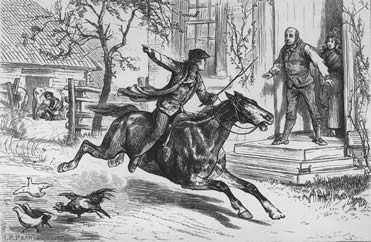
One local commemoration I hadn’t read about before is Acton’s “Robbins’ Ride.” Alas, “for the purposes of safety and practicality,” this isn’t reenacted by an actual thirteen-year-old boy on a horse. Then again, an adult is more likely to ride responsibly.

In the city, Boston National Historical Park hosts its annual “Paul Revere’s Row” on 15 April. The next morning, Roxbury celebrates William Dawes’s trip through that town with events starting at 8:00 at the U.U. Urban Ministry/First Church. The Paul Revere House has many presentations and family activities lined up for the school vacation.

Finally, on Sunday the Boston Globe ran several articles pertinent to the holiday:
  • On reenacting the real fight in Lexington on 19 Apr 1775, which occurred in the afternoon as the British expedition came back through town and met the reinforcement column. In the late 1900s the town militia’s attack on the regulars withdrawing to Boston became known as “Parker’s Revenge.” 
  • On Bedford’s pole-capping ceremony, a tradition that goes back 47 years. (While I’ve found scattered references to the “Liberty Cap” in Revolutionary times, the symbol seems to have reached its greatest popularity as a Jeffersonian symbol during the partisan politics of the early republic.)
  • On Cyrus Dallin, sculptor of the Paul Revere statue in the North End, and his museum in Arlington.
  • On the legacy of the “praying Indian” communities of Massachusetts—Natives who adopted Christianity and a lifestyle that combined American and European culture, only to be eventually swept along by the growing population of British settlers and their descendants.

Tuesday, April 06, 2010

The Real Fight at Concord Bridge

The thumbnail image to the right is N. C. Wyeth’s “Fight at Concord Bridge.” It shows Concord’s “embattled farmers,” apparently standing athwart the town’s North Bridge, blocking the British troops.

In the same spirit is this painting, which allposters.com doesn’t credit to a particular artist. The site labels it “American Minutemen Fight to Hold Off the British Army at Concord Bridge, April 10, 1775.” That’s not only nine days early, but misrepresents how the fighting at the North Bridge in Concord went down.

Many people conceive of that skirmish as the local militiamen taking a stand on the bridge and refusing to let the British troops cross. In fact, the two forces’ movements were much more complicated.

When Lt. Col. Francis Smith’s British expedition came into view east of Concord, the militia companies assembled in town turned and marched west, away from the regular troops and across that North Bridge. They took positions on high ground that overlooked the Concord River, eventually ending up more or less where the North Bridge Visitor Center is now.

Lt. Col. Smith sent seven companies of light infantrymen to that bridge. Four of those companies crossed and went two miles beyond to search the farm of militia colonel James Barrett, where Gen. Thomas Gage had heard (correctly) that the Massachusetts Provincial Congress had hidden weapons. The militia didn’t try to block that search party. Three other British companies remained near the bridge, on either side of the Concord River, in order to guard their comrades’ withdrawal route.

The regulars down by the river watched the militia up on the rise. The militiamen, numbers growing, watched the regulars. The situation was so static that one English-born farmer from Lincoln, James Nichols, walked down the hill to talk to the soldiers, then walked back up and said he was done for the day—he wasn’t interested in fighting his countrymen.

Then some men on the hill spotted smoke from the center of Concord. The grenadiers there had found some cannon carriages and extra wheels, piled them up, and set them on fire. The flames threatened the town house. Officers ordered soldiers to douse the fire, but by then it had done too much damage—not to the building, but to the stalemate back at the bridge.

Lt. Joseph Hosmer asked Col. Barrett, “Will you let them burn the town down?” After hearing from other officers, the militia colonel ordered an advance. Two militia regiments began to march down toward the bridge and the three British companies guarding it.

Clearly outnumbered, those regulars withdrew to the town side of the bridge and started to take up the planks to keep the militia regiments from crossing. To the locals, that looked like more property destruction. Men shouted down at the redcoats, and the militia companies kept marching.

As Capt. Walter Sloane Laurie and Lt. William Sutherland tried to get the British soldiers in formation to protect themselves, three soldiers fired without orders. Capt. Isaac Davis and Pvt. Abner Hosmer of Acton were killed, and four other men were wounded. The provincials fired back, hitting four British officers, killing three privates and wounding five more. The redcoats retreated at a run back to the center of Concord.

Thus, the “embattled farmers” of Middlesex County weren’t trying to keep the redcoats from crossing the Concord River—it was the other way ’round!

TOMORROW: In pulling back from the North Bridge, the British left four companies cut off behind enemy lines. What happened to them?