J. L. BELL is a Massachusetts writer who specializes in (among other things) the start of the American Revolution in and around Boston. He is particularly interested in the experiences of children in 1765-75. He has published scholarly papers and popular articles for both children and adults. He was consultant for an episode of History Detectives, and contributed to a display at Minute Man National Historic Park.

Subscribe thru Follow.it


•••••••••••••••••


Showing posts with label Elizabeth Murray Campbell Smith Inman. Show all posts

Monday, June 17, 2024

Capt. John Linzee’s Ties to Boston

This is the anniversary of the Battle of Bunker Hill in 1775.

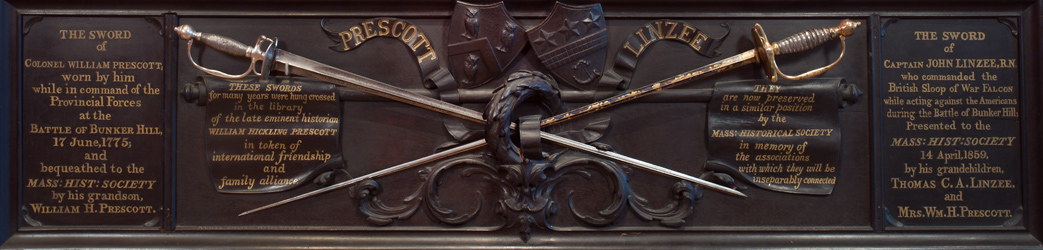
Among the Massachusetts Historical Society’s unique artifacts from that event are the crossed swords of Col. William Prescott from the provincial troops and Capt. John Linzee from the Royal Navy, as highlighted here.

Those weapons were donated by the historian William Hickling Prescott, his wife Susannah, and her cousin. William was a grandson of the colonel. Susannah was a granddaughter of the captain.

Though born in England and serving the king, Capt. Linzee had strong ties to Boston. In 1772, while master of H.M.S. Beaver, he married Susannah Inman of Cambridge, favored niece of John and Hannah Rowe.

The Linzees started having children. The first was born in Plymouth, England; the second back in Boston during the siege; the third on the Delaware River, reportedly during a battle which it didn’t outlive.

The Linzees’ fourth child was born at Barbados, the next four in Plymouth. The captain had a busy war.

Susannah Linzee’s father, Ralph Inman, had left Boston in the evacuation of 1776. Her stepmother, Elizabeth (Murray Campbell Smith) Inman, never left. She kept hold of their property, which is how he could return to his Cambridge estate when the fighting died down.

John Rowe also never left. When that merchant died in 1787, he bequeathed Susannah Linzee some Boston property. She came back to America, and the Linzees’ ninth child was born in Boston in 1789.

The following September, Capt. Linzee sailed H.M.S. Penelope into Boston harbor, writing to Gov. John Hancock that he intended to salute the flag of the U.S. of A. with thirteen guns if the battery at the Castle would reciprocate.

Linzee’s letter also mentioned his “exceeding ill State of Health,” and indeed he was so sick the Penelope sailed away without him while he recuperated in his wife’s house. A few months later, however, Capt. Linzee was back “in perfect health” on his ship along with his two eldest sons.

In the following years, things started to go wrong for Capt. Linzee.

TOMORROW: A British officer in Boston.

Friday, March 24, 2023

“Genl. Putnam & Some Troops came into Town”

In his diary, the merchant John Rowe noted that Sunday, 17 Mar 1776, was “St. Patricks Day” with “Pleasant Weather.”

He appears to have started his entry in the wee hours of the morning, perhaps before second sleep, then added to it later:
The Provincials are throwing up a Battery on Nook Hill on Dorchester Neck, which has occasioned much Firing this night.

This morning The Troops evacuated the Town & went on board the Transports at & about Long Wharff

they sailed & got most part of them into King Road

about Noon Genl. [Israel] Putnam & Some Troops came into Town to the Great Joy of the Inhabitants that Remained behind

I din’d at home with Mr. [Ralph] Inman Mrs. [Elizabeth Murray Campbell Smith] Inman, Mr. [Jonathan] Warner Mrs. Rowe & Jack Rowe—

I Spent the Evening at home with Major Chester Capt. Huntington Mr. [Samuel] Parker Mr. Warner Mrs. Rowe & Jack Rowe.
Once again, Rowe was distancing himself emotionally from “the Inhabitants that Remained behind,” though he undoubtedly was part of that group.

The Inmans had been separated by the siege lines, which strained their marriage. Back in July 1775 Ralph and the Rowes were talking about sailing to Britain together, and Elizabeth had responded with “pointed remarks.” This was the Inmans’ first dinner together in about a year, and it might have been tense.

Maj. John Chester (1749–1809, shown above) and Capt. Ebenezer Huntington (1754–1834) were Continental Army officers from Connecticut. They were also brothers-in-law, Chester having married Huntington’s sixteen-year-old sister Elizabeth in 1773.

Rowe’s diary gave no hint about how much pressure he felt to host officers from the conquering army, but he was making a quick transition to being friendly to the Revolutionary cause.

The first full day of independent Boston, 18 March:
Major Chester and Capt. Huntington Lodgd at Our house

The Town very quiet this night. Severall of my Friends came to see Mee from the Country
And the second:
Numbers of People belonging to Boston are dayly coming in—

Genl. [George] Washington & his Retinue were in Town yesterday I did not hear of it otherways Should have paid my Respects & waited on him—

This afternoon the King’s Troops burnt the Blockhouse at the Castle & the Continental Troops A throwing up a Battery on Forthill

Most all the Ships are gone from King Road into Nantasket Road—
TOMORROW: Royal Navy off the coast, Continental generals in the town.

Tuesday, August 11, 2020

“I will take your Body and I will Tar it”

When I was posting about Henry Barnes’s conflict with his Marlborough neighbors in the summer of 1770, I looked for the text of the anonymous threatening letter he reported receiving in late June.

But I couldn’t find that text and had to settle for quoting the proclamation Lt. Gov. Thomas Hutchinson issued about it.

Later I came across the text of that letter in E. Alfred Jones’s The Loyalists of Massachusetts, so I’ll quote it today.

Henry’s wife Christian had already told her friend Elizabeth Smith about the local protesters:
the first thing that fell a Sacrifice to their Mallace and reveng was the Coach which caused so much desention between us they took the cushings out of and put them in the Brook and the next night Cut the Carraig to Peices.
I first interpreted that “desention” to be between the Barneses, perhaps arguing over the expense of the coach. But in another letter Christian Barnes told Smith about “the Person that cut your Coach to Peices,” meaning that vehicle had first belonged to Smith or her late husband. So now I’m wondering if there had been some disagreement between the two ladies over that coach—perhaps Smith insisting that the Barneses take it as she left for Britain and Christian Barnes trying to resist.

The anonymous letter referred to the coach as a “booby hut,” a New England term for a carriage or coach body put on sleigh runners, as John Hancock’s coach has been preserved. Was that just a pejorative reference, or had the Smith carriage been left on runners since the winter?

In any event, Henry Barnes’s public complaints about the destruction of that vehicle spurred the anonymous writer:
I understand you are about carrying your Old dam’d Booby Hutt to the General Court and from thence Home to England to get recompence for all the damage you have sustained since you have been an infamous Importer or a common Enemy to the Country—

Therefore if you only want recompence for the damage you have done the Country in Importing goods contrary to the Agreement of Body of Merchants on this Continent I will recompence you without going there or any where else for I am determined to fetch you to terms even if I do it at the expence of my own Soul, or the Coat of a Sore Back or any other punishment in this World only for the good of my Country, for I stile myself a Son of LIBERTY,

therefore if you will Shut up your Store and Sell nothing out, nor Import any goods till the Importation takes place you shall sustain no more damage

But if not I will Fire your House and Store and destroy all your substance you have on the earth, And I will take your Body and I will Tar it, and if nothing else will do but Death you shall have it certainly, and so you will have no more Notice and if you do it by the 20th June 1770 Good and well, and if not you may depend upon my being as good as my word and so I will never write no more and so I stile myself Inspector General
I find it striking that this letter doesn’t speak in the voice of the community as Whig missives usually did. Instead, the writer emphasizes himself as an individual—willing to sacrifice for the country, to be sure, but speaking and acting on his own. That makes me inclined to think it didn’t come from Alpheus Woods or another member of the Marlborough town committee to enforce non-importation but from someone riled up by the conflict and perhaps not in his right mind.

Friday, January 04, 2019

“Mary makes and sells Tea-Kettles and Coffee pots”

As recounted in yesterday’s posting, by the end of 1735 Mary Jackson had reopened her husband James’s braziery shop a few weeks after he died at sea.

Mary Jackson had two sons under age five to provide for, and, according to accounts she later filed to the probate court, a staff of seven dependent on the shop. Plus her husband left well over a thousand pounds in inventory, and well over two thousand pounds in debt. So there were many reasons to make the most of the business.

Given that amount of stock at the Sign of the Brazen Head and the shop’s location near the center of Boston, Jackson immediately became one of the town’s most visible businesswomen.

The best documented “she-merchant” in pre-Revolutionary Boston was Elizabeth Murray, subject of Patricia Cleary’s 2000 biography. Murray opened a millinery shop after arriving from Scotland as a young woman in 1751. She imported the latest dress fashions, cloth, ribbons, and other dry goods, and she gave lessons in genteel embroidery and other skills for girls.

Murray married three times, gaining a great deal of wealth with her second marriage to Isaac Smith, but she was always able to support herself. She used prenuptial agreements to ensure she controlled her own wealth. And she acted as mentor to younger single women in Boston business, such as Janette Day and the Cumings sisters.

Jackson, in contrast, appears to have become a businesswoman by default because of her husband’s death. Furthermore, manufacturing brass hardware was not a traditionally female profession like millinery.

On 11 Oct 1736 Jackson published this advertisement in the Boston Gazette:
MARY JACKSON, at the Brazen-Head, in Cornhill, makes and sells all sorts of Brass and Founders Ware, as Hearths, Fenders, Shovels and Tongs, Hand-Irons, Candlesticks, Brasses for Chaises and Saddles, of the newest Fashion; all sorts of Mill Brasses; Mortars, Cocks, large and small; all sorts of polish’d Brazier’s Ware, at reasonable Rates.

A Quantity of large brown Paper fit for sheathing Ships, to be sold: Likewise buys old Copper, Brass, Pewter, Lead and Iron.
I’ve found a couple of other ads in which Jackson stated in some way that she actually produced the metal goods she sold, such as this line in the 21 June 1750 Boston News-Letter:
Said Mary makes and sells Tea-Kettles and Coffee pots; copper Drinking-pots, brass and copper Sauce-pans, Stew-pans, and Baking-pans; Kettle-pots, and Fish-Kettles.
However, in many more advertisements over the course of twenty years, Mary Jackson emphasized that she sold the hardware and other goods at the Brazen Head. So I’m not sure how hands-on she was in the production of brassware, as opposed to supervising employees’ work, managing imports from Britain, and running the retail shop. Because she was definitely the boss of the enterprise.

TOMORROW: The men who worked for Mary Jackson.

Monday, December 24, 2018

Anna Green Winslow’s Cold Christmas Eve

On 24 Dec 1771 twelve-year-old Anna Green Winslow sat down to write a letter to her mother in Halifax. Anna was living with an aunt in Boston for the better educational opportunities. Of course that meant private lessons, not the town schools, since she was a girl.

Anna started this letter with the winter weather:
to-day is by far the coldest we have had since I have been in New England. (N.B. All run that are abroad.)
Which I think means that anyone who had gone outside hurried through their errands in order to get back inside as fast as possible.
Last sabbath being rainy I went to & from meeting in Mr. Soley’s chaise. I dined at unkle Winslow’s, the walking being so bad I rode there & back to meeting. Every drop that fell froze, so that from yesterday morning to this time the appearance has been similar to the discription I sent you last winter.

The walking is so slippery & the air so cold, that aunt [Sarah Deming] chuses to have me for her scoller these two days. And as tomorrow will be a holiday, so the pope and his associates have ordained, my aunt thinks not to trouble Mrs Smith with me this week.
“Mrs Smith” was Elizabeth Murray Campbell Smith, who was teaching Anna embroidery and other needle crafts. The Smiths were Anglican, so they celebrated Christmas. So between that holiday and the weather, Aunt Deming decided to keep the young “scoller” at home so she wouldn’t slip and fall on the ice.

Anna and her aunt attended the Old South Meeting-House, and like a good descendant of the early Puritans, she viewed the 25 December holiday as a fallacy of “the pope and his associates.” Still, she got to stay home from schooling.

Wednesday, November 07, 2018

“No appointment of this sort could have been more unpopular”

As described last week, on 26 Oct 1768 Gov. Francis Bernard told his Council that the royal army had started renting buildings around the center of Boston to convert into barracks.

That news couldn’t have come as a surprise to the Boston Whigs. Three weeks before, they had reported just such a rumor in their “Journal of Occurrences”:
Report, that James Murray, Esq; from Scotland, since 1745, had let his dwelling house and sugar houses, for the quartering of troops, at £15 sterling per month
But soon the Whigs found something new to complain about besides Murray being Scottish. They suggested that he and the governor had agreed on a corrupt quid pro quo.

As you recall, Gov. Bernard had started to press Boston’s justices of the peace to provide legal authorization for taking over the Manufactory or other buildings in Boston. A magistrate could empower government employees to carry out some legal actions, conceivably with the help of the troops themselves. Boston’s established magistrates threw up the same obstacles as the Council. Then on 27 October the Boston Whigs reported:
The people were this morning filled with astonishment on hearing that the G——r had nominated and appointed the J——s M——y already noticed in this Journal, as one of his Majesty’s justices of the peace for the county of Suffolk; no appointment of this sort could have been more unpopular, or have raised a more general indignation.

The inhabitants being fully persuaded that by means of the steady conduct of our bench of justices in refusing to quarter and billet troops in this town contrary as they apprehend to an act of Parliament, this gentleman was added to their number, and that the G——r will not now want a Justice Gillam, or a more fit instrument to carry his purposes into the utmost execution.

It is given out that when this nomination was made [in the Massachusetts Council], there was silence for a space of time, and such signs of disgust as raised the passions and voice of this G——r, who afterwards condescended to use arguments and intreaties with his C——l in favour of his said friend, which finally prevailed to obtain the consent of a majority of two only.
Murray had been a member of the appointed governor’s council in North Carolina before joining his little sister, Elizabeth (Murray Campbell) Smith, in Boston. He wasn’t as wealthy as his sister and elderly brother-in-law, despite his efforts, but he was the sort of mature, genteel merchant who often got picked for political posts in the British Empire. As a native of Britain with family and business ties back there, Murray was a natural Loyalist. That was no problem for Bernard, of course.

In “Justice Gillam,” the Whigs alluded to Samuel Gillam, a magistrate in Surrey, England. On 10 May he had read the Riot Act twice to a crowd showing support for John Wilkes, then held in the King’s Bench Prison near St. George’s Field. After that warning had no effect, Gillam authorized soldiers guarding the prison to fire on the increasingly violent crowd. About six people were killed, more than a dozen wounded. A grand jury indicted Gillam for his part in the “St. George’s Field Massacre,” but in July the court acquitted him on the grounds that he had acted within the law. The Boston Whigs feared a similar outcome locally, and used that prospect to link themselves to the London Whigs.

The day after reporting Murray’s appointment, the “Journal of Occurrences” went back to the question of barracks:
In the morning it was known that the troops which lately occupied Fanueil-Hall, had been placed, or had quartered themselves in the buildings, which had been hired of James Murray, Esq; but owned by James Smith, Esq; of Brush-Hill, [in Milton.]

such a procedure in the face of an act of Parliament, may well surprise the inhabitants, and lead them to think that some gentlemen of the civil or military order have concluded that they have a right for certain purposes, of dispensing with those acts at their pleasure:

However this may be, it is hoped that the people will soon have the satisfaction of knowing whether such steps can be taken by any with impunity; or whether every order and person among us is not equally held to the due observance of law.
Murray was acting as agent for his ailing brother-in-law and sister. The buildings he rented, formerly used to distill molasses into sugar or rum, became known as “Smith’s barracks” or “Murray’s barracks.”

The Boston Whigs were still arguing that the Quartering Act required regiments to go into the barracks on Castle Island, far from central Boston. They had objected to the army taking over publicly owned buildings. But at this point those activists were also objecting to the army renting private properties from their legal owners.

COMING UP: A less likely landlord.

Thursday, March 19, 2015

Women to Meet at the Shirley-Eustis House this Spring

This spring the Shirley-Eustis House in Roxbury is hosting a series of first-person interpretive presentations on women of Revolutionary Boston and later periods.

Sunday, 22 March, 2:00 P.M.
Meet Phillis Wheatley
Valerie Link Foxx kicks off the series with a poignant first-person performance of the life of Phillis Wheatley. Brought to Boston from Africa at about the age of seven, little Phillis learned English so quickly that she was composing impressive verse while she was still in her teens. As a young woman she pursued literary success with a trip to London even while she was still enslaved, then personal independence as an author, wife, and mother in Boston.

Foxx is an actor, author, wife, and mother. She is also a native of Roxbury and has performed since the age of seven. In 1977, Valerie and her mother, Bernice Link, co-founded Link & Foxx Productions to produce one-woman and family skits and stage plays.

Sunday, 29 March, 2:00 P.M.
Meet Rachel Revere—Petticoats at the Revolution
Hear a remarkable story of tea and Revolution from the woman who rode through life with Paul Revere. Rachel Revere tells of the Boston Tea Party, the midnight ride, and the siege of Boston through the eyes of a woman who had to keep the home fires burning while her husband fanned the flames of Revolution.

This presentation will be performed by Joan Gatturna, creator of Petticoat Adventures. Gatturna is an actor and storyteller. She has been named as a Creative Teaching Partner of the Massachusetts Cultural Council and is on the Touring Roster of the New England Foundation for the Arts.

Sunday, 12 April, 2:00 P.M.
Meet Elizabeth Murray—Shopkeeper to Farmstead
Elizabeth Murray, a Scottish immigrant, developed a successful retail business in colonial Boston. By offering the latest fashions and teaching advanced crafts, and by insisting on prenuptial agreements in two of her three marriages, she achieved economic independence and became a mentor for younger women. Through the upheavals of the American Revolution, Elizabeth (Murray Campbell Smith) Inman faced the challenge of separating from Tory family members while maintaining her home in Massachusetts.

Una McMahon, Founder-Owner of Acorn Tours, provides customized sightseeing tours of Boston and New England and specializes in their rich colonial histories. She is a Governor/Board Member and the Chair of the Events Committee for the Shirley-Eustis House Association. McMahon has taught French Language, led student tours to France and Canada, and established organizations such the Irish Business Network Small Business Forum.

In addition, on 26 April Marcia Stein-Adams will present “Meet Isabella Stewart Gardner,” and on 3 May Jan Turnquist will offer “Meet Louisa May Alcott.”

Admission for each lecture is $10 per person.

(The copy of Gilbert Stuart’s portrait of Rachel Revere above comes courtesy of Oceansbridge.)

Wednesday, February 18, 2015

An American Artist in London

Yesterday I quoted a Boston News-Letter advertisement about a black man making portraits in Boston in 1773. I also noted how Prince Demah (Barnes) painted William Duguid in February 1773, according to a note on the back of that portrait, acquired just a few years ago by the Metropolitan Museum of Art.

We also have a May 1773 letter from Christian Barnes of Marlborough to her friend Elizabeth (Murray Campbell Smith) Inman to sit for a portrait by her former house-servant Prince the next time she was in Boston. So Prince Demah (Barnes) was definitely working as a painter in Boston in early 1773. How did he come to that business?

According to Christian Barnes, her husband Henry (shown here, courtesy of the Hingham Historical Society) bought Prince before 1769 “not solely with a View of Drawing my Picture but I believe he has some design of improving his Genius in painting.” She described Prince as the son of another family slave named Daphney and “Born in our family.”

As noted by Amelia Peck and Paula M. Bagger in the current issue of The Magazine Antiques, Prince therefore appears to be the child mentioned in this record of a baptism at Trinity Church in Boston on 23 May 1745:
Dafney an adult & Prince negroes.
In that case, Prince was at least in his early twenties when Henry Barnes acquired him from relatives.

In 1769 and 1770 Christian wrote to her friend Elizabeth Smith in London about Prince’s progress as a portraitist. She sent a sample of his work to Smith, and speculated about whether “Mr. Copling” (John Singleton Copley) might train him. So we know the Barneses were seeking opportunities for Prince to learn more.

In those same months Henry Barnes was under attack as one of the few holdout importers of goods from Britain, contrary to Boston’s non-importation agreement. In early 1770 he was called an enemy of his country, threatened with tar and feathers, and found his horse had been attacked that way. That hostility calmed down after Parliament revoked the Townshend duties (except for the tea tax) and removed troops from Boston.

In autumn 1770 Henry Barnes sailed for London, as reported in the 11 October Boston News-Letter. Peck and Bagger report that in February 1771 Barnes wrote to Elizabeth Smith that he’d found an art tutor for Prince in London: “Mr. Pine who has taken him purely for his genius.”

Peck and Bagger conclude that was probably Robert Edge Pine (1730-1788), an established portraitist. Some authors suggest that Pine himself had African ancestry through his father, the engraver John Pine, but that tradition seems to be based simply on how he looks in one engraving, not on his genealogy. Barnes actually wrote that he didn’t want Prince to “converse with any of his own colour here” in Britain. Ironically, while Henry and Christian Barnes eventually became Loyalists, Pine went the opposite way: after the war he moved from his lifelong home in London to Philadelphia.

Henry Barnes returned to North America with Elizabeth Smith and her relatives in the summer of 1771, as stated in the 15 July Boston Evening-Post. Evidently he brought Prince Demah back as well. It wasn’t until the next year that James Somerset’s case made slavery unenforceable in Britain, but Barnes might have emancipated Prince or come to some sort of understanding. The young man appears to have acted as an independent craftsman in the following years.

Thus, Prince Demah had indeed received a little assistance from “one of the best Masters in London” before advertising his skills in Boston, though a few months in 1771 was hardly comprehensive training. Peck and Bagger report that X-ray analysis of the three portraits linked to Prince Demah shows that he used a different technique while painting Duguid than appears inside the picture of Christian Barnes, which is almost certainly a copy of one by Copley. Frankly, I find the body proportions of the Duguid painting to be awkward, but the costume and setting are more ambitious.

All this means that Prince Demah traveled to London to make artistic connections before Phillis Wheatley made her famous trip in 1773, and before Copley first visited the imperial capital in 1774. Indeed, his experiences there might have helped to inspire their journeys.


Tuesday, August 20, 2013

A Look at Loyalist Ladies from Common-place

Common-place has a couple of new articles on Loyalists in the American Revolution. The first is from Prof. Kacy Tillman at the University of Tampa: “What is a Female Loyalist?”
Female Loyalists, like their male counterparts, are typically defined as being ideologically opposed to separating from Great Britain, but their inability to vote, fight, or legislate complicates how we understand their political affiliation. Many Loyalist women were persecuted because of familial ties to other Loyalists, and not because of their own political opinions, in part because eighteenth-century society did not view women as political creatures.

Early in the Revolution, women with Loyalist husbands could claim neutrality, since they could not own property or sign oaths of loyalty. Under coverture—the legal doctrine that held that a woman’s legal rights were subsumed by her husband’s upon marriage—husbands assumed a political position on their wives’ behalf, which rendered women politically invisible. Sometimes, this invisibility worked in their favor. Women (both Loyalists and Rebels) were allowed to take food, clothing, and letters across enemy lines—even into prisons—because they were not considered a threat.

Letters written by Loyalist women during the war show that such women were considered (and considered themselves) Loyalists not only if they verbally supported independence from or war with England, but also if they married a Loyalist, imported and sold British goods, resisted edicts from Committees of Safety or other local militias, delivered intelligence for the British, declared pacifism, and/or fled occupied cities to live with other Loyalist exiles.
Tillman discusses Elizabeth Inman (shown above), Christian Barnes, Sarah Deming (1722-1788), and Ann Hulton as Boston-area women whose lives were affected by their, or their families’, political loyalties. All were from the upper class, probably a reflection of which women left papers for us to read.

However, the article doesn’t make clear that Inman never left Massachusetts, even after Patriot newspapers had named her as suspicious. Her husband Ralph, older brother James Murray, and many friends like Christian Barnes and the Cumings sisters were definitely Loyalists, but was she? Or was she more wedded to her property than to any ideology?

And I don’t think Deming counts as a Loyalist at all, though some of her Winslow relatives were and she expressed concern for them. Tillman quotes two of Deming’s accounts of fleeing Boston in April 1775, but not the part of her journal that complains about more British troops arriving in the town and states her determination ”to git out of their reach.” All the more evidence that it’s hard to determine the political leanings of people whom society tried to keep out of politics.

Sunday, November 18, 2012

What Upset Deborah Putnam?

After Gen. George Washington organized the Continental Army into brigades in late July 1775, Gen. Israel Putnam moved into the Ralph Inman mansion in east Cambridge. He had already stationed his son Daniel there with instructions to see that Elizabeth (Murray Campbell Smith) Inman wasn’t harassed.

Soon, however, Inman moved to the estate she had inherited in Milton, and the army finished filling her Cambridge farm with barracks and fortifications. At some point Gen. Putnam’s wife Deborah joined him, as shown by some letters he exchanged with the Cambridge committee of safety in 1776.

After leaving Massachusetts, on 22 May Putnam sent back a letter that “remonstrated against the treatment that Mrs. Putnam had received from an agent of this committee.” The only surviving excerpt, probably with its spelling and punctuation cleaned up, offers a sense of that letter’s tone:

Pray did not I labor and toil night and day, through wet and cold, and venture my life in the high places of the field, for the safety of my country, and the town of Cambridge in particular? For it was thought we could never hold Cambridge, and that we had better quit it, and go back and fortify on the heights of Brookline. I always told them we must hold Cambridge; and pray did not I take possession of Prospect Hill the very night after the fight on Bunker Hill, without having any orders from any person? And was not I the only general officer that tarried there? The taking of said hill I never could obtain leave for before, which is allowed by the best judges was the salvation of Cambridge, if not of the country.
On 18 June the committee replied that Putnam’s conduct
while in Cambridge, in every respect, and more especially as a general, (without having it set forth,) we hold in the highest veneration, and ever shall. . . .

Nothing was ever aimed at treating you or yours unbecoming the many obligations that we are under for the extraordinary services you have done to this town, which must always be acknowledged with the highest gratitude, not only by us, but by rising generations.
Richard Frothingham quoted from those letters in his History of the Siege of Boston, thanking “J. Harlow, Esq.” for a look at the original documents. As a historian he was mostly interested in the question of what role Putnam played in the Battle of Bunker Hill. Frothingham avoided stating why the general had complained to the committee about “the treatment that Mrs. Putnam had received.”

The best evidence we have about the root of that conflict, and it’s a tradition without a cited source, appears in Old Cambridge and New by local historian Thomas C. Amory, published in 1871. He wrote that:
Mrs. Putnam took her airings in the [Inman] family coach. The Cambridge selectmen, provoked at this by them unwarranted appropriation of confiscated property, had the presumption, when she was some distance from home, to compel her to alight. The general was not of a temper to submit very meekly to such an affront, and his indignation was expressed with sufficient force to have become historical.
That appears to be based on local memory rather than documents. It mixes up the selectmen and the committee of safety (though they probably overlapped). But the fact that Frothingham saw letters referring to a dispute means something serious must have happened.

It’s conceivable that Deborah Putnam tried to take the coach not for “airings” but for her journey south at the end of the siege. That could explain why the general wrote back to the committee rather than storm into their meeting-place and cuss them out, which would be more his style. It also fits the legal issues involved: Patriot committees were happy to let the army use local Loyalists’ property during the siege but didn’t want it permanently removed or damaged without legal authorization.

Saturday, June 21, 2008

More on Prince, the “Black Limner”

Back in November 2006, I quoted some remarks from Christian Barnes of Marlborough to her friend Elizabeth ((Murray) Campbell) Smith about a young black slave named Prince who was showing remarkable ability as a portrait artist.

Yesterday I revisited that collection of letters at the Library of Congress, and found a little more about Prince. On 22 July 1773, Barnes wrote again to her friend, now Elizabeth (((Murray) Campbell) Smith) Inman:

I had a favor to ask which I must now petition you will grant me which is that if you have an hour to spare at any time when you are in Boston you will allow Prince to make some alteration in the Coppy he has taken from your Picture which he says he cannot do but from the life and Please to give him any directions you think proper as to the Dress of the Head
So in that year Prince was no longer living with Barnes in Marlborough but in Boston. He might have copied the portrait of Inman created by John Singleton Copley, shown on the cover of her biography above.

Then came the war. Barnes and her husband moved to Britain while Inman remained in Massachusetts. On 16 June 1783 Barnes renewed their correspondence with a letter from Bristol, which she closed this way:
P.S. pray let me know if good old Daphney be living and whether she is capible of giting her living. Her son I hear is provided for and so we shall all be in time
Daphney was Prince’s mother, so that postscript implies that by then Prince had died. And as yet I’ve found no trace of him in any other source.

Friday, April 11, 2008

“We was alarmed with a violent Skreeming”

For today’s dose of primary-source material, interesting analysis, and commentary, just hop over to Vast Public Indifference’s discussion of Elizabeth Murray, her school for girls in mid-1700s Boston, and how her business protegĂ©es the Cumings sisters reacted to political violence right outside their shop window. Excellent stuff.

Murray was an expert in needlework, but her school went well beyond that subject. And speaking of needlework, the antiques broker who blogs under the name Maine Cliff Dweller had a lot to say last year about collecting eighteenth-century embroidery, including the shepherdess to the right.

Off with you now. See you tomorrow.

Sunday, January 21, 2007

Elizabeth Smith Has a London Makeover

In October 1769, the wealthy widow Elizabeth Smith sailed for Britain, her first visit in fifteen years, as Patricia Cleary recounts in Elizabeth Murray: A Woman’s Pursuit of Independence in Eighteenth-Century America (UMass Press, 2000).

In 1749 Elizabeth had emigrated to Boston from Scotland. Originally she was supposed to live with her older brother James Murray on his plantation in North Carolina, but she saw better prospects for herself as an unmarried shopkeeper in the northern port. She prospered, taught embroidery to a generation of young ladies, mentored a few women in business, and married twice, the second time to elderly merchant and distiller James Smith.

James Smith died in August 1769, leaving Elizabeth a substantial fortune. She put her real estate in the hands of her brother, who hadn’t done so well to the south after all, and went to visit the Empire’s big city. Of course, she had to have clothing and hairstyle appropriate to a woman of her age and station. Cleary describes the arrangements Elizabeth made in London:

“I have submitted to all the forms of Dress,” she reported, ”except blacking my hair.” Instead, Elizabeth paid a barber to come to her quarters every other day to curl and powder her tresses. On the days the barber did not make a house call, she had someone to tend to her locks for her.

In the mornings, before going out, Elizabeth covered her head with a queen’s nightcap that made her look “a strange figure.” Once it was off and her hair elaborately styled, Elizabeth wore a “genteely made” outfit with ruffles and a high crowned cap. “You would be pleased with my appearance,” she told a friend.
(Boston 1775 has also posted some of the other side of Elizabeth Smith’s correspondence with that friend, Christian Barnes of Marlborough.)