J. L. BELL is a Massachusetts writer who specializes in (among other things) the start of the American Revolution in and around Boston. He is particularly interested in the experiences of children in 1765-75. He has published scholarly papers and popular articles for both children and adults. He was consultant for an episode of History Detectives, and contributed to a display at Minute Man National Historic Park.

Subscribe thru Follow.it


•••••••••••••••••


Showing posts with label Lexington. Show all posts

Saturday, August 29, 2026

“15,000 people over 4,000 days”
Robert Parkinson is the author of The Common Cause: Creating Race and Nation in the American Revolution, its distillation as Thirteen Clocks: How Race United the Colonies and Made the Declaration of Independence, and Heart of American Darkness: Bewilderment and Horror on the Early Frontier.

John Fea at the Way of Improvement Leads Home site interviewed Parkinson on the publication of his 2026 book, Tyrants and Rogues: Understanding the Declaration of Independence, looking at the grievances of the Declaration of Independence and the British officials blamed for them.

But the parts of the conversation that interested me most looked back and ahead:
JF: When and why did you decide to become an American historian?

RP: At a very impressionable age, I lived halfway between Lexington Green and Plymouth Rock. Each weekend I tried to convince my parents to take me to one or the other. Early American history seeped into my bones from these public history sites in the years after the Bicentennial. (Hopefully, a similar process is happening among little boys and girls in these days after the 250th, too…)

JF: What is your next project?

RP: I am embracing that original thrill. Boston in the years before the Revolution was my first love. I’ve decided to return to that place in those years. Boston in the middle years of the 18th century was a very small place. And in just a few years a few among them recognized they had a political emergency on their hands and took steps to organize and craft an effective resistance campaign. How 15,000 people over 4,000 days faced (and refaced) a decision to either embrace resistance – or not – is a fascinating story. No one yet has tried to encompass the whole story of Boston’s Revolution. If you can explain Boston, you can learn a lot about the causes of the Revolution. By featuring the rivalry between the families fighting for control of the city’s politics – the Adams/Otis and the Hutchinson/Olivers – I propose to do just that in Boston’s Revolution, 1754-1774.
Four thousand days is just less than eleven years, not twenty, but the preceding nine will probably serve to establish the situation most Boston politicians viewed as better and wanted to get back to.

In 1755 William Shirley was not only governor of Massachusetts but commander-in-chief of the British forces on the continent. I think that let Bostonians think they still lived at the center of British North America, despite Philadelphia and New York growing larger and richer. That status changed during the war.

In the late 1750s the royal governor was Thomas Pownall, a Whig willing to cooperate with the local legislature. Pownall departed for his own career reasons in 1760. Lots of Massachusetts politicians viewed his brief administration as the way the province ought to be run.

Tuesday, August 25, 2026

New Website Sharing a Lifelong Interest

A new online resource of information about the start of the Revolutionary War launched last month: J. Bohy Historical Consulting.

This is the website of Joel Bohy, expert on military artifacts and battlefield relics, local speaker and televised antiques expert, participant in both living history and archeological studies.

Because Joel Bohy grew up in Concord and still lives in Massachusetts, he has a particular interest in the opening months of the Revolutionary War. Which is, of course, the most interesting part.

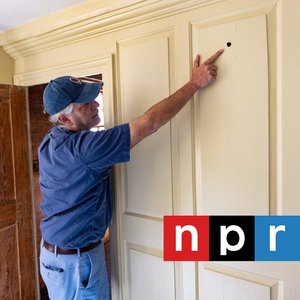
I especially appreciate the Publications section of the site, with P.D.F. files of many articles (and links to a few behind publishers’ paywalls). These range from grunt-level recountings of the Battle of Lexington and Concord for general readers to technical analyses of bullet strikes and metal detecting on battlefields.

I particularly recommend “Warlike Preparations of Every Sort: Stores in Concord, Massachusetts, on the Eve of the Revolution,” published in Man at Arms for the Gun and Sword Collector in October 2025.

There’s also a Media Appearances section of recorded lectures, podcast episodes, and news stories. With, no doubt, more to come.

Wednesday, August 05, 2026

“Transmitted to us, their Posterity, a fair and rich Inheritance”

The American Scholar just published Robert A. Gross’s essay “Gratitude Isn’t Everything,” considering the start of the American Revolution in contrast to Vice President J. D. Vance’s one-way demands for gratitude.

American Patriots felt obligations to their ancestors who established the colonies, and to their further ancestors who established the British constitution as they understood it. But to them those obligations called for resistance to Parliament’s new laws, not simple loyalty to the government.
In the Revolutionary movement it was a mark of militancy to appeal to the ancestors in protests against British policies. Such statements rehearsed the history of New England from the Puritans’ first settlements down to the latest generation.

Lexington elaborated on this narrative in January 1773. The saga opened as the Puritans fled the tyranny of Charles I and Archbishop Laud, made the hazardous Atlantic crossing, and carved out new homes in the American wilderness. “Our worthy ancestors … [endured] many Struggles with their Enemies in the Face of every Danger and at the expence of much Treasure and Blood,” the Lexington town meeting declared. They thereby “secured to themselves, & transmitted to us, their Posterity, a fair and rich Inheritance, not only of a pleasant fertile Land, but also of Invaluable Rights & Priviledges both as Men & Christians, as stated in the Royal Charter of this Province, and … [guaranteed] by the Faith of the British Crown & Kingdom.” So precious a legacy came as a sacred trust. It was the townspeople’s duty to protect and preserve this birthright of liberty and pass it on intact to the next generation. To do otherwise would betray their very character as a people.

The rhetoric of filial duty became ubiquitous in 1774–75 and with good reason. To punish the Bay Colony for the Tea Party and to curb what royal officials deemed a disorderly democracy, Britain effectively revoked the revered 1691 Massachusetts Charter. Under the Massachusetts Government Act (MAGA), the Crown took over the hiring and firing of all judicial officials and excluded the assembly from its previous role in choosing the provincial council, the upper chamber of the general court. Most important, the new law barred town meetings without the governor’s consent, except for an annual session to elect municipal officials.

MAGA was a direct attack on local autonomy and on popular influence in government. To the inhabitants, these arbitrary changes, imposed from above, amounted to disinheritance, and as worthy heirs of virtuous forefathers, they rose up in outrage.
One result of Parliament’s overreach, Gross argues, was to spur the Patriots into adopting a broader view of their cause, not linked to one nation’s history. The article quotes Dr. Joseph Warren’s praise for a “universal enquiry into the rights of mankind in general” as well as the rights of British subjects.

Eventually that produced the natural-rights argument of the Declaration of Independence, which could inspire many later movements, not bound to Britain or the limits of eighteenth-century society.

The current administration may invoke the Founding, but in disregarding the natural rights of anyone who’s not an American citizen, that administration is showing contempt for the philosophy the Founders came to champion.

Monday, July 13, 2026

“Headquarters of a Revolution” in Cambridge, 19 July

On Sunday, 19 July, the Longfellow House–Washington’s Headquarters National Historic Site in Cambridge will host a commemoration called “Headquarters of a Revolution: Washington’s Arrival in Cambridge,” coinciding with the 251st anniversary of the new commander-in-chief’s first week living in that mansion.

Here are the events scheduled for that day, including two from me.

10 A.M. to 3 P.M.
Living History
On the Lawn

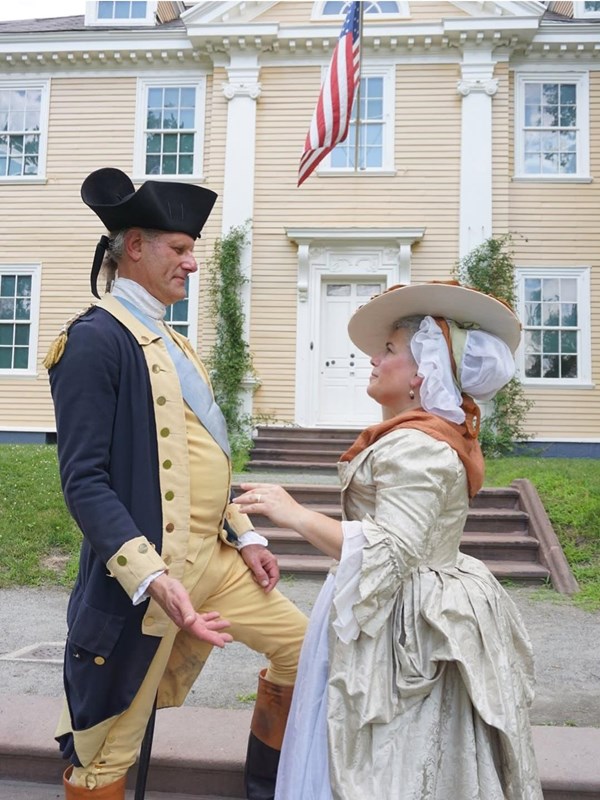
Interact with living historians John Koopman (as George Washington) and Sandy Spector (as Martha Washington), including a noontime Q&A with Mrs. Washington. Free family activities and a story walk available all day.

10 and 11:30 A.M., 2:30 P.M.
House Tour: Headquarters of a Revolution
Starting in the Visitor Center

General George Washington’s Cambridge headquarters was a testing ground for many of the ideals, institutions, and questions that still define our nation. This conversational tour with an N.P.S. ranger explores Cambridge Headquarters as a hub of revolutionary activity, where generals, enslaved people, paid laborers, poets, Indigenous diplomats, politicians, and soldiers shaped history—and how later generations would shape its memory.

10:15 A.M.
Get Ready with Martha
Carriage House

Learn all about the clothing of 1775 as Mrs. Washington finishes dressing for her day. There will be some stories and some gossip, too! Sandy Spector is a Boston-based historian, researcher, and interpreter, and has been a Revolutionary War reenactor since 2000. She spends most of her time researching and interpreting Mrs. Washington and has been portraying Martha—alone or with George—in numerous states and venues for the past 10 years.

11:30 A.M. to 12:15 P.M.
The Last British Army to Come Through Cambridge
Carriage House

In November 1777, nearly 6,000 soldiers of the king arrived in Cambridge. With them came about a thousand women and children. These weren’t invaders but prisoners of war, British and German, captured at Saratoga. Top officers were housed in mansions along “Tory Row” while enlisted men went into the leftover barracks on Prospect and Winter Hills. Over the next few months Cambridge, Charlestown, and neighboring towns had to adjust to a new population under guard. J. L. Bell explores what we should remember about this “Convention Army” as we approach the 250th anniversary of its arrival.

12:30 to 1:15 P.M.
“Though Dwelling in a Land of Freedom”
Carriage House

Join poet, educator, and Darby Vassall descendant Denise Washington for an exploration of Revolutionary-era freedom struggles surrounding Washington’s Headquarters through the lens of Anthony, Cuba, and Darby Vassall, as well as Phillis Wheatley Peters.

1:30 to 3 P.M.
The Black Patriots of Lexington – Silas Burdoo
Carriage House

This film explores the role that third-generation Lexington resident Silas Burdoo played in the Revolutionary War, starting with the battle on 19 Apr 1775. Burdoo was a grandson of Ann and Philip Burdoo, who married in Medford in 1704 and then purchased 40 acres in Cambridge Farms, which became Lexington. This film screening will be followed by a discussion with Zine Magubane, professor of historical sociology at Boston College, and Sean D. Osborne, producer of the Black Patriots of Lexington YouTube series.

3 P.M.
What Washington Saw on Cambridge Common
Walking Tour starting at the gate at the southern tip of the common

What did the center of Cambridge look like in July 1775? Since April, the town had been the base of the New England army besieging Boston, with war transforming the community. On this walking tour J. L. Bell looks at sites in and around the common, including the first headquarters, buildings turned into barracks, and the Continental artillery’s lost laboratory. How well do the Washington Elm and the Revolutionary monuments that dot the common memorialize the men who were actually there?

All of these events are free, as organized by the National Park Service.

Tuesday, June 09, 2026

“Paul Revere and Plan B” in Medford, 11 June

On Thursday, 11 June, I’ll speak to the Medford Historical Society on the topic of “Paul Revere and Plan B: Planning and Improvisation in the Lexington Alarm.”

Our event description says:
After the Battle of Lexington & Concord on April 19, 1775, Massachusetts resistance leaders portrayed the uprising as a mostly spontaneous response to the army’s incursion into a peaceful countryside. Decades later, Henry W. Longfellow presented “Paul Revere’s Ride” as nearly a one-man show.

In truth, the Massachusetts Patriots had prepared for months to resist the Crown military. Revere was part of a network of organizers, informants, and alarm riders. At the same time, Revere and his colleagues succeeded by being able to respond to contingencies by changing their plans.

Drawing on new research, this talk will shed light on one of independent America’s oldest stories—and how the day could have turned out differently.
I developed an earlier, short version of this talk for the 19th of April several years ago, and now I’m backloading it with more about Revere’s pre-war propaganda and espionage work.

The society will meet at the Charlotte and William Bloomberg Medford Public Library starting at 7 P.M. This event is free and open to the public.

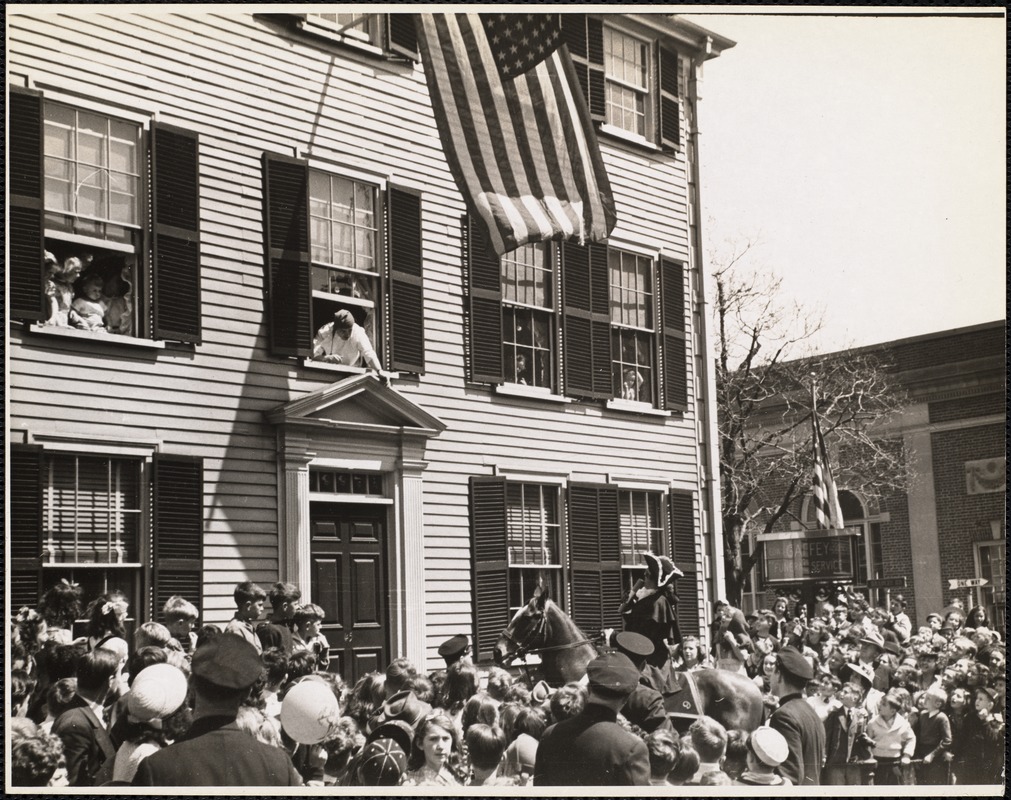
(The photograph above, which comes courtesy of Digital Commonwealth, shows the reenactment of Paul Revere’s stop at the Isaac Hall House in Medford sometime in the mid-1900s.)

Saturday, May 30, 2026

“How the Shooting Began in 1774” in Hampstead, N.H., on 2 June

On Tuesday, 2 June, I’ll be at the Hampstead, New Hampshire, public library, speaking to the Hampstead Historical Society about “How the Shooting Began in 1774: The Start of the Revolutionary War in New Hampshire.”

Here’s our event description:
Officially the Revolutionary War began with the Battle of Lexington and Concord in April 1775, but the first exchange of fire between the king’s government and the Patriots came the previous December in New Hampshire. The bloodless fight over Fort William & Mary in Portsmouth harbor was one stage of a months-long “arms race” as New England’s royal governors and political resistance vied to seize cannon and other artillery supplies in preparation for a war. This talk explores the mass demonstrations, armory break-ins, shadow governments, and espionage that brought on the war.
I’ll be drawing on The Road to Concord and more recent research to pander to the local audience speak bold truths about the start of the Revolutionary War—a story that starts months before the 19th of April and involves events hundreds of miles apart.

This free event is scheduled to take place from 6:30 to 8 P.M. at the library.

This talk is made possible by New Hampshire Humanities, N.H.P.B.S., and the Cogswell Benevolent Trust. It’s part of the “By the People: Conversations Beyond 250” series of community events developed by the Federation of State Humanities Councils and the Smithsonian Center for Folklife and Cultural Heritage.

Friday, March 20, 2026

“Alarmed in Lexington” in Lexington, 21 Mar.

Evacuation Day over, so it’s time to look ahead to another Patriots Day season. 

On Saturday, 21 March, the Lexington History Museums will host two performances of Alarmed in Lexington, a series of three short plays by Debbie Wiess about events in the Hancock-Clarke House on 19 Apr 1775.

The audience will take in these three vignettes while moving through the house in small groups (including going up and down stairwells).

As the action begins, it’s shortly after midnight and Paul Revere and William Dawes have just left after bringing news of approaching British regulars. The vignettes dramatize the responses of the town minister, the Rev. Jonas Clarke, and his granddaughter Lucy; Massachusetts resistance leaders John Hancock and Samuel Adams; and Hancock’s fiancĂ©e, Dorothy Quincy, and his aunt, Lydia Hancock. Those conversations take place in the same rooms where those people were living in 1775.

The performances are scheduled for 4 and 7 P.M. Tickets are limited and cost $40, or $30 for Lexington History Museums members.

Tuesday, February 24, 2026

“As ever the two Armies met”

Yesterday we left schoolteacher Jonathan Hastings, Jr., and the rest of Col. Thomas Gardner’s Cambridge militia contingent caught near the Lexington meetinghouse on 19 Apr 1775.

Lt. Col. Francis Smith’s expedition to Concord (which Hastings called “the Detachment”) was headed back their way from the west, harried by other militia companies.

Col. Hugh Percy’s reinforcement column (“the Brigade”) was approaching from the east. Percy had more soldiers. And he had cannon.

We return to Hastings’s 11 June letter, now in the Thomas Gage Papers:
We were commanded to retreat into a thick Grove of Oaks over a Meadow, up to our Knees in water, wch. saved us. The Brigade turned their Artillery immediately upon us.—Their Cannon Balls cut down the Branches of the Trees merrily but none of us were killed.

As ever the two Armies met, it being about 3 Quarters after one OClock, they begun a precepitate Retreat for Bunkers Hill in Charlestown under the Protection of the navy. There were not above 400 that attacked them, being 1850 at once that day. Lord Peircy put the Cannon in Front, himself in the Centre, & the Marines were formed in the Rear. The Grenadiers & Marines were nobly peppered. Peircy had a Ball shot thro’ the Bosom of his shirt.

Two Officers were treppaned in the Red House leading to Charlestown. Quarters were offered them, they refused, replying their Orders were neither to give nor take any Favour. They met Death bravely.—

It is easier for you to imagine, than for me to describe the Horrid Barbarity & savage Cruelty of the British Troops in their Retreat. Houses plundered & burnt, wounded Men begging for mercy, had Bayonets struck into their Heads, & the Piece discharged, Women in Child Bed commanded into the Streets with a Gun at their Breasts, Old Men unarmed thrust thro’ their Bodies. Harmless young Fellows shot dead, such was the horrid Scene.

But on our side no such Vestiges of Cruelty were seen or exercised on any who chose to live: the wounded taken the utmost Care of, & when exchanged for our Men who were taken Prisoners, & have been treated most inhumanly: they cryed like Children to tarry among us.—
Of course, the redcoats had their own tales of atrocities by the enemy, starting with the “scalping” at Concord’s North Bridge.

I can think of one example of a woman who had recently given birth ordered out of her house (Hannah Adams of Menotomy) and one of a young teenager shot when he peeked out a window (Edward Barber of Charlestown). But Hastings’s letter rendered those examples as plural. And I’m not sure what he referred to with the bayonets.

Likewise, Hastings’s numbers of the troops engaged—400 militiamen chasing off 1,850 regulars—are skewed to make his side look good. Many groups of 400 provincials attacked the British column in turn. The Massachusetts force had a clear advantage in numbers.

Hastings wrote of emergency surgeries in “the Red House leading to Charlestown” as if his correspondent knew that location. Indeed, there appears to have been a brick house fitting that description. I haven’t been able to identify who owned or lived there, but sources do refer to its appearance and location.

On 12 May the Massachusetts committee of safety mentioned “the red house at the head of the creek near the road from Cambridge to Charlestown.” Soon provincials built the “Red House Fort,” more commonly called Fort No. 3, to guard a nearby crossroads, as shown in the detail of Henry Pelham’s map above. Today the site is just south of Union Square in Somerville.

TOMORROW: Finishing the letter.

Monday, February 23, 2026

“At length we have had the Commencement of Hostilities begun”

Here’s an account of the start of the Revolutionary War that I don’t believe has been published before.

It’s a letter dated 11 June 1775 from Jonathan Hastings, Jr. (1751–1831), son of the steward of Harvard College, to a friend named Jacob.

Hastings graduated from Harvard in 1768 and a few years later become one of Cambridge’s school teachers. He was living in his father’s house beside the common, shown here. On 8 June, three days before writing this letter, the young man took the job of town postmaster.

Ironically, his letter appears to have been intercepted by the Crown forces because it’s filed among Gov. Thomas Gage’s papers at the Clements Library. The library offers scans and an imperfect transcription.

Hastings wrote:
Your Brother’s Letter of 18th. May we received the 9 of June. Notwithstanding my many Avocations (our House being made Head Quarters) I cannot miss an Opportunity of sending you a Letter. Am happy you had so safe a Passage & found your Friends well.

At length we have had the Commencement of Hostilities begun by Gage’s Troops, at the Battle of Lexington, where 8 of our Men were killed, there being about 50 assembled on a Green.—

The Evening preceeding the 19 of April, I was met by 11 Officers equipt with Pistols & Cutlasses; when I got Home I acquainted several Gentlemen therewith; but they thought it was like to prove nothing but a false Alarm. They were mistaken. About 2 OClock the next Morning, we were roused out of Bed to pursue 1100 Grendadiers & Light Infantry being a Detachment from all the Regiments in Boston.—

They made their way to our Magazines at Concord, but affected nothing more than destroying 80 Barrels Flour, knocking of [sic] the Ears of 3 twenty four pounders & burning the Carriages. A Quantity of Bullets they threw into a pond, but have been got out since.

Coll. [Thomas] Gardner ordered our Regiment to parade at Watertown, not knowing but that Gage’s Reinforcement would take that Course. He was mistataken [sic], they marched thro’ Cambridge, wch. being known our Regiment took the nearest Way to meet the Detachment. Unluckily for us we had no sooner placed ourselves in an advantageous Post near Lexington Meeting House to give Battle to the Detachment, than we perceived the Brigade in the other Side of us. Our Situation was bad, being between both Armies.
Well, that seems like an exciting place to break, doesn’t it?

TOMORROW: Under fire.

Sunday, January 25, 2026

“How should patriotic Americans think about political violence”?

On 15 January, Prof. Johann Neem shared an essay titled “The Problem of Violence in Authoritarian America.” Here’s a sample:
No American should be shot so easily or blithely. In a country where, as Tom Paine put it, the law is king, we are entitled to due process. Instead, we have become victims of state violence encouraged by the Trump regime’s policies, statements, and values. Trump has permitted federal agents to use illegal amounts of force; ICE agents now regularly assault Americans on the streets, in their cars, and in their homes. . . .

As Trump expands his rule, we must ask ourselves unsettling—and unsettled—questions about the role of violence: How should patriotic Americans think about political violence, and what might we learn from our Revolutionary political tradition?

At first glance, the answers to these questions are easy: violence in a constitutional democratic republic is never permitted. Democracies require citizens to embrace disagreement and accept the outcome of free, fair elections.

But we are no longer living in a free state. Under Trump, the Constitution is no longer active. The rule of law has ended. Donald Trump has deployed lies, violence, and lawlessness to amass power. As I have written before, Trump’s violation of his oath of office means that he is no longer the constitutional president of the United States. We Americans are now subjects of an arbitrary regime ruled by a tyrant. Under Trump, the federal government has become the enemy of the American people. We are subject to force, not law. . . .

In our current context, conversations about violence are complicated because our political tradition recognizes the legitimacy of violence against tyrants but denies the legitimacy of violence by tyrants. Two and a half centuries ago, when the colonists found themselves in a similar situation, the leaders of the patriot cause had to explain why they had embraced violent resistance against their own government. They did so in Continental Congress’s 1775 “Declaration…[on] the Causes and Necessity of Taking Up Arms.”

The situation was fraught. America’s resistance leaders in Congress had hoped to resolve differences between the colonists and England peacefully through meetings, petitions, and boycotts. Yet as Americans faced an increasingly hostile British government, patience was running out and the people got ahead of the opposition’s leaders. In April 1775, patriotic Minutemen at Lexington and Concord showed up to prevent British soldiers, then occupying Boston, from seizing arms in the Massachusetts countryside. Soon after, Ethan Allen’s Green Mountain Boys and colonial militiamen stormed Fort Ticonderoga.

Similarly, today, we see incidents in which protestors are getting increasingly unwilling to stay out of ICE’s way as Trump’s agents cross line after line that protects Americans from arbitrary force, arrest, and imprisonment, as the Cato Institute recently concluded. Most protestors are peaceful and obeying the law—but deciding what counts as lawful becomes harder when federal agents act violently and unlawfully. . . .

As our patriotic forebears 250 years ago understood, we too have a responsibility to our children and future generations who deserve to live in a free country. Violence is always a last resort. But at some point, some people in some city may be pushed to cross a line that most of us never want to cross. Just as [the] Continental Congress struggled with how to respond, so will we. The answer of what to do next is not easy or simple. The question we must all start asking ourselves, then, is how we will respond if that time comes, hoping and acting all along to prevent it from arriving.
Over a week later, as I type this, we see multiple videos of how I.C.E. agents approached, shoved, tackled, beat, maced, and finally shot observer Alex Pretti several times, killing him on the street. Along with the shooting of Renée Good, that made I.C.E. agents responsible for 66% of all homicides in Minneapolis so far this year.

The day before those agents killed Pretti, tens of thousands of local citizens braved harsh winter weather to march peacefully against federal oppression (shown in the photo at top). As Neem says, it’s hard to see Americans remaining committed to such peaceful protest if the forces of trumpery try to maintain their tyranny. 

Saturday, October 18, 2025

“Who Cares About the Midnight Ride?” in Boston, 21 Oct.

On Tuesday, 21 October, the Paul Revere House and GBH Forum will host a panel discussion on the topic “Who Cares About the Midnight Ride?: Perspectives on an American Legend.”

The event description says:
What does Paul Revere’s Midnight Ride mean today, and who does it matter to? In this panel, a university professor, a high school teacher, and a public history content creator will discuss how the Midnight Ride resonates (or doesn’t) with their audiences. They will compare perspectives on societal trends that influence whether a historical event like this feels relevant today.
The panelists will be:
  • Ahsante Bean, creator of Bean Thinking, a YouTube channel exploring American politics through history, psychology, and ideology. She is a recent Us@250 Fellow with the New America Foundation.
  • Eileen Ka-May Cheng, associate professor of history at Sarah Lawrence College and author of The Plain and Noble Garb of Truth: Nationalism and Impartiality in American Historical Writing, 1784-1860
  • Kerry Dunne, now in her fifth year as the head of the History/Social Studies Department at Lexington High School and an adjunct instructor of education coursework at area universities.
  • Noelle N. Trent (moderator), a public historian has worked with the National Park Service and the Smithsonian Institution’s National Museum of African American History and Culture.
This discussion will start at 6:30 P.M. in the Commons on the 5th floor of Suffolk University’s Sargent Hall, 120 Tremont Street in Boston. It will also be streamed lived on the GBH Forum Network and recorded for later viewing.

Speaking of which, my own talk earlier in this series can be viewed on this page.

Saturday, October 11, 2025

Two Talks on Thursday, 16 Oct.

It used to be that when two historical organizations scheduled talks on the same night you had to choose between them.

Now, thanks to live-streaming, it’s may be possible to catch both events and not even leave the house to watch them.

Here are two interesting talks scheduled for this upcoming Thursday.

Thursday, 16 October, 6 P.M.
“Within the compass of good citizens”: Paul Revere’s Masonic Journey
Steven C. Bullock
Scottish Rite Masonic Museum, Lexington

From the son of an immigrant to speaking beside the governor on Beacon Hill, Paul Revere traveled far in his extraordinary life. His membership in the Freemasons played an important role in that journey. This talk will consider how the fraternal order fit into Revere’s life—and into the development of Boston and the new nation of which they were a part.

Bullock is a Professor of History at Worcester Polytechnic Institute and author of Revolutionary Brotherhood: Freemasonry and the Transformation of the American Social Order, 1730–1840. This lecture is produced in partnership with the Paul Revere House. It will take place in person at the museum and be livestreamed on YouTube by LexMedia.

Thursday, 16 October, 7 P.M.
I Am So Tired of Waiting, Aren’t You?: Revisiting Black Majority
Peter H. Wood
American Antiquarian Society, Worcester

Black Majority: Race, Rice, and Rebellion in South Carolina, 1670-1740, first published in 1974, marked a breakthrough in understanding of early American history. This landmark book chronicles the crucial formative years of North America’s wealthiest and most tormented British colony. It explores how West African familiarity with rice determined the Lowcountry economy and how a skilled but enslaved labor force formed its own distinctive language and culture.

In this annual Robert C. Baron Lecture, an A.A.S. member who has written a seminal work of history reflects on its impact since publication. The series was endowed to honor Robert C. Baron, founder of Fulcrum Publishing and chairman of the A.A.S. council for a decade. Wood will speak in person at the A.A.S., and people can register to watch online.

Monday, September 15, 2025

Revolutionary Talks This Week in Dedham and Westford

Here are a couple more Revolutionary lectures coming up this week.

Wednesday, 17 September, 7:00 P.M.
Bullet Strikes from the First Day of the American Revolution
Joel Bohy
Dedham Museum, 612 High Street

In 2013, Joel Bohy began a collaboration with conflict archaeologist Dr. Douglas Scott to better understand the ammunition found during archaeological investigations on former battlegrounds. This morphed into live-fire research and the study of the extant battle-damaged structures and objects from April 19, 1775.

From the Elisha Jones house in Concord, through Lexington and the Jason Russell house in Arlington, Massachusetts—where Dedham soldiers fought—the two carefully studied all the surviving bullet strikes and bullet-struck objects. Using modern forensic techniques adapted to historical studies and live-fire validation, Bohy and Scott tell the story of the brutality of the fighting on the first day of the American Revolution as British forces retreated to Boston.

Joel Bohy is the owner of J.Bohy Historical Consulting. He is an arms & militaria specialist at Blackstone Valley Auctions and an appraiser on the PBS TV series Antiques Roadshow.

Admission is $10, free to museum members. This event will be recorded by C-SPAN for its America 250 series and by DedhamTV.

Thursday, 18 September, 7:00 P.M.
The Plight of the Loyalist in Massachusetts
Larry Kerpelman
Westford Museum, 2 Boston Road

It’s been said that history is written by the victors, so it’s not surprising that the story of Loyalists to the Crown who lived in the American colonies is not as widely known as that of the Revolutionary War’s victors, the Patriots. As the drumbeat to independence grew louder, Loyalists faced their Patriot neighbors’ scorn and the agonizing decision of whether or not to flee their towns and homes. Various historians have estimated that between 60,000 and 100,000 people fled the colonies by the time “America’s first civil war” ended. Dr. Kerpelman will present a picture of how ordinary Massachusetts Loyalists and their Patriot neighbors interacted with one another during the fraught period between the 1750s and the 1790s.

Larry C. Kerpelman, Ph.D., is a freelance writer and communications professional from Acton, Massachusetts. Upon retiring as Vice president and Director of Corporate Communications after 30 years with the Cambridge public policy research and consulting firm Abt Global, he turned to researching, writing, and speaking on singular moments in American history. His work has appeared in American History, American Heritage, The Boston Globe, The Rochester Review, and The Chronicle of Higher Education, among other publications. He holds a B.A. from the Johns Hopkins University and a Ph.D. from the University of Rochester.

Suggested Donation for this lecture of $10 per person.

Saturday, September 06, 2025

“He Lieut. Thos. Hawkshaw did affirm this to be the Fact & Truth”

On 23 Apr 1775, Lt. Thomas Hawkshaw of the 5th Regiment was lying near death.

He’d been shot through the throat during the Battle of Lexington and Concord. He’d lost a lot of blood, not only from that wound but from supposedly therapeutic bleeding. He was suffering spasms of pain. He had trouble swallowing pain relief, much less solid foods.

And his commander-in-chief, Gen. Thomas Gage, had just intercepted a letter from justice Edmund Quincy to the Patriot leader John Hancock saying Hawkshaw had been heard saying that British troops had fired first and started the war.

Hawkshaw’s regimental commander, Lt. Col. William Walcott, and other officers came to speak to him. They went away with this document, now in Gage’s papers. It said:
Boston, 23d. April 1775

Lieut. Thos. Hawkshaw of the 5th: Regt. of Foot, declares in the most solemn Manner to Lt. Col. Walcott, in the Presence of Capt. Smith & Lieut. Ben. Baker All of the same Regimt.,

That, he, Lieut. Thos. Harkshaw, never did say to any Person whatsoever, that, the King’s Troops gave the first Fire upon the People of this Country in the Affair which happened between the said Troops & the said Country People on Wednesday last the 19th. April;

that, so far from knowing or believing that the Troops were the first who fired, he, Lieut. Thos. Harkshaw, knows & believes that the Country People did fire first upon His Majesty’s Troops, & that he Lieut. Thos. Hawkshaw did affirm this to be the Fact & Truth to Lt: Col. [Francis] Smith of the 10th: Regt. of Foot who commanded the Grenadiers & Light Companies, upon the Spot, and that he, Lt. Thos. Harkshaw, did again upon his being brought into Boston, make the same Declaration to Capt. [John] Gore of the 5th. Regt. of Foot, That, to the best of his Knowledge & Belief, the Country People fired first upon His Majesty’s Troops.

Thomas Hawkshaw
Lieut 5th Regt. Foot

Wm: Walcott, Lt: Col. 5th. Foot.
John Smith Capt: 5th. Foot
Ben Baker, Lt. & Adjt. 5th. Foot
The regiment contained lieutenants named Benjamin Baker and Thomas Baker, so they used first names to sort out those men. The handwriting of the document looks like Walcott’s.

The detail about Hawkshaw telling Lt. Col. Smith (shown above) that the provincials in Lexington had fired first suggests the lieutenant was on or near the common during that shooting while Smith was still back with the grenadiers.

However, the document doesn’t add any detail about what Hawkshaw actually heard or saw there, and Gage was collecting such detail from other officers at this time. That makes me think Hawkshaw had passed on what he’d heard from other officers. (If Hawkshaw turns out to have been a light-infantry officer, then that’s off.)

In any event, from his sickbed Lt. Hawkshaw was insisting that he’d consistently blamed the provincials for shooting first.

TOMORROW: Corroborating witnesses.

Friday, September 05, 2025

“Lt. Hawkshaw yesterday near expiring thro. his bad wounds”

During the British army withdrawal on 19 Apr 1775, Lt. Thomas Hawkshaw of the 5th Regiment was shot in the side of his face.

As recorded by his regiment’s surgeon, blood gushed from his nose and mouth as well as his wound. Some of the affected tissue became inflamed. He had trouble swallowing.

People thought Lt. Hawkshaw was lying on his deathbed. And according to legal and popular understandings of the time, that meant he couldn’t lie in another way. After all, a person wouldn’t utter a falsehood just before meeting his maker, right?

Or, as a legal maxim quoted in 1700s reference books said: Nemo moriturus præsumitur mentiri. A dying person is not presumed to lie.

Usually that “dying declaration” doctrine allowed testimony from a dead victim that would otherwise be ruled out as hearsay. Thus, Patrick Carr’s doctors could report his remarks about the soldiers holding back before the Boston Massacre in 1770. To discredit such strong evidence, Samuel Adams had to resort to sneering that Carr “in all probability died in the faith of a roman catholick.”

The same thinking made “deathbed confessions” convincing. In the case of Lt. Hawkshaw, word went around that as his life slipped away he blamed the army for starting the war. Justice of the peace Edmund Quincy wrote to John Hancock on 22 April:
Here they say & swear to it all round, in excuse of ye Regulars, proceeding at Lexinton—that they were attack’d first & I doubt not many oaths of Officers & men are taken before J. G—ley [Justice Benjamin Gridley], to confirm it—but among others who contradict ’em—Lt. Hawkshaw yesterday near expiring thro. his bad wounds——Call’d Several Credible persons to him & told ’em as a dying man—that he was obliged in Conscience to confess—that the first Action of ye Whole at L. was done by the Kings troops—wr. they killd & wounded eight men—but doubtless you have sufficient proof of ye Fact & every Circumstance attending near at hand— . . .

Capt. [John] Erving, at his house yesterday Gave me ye Account of Hawkshaws Confesso.-proved to him at ye No: End yesterday to be real
As discussed here, Quincy gave that letter to Dr. Benjamin Church, Jr., who slipped it to Gen. Thomas Gage. Which meant Lt. Hawkshaw’s commander read that he was contradicting the official army line.

TOMORROW: A quick response.

Sunday, July 13, 2025

Simeon Potter and Rhode Island’s Army of Observation

Capt. Simeon Potter’s appeal to Rhode Island’s top court to overturn the verdict against him for assaulting the Rev. John Usher in 1761 didn’t work, despite having Robert Treat Paine to represent him.

So Potter appealed to an even higher court: the Privy Council in London.

According to Bruce Campbell MacGunnigle, who published the surviving record of this case through the Society of Colonial Wars in Rhode Island in 2006:
Usher won again, but under the condition that [he] come to England to collect [the judgement]. As Usher couldn’t afford the voyage, Potter never paid a cent.
Clifford K. Shipton likewise reported that Usher never collected any damages.

Capt. Potter continued to command respect in his home town of Bristol because of his wealth. He continued to serve in public offices. Usher continued to be the minister of St. Michael’s Church in the same neighborhood.

In 1772 Potter personally helped to attack H.M.S. Gaspee. When the Crown started an inquiry and found some witnesses, the captain apparently leaned on people to ensure he wasn’t identified. That whole affair seems to have made him only more popular.

At the end of 1774, Rhode Island made Potter the first major general of its militia forces. He looked like the right man to stand up to the Crown. By then people knew he was violent, possessive, and extremely stubborn—but those were pluses. Nobody could make Simeon Potter do what he didn’t want to do.

Come spring, Simeon Potter didn’t want to fight in the Revolutionary War.

On the evening of 19 April, according to American newspapers, Continental Congress delegate Stephen Hopkins wrote to Potter, calling on him to report to Providence in his capacity as major general; “The King’s troops are actually engaged butchering and destroying our brethren in the most inhuman manner, the inhabitants oppose them with great zeal and courage.”

Potter stayed home. In Beggarman, Spy: The Secret Life and Times of Israel Potter, David Chacko and Alexander Kulcsar wrote that Potter “claimed to have received a letter from the commanding general of the Massachusetts Militia telling him that no troops were needed,” but I can’t trace that reference and don’t trust the claim.

By 22 April Rhode Island’s legislature, having sidelined Gov. Joseph Wanton, was voting to form an “army of observation” which might march into Massachusetts. But the government had no one to lead those men.

TOMORROW: Finding a general.

Saturday, May 31, 2025

Heading into June 1775 with Confidence

One consequence of the Battle of Chelsea Creek is that by the end of May 1775 the provincial troops started to feel pretty powerful.

The militia mobilization of the Lexington Alarm had done significant damage to the Crown forces. Fortifications were keeping the king’s troops inside Boston.

The Royal Navy was seizing some ships and raiding coasts and islands for food. But three times now the provincial defenses had pushed back. Fairhaven men had recaptured two ships from Capt. John Linzee of H.M.S. Falcon. Hingham and other South Shore companies had forced troops off Grape Island with only a fraction of the hay they wanted.

And the fight over Hog Island and Noddle’s Island was even more impressive. The provincials came away with some livestock, reducing the food supply for besieged Boston. They set fire to hay being grown to feed the army’s horses.

In the fighting that followed, the provincials had deployed artillery for the first time and withstood return fire. They hadn’t lost any men, with four wounded and expected to recover, and reports out of Boston suggested some of the enemy had died. (Two seamen were killed, in fact, but some early reports put the number of Crown casualties as high as thirty.)

From H.M.S. Diana the provincial troops had pulled useful supplies: four four-pounder cannon, twelve swivel guns, the mast, and various bits of fresh rigging—the ship had been launched only the previous year.

And then those troops had actually destroyed the Diana—a Royal Navy warship! True, it was a relatively small vessel that had run aground, but that was obviously a provincial victory and a royalist loss.

Even the most cautious New England commanders and soldiers must have felt they were on a roll when they made the move onto the Charlestown peninsula on the night of 16 June. But the scale of the battle that followed was far beyond any other fight in the Boston campaign.

The Sestercentennial of the Battle of Bunker Hill will be observed on two successive weekends in June:
Make your plans now!

Saturday, May 17, 2025

“Commemoration of the 135th anniversary of the battle of Lexington”

grayscale photographic portrait of a man apparently in his late thirties with thick dark hair and a dark moustache
As a sort of “guest blogger” entry today I’m running an article that appeared in the 19 Apr 1910 Boston Herald reporting on an anniversary oration in Lexington by Rabbi Charles Fleischer (1871–1942), then of Temple Adath Israel of Boston.

Exercises Begin at Lexington

Rabbi Fleischer Delivers Address on “Americanizing America” and Criticises Conditions Prevailing at Present Here.

“Is America American? Are we as a people, and as individuals, democratic? Are our institutions democratic? Have we made any serious effort to organize our national life on the basis of democracy?” These were the questions asked, and answered in the negative, by Rabbi Charles Fleischer in an address at Lexington last night.

The occasion was the commemoration of the 135th anniversary of the battle of Lexington, at the town hall, by the Lexington Historical Society. Rabbi Fleischer’s address was on “Americanizing Americans.” He said in part:

“Let us see what this process of Americanizing and democratizing America implies. In politics it means, not only war on the machine and on boss rule, but it means an end to discrimination against sex, the actual institution of universal suffrage, female as well as male, this being implied in a political democracy, in which the ballot is the symbol of social status.

“Also it means the elimination of business from politics, the cutting away of that cancerous growth, the corruption of corporate influence, which threatens the integrity of our political democracy. We don’t want the business man as such in politics. Nor, on the other hand, is the tariff to be considered a political question, but an industrial problem.

“The Americanization of America further involves the democratization of industry to the end of distributing more equably (not equally, of course), the fruits of the co-operation between capital and labor. This is demanded by the situation, not only to promote economic justice, but still more is it needed in order to prevent our degenerating into the most corroding type of human society, a soulless plutocracy—already prefigured in our worship of the almighty dollar.[”]

I share this not because it offers information about the Revolutionary War but because it shows what at least some Americans of 115 years ago thought that American history pointed toward.

Charles Fleischer was a Reform rabbi—radical Reform, some might say. He left Temple Adath Israel the year following this address in order to start a non-sectarian movement he called “Sunday Commons.” Here’s a Commentary article about Fleischer written by Arthur Mann in 1954.

Sunday, May 04, 2025

“It means exactly what it says, it’s a declaration”

Back in early March, following reports that Donald Trump was demanding a Declaration of Independence to hang in the Oval Office, I wrote:
Donald Trump doesn’t want the Declaration in his office to honor that text or its values. He wants a rare, beloved national asset brought to him to glorify himself.
Eventually Trump did get a printed Declaration behind a curtain in his heavily guarded workspace, an odd way for it to be “shared and put on display,” as a White House publicist had claimed.

This past week the television journalist Terry Moran visited the Oval Office and asked Trump what the Declaration meant to him. Trump confirmed my reading of his character by offering this ignorant blather:
Well, it means exactly what it says, it’s a declaration, it’s a declaration of unity and love and respect and it means a lot and it’s something very special to our country.
Trump couldn’t explain the meaning of the Declaration, its historical significance, or its relevance to today. His comments reveal his desperation to believe that a rare copy’s presence in his office shows the country feels “unity and love and respect” for him.

Last month the White House issued a proclamation on the 250th anniversary of the Battle of Lexington and Concord, as a Boston 1775 commenter alerted me. This document was obviously not written by Trump since it was focused on the historical event, coherent, and grammatical.

Much of that proclamation landed within the realm of common accuracy. In other words, it made the usual mistakes: that Paul Revere rode to Concord, that the “shot heard ’round the world” happened at Lexington, and so on. But a lot of other cursorily researched descriptions of the 19th of April make those same mistakes.

This White House document, however, made some mistakes all its own. It described the opening skirmish as “The British ambush at Lexington.” It said that at the North Bridge “the startled British opened fire, killing 49 Americans.” The correct number is 2. (The number 49 refers to the total number of provincial dead over the whole day.) Obviously the team drawing public salaries to prepare that proclamation for signature didn’t value fact-checking.

Incidents like these show how hollow the Trump administration’s claim to value American history really is. Behind the rhetorical trumpery, the White House is trying to defund our national parks, museums, libraries, universities, humanities research, public schools, and public television. The only forms of history its occupant shows any sign of valuing are statuary and birthday parades.

Tuesday, April 29, 2025

“Commitments to equality and democracy and an aversion to aristocratic rule”

Earlier this spring the History News Network published Eran Zelnik’s essay “The Dangerous Afterlives of Lexington and Concord.”

The article states:
According to legend, the Revolutionary War started suddenly, when an aggressive and conceited British regime based in Boston sent soldiers to seize arms stored in Concord. In response, roughhewn American farmers heeded the call to defend their homes and hearths from British tyranny. Miraculously, the underdogs succeeded. The tenacity and will of virile American farmers, it turned out, could vanquish a well-trained army of British Regulars, foreshadowing the ultimate success of the American Revolution as a monumental event in world history.

This mythology, however, is inaccurate. In reality, the Americans were initially overwhelmed by extensive British forces at Lexington.
The redcoats’ overwhelming attack on the Lexington militia companies has been a vital part of the story from the beginning, never denied by “mythology.” Patriot propagandists even played up that violence, insisting the British attack was unprovoked.

In the 1800s local chroniclers added some face-saving details of counterattacks, like some of the Lexington company firing back and Capt. John Parker leading his men to ambush the British as they came back into town in the afternoon. But no one ever claimed that Lexington was where American farmers “succeeded” in stopping the regulars.

Zelnik’s command of detail goes down from there:
But the larger force of fighters that engaged the Redcoats further along the road in the Battle of Concord led the British to retreat to Boston, so as not to be stranded so far from reinforcements.
The British plan was always to search Concord and then return as quickly as possible, meeting reinforcements on the way. The exchange of fire at Concord’s North Bridge alarmed the British commanders, but it didn’t really hurry them.
It was on the road back to Boston — not in Lexington and Concord — where most of the fighting took place, and that counterassault was largely led not by militia members, but rather by minutemen. These highly trained units, composed of thousands of the region’s hardiest gun-owning fighters, were accustomed to irregular guerilla warfare. During the Seven Years’ War (1754-63) many New Englanders had served in provincial regiments that proved crucial for turning the tide of war in favor of the British.
The minute companies were part of the militia system. Generally those men had more equipment and training than average, but how much more varied from town to town. Zelnik implies the minutemen were drawn from veterans of the war that had ended twelve years before. In fact, they were usually the younger militia members, less likely to have seen combat. (And few British officers in the Seven Years’ War would have agreed that the provincial troops were their crucial edge.)
Moreover, since the British had sent several expeditions into rural Massachusetts over previous months that turned out to be dry runs for April 19, the minutemen were already drilled and ready when the actual fighting began.
The minute companies started to form in the fall of 1774. There was only one British expedition after that season—to Marblehead and Salem, large coastal towns, in February 1775. The regulars also made a handful of practice marches that provoked militia alarms, but those went no farther than two towns outside of Boston. Few of the militiamen who marched on 19 April had seen redcoats in any numbers.

These misconceptions are a shame because Zelnik’s hypothesis is sound: “more than any other moment in the nation’s collective memory of the war, the myth of Lexington and Concord has for generations represented commitments to equality and democracy and an aversion to aristocratic rule.”

Furthermore, he’s right in warning that that national myth’s “commitments to equality and democracy” have at many times been hijacked by people who want “equality and democracy” only for part of American society—which isn’t equality and democracy at all.