J. L. BELL is a Massachusetts writer who specializes in (among other things) the start of the American Revolution in and around Boston. He is particularly interested in the experiences of children in 1765-75. He has published scholarly papers and popular articles for both children and adults. He was consultant for an episode of History Detectives, and contributed to a display at Minute Man National Historic Park.

Subscribe thru Follow.it


•••••••••••••••••


Showing posts with label John Singleton Copley. Show all posts

Saturday, June 27, 2026

New Boston Museum Exhibits to Visit During the Sestercentennial

Two venerable Boston museums are unveiling big reworked exhibit spaces for the Sestercentennial.

At Revolutionary Spaces’ Old South Meeting House, “Ruckus!” opens formally on 2 July. This is a 25-minute “immersive” show that
drops you right into the heart of the debate and defiance that once filled this iconic space, where ordinary people set extraordinary change in motion.

From the floorboards to the balconies, you will be surrounded by dynamic sound, lighting, and projected animations of fiery revolutionaries, determined citizens, and some unlikely troublemakers whose courage shook these walls.
Revolutionary Spaces encourages people to buy tickets in advance since space at each showing is limited. Arrive around the top of the hour, and the show begins at fifteen minutes past. Tickets include admission to all of Old South’s exhibits and the Old State House.

“Ruckus!” includes loud noises and dynamic lighting to reflect the intensity of the story it tells. It therefore might not be comfortable all visitors. Revolutionary Spaces also offers “Sensory-Friendly Mornings” at the Old State House each month.

The Museum of Fine Arts has reopened its “Art of the Americas: 1700–1800” galleries with a new, hemispheric approach. Thomas Sully’s massive painting of Washington crossing the Delaware stayed where it is, but lots of other iconic artworks are arranged in a new way.

The museum says:
The MFA’s reimagined galleries of 18th-century Art of the Americas bring together works from across North, Central, and South America, and the Caribbean—including works by Native American and Indigenous makers. Together, the eight spaces in this suite, organized by theme, explore how artists have contributed to, or in some cases resisted, ideas of nationhood and identity. Visitors can immerse themselves in expansive versions of familiar stories, discovering the interconnectedness of the Americas and its history, institutions, and people.
The galleries have the themes of “Power and Resistance,” “History and Mythmaking,” “Asian Styles in the Americas,” “Boston’s World,” “Something’s Brewing” (not revolutions but caffeinated beverages), “Communities of Makers,” “Families at Home,” and “Copley’s Ambition.”

Sunday, September 28, 2025

A Last Word on Boston’s Sedan Chairs

Originally I flagged Alun Withey’s blog post about sedan chairs in Britain just because I thought it had interesting details about daily life in the eighteenth century.

But then I got interested in the question of whether those details also applied in Boston.

Looking for sedan chairs locally led me into the smallpox epidemic of 1764, and thus to the name “Williston” appearing over and over in the selectmen’s records. So I had to figure out who Thomas Williston was.

So, having spent nearly a week on what I’d thought was a one-day topic, I’m coming back around to complete this sedan chair trip with some familiar names.

In 1769 the smallpox virus flared up again in Boston, though not nearly as badly as five years before. On 21 June the selectmen’s minutes reported:
Mr. Thomas Cunningham living near Dr. [Jonathan] Mountforts gives information to the Selectmen, that one Joseph Hading who came to his House on Satturday last, from a Vessel which then arrived here from Philadelphia is suspected of having the Small Pox broke out upon him.

Dr. [Joseph] Warren was in consequence of the above information sent to the said Cunninghams house to examine into the same, who having done it, makes Report that the Person has got the Small Pox.

Whereupon the Sedan was sent to carry him to the Hospital at New Boston.
“Mountforts Corner” was the site of a well-known apothecary shop in the North End. The Jonathan Mountfort running it in 1769 was a son of the man with the same name who’d set it up. When he died in 1781, the business passed to his own son, also named Jonathan (born in 1746 and painted as a kid by the young John Singleton Copley, as shown above courtesy of the Detroit Institute of Arts). That third Jonathan Mountfort died only four years later, but the name survived for at least another decade.

In late July 1769 the selectmen sent the town sedan chair to carry more smallpox victims to the province hospital: “Mr. Jabez Searl,” “a Child a Daughter of Abijah Lewis,” and “Capt. Timothy Parker…between the Hours of Two & Three OClock in the morning.” (Others, such as “a Negro Woman Servant to Mr. William Wingfield,” were simply ordered to be removed to the hospital, and it’s not clear how that happened.)

These people were surprised to be catching smallpox. They must not have volunteered to be inoculated with what doctors believed was a mild strain. Health statistics stretching back decades showed that contracting the disease “in the natural way” was more deadly than being inoculated. And indeed, by 9 August, Searl and Parker had both died.

A few months later, the army drummer Thomas Walker was carried to the hospital in what he called “the Machine for the Conveniency of Removing the Sick.” He didn’t have the smallpox; instead, he’d been injured in the fight between soldiers and ropemakers on 2 Mar 1770. I wonder if that “Machine” was the town sedan chair or if the army had its own equipment.

My next milestone in the story of sedan chairs in Boston comes in 1799. In that year the town established its first board of health. Paul Revere was board president, the silversmith’s highest civic office. On 8 Apr 1800, the selectmen’s records say: “On application from the Board of Health, order’d that the Sedan Chairs belonging to the Town be delivered to them for their use”.

Thus, in eighteenth-century Boston, sedan chairs were ambulances. We can find a few individual sedan owners in the records, but they appear to have been in poor health. The appearance of a sedan chair on your street signified not luxury but illness.

Friday, June 27, 2025

“Crying most pitifully all exceeping one”

This is a portrait of Mary Hubbard (1734–1808) painted by John Singleton Copley about 1764 and now owned by the Art Institute of Chicago.

According to the institute, Hubbard’s “pose, gown, and background were precisely copied from a British engraving of a noblewoman, yet Copley distinguished the work as his own by capturing the figure’s individual features as well as the surfaces and colors of the luxurious fabrics.”

Mary Greene had married Daniel Hubbard (1736–1796) in 1757. Their mothers were first cousins. What’s more, her widowed father had married his widowed mother in 1744. That was one way mercantile families retained their money.

The Hubbards were Loyalists, particularly invested in importing sugar from the slave-labor plantations in Demarara. Daniel Hubbard signed the merchants’ addresses to the last royal governors, and the family remained in town during the siege

On 18 June 1775, Mary Hubbard wrote this description of the the Battle of Bunker Hill to her half-brother, David Greene (1749–1812):
once more at my Pen I can scarcely compose myself enough for any thing nor will you wonder when you know the situation we are in at present

Yesterday another Battle fought Charlestown the Scene of action they began early in the Morning & continued all day fighting. in the afternoon they set fire to the town & it is now wholy laid in ashes we could view this Melancholy sight from the top of our house

one poor Man went on the top of the meeting house to see the Battle was not able to git down again but perished in the flames.

about five in the afternoon they began to send home their wounded here my dear Brother was a Scene of woe indeed to see such numbers as pass’d by must have moved the hardest heart, judge then the fealings of your Sister, some without Noses some with but one Eye Broken legs & arms some limping along scarcely able to reach the Hospital, while others ware brought in Waggons, Chaise, Coaches, Sedans, & beds on mens Shoulders

the poor Women wringing their hands & crying most pitifully all exceeping one who on seeing her Husband in a cart badly wounded vou’d revenge went of but soon return’d compleatly Equip’t with her gun on her Shoulder her Knapsack at her back march’d down the street & left the poor Husband to try how many she could send along to tell he was comeing.

there is a vast Number of our Men killd & wound a great many Oficers two are sent to their long homes amongst the rest one fine looking Man much about your age who stopt against our windows to have his leg which was sliping moved a little he lived till this morning the poor fellow came a shore but yesterday or the day before, Perhaps his Mothers darling & his Fathers Joy cut of in the midst of his days his Sisters two if he had any must weep his untimely fate

hope it will never be my lot to have any of my near connections follow the Army.

Major [John] Pitcarn & Mr. Gore* both dead with many more that I dont know. we cannot yet learn how many of the enemy are kill’d, think it likely Mr. Hubbard who I supose will give you a particular account of the Battle will be able to write you word, to his Letter I refer you.

* have since heard Mr. Gore is a live
I don’t know who “Mr. Gore” is, not seeing such a British officer on the list of wounded. Hubbard wrote as if that man had been in the battle and thus not from the civilian family of Gores I’ve studied. (Samuel Gore was arrested after the battle for cracking a joke about the British deaths.)

The Hubbards didn’t evacuate Boston with the British military. Daniel kept at his business, and in 1792 was one of the founders of the Union Bank. He died on St. Croix during a voyage back from Demarara in 1796.

Mary Hubbard’s letter was first published by the Charlestown historian Richard Frothingham in 1876 and then as transcribed here in the D.A.R.’s American Monthly Magazine in 1894.

(The correspondent who sent the text to the magazine was Anita Newcomb McGee, a military doctor in the Spanish-American and Russo-Japanese Wars.)

Tuesday, February 04, 2025

A Copley Portrait and the Story Behind It

Last month the Pook & Pook art auction house in Pennsylvania sold two paintings of a little girl named Priscilla Greenleaf (and her dog).

One, attributed to Joseph Badger and dated about 1750, went for $20,000, or double the top range of its estimate. 

The other, an early work by John Singleton Copley, sold for $500,000, or more than six times the initial estimate. That’s what appears in this thumbnail.

The Copley portrait, which Pook & Pook dated to about 1757, was posthumous. That’s because Priscilla had probably died in 1750, soon after Badger painted her.

John Greenleaf, the children’s father, was an apothecary. As D. Brenton Simons wrote in Witches, Rakes, and Rogues, when Greenleaf’s eleven-month-old son died in January of that year, soon after the deaths of his daughters, he suspected poison.

Greenleaf accused a sixteen- or seventeen-year-old girl he enslaved, Phillis Hammond, of giving the baby arsenic. Arrested and under pressure, she confessed to killing John, Jr., and Elizabeth. The family believed she killed Priscilla as well. The newspapers published little about the case, not even the Greenleaf name.

Phillis Hammond pled guilty to murdering baby John that spring. She was sentenced to death. The Boston Evening Post reported, “Her Mother died with Excess of Grief.” Phillis was hanged on 16 May 1751. The Rev. Dr. Mather Byles preached at the execution. Some printer issued a broadside with a crude woodcut and verse titled “The bitter Effects of Sin,” the source for Phillis’s surname.

The Greenleafs had Badger’s portraits of Priscilla and Elizabeth to remember their daughters. (The latter is now in the collection of Colonial Williamsburg.) But evidently they wanted an image of their murdered son, and for the pictures to match.

John Singleton Copley was still a teenager himself when the Greenleafs commissioned him to paint all three of their lost children. The pictures of Elizabeth and John are now in the Metropolitan Museum of Art.

The museum website says of the boy’s outfit: “Copley’s source for John’s exotic cap and pose was a print after Sir Godfrey Kneller’s portrait of Lord Bury as a child.” Likewise, though his picture of Priscilla followed Badger in posing the little girl with a dog, he may have used a European print as a better model.

Tuesday, January 14, 2025

Online Talk about Henry Pelham and His Map, 15 Jan.

On Wednesday, 15 January, the National Parks of Boston, in partnership with the Boston Public Library, will present a virtual lecture on the topic “Mapping a City Under Siege: Henry Pelham.”

The event description says:
In 1775, Henry Pelham, aspiring artist and half-brother of the famed John Singleton Copley, found himself inside a city under siege. A loyalist with ample time and nowhere to go, Pelham gained permission from the British military to map the war developing around him. Though many other engineers mapped Boston in 1775 and 1776, Pelham’s artistic eye and intimate loyalist connections resulted in something unparalleled in how it depicts the landscape of the first chapter of a civil war. Today, his work is immensely valuable in helping us understand and reconstruct a Boston under siege 250 years ago.
The N.P.S. ethos apparently precludes naming who on the interpretive staff will speak about this map, but of course the agency has high standards for accuracy.

This Zoom program begins at 6:00 P.M. Anyone who registers can tune in for free.

For more on places that appear Henry Pelham’s map of Boston, and how they appear today, check out the sunny video I made with Lee Wright of The History List.

To tie this event together with my talk at Gore Place on Sunday, in the summer of 1788 the painter and paint merchant Samuel Gore was advertising:
A few elegant Plans of Boston, and its environs, including Milton, Dorchester, Roxbury, Brookline, Cambridge, Medford, Charlestown, parts of Malden and Chelsea, with the military works constructed in those places, in the years 1775 and 76, by Mr. H. PELHAM.
That was shortly after Samuel’s father John Gore had returned from Loyalist exile, probably bringing the first copies of Pelham’s siege map to be sold in Boston. The Gore and Copley/Pelham families had done business before the war, and they did business after the war, too.

Wednesday, May 22, 2024

Adm. Benjamin Hallowell Carew, R.N., a Son of Boston

Last month David Morgan’s Inside Croydon website profiled a notable British naval figure who grew up in pre-Revolutionary Boston.

Adm. Benjamin Hallowell Carew was one of the sons of Loyalists who joined the British military during the American War and remained in it through the wars with Revolutionary and Napoleonic France.

Morgan writes:
He was an American, born in 1761 in Boston to a family who were supporters of the British in the difficult years before the American War of Independence. Hallowell’s father, also named Benjamin, had also seen service in the Royal Navy, and had become a Commissioner of the Board of Customs in the port of Boston. His mother, Mary Boylston, was a second cousin of John Adams, who would go on to become the second President of America. . . .

The Hallowells of Boston lived a comfortable life by the standards of the time, with enough income to be able to employ one of the great American portrait painters of the day, John Singleton Copley, to produce family portraits.
Distance from Boston led Morgan into some geographical errors in describing the Hallowells’ houses. On 26 Aug 1765, an anti-Stamp Act mob damaged the Customs official’s house in Boston. He also owned a mansion in the Jamaica Plain part of Roxbury which was more secluded and safe. (J.P. and Roxbury are separate neighborhoods now, but in colonial times Roxbury was the town, Jamaica Plain simply an area within it.)

As a Customs officer, Benjamin Hallowell was unpopular with the merchants and people of Boston. He may have attracted special resentment because he was from a local family, his father a prominent merchant captain himself. In other words, people might have perceived him as switching sides.

In 1768 Hallowell helped to seize John Hancock’s ship Liberty, and the waterfront crowd physically attacked him, driving him into hiding onto Castle Island. Within the Customs service, however, Hallowell parlayed that treatment into a promotion as the Crown’s replacement for John Temple, a commissioner the administration came to see as too close to the locals.

Commissioner Hallowell was also the target of part of the “Powder Alarm” multitude gathered on Cambridge common on 2 Sept 1774. Leaders of that crowd successfully urged most of the men to leave him alone, but some chased him on horseback all the way across the Charles River bridge, up through Brookline and Roxbury to the gates of Boston.

Naturally, the family didn’t stick around to try their chances in March 1776. Commissioner Hallowell moved to Britain, taking his wife and children.

The next Benjamin's story continues:
Young Hallowell was aged 14 or 15 when he arrived in England, and wasted little time before joining the navy.

Hallowell enjoyed Navy life and was promoted to lieutenant in 1783 having already been involved in the Battle of Chesapeake Bay in 1781, St Kitts in 1782 and the Battle of Dominica later that same year.

Hallowell, by then a Commodore on frigate HMS Minerve, was on board the British flagship HMS Victory with Nelson at the Battle of Cape Saint Vincent in 1797. . . .

By the time of Battle of the Nile in 1798, Hallowell was in command of the 74-gun HMS Swiftsure. The British had hunted down the French fleet all the way from Toulon, via Malta, and tracked them to Egypt.
For how that fight worked out for Hallowell, why Adm. Horatio Nelson sent him a coffin, and finally how his surname became Carew, see the Inside Croydon post.

Wednesday, March 20, 2024

“Rebellion in New England” Now Open for Registration


I’m working with the Pursuit of History to produce a weekend filled with historical exploration of the “Rebellion in New England” 250 years ago this year.

As the year 1774 began, people in Massachusetts were worrying about how the royal government in London would react to the Boston Tea Party. Twelve months later, Massachusetts had a new governor and a revised charter, but most of the province was in open rebellion, preparing for war.

I explain more about our weekend exploring that history in the video above. The handsome Georgian building behind me is the Longfellow House–Washington’s Headquarters National Historic Site in Cambridge, our main host for this weekend.

“Rebellion in New England” will offer two full days of presentations, archive visits, and walking tours. On Friday and Saturday, 10–11 May, there will also be lunches with the speakers, plus a dinner for all attendees on Friday evening. On Sunday, we’ll have an optional extra session: a docent-led tour of the Museum of Fine Arts’s Early American galleries, including John Singleton Copley portraits of some of the people we’ll talk about.

I’ll lead the walking tours and speak about the “arms race” of late 1774. I’ve been recruiting other authors and scholars: Robert J. Allison on the royal government’s policy toward Massachusetts, Samuel Forman on the Patriots’ resistance organizing, Chris Beneke on how Massachusetts’s religious tradition affected its delegates’ reception at the First Continental Congress, Brooke Barbier on the rise of John Hancock. In the coming weeks I’ll announce the complete lineup (though I may preserve some surprises).

The Pursuit of History is the non-profit founded by Lee Wright which also organizes History Camp Boston. That event brings together hundreds of people to share presentations on a range of historical topics. This weekend is designed differently: only thirty seats, a focused subject, speakers recruited for their expertise, and visits to actual sites so we explore history where it happened. Go to this page for more detail and to register.

If “Rebellion in New England” is as much fun as we want, we’ll organize similar weekends in 2025 on the outbreak of the Revolutionary War and in 2026 on the departure of the British and the coming of independence.

Saturday, October 21, 2023

Book Signings in Boston and Newport

On Monday, 23 October, the Old South Meeting House will host the launch of the paperback edition of Stacy Schiff’s biography The Revolutionary: Samuel Adams.

After the hardcover appeared last year, the Wall Street Journal named The Revolutionary one of its Best 10 Books of 2022 and Barack Obama listed it among his recent favorites.

Schiff will discuss the book in the space where a town meeting on 6 Mar 1770 empowered Adams to lead a town committee demanding that the royal government remove all troops from the streets of Boston. John Singleton Copley’s portrait of Adams depicts that effort.

The Old South will open its doors at 6:30 P.M., and the event will begin at 7:00. It is free and open to the public, but Revolutionary Spaces encourages people to register at this link.

The next night, Tuesday, 24 October, Schiff will appear with Brooke Barbier, author of King Hancock: The Radical Influence of a Moderate Founding Father, at the Colony House in Newport, Rhode Island.

This authors’ discussion will look at the Boston Tea Party as a milestone in the collaboration of the two Boston politicians. Adams and Hancock served together in the Massachusetts General Court in the 1760s and 1770s and later were back-to-back governors in the 1790s. (There were some serious bumps in their relationship in between.)

This event is scheduled to run from 6:00 to 7:30 P.M. The Newport Historical Society is hosting, and admission is $20, or $15 for members. Charter Books will have copies of the two biographies available for purchase. Register here.

Monday, July 31, 2023

Behind Watson and the Shark

The National Gallery of Art recently shared Alysha Page’s article about an unusual figure in John Singleton Copley’s painting Watson and the Shark.

Copley actually made three versions of this picture for merchant Brook Watson, the oldest now in the National Gallery. A second copy, also from 1778, is in Boston’s Museum of Fine Arts. A smaller version painted in 1782 is in the Detroit Institute of Arts.

Page’s essay focuses on one figure, writing: “The Black man stands upright at the top of the pyramid-like composition of this busy harbor scene.” I think the apex of the pyramid is clearly the right hand of the white sailor beside that man, about to thrust a lance down toward the shark. At the very least that white sailor’s head is at the same level as the black man’s.

It seems significant that the black sailor in the boat is positioned behind all the white men. Though he loosely holds the rope tossed to Watson, we don’t see him throwing out that life line. Instead, other sailors are frozen in dramatic action: spearing the shark, leaning down toward the water to grasp Watson.

All that said, the mere presence of a black sailor among Watson’s rescuers is clearly significant. As Page points out, Copley’s sketch for the scene showed that man as white, so he made a conscious effort to change that detail.

Among Copley’s other canvases is a study of a black man’s face, usually assumed to be the model for this figure in Watson and the Shark. I think the study is much more individualized and expressive than the figure in Watson and the Shark. But it was so rare for paintings to show black men among white men that the final figure doesn’t have to be most lively, or at the apex of the people shown, to be meaningful.

Monday, December 26, 2022

How John Adams “Dined at Mr. Nick Boylstones”

John Adams finally got his invitation to dinner at Nicholas Boylston’s mansion in January 1766.

Adams’s mother was a Boylston, first cousin to this Boston merchant. However, Adams visited Boylston’s home only after becoming a rising young lawyer from Braintree, in Boston for court business and a whirl of political conversations.

On 14 January, for instance, Adams dined at town clerk William Cooper’s house with Thomas Cushing, speaker of the house; William Story, an Admiralty Court official; and John Boylston, yet another cousin on his mother’s side.

Adams recorded in his diary:
Boylstone, affecting a Phylosophical Indifference about Dress, Furniture, Entertainments &c., laughed at the affectation of nicely distinguishing Tastes, such as the several Degrees of Sweet till you come up to the first degree of bitter, laughed at the great Expences for Furniture, as Nick Boylstones Carpetts, Tables, Chairs, Glasses, Beds &c. which Cooper said were the richest in N. America.—The highest Taste and newest Fashion, would soon flatten and grow old.
The next evening, Adams met with “the Sons of Liberty, at their own Apartment in Hanover Square, near the Tree of Liberty.” This was the group also called the “Loyall Nine,” principal organizers of the protests that had negated the Stamp Act the year before. They were preparing to celebrate the law’s expected repeal.

Finally came this diary entry:
Thurdsday. Jany. 16th. 1766.

Dined at Mr. Nick Boylstones, with the two Mr. Boylstones [Nicholas and his brother Thomas, probably], two Mr. [James and Isaac?] Smiths, Mr. [Benjamin] Hallowell and the Ladies [the Boylstons’ sister Mary Hallowell and possibly James Smith’s wife, Elizabeth]. An elegant Dinner indeed!

Went over the House to view the Furniture, which alone cost a thousand Pounds sterling. A Seat it is for a noble Man, a Prince. The Turkey Carpets, the painted Hangings, the Marble Tables, the rich Beds with crimson Damask Curtains and Counterpins, the beautiful Chimny Clock, the Spacious Garden, are the most magnificent of any Thing I have ever seen.
Even though those luxurious furnishings might “soon flatten and grow old,” they awed the young country lawyer.

TOMORROW: Dinner conversation.

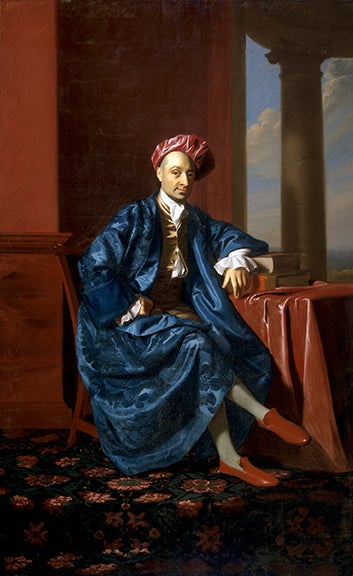
[The image above shows how John Singleton Copley remade his portrait of Nicholas Boylston, shown yesterday. Harvard College commissioned this copy in 1773, after the merchant had died and left money for a professorship. To match other paintings Copley had made for the college, he turned his original composition into a taller, full-figure portrait. As a result, Boylston was immortalized in honking big red slippers.]

Sunday, December 25, 2022

A “Christmas eve” in John Adams’s Imagination

On 23 July 1813, John Adams wrote to his son-in-law, William Stephens Smith, then serving in the U.S. House of Representatives.

That letter was about political affairs, with the war going badly for the U.S. of A., but another big theme was how no one appreciated John Adams.

In making that case, the former President drew up a picture, possibly conjectural, of a Christmastime tradition among certain Boston gentlemen of the mid-1700s:
Remember the fate of Cassandra. The prophet of ill ’tho’ as true as a goose’s bow is always detested. I also have been now and then reckoned among the minor prophets. Not a bone of any Goose ever picked by Jo Green, Nick Boylston, & Master Lovel on a Christmas eve, tho’ they had Nat Gardner for a guest, and exhausted all their wit, Gibes, & Jokes upon it, ever foretold an approaching winter, with more certainty that I have foreseen two or three small events in the course of my Life, such as the American Independence, & the result of the french revolution for example. But I was always execrated for it; & persecuted worse than the hebrew prophets, when they were set in the stocks.
“Jo Green” was Joseph Green (1706–1780), known for his biting literary wit. That seems to have manifest mostly in semi-anonymous verse poking at the Rev. Mather Byles, Sr., and anything new in town, like Freemasons. After a career as a merchant, Green took a post in the Customs service and then had to evacuate town as a Loyalist.

“Nick Boylston” was Nicholas Boylston (1716–1771), Green’s even more wealthy business partner. He and Green, both bachelors, owned houses near each other on School Street. Boylston is best known these days for his portraits by John Singleton Copley (one shown above). For those he posed as a wealthy man of learning, wearing a casual banyan and nightcap and leaning on a book. But I don’t recall any example of Boylston’s own writing or wit.

“Master Lovel” was John Lovell (1710–1778), master of the South Latin School for decades. He, too, was known for writing poetry, in his case serious verse and in various languages. Like Green and Boylston, Lovell’s surviving portrait shows him in a nightcap instead of a formal wig, signalling that he was concerned more with learning than with commerce. He, too, left Boston with the British troops in March 1776.

“Nat Gardner” was Nathaniel Gardner, Jr. (1719–1760), regarded in the 1750s as Boston’s leading poet, particularly in Latin. He was Lovell‘s usher, or assistant master, at the grammar school. Gardner died at forty-one and was soon largely forgotten. In 1989 David S. Shields wrote a study designed to bring him and his work back “from limbo.”

The appearance of Gardner at this Christmas Eve gathering shows that Adams was imagining a scene in the 1750s, when he himself was a university student, country schoolmaster, and legal trainee. He wouldn’t have been invited.

Nonetheless, Adams left a picture of how Boston’s small intellectual crowd spent their Christmas Eves, exchanging witticisms over a roasted goose.

Tuesday, July 05, 2022

“They found in its stomach a package…”

I couldn’t help being intrigued by this anecdote from Aderivaldo Ramos de Santana’s recent article on the Black Perspectives history blog, as translated by Ana Catharina Santos Silva:
[In 1799] in the West Indies, in the context of conflicts involving France, Spain, Holland and England, Lieutenant Hugh Whylie [of the Royal Navy] stopped Nancy, an American ship.

Nancy’s journey, a 125-ton brig, began in the port of Baltimore on July 3, 1799, and was bound for the ports of Curaçao and Santo Domingo (now Haiti) to buy goods that would supply American trade. After the first stage, the ship followed its destination towards Port-au-Prince, but bad weather and a broken mast forced it to stop at the small ÃŽle à Vache (Cow Island), in southern Haiti.

Soon after, Nancy was chased and approached by Sparrow, one of the English cruisers commanded by Lieutenant Whylie, who watched the Haitian coast. Since the ship was suspected of being a “good prey” for the illegal trafficking of goods with the enemy nations, it was then escorted to Port Royal, Jamaica, where a lawsuit was filed. Nancy’s captain, Thomas Briggs, fervently claimed the vessel was neutral, with no connection to the Dutch or Spanish.

As investigations progressed, another English cruiser, H.M.S. Aberdavenny, commanded by Lieutenant Michael Fitton, found the main evidence to convict Briggs and his crew of the crimes of perjury and smuggling. On August 30, Fitton spotted, near Jacmel, a dead bull [whale] fought by hungry sharks, 119 kilometers from Cow Island, a description that might take one back to Herman Melville’s novel Moby Dick. In the interest of catching at least one of the predators, the lieutenant threw a bait and managed to lure the biggest of them. As the sailors opened and cleaned the animal, they found in its stomach a package with documents carefully tied. The leaves were separated on deck and set to dry in the sun, revealing who the real trading partners of the American brig were.

Except for the envelope, the letters were in perfect shape. One of them, dated on the island of Curaçao, was addressed to Christopher Schultz, a Jewish merchant from Baltimore, and dealt with merchant affairs. Based on this documentation, Nancy and her charge were condemned as “proper war preys” on November 25, 1799.
Ramos de Santana’s article discusses other ways that sharks intersected with the transatlantic slave trade, both biologically and symbolically. Indeed, this wasn’t the only example of a ship’s records being thrown overboard and retrieved from the intestinal tract of a shark.

(The picture above is, of course, John Singleton Copley’s Watson and the Shark, showing the British merchant Brook Watson’s close encounter with a predator in Havana harbor in 1749. This version hangs at the Museum of Fine Arts in Boston.)

Monday, April 11, 2022

The Return of Public Patriots’ Day Events

We’ve entered into the Patriots’ Day season, commemorating the Battle of Lexington and Concord and subsequent transition of the American Revolution into outright war on 19 Apr 1775.

For the past two years, the pandemic canceled all or most public ceremonies. We produced videos instead of talks, parades, and battle reenactments.

Now, between vaccinations and complacency [an average of 500 people died of Covid-19 in the U.S. of A. each day of the past week], we’re going back to public events. With intelligent precautions, I hope.

Massachusetts municipalities and organizations celebrate Patriots’ Day in many different ways, and it’s proven impossible to aggregate them all. The Boston Discovery Guide counted more than sixty separate events, and it doesn’t include most smaller community celebrations. Battleroad.org offers a long list of happenings and links to major organizations. Here’s my less systematic round-up.

The Concord Museum will host “Patriots’ Day Town Night” on Tuesday, 12 April, starting with gallery talks and including a presentation and a conversation with Prof. Jane Kamensky, author of A Revolution in Color: The World of John Singleton Copley. On Monday, 18 April, the museum will have an encampment outside and free admission inside.

Old North Church holds its Lantern2022 fundraiser on Wednesday, 13 April, this year honoring area native Michael Bloomberg. At 8:00 P.M. on Sunday, 17 April, the church will light two lanterns in its steeple.

At Minute Man National Historical Park there are reenactments and other mostly outdoor programs each day from Saturday to Tuesday, recreating particular skirmishes, highlighting the civilian experiences of war, and hiking the length of the park. To support such events, folks can join Friends of Minute Man Park.

In Lexington, the town’s website lists local events from Saturday to Monday, including reenactments, film screenings, and community celebrations. The historic taverns and parsonage of the Lexington Historical Society will offer special programs all weekend.

Patriots Day is also the start of a school vacation week in Massachusetts, and the Paul Revere House invites families to meet Paul Revere, his wife Rachel, and their daughter Harriet, and to hear period music, on various days from Saturday, 16 April, to Thursday, 21 April.

I can’t confirm whether some other usually annual events will take place this year, so I’m not listing them. But as long as the weather holds out, there will be plenty to keep us busy while we keep ourselves healthy.

(The photo above shows drummers of the William Diamond Junior Fife and Drum Corps this past New Year’s Eve.)

Thursday, January 27, 2022

“The General himself in his wife’s cloaths”

Looking back over the sources about Thomas and Margaret Gage that came to light in the late 1800s, as quoted yesterday, reveals some clear patterns.

Some of Gen. Gage’s junior officers really didn’t like how he handled the crisis in Massachusetts. To be sure, Gage wasn’t the only commander in history to inspire such contempt. And he definitely didn’t manage the crisis successfully.

The letter from Margaret Gage’s friend makes it likely that she did express regret that a bloody civil war was breaking out in North America. Again, she was not unique in dreading that event. Almost everybody said a war would be horrible—with most adding that therefore the other side should back down.

Above all, it’s striking how much ideas of gender played into the criticism of the Gages. John Andrews wrote that army officers called Gen. Gage “an Old Woman” because he was too lenient on the locals. When Margaret Gage arrived in Portsmouth, England, in September 1775, the St. James’s Chronicle newspaper printed this snarky comment:

We are assured that it is not General Gage’s wife who is arrived from Boston, but the General himself in his wife’s cloaths. His wife is left behind, invested with the supreme command, and will prove a much more formidable enemy to the Americans than her husband, who has been beaten twice abroad and every day grows more and more contemptible at home.
I quote that from Herbert Hughes’s Chronicle of Chester (1975).

Some of the Gages’ critics complained that Margaret thrust herself into Thomas’s affairs. “He was governed by his wife,” groused Maj. James Wemyss. She “said she hoped her husband would never be the instrument of sacrificing the lives of her countrymen,” whispered Whitshed Keene. Her brothers and brother-in-law got positions on the general’s staff that could have gone to other officers (including those who passed on complaints about her).

But others criticized Mrs. Gage for showing too much feminine desire—encouraging her friends to organize a ball inside Boston, wearing a daring turquerie-style gown in her painting by Copley, which that anonymous engraver in 1776 appears to have caricatured by portraying her bare-breasted. As a woman, Margaret was vulnerable to criticism from both sides.

Another way gender played a role in this story is that being a woman probably did allow Margaret Gage to express her sadness about the coming conflict, to lament the big loss of life at Bunker Hill and sympathize with the divided loyalties of Janet Montgomery. An eighteenth-century gentleman like Thomas Gage, or like John Adams, was supposed to keep his emotions in check. Mrs. Gage was freer to say she wished her husband didn’t have to kill Americans than he was.

But no critical contemporaries accused Margaret Gage of betraying her husband and the Crown. No one said she befriended Massachusetts Patriots in the one year she lived in the province, much less forged close connections. 

Nonetheless, by the first decades of the twentieth century the idea developed that Margaret Gage had leaked her husband’s plan for the march to Concord to the Patriots. And of course, if she really did that, she would have kept it secret, so there would be very little evidence for us to find.

COMING UP: A treacherous hypothesis. 

Wednesday, January 12, 2022

A Closer Look at the Gages

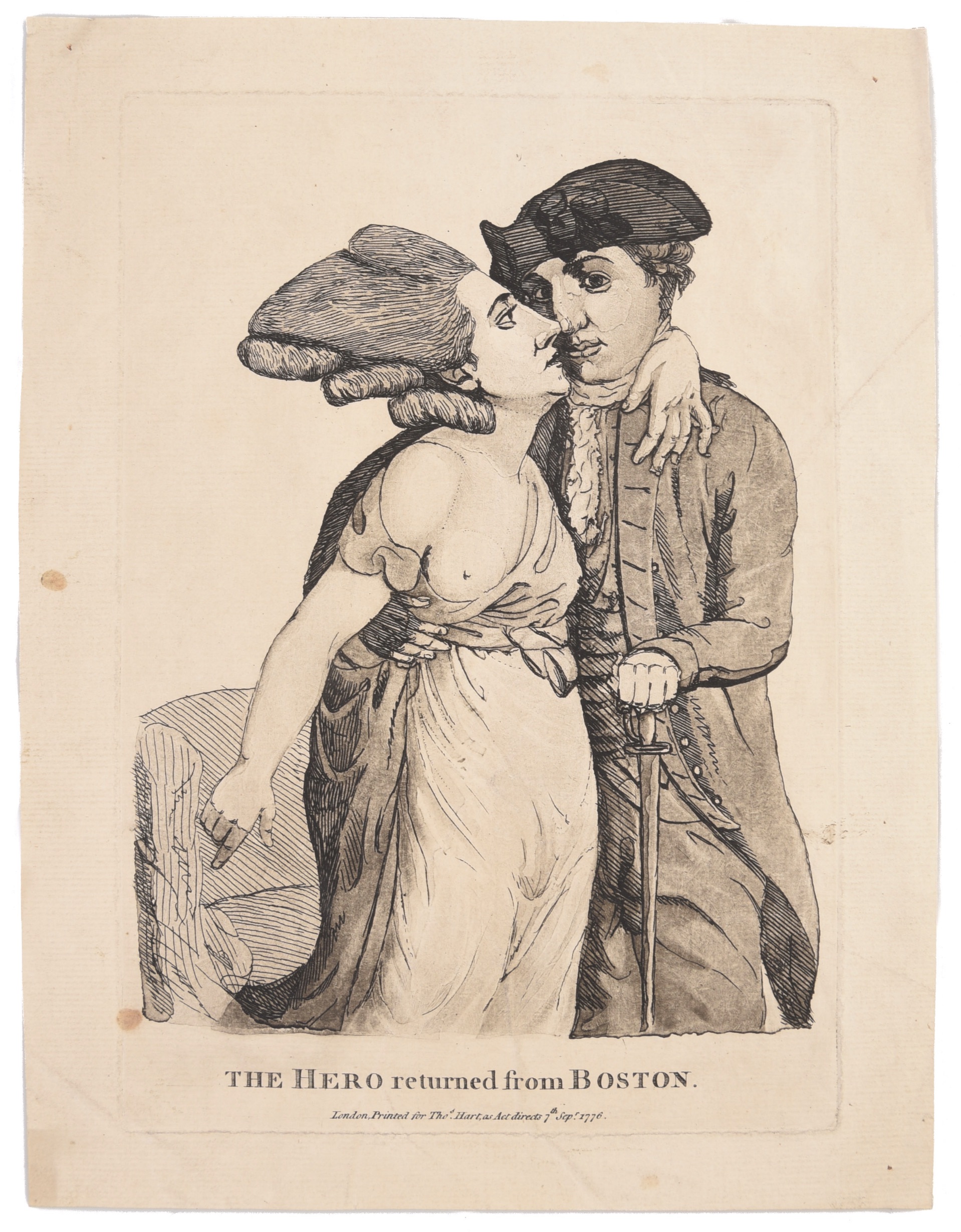
The main thrust of the American Revolution Institute blog posting I pointed to yesterday concerns the subject of the engraving titled “The Hero returned from Boston.”

This print says it was published in London on 7 Sept 1776 by Thomas Hart. Hart didn’t exist, the image bears signs of having been produced in Augsburg, and there’s probably no way to confirm the date.

Regardless, someone went to the trouble of engraving this picture of a woman, her gown flowing and one breast bared, kissing a gentleman holding a sword. Which meant someone believed there would be public demand for such a print. And it all had something to do with Boston around 1776.

The blog post posits:
The man in the print bears a casual resemblance to General Thomas Gage as portrayed by John Singleton Copley in 1768. Gage had commissioned the portrait and when it was complete, sent it home to England. “The Generals Picture was received at home with universal applause,” one of Gage’s aides [John Small] reported to Copley in 1770, “and Looked on by real good Judges as a Masterly performance. It is placed in one of the Capital Apartments of Lord Gage’s house in Arlington Street.”
Gage then commissioned a portrait of his wife, Margaret. Copley painted her in an unusual pose and garments, probably evoking her family roots in eastern Europe. The blog post elaborates:
Part of the attraction of turquerie was that it was sexually suggestive without being lewd. In Copley’s portrait Mrs. Gage is not wearing a corset and reclines in her loose fitting clothes. Copley called it “beyond Compare the best Lady’s portrait I ever Drew.” Proud of the portrait, the Gages packed it off to London, where it created a mild sensation when it was displayed.
In January 1773, Benjamin West told Copley: “the portrait of Mrs Gage as a picture has received every praise from the lovers of arts. her Friends did not think the likeness so favourable as they could wish, but Honour’d it as a pice of art.”

Thus, people in London had seen and discussed the Gages’ portraits. They had seen the Gages themselves in 1774, when the general assured King George III that he could bring Massachusetts back under control. They had followed the news from Boston as the conflict got worse. They had seen Gov. Gage return defeated after the outbreak of war and the costly Battle of Bunker Hill, his wife preceding him by a few weeks.

I find that interpretation of “The Hero returned from Boston” as a lampoon of the Gages convincing. In addition to the points in the blog post, the man in the print grips his sword the same way Copley’s general grips his cane. The engraver didn’t show Gage in uniform, but that might have been a satirical step too far, and Gage no longer had a military command, anyway.

The last section of the blog post discusses the supposition that Margaret Gage sympathized with the rebels and even disclosed her husband’s plans to them. Ultimately the author discards that idea (citing some of my own writing on the subject). Along the way the essay acknowledges counterarguments, however, and this passage caught my eye:
A local guest at one of the Gage’s parties attended by British officers wrote in June 1775 that “Madam Gage presided with the social adroitness and tact of a lady of a high New Jersey family . . . Yet suspicion attended this lady as not being too loyal to her husband’s party and to the King. It was hinted that the Governor was uxorious, and had no secrets from his wife, who passed word to the spies swarming outside.”
I didn’t recognize that quotation. Had I missed a source so close to Gage? I had to track this “local guest” down. And here’s what I found.

That’s not a contemporaneous statement from someone who socialized with the Gages. Rather, the historian Henry Bentley Belcher wrote those words in The First American Civil War, published in 1911, summarizing how he perceived rumors and leaks swirling around the Gage household.

What’s the source of that misinterpretation? In 2016 Deborah Gage wrote on the website for Firle Castle, the Gage family seat:
It has long been rumoured that Margaret provided Dr. [Joseph] Warren with the information that the British troops would be moving out the evening of April 19th, 1774 bound for Lexington and Concord, for example as cited in this letter written by Dr. Belcher in June 1775 ‘Entertainment at Providence House, where Madam Gage presided with the social adroitness and tact of a lady of a high New Jersey family, were crowded with uniformed men from both fleet and camp. Yet suspicion attended this lady as not being too loyal to her husband’s party and to the King. It was hinted that the Governor was uxorious, and had no secrets from his wife, who passed word to the spies swarming outside. At any rate whatever was designed in Boston was, it is alleged, known within an hour or two at Medford, at Roxbury, at Cambridge, at Brookline and in every Boston tavern.’
That quotation introduced some big errors. The governor’s mansion, Province House, became “Providence House.” Dr. Henry Bentley became “Dr. Belcher.” And, most important, a statement by a historian in 1911 was put into the pen of someone in 1775.

Tuesday, November 23, 2021

Meeting the Clerks of the Market

Last week at dinner, the conversation turned to the question of what colonial Boston’s clerks of the market did. This is the kind of the dinner I like.

The post of clerk of the market was established in English law well before the kingdom colonized America, and it came to the colonies in different ways. In Philadelphia, the city charter of 1701 gave the mayor the power to appoint those officials. In contrast, the Boston town meeting elected clerks of the market, starting with two men in 1649. By the mid-1700s, there were twelve, one for each ward.

Clerks of the market were among the town’s lowest-ranking elected offices. But the post was a stepping-stone for young gentlemen seeking higher positions in politics or society. Many prominent men once served as clerks of the market for a year.

In March 1769, for example, the new clerks of the market included John Singleton Copley, Elisha Hutchinson, John Bernard, and John Gore, Jr. In 1770 the nod went to John Pulling, John Andrews, Nathaniel Wheatley, and Henry Jackson, among others.

The main stated duty of the clerks of the market was to ensure that the loaves of bread and the butter sold at the town market conformed to the selectmen’s stipulations. Each year, those officials announced what would be a fair weight for a loaf of bread of a standard price and quality. The price stayed the same, but the weight varied depending on the cost of grain, with a fair profit for the bakers mixed in.

For instance, in February 1773 the selectmen
Ordered that the Assize of Bread be set at Wheat at 7/ [seven shillings] p. bushel, and that 6d. [sixpence, or about 7%] p. bushel be allowed to the Bakers for their Charges Pains and Livelihood, which is computed as follows Vizt.
  • A Loaf of Brown Bread 3/4 Wheat 1/4 Rye meal must weigh 2 [lbs.] 8 [oz.]
  • a 4d. Ditto not above 1/2 Indian Meal must weigh 3 [lbs.] 8 [oz.]
  • Bisket of a Copper price 4 [oz.] 2 [drachms]
This was a long-established form of price-fixing, designed to avoid food riots like those in the 1710s. The selectmen tried to balance the needs of the populace against those of the bakers, as we can see in this extract from the town records in 1789:
On the application of Majr. [Edward] Tuckerman & Mr. [William] Breed two of the Town Bakers — It was agreed by the Selectmen that there should be 4 ounces instead of 2 ounces difference in the weight between 4d. white Loaf Bread & 4d. Superfine Brick Bread — and the Clerks of the Market were accordingly acquainted with this alteration, for their government in the weighing the same —
As that entry shows, the clerks of the market were supposed to enforce the bread rules. The law empowered them to seize loaves that were underweight, and even to go into any bakery or house where they knew bread was being baked for sale and check on how heavy the loaves were.

But did the elected clerks of the market really do that work? Usually a few of the men selected on the first round excused themselves by pleading inability and/or paying a fine, necessitating a second round. That suggests that many of those gentlemen weren’t actually that keen on the honor of serving their town that way.

Boston already had a full-time clerk of Faneuil Hall Market administering the rent on stalls, maintaining the infrastructure, and overseeing the maintenance staff of one. So were the gentlemen chosen to be clerks of the market actually out inspecting the bakers’ stalls every week? 

TOMORROW: Reading a clerk of the market’s diary.

[The image above comes from Food and Streets’ posting about making and tasting bread from an eighteenth-century recipe.]

Thursday, September 23, 2021

A Portrait by Pelham

We know that Henry Pelham followed his older half-brother John Singleton Copley into an artistic career.

However, aside from Pelham’s engraving of the Boston Massacre and his magnificent engraved map of Boston under siege, it’s hard to find artwork that he created.

Most of the portraits identified with Pelham are miniatures, and a lot of them are derived from his brother’s larger paintings.

For example, the Boston Museum of Fine Arts owns one small portrait attributed to Pelham showing the lawyer Peter Chardon (1737-1766). Experts believe Pelham created it based on Copley’s portrait of the man.

Likewise, Pelham probably miniaturized Copley’s portrait of the Connecticut merchant Adam Babcock, and the result is also now at the M.F.A. (picture shown here).

In New York, the Metropolitan Museum has a miniature of the Newburyport merchant Stephen Hooper that matches a line in Pelham’s correspondence. Another carries the signature “H P 1779,” which isn’t a positive identification but narrows the field.

The Dr. Joseph Warren Foundation just shared a quotation showing that the full-sized portrait of Elizabeth (Hooton) Warren shown above was made by Pelham. The M.F.A. has attributed this painting to the “Circle of John Singleton Copley,” which could mean almost any portrait artist from the period except Copley himself. Pelham and Copley really were a small artistic circle in Boston, however.

Descendants of Elizabeth Warren and her husband, Dr. Joseph Warren, owned portraits of them both. In seeking to sell the paintings in the 1850s, they described the doctor’s picture (the famous one now at the M.F.A.) as by Copley and “that of Madame Warren by Pelham.” Since at that time hardly anyone knew who Pelham was, there would be no reason to make a false attribution.

Portrait artists often priced their work in pairs, especially for married couples. Copley created handsome matched portraits of Elizabeth and Ezekiel Goldthwait, for instance. The Warren pairing suggests Copley and Pelham teamed up to create such a pair, perhaps at a discount from a complete set of Copleys. 

Tuesday, June 08, 2021

A Portrait of a Gentleman at Matawan

Earlier this year the Asbury Park Press published an article about a man who owned the Matawan, New Jersey, house of the poet and journalist Philip Freneau and started looking for a reported portrait of Freneau as a young man by John Singleton Copley.

The Frick Art Reference Library listed such a painting in the collection of the Plimpton family. It was put up for auction in 2018 as “Portrait of a Gentleman” and “attributed to Circle of Copley,” but failed to sell at the estimated price of $5-7,000.

The homeowner contacted the Plimptons and convinced them to donate the portrait to the Matawan Historical Society. On retrieving the canvas, he discovered that “The nameplate on the frame identified the subject as Philip Freneau, and the artist as John Singleton Copley.”

The local newspaper presents this as evidence of an exciting rediscovery of an authentic portrait. It’s merely evidence that at some point that painting was labeled and sold as Copley’s portrait of Freneau.

But we knew that already. The American Art Annual for 1923 reported that painting had sold the previous year for $260. Undoubtedly its price was higher for having the names of a famous artist and a famous subject attached—but by whom? There’s no evidence Copley made such a portrait and no mention of this canvas before that date.

In the 1920s, as I discussed back here, the Copley Gallery in Boston sold a lot of eighteenth-century portraits as products of colonial America. Those canvases probably showed little-known British gentlemen as painted by little-known British portraitists. But their value increased if rich Americans believed they came from the few artists working in North America before the Revolution and showed people whose names appeared in our history books.

In 1941 Lewis Leary published the biography That Rascal Freneau: A Study in Literary Failure. In a footnote he wrote:
Another “Freneau portrait,” listed in the Frick Art Reference Library, 1121 14Q, as by Copley, represents a young man dressed in the attire of a dandy of about 1770. It is not mentioned by Barbara Neville Parker and Ann Bolling Wheeler, John Singleton Copley, American Portraits in Oil, Pastel and Miniatures with Biographical Sketches, Boston, 1938. The portrait is at present part of the George A. Plimpton Collection, Columbia University Library. “I cannot find,” says Mrs. Plimpton in a letter (June 24, 1938) to the writer, “that we have anything but the dealer’s word for the authenticity of the Freneau portrait.” I have been convinced that it is neither by Copley nor of Freneau. 
The Frick Art Reference Library continues to list that painting as “not by Copley.” As for the “Circle of Copley,” in 1770 that circle consisted entirely of Henry Pelham, who didn’t travel with his stepbrother to the New York area when he supposedly painted this canvas.

Wednesday, May 19, 2021

Miles Sherbrook in the Flesh

Lately I’ve been noodling on John Singleton Copley’s portrait of the New York merchant Miles Sherbrook (1738-1815), now at the Chrysler Museum. As you can see above, Copley painted Sherbrook without a wig.

Copley made several other pictures of men not wearing wigs or powdered hair. The most famous are his portraits of the Boylston brothers. Other examples show Ebenezer Storer, Nathaniel Hurd, Thomas Hubbard, and Joseph Sherburne.

In all those pictures, however, the gentlemen wore nightcaps and banyans in a studious form of casual dress. Viewers could glimpse their shaved scalps, showing how the men kept themselves prepared for formal dress, but for their portraits they made a show of not being dressed for the world, of staying at home to do the work of wealthy scholars. (The Rev. Thomas Cary also posed in a banyan with no wig, but his head wasn’t shaved.)

In contrast, Sherbrook is dressed for a day at the counting-house. He holds a piece of correspondence dated 1771, not a scholarly book, architectural drawing, or artwork.

The pose and costuming are a lot like Copley’s 1764 painting of Benjamin Hallowell, but that Customs official wore carefully curled, “lightly powdered” hair, probably not his own. 

Another comparison is Copley’s portrait of John Bours, who also wore a gentleman’s suit and his own hair. But Bours’s pose, apparently lost in thought about the book he’s reading, seems more scholarly than mercantile.

Sherbrook displays his own receding, thinning, graying hair. Other details of the portrait eschew luxury as well: no gold buttons or trim, no watch or buckles. The jacket has “coattails that Copley made progressively slimmer in the course of painting—as pentimenti evidence,” according to John Singleton Copley in America. Another sign of lack of vanity: Copley included the pockmarks left on Sherbrook’s face by smallpox.

Why did Copley create such an unusual picture? I considered the possibility that Sherbrook’s aesthetic represented a different culture from his neighbors’. But he wasn’t Quaker like Thomas Mifflin, another gentleman Copley painted without a wig. Sherbrook had come to America from Britain as a young man and remained the agent of his London firm, so was he displaying a more progressive fashion from the imperial capital? By 1771, though, he had been in New York for fifteen years, enough time for to marry a local woman and assimilate to local manners.

We know that Sherbrook signed up for a portrait by Copley through Stephen Kemble even before the painter came to New York in 1771. Furthermore, in his house Sherbrook had what Copley called his portrait of “Capt. Richards”—most likely Sherbrook’s wife Elizabeth’s late uncle and guardian, Paul Richard, who was referred to with the rank of captain in a 1746 legislative act. Copley also painted Richard’s widow on his 1771 visit.

According to Copley, that Richard portrait was “so much admired that vast numbers went to see it.” Sherbrook even let the painter display it at his own rooms to attract more customers. That picture is lost, so we have no clue about how Richard was clothed or wigged, but we can be sure that Sherbrook knew and valued Copley’s work and that Copley was grateful to him.

Thus, Copley’s painting of Miles Sherbrook shows the man as he wanted to be preserved, pocks and all.

Monday, March 29, 2021

Reverse Course on the Copley Cartoon?

Yesterday I mused about the possibility that a British political cartoon inspired some elements of the Loyall Nine’s anti-Stamp Act protests in late 1765—in particular, hanging the stamp agents in effigy and dedicating a tree to liberty.

That idea was based on the common belief that the cartoon was created in London in the spring of 1765 and shipped to America in time for Boston’s 14 August protest. And that later that cartoon inspired John Singleton Copley to publish his own version on 1 November.

I have to note another possibility, however. What if the sequence was different, with the Loyall Nine’s protests inspiring Copley’s cartoon, which in turn inspired a version for the London market?

The British cartoon has been assigned the date of 22 Mar 1765 for over a century. But that’s actually the date when Parliament passed the Stamp Act. The print must have followed the law, but how much later? Since an Atlantic crossing usually took six weeks, it could have come out as late as June and still had plenty of time to reach Boston before the first protest in August.

However, the British Museum’s webpage about this picture says, “The print was announced in the Gazetteer and New Daily Advertiser, 2 January 1766.” Would an engraving several months old have warranted such an announcement? (It would be nice to see the actual language of this announcement.)

The picture also appeared in the fifth volume of The British Antidote, a series of collections of anti-Bute cartoons. According to the 1883 catalogue of the British Museum’s prints, the 28 Nov 1766 Public Advertiser stated that fifth volume of The British Antidote “contains all the Political Prints that have been published since Nov. 1. 1765, down to the present Time.”

Thus, we don’t have a definite mention of the British “Deplorable State of America” print until two months after Copley’s print was published in Boston. And the description of the British Antidote implied that picture appeared in or after November, not months earlier.

Just as a copy of the print could have traveled from Britain to America in six spring or summer weeks, one could have traveled from America to Britain in six fall weeks. That would leave a couple more weeks for the practiced artists of the imperial capital to come out with their own version of “The Deplorable State of America” by 2 January.

I don’t know enough about the nuances of British political printmaking to assess the probability of the latter scenario. How long did it take to bring a print to market? How often did London artists adapt (not copy) work from the provinces? Did print sellers advertise pictures months after they first appeared?

But I have to acknowledge the possibility that the British version of “The Deplorable State of America” didn’t inspire the form of protests in North America but rather depicted those protests for British viewers. In that case, the slim tree labeled “To Liberty” couldn’t have been the seed for Boston’s Liberty Tree but rather a London artist’s attempt to interpret Copley’s picture of that tree for the local audience.

One of the major differences between the London and Boston prints involves the depiction of kings. The British picture shows the French king bribing a corrupt boot and the British king losing his crown and scepter. Copley presented France as an allegorical woman and used the even more symbolic figure Loyalty instead of his monarch.

In sum, the British print was far more direct and radical than the American one. Did Copley tone down the original, or did the London artist amplify Copley’s allegory with real rulers? Given the cultural dominance of London, the first scenario seems more likely, but it raises questions—and the limited evidence raises more.