


J. L. BELL is a Massachusetts writer who specializes in (among other things) the start of the American Revolution in and around Boston. He is particularly interested in the experiences of children in 1765-75. He has published scholarly papers and popular articles for both children and adults. He was consultant for an episode of History Detectives, and contributed to a display at Minute Man National Historic Park.

Subscribe thru Follow.it


•••••••••••••••••


Showing posts with label Lydia Dexter. Show all posts

Saturday, September 19, 2020

Dr. Dexter’s Boys

When Lydia (Woods Dexter) Curtis died at the end of 1772, her three surviving sons were all in their late teens, of age to be apprentices. They may therefore have left the household of their stepfather, Dr. Samuel Curtis.

Lydia was from a large and established family in Marlborough. The boys’ paternal relatives in Dedham were also rich enough to take them in if that seemed like the best course. (In 1771 their grandmother there offered to pay “the Charge of Rideing” for one boy so that he could recover from an illness through “moderate exercise.”)

Two of those Dexter boys went into medical professions, and it’s possible that Dr. Curtis helped to train them. But it’s also possible those sons were inspired entirely by their father, Dr. Ebenezer Dexter, and wanted little to do with Curtis. Here’s what we know about the next generation of Dexters.

William (1755-1785) went out to Shrewsbury, perhaps to train under Dr. Edward Flynt, who had treated his father in his last illness. In February 1775, at the age of nineteen, William married a local woman named Betsy Bowker, age twenty-one. Their first child, named Ebenezer after William’s father, arrived eight and a half months later.

By then, Edward Flynt and William Dexter had enlisted as surgeon and surgeon’s mate for Gen. Artemas Ward’s regiment of the Massachusetts army. The young man’s handwritten commission signed by James Warren for the Massachusetts Provincial Congress appears above. Dexter served in the Continental Army through the siege of Boston and accompanied the regiment down to New York under Col. Jonathan Ward.

Betsy Dexter, according to her 1843 application for a pension, was living at her father’s house in Shrewsbury all this time. William “returned after warm weather in 1776,” she recalled. He had reached the age of majority that April, and I wonder if he inherited his father’s estate in Marlborough. (It’s worth recalling that Dr. Curtis decided to leave town and go to sea the next spring.)

According to his wife, William brought his little family home to Marlborough in December 1776 and set up his own practice as a physician. William and Betsy had children in 1777, 1778, and 1779, all of them living to adulthood. But like his father, William Dexter died young, at age thirty. His widow Betsy remarried ten years later to a man named Edward Low and settled in Leominster, living until 1846.

Samuel Dexter (1756-1825) became an apothecary, married Elizabeth Province in Northampton in 1790, and settled in Albany, New York. She was a daughter of John and Sarah Province of Boston, and thus a sister of the David Province whom George Gailer sued for helping to tar and feather him in 1769, when she was six. How she got to Northampton is a mystery. Samuel and Elizabeth had five children, three living to adulthood. Samuel was the longest-lived of the brothers, and Elizabeth died in 1846.

John Dexter (1758-1807) worked as a quartermaster sergeant for the Continental Army for several years under Col. Timothy Bigelow of Worcester. On 3 Mar 1783 he married a woman from Marlborough named Mary Woods, likely a cousin on his mother’s side, with a justice of the peace from Stow rather than a local minister presiding. John and Mary Dexter’s first daughter arrived in late December, and three more children followed by 1794.

John was a tanner. He gained the militia rank of ensign under Gov. John Hancock. In the 1790s the Dexters moved to Berlin. Then John “went into Trade,” and in 1802 he moved the family into Boston. John died five years later, Mary in 1823. The children all lived well into the latter half of the nineteenth century, but none had children.

John Dexter’s third child was John Haven Dexter (1791-1867), who apprenticed at Benjamin Russell’s Columbian Centinel but then went to work in the mercantile firm of Amos and Abbott Lawrence. J. H. Dexter wrote two books (Mercantile Honor, and Moral Honesty and A Plea for the Horse) and also left several manuscripts of genealogical information and gossip about his family and fellow Bostonians, some helpfully transcribed and published in 1997.

Friday, September 18, 2020

The Short Marriage of Dr. Samuel and Lydia Curtis

In March 1769, as I recounted yesterday, Dr. Ebenezer Dexter of Marlborough died. He left a wife, Lydia, and four young sons.

By July a young physician named Samuel Curtis was boarding in the Dexter house, treating the late doctor’s patients.

On 30 June 1771, the widow Lydia Dexter married Dr. Samuel Curtis. The bride was almost eleven years older than the groom.

The new couple’s neighbors wouldn’t have needed medical training to understand their reason for marrying. Their first child, Anna, arrived on 5 October, or three months and one week later.

Those necessary nuptials didn’t stop Dr. Curtis from gaining his neighbors’ respect, however. In 1772 the Marlborough town meeting put him on its committee of correspondence.

Unfortunately, the Curtis marriage didn’t last long. Not because of incompatibility but because of illnesses.

In August 1772 the Dexters’ youngest son, Jason Haven Dexter, died at the age of ten.

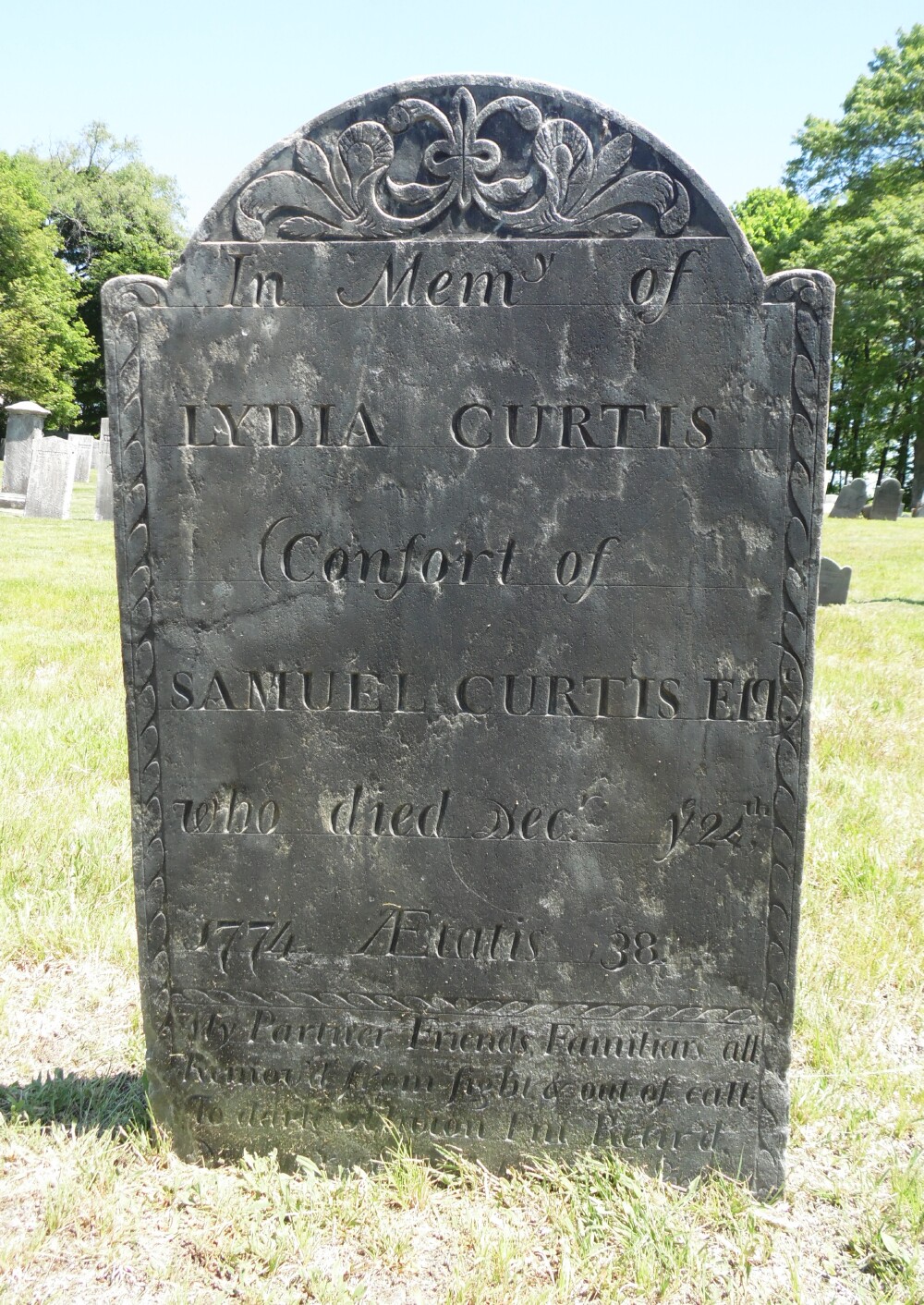
In March 1774, Lydia Curtis gave birth to her second child by Samuel, a daughter named Christian. (Was she named after Loyalist neighbor Christian Barnes?) But within one week in December, the Curtises’ first daughter, Anna; their new baby, Christian; and Lydia all died.

Dr. Samuel Curtis was now the widowed stepfather of three teen-aged boys from Lydia’s first marriage. I don’t know how much the doctor was involved in raising them after that, though. He was putting a lot of his energy into Patriot politics, serving on the town’s committee of correspondence and as a representative to the Middlesex County convention in August 1774.

On 1 Mar 1775, when Henry Barnes tried to shelter two British officers on a clandestine scouting mission, Curtis politely pushed himself into the house and quizzed Barnes’s young niece about those family guests. That September, the Massachusetts government appointed the doctor as a justice of the peace.

In March 1777, Dr. Curtis’s Patriotism took a new turn. He enlisted as a surgeon on the Continental Navy ship Hancock under Capt. John Manley. Joseph Ross has provided a long discussion of Dr. Curtis’s adventures in the navy. It doesn’t agree in all details with the profile of Curtis in Sibley’s Harvard Biographies, so I need more time to sort those out.

But I definitely plan to come back to Dr. Samuel Curtis. He seems to have found drama wherever he went, often by making it himself.

TOMORROW: The Dexter boys.

Thursday, September 17, 2020

Young Doctors in Marlborough

Yesterday I introduced the figure of Dr. Ebenezer Dexter, Marlborough’s leading doctor in the 1760s.

On 3 May 1769, however, the Rev. Ebenezer Parkman of nearby Westborough wrote in his diary: “Dr. [Edward] Flynt came from Dr. Dexter, and says the latter will hardly live through the Night.”

Indeed, Dr. Dexter died the next day. On 6 May Parkman reported: “Dr. Dexter was buryed at Marlborough.”

The doctor’s gravestone, shown here courtesy of Find a Grave, says, “He was an Eminent Physician but was Subject unto Death even as other men.”

The doctor’s death left an opening in his town. Two young physicians soon moved into Marlborough, hoping to establish their own practices.

One was Amos Cotting, born in Waltham in 1749 (under the name Cutting, which would have been apt for a surgeon). He graduated from Harvard College in 1767 and then earned his M.A., presumably while studying medicine. Charles Hudson’s history of Marlborough said Cotting came to that town “On the death of Dr. Ebenezer Dexter, 1769,” but he wasn’t on the list of men paying the poll tax in 1770, so he may have arrived later.

The other young doctor was Samuel Curtis, eldest son of the Rev. Philip Curtis of Stoughton. He graduated from Harvard a year before Cotting and also gained an M.A. Curtis was apparently starting to practice medicine in Roxbury when he learned about the sudden opportunity in Marlborough. Hudson quoted from the town’s warning-out records to reveal what happened next:
Dr. Samuel Curtis came to town, June, 1769; came last from Roxbury. Taken in by widow Dexter.
The following month, the Rev. Mr. Parkman rode to Marlborough to see a sick relative, and he also recorded: “Visit Mrs. Dexter and Dr. Curtis who lodges there.”

Curtis had advantages over Cotting in any competition to become the town’s favorite physician. He was slightly older, and as son of a minister instead of a farmer he was probably more genteel. But the big edge appears to have been that he was now living in Dr. Dexter’s house, thus endorsed by Dr. Dexter’s wife, all ready to see Dr. Dexter’s patients.

The widow Dexter was still only in her early thirties, with four young sons to care for and an estate to maintain. Then, in early 1771, Lydia Dexter became pregnant.

TOMORROW: Can this marriage be saved?

Wednesday, September 16, 2020

Dr. Ebenezer Dexter Practicing Medicine in Marlborough

Ebenezer Dexter was born in 1729, son of the Rev. Samuel Dexter of Dedham.

Ebenezer chose to go into medicine, and after marrying Lydia Woods, daughter of a selectman in Marlborough, he set up his practice in that town. In 1754, the year of their marriage, Ebenezer was twenty-five and Lydia was eighteen.

We can glimpse Dr. Dexter at work in the diary of the Rev. Ebenezer Parkman in nearby Westborough. That minister is shown here, and his diary is fully transcribed and annotated at this website.

Westborough’s northern precinct, which would eventually split off as Northborough [stay with me here], had its own meeting and minister, the Rev. John Martyn. On 13 Aug 1756, Parkman wrote about his colleague’s fifteen-year-old son Nathaniel being ill:
Sarah and Suse undertake to go to Mr. Martyn’s: they return at Eve Well. They tell me Natty Martyn, tis feared, grows bad.
Twelve days later, the father traveled to see Dr. Dexter:
Mr. Martyn has carryed down his Son Natty, to Marlborough to Dr. Dexter’s, who gives great Encouragement concerning the Sore, that he Shall effect the Cure of it.
And indeed, almost a year later Parkman mentioned the son again, apparently healthy: “Natty Martyn brought a Letter from Leominster.” Nathaniel Martyn survived and eventually became a doctor himself.

(The trouble in Leominster was that the Rev. John Rogers had turned into an Arminian, or what a later generation would call a Unitarian. This required a council of other ministers and eventually an approval to allow the Leominster congregation to split. But I digress.)

Dr. Ebenezer and Lydia Dexter had four sons between 1755 and 1762: William, Samuel, John, and Jason Haven, the last named after the minister who had succeeded the doctor’s father in Dedham. Dexter also served Marlborough as the town clerk starting in 1768.

But in May 1769, Dr. Dexter, still only thirty-nine years old, fell seriously ill.

TOMORROW: Opening for a young doctor.