J. L. BELL is a Massachusetts writer who specializes in (among other things) the start of the American Revolution in and around Boston. He is particularly interested in the experiences of children in 1765-75. He has published scholarly papers and popular articles for both children and adults. He was consultant for an episode of History Detectives, and contributed to a display at Minute Man National Historic Park.

Subscribe thru Follow.it


•••••••••••••••••


Showing posts with label law. Show all posts

Saturday, July 25, 2026

“When at liberty very sociable and familiar”

Yesterday’s posting left Richard Steele in New Haven, Connecticut, in December 1770, being branded and cropped on his ear the second time in a few months.

(I presume his right ear was cropped first, then his left, but the newspaper accounts don’t specify that.)

You might think that punishment would have taught Steele the error of his ways, or at least made it harder for him to keep committing crimes.

But no, Steele managed to get in one more theft before the end of the year, according to the Connecticut Journal of 4 Jan 1771:
----Stop the Felons!----

A Goldsmith’s Shop, belonging to the Subscriber in Waterbury, was broken up, on the Night of the 27th Instant, and sundry Pair of Stone Ear Rings, one Pair Stone Buttons, one Pair Gold ditto, and one Gold Ring, with some Shillings in Coppers, and some other Money, and likely some other Articles of Goldsmith’s Ware, was taken away, supposed by one Richard Steele, (and his Partner unknown) who was lately punished for breaking open Mr. Marks’s House in Derby.

Said Steele is of middling Stature, about 21 Years of Age, has dark brown Hair, not much curl’d, black Eyes, and beautiful Complection, but much Pockbroken, both Ears crop’d, branded twice in the Forehead, wears a brownish Coat, check’d woollen Shirt, old leather Breeches, and Hat slop’d.

Whoever will take up said Steele, or his Accomplice, and secure him or them, and notify me, shall have Three Dollars Reward, and necessary Charges paid, by
JOSEPH HOPKINS.
Dec. 31, 1770.
The 8 January Connecticut Courant, published in Steele’s usual haunt of Hartford, summarized the news about him for local readers.

Then on 5 February the Connecticut Courant had good news:
The Thief is Caught!

And was last thursday bro’t to this town and again committed to goal. He is perhaps the most notorious one that ever infested this colony, was last September before the hon. Superior Court, held in this place, convicted of Burglary by the name of Richard Steele, and in consequence thereof crop’d and branded, not long after which he broke goal, and escaped but pursuing his trade, was again taken for Burglary committed in Derby, and indicted at New-Haven before the adjourn’d Superior Court in December last, for the second offence, and again crop’d and branded, and very soon after escaped from that goal, and has since (perhaps) committed more Burglary’s than ever the notorious [Isaac] Frasier who was hanged at Fairfield ever did in so short a time.

He is now put in irons in very close confinement but least he should again escape, would that the world might know him, observe that he is a young man of about 20 years old, rather of a slender make, and about or little more than middling for stature, his facce [sic] finely pitted with the small pox, has a keen black eye, wears his own hair, of a very dark colour, pretty well down on his forehead in order no doubt to hide his scars, is a very lively active man and I believe when at liberty very sociable and familiar.

He had on him now when taken a light coloured surtout, of a cloth call’d bearskin or coating, most probably stolen from Mr. Ingersol of Westfield; a strait bodyed coat, stolen from Dr. Hooker of this town, trim’d with silver buttons, one each of which was wrote at large Sept. 2d, Daniel Hooker 1764; also 2 summer jackets stolen out of Mr. Mattock’s shop a barber in this place from whom also it is supposed, he took at the same time 2 wiggs, not yet found; had also with him, two silver watches; one of which stolen from Mr. Jonah Gillot of Wintonbury, the other with a China face, seems to answer the description of one advertized to be stolen from somebody in Stratford; also 5 pair silver shoe buckles; 2 gold necklaces; 2 pair stone jewels set in gold; 2 small Rings with 3 stones set in each; 3 watch seals set in silver; one pair gold sleeve buttons; one chain ditto, marked within side B W; one worsted purse with a mill’d dollar, marked G R and sundry other pieces of silver money; 4 very good black Barcelona handkerchiefs, with a paper pin’d on one of them marked 9s; a hatt crape; one brass inker with penknife and case, marked D, a scale for a womans finger; a bodkin, and a small gimblet; said to be owned by Jonathan Burney of Union, where he has disposed of a considerable quantity of valuable goods—

The foregoing articles are now lodged with the Sheriff of this County, and may be seen by any claimers this week at the Court House in Hartford, and any time afterwards before the setting of the superior court, in March next at his own house in Weathersfield.

If the Printers should generally insert the foregoing in their papers, it might perhaps be of public service.
This was, by my count, the fourth time Sheriff Ezekiel Williams had Steele in his custody.

And it looks like this time Steele stayed in jail for nearly two months.

TOMORROW: A busy April.

Friday, July 24, 2026

“Punished at Hartford, for Burglary, by the Name of Richard Steele”

On 17 Sept 1770, the Connecticut Courant of Hartford reported on recent cases from “the Superior Court of Assize and General Goal Delivery.”

After trials on bestiality (acquitted) and rape (acquitted), the newspaper told readers:
Also, Richard Steele and John Galloway, both transient Persons, were convicted of Burglary, and sentenced to be whip’d 15 Stripes each, and to be crop’d and branded with the Letter B on their Forehead, which Punishments they accordingly received on Friday last.
That corporal punishment took place on 14 September. Then the felons were set free.

Several weeks later, the Connecticut Courant for 6 November advertised Steele, Galloway, and Charles Livingston as wanted men. They had evidently been arrested again and escaped because the paper said:
The two first are shrewdly suspected to be the same that on the next evening, broke open a shoe makers shop, in said Hartford, and stole a greatcoat suit of cloaths, and two pair of shoes, and also last night Mr. [Peter] Verstille’s shop at Weathersfield, carried off considerable money, and sundry goods, were poorly clad when they went away, but probably by this time are well cloathed.

Whoever shall take up either of the two first mentioned persons, and convey the said Galloway to New-Haven Goal or to this, and the said Steel to this, shall have 20s. lawful money reward for each, and, for the said Livingston, a reward of 10s.

per Ezekiel Williams, Sheriff.

N.B. The Thief stole from Mr. Verstille two dollars, the one a Cobb, the other a Mill’d Dollar, which were both counterfeit, & about a Doz. black Barcelona handkerchiefs, several pieces of ribbon, &c.
That advertisement included a physical description of Steele, but unfortunately the page is ripped in the newspaper database I use, so I can’t offer a word picture of him yet.

On 4 December, the Connecticut Courant offered some good news, datelined New Haven on 30 November:
Last Tuesday was committed to the Goal in this Town, a Person Charged with breaking open and robbing the Shop of Mr. Marks of Derby: he says his Name is Richard James, but by the Mark on his Forehead, and some other Circumstances, it appears he is the Person who was lately punished at Hartford, for Burglary, by the Name of Richard Steele.
The authorities in New Haven sent the man back to Sheriff Williams in Hartford County. (The sheriff’s house in Wethersfield appears above, courtesy of Daniel Sterner’s Historic Buildings of Connecticut.)

On 24 December, the Boston Evening-Post ran this item from New London, dated 14 December:
Last Monday, one Richard Steele, was punished at Hartford, for the second offence of Burglary, by being whipt & branded, and having his left Ear cropt. He has since escaped from goal, but was yesterday taken and re-committed.
Thus, in the course of four months Richard Steele had been accused of burglary in Hartford, Wethersfield, and Derby; had been whipped, branded, and cropped on his ears twice; and had escaped jail twice—but was once again back in custody.

TOMORROW: On into 1771!

Thursday, July 23, 2026

Back to the Old New-Gate Prison

In January I broke off a series of postings about the first years of Connecticut’s New-Gate Prison because of the press of other matters.

As awful as we might think of being imprisoned underground in an old, dank copper mine, the colony actually opened that prison as a reform measure. It was an alternative to corporal and capital punishment. And enforced labor might even make that mine profitable.

From December 1773 to April 1774, Connecticut courts sent six convicted criminals to the prison in Simsbury, to be locked down under the eye of keeper John Viets.

By that April, all six had disappeared, either to parts unknown or under the rubble of a collapsed tunnel.

In a comment on my last posting Mike asked:
Did it occur to the people of Connecticut that Mr. Viet may have been a less than adequate overseer?
That’s a good question, and here are some thoughts grappling for an answer.

First, the official “overseers” of the prison were three members of the Connecticut legislature who supervised Viets. They had the responsibility to hire the keeper, but they were also responsible for securing him the resources necessary to do that job.

Second, long-term incarceration was still an experiment. If the Connecticut legislature wanted its prison to work (and the government had already sunk a fair amount of money into converting the old mine), it needed to get the budget and rules right. The legislators might have expected (or accepted) a period of adjustment.

Finally, the overseers had probably hired John Viets because he was convenient. He owned a tavern right next to the mine. That was the infrastructure for feeding the prisoners, housing the guards, and keeping someone on site watching for disturbances and escapes. Hiring a new keeper and setting him up in Simsbury would have been a big expense.

Viets knew that an unfortunate pattern was developing. His 26 April advertisement began “New Gate Prison was again broke open…” But he remained on the job.

TOMORROW: A hardened criminal appears.

Thursday, July 16, 2026

New Signage Installed at the President’s House During the Night

Since September 2025 I’ve been following the dispute over displays at the President’s House, part of Independence National Historical Park in Philadelphia.

Reflecting its overall ideology, the Trump White House ordered the National Park Service to replace signs discussing how that site had been a site of enslavement when George and Martha Washington lived there in the 1790s.

Because the city of Philadelphia had participated in creating the exhibit, it claimed legal standing to sue for the signs to be restored. A district judge agreed. A higher judge stopped the restoration process. Over the last month the full circuit ruled that the federal government could control the site and remake the signage.

Yesterday WHYY reported: “Workers replaced the remaining exhibits overnight Tuesday.”
The new exhibit retains references to slavery and those enslaved by Washington while serving as president in Philadelphia, but it devotes significantly more space to the history of the executive mansion and the early presidency. A panel that had been titled “The Dirty Business of Slavery,” for example, has now been replaced by signage that reads, “Celebrating Independence Throughout the Years.”

It also softens Washington’s views on slavery compared to the previous display.

“In 1774, Washington helped draft the Fairfax Resolves at Mount Vernon,” one panel reads. “These condemned the slave trade as ‘wicked,’ ‘cruel,’ and ‘unnatural’ and called for putting ‘an entire Stop’ to it. Over time, he became increasingly committed to the gradual abolition of slavery.” . . .

on Wednesday, several armed members of the National Park Service Police were seen vigilantly watching over the site.

Park service officials stopped one activist, Dr. Sandra Shachar-Krasnoff of Philadelphia, after she briefly taped a piece of paper with “the excavation revealed a kitchen and a slave quarters below the president’s house site” to one of the walls.

She was fined $310.
The photo above, taken by Abraham Gutman for the Philadelphia Inquirer, shows a federal officer writing a citation for Dr. Shachar-Krasnoff. The Inquirer also reported that the N.P.S. installed security cameras at the outdoor site last week, ostensibly because the All-Star Game was about to be played in the city. So there’s no doubt the government will surveil the walls more tightly.

The park website displays eleven large new panels, but the Inquirer states there are also “more than a dozen smaller panels that detail governmental processes, the lives of various historical figures, and a panel dedicated to the escape of Ona Judge and Hercules [Posey], two people enslaved by Washington who fled to freedom.”

All told, says the Inquirer, “the new exhibits mostly offer a broad timeline of U.S. history that significantly strays from the original intent of the President’s House as outlined in the park’s foundation document in 2017: ‘It would explore the historic context of the site in the context of its ties to slavery and the lives of the enslaved who lived at the site.’”

There’s already an effort to have Philadelphia erect a historic marker about Hercules Posey outside of federal control, like one already up for Ona Judge.

Monday, June 15, 2026

“To rewrite the Nation’s history with a white-out pen”

I’ve reported on how the White House mandated changes to signs interpreting the American Revolution and its legacy at Independence National Historical Park.

This month brought reports that the administration was trying to do the same at the National Parks of Boston.

Groups advocating for the parks, for history, and for science sued to reverse such changes across the system. Last week U.S. District Judge Angel Kelley, based here in Massachusetts, ruled that that lawsuit has a high chance of winning and ordered the National Park Service to restore the interpretive material to how it looked before.

You can download the 63-page ruling. Here are excerpts.
Often referred to as “America’s largest classroom,” National Parks serve in that spirit by telling the stories both of those who write history and those who go unheard. The beauty of history is the unvarnished storytelling of a time gone by and the delivery of undeniable truths. The Government’s stewardship of these park sites thus carries a responsibility to present history in full rather than in favored fragments.

Unfortunately, the Government has disregarded these principles. Under the guise of promoting American dignity, this Administration seeks to share a limited history by ordering the removal of all signs, displays, and interpretive exhibits at National Parks that do not align with its preferred narrative, thereby telling half-truths. . . .

Not only does this undermine the integrity of the National Parks; it sets a dangerous precedent of censorship and sanitization. The National Park Service Organic Act, the National Park Service Centennial Act, and the National Parks Omnibus Management Act, as well as the Administrative Procedure Act do not authorize such arbitrary and capricious action. . . .

National Parks were established to serve the public, yet the Order does not point to any evidence regarding the public’s reaction to signage at National Parks—let alone evidence that the public reacts negatively to representing diverse viewpoints and marginalized voices, or that existing interpretive materials are disfavored. Instead, tens of thousands of public comments submitted through QR codes at park sites have criticized Defendants’ actions, demonstrating that these materials instead promote the public’s ability to form stronger connections with park resources. . . .

A unilateral, unreasoned, and lawless Executive Order of a President cannot be the sole justification for an agency’s actions, lest the country be prepared to entrust its future to the whims of a single individual. . . .

According to Plaintiffs, the Secretary’s Order violates Defendants’ duty [under the Centennial Act of 2016] to implement a program of the “highest quality education and interpretation,” because such a program must include the topics now disfavored by the Order. Defendants contend that the phrase “highest quality education and interpretation” is ambiguous and, therefore, left to agency discretion. The Court agrees with Plaintiffs.

First, the Centennial Act unambiguously requires the NPS to incorporate diverse viewpoints into its interpretation and education program. Section 100802 mandates that the program be “of the highest quality.” Congress then provided clear instructions for what qualifies as “highest quality.” Section 100803 of the Act explains that the Secretary may undertake a program of regular evaluation “to ensure that [interpretation and education programs]…reflect different cultural backgrounds, ages, education, gender, abilities, ethnicity, and needs.” . . .

By its terms, the Order erases the history of countless people; alienates communities from public spaces; limits the availability of scientific information relevant to ensuring the long-term preservation of the parks themselves; and impairs the mission of the NPS to preserve the parks “for the enjoyment, education, and inspiration of this and future generations.” The Executive Order, in fact, tarnishes the legacy of this great Nation by attempting to remove these items in time for, and in honor of, the 250th anniversary of our Nation’s creation. The gravamen of these public interests cannot be overstated. . . .

Plaintiffs have demonstrated a likelihood that Defendants’ efforts, ostensibly taken in the name of restoring dignity, instead seek to rewrite the Nation’s history with a white-out pen. History cannot be faithfully told while excluding the experiences of communities whose contributions, struggles, and achievements form an important part of our Nation’s story. Indeed, at a time of facts and alternative facts, the only thing we must be able to rely on as undeniable truth is history. And telling the full truths of our shared story helps our Nation heal from past wrongs, rather than prolonging us.

Because Defendants deemed it important to strip the parks of these undeniable truths in anticipation of the 250th Anniversary of our great Nation, it is equally important that our shared history be honestly told and fully restored by the 250th Anniversary to properly honor the remarkable achievements of the United States.
I expect the executive branch, increasingly staffed by the President’s criminal-defense lawyers, will appeal this ruling. By invoking the Sestercentennial, however, the White House and Secretary of the Interior empowered Judge Kelley to impose a 4 July deadline for restoring the interpretive signs. 

Sunday, May 24, 2026

“Acquainted with the conduct of Doctor Preserved Clap”

I lose track of Dr. Preserved Clap after 1776 until 5 Feb 1781, when the Continental Congress referred a petition from him to its board of war.

On 20 February, board members Richard Peters of Pennsylvania and Ezekiel Cornell of Rhode Island met and formulated a response to that petition:
The Board having considered the reference with which they were honored on the memorial of Preserved Clap, beg leave to observe, That it appears from his memorial and General [Henry] Knox’s letter that he hath been with the Army as a volunteer for eighteen months without pay or any emolument.

That it farther appears by General [Benjamin] Lincolns and Knox’s letters that Mr Clap was sole inventor of stocking the Cannon that were supposed to be rendered useless by the enemy at Boston, and in the vicinity, in the spring of 1776; from which the Continent at large received a real benefit; for which he received no emolument but barely day wages.

From the foregoing state of facts it may be proper for Congress to resolve,

Resolved, That the supreme executive of the State of Massachusetts examine into the merit and services of Preserved Clap, and order payment on the account of the United States, for such sum as they think he may justly deserve; provided it shall not exceed one thousand dollars in bills of the new emissions:

That Preserved Clap be informed, that Congress cannot employ him in public service, consistent with their arrangements.
The Congress approved that response the next day. Clap’s petition, which might include the letters from Knox and Lincoln, is preserved in the Congress’s files but not published.

There is, however, a second published letter from Henry Knox on the doctor. On 13 March, Gen. John Sullivan wrote to Knox about him, and on 22 March the artillery commander replied:
I received your favor of the 13th instant, requesting a certificate from me, & such of my officers who were best acquainted with the conduct of Doctor Preserved Clap, & how he employed himself in the Army.

The result of my knowledge & information is that the said Preserved has great mechanical abilities, & that he joined himself to the Army in ’79, as a volunteer, ready to do any kind of work in his power, either for officers or soldiers, sometimes with & sometimes without pay.

When the Continental troops were principally withdrawn from West Point last August, the Doctor attached himself to the Post, but he declined to the best of my remembrance to be enrolled as an artificer, & apply himself to public work entirely.

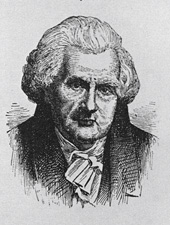
Sometime in November he applied to me for a letter to Mr. Hodgson [Samuel Hodgdon, shown above], D[eputy].C[ommissary].G[eneral].M[ilitary]. Stores, the intent of which he informed was to procure assistance or permission to work with the artificers’ tools at Philadelphia to execute some design of a machine to destroy shipping, which he intended to present to Congress or the Board of War.

But I had not the least idea of his intending to claim pay for the time he had been with the army.
This looks like the second time Dr. Clap threw himself into devising equipment for the army without arranging an official rank or contract, and without discussing pay. Not the wisest way to operate, especially when good money was scarce.

The Congress referred Clap’s case to Massachusetts, where the “supreme executive” was now Gov. John Hancock. The state archives might therefore contain more sources on Dr. Clap. However, I’ve found no evidence of pay for him on either state or national level.

TOMORROW: Last traces.

Friday, May 08, 2026

“The only ‘emancipation’ relevant to this site was Ona Judge’s own”

On 21 April, the Philadelphia Inquirer shared an opinion piece about the President’s House exhibit by Sharon Ann Holt, a public historian recently retired from Penn State Abington.

Holt was previously director of education and interpretation at the Historical Society of Pennsylvania and director at the Sandy Spring Museum in Maryland. She’s the author of Freedom Pay: North Carolina Freedpeople Working for Themselves, 1865–1900.

The web headline for Holt’s essay is “We can’t give in to the Trump administration’s attempts to make the history of slavery invisible in Philadelphia.” I don’t know if it appeared in the newspaper’s print edition, and the webpage now behind a paywall unless one has a guest link. So here’s an extended extract:
The digital images posted on the Park Service’s website make it clear that, under Donald Trump, the first priority of the Park Service seems to be to make enslaved people and slavery itself as invisible as possible. Panels that discussed the lives of urban enslaved people, Philadelphia’s free Black community, the Washingtons’ enslaved “family,” fugitives from enslavement (and the laws Washington signed to reclaim them) have all disappeared. The rich biographies of Christopher Sheels, Hercules, Richmond, Austin, Giles, Ona Judge, Joe Richardson, Moll, and Paris have shrunk to single sentences. . . .

So what stories are they telling? George and Martha’s determination to flout Pennsylvania’s six-month limit on holding people in slavery is reframed as a lovely gift of theatre tickets rather than their cynical move to get enslaved people across the river to New Jersey, thus restarting the six-month residential countdown. I’m surprised the Park Service left out the Washingtons’ “kind” willingness to let enslaved workers visit their families left behind in Virginia, which worked the same trick.

If Park Service bureaucrats value relevance, I challenge them to explain the transformation of the story about 18th-century slavery at the President’s House into a puzzling evocation of the Emancipation Proclamation of the 19th century and the Civil Rights Movement of the 20th century. Is it that, to them, all stories having to do with African Americans belong in the same place? They must think so, because they have randomly added completely irrelevant references to Frederick Douglass, the Civil War, the Rev. Dr. Martin Luther King Jr., the Underground Railroad, and Abraham Lincoln to the history of the President’s House.

Worse, the Park Service has embraced sentimental claims that Washington, Thomas Jefferson, and James Madison all “had their doubts” about slavery from the beginning.

None of those “doubts” persuaded the Founders to end slavery when they could have, either in our founding documents or in their own personal lives. None of the 19th- and 20th-century stories that the Park Service has shoehorned into their new panels ever involved the President’s House at all. The only “emancipation” relevant to this site was Ona Judge’s own self-liberation — the very story the Park Service has all but erased.

Speaking of irrelevance, the opening panels are even more laughable. Park Service interpreters have decided to feature discussions of the 1876 Centennial, the 1926 Sesquicentennial, and the 1976 Bicentennial, all of which happened long after the President’s House had been remodeled into oblivion or entirely demolished. . . .

If the judges choose these new panels to replace the ones taken down earlier this year, they will disparage millions of Americans who have struggled since 1776 to improve on the shaky foundations the founders laid. The President’s House should honor those struggles, alongside the nine people enslaved there by George and Martha Washington.
While Holt directs her critique at the National Park Service, which produced this revised signage, it’s clear that agency was working under directives from the White House. Based on what sort of historical presentations the White House has produced on its own, N.P.S. historians undoubtedly worked hard to drag this material into the realm of historical fact, even if it’s far from complete and relevant.

Thursday, May 07, 2026

A Closeup Look at the President’s House in Philadelphia

I’ve been following the story of the President’s House site within Independence National Historical Park.

That structure marks the residence of George Washington and John Adams before the District of Columbia was built and also memorializes the people enslaved to the Washingtons who lived and worked there.

In September, we first learned that White House policy was putting pressure on the park to change the signage on that site. In January, the signs were taken down.

In February, after the city of Philadelphia filed a lawsuit, a judge ordered the signs be put back up. But then a higher judge halted that process while also requiring those signs already restored to remain. The U.S. Circuit Court has upheld that stasis.

Last month I traveled to Philadelphia for the Pursuit of History’s weekend examining the creation of the Declaration of Independence. One morning I walked through the President’s House.

Most of the frames for signs are empty; the few panels that have been restored appear to be almost random. In some of the blank spaces people had posted small images of the missing signs. While I was there, a local taped a large sheet of paper in another space along with two markers, inviting people to share their own thoughts on the controversy. I presume those unofficial displays are taken down each evening and replaced each day.

In April the National Park Service unveiled new draft signage, created (by people unknown) to please the White House. Those panels now appear on the webpage for the President’s House Site. WHYY reported:
The new panels include references to slavery, the Underground Railroad and figures like Frederick Douglass. Like the previous panels, they also make mention of the nine enslaved people held by Washington while he was president and living in Philadelphia.

However, they would have changed the overall tone of the site, softening and significantly reducing references to slavery, and shifting the focus toward the “anti-slavery sentiments” of the slave-owning Founding Fathers. For example, text on one notes that the U.S. Constitution did not contain the word “slavery,” and another one argues that Washington had “doubts” about the institution.
Local critics called that revision “whitewashing” and “maliciously outrageous.”

TOMORROW: A historian’s take.

Friday, May 01, 2026

”No other Crime, but retaining their Allegiance to the King”

We left John Hill, his wife Elizabeth (?), and his daughter in the Boston jail in February 1777, suspected of “being Enemical to the States” and “attempting to Carry Intillegence to the Enemy.”

The next trace of Hill that I’ve found is from John Noble’s article “Some Massachusetts Tories” for the Colonial Society of Massachusetts in 1900:
At the July [court] Term, 1777, John Hill of Boston recovers judgment in a plea of the case against Crean Brush for £2.8s.10d lawful money, and costs.
Did Hill sue Brush, his employer during the evacuation from Boston, for some loss? Or was this another John Hill?

There’s firmer information from John Howe’s Newport Gazette, published in the British-occupied city on 20 Nov 1777:
By Mr. JOHN HILL, who left Boston the 15th of October, we learn, that Dr. [Benjamin] Church, Mr. John Dean Whitworth, of the Queen’s Rangers, and a Number of others, are yet confined in Boston; Dr. [Mather] Byles is confined in his own House; and upwards of 70 Persons, who can be charged with no other Crime, but retaining their Allegiance to the King, and Attachment to that happy Constitution under which they were born, and from which they have enjoyed the most solid and inestimable Blessings, are now confined on board a Prison Ship in that Harbour.—

He also adds, that almost every Goal in New England is filled with these unhappy People.

Mr. Hill has also favoured us with the current Prices, in Lawful Money, of the following Articles, at the Time he left it:
Beef, — — 0.1.3
Mutton, — — 0.1.6
Butter, — — 0.4.0
And so on through a list of other meats and foods, alcohols, sugars, teas, and cordwood to shoes for men (£2.2/pair) and women (£1.10/pair).

Presumably Howe was making the point about price inflation in Continental-governed areas, but we’d have to find pre-war costs for comparison.

Years later John Hill told the Loyalists Commission, as recorded by Todd Braisted:
That on the 17th of March 1776, he left Boston, with the Royal Army; but was taken at Sea, by the Rebels, . . . himself, his Wife, & Daughter was carried back to Boston, and he confined in Prison 19 months; they were all tried For their lives, but not Condemned.

In November 1777, they were Exchanged, went to Halifax, and afterwards to New York
Hill’s memory was off by just a few weeks. It’s possible he didn’t remember the port his family came through, or that the Hills went from Newport to Halifax. Adding to the confusion on that point, on 16 Oct 1777 the Independent Chronicle reported that “a Cartel” ship “with upwards 130 Prisoners on board” had sailed the previous day from Boston for Halifax. 

By whatever route they left New England, John Hill, his wife, and his daughter eventually returned to New York, the city he’d been chased out of in the spring of 1775. But now it was held by the British military.

TOMORROW: Inspector Hill.

Thursday, April 30, 2026

“Now in his majesty’s Goal in Boston” in January 1775

Yesterday I illustrated a posting that quoted Boston jailer Joseph Otis’s list of prisoners with a small image of such a list.

However, that picture didn’t show the list I quoted from 1777, which is reportedly at the Boston Public Library. I couldn’t find a digital image of that document.

Instead, I ran an image of Otis’s list of prisoners from 3 Jan 1775, in the collection of the Newberry Library in Chicago.

That list includes Samuel Dyer, whom I wrote about in these articles, so I was eager to see if this source said anything more about him. It says he was being held for assault and battery, though he had clearly tried to murder two British army officers. 

But before I got to Dyer my eye fell on the top of the list.

First name on list is John Bell, held for Breach of Peace
The first prisoner was “John Bell,” held for “Breach of Peace.” I’m taking that personally.

Sunday, April 26, 2026

“John Hill be sent under a proper Guard to Boston Goal”

As recounted yesterday, on 25 Apr 1776 the Massachusetts General Court issued a resolve to catch John Hill, an Irish-born Loyalist accused of helping to loot Boston as the British evacuated.

I haven’t found any newspaper advertisements for Hill, suggesting that local authorities located him within just a few days.

The Marblehead committee of correspondence sent the man back to Watertown, and on 1 May the legislature passed a new act: 
Whereas John Hill a Prisoner now before this Court is justly suspected to have been assisting Crean Brush in Robbing the Inhabitants of the Town of Boston of their Goods & Merchandize

It is therefore
Resolved that the said John Hill be sent under a proper Guard to Boston Goal, there to be confined as a prisoner until he shall be Examined by the Seven Justices of the Peace of the County of Suffolk or the major part of them who are appointed to try associators and abetters of the Ministerial Army, which Justices are impowered to Examine the said Hill and deal with him in the same manner as if he had remained in Boston after the said Fleet & Army had gone away
Magistrates in Boston were questioning a long list of people who had stayed in town through the siege about their political loyalties.

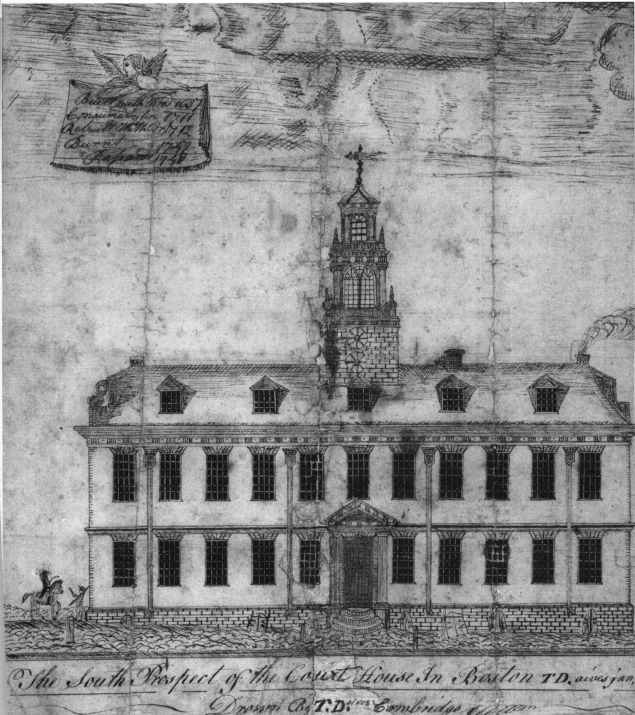
Boston’s “goal” or jail appears on the detail from the 1769 town map above, but barely. At the bottom of that image are two large buildings: the Town House, now the Old State House (lowercase a), and the First or Old Brick Meeting-House (big A). Above the meeting-house is the label “Church Square.” And above that, mostly worn off because of a fold, is the label “Prison.” That building faced onto Queen Street, now Court Street—named for the courthouse, which was conveniently near the prison.

Hill remained in that Boston jail for several months. The United States declared independence. The British military returned to New York in force.

On 18 October, the Connecticut Gazette of New London reported:
Last Saturday [12 October], the Wife and Daughter of one John Hill, a Prisoner in Boston Goal, for being concerned with Crean Brush and others, in Robbing the Inhabitants of Boston, when that Place was evacuated; came to this Town from Providence by Water, and was endeavouring to get a Passage to the West End of Long-Island, but were stopped by the Committee of this Town, and on Examination were found upon them, sundry Papers, containing Matters of Intelligence respecting the People, and State of the Country, sent from said Hill and others in Boston, to be communicated to General [William] Howe;…
TOMORROW: Mystery women.

Saturday, April 25, 2026

“That the said Hill be immediately apprehended”

John Hill was yet another of the Loyalists captured aboard the brig Elizabeth.

[I feel like I’m never getting away! Then again, that’s probably how those passengers felt when they were brought back to New England after trying to evacuate.]

According to recent research shared in the Loyalist Directory, John Hill was born in Ireland about 1737. He moved to New York City in the early 1770s and ran an inn.

In March 1775, Hill came to the aid of William Cunningham during a fight near New York’s Liberty Pole (shown here). Hill later told the Loyalists Commission that “a Mob…beat us with Clubs, and stoned us.” The two men were thrown into prison and put on trial in April. But the foreman of the jury, John Wetherhead (another future Loyalist), kept them from being convicted and punished.

Cunningham and Hill “escaped to Boston,” reaching the besieged town by 5 May. They enlisted in the militia company of James Forrest, another man from Ireland. Hill said he was “appointed Quarter Master to the same Company.”

In March 1776, Gen. William Howe decided to evacuate the town. He ordered Crean Brush to confiscate all cloth that could be useful to the Continental Army. Brush enlisted Richard Hill, formerly sheriff in his county of northeastern New York (which would become Vermont), as an assistant. Richard presumably brought his younger brother, John Hill, onto that team.

As ships pushed off from Boston’s wharves, John Hill and his family squeezed onto the Elizabeth along with Brush, most of the confiscated goods, a squad of British soldiers, and other Loyalists. In Hill’s words, “on the 17th of March 1776, he left Boston, with the Royal Army; but was taken at Sea, by the Rebels.”

The brig, its property, and its wealthiest passengers were sent to Portsmouth, New Hampshire. The Hill family and several others were landed on Cape Ann by 7 April. The Massachusetts authorities summoned John Hill to Watertown for questioning.

On 19 April, the Massachusetts Council reported:
The Committee appointed to examine sundry Persons taken on board the Brigt Sally [sic] bound to Hallifax, & sent to the Council by the Committee of Marblehead…examined [John] Hill who informs your Committee that he is a native of Ireland that he came to New York three or four years since that he came to Boston about ten months ago on the removal of the troops from New York to Boston for the recovery of monies due to him from them and that for the same purpose he was going to Hallifax having acted as a Sutler among the troops.
Sailing off to Canada out of political loyalty was suspect. Sailing there just to collect debts from soldiers seemed more reasonable to these office-holders.

The Council agreed that Hill should be allowed to go free after providing a “written parole not to bear arms against the United Colonies, nor in any way aid or assist the Enemies of the said Colonies.” He probably headed back to Cape Ann to find his wife and at least one child.

In Boston, however, some merchants were still seething at how Brush and his assistants had taken their property. That property itself was up in Portsmouth, being sorted by Continental agent Joshua Wentworth. More information filtered back to Watertown.

On 25 April, 250 years ago today, the whole Massachusetts General Court passed a new resolve:
WHEREAS a certain John Hill, lately taken Prisoner by Commodore [John] Manly, in a Vessell bound from Boston to Hallifax, and brought into Portsmouth, was examined before the Council; and no Evidence then appearing against him, he was discharged & set at Liberty;

And whereas it hath since been made to appear to this Court; that the said Hill, at the time he was taken, as aforesaid, had in his possession Chests, Trunks & Packages of Goods and Merchandizes to the value of three hundred pounds Sterlg. supposed to have been stolen from the distressed Inhabitants of the Town of Boston; and was an Assistant to Crean Brush in his late unwarrantable and highhanded Thefts & Robberies
Therefore

Resolved, That the said Hill be immediately apprehended, wherever to be found, & brought before this Court for Examination, touching the Premises, and all Sheriffs, Constables & other executive Officers, and all the good People of this Colony, are hereby directed & impowered to apprehend the said Hill, wherever he may be found, and bring him forthwith before this Court, in order that he may be dealt with for his aforesaid highhanded Crimes, as to Law & Justice appertains.
TOMORROW: The manhunt was on!

[Boston also had a justice of the peace named John Hill, very involved in events surrounding the Boston Massacre. Unfortunately, the same tag applies to both men, but I think context will make it easy to sort out their stories.]

Friday, April 24, 2026

William Jackson in and out of the Boston Jail

One month after he’d decided to sail out of Boston with his goods, the brazier William Jackson was locked up in the town jail, suspected of stealing from his fellow merchants.

Cdre. John Manley had captured him on the Elizabeth. Crowds in Newburyport, Salem, and Boston had jeered him. The Massachusetts Council had ordered him into prison.

Bostonians already had some reasons to dislike Jackson. The great fire of 1760 started in his shop. He defied the non-importation movement in 1770, and on top of that he hosted Capt. Thomas Preston before the Massacre.

Then in 1774 Jackson signed the complimentary Addresses to Govs. Thomas Hutchinson and Thomas Gage. He stayed in town when war broke out. He joined the Associators, the Loyalist militia formed in Boston during the siege, though he tried to explain that away:
General [William] How…isued a Proclamation for the Inhabitants to Associate themselves and bear Arm’s in defence of the Town, being what I did not thing [think] was my duty I did not sing [sign],

sometime After he Isued another recommending to the Inhabitants to Associate themselves for preserving the peace and good Order of the Town by preventing any Riotous doings by the Soldier’s or other’s which I thought Incumbent with every good Citizen to comply
The Patriot government naturally looked askance at any “associators” who fell into its hands.

At the same time, William Jackson had some local support. Unlike Crean Brush and the other merchants locked up alongside him, Jackson had grown up in Boston. His mother Mary and older brother James still lived there. His shop sign, the Brazen Head, was a long-time landmark for locals and visitors.

The jailers had been ordered not to let Jackson have pen and paper, but he could ask his family for help. He stated, “after my Committment my brother wrote Mr [Joshua] Wentworth for my Baggage.”

More surprisingly, other members of Boston’s business community spoke up for him. I already quoted Isaac Smith, Sr.’s comment that he hadn’t really done anything bad. A few years back, Chris Hurley told me that Jackson garnered letters of support from selectmen John Scollay and Samuel Austin, printer John Gill, and other Patriots. (Among those names is John Peters, who could be the future husband of Phillis Wheatley.)

Later William Jackson would tell the Loyalists Commission that he was let out of jail after 126 days, or in August 1776. Some of his fellow prisoners would be locked up for much longer.

TOMORROW: Back to Cape Ann.

Thursday, April 23, 2026

“Without the Privelege of Pen, Ink, Paper or Candle”

In April 1776, Watertown was the seat of Massachusetts’s government.

Though people could now go into Boston, that town was still reeling from the siege. Plus, there was smallpox.

So the Massachusetts General Court stayed in Watertown—the assembly in the town’s meeting-house and the Council in an upper chamber of Edmund Fowle’s house (now headquarters of the Historical Society of Watertown, shown here).

Under the provincial charter, because the governor and lieutenant governor were absent (both driven away by the war), the Council exercised executive power.

That’s why, on 12 April, James Otis, Sr., as senior member of the Massachusetts Council, signed this order to imprison five genteel Loyalists captured aboard the brig Elizabeth:
To the Keeper of the Goal at Boston, in the County of Suffolk—Greeting—

You are hereby directed and commanded to take into your Custody Crean Brush, William Jackson, Peter Ramsey, Edward [K]eighley, and Richard Newton, lately taken in their flight from Boston in attempting to carry away from thence under the protection of the British fleet, large Quantities of Goods Wares & Merchandizes, the Rightful Property of the Inhabitants of that town, and having joined themselves with the Fleet & army employed against the united Colonies of America—

and you are commanded to confine the said Crean Brush William Jackson & Peter Ramsen [sic], each in an apartment by himself, without the Privelege of Pen, Ink, Paper or Candle, and not suffer them, or either of them to converse with any person whatever, unless in your hearing, and for the better Security of the said Crean Brush you are further ordered & commanded to put him into Handcufts immediately—

And them and each of them safely keep, ’till the further Order of the Major part of the Council, or they be otherwise discharged by due Course of Law—Hereof fail not at your Peril.
Two days later, Maj. John Grizzage Frazer, as assistant quartermaster for the Continental Army, wrote to Gen. George Washington to say that those men were now locked up. Brush was “in Irons.”

Frazer also passed on the news that on 12 April “8 british seamen” had made off with the cutter from H.M.S. Renown, one of the Royal Navy ships still hovering in the outer harbor, and got into Boston. Those defectors were much more welcome than the Loyalists who had tried to leave.

TOMORROW: Free William Jackson!

Tuesday, April 21, 2026

William Jackson “shipt on board the Brig Elizabeth”

When I started to look at the Continental capture of the brig Elizabeth in early April 1776, I didn’t expect to find so much drama and mystery in the Wheaton family.

I thought they’d be a one-day diversion before I got back to the main storyline, following the other Loyalists on that ship—those sent to Portsmouth, New Hampshire.

Instead, the Wheatons’ story took me right through Patriots Day. But now I’m returning to the others—which also means resuming the Saga of the Brazen Head!

On 6 July 1776, the brazier William Jackson wrote to the Continental Congress, describing his experience of trying to evacuate Boston. His letter started with a bunch of special pleading about not intending to be political when he signed two documents that marked him as a Loyalist. Mind you, that was five years after he’d put himself among the “Enemies of their Country” for not signing the Boston Whigs’ non-importation agreeement.

Eventually Jackson got to his escape narrative:
General [William] How’s quiting this Town in so short a time as he did must of Consequence be attended with the utmost Confusion and gave no one time to settle his thoughts what to do with themselves or property, but the past unhappy situation we had been in this Town I finally concluded to take the Opportunity to go to Halifax their to have tarried or gone from thence to England untill the unhappy disputes whare settled leaving my Property behind,

but upon the proceedings of Mr. [Crean] Brush takeing away the property of the people of this Town as you will see by the copy of paper’s accompanying this which I have related to the Hon’ble Councill of this Province [Massachusetts], I then alter’d my mind and concluded to carry my Goods with me which I shipt on board the Brig Elizabeth being Twenty-Six packages

on the Passage was taken by three of the United Colony Vessell’s and brought in Portsmouth New Hampshire
The Congress had appointed the merchant Joshua Wentworth (1742–c. 1809) as its agent in that port. His job included using the admiralty court to “condemn” captured ships, then selling them and their cargo for the benefit of the government and the mariners who’d made those captures. Wentworth’s house—since expanded, moved, and restored—appears above.
Upon my landing your agent Mr Wentworth Inform’d me he must Examine my Baggage as also what Money and Paper’s I had, from the former he has detain'd about £35- LMy [lawful money] and from the latter five setts of Bills of Exchange amounting to £100- stirlg payeable to my self Only,

after he Examined my Baggage had his leave to carry it with me but haveing no Acquaintance in the Town accepted his Offer of his store, and haveing tarried one day upon Parole the next morning the Master [Peter Ramsey] and two other passenger’s and my self haveing provided Carriadge’s at our own Expence and being attended by a Man sent with us by Mr. Wentworth we set of for head Quarter’s,

but upon our reaching Newbury Port about 20 miles whare we stopt to refresh our selves the popular Assembled and swore we should not ride and threatened to destroy the Carriadge
This was the anti-Loyalist sentiment I wrote about yesterday.

TOMORROW: Escape from Newburyport.

Sunday, April 12, 2026

“What I am to dow whith the Prisoners for I have Thirtey hear now upon Expences”

A lot of the correspondence that followed the Continental capture of the Elizabeth in April 1776 involved money.

First, there was the cost of housing the prisoners taken on that brig.

Eleven men were sent to Gloucester, including four British soldiers and Caleb Wheaton, the Customs officer from Maine. Their families came along.

Winthrop Sargent, Sr. (1727–1793), the Continental Army’s agent at that port, wrote to Gen. George Washington on 7 April:
The Bayer [bearer] of this has under his Gard a Number of Prisoners & Toreys tachen by Comodor [John] Manley & Capt. [Daniel] Warters the Prise is sent to Portsmouth I mack Know doubt you have had Acount of before this Reaches your Excellence thar nams you have below

thare is two Women & Sum Children Left hear which is not Abel to Travel Should be glad your Excellence would Send me Answor to what I Roat you Last about Capt. Watt:s Goods and what I am to dow whith the Prisoners for I have Thirtey hear now upon Expences.

I Rem[ai]n You[r] Hume Sarv.
Winthrop Sargent, Agent

P.S. Sence I rote the above Capt. [Samuel] Tucker here Carres the Prisners to Marvelhead ware thay well be sent to head Quartr will not Carrey the women & Children for fear of the Small Pox so I am fors to porvide for them hear Should be glad of your Order in Regard to the afore
Capt. Tucker on the armed schooner Franklin carried twenty-two people, including the Wheatons, to Marblehead on 9 April. That town’s committee of correspondence sent Azor Orne to ask the Massachusetts Council what to do with them.

On 13 April, the legislature “Resolved that the Soldiers belonging to the British Army, with their Wives and Children, be sent to General [Artemas] Ward.” Apparently they would be treated like other prisoners of war.

The Marblehead committee would be responsible for maintaining all the civilian women and children, tracking the expenses so the town could “endeavour to have the same discharged out of the Monies arising on the Sales of the Cargo and effects found on Board the said Vessel.”

And that was where the big money was. John Rowe heard that the Elizabeth had “Twenty five Thousand pound Sterling On board—in English Goods & Other Merchandise.” The Boston Gazette reported, “she is estimated to be worth about 35,000l. sterling.”

Cdre. Manley had sent the brig into Portsmouth, New Hampshire, where Continental agent Joshua Wentworth would go through the legal process of ”condemning” the ship and its contents and putting them up for auction. Manley, his captains, and his crews were no doubt anticipating a good payday.

TOMORROW: What to do with the Wheatons.

Wednesday, April 08, 2026

“The officer (Crean Brush) who took my goods”

As quoted back here, on 10 Mar 1776 Gen. William Howe authorized Crean Brush to seize linen and woolen goods inside Boston to ensure they would be carried out of town and not fall into the hands of (or be sold to) the rebel army.

By that point, most of the wealthy people inside besieged Boston were Loyalists, and they planned to leave with the British military. But many adherents to the Patriot cause had left their goods in the town months before. And a few men had stayed to look after their property, their family, or their constituents.

Selectman Samuel Austin was in the last category. Nine years later he told John Adams, who had once employed his son as a law clerk and was now the U.S. of A.’s minister to Great Britain, what he remembered about those days:
I apprehend it needless to Say anything about the Rude, and insulting behavior of the officer (Crean Brush) who took my goods, all which I was oblidg’d to Submit to.—

Suffice it to say that on the 11th. March 1776 Crean Brush, an officer appointed by Genl. How, and by his written Orders…did by force and Arms, with near Twenty Soldiers, with their Guns and Bayonets enter my House and took from me in goods & Merchandize to the amount of Two Thousand Four hundred and Thirty Pounds 18/7 Neat Sterling Cost, to which I have aded Fifty per ct. Advance, which would not pay the Insurance & Freight, as also Interest on the same, untill paid. . .

I had an Opportunity of Conversing with [Gen. Howe] on the Subject of taking my goods from me in the manner he did, He Expressd himself with great Surprize and Indignation, that I should even think he mean’t to Alienate the Property of my goods, by no means he said, he mean’t no such thing, on the Contrary, he assured me in the most Sollemn manner my goods should all be Returnd me again, or the Cash paid for them. He aded it was a Common thing for an Army when Retreating and another army Pursuing, for the Retreating Army to take from the inhabitants, every thing that might any ways be servicable to the Pursuers, but that as soon as the Confusion was over, the inhabitants had their goods Return’d or the money paid them, to the amount of what was taken away, and this he Asur’d me should be the case with mine.—

He said further that what he had done was in Conformity to orders Rec’d from the Minster, to Prevent the Rebels as he calld them from being benifitted by them. Accordinly in a letter he writes Lord Dartmouth (which I have seen) given him an Accot. of Evacuating the Town, he has these words, “all the Woolen good also, that I could find Room for belonging to those who chose to stay behind, the want of which is more distress to the Enemy than any other Article whatever, has been shipd, Inventories of them taken in the best manner Possible, and Put under the Charge of proper persons, in order hereafter to be stor’d.”

Agreeable to this, is his Orders to Crean Brush when he took the goods (Coppy of which you’ll have withe Papers sent you from Congress) in which are these words, “You are hereby Authorizd, and Requir’d to take into your Possession, all such goods as Answer this discription, to give Certificates to the owners that you have Reciev’d them for their use, and will deliver them to the owners orders, Unavoidable Accidents Excepted.”

Both the above Extracts, Plainly Evince, that it was never the intention, or design either of Genl. How or the Minister, that such goods so taken, should be look’d upon as forfited goods, on the Contrary, they were to be inventoried and Stored, and taken Proper care of, for the bennefit of the owners, and to be deliverd to their Orders, all which is Exactly agreeable to Genl Hows declaration to me, that they or the money should be Return’d.
Austin’s point in 1785 was that the British government still owed him for the value of his confiscated goods. London merchants were pushing him to repay his debts from before the war, so he wanted that money—or he wanted to be able to tell those creditors that they should go after their own government for repayment instead of him.

TOMORROW: More complaints about Crean Brush.

Monday, April 06, 2026

“All good Subjects will use their utmost Endeavors to have all such Articles convey’d”

When Crean Brush came to him after confiscating Cyrus Baldwin’s goods in March 1776, Gen. William Howe was looking ahead to the next phase of the war.

The British military was about to leave Boston. The American rebels lacked a lot of manufactured goods, from cannon down to woven cloth. Gen. Howe didn’t want them to find such useful material in the town.

In the coming days, the Royal Artillery would damage or spike all the cannon they left behind or pitch them into the water. Local Patriots would congratulate themselves on restoring those guns, but that took a lot of effort, and some of that ordnance was never as good again.

As for cloth, Gen. Howe issued this proclamation on 10 March:
By His Excellency
WILLIAM HOWE,
MAJOR GENERAL, &c. &c. &c.

AS Linnen and Woolen Goods are Articles much wanted by the Rebels, and would aid and assist them in their Rebellion, the Commander in Chief expects that all good Subjects will use their utmost Endeavors to have all such Articles convey’d from this Place:

Any who have not Opportunity to convey their Goods under their own Care, may deliver them on Board the Minerva at Hubbard’s Wharf, to Crean Brush, Esq: mark’d with their Names, who will give a Certificate of the Delivery, and will oblige himself to return them to the Owners, all unavoidable Accidents accepted.

If after this Notice any Person secretes or keeps in his Possession such Articles, he will be treated as a Favourer of Rebels.
That announcement was important enough to be printed, probably by John Howe (no relation).

Gen. Thomas Gage had already put Brush in charge of seizing abandoned property, but this order extended the New York lawyer’s mandate to cover linen and woolen from anyone in Boston.

TOMORROW: Assembling a team.

Saturday, April 04, 2026

Crean Brush’s American Career

Yesterday’s post reported that among the people captured aboard the evacuation ship Elizabeth in April 1776 was Crean Brush.

Eric Wiser wrote a good article about Brush for the Journal of the American Revolution: “Hell’s Half-Acre: The Fall of Loyalist Crean Brush.” More information can be found in “Crean Brush vs. Ethan Allen: A Winner’s Tale” by John J. Duffy and Eugene A. Coyle, published in Vermont History (P.D.F. download). I’ll review just the main points here.

Brush came to America from county Tyrone in Ireland in the 1760s when he was in his thirties and already a widower. He soon established himself as a lawyer and government appointee in New York City.

Brush married Margaretha Schoolcraft, who had a daughter named Frances from her previous relationship with Capt. John Montresor, the British army engineer. (Some sources say this girl was Margaretha’s niece. Others give the girl’s surname as Montezuma. It seems clear those were cover stories.)

In 1772, after accumulating grants of tens of thousands of acres of frontier land, Brush moved his family to the new town of Westminster, New York, between Lake Champlain and the Connecticut River. Soon he was a leader of the new community, variously commissioner of the court, surrogate of the court, county clerk, and representative in the colonial legislature. Brush worked with Philip Schuyler to establish the rule of (New York) law in his new county.

Unfortunately for Brush, others had settled the same region with grants from New Hampshire that overlapped and competed with the grants from New York. These men, led by Ethan Allen, Seth Warner, and Remember Baker, called themselves the Green Mountain Boys. Brush called them the Bennington Mob, becoming an early opponent and target of that faction. The London government had approved New York’s side of that dispute, giving Brush more reason to support royal policies.

On 13 Mar 1775, while Brush was away at the legislature, there was a fatal fight around the Westminster courthouse. Then war broke out in Massachusetts. The Green Mountain Boys seized Fort Ticonderoga for the rebels. Brush realized the region wasn’t safe for him, and neither was his former home in New York City. The Brush family moved into besieged Boston.

On 1 October, Gen. Thomas Gage gave Brush a commission to collect goods from the buildings of people who had left Boston so they wouldn’t be damaged when British soldiers were lodged in those homes and warehouses. The general required Brush “to take all due Care thereof, and to deliver said Goods when called upon, to those to whom you shall have given Receipts for the same.”

What Brush really wanted, though, was the British commander’s approval for his scheme to raise a Loyalist regiment and take back his corner of New York from the Green Mountain Boys. Gage never authorized that, which probably saved Brush from dying in a futile battle. Still, Brush presented the same proposal to Gen. William Howe in early 1776, but he didn’t get any further before it was time to leave.

TOMORROW: Preparing to evacuate.

Thursday, March 12, 2026

“Without the leave of the Governor”

Earlier this month the Journal of the American Revolution ran an article by Ray Raphael about colonial Massachusetts’s constitution and how the royal government tried to curtail it.

Here’s a taste:
Of the four punitive acts passed in response to the Boston Tea Party, closing the port of Boston receives most attention in textbooks today—but at the time, with 95 percent of the colony’s population living outside Boston, it was “An Act for the Better Regulating the Government of the Province of the Massachusetts Bay”—known today as the Massachusetts Government Act—that sparked the people’s fury and led them to cast off British rule.

Under the 1691 Charter, “freeholders” could call a town meeting whenever they saw fit—but no longer: “Whereas a great abuse has been made of the power of calling such meetings, and the inhabitants have, contrary to the design of their institution, been misled to treat upon matters of the most general concern, and to pass many dangerous and unwarrantable resolves,” the 1774 act declared, “no meeting shall be called by the Selectmen, or at the request of any number of freeholders of any township, district, or precinct, without the leave of the Governor, or, in his absence, of the Lieutenant Governor, in writing, expressing the special business of the said meeting.”

Likewise, on the provincial level, power was wrested from the people. No longer would the incoming “general court or assembly” choose the Governor’s Council:
Whereas the said method of electing such counsellors or assistants. . . hath been so far from contributing to the attainment of the good ends and purposes thereby intended, and to the promoting of the internal welfare, peace, and good government of the said province, or to the maintenance of the just subordination to, and conformity with, the laws of Great Britain, . . . the said method of annually electing the counsellors or assistants . . . should no longer be suffered to continue . . .

Be it therefore enacted . . . that the council, or court of assistants, shall be composed of such of the inhabitants or proprietors of lands within the same as shall be thereunto nominated and appointed by his Majesty.
All other officers would also be appointed by the governor, who could remove them at will…
The voters of Massachusetts didn’t like to see Gov. Thomas Gage implement the new law. Soon they were protesting against it—and shutting down the colonial government to do so.
The next courts were scheduled for Springfield, shiretown of Hampshire County, two weeks later, on August 30—but some 1,500 citizens made sure they did not sit. One eyewitness, Joseph Clarke of Northampton, gave a vivid account: “The people of each town being drawn into separate companies marched with staves & musick . . . The trumpets sounding, drums beating, fifes playing and Colours flying, struck the passions of the soul into a proper tone, and inspired martial courage into each.”

The judges and justices of the peace offered no resistance to “the body of the county,” as Clarke called the men who marched with their town’s militia companies. When a committee asked them “whether they meant to hold their commissions and exercise their authority according to the new act of parliament for altering the constitution of the province,” they all said they would not.
One corrective for the article: The Boston Port Bill went into effect on 1 June 1774. The Massachusetts Government Act may have been drafted to start at the same time, but the final language said it took effect on 1 August. And then the text didn’t arrive in Salem until a few days after that.

In other words, it took only about two weeks from the start of the law for people in western Massachusetts to organize major protests and shut down a branch of the royal government. That’s how much people wanted to maintain their constitution.