J. L. BELL is a Massachusetts writer who specializes in (among other things) the start of the American Revolution in and around Boston. He is particularly interested in the experiences of children in 1765-75. He has published scholarly papers and popular articles for both children and adults. He was consultant for an episode of History Detectives, and contributed to a display at Minute Man National Historic Park.

Subscribe thru Follow.it


•••••••••••••••••


Showing posts with label Thaddeus Blood. Show all posts

Saturday, May 04, 2024

G. F. Hoar and “stories of the Battle of Concord”
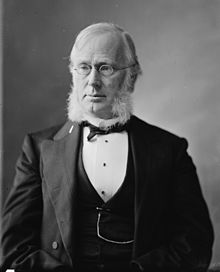
George Frisbie Hoar (1826–1904, shown here) was born in Concord. His father, Samuel Hoar, represented the area in the U.S. Congress and contributed to the wording of the town’s monument at the North Bridge.

In his autobiography Hoar wrote fondly about growing up in Concord, and particularly about living reminders of the Revolutionary War:
Scattered about the church were the good gray heads of many survivors of the Revolution—the men who had been at the bridge on the 19th of April, and who made the first armed resistance to the British power. They were very striking and venerable figures, with their queues and knee-breeches and shoes with shining buckles. Men were more particular about their apparel in those days than we are now. They had great stateliness of behavior, and admitted of little familiarity.

They had heard John Buttrick’s order to fire, which marked the moment when our country was born. The order was given to British subjects. It was obeyed by American citizens. Among them was old Master [Thaddeus] Blood, who saw a ball strike the water when the British fired their first volley. I heard many of the old men tell their stories of the Battle of Concord, and of the capture of Burgoyne.

I lay down on the grass one summer afternoon, when old Amos Baker of Lincoln, who was in the Lincoln Company on the 19th of April, told me the whole story. He was very indignant at the claim that the Acton men marched first to attack the British because the others hesitated. He said, “It was because they had bagnets [bayonets]. The rest of us hadn’t no bagnets.”

One day a few years later, when I was in college, I walked up from Cambridge to Concord, through Lexington, and had a chat with old Jonathan Harrington by the roadside. He told me he was on the Common when the British Regulars fired upon the Lexington men.

He did not tell me then the story which he told afterward at the great celebration at Concord in 1850. He and Amos Baker were the only survivors who were there that day. He said he was a boy about fifteen years old on April 19, 1775. He was a fifer in the company. He had been up the greater part of the night helping get the stores out of the way of the British, who were expected, and went to bed about three o’clock, very tired and sleepy. His mother came and pounded with her fist on the door of his chamber, and said, “Git up, Jonathan! The Reg’lars are comin’ and somethin’ must be done!” . . .

A very curious and amusing incident is said, and I have no doubt truly, to have happened at this celebration. It shows how carefully the great orator, Edward Everett, looked out for the striking effects in his speech. He turned in the midst of his speech to the seat where Amos Baker and Jonathan Harrington sat, and addressed them. At once they both stood up, and Mr. Everett said, with fine dramatic effect, “Sit, venerable friends. It is for us to stand in your presence.”

After the proceedings were over, old Amos Baker was heard to say to somebody, “What do you suppose Squire Everett meant? He came to us before his speech and told us to stand up when he spoke to us, and when we stood up he told us to sit down.”
In Concord, George F. Hoar became lifelong friends with Henry David Thoreau. They met as schoolboys at different grades, and George later attended the Thoreau brothers’ Concord Academy for a while. It’s unclear whether he overlapped with Edmund Quincy Sewall, Jr.

However, in an 1891 letter Hoar wrote that as a boy he attended a lecture in Concord where the speaker exhibited the skull of a British soldier killed in 1775. That could only have been Walton Felch at the town’s lyceum in the spring of 1840.

After the obligatory years at Harvard, George F. Hoar went into the law, establishing his practice in Worcester. Then he went into politics. He served in the Massachusetts General Court, then the U.S. Congress after the Civil War, and finally the U.S. Senate from 1877 to 1904.

Back home, Hoar helped found what became the Worcester Polytechnic Institute and served as president of the American Antiquarian Society. He also sat on boards of the Smithsonian Institute and the Peabody Museum of Archaeology and Ethnology, so he didn’t have a complete aversion to museums holding human remains.

But Sen. Hoar didn’t like the idea of the Worcester Society of Antiquity holding that skull of a British soldier killed on 19 Apr 1775.

TOMORROW: A private arrangement.

Friday, May 17, 2019

Whatever Happened to James Marr?

As quoted yesterday, in 1835 the Revolutionary War veteran Thaddeus Blood told Ralph Waldo Emerson that he doubted the deposition published over the name of Pvt. John Bateman really came from that prisoner.

Bateman, Blood said, was too badly injured on 19 Apr 1775 to give testimony. He believed instead that “It was probably Carr’s or Starr’s deposition.” But there’s no one named Carr or Starr in this story.

There was, however, a Pvt. James Marr, another British soldier captured on the first day of the war and held in Concord. Marr also gave a deposition to provincial magistrates and spoke to the Rev. William Gordon. I suspect Blood remembered that man but not exactly.

Blood saw Bateman’s deposition reprinted in “Dr. R’s History”—A History of the Fight at Concord, by the Rev. Dr. Ezra Ripley, first published in 1827. Blood knew Ripley well; the minister provided a character reference when the veteran applied for a pension.

Ripley’s book focused on whether the Lexington militiamen had fired back at the redcoats on 19 April in some significant way. It did not cite or reprint James Marr’s deposition, which was about the fight at the North Bridge.

Bateman thus had no reminder about Marr’s name in front of him. He also didn’t see how every time Patriots recorded Bateman’s testimony in 1775, they took down Marr’s testimony the same day. In other words, there was no motive for them to put Marr’s words into Bateman’s mouth since it would have been easier just to credit those words to Marr.


Blood had a vivid memory of Bateman when he was dying in Concord; “his wounds stunk intolerably,” the old man recalled sixty years later. But before the infection set in, Bateman was probably well enough to testify. Blood also must have remembered Marr, but less exactly, as a cooperative prisoner, the kind who would give testimony against his own army. Why would Blood recall Marr that way?

One clue appears in Lemuel Shattuck’s history of Concord, published the same year that Blood spoke to Emerson. Shattuck listed a James Marr among the men from Middlesex County whom Col. James Barrett enrolled in the Continental Army for three years starting in January 1777.
This may be the same James Marr(s) who is recorded as serving during the 1780s out of Groton, according to documents transcribed in Samuel Abbott Green’s Groton During the Revolution. Volume 25 of the Proceedings of the Worcester Society of Antiquity likewise lists James Marr in Capt. Sylvanus Smith’s company but doesn’t state a home town.

Massachusetts Soldiers and Sailors of the Revolutionary War puts James Marr of Groton in Capt. Sylvanus Smith’s company, Col. Timothy Bigelow’s regiment. He was 5'9" tall and turned 24 years old at the end of 1780, which would make him 18 when the war began. This Marr was even promoted to sergeant. But his name never appeared in the Groton vital records, and there’s no clue about where he settled after the war.
To be sure, the James Marr from Groton might not have been the former prisoner. (There was at least one other James Marr from Massachusetts serving in the Continental Army, a man from Scarborough and Limington, Maine.) But I suspect the James Marr who cooperated with the provincials in April 1775 did even more cooperating in the years that followed.

Thursday, May 16, 2019

“Bateman, he thinks, could not have made the deposition”

When the Rev. William Gordon visited British prisoners of war in Concord in the spring of 1775, he reported that Pvt. John Bateman was “too ill to admit of my conversing with him.”

Bateman didn’t get any better. In 1835 local historian Lemuel Shattuck wrote that this wounded redcoat “died and was buried on the hill.” That was Concord’s elevated burying-ground, shown in the right foreground of the Amos Doolittle print of regulars searching the town.

In 1825 Elias Phinney’s History of the Battle of Lexington argued that the militiamen of Lexington were the first to shoot back at the redcoats. Two years later, the Rev. Ezra Ripley of Concord published A History of the Fight at Concord to refute that claim; five years later, Ripley brought out an expanded edition.

Both Phinney and Ripley gathered new testimony from veterans of the battle to support their case. Ripley also republished John Bateman’s deposition from 1775, which had said, “I testify, that I never heard any of the [Lexington] inhabitants so much as fire one gun on said troops.”

A few weeks back, I quoted some statements that Ralph Waldo Emerson wrote into his diary after a visit from Thaddeus Blood, a long-lived veteran, on 5 Aug 1835. (Thanks to Joel Bohy for alerting me to this latter-day source.) After recording Blood’s recollection of Lt. Isaac Potter, Emerson wrote:
Bateman, he thinks, could not have made the deposition in Dr. R[ipley]’s History. A ball passed through his cap and he cried, “A miss is as good as a mile.” Immediately another ball struck his ear and passed out at the side of his mouth, knocking out two teeth. He lived about three weeks, and his wounds stunk intolerably. It was probably Carr’s or Starr’s deposition.
Evidently Bateman’s wound became infected, and he died in American custody. Don Hagist tells me the muster rolls of Bateman’s regiment, the 52nd, state he died on 21 April, but his deposition was dated 23 April and Gordon encountered him after that. He probably died in early May.

Was Blood correct in saying that Bateman was never well enough to give the testimony published over his name? Probably not. In addition to magistrates Dr. John Cuming and Duncan Ingraham on 23 April, four other people told Gordon that they “heard the said Bateman say, that the Regulars fired first, and saw him go through the solemnity of confirming the same by an oath on the bible.” Those four reported witnesses were Bateman’s fellow prisoners in Concord.

I therefore think Bateman’s 23 April deposition was authentic, though he may well have been under the duress of being a prisoner and needing medical care.

TOMORROW: So who was “Carr” or “Starr”?

Tuesday, April 30, 2019

Lt. Isaac Potter as a House Guest

We have a couple of glimpses of Lt. Isaac Potter as an involuntary guest of Concord harness-marker Reuben Brown after the start of the Revolutionary War.

Earlier this year Joel Bohy alerted me to a passage from the diary of Ralph Waldo Emerson dated 5 Aug 1835:
It is a good trait of the manners of the times that Thaddeus Blood told me this morning that he (then twenty years old) and Mr. Ball (fifty) were set out to guard Lieutenant Potter, the British Officer taken at Lexington, 19 April, ’75; and, whilst staying at Reuben Brown’s, Potter invited them both to dine with him.

He, Lieutenant Potter, asked a blessing, and after dinner asked Mr. Ball to dismiss the table, “which he did very well for an old farmer.” Lieutenant Potter then poured out a glass of wine to each and they left the table.

Presently came by a company from Groton, and Lieutenant Potter was alarmed for his own safety. They bolted the doors, etc., etc.
Presumably those were men from Groton on their way to the siege lines. Their town was in a struggle with its Loyalist minister that verged on violence, so they may well have had a reputation for being especially hearty Patriots.

Thaddeus Blood was indeed an aged veteran of the Revolutionary War, the author of a long and detailed account of the start of the fighting that was finally published in the 1880s. As for old Mr. Ball, so many men named Ball were living in Concord at the time—there’s a whole website devoted to them—that I haven’t been able to identify the one about age fifty who dismissed the table.

Lt. Potter reportedly left something else behind at Brown’s house: a military sword. It was displayed at the one-hundredth anniversary of the battle in 1875 and described like this:
The weapon is much heavier than the American swords, and the blade wider and longer. It appears to be a fighting sword, while the others are more of an ornamental or parade article. The handle is black, with heavy brass surroundings on the hilt. The inscription on the guard is ”Xth Rgt. Co. VI. No. 10.” This is also the property of Mr. [Cummings E.] Davis.
By then, people in Concord misremembered Potter’s first name as “James.” He was an officer in the marines, so it’s not clear why he would have been carrying a sword marked for the army’s 10th Regiment of Foot. It’s possible that sword was lost by an officer in the 10th and then mistakenly linked to Potter.

The last we see of Lt. Potter was during a prisoner exchange in Charlestown on 6 June. The newspaper report listed one of the British officers being returned to his side of the lines as “Lieut. Potter, of the marines, in a chaise”—presumably he was still feeling the effects of his wounds.