






Dinner at the Sign of Liberty Tree
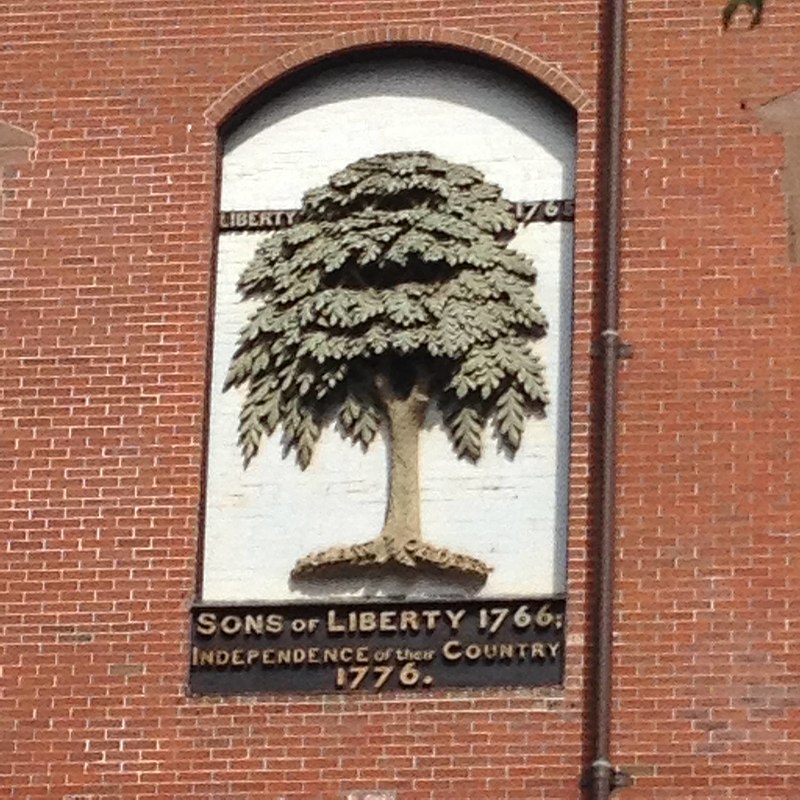
Of course, they were also celebrating what they saw as their triumph over Gov. Francis Bernard, who had sailed away from Massachusetts at the start of the month, never to return.
The celebration actually began with fourteen toasts at Liberty Tree at eleven o’clock. Those started with “The KING” and “The QUEEN and Royal Family,” moved through John Wilkes, the “Glorious Ninety-Two,” Paschal Paoli and his Corsicans, “American Manufactures,” and finally “May the 14th of August be the annual Jubilee of Americans, till Time shall be no more.”
Then the company left town. The Sons had organized dinner for more than 300 at Lemuel Robinson’s tavern in Dorchester, the Sign of Liberty Tree. [In the winter of 1775, that tavern was a crucial spot in the story of The Road to Concord.] By dining outside of Boston, the upper-class politicians guaranteed that they could control their setting and the level of festivity.
This dinner was in honor of “the Farmer”—John Dickinson, author of The Farmer’s Letters and coauthor of “The Liberty Song.” He wasn’t there. But two of his friends from Philadelphia were: his brother, Philemon Dickinson, and Joseph Reed, then secretary of the colony of New Jersey.
John Hancock’s business protégé William Palfrey made a list of 355 gentlemen at the dinner. That list included far more than Boston's political activists. The most important elected officials were all there, including some who would later be Loyalists. The town’s schoolmasters had taken the day off, as had many merchants, doctors, lawyers, and militia officers. John Adams wrote in his diary about feeling pressure to attend: “many might suspect, that I was not hearty in the Cause, if I had been absent whereas none of them are more sincere, and stedfast than I am."
Adams described the banquet setting this way:
We had two Tables laid in the open Field by the Barn, with between 300 and 400 Plates, and an Arning of Sail Cloth overhead, and should have spent a most agreable Day had not the Rain made some Abatement in our Pleasures.There’s that New England non-rhotic R in how Adams spelled “awning.”
Because the fourteen toasts before noon weren’t enough, after dinner the party drank forty-five more. This series started with the “King, Queen and Royal Family,” followed by “A Discharge of Cannon, and three Cheers.” The toasters named fourteen British politicians considered friendly to America and the historian Catharine Macaulay. They honored “The Cantons of Switzerland,” “The States General of the seven United Provinces” of Holland, and “The King of Prussia.”
Some of the after-dinner toasts delineated the Whigs’ political ideals: “Annual Parliaments,” “A perpetual Constitutional Union and Harmony between Great Britain and the Colonies,” and “Liberty without Licentiousness.” Others identified enemies: “May the detested Names of the very few Importers every where, be transmitted to Posterity with Infamy” (more cannon). And finally “Strong Halters, Firm Blocks, and Sharp Axes, to all such as deserve either.”
Evidently the diners didn’t imbibe deeply at each and every toast because Adams declared, “To the Honour of the Sons, I did not see one Person intoxicated.”
As for the subsequent entertainment, the Sons of Liberty had provided…a hatter.
TOMORROW: But not just any hatter.

