
J. L. BELL is a Massachusetts writer who specializes in (among other things) the start of the American Revolution in and around Boston. He is particularly interested in the experiences of children in 1765-75. He has published scholarly papers and popular articles for both children and adults. He was consultant for an episode of History Detectives, and contributed to a display at Minute Man National Historic Park.

Subscribe thru Follow.it


•••••••••••••••••


Showing posts with label William H. Sumner. Show all posts

Friday, June 20, 2025

The Last Years of Henry Howell Williams

I’ve written before about how Henry Howell Williams came from a wealthy, well-connected Roxbury family.

Close relatives married members of the Crafts, Dawes, Heath, and May families, all prominent in republican Boston.

Though in 1787 he told Henry Knox that he’d been “reduced to beggary” by his losses in the spring of 1775, Williams actually appears to have maintained a genteel lifestyle.

By 1784, as I wrote back here, Williams was once again living on Noddle’s Island, employing enough laborers that they needed their own building. An 1801 survey of the island labeled his rebuilt home as a “Mansion House.”

Williams also had the resources to keep petitioning one level of government after another, cajoling supportive letters from various officials. In 1789, the state of Massachusetts granted him £2,000.

Four years later, Williams bought the Winnisimmet ferry from the family that had run that concession for decades. He upgraded it and made good money for a decade crossing the Mystic River.

In 1797, Williams’s eldest daughter Elizabeth (1765–1843, shown here in a portrait by Gilbert Stuart) married Andrew Sigourney, who became the treasurer of Boston. His daughter Harriet married a son of John Avery, the state secretary. Other Williams siblings married another Sigourney, another Avery, and a couple of Williams cousins.

In that decade, Henry Howell Williams moved his family off of Noddle’s Island to mainland Chelsea. One of his last public acts, in January 1802, was to petition the state legislature to compensate him for the income he’d lose after a consortium built a bridge across the Mystic.

Williams didn’t live to see that bridge. He died in December 1802 after “three months confinement.” Lengthy death notices appeared in the Columbian Centinel and Massachusetts Mercury, obviously written by relatives and friends. They praised him as a generous host, a vigorous farmer, and a beloved family patriarch. (Notably, they make no mention of any service to the republic during the war.)

As I mentioned above, Williams’s daughter Harriet married John Avery’s son, John, Jr. In 1800, the next year, they had a son, also named John. And then in October those parents were lost at sea. Little John was raised by relatives, perhaps maiden aunts. He wouldn’t have remembered his grandfather, but he would have grown up on stories about him.

In particular, young John probably heard about the building on the Noddle’s Island farm that had once been a barrack for the Continental Army in Cambridge, and about how his grandfather’s livestock had gone to feed those troops. Putting those facts together in the most complimentary way probably gave rise to what Avery told William H. Sumner later in life: that his grandfather had been some sort of quartermaster supplying the army, and that the barrack had been a reward from the Continental commander, George Washington himself. Contemporaneous records tell a different story.

The third John Avery showed Sumner the file of documents his grandfather had collected to make his case for compensation. In 1911 another heir, Henry Howell Williams Sigourney, donated those papers to the Massachusetts Historical Society. They’re what got me started on this series about one long-extended outcome of the Battle of Chelsea Creek.

Thursday, June 12, 2025

“The Continental Barracks on Noddle’s Island”

As soon as the siege of Boston ended, the Massachusetts government moved to fortify Noddle’s Island and other spots in Boston harbor.

On 6 Apr 1776, the lower house of the General Court formed a “Committee for fortifying the Harbour of Boston” and told those members
immediately to take a View of Noddle’s-Island, and report to this Court what Time it will probably take a Regiment, consisting of Seven Hundred and Twenty-eight Men, to perform the Business of Fortifying said Harbour.
Twelve days later the house empowered that committee
To purchase on the best Terms they may be had, eight Hundred Feet of the Continental Barracks (provided their Cost, with the Expence of removing and rebuilding them, shall in the Opinion of the Committee, be less than the Value of new ones) and cause them to be removed to, and re-built on Noddle’s-Island
The Council approved that plan the next day. Until John Hancock took office as an elected governor in 1780, the Council would serve as both the upper house of the legislature and the executive branch of the state government, carrying out legislative policies.

The barracks were assembled on Jeffries’s Point, the southwestern corner of the island. It looks like that building housed provincial soldiers while they built the harbor fortifications, but not year-round.

Those barracks were put to another use in 1780, after French warships started arriving in Boston harbor. That summer Thomas Chase, the state’s deputy quartermaster general, wrote to the Council:
The Commanding Officer of the French Troops has applyed to me for a Hospital for the sick, and as there is Continental Barrack on Noddles Island, suitable for that purpose, and as Mr. [Henry Howell] Williams owns the Soil, and I suppose he will make Objection to their going into Barracks, I pray your Honors would be pleased to give Orders that they shall not be molested in said Barracks.
Chase’s colleague from the “Loyall Nine” fifteen years earlier, John Avery (shown above), had become the state secretary. He reported this action by the Council on 15 July:
Read & Ordered — that Col. Thomas Chace, D.Q.M.G., be, and hereby is directed to take Possession of the Continental Barracks on Noddle’s Island for the Use of the sick Soldiers on Board the Ship Le isle de France, arrived this morning from France, belonging to his most Christian Majesty.
The local historian William H. Sumner, having accepted family lore that Gen. George Washington had given Henry H. Williams barracks from Cambridge before leaving New England in April 1776, concluded that these barracks converted into a hospital must have been a second building. But, as I wrote yesterday, there’s no evidence for such a grant. Nor any mention of multiple barracks on Noddle’s Island.

Furthermore, Chase didn’t write about Williams as having a home on the island, only as protective of his “Soil” there. Chase clearly expected Williams to interfere with turning the barracks into a hospital for the French, so the state explicitly approved his plan. That action suggests the Patriot government still didn’t trust Williams to cooperate with the war effort.

TOMORROW: Where was Henry Howell Williams during the war?

Wednesday, June 11, 2025

Henry Howell Williams as a Quartermaster?

In his 1858 History of East Boston, William H. Sumner wrote, “I think [Henry Howell Williams] was a quartermaster-sergeant in the army” during the siege.

To research that book, Sumner relied on Williams family sources. He wrote favorably of Williams and included the portrait of the man shown here. So that impression probably came from descendants.

In fact, the Continental Congress didn’t establish the rank of quartermaster sergeant until July 1776.

As for the possibility that Williams helped in supplying the Continental Army around Boston less formally, I’ve found no contemporaneous documentation for that. Unless, of course, we count how the Massachusetts government commandeered his livestock for the public benefit.

Adm. Samuel Graves did claim that the destroyed property on Noddle’s Island belonged to “a notorious Rebel then in Arms.” But there’s no evidence for Williams joining the Massachusetts or Continental army. We shouldn’t rely on Graves’s self-justifying account for what was happening on the other side of the siege lines.

Sumner linked Williams’s alleged work for the army to how he obtained some property from the Continental authorities after the siege:
In partial compensation for this destruction of private property was the gift of the barracks at Cambridge, after the army quitted it, by General [George] Washington, to Mr. Williams. . . . The barracks were removed to the Island, and part of them used for a house, which Mr. Williams erected over the old cellar, to be used as tenements for his workmen, and for barns and sheds for the sheep and cattle, at the westerly slope of Camp hill.
Again, I’d like to see contemporaneous evidence for such a gift. Gen. Washington was careful to work with the Continental Congress and local governments in managing public assets, so such a grant should have left a paper trail. The documents I’ve found suggest another story.

[The search function for Founders Online has slowed down considerably in the past month. On 19 May the U.S. government issued an acknowledgment of “periodic degraded performance owing to extreme spikes in traffic caused by excessive website crawling, associated with content scooping from AI platforms and other indexers.” This slowdown coincided with the D.O.G.E. takeover of federal government computer networks. Given that new agency’s faith in A.I. programs, that could be related to the “scooping.”]

TOMORROW: The barracks on Noddle’s Island.

Saturday, April 20, 2019

A Musket Ball “whizzed by old Mrs. Hancock’s head”?

In 1822, William H. Sumner visited Dorothy Scott, the widow of John Hancock.

Before going to bed, Sumner wrote down notes on their conversation. That memorandum was published in the New England Historic and Genealogical Register in 1854.

About the first shots on Lexington common on the morning of 19 Apr 1775 Sumner wrote:
Mrs. Scott says the British fired first, she is sure. This was a point much contested at the time, and many depositions were taken to prove the fact that the British were the actual aggressors.

One of the first British bullets whizzed by old Mrs. Hancock’s head, as she was looking out of the door, and struck the barn; she cried out, What is that? they told her it was a bullet, and she must take care of herself.
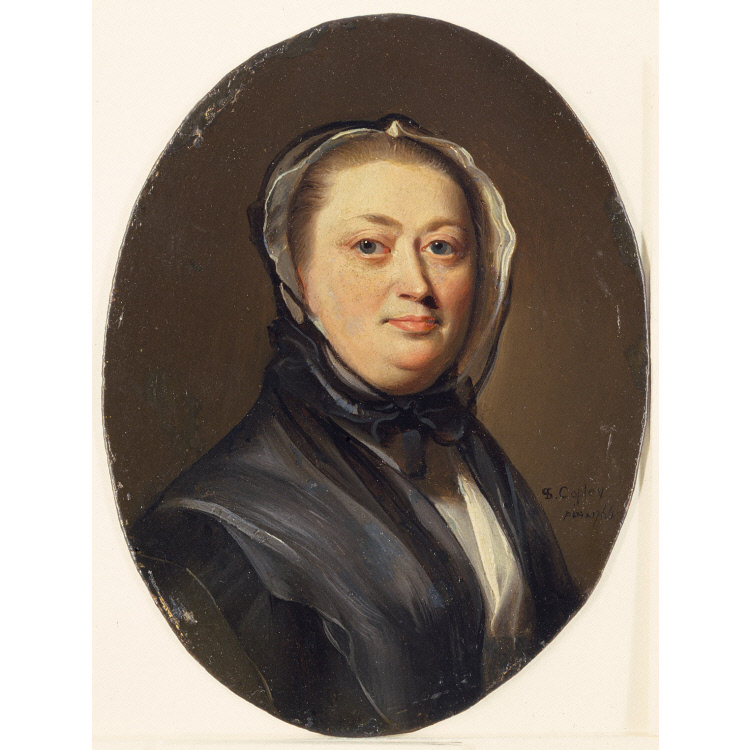
Was Lydia Hancock (shown above) really almost hit by a musket ball from Lexington common?

From the end of the common, where the British troops were standing, one could look down a road to the parsonage. (The barn no longer stands, and I have no idea where it was.)

However, the distance between those spots is more than a quarter-mile. As Michael Barbieri documents in this Journal of the American Revolution article, eighteenth-century experts agreed that a “musket shot” was 300 yards—which is significantly longer than most modern authorities say.

Now that 300 yards was based on firing from a leveled musket, so it’s conceivable that an elevated shot would travel farther. But then it would have come down at an angle as well—unlikely to be whizzing by the head of a lady at the door of a house and then hitting a separate barn.

Of course, it’s possible that Lydia Hancock heard something strike the barn and then felt certain it had whizzed by her head. Or that Dorothy Scott’s recollection of the first shots at Lexington became more dramatic than it actually was.

Monday, December 10, 2018

“He ordered powder casks to be filled with sand”

Here’s one last story of gunpowder and sand supposedly getting mixed up during the siege of Boston. It comes from the recollections of William H. Sumner (shown here), who wasn’t even born until 1780. He later became adjutant general of the Massachusetts militia, so he got to hear a lot of older men’s stories.

Sumner wrote down this account of the end of the siege about 1825, and it appeared in the New England Historical and Genealogical Register in 1858:
In the following year, we took possession of Dorchester heights ourselves. At the time they were taken possession of, as I have received the impression from some person—whose name I do not now recollect—[Gen. George] Washington had but little ammunition. In order to conceal from the soldiers the true state of the army in that respect, he ordered powder casks to be filled with sand, and that several loads of them should be carried to the heights by the way of Roxbury, where the right wing of the army, under Gen. [John] Thomas, was posted. By this deception, the soldiers were satisfied that the army was in a condition to defend itself, notwithstanding the reports that the supply of ammunition was nearly exhausted.

After possession was taken of the heights, hogsheads were filled with earth, and so placed that they could be rolled down upon the enemy to break the columns, if they should dare attempt to march up the hill.
Again, this has no support from contemporaneous sources. Washington felt himself well supplied with powder by early 1776. Gen. Artemas Ward was overseeing the right wing of the army from Roxbury, with Thomas under him.

The Continental plan to defend their quickly built fortifications on Dorchester Heights definitely  involved barrels full of rocks, dirt, and/or sand. Washington even wrote a special note to Ward about that: “Remember [the?] Barrels.” Author and early-photography collector Joe Bauman just sent me an email quoting the aged veteran Simeon Hicks’s pension application as stating that “he assisted in filling Hogsheads & Barrels with sand to roll upon the British should they attempt to ascend.”

It’s conceivable, therefore, that some Continentals or members of the militia companies mobilized for that final push saw wagons moving barrels toward or onto the Dorchester peninsula and assumed they were full of gunpowder, only to learn later they were (to be?) filled with sand. But that’s not the same as Washington ordering barrels of sand to be trucked around to fool his own men.

Thursday, January 15, 2015

Schoolboy Views of President Washington in 1789

When President George Washington finally reached Boston on 24 Oct 1789, he found that the town had planned a huge celebration for him. Huge.

The young architect Charles Bulfinch had designed a triumphal arch, shown above. (For more about that structure, see the Massachusetts Historical Society’s recent posting about it.) Townsfolk turned out in a big parade, organized by their professions.

Among those groups were Boston’s schoolboys. The town was in the midst of reorganizing its public school system to allow girls to attend as well (for half the year), but boys were still considered the model scholars.

William H. Sumner was one of those boys, and his recollections of the day appeared in the New England Historical and Genealogical Register in 1860:
I, then a boy of between nine and ten years of age, was a pupil at Master [Oliver Willington] Lane’s West Boston writing-school. Washington entered Boston on Saturday, the 24th of October, 1789. The children of the schools were all paraded in the main street, and stood in the gutters in front of the long rows of men whose strength was required and exerted to protect them from the crowd on the side-walks as the procession passed along the street. The General rode on a noble white charger with characteristic erectness and dignity. Colonel [Tobias] Lear and Major [William] Jackson accompanied him as his aids. Washington was in uniform, and as he rode, his head uncovered, he inclined his body first on one side and then on the other, without distinctly bowing, but so as to observe the multitude in the streets, and the ladies in the windows and on the tops of the houses, who saluted him as he passed.

Master Lane’s boys were placed in front of Mr. Jonathan Mason’s hard-ware store, near the bend in Washington Street (then Cornhill) opposite Williams Court. I well remember the laugh which our salute created, when, as the General passed us, we rolled in our hands our quills with the longest feathers we could get.

Mr. N. R. Sturgis, who was at school with me at that time, remembers this circumstance. From our position at the angle of the street, we had a fair view of the procession as it approached and after it passed us. A select choir of singers, led by [Daniel] Rhea, the chorister of Brattle Street Church, was placed on the triumphal arch under which the procession was to pass, and which extended from the Old State House to the stores of Joseph Pierce and others at the opposite side of Cornhill. The arch was decorated with flags, flowers and evergreen, so that the musicians were not seen until they rose up and sang the loud paean, commencing as Washington first came in sight at the angle where we stood, swelling in heavy chorus until he passed from our sight under the triumphal arch and took his station upon it.
And Edward G. Porter’s Rambles in Old Boston (1887) reported:
Isaac Harris…was born in 1779, one of ten children of Samuel Harris, mast-maker. . . . At the reception of President Washington, in 1789, Samuel Harris was chosen to carry the mast-makers’ flag, which is still preserved in the family. On the same occasion the young Isaac participated with the boys of the public schools in doing honor to the distinguished visitor. They were ranged in two lines on the mall through which Washington passed on horseback. Each boy held a quill pen in his left hand, and was to take off his cap with the other when the President approached. Harris agreed with the boy next him that, as soon as they had made their bow, they would stroke their pens across the President’s boot. They did it successfully, and kept the pens as mementos of a famous event.
Anne Haven Thwing reports, “Harris was one of the six boys to receive the first Franklin medal in 1792,” endowed by Benjamin Franklin and still given to top scholars today. In 1810 he helped to save the Old South Meeting-House from a fire, receiving a silver cup from the congregation as thanks.