


J. L. BELL is a Massachusetts writer who specializes in (among other things) the start of the American Revolution in and around Boston. He is particularly interested in the experiences of children in 1765-75. He has published scholarly papers and popular articles for both children and adults. He was consultant for an episode of History Detectives, and contributed to a display at Minute Man National Historic Park.

Subscribe thru Follow.it


•••••••••••••••••


Showing posts with label Jonathan Harrington. Show all posts

Saturday, May 04, 2024

G. F. Hoar and “stories of the Battle of Concord”
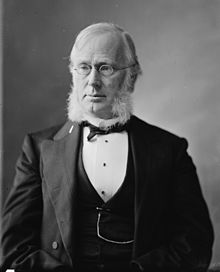
George Frisbie Hoar (1826–1904, shown here) was born in Concord. His father, Samuel Hoar, represented the area in the U.S. Congress and contributed to the wording of the town’s monument at the North Bridge.

In his autobiography Hoar wrote fondly about growing up in Concord, and particularly about living reminders of the Revolutionary War:
Scattered about the church were the good gray heads of many survivors of the Revolution—the men who had been at the bridge on the 19th of April, and who made the first armed resistance to the British power. They were very striking and venerable figures, with their queues and knee-breeches and shoes with shining buckles. Men were more particular about their apparel in those days than we are now. They had great stateliness of behavior, and admitted of little familiarity.

They had heard John Buttrick’s order to fire, which marked the moment when our country was born. The order was given to British subjects. It was obeyed by American citizens. Among them was old Master [Thaddeus] Blood, who saw a ball strike the water when the British fired their first volley. I heard many of the old men tell their stories of the Battle of Concord, and of the capture of Burgoyne.

I lay down on the grass one summer afternoon, when old Amos Baker of Lincoln, who was in the Lincoln Company on the 19th of April, told me the whole story. He was very indignant at the claim that the Acton men marched first to attack the British because the others hesitated. He said, “It was because they had bagnets [bayonets]. The rest of us hadn’t no bagnets.”

One day a few years later, when I was in college, I walked up from Cambridge to Concord, through Lexington, and had a chat with old Jonathan Harrington by the roadside. He told me he was on the Common when the British Regulars fired upon the Lexington men.

He did not tell me then the story which he told afterward at the great celebration at Concord in 1850. He and Amos Baker were the only survivors who were there that day. He said he was a boy about fifteen years old on April 19, 1775. He was a fifer in the company. He had been up the greater part of the night helping get the stores out of the way of the British, who were expected, and went to bed about three o’clock, very tired and sleepy. His mother came and pounded with her fist on the door of his chamber, and said, “Git up, Jonathan! The Reg’lars are comin’ and somethin’ must be done!” . . .

A very curious and amusing incident is said, and I have no doubt truly, to have happened at this celebration. It shows how carefully the great orator, Edward Everett, looked out for the striking effects in his speech. He turned in the midst of his speech to the seat where Amos Baker and Jonathan Harrington sat, and addressed them. At once they both stood up, and Mr. Everett said, with fine dramatic effect, “Sit, venerable friends. It is for us to stand in your presence.”

After the proceedings were over, old Amos Baker was heard to say to somebody, “What do you suppose Squire Everett meant? He came to us before his speech and told us to stand up when he spoke to us, and when we stood up he told us to sit down.”
In Concord, George F. Hoar became lifelong friends with Henry David Thoreau. They met as schoolboys at different grades, and George later attended the Thoreau brothers’ Concord Academy for a while. It’s unclear whether he overlapped with Edmund Quincy Sewall, Jr.

However, in an 1891 letter Hoar wrote that as a boy he attended a lecture in Concord where the speaker exhibited the skull of a British soldier killed in 1775. That could only have been Walton Felch at the town’s lyceum in the spring of 1840.

After the obligatory years at Harvard, George F. Hoar went into the law, establishing his practice in Worcester. Then he went into politics. He served in the Massachusetts General Court, then the U.S. Congress after the Civil War, and finally the U.S. Senate from 1877 to 1904.

Back home, Hoar helped found what became the Worcester Polytechnic Institute and served as president of the American Antiquarian Society. He also sat on boards of the Smithsonian Institute and the Peabody Museum of Archaeology and Ethnology, so he didn’t have a complete aversion to museums holding human remains.

But Sen. Hoar didn’t like the idea of the Worcester Society of Antiquity holding that skull of a British soldier killed on 19 Apr 1775.

TOMORROW: A private arrangement.

Wednesday, April 23, 2014

Where Did Jonathan Harrington, Jr., Die?

In 1775 this house facing Lexington common, shown courtesy of the Along the King’s Highway blog, was the home of Jonathan Harrington. There were three Jonathan Harringtons among the Lexington militiamen who turned out on 19 Apr 1775, and this is the one who was shot dead.

The plaque on the right side of the house façade explains the standard story of Harrington’s death: “Wounded on the common April 19 1775 [he] dragged himself to the door and died at his wife’s feet.” That story played a role in the discussion over preserving the house, as James M. Lindgren’s Preserving Historic New England describes.

That story took a while to get into print, however. Elias Phinney’s History of the Battle of Lexington (1825) quotes from a deposition of John Munroe dated 28 Dec 1824:
Isaac Muzzy, Jonathan Harrington, and my father, Robert Munroe, were found dead near the place where our line was formed. Samuel Hadley and John Brown were killed after they had gotten off the common.
Munroe’s recollection suggest Harrington died on the common close to where he had been standing in the ranks. The separate sentence about those “killed after they had gotten off the common” reinforces that impression. None of the eyewitnesses quoted in that book described Harrington dragging himself home.

In 1835, the famed orator Edward Everett came to Lexington to speak on the battle’s anniversary. Using Phinney and other, unspecified sources, Everett recounted the events of the day, including:
Robert Munroe was killed with Parker, Muzzy, and Jonathan Harrington, on or near the line, where the company was formed. . . .

Harrington’s was a cruel fate. He fell in front of his own house, on the north of the common. His wife, at the window, saw him fall, and then start up, the blood gushing from his breast. He stretched out his hands towards her, as if for assistance, and fell again. Rising once more on his hands and knees, he crawled across the road towards his dwelling. She ran to meet him at the door, but it was to see him expire at her feet.
So far as I can tell, this is the earliest description of Harrington crawling toward his wife and home. In February 1777, Ruth (Fiske) Harrington remarried a Boston man unhelpfully named John Smith, and I can’t trace her further. It’s possible that Everett heard this story somehow from her, or people who knew her. Note that he didn’t say Harrington actually got to his house: the wounded man “crawled across the road towards his dwelling.”

Frank Coburn’s The Battle of April 19, 1775 (1912) states that Harrington “fell near the barn, then standing in what is now Bedford Street.” For that statement, Coburn cited a manuscript setting down what Levi Harrington, an eyewitness to the battle, told his son in March 1846.

But nine years later, in The Battle on Lexington Common, April 19, 1775, Coburn spoke about Harrington thusly in the historical present:
He is mortally wounded on the northerly end of the Common. Across the road is his home. He struggles to reach it, falls, but with renewed effort rises and staggers to his own door-stone. His wife meets him there, and he dies in her arms.
So for that audience Ruth Harrington doesn’t just see her husband dying, but she holds him “in her arms” on their “own door-stone.” No citations this time.

In Paul Revere’s Ride (1994), David Hackett Fischer reported that the Levi Harrington manuscript is at the Lexington Historical Society. That book repeats the details of Coburn’s second telling, however, and adds another figure, saying Harrington’s death was witnessed not just by his wife but by his young son. It’s a very affecting story, one that stuck with me since I first read that book, but it seems to be one of those stories that keeps getting better with each retelling.