J. L. BELL is a Massachusetts writer who specializes in (among other things) the start of the American Revolution in and around Boston. He is particularly interested in the experiences of children in 1765-75. He has published scholarly papers and popular articles for both children and adults. He was consultant for an episode of History Detectives, and contributed to a display at Minute Man National Historic Park.

Subscribe thru Follow.it


•••••••••••••••••


Showing posts with label Samuel Ashbow. Show all posts

Friday, June 05, 2026

“I know that our way will bring us there”

Yesterday’s posting mentioned the Rev. Samuel Ashbow, a Baptist minister from the Mohegan community in Connecticut.

A lot of information about Ashbow comes from Samson Occom and the Christian Indians of New England by W. DeLoss Love (1899). Both Ashbow and Occom studied with the Rev. Eleazer Wheelock and worked on his conversion missions before breaking with him theologically and organizationally.

The Rev. David McClure (1748–1820, shown here) also left a glimpse of Ashbow in his diary. This passage comes from the summer of 1768 when McClure was an undergraduate at Yale College. He “took a ride to the Sea Shore & in company with Mr. Chester Bingham tarried a few days at Narraganset,” the Native community in what’s now Charlestown, Rhode Island.
Sabbath, attended the Indian meeting, at their meeting house, which was small & about the size of a common school house. About 50 Indians were present. They were mostly elderly people. They sung, prayed & exhorted. There were 4 or 5 who exhorted. The principal speaker was called Sam’l Ashpo.

They were all very earnest in voice & gesture, so much so that some of them foamed at the mouth & seemed transported with a kind of enthusiasm. When they prayed, all spake audibly, some in english & some in Indian. It was indeed a confused noise. . . .

I stood near to Ashpo, and noticed the following expressions in his prayer er in confession of sins. We must allow for grossness of the style, from his imperfect knowledge. “Lord, thou knowest what a poor vile sinner I have been; how I have been a vile drunkard, and like a beast have lain drunk in my own spue, all night at taverns and on the road; but O Lord, thou has forgiven me my sins, for the sake of our blessed Saviour Jesus Christ, who can save the vilest sinner” &c.— . . .

As a sample of their ready wit even in serious things, among other instances, after meeting passing the house of one of the speakers, standing in his door, He said to me, “How do you like our way of worship?[”] I replied some things are very good; but would it not be more edifying, in prayer for one to pray & the congregation to join?—He replied “that will never do. Must make ’em all pray. Plaguy apt to cheat.”

When in the Meeting, one of the Exhorters addressed me & my companion, & said “this is the way that we Indians have to get to Heaven. You white people have another way. I don't know but your way will bring you there, but I know that our way will bring us there.”
Though McClure was contemptuous about the worshippers’ “simple and vulgar” way of expressing their understanding, I thought the metaphors he recorded them using were actually quite evocative.
One of the exhorters said, “I have been up the North ward in the french war, and when cold weather come on orders come—Go into winter quarters. This was dreadful news, to stay there all winter in cold & hunger; but soon word come again, strike your tents & home boys home. Then was all glad, and so it is with a christian going to Heaven.”

Another said, “I have been to New Port & down the wharf, & seen a ship just going to sea. There friends shake hands, and cry farewell, soon the sails are up & the wind comes & she goes, & all hands huzza, (hurraw) so it is with a christian going to Heaven.”
Three or four of Ashbow’s sons died fighting for the Continental cause, starting with Samuel, Jr., at Bunker Hill. He remained in Connecticut after the war while many other Christian Natives in the northeast, including Occom, were pushed to the Brotherton community in upstate New York and then on to Wisconsin. 

Thursday, June 04, 2026

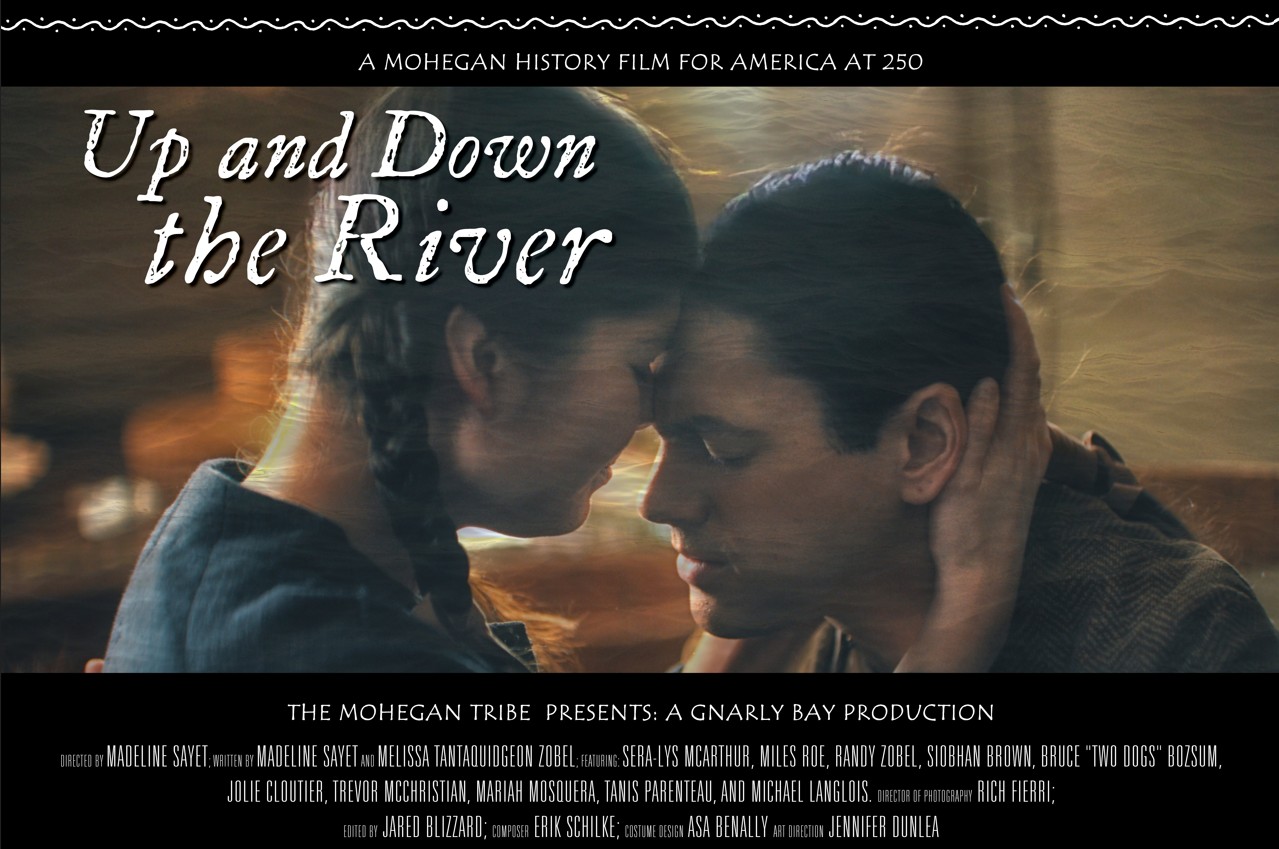
Up and Down the River Screening and Discussion in Charlestown, 11 June


On Thursday, 11 June, the National Parks of Boston and Bunker Hill Community College will host a screening and discussion of the new short film Up and Down the River, dramatizing the choices of Mohegan people during the American Revolution.

This movie was directed by Madeline Sayet and co-written by her and her mother, Melissa Tantaquidgeon Zobel, vice chair of the Mohegan Council of Elders. It stars several Native actors from the Mohegan and other communities.

The film description says:
Spanning the colonial and American Revolutionary eras, Up and Down the River delves into the difficult decisions made by members of the Mohegan Tribe at these pivotal periods in both tribal and U.S. history. Featured in this film is the Ashbow family, including Hannah and her son Samuel Ashbow, Jr. Choosing to fight alongside the American colonists, Samuel Ashbow, Jr., died at the Battle of Bunker Hill in 1775, becoming one of the first Indigenous soldiers to die in the American Revolution.
Ashbow’s father was the Rev. Samuel Ashbow (1718–1795) of New London, Connecticut.

After the film showing, there will be a reflective conversation between Zobel and endawnis Spears, Practitioner in Residence for Tribal Engagement at Brown University and Co-Founder and Director of Programming and Outreach at the Akomawt Educational Initiative.

This program will begin at 6 P.M., with doors open half an hour before. It’s scheduled to last ninety minutes. The showing and discussion are free to the public, but registration is required.

Saturday, March 21, 2015

A Mohegan Woman’s Deathbed Remarks

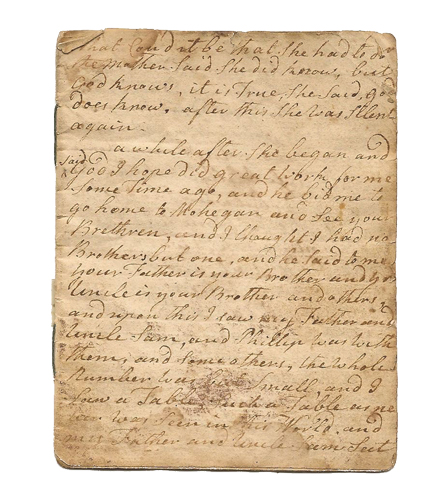
A recent issue of the Yale magazine offered a look at a newly recognized document in the handwriting of the Rev. Samson Occom. Apparently in 1776 he took down the deathbed statement of a young woman:
That December, a daughter of Mohegan leader Robert Ashbow, motivated by a religious vision, returned home after what appears to have been a long absence. By the end of the month, the young woman was dying. On Christmas Eve, Occom wrote an account of the last moments of her life, which included a conversation with her mother. (The daughter’s name, unfortunately, is never given.)

The beginning is typical for Christian deathbed narratives—a confirmation of belief in God and an acceptance of death. But then the woman declares, “No one that fights Shall ever enter the Kingdom of Heaven, nor them that Cary Sharp Weapons and Heavy things for the first Christians did not fight but were Loving.” She adds that her aunt Hannah thought herself “better and above” Hannah’s daughter-in-law, Jerusha, but Jerusha had “better inheritance.” These are unusual, unexplained statements.

At first, we thought “inheritance” referred to spiritual redemption. But as we reconstructed the lives of the people in the narrative, another explanation seemed plausible. Hannah’s husband, we found, was Rev. Samuel Ashbow, Robert Ashbow’s brother. The couple had lost one of their sons, Samuel Jr., at Bunker Hill—the first Native American killed in the Revolution. For Hannah and Samuel, that death would begin their family tragedy: they would lose three more sons before the war was over. On the other hand, Jerusha, the widow of Samuel Jr., had a young son whose life was just beginning. Were the dying woman’s remarks a comment on the futility of war? A portent of the immense physical and cultural losses the Mohegans would endure as a result of that war?
Did they reflect that particular moment during the war in late 1776, when the royal forces were handily dispatching the Continental Army and armed resistance seemed like a poor idea? With so few written sources preserved, we‘re unlikely to have the answers to those questions.

The same magazine also notes a rare harpsichord from about 1770 that somebody decided to make look like an even rarer harpsichord from several decades before.