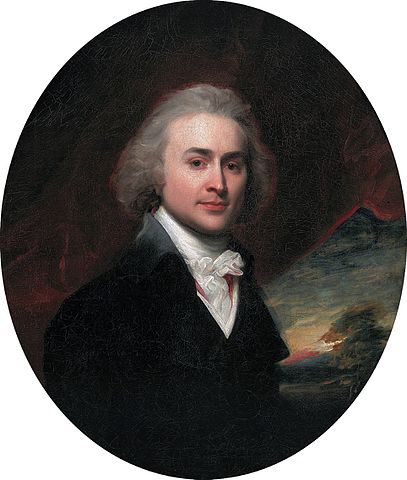
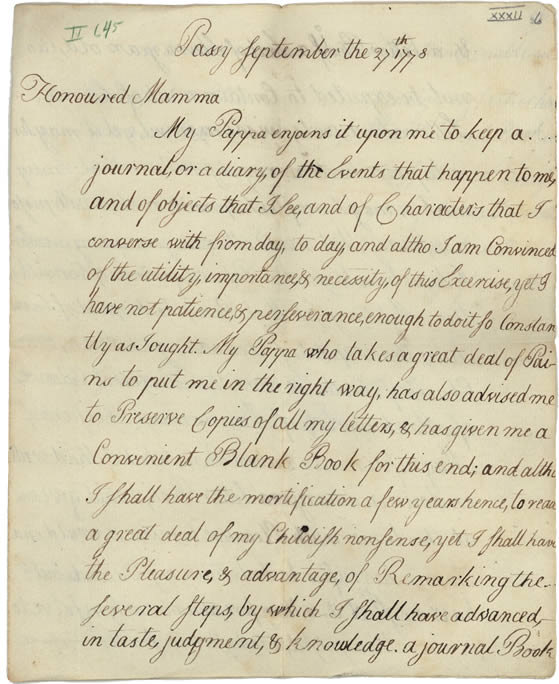
J. L. BELL is a Massachusetts writer who specializes in (among other things) the start of the American Revolution in and around Boston. He is particularly interested in the experiences of children in 1765-75. He has published scholarly papers and popular articles for both children and adults. He was consultant for an episode of History Detectives, and contributed to a display at Minute Man National Historic Park.

Subscribe thru Follow.it


•••••••••••••••••


Showing posts with label Charles Adams. Show all posts

Wednesday, December 25, 2024

“This is a great day with the Roman Catholics”

On Saturday, 25 Dec 1779, John Quincy Adams was in the coastal town of La Coruña.

He and his younger brother Charles were accompanying their father on his second diplomatic mission to Europe. Aiming for France, their ship had run into trouble, and the captain had chosen to dock in allied Spain instead.

That provided the occasion for John Quincy to experience another culture. Which his diary shows him doing with characteristic primness:
This is a great day with the Roman Catholics. “Fete de Nouailles” Christmas. However I find they dont mind it much. They dress up and go to mass but after that’s over all is. So if they call this religion I wonder what is not it; after Mass, almost all the Shops in town are open’d.

But stop. I must not say any thing against their religion while I am in their country but must change the subject.

This forenoon Madame Lagoanere [wife of the American consul] sent us some sweetmeats: for my part I was much obliged to her for them, but I shall diminish them but little.
John Quincy’s idea of a proper religious holiday involved closing the shops. That was how people observed fast days in New England, after all. And the gift of sweets seems to have puzzled him. I suspect Charles wasn’t so bothered.

Monday, October 04, 2021

“There to pursue their Studies of Latin and Greek”

John Adams wasted no time in reacting to Benjamin Waterhouse’s 13 Dec 1780 letter about educational opportunities in Leyden, quoted yesterday.

Five days later, the American diplomat packed his eldest sons, John Quincy and Charles, off to that Dutch university town with their occasional tutor, John Thaxter.

Even before knowing that they had settled in, Adams wrote home to his wife Abigail in Braintree:
My dearest Portia

I have this morning sent Mr. Thaxter, with my two Sons to Leyden, there to take up their Residence for some time, and there to pursue their Studies of Latin and Greek under the excellent Masters, and there to attend Lectures of the celebrated Professors in that University. It is much cheaper there than here: the Air is infinitely purer; and the Company and Conversation is better.

It is perhaps as learned an University as any in Europe.

I should not wish to have Children, educated in the common Schools in this Country, where a littleness of Soul is notorious. The Masters are mean Spirited Writches, pinching, kicking, and boxing the Children, upon every Turn.
The last paragraph looks like a comment on the Latin School on the Singel, where John Quincy had had such a poor experience in September and October.

This letter is our first sign that part of the pedagogy, and part of the problem, at that school was corporal punishment. Or, probably more accurately, even more corporal punishment than a New England family like the Adamses thought was just.

As Adams wrote, he and his wife were staying on friendly terms with James Lovell, a former usher at Boston’s South Latin School whose method of beating boys on the hand with his ruler was legendary. But whatever happened in Amsterdam was supposedly worse.

Another implication of this letter is that John Adams had not told Abigail anything about John Quincy’s problems at the Latin School. She may never have learned about those difficult fifty days and how her eldest son reportedly misbehaved to force his removal.

Fortunately, John Quincy liked the new arrangements in Leyden. The day after the party arrived, he told his father, “we went to hear a Medicinal lecture by Professor Horn, we saw several experiments there. In the afternoon we went to Hear a Law lecture by Professor Pessel.” The next day he reported: 
I have this day seen the master who is to teach us greek and Latin. He is to come to us twice a day; from twelve to one oclock and from five to six in the afternoon, so that I shall be two hours occupied with our master an hour at each lecture is two more and the rest of my time I shall be writing from Homer, the Greek testament, of Grammar, and learning lessons for our Master.
Thaxter engaged this man, an usher at the town’s high school, for thirty Guilders per month. The lessons were in French, as the boys had prepared for.

In addition, in January 1781 the university registered Thaxter, John Quincy, and Charles as students, the first two to study law and the youngest to study letters. Thaxter reported: “Ils travaillent avec beaucoup d’ardeur, et ils avancent très bien.” They work with lots of ardor and they progress very well.

Thus ended the only significant blot on John Quincy Adams’s scholastic career.

Sunday, October 03, 2021

“Send my Children to me this Evening”

As I quoted yesterday, on 10 Nov 1780 Latin School rector Heinrich Verheyk sent American diplomat John Adams a letter stating that his eldest son, John Quincy Adams, was misbehaving in an attempt to get expelled.

John Adams responded immediately:
Sir

I have this moment received, with Surprise and Grief, your Billet.

I pray you Sir, to send my Children to me this Evening and your Account, together with their Chests and Effects tomorrow. I have the Honour to be, with great Respect, Sir, your humble servant,
He whisked both John Quincy and younger son Charles out of the Latin School at the Singel.

We don’t know what conversations took place in the Adams house that night. We do know that Adams already disagreed with how the school was placing John Quincy in a class with younger boys instead of letting him study Greek. So, while he may have been mortified at his son’s reported misbehavior, he sympathized with the motive behind it.

Adams cast about for a way for his boys to continue their education. John Quincy was thirteen, a year away from the age when many elite Massachusetts boys went to Harvard, and Charles was ten. They needed Latin and Greek for college. Adams was too busy trying to convince the Dutch republic to recognize the U.S. of A. to teach them himself. John Thaxter, who had tutored the boys in Braintree and aboard the ship to Europe, was still in Paris helping the American diplomats there.

Somehow Adams learned about another possible source of information: a young man from Newport, Rhode Island, named Benjamin Waterhouse (1754-1846, shown above as painted by Gilbert Stuart in 1775). He had started studying medicine as an apprentice at age sixteen and then sailed to Britain for more advanced training in March 1775, just before the Boston Port Bill took effect. Though Waterhouse spent the next three years in wartime Britain, he supported the independent U.S. of A.

In 1778 Waterhouse went to study at the University of Leyden, reportedly disconcerting the authorities by declaring himself a citizen of the free American states, which Holland had yet to recognize. After finishing a medical degree in 1780, he went back to Britain to visit his mentor there, then returned to Leyden to attend lectures on law and history. Perhaps on that trip he passed through Amsterdam, a little over twenty miles north of Leyden, and met the American minister.

Sometime in November or early December Adams asked Waterhouse if there were educational opportunities for his sons in Leyden. On 13 December the young doctor wrote back:
It so happened that I could not see the persons of whom I wished to enquire concerning the Schools, mode of education &c. untill yesterday, otherwise I should have written before.—

The Gentlemen from whom I have my information have each of them a young person under their care about the age of your eldest, and are well acquainted with every thing appertaining to education in this City, from conversing with them I am able to inform you that besides the publick-school which is a good one, there are private masters in the latin and greek, who at the same time they teach these languages, teach the greek and roman History. With boys who are far advanced in greek they read and explain Euripides, Sophocles and others.

The same person will if required repeat any of the Law-lectures to the pupil, and that indeed is what they are principally employed for, by those whose wives are to be Mevrouws [i.e., ladies].— There is a teacher of this kind in Leyden who is both an elegant schollar and a gentleman, such a one asks 20 ducats a year. . . .

In regard to living I am persuaded they can live here for much less than at Amsterdam. Three furnished rooms would probably cost 20 guilders a month. We find our own tea, sugar, wine, light and fire, and give one ducat a week for dinner, it is always the same price whether we go to the public-house, or have it brought from thence to our own rooms . . .

In respect to their being Americans or Sons of Mr. Adams they will never meet with any thing disagreeable on that head, where any profit is like to accrue little do the Dutchmen care for their political, or even religious principles—Turk, Jew, or Christian make no difference with them. I beleive we may say of them as they said of themselves at Japan when the Japonese enquired if they were christians—they answered, they were Dutchmen.

If the Gentlemen should come, I can insure them an agreeable Society and a genteel circle of acquaintance. If they should not, I hope at least they will come and pay us a visit, and I think I need not add how ready I should be to render them any service in my power.
Meanwhile, Adams had summoned Thaxter from Paris.

TOMORROW: A new arrangement.

Saturday, October 02, 2021

“The disobedience and impertinence of your eldest son”

John Quincy Adams signed off his 30 Sept 1780 diary entry with: “End of My Journal.”

It’s not clear whether he meant the end of that month, the end of one little volume, or the end of his resolve to write daily entries about his life. But no journals from John Quincy survive until June 1781, when his life was quite different.

Back on 6 September John Quincy recorded that at the Latin School on the Singel: “Brother Charles and Myself Study in a little chamber apart because we dont understand the Dutch.” And on 9 September he wrote:
At about twelve o clock [family servant Joseph] Stevens came here for us, as we were going we met our Dutch Master who was coming to give us a Lesson.
The Adams brothers didn’t stay for that lesson; they were at their father’s home well before one o’clock. It’s also notable that John Quincy didn’t put the name of his Dutch teacher or any other teacher at the Latin School into his journal. He wasn’t connecting with them.

After September, our evidence about John Quincy’s life at the Latin School come from his father John Adams’s correspondence. First, on 18 October he wrote out a letter to the heads of the school:
Mr. Adams presents his Compliments to the Rector and the Preceptor, and acquaints them that his eldest Son is thirteen Years of Age: that he has made considerable progress already in Greek and Latin: that he has been long in Virgil and Cicero, and that he has read a great deal for his Age, both in French and English; and therefore Mr. Adams thinks it would discourage him to be placed and kept in the lower Forms or Classes of the School; and that it would be a damage to interrupt him in Greek, which he might go on to learn without understanding Dutch. Mr. Adams therefore requests that he may be put into the higher Forms, and put upon the Study of Greek.
In the end, however, Adams didn’t send that letter. He continued to defer to the teachers’ judgments about his eldest son.

That presumably left John Quincy stuck as a teenager in a class with little boys just starting their Latin, still struggling with rudimentary Dutch even though he could speak French.

It appears that John Quincy then took action on his own to resolve his situation. On 10 November the school’s rector, Heinrich Verheyk, wrote to John Adams (as translated from the French by Google and me):
The disobedience and impertinence of your eldest son, who does his best to corrupt his amiable Brother, is no longer to be suffered, since he himself seeks by his insolence to attract the punishment he Merits, in hopes of leaving the school under this pretext.

I beg you, therefore, to have the goodness to withdraw him from here, rather than to see public discipline rendered laughable, since at the end I shall be obliged to treat him according to the laws of our school.

I have the honor to be Monsieur Your Most Humble Servant,
As I wrote before, John Quincy rarely broke rules. He liked doing well in school, and he craved his parents’ approval. He tried to fit in at the Latin School when he arrived. But he apparently didn’t make friends among the Dutch boys, and the teachers held him back. So, at least according to the rector, he changed his usual behavior and set out to get himself expelled.

TOMORROW: What did Pappa and Momma say?

[The picture above is the title page of an edition of Antoninus Liberalis’s Metamorphoses, edited and published in 1774 by rector Heinrich Verheyk. A handsomely bound edition of this book was one of the prizes given to top boys at the Latin School.]

Friday, October 01, 2021

“I shall have but very few things to put down”

On 1 Sept 1780, his second full day at his new school in Amsterdam, John Quincy Adams warned readers of his diary that he would soon be too busy to write much in it:
As I shall have but very few things to put down I shall keep a Journal only the days when there will be something Extraodinary.
We don’t have John Quincy’s diary from that spring when he attended a school in Passy, France, alongside other American boys like Silas Deane’s son Jesse (shown here at age two) and Benjamin Franklin’s grandson. Maybe that journal didn’t survive, but his comment in September suggests he hadn’t seen a reason to keep a diary when he was busy studying and playing day after day.

As it turned out, John Quincy wrote in his diary every day in September 1780. Even when he reported, “Nothing very remarkable to day,” he took the time to write that. On several evenings he copied poetry from The Spectator, The Tatler, The Guardian, and other old volumes into his notebook, making it a commonplace book.

John Quincy’s longer entries reported his and his younger brother Charles’s moves between the school and the house where their father was staying. Classes ended at midday on Wednesdays and Saturdays, and the brothers always went home as soon as they could, returning on Wednesday evening or Monday morning. 

Three weeks of school vacation began on 22 September. John Quincy and Charles slept at the school, but they still spent every day with their father and his colleagues, often seeing local sites before getting walked back in the evenings.

The highlight of the month came just before that vacation:
To day I went with all the scholars to see the promotion and the proemiums given. It was in the old Church. There were present two burgermasters the inspector of the school the rector the Conrector, the Praeceptors and the professors, and all the scholars.

In the first place three scholars spoke Orations one after the other and then the rector named those who were to receive the praemiums and they Went and received them from the Hand of one of the Burger master’s. The praemiums of the first and Second Classes were folio Volumes magnificently bound, those of the 3d and 4th’s Quarto Volumes and the fifth and sixth Octavo Volumes.
John Adams wrote about his eldest son’s response to that prize ceremony in a letter to Abigail on 25 September:
My two Boys are at an excellent Latin School, or in the Language of this Country, Den de Latÿnche School op de Cingel by de Munt. The Scholars here all speak French.

John has seen one of the Commencements when the young Gentlemen delivered their Orations and received their Premiums, and Promotions which set his Ambition all afire.

Charles is the same amiable insinuating Creature. Wherever he goes he gets the Hearts of every Body especially the Ladies.

One of these Boys is the Sublime and the other the Beautifull.
John Quincy may not have been as naturally amiable as Charles, but he had made friends his own age on the ship to Europe and in Passy. He exchanged letters with those schoolmates after he had to leave.

On his first day at the Latin School on the Singel, John Quincy wrote down the names of the other boarders. One of those boys, “young Mr. Brants,” visited the Adamses the next weekend. But Brants never appeared in the diary again, and John Quincy never mentioned any other schoolmate by name. After that 22 September ceremony he described “three scholars” orating and others receiving prizes, but he didn’t note who those scholars were.

All the boarders had their own bed chambers, so John Quincy wasn’t thrown in with a roommate to get to know. Furthermore, despite expecting everyone to speak French, the Adams boys were taught separately: “Brother Charles and Myself Study in a little chamber apart because we dont understand the Dutch.” As a result, John Quincy wasn’t making friends.

John Quincy’s September 1780 diary suggests that he spent his free time alone in his room, copying stuff from magazines and waiting for his next opportunity to go home.

TOMORROW: The language barrier.

Thursday, September 30, 2021

“One of the schools which I was in when I was here before”

In considering how John Quincy Adams reacted to his new school in Amsterdam in the fall of 1780, it’s useful to recognize how deeply he wanted to please his parents.

Back in the spring of 1780, John Quincy returned to a small school in Passy, France, taught by a man named Péchigny. In 1771 that gentleman had issued a prospectus for an “école de mathématiques, de belles-lettres, d’arts libéraux et cours de langues”—a school of mathematics, belles-lettres, liberal arts, and language courses. 

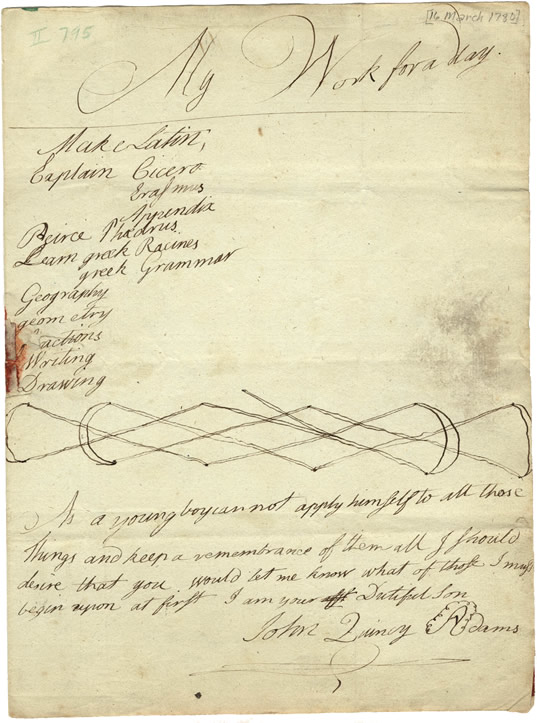
Soon after starting, the twelve-year-old sent a report to his father listing “My Work for a day”:
Make Latin,
Explain Cicero
   Erasmus [Colloquia]
   Appendix [Appendix de Diis et Heroibus ethnicis]
Peirce [i.e., parse] Phaedrus [Fables]

Learn greek Racines [i.e., roots]
   greek Grammar

Geography
geometry
fractions

Writing
Drawing
“Writing” meant handwriting practice, not composition. “Drawing” was likewise an exercise in penmanship, and John Quincy demonstrated by bridging the page with an ornamental design.

But this letter wasn’t just showing off. John Quincy finished by humbly asking his father for advice on what subjects to concentrate on:
As a young boy can not apply himself to all those Things and keep a remembrance of them all I should desire that you would let me know what of those I must begin upon at first.

I am your Dutiful Son,
When you asked John Adams what you should do, you got an answer. On 17 March he told Johnny to keep at the Latin and Greek as M. Péchigny told him. “Writing and Drawing are but Amusements and may serve as Relaxations from your studies.” And as to the mathematical subjects, he wrote, “I hope your Master will not insist upon your spending much Time upon them at present”; even elite New England schools left off geography and geometry until college.

John Adams didn’t stop there, though. He also critiqued his eldest son’s letter-writing technique. “You should have dated your Letter,” he wrote at the top. And a postscript added, “The next Time you write to me, I hope you will take more care to write well. Cant you keep a steadier Hand?”

The editors of the Adams Papers published images of John Quincy’s letters before and after this one to show how much more care the boy then took to make his handwriting neat for his father. (He was already being much more neat in letters home to his mother.)

Another glimpse of John Quincy’s attitude toward schooling appears in a letter he wrote to a cousin on 17 March, the same date as his father’s reply.
I am in one of the schools which I was in when I was here before and am very content with my situation. I will give you an account of our hours.

At 7 o clock A.M. we get up and go in to school and at 8 o clock we breakfast which consists of bread and milk. At 9 go into school again, stay till one when we dine, after dinne[r] play till half after two, go into school and stay till half after 4 and then we have a peice of dry bread. At 5 we go into School and stay till 7 when we sup, after supper we amuse ourselves a little and go to bed at 9 o clock.
Thus, John Quincy (and his brother Charles) was at study eight and a half hours of the day in Passy. His afternoon snack consisted of “a piece of dry bread.” And he was “very content.”

This was not a boy to complain about a school for petty reasons.

TOMORROW: At the Latin School on the Singel.

Wednesday, September 29, 2021

“I will also take down some of the rules of the school”

On 31 Aug 1780, John Quincy Adams woke up in an unfamiliar bed.

As I recounted yesterday, the thirteen-year-old had been left at the Latin School on the Singel in Amsterdam, along with his ten-year-old brother, Charles.

Their father, John Adams, was in Holland as the Continental Congress’s representative to the Dutch government. He didn’t want his boys to fall behind on their schooling.

Earlier in the year, when the Adamses were in Paris, John had sent his two boys to a small academy. There’s no discussion in the family papers of how he made a similar decision in Amsterdam, but presumably it wasn’t a surprise.

In characteristic mode, John Quincy immediately set about to studying his new school and home. His diary for 31 August begins:
This morning we got up and I asked the names of all the scholars who board here. They are as follows.

Roghe, Toelaer, Vander Burgs, Hulft, Slingelandt, Brants, Van Lennep, Koene, de Graft, Genets, Petri, Van der Paul, Clifford.
He added marks to help him pronounce those unfamiliar names.

Then John Quincy wrote, “I will also take down some of the rules of the school.” At least in this recording, that really meant the meal schedule, but it ran to more than 200 words.

At the end John Quincy wrote about his fellow students:
Every one of the young Gentlemen Speak french and it is a general Custom for the Gentlemen to have their sons speak french. Their comes here every day an hundred boys to learn latin.
That was helpful because he couldn’t speak Dutch, but he could read and speak French pretty well.

Indeed, John Quincy then began to write out a history of the school from a 1772 French guidebook that his father had lent him, translating the prose as he went:
This place was formerly a charity house of a Convent of Religious women. I have a book call’d le Guide D’Amsterdam in which this School is spoke of. It is in french but I will translate it as well as I can into English.
That passage came to another 600 words, starting with a count’s permission for the city to found schools in 1342 and ending with new library acquisitions.

The new schoolboy concluded his morning diary entry by writing: “At about 10 o clock our things were brought here by [family servant Joseph] Stevens. Pappa and Mr. [Herman] Le Roi came to see us.”

John Quincy didn’t record any reluctance about staying at this school. He seems to have been really eager to fit in.

TOMORROW: The school day.

Tuesday, September 28, 2021

Off to a New School in 1780

Here’s a story I’ve had in mind for a while, waiting for back-to-school season. It’s about the time young John Quincy Adams behaved so badly he had to be pulled out of school.

“What?” you exclaim. “John Quincy Adams? The prematurely mature fellow who went to St. Petersburg on a diplomatic mission at the age of fourteen and learned to speak eight foreign languages?

“The disciplined guy who kept a diary for sixty-eight years and served in the House of Representatives for eighteen years until he had a fatal stroke at his desk and was even, to be honest, a bit of a prig? Not our Johnny Quincy! No, no, you must mean Charles.”

Indeed, Charles Adams did rack up a lot of infractions at Harvard College, far more than his older and younger brothers. (See the Boston 1775 investigation starting here.) But in the episode I’m now writing about, reports said Charles was pulled into misbehavior by John Quincy. This story unveils a side of the oldest Adams boy we hardly ever see.

In August 1780, John Adams was the Continental Congress’s envoy to Holland, based in Amsterdam. He had brought his two oldest sons to Europe with him. John Quincy had just turned thirteen, and Charles was ten. John Thaxter had come along as a secretary for the minister and an occasional tutor for the boys, but he was back in Paris, and their father wanted them to have formal schooling.

On 30 August, John Quincy Adams wrote in his diary: ”After supper Mr. Le Roi went with us to a School and left us here. How long we shall stay here I can not tell.”

“Mr. Le Roi” was Herman Le Roy, New York–born son of the Rotterdam merchant Jacob Le Roy. He hosted the Adamses in Amsterdam, particularly the boys, and helped John Adams translate documents. A couple of years later as the war simmered down, Herman Le Roy sailed back to America. He formed a mercantile firm with his in-law William Bayard and made a lot of money from trade and developing land in western New York. Le Roy was also Holland’s consul to the U.S. of A.

As for the school where Le Roy left the two boys, the editors of the Adams Papers explain:
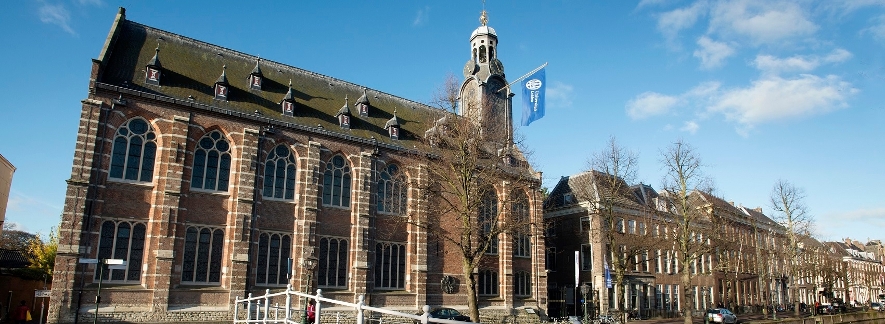
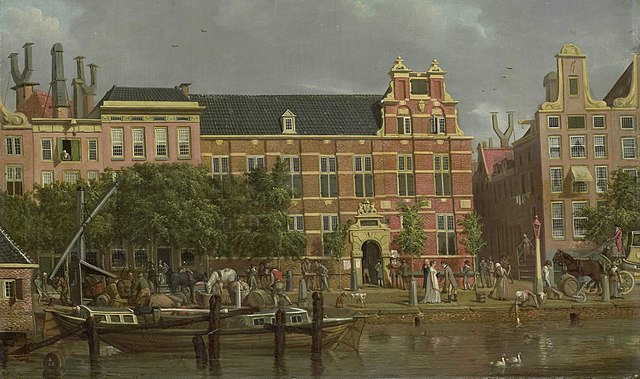
The school was the celebrated Latin School on the Singel (innermost of Amsterdam’s concentric canals), close to what is today one of the busiest sections of the city, marked by the ornate and highly conspicuous Mint Tower in the Muntplein (Mint Square) and across from the Bloemenmarkt (Flower Market). The building then used by the school is now, much altered, occupied by the city police.
The picture above shows that school building painted by Jacob Smies around 1802. Explore that painting more, courtesy of the Rijksmuseum and Google Arts and Culture, here.

TOMORROW: Settling in.

Friday, July 16, 2021

Charles Adams’s Wish

On 16 July 1775, Abigail Adams had an urgent message to pass on to her husband John, then at the Continental Congress in Philadelphia:
Our little ones send Duty to pappa. You would smile to see them all gather round mamma upon the reception of a letter to hear from pappa, and Charls with open mouth, What does par say—did not he write no more. And little Tom says I wish I could see par.

Upon Mr. Rice’s going into the army he asked Charls if he should get him a place, he catchd at it with great eagerness and insisted upon going. We could not put him of, he cryed and beged, no obstical we could raise was sufficent to satisfy him, till I told him he must first obtain your consent. Then he insisted that I must write about it, and has been every day these 3 weeks insisting upon my asking your consent.

At last I have promised to write to you, and am obliged to be as good as my word.
Charles Adams was then five years old. His father did not use his influence to land him a spot in the Continental Army. But later in the war Charles did accompany his father and older brother John Quincy on a diplomatic mission to Europe.

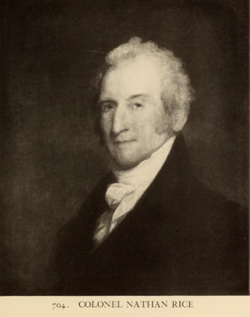
The “Mr. Rice” who started all this heartache with an offhand joke to little Charles was Nathan Rice (1754–1834, shown above later in life), son of a Sturbridge minister who graduated from Harvard College in 1773. By then his widowed mother had married a man in Hingham, bringing the family to the South Shore.

In August 1774 Rice joined the Adams household as one of John’s law clerks alongside John Thaxter. Because their arrival coincided with the shutdown of the Massachusetts courts and Adams’s service at the First Continental Congress, those young men didn’t get to see much lawyering.

Thaxter transitioned into being the Adams family’s live-in tutor, also going on that mission to Europe. Rice joined the army in May 1775, serving in staff positions for most of the war, including as aide de camp to Gen. Benjamin Lincoln.

Rice settled in Hingham, having married Sophia Blake. He returned to the army during the Adams administration’s Quasi-War, retiring as a lieutenant colonel. In the 1810s, after raising their children, Nathan and Sophia Rice moved up to Winooski, Vermont. The house they built in 1818, remodeled extensively, became known as the “Mansion House”; there was a local dispute over removing it to build apartments in 2019, and I don’t know how that turned out.

Wednesday, May 13, 2020

“I can never give any thing but general accounts of conversations”

Last fall, I discussed a moment when John Quincy Adams discovered that his younger brother Charles had been reading his diary without permission.

At the time, the Adams brothers were students at Harvard College. John Quincy was about to turn twenty and increasingly interested in young women. Charles was in his mid-teens and increasingly getting into trouble with the college authorities.

John Quincy was still worried about prying eyes the following 17 Jan 1787, when he wrote:
I had a deal of chat, with Miss [Almy] Ellery, who has a larger share of Sense, than commonly falls to an individual of her sex. We conversed upon diverse subjects, but I can never give any thing but general accounts of conversations, for I cannot always keep this book under lock and key; and some people have a vast deal of curiosity.
Despite that caution about his conversation with Almy Ellery, in the same season John Quincy set down some delightfully acidic comments about other people he met.

On 4 January:
Miss [Catherine] Jones as usual was severe. Her disposition would be much more amiable, if she was not so sensible of her satirical talents, and so fond of them as to gratify her passion upon all occasions.
12 January:
We pass’d an hour in the evening at Mr. [Caleb] Gannett’s [the Harvard steward]; he was not at home: Mrs. [Ruth] G. is quite historical; that is she gives a very minute history of whatever occurs to herself or her family.
1 February:
Mr. [Thomas] Fayerweather and his family were there. An extraordinary character. The greatest range of his ideas, is between the counter of a shop, and the potatoe-hill behind his House; these furnish him with an universal topic of conversation, which he commonly enjoys alone, for he gives no other person time to express either approbation or dislike of his sentiments.
15 February, after a dance:
Of the Ladies, some had beauty without wit, and some wit without beauty; one was blest with both, and others could boast of neither. But little was said, and sentiment did not thrive, when the feet are so much engaged, the head in general is vacant.
16 February:
Miss [Rebecca] Hastings was there, but she has neither youth nor beauty, and if she has wit it is somewhat beneath the surface.
Clearly John Quincy Adams didn’t worry about his brother seeing those comments.

COMING UP: More catty comments to come.

Tuesday, September 24, 2019

“Signally marked by idleness dissipation & intemperance”

Yesterday I quoted two letters that relatives of Charles Adams wrote at the end of May 1789, discussing his predilection to get into trouble at Harvard College.

Meanwhile, in Cambridge Prof. Eliphalet Pearson wrote the following entry into his “Journal of Disorders” with the date of 29 May:
In the evening Russell, Adams 1, Blake first & second, Sparhawk, & Ellery, went to Bradish’s [tavern], & there supped with one Green, an Englishman. The expense was mutual.

About 3 o’clock next morning the company left the house, & on their way to College grossly insulted the President by shouts & yells, challenges, imprecations, curses, threats of laying siege to, burning undermining, and burning his house, by throwing clubs & stones.

In College yard Mr. Abbot found Green & Sparhawk conducting Russell, naked, to his chamber.

Russell, being principal in these disorders, was rusticated 2d. June, & the other scholars punished 6/ each.
The faculty minutes officially repeated this account while leaving out the most interesting detail:
1. Upon examination had it appeared that Russell 1st with several others repaired on the evening of the 29th of May to the anchor tavern in Cambridge, and there, contrary to the law, supped and drank wine; that their conduct, at said tavern, was noisy and profane; that about three o’clock, the next morning, the company separated, and that a part of the same, with tumult, outcry, and abuse, highly insulted the authority and government of this Society, on their return to the College; in all which disorders and outrage said Russell was principal.

And whereas said Russell’s whole Collegiate course has been signally marked by idleness dissipation & intemperance; notwithstanding there various advices exhortation and discipline that have been used to reclaim him, and whereas such an example is highly injurious to this Society, Therefore,

Voted, that Russell be and he hereby is rusticated.

2. Voted, that Adams 1st, Blake 1st, Blake 2d Sparhawk and Ellery be punished 6/ each for going to a Tavern and being in noisy company late at night.

Memo. The sentence upon Russell was executed publickly, in the Chapel, in the usual mode, immediately after morning prayer June 2d.
This is the event that led to the recent myth of Charles Adams and friends running naked through Harvard Yard. As you can see, only one student was “naked,” and that wasn’t Adams. It was Daniel Russell, whose parallel but worse career of misbehavior at Harvard I’ve been slyly dragging along through this series.

Son of prominent merchant Thomas Russell, this young man had already been suspended from the college once and fined numerous times. He never graduated. He went into a general mercantile business on Long Wharf in Boston with John Soley, but a Masonic profile of Soley said, “The result was not favorable.” Russell died in 1804, aged thirty-five, unmarried.

It looks like the faculty couldn’t determine for certain which of the other students made all the noise and thus could do nothing more than fine them for having been in company with whoever did make that noise. That didn’t stop those scholars’ college careers. George and Francis Blake and William Pepperell Sparhawk, who had tried to get the unclothed Russell back to his dorm, all graduated in 1789. Abraham Redwood Ellery graduated two years later.

Charles Adams also graduated in the summer of 1789. At his family’s urging, he didn’t stay for commencement, which usually involved celebratory dinners on an even grander scale. Instead, the Adams family whisked Charles off to New York, where he was to read the law.

[The picture above is a study by the Danish artist Johan Edvard Mandelberg (1730-1786), courtesy of the Harvard Museums.]

Monday, September 23, 2019

“I have many anxious hours for Charles”

In early 1789, as I’ve been chronicling, Charles Adams had a couple more run-ins with the authorities of Harvard College.

Even though those incidents didn’t appear on the official faculty minutes or Charles’s permanent record, word got back to his family. That prompted a new set of conversations and correspondence. Again, we have only hints of what they knew.

On 2 May 1789, John Quincy Adams’s diary says: “Wrote to my brother Charles.” That letter doesn’t survive, but on 27 May he told their cousin William Cranch:
[With respect?] to Charles the tender solicitude, which you feel in regard to his conduct is only an additional evidence of a disposition, which I have long known to be peculiarly yours. it adds to the number of obligations for which I feel myself indebted to you, but it cannot add any thing to the settled opinion which I have of the excellency of your heart.—

I wrote him a very serious Letter three weeks ago and conversed with him at Haverhill upon the subject in such a manner as must I think lead him to be more cautious. However I depend much more upon the alteration which is soon to take place in his situation, than upon any advice or counsel, that I can ever give him. I am well convinced that if any thing can keep him within the limits of regularity, it will be his knowlege of my fathers being [near him and the?] fear of being discovered by him.—
The “alteration” John Q. wrote about was Charles’s impending graduation that summer. The family had already planned for Charles to move to New York, where his father was serving as Vice President, and study the law there.

We might marvel at the idea that New York City would offer fewer temptations than Cambridge, but the Adams family consensus was clear—the problem wasn’t Charles so much as Charles’s companions at college.

Abigail Adams expressed her feelings to John Q. on 30 May:
I have many anxious hours for Charles, and not the fewer, for the new scene of life into which he is going, tho I think it will be of great service to have him with his Father, & more to take him intirely away from his acquaintance. I have written to him upon some late reports which have been circulated concerning him. I hope they are without foundation, but such is the company in which he is seen that he cannot fail to bear a part of the reproach even if he is innocent.
The letter that Abigail wrote to Charles doesn’t survive, either.

Abigail actually opened that topic by expressing concern for her youngest son, Thomas Boylston Adams. As I’ve written, his college disciplinary record was even cleaner than John Quincy’s—he hadn’t done anything! But still a mother worried:
I must request you in my absence to attend to your Brother Tom, to watch over his conduct & prevent by your advice & kind admonitions, his falling a prey to vicious Company. at present he seems desirious of persueing his studies preserving a character and avoiding dissipation, but no youth is secure whilst temptations surround him, and no age of Life but is influenced by habits & example, even when they think their Characters formed.
Even as Charles’s relatives wrote to him, however, he was getting in trouble again at the Blue Anchor Tavern.

TOMORROW: Naked in Harvard Yard.

Sunday, September 22, 2019

“A snow ball was sent against the chapel windows”

As I wrote back here, in December 1788 Harvard professor Eliphalet Pearson began to keep a “Journal of disorders &c.”

It’s possible Pearson had assembled a similar notebook previously and it just doesn’t survive. But I think internal evidence strongly suggests that this journal was a response to an extraordinary spate of student disturbances in the 1788-89 academic year.

The most prominent study of this document is Leon Jackson’s “The Rights of Man and the Rites of Youth: Fraternity and Riot at Eighteenth-Century Harvard,” published in the History of Higher Education Annual in 1995 and then slightly anachronistically in The American College in the Nineteenth Century. (Thanks to Boston 1775 reader Ed Bell for alerting me to the second, more easily read publication.) Jackson treats the record as an undifferentiated whole, documenting a “day after day” litany of drinking, vandalism, and rudeness.

I think it’s more striking that the disorder of the 1788-89 year tapered off abruptly. From June to December 1789, Prof. Pearson recorded only one more disciplinary item in his journal, and he added only one in all of 1790. (Both involved Benjamin Foisson Trapier, a younger brother of Paul, who ended up never graduating.) The journal has no entries for 1791 or all of 1792 until December.

Thus, while we can look at the overall nature of Harvard student disturbances as Jackson did, we should also ask why those events clustered and died off. What made 1788-89 such a troublesome time for the Harvard faculty?

The first incidents Pearson recorded involved a faculty member breaking up a party in a dormitory, the faculty punishing one of the students involved, then that entire class protesting at prayers or lecture by making noise or throwing things. This happened with the juniors, then the sophomores. But tutors had broken up such parties before without seeing such a backlash. Why was this winter different?

Historians have paid a lot of attention to Harvard student activism in the pre-Revolutionary decade: the vandalism of Gov. Francis Bernard’s portrait in 1765, the “Butter Rebellion” of 1766, the identification of a “rebellion tree” in 1768, and so on. The political atmosphere of that period seems to have made the students unusually militant about their own grievances.

Was the same dynamic at work in 1788-89? The economy was still pretty bad. The Shays Rebellion had occurred a couple of years before. The national government was changing. Did that social environment produce a more militant student body? One problem with that theory is that the Harvard student body came largely from the socioeconomic class opposed to popular resistance.

Another possible factor was individual dynamics. I noted yesterday how a couple of the troublemakers in early 1789 came from South Carolina. Before the Revolution, those boys might have gone to Britain for their college experience. Now they were in Cambridge. Were scholars from outside New England more apt to push back against the Harvard establishment?

Pearson named some particular troublemakers, but he also described entire classes protesting en masse. Even before this winter, John Quincy Adams had noted how the freshman class disrupted the sophomore class recitations simply for the sake of rivalry. Such group behavior seems to have been a form of bonding among the boys.

Leon Jackson’s main finding concerned fraternal organizations such as Phi Beta Kappa, which came to Harvard in the early 1780s. Several other student social groups appeared at this time. Jackson said that students who were in fraternal societies were less prone to bad behavior. Looking over the names in Pearson’s journal and on the Phi Beta Kappa roll, I agree that there’s only a little overlap. One exception, appearing on both lists, was Charles Adams.

It’s also striking to me how much the disorder that Pearson chronicled focused on religious services. Classes started by “scraping” the floor to make noise when professors were speaking but soon escalated to throwing coins and pebbles. Professors came into the chapel to find the furnishings in a heap. Chapel windows were broken, in one case the glass striking a faculty member inside. Was there a theological dispute fueling the trouble? Or was attacking that building just the easiest way to target faculty?

That focus on religious services gives a more significant cast to an event that Prof. Pearson recorded on 26 Mar 1789:
Sunday at evening prayers, while the President was praying, a snow ball was sent against the chapel windows, by Adams 1, as by him confessed to Mr. Webber.
The president of the college was Joseph Willard (1738-1804). Samuel Webber (1759-1810) taught mathematics and natural philosophy; he would succeed Willard as president of the college. And “Adams 1” was Charles Adams.

Remarkably, this incident didn’t get into the faculty minutes. There was no official punishment for Adams. Maybe there would have been if the snowball had broken the window. Or if Adams hadn’t convinced Webber that he was sorry, or had been throwing at someone else. Or if Adams wasn’t doing well in his classes and close to graduating.

I must also note that in spring 1789, Adams’s father had become the second highest elected official in the U.S. of A.

TOMORROW: Back at the Blue Anchor Tavern.

(The picture above comes from the Museum of the American Revolution’s depiction of an earlier snowball thrown in Harvard Yard, in the winter of 1775-76, as recalled by Israel Trask.)

Saturday, September 21, 2019

“A company from Bradish’s caused disorders at College”

In discussing Charles Adams’s final semester at Harvard, I must now introduce the setting of the Blue Anchor Tavern in Cambridge.

Located at what’s now the intersection of Mount Auburn and J.F.K. Streets, the Anchor Tavern was run for decades by Ebenezer Bradish (1716-1785). It appears to have been a respectable public house, patronized by Massachusetts legislators when the General Court couldn’t meet in Boston because of smallpox or orders from London.

Because Bradish’s tavern was so close to Harvard Yard, however, it was also where the college students went when they wanted to dine beyond the direct reach of their tutors.

That may have created a conflict of interest for Ebenezer Bradish because, in addition to selling the students drink, he also had the contract for replacing window glass at the college. Here’s the account from the decade before the Revolutionary War. Prof. Eliphalet Pearson’s “Journal of disorders” records a lot of window-breaking during the winter of 1788-89.

By then the tavern had passed to the next generation of Ebenezer Bradish, who was the innkeeper the Adams brothers came to know. I don’t know if he was also a glazier, but his brother Isaac was the college blacksmith and, in these years, keeper of the town jail. So the family may still have had a financial temptation to let students get drunk and rowdy. (Town historian and genealogist Lucius Paige wrote of Isaac Bradish, “Like many of his relatives in different branches of the family, he was occasionally insane, and d. by suicide, May 1790, a. nearly 67.”)

In his journal Prof. Pearson recorded this disorder on Monday, 16 Mar 1789:
A company from Bradish’s caused disorders at College P.M.—In ye. evening the door of ye. Lecture room was burst in & thrown down, ye. table turned topsy turvy, & the chair placed in its frame; & squares of glass also was broken in one of the windows.
It’s not certain that the students coming home from Bradish’s were the same who vandalized the lecture room. There was a lot of uproar that season.

The faculty met the next day and again on 19 March to discuss the trouble. The official records discuss two students by name. The first was a junior named Paul Trapier (1772-1824), from South Carolina. Back on 24 February, the faculty had ordered him to sit out college for six months because he was leading “a dissipated and disorderly life.” The local gentleman who had “the care of him” was Thomas Russell, the same Boston merchant whose own son Daniel had been similarly suspended back in 1787.

On 16 March, Trapier had come back to Cambridge and dined with some classmates at Bradish’s tavern. In response to the trouble that followed, the faculty ordered him not to “visit the college yard or be in company with any student” until his rustication was over.

The faculty record give more attention to Francis Withers (1769-1847), another junior from South Carolina—eventually he settled in the handsome coastal town of Georgetown. The minutes say that Withers
returned to the College about half an hour after four o’clock, and in a noisy and tumultuous manner ran violently up the stairs in the west entry of Massachusetts Hall, by which an Officer of the College [Isaac Smith, the librarian, a cousin of Abigail Adams and a former Loyalist], while attending the exercises of a Class, was greatly disturbed; upon which the said Officer immediately ascended the stairs and overtook Withers at his chamber door; at which place, and also in another part of the entry a short time after this, Withers was guilty of insulting the said Officer by insolent & profane language, of disobedience to his orders, and of uttering a vile and impious imprecation against him; and it also appeared that the said Withers was guilty of behaving with irreverence at evening prayers of said day and of leaving the chapel, before divine worship was closed, with apparent insolence;…and Withers adducing no counter evidence, and making no other apology for his malconduct, but that he was too much heated by wine.
Withers was suspended for six months.

The official minutes don’t mention any other students, but Prof. Pearson named many. He wrote that Trapier sat down to dine with three classmates, and then four seniors and three juniors “called & drank wine with them.” Of that party, “most of them returned to College in a noisy manner.”

Among that group was “Adams 1,” or Charles Adams. (Another member was Daniel Russell.) Adams was in the drinking party, but there wasn’t enough evidence to say he was part of the rowdy return to campus, or the vandalism in the lecture hall. And he certainly hadn’t misbehaved as conspicuously as Withers. As a result, Charles not only suffered no punishment, but there’s not even an official notice of his conduct. Only Prof. Pearson’s journal shows that he was involved in this incident at all.

TOMORROW: An attack on a prayer service.

Thursday, September 19, 2019

“Perswaded that Charles did not deserve the suspicions”

The Harvard College Thanksgiving banquet in November 1787 ended badly. By the evening, window glass and wooden benches were lying on the ground outside the hall. That might have had something to do with how every student had brought a bottle of wine.

The Harvard faculty levied a ten-shilling fine on each student who had gone to that dinner and couldn’t prove he'd left before the destruction started. The administration then relented in the case of the sophomores, but not the seniors or juniors—including Charles Adams, class of 1789.

The fines went out in the quarterly bills at the start of 1788. So there was no way Charles could keep the bad news from his family (as he would try to do with financial reverses in the late 1790s).

At the time, Charles’s parents, John and Abigail, were still on a diplomatic mission in Britain. The task of looking after their sons had fallen to relatives: Abigail’s older sister Mary Cranch in Braintree; her younger sister Elizabeth Shaw and her husband John in Haverhill; and John’s cousin Dr. Cotton Tufts of Medford, who managed the family money.

Eldest son John Quincy Adams (shown above) had graduated from Harvard the year before and gone to Newburyport to study law. On breaks he got together with both younger brothers. On 2 Feb 1788, after one such visit, John Q. wrote in his diary:

I had with Mr. Shaw some conversation upon the subject of the disorders which happened at College, in the course of the last quarter: his fears for my brothers are greater than mine: I am perswaded that Charles did not deserve the suspicions which were raised against him: and I have great hopes that his future conduct, will convince the governors of the University, that he was innocent.
The Rev. John Shaw had tutored both Charles and Thomas Boylston Adams to prepare them for college, as well as other boys. (Including Charles’s first roommate or “chum,” who’d gotten into worse trouble—but I’ll talk about that some other time.) Shaw was clearly worried about Charles’s behavior while John Q. tried to stand up for him.

Two weeks later John wrote to Dr. Tufts for some spending money, noting that he’d asked Charles to pass on the request but, well, “I am apprehensive he forgot to deliver my message.” Like many oldest sons, he seems to have felt both protective of his little brothers and convinced they were incurable idiots.

John Q. went on with more hopeful comments about the situation:
The riotous ungovernable spirit, which appeared among the students at the university in the course of the last quarter gave me great anxiety; particularly as I understood, that one of my brothers, was suspected of having been active in exciting disturbances; but from his own declarations and from the opinion I have of his disposition, I hope those suspicions, were without foundation—I conversed with him largely upon the subject, and hope, his conduct in future, will be such as to remove, every unfavourable impression.
Others in the family were adding their voices, perhaps less optimistically. The next day, 17 February, Aunt Elizabeth wrote to Aunt Mary:
I long to hear from Charles & Thomas I charged them to write to me— I do not know that Mr Shaw & I could have given them better advice if they had been our own Sons— I hope they will conduct agreeable to it—& be wiser than they have been, & more cautious of abusing Government, for what they from choice suffer—the Ten shillings penalty, I mean—
As I wrote a couple of days ago, I think the record shows that only Charles had been fined the ten shillings and Tommy still had a near-spotless record at college. But he was the little brother, and the family didn’t want Charles to lead him astray.

Unfortunately, all those admonitions didn’t keep Charles out of trouble in his senior year.

TOMORROW: A rough winter in Cambridge.

Wednesday, September 18, 2019

“Charles has been guilty of a trick”

On 26 May 1786, John Adams wrote from London to his eldest son, congratulating John Quincy Adams on getting into Harvard College:
Give me leave to congratulate you on your Admission into the Seat of the Muses, our dear Alma Mater, where I hope you will find a Pleasure and Improvements equal to your Expectations. You are now among Magistrates and Ministers, Legislators and Heroes, Ambassadors and Generals, I mean among Persons who will live to Act in all these Characters.

If you pursue your Studies and preserve your Health you will have as good a Chance as most of them, and I hope you will take Care to do nothing now which you will in any future Period have reason to recollect with shame or Pain.
In the same letter, the U.S. of A.’s minister to Great Britain urged John Quincy to continue to be an example and mentor for his two younger brothers:
If your Brother Thomas is fitted, I hope he will enter, this Summer: because, he will have an Advantage in being one Year with you. My love to Charles. I hope he loves his Book. I have great dependence on you to advise your younger Brothers, and assist them in their Studies. You talk french I hope, with Charles, and give him a taste for french Poetry: not however to the neglect of Greek and Roman, nor yet of English.
Charles Adams was just finishing his first year at Harvard, and Thomas Boylston Adams was preparing to take the entrance examination.

Around the same time John Quincy received that letter, he caught his brother Charles snooping in his private papers. It’s not clear what Charles saw. John Q. had written about some potentially sensitive subjects in his diary that month:
  • On 12 July he criticized the freshman class—Charles’s class—for feuding with the sophomores.
  • He made multiple comments about the beauty of a young lady the brothers had met in Braintree.
  • On 26 July he wrote crankily about not getting the dorm room he expected, blaming the change on a couple of other collegians. (John Q. went back to his diary and added a note, for himself and posterity, that those classmates weren’t to blame.)
Most likely Charles commented about one of those matters, and that alerted his older brother to his snooping.

On 27 July, John Q. started his diary entry this way:
I perceive Charles has been guilty of a trick which I thought he would despise; that of prying into, and meddling with things which are nothing to him: and ungenerously looking into Papers, (which he knew I wished to keep private,) because I could not keep them under lock and key. If he looks here, he will feel how contemptible a spy is to himself, and to others.
It looks like John Quincy never directly confronted his brother about the invasion of privacy. Instead, he left this passive-aggressive note for Charles to find the next time he went looking in the diary. That approach might suggest that John Quincy’s later admonitions to his brother about behaving better weren’t actually that direct.

John Adams returned to Massachusetts in 1788. On 16 July of that year, he wrote to his eldest child, Abigail Adams Smith:
I am happy to hear from all quarters a good character of all your brothers. The oldest has given decided proofs of great talents, and there is not a youth of his age whose reputation is higher for abilities, or whose character is fairer in point of morals or conduct. The youngest is as fine a youth as either of the three, if a spice of fun in his composition should not lead him astray. Charles wins the heart, as usual, and is the most of a gentleman of them all.
The returning diplomat wrote this letter after the Harvard Thanksgiving banquet of 1787, which ended with Charles being fined ten shillings. As we’ll see tomorrow, other members of the family had been discussing that event in person and in letters for months. Yet it appears John Adams didn’t know anything about it since he still heard “from all quarters a good character” of every son.

No one was telling Papa.

TOMORROW: “The riotous ungovernable spirit.”

Tuesday, September 17, 2019

Sorting Out the Adams Boys at Harvard

I started my look at Charles Adams’s experience at Harvard College with a posting on how his aunts clustered around and made sure he had furniture for his dorm room. (His parents were far off in Britain.)

It’s only natural then to wonder how Charles’s extended family responded to his disciplinary problems at college, especially the ten-shilling fine levied at the end of 1787 after some disturbance at Thanksgiving dinner. (Windows were broken. Benches were thrown.)

In order to discuss that topic, I have to lay out how my reading of the Harvard University sources differs from the interpretation of the editors of the Adams Family Papers.

As I wrote back here, the college documents usually refer to undergraduates by last names. When there were two or more students with the same surname, they would be designated as Smith 1, Smith 2, and so on, in order of seniority.

In 1787 there were no fewer than five undergraduates named Adams at Harvard—the three sons of John and Abigail Adams of Braintree and then two more unrelated boys in the class of 1788, Solomon and Thomas. Just to make things more confusing, John Quincy Adams entered Harvard after Charles Adams, but he was admitted straight into the junior class and graduated before the middle brother in a little over a year.

I believe that means Charles was called “Adams 3d” as an entering freshman, “Adams 4th” as a sophomore (the year he hosted a noisy gathering in his dorm), “Adams 3d” again as a junior (when he was at that Thanksgiving banquet), and finally “Adams 1st” as a senior in 1788-89. That appears to be Bertha Illsey Tolman’s interpretation when she indexed the college documents.

The editors of the Adams papers read the record of that Thanksgiving disturbance to say that Charles Adams was “Adams 1st” and his little brother Thomas Boylston Adams (shown above) was “Adams 3d,” both fined ten shillings.

Since “Adams 1st” was a waiter in the senior class in 1787-88, I think that student had to be either Solomon or Thomas Adams. “Adams 3d” was a junior, thus Charles Adams (and not a waiter). Tommy B. Adams wasn’t there at all.

As noted back here, Thomas Boylston Adams’s disciplinary record shows only one minor infraction over four years—the same number that his brother John Q. amassed in a much shorter period. Nevertheless, the family worried about Tommy. I think that reflects their fear that Charles and other college boys would be a bad influence on him, not anything Tommy himself did.

If there’s one thing I can add to the Adams family historiography, it’s clearing Thomas Boylston Adams of accusations of serious misbehavior. He was just pulled into an eddy of family concern about his brother Charles.

TOMORROW: Serious talks with Charles.

Friday, September 13, 2019

Prof. Pearson’s “Journal of disorders”

In late December 1787, the Harvard College faculty did some house-cleaning. It was the end of an academic term, the end of the calendar year, and time to address some problems.

Early in the month the college president, professors, and tutors had fined more than thirty students for that disturbance on Thanksgiving. (Then they lifted the fines on the sophomores, because those students were contrite or because the upperclassmen obviously had more power and responsibility.)

At the end of the year the faculty took further action against four students involved in the Thanksgiving disorder, probably because they had all done other things as well. The educators decided that seniors Grosvenor and Wier deserved formal admonitions, and that juniors Emerson and Fayerweather should sit out the next semester.

(In addition, the Boston merchant Thomas Russell reported that he wanted his son Daniel to spend another semester studying in Weston, and the college gratefully agreed to that.)

While Charles Adams was still on the list of juniors who had to pay the ten-shilling fine, he didn’t receive any additional disciplinary attention that season. Evidently he was still keeping up his studies and not leading a completely “dissipated” life.

But Charles got into more trouble in his senior year, and for that we have an additional source beyond the official faculty records. The Harvard University Archives also hold a notebook headed “Journal of disorders &c.” kept by Eliphalet Pearson (1752-1826, shown here).

Pearson had graduated from Harvard College himself in 1773 and then gone into education, teaching in Andover’s town school. He made gunpowder for Massachusetts early in the war and then helped to found Phillips Academy in Andover. After heading that private school for several years, Pearson returned to Harvard in 1786 as Hancock Professor of Hebrew.

Prof. Pearson began his “Journal of disorders” on 4 Dec 1788. He maintained it until 1797, but The Harvard Book: Selections from Three Centuries, edited by William Bentinck-Smith (1982), says, “the most lengthy and frequent entries occurred during December 1788 and January 1789.” Those entries are transcribed here. Apparently the junior and lower classes were particularly restive that winter, and it would be good to know why.

Pearson’s journal is useful because it records more detail about incidents than is in the official faculty records, and it records some incidents that didn’t get into the official disciplinary process at all. And that’s where we can see Charles Adams celebrating his last semester in college a little too much.

COMING UP: A tavern, a snowball, and a naked undergraduate.

Wednesday, September 11, 2019

A Thanksgiving Dinner Gone Wrong

I’m looking at Charles Adams’s disciplinary record as a student at Harvard College in the late 1780s.

In the spring of 1787, Charles was fined six shillings for hosting a noisy gathering in his dormitory room. A year before, John Adams had warned his second son about such socializing:
You have in your nature a sociability, Charles, which is amiable, but may mislead you, a schollar is always made alone. Studies can only be pursued to good purpose, by yourself—dont let your Companions then, nor your Amusements take up too much of your time.
John and Abigail Adams agreed that Charles was the most charming and outgoing of their three boys, but they valued studiousness.

That fall, Charles once again got into trouble in company. The college faculty met on 5 and 7-8 December to consider trouble at the end of the previous month:
It appeared that a number of the Students, who dined in the Hall on the 29th ult. [i.e., of last month] being the day of the public Thanksgiving, were after dinner extremely disorderly and riotous, making tumultuous and indecent noises, breaking the windows of the Hall, throwing the benches out of the windows into the yard &ca. which conduct was greatly to the damage and to the dishonor of the College: Whereupon

Voted, that Adams 1st, Gardner, Gordon, Grosvenor, Hill and Wier, Senior Sophisters——Adams 3d, Blake 2d, Churchill, Coffin, Cutts 1st, Emerson, Fayerweather, Moody, Pierpont, Procter, Shapleigh and Waterman, Junior Sophisters——Clarke 2d, Cutts 2d, Denny, Grout, Ingalls, Moody 2d, Sullivan 1st, Sullivan 2d, Sullivan 3d, Trapier, Ware and Warren, Sophimores, and Tucker a Freshman, who were all of the above company and did not prove themselves to have left the Hall before the riotous proceedings, be charged in their quarterly bill to repair the damage done in the Hall.

Voted, that Adams 1st, Churchill, Emerson and Waterman who were waiters, but upon examination did not give such evidence concerning the disorders as the Governors were convinced they might have given, be dismissed from their waiterships.

Voted, that all who are assessed to repair the damages done in the Hall, those who are dismissed from waiterships only excepted, be punished by pecuniary mulct, ten shillings each.
The minutes also listed nine students by name who had been at the dinner but “left it before disorders arose to a great height.”

The four waiters were working their way through college. The faculty recognized that they didn’t have extra money to pay a fine, but they still took a financial hit in losing their jobs. They maintained student solidarity by not identifying any leaders of the disturbance.

Charles Adams was on that list as “Adams 3d.” In the middle of thirty other boys, there’s no reason to blame him alone for the trouble. Still, it wasn’t a good sign that he was resisting “Amusements.”

COMING UP: A protest from the sophomore class.